Admissions & Academic Testing • Exam
TOEIC Listening and Reading Test
The workplace English test scored 10 to 990 that measures listening and reading ability.
Researched and maintained by TestPrepPilot Editorial BoardEnglish-language assessment desk · Figures last verified August 2026
The short version
What is the TOEIC Listening and Reading Test and is it worth it?
The TOEIC Listening and Reading test is a 200-question ETS exam in about two hours measuring workplace English, scoring 10 to 990 across listening (5 to 495) and reading (5 to 495). It is used by employers for hiring and promotion rather than university admission.
- Recognised by employers across many industries and regions
- Clear 10 to 990 score for benchmarking job candidates
- Two-hour, all-multiple-choice format is easy to schedule
- Signals practical business English, not just academic skill
What is it?
What exactly is the TOEIC Listening and Reading Test?
The workplace English test scored 10 to 990 that measures listening and reading ability.
The TOEIC Listening and Reading test is an ETS assessment of everyday business and professional English, with 200 multiple-choice questions across two sections completed in about two hours. It is widely used by employers and job seekers, especially in Asia, to certify workplace English ability, and it scores from 10 to 990. Unlike the TOEFL iBT, it focuses on general and business settings rather than academic study.
The path in brief
- Confirm employer requirement
- Register via a test center or employer
- Practice workplace English
- Sit the two-hour test
- Receive 10 to 990 score
Before you book
Who is eligible to sit the TOEIC Listening and Reading Test?
Who it is for: Job seekers and employees needing workplace English proof
The test itself
What is the format of the TOEIC Listening and Reading Test?
The TOEIC Listening and Reading Test is administered by Administered by ETS licensees and employers and runs About 2 hours and contains 200 multiple-choice questions.
| Administered by | Administered by ETS licensees and employers |
|---|---|
| Questions | 200 multiple-choice |
| Time limit | About 2 hours |
| Pass mark | No pass mark; employers set their own targets |
| Exam fee | Set by local ETS licensee or employer |
| Format | Paper or digital, two-section multiple-choice |
Content outline
What topics are on the TOEIC Listening and Reading Test?
The TOEIC Listening and Reading Test covers 2 content domains.
Weightings come from the official exam outline. Study time is best allocated in roughly these proportions rather than evenly across domains.
- Listening (photographs, conversations, talks)
- Reading (incomplete sentences, texts, documents)
Money & time
How much does the TOEIC Listening and Reading Test cost?
For the TOEIC Listening and Reading Test, the exam fee is Set by local ETS licensee or employer; the all-in cost is typically Varies by country; most candidates spend 4 to 8 weeks typical prep preparing.
Cost breakdown
| Fee | Set by local administrator |
|---|---|
| Typical total | Varies by country |
Pricing is handled by regional ETS licensees, not a single global fee.
Timeline
- Study 4 to 8 weeks
- Test ~2 hours
- Scores per administrator
Typical prep: 4 to 8 weeks typical prep
The path
How do you register for the TOEIC Listening and Reading Test?
- 1
Read your state requirements page20 minutes
Open hiset.org and select your state or jurisdiction. Age minimums, residency rules, whether you must enrol in an adult education programme first, and the exact fees are all set locally.
- 2
Create a myHiSET account15 minutes
Sign up through the state requirements page to generate your HiSET number, which you need for scheduling, score access and any state paperwork.
- 3
Take the official practice tests1 to 2 hours per subtest
HiSET publishes free and low-cost official practice tests for each subtest. Unlike the GED at-home route, HiSET does not require a practice-test pass before you can schedule.
- 4
Schedule subtests one at a time10 minutes each
Book any of the five subtests in any order, on paper or computer at a test centre or through HiSET@Home online proctoring where your state allows it.
- 5
Test with valid photo ID65 to 120 minutes per subtest
Bring a current government-issued photo ID showing your name, date of birth, signature and photograph. At-home testers need a private room, a webcam and a stable connection.
- 6
Check scores and claim your credential1 to 2 weeks
Multiple-choice results typically post within about five to seven days and essay results within about seven to ten days. Once all five subtests pass, your state issues the credential.
The fine print
What are the retake and renewal rules for the TOEIC Listening and Reading Test?
- Proctoring & delivery
- HiSET is offered in three ways: paper-based at a test centre, computer-based at a test centre and HiSET@Home under live online proctoring, with availability depending on the state. Calculators and formula sheets are supplied at test centres. The full battery in English or Spanish is permitted, and several states allow candidates to mix languages across subtests.
- Retake policy
- Retake rules are set per state, but a common pattern allows three attempts per subtest in a calendar year, sometimes extending to six. Several states use a favourable pricing structure in which the full fee is charged only on the first and fourth attempts while the second and third cost only the test centre or proctor fee.
- Score reporting
- Each of the five subtests is scored 1 to 20. To pass you must score at least 8 on every subtest, at least 2 out of 6 on the Language Arts Writing essay, and at least 45 out of 100 in total across the five. A score of 15 or higher on a subtest is treated as HiSET honours-level performance in several states.
- Recertification
- The credential a state issues on the strength of a passing HiSET battery is permanent and needs no renewal. Passing subtest scores are carried forward within a state-defined window while you complete the remaining subjects.
- Refunds & rescheduling
- Refund and reschedule windows are administered by PSI and vary by state and test centre; most centres require cancellation at least 24 hours before the appointment. Registering by phone rather than online attracts an additional fee in some states.
Context
HiSET subtests at a glance
| Subtest | Questions | Time | |
|---|---|---|---|
| Language Arts - Reading | About 40 to 50 multiple choice | 65 minutes | |
| Language Arts - Writing | About 50 multiple choice plus 1 essay | 120 minutes | |
| Mathematics | About 50 multiple choice | 90 minutes | |
| Science | About 50 multiple choice | 80 minutes | |
| Social Studies | About 50 multiple choice | 70 minutes |
What it pays
How much does this credential pay?
TOEIC has no direct salary outcome — it is a workplace English-proficiency credential, and the payoff is employment access and advancement rather than a wage line.
The salary answer for TOEIC is different from certification exams: the BLS does not publish a wage for English-proficiency scores, because TOEIC is not an occupation credential but a language-assessment test used by employers, governments, and schools to verify workplace English. The real earnings story is the language premium: in global companies, English-proficient staff are consistently paid more than equally qualified non-English speakers because they can serve international clients, work in cross-border teams, and take on roles that require documentation and negotiation in English, and large employers in sectors such as banking, airlines, hospitality, and outsourcing use TOEIC scores in hiring and promotion decisions. The test is administered by ETS and scored on a 10-to-990 scale (Listening 5-495 plus Reading 5-495), with no pass/fail line — each organization sets its own cut score, commonly 600-700 for operational roles and 750-850 for managerial positions in multinational companies. The practical value of the score is its shelf life: ETS reports that TOEIC scores are typically accepted for two years, matching the hiring cycle in most industries, and the score is portable across employers, unlike an internal language test. The honest caveat is that TOEIC certifies reading and listening comprehension only — the Speaking and Writing tests cover the productive skills, and jobs that require spoken client interaction will also ask for those — so a candidate maximizing employability should treat TOEIC L&R as one component of a broader English portfolio. For a candidate asking whether TOEIC pays, the direct answer is that it does not pay directly, but it removes a filter: in the companies that use it, a strong TOEIC score is a precondition for the interview, and the wage gap between screened-in and screened-out candidates can be substantial.
| Measure | Figure | Source / note |
|---|---|---|
| Score scale | 10-990 | Listening 5-495 + Reading 5-495; no pass/fail |
| Typical cut scores | 600-850 | Employer-set; 750+ common for managerial roles |
| Score validity | 2 years | ETS-recommended acceptance window |
| Salary impact | Indirect | Employment access and advancement in global companies |
Job growth.TOEIC volumes track global business English demand; the test remains one of the most-used workplace English assessments worldwide with millions of tests per year.
Source: ETS TOEIC program page
Your odds
What are the pass rates?
TOEIC has no published pass rate because there is no pass/fail standard — candidates receive a 10-990 score and employers set their own cut lines.
The direct answer on pass rates is that none exists to publish: the TOEIC Listening and Reading test is scored on a 10-to-990 scale and has no pass/fail threshold, so ETS does not report pass rates the way certification bodies do. Instead, each score user — an employer, a university, a government program — defines what score is acceptable for a given role or purpose, which is why the same candidate can be "passing" for one job and "failing" for another with the identical score. What is published and stable is the test structure: the test contains 200 total questions across two sections — Listening (100 questions, about 45 minutes) and Reading (100 questions, about 75 minutes) — for a total testing time of approximately 2 hours, delivered at ETS-authorized test centers. The Listening section covers photographs, question-response, short conversations, and short talks; the Reading section covers incomplete sentences, text completion, and single and multiple reading passages, all in a workplace context. Scores are reported in five color-coded proficiency bands (bronze through platinum) that ETS uses to describe functional English levels, and organizations often map their cut scores to those bands. The practical read on difficulty: TOEIC L&R rewards familiarity with business English vocabulary and workplace documents, and candidates who complete the official ETS practice sets and drill the format reliably move scores in the 600-850 range that most employers use, while candidates who arrive cold often score in the 400-600 band and need targeted study to clear an employer’s cut. Because the score is the deliverable, the smart approach is to take a practice test first, identify the band, and study toward the specific cut score the target employer or school requires.
Read this before quoting the number.ETS publishes no pass rate for TOEIC because the test has no pass/fail standard; employer and school cut scores define what counts as passing for each user.
Source: ETS TOEIC Listening and Reading test content and scoring
Your schedule
How long should I study for it?
60-90 hours over 6-10 weeks of focused study
An efficient TOEIC study plan is 6-10 weeks of about 60-90 total hours, because the test is a workplace-English breadth exam with a predictable format: 100 listening questions in about 45 minutes and 100 reading questions in about 75 minutes, and the score moves fastest when candidates drill the format while building the business-English vocabulary the passages assume. The first step is a diagnostic practice test to establish the current band, because the target — an employer’s cut score, commonly 600-850 — determines how much work is needed: a candidate at 550 targeting 750 has a different plan from a candidate at 750 targeting 850. The study window should split into format mastery (weeks 1-2), vocabulary and content building (weeks 3-6), and full-length timed practice (weeks 7-10). The listening section rewards daily exposure — short conversations and talks in workplace settings — and the reading section rewards speed on the passage types, so a timed full test each week is essential to build the pacing that the 75-minute reading block demands. Candidates whose English is intermediate should budget the upper end and add daily listening practice; candidates at an advanced band who are chasing a specific cut should budget the lower end and weight time toward the question formats they miss on diagnostics. The final two weeks should be pure timed practice with a miss log, because TOEIC is a speed-and-accuracy test and the score ceiling comes from eliminating format errors, not from learning new grammar rules. A weekly rhythm helps: study the same block of time each day so the listening exposure accumulates, and keep a running vocabulary list of workplace terms you meet in practice items, because the score ceiling on the listening section is set by vocabulary recognition speed as much as by grammar. Candidates who combine daily listening with weekly full tests report the steadiest score movement, and the two hours of testing time should be rehearsed at least three times before the real sitting.
- Week 18
Diagnostic and format
- Take a full TOEIC practice test to establish the current band
- Review the test structure: 100 listening + 100 reading questions
- Identify the two or three weakest question types
- Week 2-318
Listening mastery
- Drill the four listening types: photos, response, conversations, talks
- Practice daily with workplace-English audio
- Transcribe short conversations to build accuracy
- Week 4-624
Reading and vocabulary
- Drill incomplete sentences and text completion (grammar in context)
- Practice the passage types: single and multiple documents
- Build business-English vocabulary by topic area
- Week 7-816
Timed full tests
- Take a full 2-hour practice test each week
- Log every miss and re-study the associated skill
- Re-take the diagnostic to measure band movement
- Week 9-1014
Pacing and readiness
- Take two more full timed tests scoring above the target band
- Re-drill the miss log until clean
- Confirm the test-center booking and ID requirements
Adjusting the pace
Targeting an employer cut score.Study toward the specific band (e.g., 750 for managerial roles) rather than a generic target.
Advanced English candidates.Weight time toward question formats and pacing; the score ceiling is format-related, not grammar-related.
How to study
How do I prepare most effectively?
The dominant prep strategy for TOEIC L&R is format-driven timed practice plus workplace-English vocabulary, because the test is a speed-and-accuracy exam with a fully predictable structure and the score moves fastest when candidates eliminate format errors. First, take an official ETS practice test before any study, because the diagnostic band determines the plan: the gap between the current score and the employer cut score tells you whether this is a two-week tune-up or a two-month build. Second, use the official ETS TOEIC prep materials first — the ETS practice sets and the official test-preparation books define the item style and difficulty precisely, and the score bands on the official materials are the most reliable predictor of the real score. Third, drill the listening section daily: the four listening types (photographs, question-response, conversations, talks) reward exposure to workplace audio, and candidates who only study reading items arrive at the listening block cold. Fourth, build a miss log tied to question type, not topic — if text-completion errors dominate, that is a grammar-in-context problem with a specific fix, while passage-timing errors need a pacing drill. Fifth, run a full 2-hour timed test every week in the final month, because the reading block’s 75-minute limit is the pacing constraint most candidates underestimate, and the score ceiling on TOEIC comes from finishing accuracy, not from knowing more vocabulary. Finally, register early and pick a test date that lands after the planned practice-test progression, because the score is the deliverable and a rushed sitting wastes the test fee. A further high-yield tactic is to read workplace documents — memos, emails, notices, schedules — in English during the study window, because the reading passages are drawn from exactly those genres, and candidates who read them for content instead of studying grammar lists find the passage items familiar.
Diagnose before studying
A full practice test establishes the current band and the gap to the employer cut score.
Use official ETS materials first
The official practice sets define item style and difficulty; their band predictions are the most reliable.
Drill listening daily
The four listening types reward daily workplace-audio exposure.
Log misses by question type
Text-completion errors and pacing errors need different fixes.
Read workplace documents
Memos, emails, and notices are the passage genres; read them for content during study.
What to buy
Which study resources are worth paying for?
TOEIC prep resources split into the official ETS set, general English-proficiency courses, and practice-test packages, and the buying logic is anchored by the official materials because ETS publishes the only practice sets that mirror the real test difficulty. The ETS official TOEIC practice sets and the ETS TOEIC prep books, roughly $30-60, are the standard purchase and the closest thing to the real paper. General English courses — online subscriptions or classroom programs at $50-300 — help candidates whose listening or grammar fundamentals are weak, but they are a complement, not a substitute, because TOEIC is a format-driven test and generic English study does not replicate the item types. Practice-test packages from reputable providers run $20-80 and add volume and timed simulations, which helps candidates in the final month who need pacing reps. The footnote that anchors the comparison: prices below are list prices as of mid-2026 and change frequently, and we rank nothing by commission. The test fee itself is set by the test center or country program — commonly $100-200 in most markets, and it varies by region, so candidates should confirm the local ETS-authorized fee when booking. A cheap readiness check is the free TOEIC sample questions on the ETS website before buying anything, because candidates who are close to the target band often need only the official practice sets and a pacing plan, not a course. Candidates should also check whether their target employer or school offers a discounted or sponsored test, because many global companies cover TOEIC fees for employees and applicants.
| Resource | Price | Format | Best for |
|---|---|---|---|
| ETS official practice sets | $30-60 | Print/online, official | The closest thing to the real test |
| General English course | $50-300 | Online or classroom | Candidates with weak fundamentals |
| Practice-test package | $20-80 | Online, timed simulations | Final-month pacing reps |
| Employer-sponsored test | Often $0 | Company or school | Candidates with employer coverage |
List prices as of mid-2026 and change frequently; we rank nothing by commission. Confirm the local ETS-authorized TOEIC fee when booking.
Avoid these
What mistakes do candidates most often make?
The most common mistake on TOEIC L&R is studying general English instead of the test format, because TOEIC is a format-driven speed test and generic grammar study does not build the item-type fluency the score rewards; the second is never taking a timed full test, so the 75-minute reading block and the 45-minute listening block surprise candidates on pacing. A third recurring error is ignoring the listening section’s question-response type, which is the most format-specific part of the test and the one that moves scores fastest when drilled. Candidates also routinely treat the score like a pass/fail and aim at a generic number instead of the specific cut score their target employer or school uses — a 700 might be excellent for one job and short for another. Another pattern is skipping the official ETS materials and relying on third-party tests whose difficulty drifts from the real paper, which makes the diagnostic band unreliable. Finally, some candidates neglect vocabulary building and rely on grammar review alone, when the reading passages assume workplace-English vocabulary that grammar study does not cover. Candidates also routinely skip the question-response drill and lose the most format-specific points, and some ignore the pace of the reading block until the real test, finishing the last passage set in a rush. A further pattern is studying without a diagnostic, so the study time goes to skills that were already strong while the weak skill that sets the score ceiling goes untouched, which is why the first practice test should drive the plan.
✕Studying general English instead of the format
✓Drill the TOEIC item types; the score rewards format fluency, not grammar knowledge alone.
✕Never running a timed full test
✓Run a 2-hour practice test weekly in the final month; pacing is the main constraint.
✕Ignoring the question-response type
✓Drill the four listening types daily; question-response is the most format-specific.
✕Aiming at a generic score
✓Identify the target employer/school cut score and study toward that band.
✕Using non-official diagnostics
✓Use ETS official practice sets; their band predictions are the most reliable.
What you'll face
What question types will I see?
The TOEIC L&R test contains 200 questions — 100 listening items over about 45 minutes and 100 reading items over about 75 minutes — scored on the 10-990 scale. The listening section has four fixed types: photograph descriptions, question-response, short conversations, and short talks; the reading section has three: incomplete sentences, text completion, and single or multiple reading passages. All items are four-option multiple choice in a workplace context. The samples below illustrate three of the fixed types — a photograph item, a text-completion item, and a passage item — using the real format. The sample items are editor-written illustrations of the published format, not live test items. The listening section plays audio once, so the item types reward predicting the question shape while the audio runs — photograph items test present-tense descriptions, question-response items test choosing the appropriate reply, and the conversation and talk items test detail and inference from workplace exchanges. The reading types shift from grammar (incomplete sentences, text completion) to comprehension (single and multiple passages), and the multiple-passage items are the pacing challenge of the section. The listening section plays audio once, so the item types reward predicting the question shape while the audio runs — photograph items test present-tense descriptions, question-response items test choosing the appropriate reply, and the conversation and talk items test detail and inference from workplace exchanges. The reading types shift from grammar (incomplete sentences, text completion) to comprehension (single and multiple passages), and the multiple-passage items are the pacing challenge of the section, so candidates should rehearse the passage timing in full practice tests rather than studying the types in isolation.
Choose the sentence that best describes a photo; tests workplace-vocabulary and present-tense accuracy.
Choose the best response to a spoken question or statement; the most format-specific type.
Complete a workplace sentence; tests grammar in context.
Single and multiple documents (memos, emails, notices) with comprehension questions.
Try these
Q1Listen-and-read item (illustrated): You see a photo of two employees shaking hands at a desk. Which sentence best describes the photo?
Answer:B
The photo shows two people shaking hands at a desk in an office, which the sentence "two colleagues are greeting each other" describes. The other options describe actions or settings not shown in the photo.
Q2Complete the sentence: "All employees are required to ___ the new safety policy by Friday."
Answer:A
"Required to" is followed by the base form of the verb, so "review" is correct. The other forms do not fit the "to + base verb" structure.
Q3Notice item: "The office will be closed on Monday, June 15, for a public holiday. Deliveries scheduled for Monday will be made on Tuesday." What will happen to Monday deliveries?
Answer:B
The notice states that Monday deliveries will be made on Tuesday, so option B restates the information directly. The other options contradict or misstate the notice.
Samples are editor-written illustrations of the published format, not live test items.
The big day
What should I expect on exam day?
The TOEIC L&R test is a paper-and-pencil or computer-based test delivered at ETS-authorized test centers, and the direct exam-day answer is that you will complete 100 listening questions in about 45 minutes and 100 reading questions in about 75 minutes, for roughly 2 hours of testing, with a score reported on the 10-990 scale within about two weeks. Arrive with the required government-issued photo ID matching your registration, and follow the test-center confirmation for check-in rules, because ETS-authorized centers vary slightly in procedures. The test begins with a short tutorial (computer-based) or instructions (paper-based), then the listening section plays once — there is no replay — so the listening block is the one place where attention and format fluency matter most. The reading section follows immediately; there are no scheduled breaks between sections in most administrations, and the clock for the reading block starts when the listening section ends, so manage the 75 minutes for 100 reading questions with pacing. Expect a quiet, proctored environment with strict identification and anti-cheating rules; bring only permitted items. The score report, showing the Listening and Reading sub-scores and the total on the 10-990 scale, is delivered online and by mail within roughly two weeks, and candidates who need the score for an employer or school should verify the deadline before booking, because the reporting window matters for application cycles. If the score falls short of a cut line, the test can be retaken — there is no limit on retakes — and candidates should use the score report to identify the weaker section and re-target study before the next sitting.
Bring
- Government-issued photo ID matching your registration
- Test-center confirmation and booking reference
- Approved glasses or hearing aids if used
- Snacks for before the test (not in the test room)
Leave at home
- Phone, smartwatch, and other electronics (stored per center rules)
- Study materials and notes
- Personal stationery (the center supplies pencils)
- Any item on the test-center prohibited list
How the day runs
Rules in the room
- Valid photo ID required; it must match the registration
- The listening section is played once — no replay
- No personal electronics in the test room
- No scheduled breaks between sections in most administrations
Afterwards.Receive the 10-990 score report, compare it to the target employer/school cut score, and retake if needed — there is no retake limit. Use the section scores to re-target study toward the weaker skill.
Reference
What are the key facts about the TOEIC Listening and Reading Test?
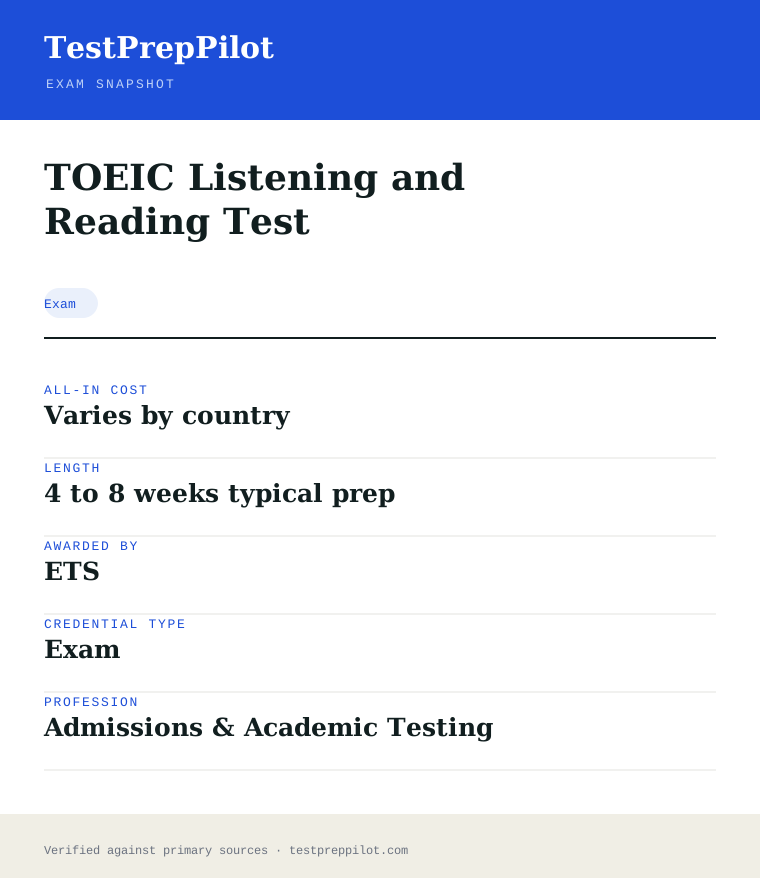
TOEIC Listening and Reading Test is a exam credential; awarded by ETS; the exam fee is Set by local ETS licensee or employer; typical preparation is 4 to 8 weeks typical prep; holders typically earn No direct salary outcome (workplace English proficiency; 10-990 score).
| Credential | TOEIC Listening and Reading Test |
|---|---|
| Type | Exam |
| Profession | Admissions & Academic Testing |
| Specialty | English Proficiency |
| Awarded by | ETS |
| Difficulty | Moderate |
| Typical prep time | 4 to 8 weeks typical prep |
| All-in cost | Varies by country |
| Typical salary range | No direct salary outcome (workplace English proficiency; 10-990 score) |
| Scoring | 10 to 990 total; 5 to 495 per section |
| Validity | Two years from test date |
| Purpose | Workplace hiring, promotion and benchmarking |
| Registration | Through centers or employers |
| Scope | National / Multi-state |
Real questions
Frequently asked questions about the TOEIC Listening and Reading Test
Is TOEIC for jobs or university?
Primarily for the workplace. Employers use it for hiring, promotion and benchmarking, while universities generally prefer the TOEFL iBT for admission.
What score do employers want?
There is no universal pass mark. Many office roles look for 600 to 700, while roles needing frequent English communication may ask for 800 or more.
How is it different from TOEFL?
TOEIC uses everyday and business English in a two-hour multiple-choice format, whereas TOEFL iBT uses academic English with speaking and writing tasks.
How long are TOEIC scores valid?
Scores are generally considered valid for two years, after which employers may ask for a refreshed result.
Is HiSET run by ETS or by PSI?
Both. ETS develops the HiSET test content and PSI delivers it operationally, following the ETS acquisition of PSI in January 2024. In practice you register and schedule through myHiSET on the PSI platform.
Do I have to live in a HiSET state to test?
Usually not. Several HiSET states, including Georgia and Oklahoma, explicitly allow non-residents to test, though you generally must pass your final subtest in the state whose credential you want.
Is HiSET easier than the GED?
They are set to comparable standards but structured differently: HiSET has five subtests with reading and writing separated, while the GED combines them into one Reasoning Through Language Arts test. HiSET is more widely available on paper, which some candidates prefer.
In short
Is the TOEIC Listening and Reading Test worth it?
- Workplace English test of 200 questions in about two hours
- Scored 10 to 990; used by employers not universities
- Focuses on business and everyday settings, not academia
Same awarding body
What other credentials does ETS award?
Worth comparing
How does the TOEIC Listening and Reading Test compare with similar credentials?
Trust
Where does this information come from?
Everything above is taken from the awarding body's own published material. Fees, question counts and domain weights are revised regularly — check the official page before you pay.
- ETS Awarding body
- Official TOEIC Listening and Reading Test exam page Exam page
Research confidence: high · Last reviewed 2026-08