Admissions & Academic Testing • Exam
Pharmacy College Admission Test
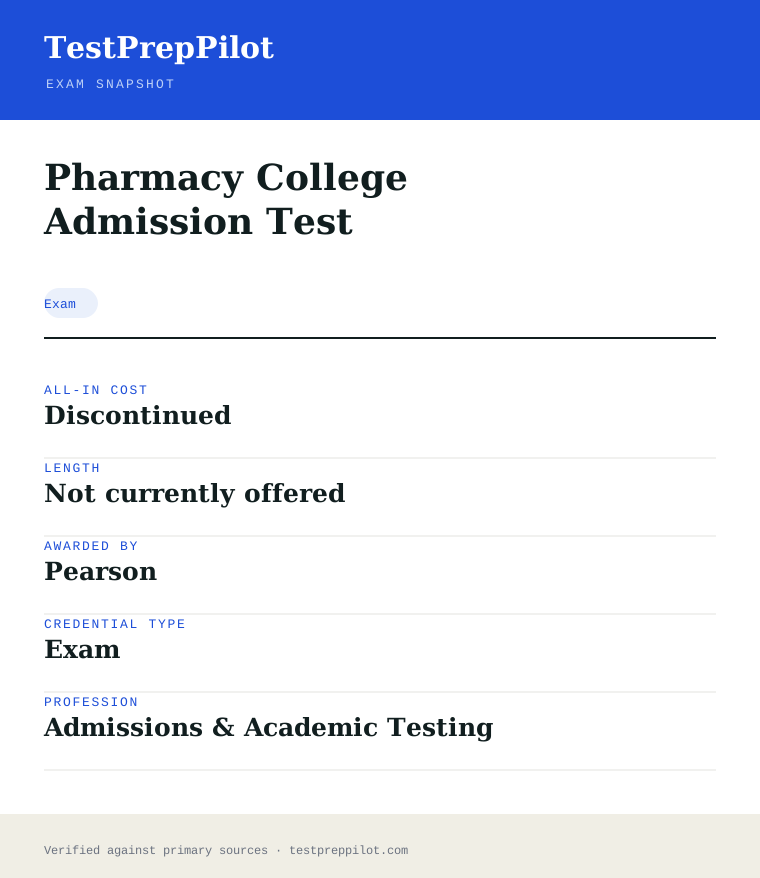
A retired pharmacy school admissions test that ended in January 2024.
Researched and maintained by TestPrepPilot Editorial BoardCollege admissions & graduate-health assessments desk · Figures last verified August 2026
The short version
What is the Pharmacy College Admission Test and is it worth it?
The PCAT was a pharmacy school admissions exam covering writing, science, reading and quantitative sections that Pearson retired after 10 January 2024. It is no longer offered, so new applicants cannot register; most PharmD programs now use test-optional or holistic review instead of a required PCAT score.
- Once a common pharmacy admissions benchmark
- Covered science and quantitative readiness
- Scores were reportable for a defined window
- Accepted by many PharmCAS programs
- Structured like other health-admissions exams
What is it?
What exactly is the Pharmacy College Admission Test?
A retired pharmacy school admissions test that ended in January 2024.
The Pharmacy College Admission Test (PCAT) was a standardized admissions exam for doctor of pharmacy (PharmD) programs that Pearson retired after 10 January 2024. It covered writing, biological and chemical sciences, critical reading and quantitative ability, and was historically required or recommended by many PharmCAS programs. New test takers can no longer register, and schools have moved to test-optional or holistic review; applicants with a still-valid score may report it where allowed.
The path in brief
- Confirm your PharmD program PCAT policy
- Look for any valid prior score
- Otherwise apply test-optional where allowed
- Strengthen coursework and experience
- Submit available evidence
Before you book
Who is eligible to sit the Pharmacy College Admission Test?
Who it is for: Former PharmD applicants
The test itself
What is the format of the Pharmacy College Admission Test?
The Pharmacy College Admission Test is administered by Pearson (retired) and runs About 3 hours 40 minutes.
| Administered by | Pearson (retired) |
|---|---|
| Questions | Approximately 192 multiple-choice plus one writing essay |
| Time limit | About 3 hours 40 minutes |
| Pass mark | No pass mark; scaled 200 to 600 |
| Exam fee | Discontinued |
| Format | Multiple-choice and essay, computer-delivered |
Content outline
What topics are on the Pharmacy College Admission Test?
The Pharmacy College Admission Test covers 5 content domains.
Weightings come from the official exam outline. Study time is best allocated in roughly these proportions rather than evenly across domains.
- Writing
- Biological Sciences
- Chemical Sciences
- Critical Reading
- Quantitative Ability
Study materials
Which study guide should you use for the Pharmacy College Admission Test?
Start with the exam sponsor's official content outline. If you also want one structured resource to work through, these are the Mometrix titles that match this exam.

Affiliate links We may earn a commission if you buy through these links, at no extra cost to you. Mometrix has no say in what our exam guides cover. How we make money.
Money & time
How much does the Pharmacy College Admission Test cost?
For the Pharmacy College Admission Test, the exam fee is Discontinued; the all-in cost is typically Discontinued; most candidates spend Not currently offered preparing.
Cost breakdown
| Former registration fee | $210 |
|---|---|
| Typical total | Discontinued |
No longer bookable; last fee shown for reference only.
Timeline
- Historical administration Through 10 Jan 2024
Typical prep: Not currently offered
The path
How do you register for the Pharmacy College Admission Test?
- 1
Confirm the assessment your school requiresper school
Ask the admissions or gifted office which Pearson instrument it accepts, since ability and achievement tests differ by age and purpose.
- 2
Locate a qualified administratorvaries
For KBIT-2, WISC-V, WPPSI-IV and similar tools, book a licensed psychologist or school psychologist; schools usually handle NNAT3, OLSAT and Stanford 10 directly.
- 3
Schedule the administrationvaries
Book a testing appointment or wait for the school testing window; PTE Academic is booked through the test taker Pearson account.
- 4
Prepare as advisedvaries
Ability tests need little study; PTE Academic benefits from the official scored practice test and sample questions.
- 5
Receive the reportafter testing
The examiner or school issues a written report with standard scores and percentiles that you submit to the admissions office.
The fine print
What are the retake and renewal rules for the Pharmacy College Admission Test?
- Proctoring & delivery
- Ability and achievement instruments are administered by qualified examiners or school staff under standard conditions; PTE Academic is taken at a Pearson VUE centre or at home with online proctoring.
- Retake policy
- Most ability and achievement tests are given once per admissions cycle and retaken only if the school permits a later administration. PTE Academic may be retaken with no fixed lifetime limit, subject to a short waiting period between attempts.
- Score reporting
- Scores are reported as standard scores, indexes or scales with age- or grade-based percentiles depending on the instrument; PTE Academic uses a 10 to 90 overall scale.
- Recertification
- These are diagnostic or admissions assessments rather than certifications, so there is no recertification; scores reflect performance on the test date.
Context
Selected Pearson admissions and ability tests
| Test | Used for | Length | Score | |
|---|---|---|---|---|
| KBIT-2 | Brief ability screen | 15 to 30 min | Standard score 100 | |
| WISC-V | Full IQ evaluation | 45 to 65 min | FSIQ 100 | |
| PTE Academic | English proficiency | 2 hours | 10 to 90 |
What it pays
How much does this credential pay?
No current exam — and the career it fed pays a median of $137,480 (BLS, May 2024): pharmacists, SOC 29-1051
The direct answer is that the Pharmacy College Admission Test no longer exists — Pearson retired it on January 10, 2024 — so there is no current exam-day salary story to tell, but the career the test once fed still pays well and is the reason applicants ask: pharmacists earned a median of $137,480 per year in May 2024, the most recent BLS Occupational Employment and Wage Statistics survey, under SOC 29-1051. That is a high median, but it must be read honestly. The lowest 10 percent of pharmacists earned less than $86,930 and the highest 10 percent more than $172,040, and the pharmacy labour market has been under visible pressure for a decade — rising Pharm.D. supply, flat or falling employment in some retail segments, and a shift of jobs toward hospital and clinical settings. The BLS projects pharmacist employment to grow 5 percent from 2024 to 2034, faster than the average for all occupations, with roughly 14,200 openings a year, most of them replacement need as the workforce ages. For an applicant, the salary figure matters in a different way now that the test is gone: the entire competitive edge has moved to the application itself. With no PCAT scores to compare, Pharm.D. programs weigh cumulative and science (BCP) GPA, completed prerequisite coursework, pharmacy or healthcare experience, letters of recommendation, and the interview — so the hours you might once have spent on PCAT prep now need to be spent on those inputs. The honest framing for anyone reading an older guide that says "register for the PCAT" is that the advice is obsolete: no U.S. Pharm.D. program requires a test that is no longer administered, and energy invested in lifting the science GPA and building pharmacy experience will move an application more than any legacy score ever did.
| Measure | Figure | Source / note |
|---|---|---|
| Median annual wage, pharmacists | $137,480 | BLS Occupational Outlook Handbook, May 2024 (SOC 29-1051, $66.10/hr) |
| Lowest 10 percent | less than $86,930 | BLS OOH Pay tab, May 2024 |
| Highest 10 percent | more than $172,040 | BLS OOH Pay tab, May 2024 |
| Employment, 2024 | 335,100 jobs | BLS OOH Quick Facts, 2024 |
| Projected annual openings | ~14,200 per year | BLS OOH Job Outlook, 2024-34 — largely replacement need |
| The PCAT itself | Retired January 10, 2024 | No testing dates in the 2024-25 cycle or beyond; no longer part of any admission file |
Job growth.5% projected change 2024-34 (faster than average) with ~14,200 openings a year, but the entry competition is now driven by GPA, prerequisites, experience and interviews — the PCAT plays no role
Your odds
What are the pass rates?
No pass rate exists — the PCAT is retired, and it never had one: it was a norm-referenced test scored by percentile, not a pass/fail exam
The honest answer to any pass-rate question about the PCAT is that there is no pass rate to report, for two reasons, and both are now permanent. First, the exam is gone: Pearson retired the Pharmacy College Admission Test on January 10, 2024, no testing dates were offered in the 2024-2025 admissions cycle or beyond, and even Official Transcripts and Personal Score Reports ceased to be available on December 2, 2024. Second, while it existed, the PCAT never had a pass/fail line the way a licensing exam does — it was a norm-referenced admissions test, scored on a 200-to-600 composite scale with a mean around 400 and a standard deviation of 25, and what mattered to admissions committees was the percentile rank comparing your performance to a norm group of first-time test takers. A candidate did not "pass" the PCAT; they produced a composite score and section scores in Writing, Biological Processes, Chemical Processes, Critical Reading, and Quantitative Reasoning, and each Pharm.D. program decided internally how much weight to give those scores, which is why different schools had different effective cutoffs and why no single published percentage ever existed. The retirement came after years of declining use: a growing share of programs dropped the requirement, applicant numbers fell, and by the end the test was optional or unused at most schools. What replaced it is the current admissions reality — cumulative and BCP GPA, prerequisite coursework, pharmacy or healthcare experience, letters of recommendation, and interviews, all reviewed holistically through PharmCAS. For a candidate reading a prep guide published before 2024, the single most useful fact is this: do not study for a test that no longer exists, and do not spend money on a PCAT prep product, because no current U.S. Pharm.D. program requires it.
Read this before quoting the number.The PCAT is retired (January 10, 2024) and was norm-referenced, not pass/fail, so no pass rate was ever published. Programs now evaluate GPA, prerequisites, experience, letters and interviews; any guide still advising PCAT prep is obsolete.
Your schedule
How long should I study for it?
The PCAT needs zero hours — reallocate to GPA, prerequisites, experience, and application polish over roughly 12 months of focused study
There is no PCAT study plan, because the PCAT no longer exists — the correct plan for a 2026-27 pharmacy applicant is an application-build plan, not a test-prep plan, and treating it as such is the single highest-yield move available. The old six-to-ten-week PCAT study block has been replaced by a twelve-month arc that ends with a strong PharmCAS submission: your grades come first and are already being made in the courses you are in right now, so the plan below assumes you can raise or protect your science GPA, complete the specific prerequisites each target program lists, and accumulate pharmacy or healthcare exposure that you can describe concretely. Start by making a list of target programs on PharmCAS and reading their actual requirements, because prerequisite lists and timelines differ. Then audit your transcript against those requirements — the classic failure mode is missing a single required course and discovering it the month applications open. Use the next several months to lift the weakest science grades you can still retake, and bank pharmacy experience in parallel: retail technician hours, hospital volunteer work, or a shadowing arrangement, with dates and duties recorded so your PharmCAS experience entries are specific rather than vague. Letters matter in a test-optional world: identify three recommenders — a science professor, a pharmacist who supervised you, and an employer or advisor — and ask early with a briefing on your goals. Write the personal statement across several drafts rather than in one weekend, because it now carries weight the PCAT once absorbed. Then submit early in the PharmCAS cycle, when rolling review means your complete file competes against a smaller pool, and prepare for the interview as the final gate. The hours that used to go to PCAT practice tests now go to prerequisite completion, GPA, experience documentation, and interview rehearsal — and that reallocation is exactly what the schools themselves have moved to.
- Months 1-32-3 hrs/week
Program list and transcript audit
- Build your PharmCAS target list and read each program's actual prerequisite and timeline requirements
- Audit your transcript against every prerequisite and flag any missing or weak course
- Enrol in or plan any prerequisite courses you are missing, including their timing
- Identify three recommenders and brief them on your goals early
- Months 4-8Varies with coursework and shifts
GPA work and pharmacy experience
- Protect or raise your cumulative and BCP GPA in the courses you take now
- Retake any weak prerequisite science course that is still salvageable
- Accumulate pharmacy or healthcare experience and log hours, duties and dates as you go
- Shadow a pharmacist or work a technician role so you can describe the profession from inside
- Months 9-104-6 hrs/week
Application and personal statement
- Draft and redraft the PharmCAS personal statement and experience entries
- Request letters of recommendation with a deadline and a briefing on your goals
- Verify all transcripts are submitted to PharmCAS and your file is complete
- Prepare for interviews: rehearse answers about motivation, experience and handling pressure
- Months 11-123-5 hrs/week
Submit early and interview
- Submit your complete PharmCAS application early in the cycle while rolling review favours complete files
- Attend program interviews with specific stories from your experience entries
- Send thank-you notes and keep programs updated on new grades or hours
- Follow up on any missing document so no file stalls
Adjusting the pace
Already holding strong science grades.Condense months 1-8 to about six months and shift the surplus time to experience hours and interview rehearsal — in a test-optional admissions world, documented experience and a polished file separate otherwise identical GPAs.
Rebuilding a weaker science GPA.Extend the plan to 18 months and front-load the weakest prerequisites you can retake; with no PCAT in the file, the science GPA is the single strongest quantitative signal programs screen on.
How to study
How do I prepare most effectively?
The strategy that now moves a pharmacy application is "protect the GPA, complete the prerequisites, document the experience, and interview like a professional," because the PCAT's retirement moved the entire competitive load onto the written application and the interview. The single biggest error a current applicant can make is studying for the retired PCAT or relying on a prep product that still sells it, when the hours belong in the places admissions committees actually read. The logic of the shift is simple: with no standardized test in the file, every program has moved to holistic review through PharmCAS, and the four quantitative and qualitative signals they weigh are cumulative and science (BCP) GPA, completed prerequisite coursework, documented pharmacy or healthcare experience, and letters of recommendation, with the interview as the final gate. That ordering should drive a candidate's time budget in the same order — the GPA is the strongest quantitative signal and is being written right now in the courses you are taking, so a candidate who is mid-program should prioritise the science sequence over any other discretionary study; the prerequisites are the hard eligibility floor, so a transcript audit against each target program's list should happen months before the application window, not the week it opens; and the experience, letters and personal statement are where differentiation happens between applicants with similar grades. The single highest-leverage habit is to log experience as it happens — dates, hours and specific duties — because PharmCAS entries that read "worked in a pharmacy" cannot compete with entries that describe what was actually done. The interview completes the picture: prepare answers about motivation, handling a difficult patient, and why each specific program, and practise them out loud, because in a test-optional world the interview absorbs some of the differentiation the PCAT once provided, and it is the one part of the file a candidate can actively improve in the final weeks.
Stop studying for the PCAT entirely
Pearson retired the exam on January 10, 2024 and no program requires it. Any guide, book or course still selling PCAT prep is selling a test that does not exist. Redirect every hour to GPA, prerequisites, experience, letters, the personal statement, and interview practice — the inputs every Pharm.D. program actually evaluates now.
Treat the BCP GPA as the primary quantitative signal
With no standardized test in the file, cumulative and science (BCP) GPA carry the quantitative assessment. If you can retake a weak science course, do it; if you are mid-program, prioritise the science sequence that matters most to the schools you want. The difference between a 3.4 and a 3.7 BCP GPA is worth more than any legacy PCAT score ever was.
Build pharmacy experience you can document
Technician hours, hospital volunteer work, or structured shadowing give admissions committees evidence that you understand the profession from the inside. Log dates, hours and specific duties as you go, because PharmCAS experience entries need concrete detail, and ask a pharmacist who supervised you for one of your letters.
Write the personal statement across drafts
In a test-optional world the personal statement absorbs some of the differentiation the PCAT once provided. Draft it early, revise it across weeks, and have it read by people who know the profession; vague enthusiasm loses to specific, honest accounts of what you have done and why you are doing it.
Apply early and rehearse the interview
PharmCAS admissions are rolling, so a complete early application competes against a smaller pool. Treat the interview as the final gate: prepare answers about motivation, handling a difficult patient or ethical situation, and why each specific program, and practise them out loud rather than in your head.
What to buy
Which study resources are worth paying for?
The comparison table for the PCAT has shrunk to one honest row: nothing should be purchased for the PCAT itself, because the exam no longer exists, and any resource still advertising PCAT practice is selling a product that cannot possibly be current — a trap worth spelling out, because those books and courses remain on the market with plausible prices long after the exam's retirement. What a 2026-27 applicant should spend on is the application-side stack: the PharmCAS application and transcript fees, which vary by school and by the number of programs you designate, official test scores where a specific program wants them, and interview travel for the programs that invite you. The optional adds are modest — a pharmacy-school admissions guide to navigate the process, and possibly an application-review service if you want a second pair of eyes on the personal statement — but none of them replaces the two free resources that matter most: each target program's official admissions page, which lists the actual prerequisites and timeline, and the AACP and PharmCAS guidance pages, which explain the process as it actually runs. The buying rule is to treat the exam-prep era as over: redirect every dollar and hour to the inputs programs evaluate — GPA, prerequisites, documented experience, letters and interview readiness — and to confirm every fee on PharmCAS and the school's own page before paying, because application fees are the real money in this process now. Interview travel deserves a budget line of its own, because the interview is where the final decisions are made in a test-optional world, and a candidate who cannot comfortably reach the programs that shortlist them is leaving the last gate unguarded.
| Resource | Price | Format | Best for |
|---|---|---|---|
| PCAT prep books, courses and practice tests | Do not buy — the exam is retired | Obsolete inventory still on sale | Nothing; the PCAT is no longer administered |
| PharmCAS application and transcript submission | Application fee per program; transcript fees per institution | Centralized online application | Every pharmacy applicant — submit early |
| AACP and program websites | Free | Official admission pages and PharmCAS listings | Reading actual prerequisites and timelines per school |
| Recommended colleges and employer advisors | Free | Advising office / pharmacist mentors | Course planning, letter writers and interview practice |
| Interview travel | Varies by program and location | In-person visits | The final gate once your file is complete |
Prices checked 2026-08 in USD; PharmCAS and per-program fees vary and change each cycle, so confirm on PharmCAS and each school's admission page. PCAT prep products are listed as obsolete because the exam was retired on January 10, 2024. We do not rank by commission.
Avoid these
What mistakes do candidates most often make?
The mistakes that most damage a current pharmacy application are the ones left over from the PCAT era: studying for a retired test, treating the GPA as a completed fact rather than a work in progress, applying with vague experience entries, and submitting late in a rolling cycle. Every one of them is avoidable, and every one of them costs more now that the standardized test is gone from the file, because there is no single score left to compensate for a weak file — the GPA, the prerequisites, the experience and the letters are the entire file. The most expensive mistake is the first one, because it wastes both money and months: buying PCAT prep products and sitting study hours that would have moved the GPA or the experience, at a time when no program requires the test. The most damaging is the second, because the GPA is the strongest quantitative signal and is written in real time — a candidate who treats last term's science grades as fixed fact forfeits the retakes and the course planning that could have lifted them before the file closed. The vague-experience mistake is the most common: programs read experience entries for evidence, and a candidate who logged duties, dates and hours has a materially stronger file than one who wrote adjectives. The late-submission mistake is the most structural, because PharmCAS admissions are rolling and a complete early file competes against a smaller pool, so a stalled transcript or a missing letter quietly costs weeks of competitive advantage. The letters-at-the-last-minute mistake rounds out the list, because a rushed generic letter cannot help a file and a prepared, specific one can be the difference between similar GPAs. The common thread is treating the application as something that happens in the submission week, when every input on it is built across the twelve months before.
✕Studying for the retired PCAT
✓The PCAT was retired on January 10, 2024 and no U.S. Pharm.D. program requires it. Redirect the study hours to science GPA, prerequisite completion, documented pharmacy experience, letters, the personal statement, and interview rehearsal — the inputs programs actually evaluate.
✕Discovering a missing prerequisite the month applications open
✓Audit your transcript against each target program's requirements at the start of the cycle, not the end. Missing one required course delays a file for a full year in a rolling process. List every program's requirements in a table and mark each course off as you take it.
✕Writing vague PharmCAS experience entries
✓Programs read experience entries for evidence, not adjectives. Log dates, hours and specific duties — "200 hours as a technician, entering and verifying prescriptions under a licensed pharmacist" beats "worked in a pharmacy." Start the log the day you start the work.
✕Submitting late in a rolling cycle
✓PharmCAS admissions are rolling, so a complete early application competes against a smaller pool and programs are more likely to interview candidates before seats fill. Target submission early in the cycle and follow up on any missing transcript or letter so no file stalls.
✕Asking for letters at the last minute
✓Ask three recommenders — a science professor, a pharmacist who supervised you, and an employer or advisor — early, with a briefing on your goals and a deadline. A rushed generic letter cannot help a file; a prepared, specific one can be the differentiator between similar GPAs.
What you'll face
What question types will I see?
There are no live PCAT question types, because the exam was retired on January 10, 2024 — but the legacy format is worth recording as history and as evidence of why no pass rate ever existed. The PCAT was roughly 192 multiple-choice questions plus one writing prompt across five separately timed sections: Writing (one prompt, 30 minutes), Biological Processes (48 questions, 45 minutes), Chemical Processes (48 questions, 45 minutes), Critical Reading (48 questions, 50 minutes), and Quantitative Reasoning (28 questions, 50 minutes), about three hours and forty minutes of testing time plus an optional break. It was norm-referenced: scores were reported on a 200-to-600 composite scale with a mean near 400 and a standard deviation of 25, and admissions committees used percentile ranks, not a pass line, to compare applicants against a norm group of first-time test takers. Multiple-choice items included both standalone questions and set-based items accompanying a short passage, and experimental items were embedded that did not count toward the score — which is why a candidate could never know precisely which items mattered, and why the exam could not produce a simple pass rate even while it existed. The samples below are editor-written illustrations of those legacy styles, included only so a reader can recognise what older guides are describing — they are not a study aid for anything a current applicant must take. What a current applicant actually faces is the application-based admissions model described throughout this file: GPA, prerequisites, experience, letters, and the interview, all moving through PharmCAS with no standardized test in the file, and the honest bottom line is that no current U.S. Pharm.D. program requires a test that no longer exists, so the hours that used to go to PCAT preparation belong in the application itself.
A health, science, or social issue prompt asking the candidate to present a solution in an original essay. Scored holistically; never a multiple-choice item.
General biology, microbiology, and human anatomy and physiology, presented as sets accompanying a passage or as standalone items.
General chemistry, organic chemistry, and basic biochemistry, in the same set-based and standalone mix.
Comprehension, analysis, and evaluation items in sets that accompany reading passages.
Standalone word-problem and problem-solving items spanning basic math, algebra, probability and statistics, precalculus, and calculus.
Try these
Q1The PCAT was scored on which reporting scale? (Legacy exam, retired January 10, 2024.)
Answer:B
The PCAT reported scores on a 200-to-600 composite scale with an original mean of 400 and a standard deviation of 25, and admissions committees relied primarily on percentile ranks. A and C describe scoring models the PCAT never used, and D describes the AP model — the trap for candidates mixing up exam families. The exam is retired, so this is purely historical context.
Q2Which of the following best describes why the PCAT was discontinued? (Legacy context.)
Answer:B
Pearson retired the PCAT because a growing share of Pharm.D. programs dropped the requirement and applicant numbers fell, thinning demand until the test was no longer viable. A invents a regulation that does not exist, C confuses admissions with licensure exams, and D is wrong — pharmacy admissions moved to holistic review, not to another standardized test.
Q3What does a current U.S. Pharm.D. application evaluate in place of the PCAT?
Answer:A
With the PCAT gone, programs weigh cumulative and BCP GPA, completed prerequisite coursework, pharmacy or healthcare experience, letters of recommendation, and the interview, all reviewed through PharmCAS. B describes something that does not exist, C confuses licensure-stage testing with admissions, and D contradicts the test-optional, holistic reality of current admissions.
Samples are editor-written illustrations of the published legacy blueprint, not live exam items — the PCAT has been retired since January 10, 2024.
The big day
What should I expect on exam day?
There is no PCAT exam day anymore — the test was retired on January 10, 2024 — so the honest exam-day section for a current applicant describes the two events that replaced it: the day your complete PharmCAS application is submitted, and the interview day that follows for candidates who make the shortlist. The application submission day is administrative but consequential: you confirm every transcript is on file, every letter of recommendation is in, and every experience entry is accurate, because a complete early file is what rolling admissions reward, and a missing document is what quietly stalls a candidacy. The interview day is the real gate. Program interviews are typically half a day or an afternoon, with one or more structured conversations covering motivation, ethics, teamwork, and why you chose that specific program, and often a written prompt or a tour. You should arrive with your application fresh in your head — interviewers routinely open your own personal statement and ask you to defend or expand it — with specific stories from your experience entries ready, and with your own questions for the program, because preparedness itself is being scored. Bring a government-issued photo ID, a printed copy of your application and personal statement, your schedule, and a notebook; leave phones silenced or off, bulky bags, and any attempt to wing a prepared question. Treat the interview as a professional meeting, not a test you cram for: the committee is evaluating fit, judgment and communication as much as knowledge. Afterwards, send prompt thank-you notes, keep programs updated with any new grades or hours, and be patient — decisions arrive on each school's published timeline, and following up respectfully is fine while pestering is not.
Bring
- Government-issued photo ID for check-in at any interview or campus visit
- A printed copy of your PharmCAS application and personal statement — interviewers will reference them
- A notebook and pen for notes, directions and contact details
- Your schedule, the program's address, and the contact name for the admissions office
- Specific stories and numbers from your experience entries, rehearsed
Leave at home
- Phones and smartwatches off during the interview itself
- The mentality that this is a test to be passed in one session — treat it as a professional conversation
- Bulky bags and anything you would not carry into a business meeting
- Vague answers: "I like helping people" is not a prepared answer in a competitive cycle
How the day runs
Rules in the room
- The PCAT cannot be taken — it was retired January 10, 2024; no testing dates exist in the 2024-25 cycle or beyond.
- Admissions decisions rest on the complete PharmCAS file: GPA, prerequisites, experience, letters, and the interview.
- Rolling admissions reward complete early applications; a stalled file loses ground every week.
- Interview day is closed-book but open-folder: your own application and personal statement are fair game for questioning.
- Follow up politely on the published timeline; repeated contact does not help a file.
Afterwards.The outcome of a pharmacy application is a decision, not a score. If you are admitted, confirm your seat, complete any remaining prerequisites, and prepare for the professional phase of the pathway — the Pharm.D. curriculum and, eventually, licensure, where the pharmacy career's median pay of $137,480 (BLS, May 2024) is actually earned. If a program defers or denies you, treat the file as a diagnostic: ask what to strengthen, retake or add experience, and reapply with a stronger application early in the next cycle. The single most useful habit after any decision is to keep the science GPA rising and the experience log current, because in the post-PCAT admissions model those two inputs compound across every cycle you run.
Reference
What are the key facts about the Pharmacy College Admission Test?
Pharmacy College Admission Test is a exam credential; awarded by Pearson; the exam fee is Discontinued; typical preparation is Not currently offered; holders typically earn $85,000-$150,000 (29-1051 median $137,488).
| Credential | Pharmacy College Admission Test |
|---|---|
| Abbreviation | PCAT |
| Type | Exam |
| Profession | Admissions & Academic Testing |
| Specialty | Graduate & Professional Admissions |
| Awarded by | Pearson |
| Difficulty | Hard |
| Typical prep time | Not currently offered |
| All-in cost | Discontinued |
| Typical salary range | $85,000-$150,000 (29-1051 median $137,488) |
| Status | Retired 10 January 2024 |
| Scoring | Scaled 200 to 600 per section |
| Validity | Former scores may still be reportable |
| Replacement | Program-specific, often test-optional |
| Scope | National / Multi-state |
Real questions
Frequently asked questions about the Pharmacy College Admission Test
Can I still register for the PCAT?
No. Pearson retired the PCAT after 10 January 2024, and the exam is no longer scheduled or scored.
How do PharmD programs admit students now?
Most PharmCAS programs have moved to test-optional or holistic review, weighing prerequisites, GPA, experience and letters rather than a required PCAT score.
Are my old PCAT scores still accepted?
If you tested before retirement, a program may still consider the report where its policy allows, but you cannot earn a new score.
Was the PCAT like the DAT or OAT?
It was similar in being a health-admissions exam with science and quantitative sections, but the DAT and OAT remain active while the PCAT is retired.
Can I book a Pearson ability test directly?
The publisher restricts ability and achievement instruments to qualified purchasers, so families usually arrange administration through a school or licensed psychologist rather than booking on their own.
Is PTE Academic the same as the school ability tests?
No. PTE Academic is an English-proficiency exam that any adult can book individually, while KBIT-2, WISC-V and similar tools are clinically administered assessments.
In short
Is the Pharmacy College Admission Test worth it?
- Retired by Pearson after 10 January 2024
- Was a 3h 40m PharmD admissions exam
- Programs now use test-optional or holistic review
Same awarding body
What other credentials does Pearson award?
Trust
Where does this information come from?
Everything above is taken from the awarding body's own published material. Fees, question counts and domain weights are revised regularly — check the official page before you pay.
- Pearson Awarding body
Research confidence: medium · Last reviewed 2026-08