Admissions & Academic Testing • Exam
Casper Situational Judgment Test
An open-response situational judgment test required by many health-professions programs.
Researched and maintained by TestPrepPilot Editorial BoardAdmissions & professional testing desk · Figures last verified August 2026
The short version
What is the Casper Situational Judgment Test and is it worth it?
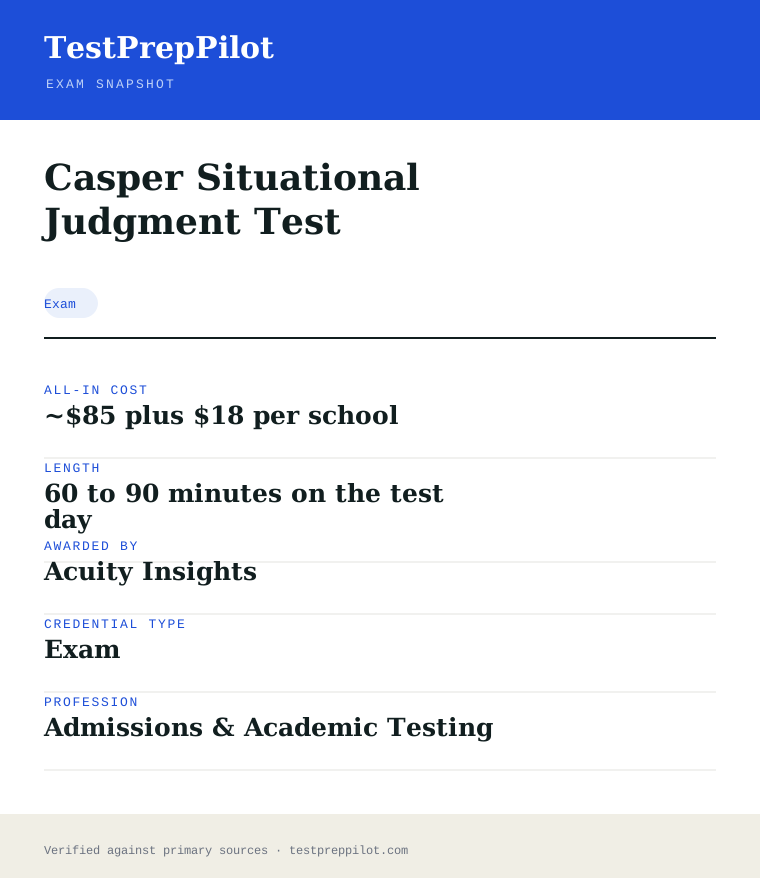
Casper is an open-response situational judgment test for health-professions admission, taken online with proctoring. It presents about 14 scenarios with video and typed responses over 60 to 90 minutes. The US base fee is about 85 dollars plus 18 dollars per additional school, and the result is a quartile of 1 to 4 sent only to programs.
- Required by many health-professions schools
- Measures judgment, not academic knowledge
- Online with identity verification
- One attempt per admission cycle
- Widely used across medicine and dentistry
What is it?
What exactly is the Casper Situational Judgment Test?
An open-response situational judgment test required by many health-professions programs.
The Casper Situational Judgment Test is an open-response exam in the Altus Suite that many US and Canadian medical, dental, nursing and other health-professions programs require. It presents video and text scenarios and asks the test taker to type responses that show judgment, ethics and communication. In the United States the base fee is about 85 dollars plus roughly 18 dollars for each additional school receiving the score, and the result is a quartile of 1 to 4 that only the programs see.
The path in brief
- Confirm programs require Casper
- Create an Acuity account
- Book a test date
- Practice with sample scenarios
- Complete it online and send scores
Before you book
Who is eligible to sit the Casper Situational Judgment Test?
Who it is for: Health-professions program applicants
The test itself
What is the format of the Casper Situational Judgment Test?
The Casper Situational Judgment Test is administered by Acuity Insights and runs 60 to 90 minutes.
| Administered by | Acuity Insights |
|---|---|
| Questions | About 14 scenarios, video and typed responses |
| Time limit | 60 to 90 minutes |
| Pass mark | No pass mark; quartile 1 to 4 |
| Exam fee | About $85 base plus ~$18 per additional school (US) |
| Format | Online, open-response, proctored |
Content outline
What topics are on the Casper Situational Judgment Test?
The Casper Situational Judgment Test covers 4 content domains.
Weightings come from the official exam outline. Study time is best allocated in roughly these proportions rather than evenly across domains.
- Situational judgment
- Ethics and professionalism
- Communication
- Empathy
Money & time
How much does the Casper Situational Judgment Test cost?
For the Casper Situational Judgment Test, the exam fee is About $85 base plus ~$18 per additional school (US); the all-in cost is typically ~$85 plus $18 per school; most candidates spend 60 to 90 minutes on the test day preparing.
Cost breakdown
| Base fee (US) | ~$85 |
|---|---|
| Each additional school | ~$18 |
| Typical total | ~$85 plus $18 per school |
Exact fees and currency vary by country; Duet is included where programs require it.
Timeline
- Book Per test date
- Test 60 to 90 minutes
- Scores Sent to programs
Typical prep: 60 to 90 minutes on the test day
The path
How do you register for the Casper Situational Judgment Test?
- 1
Confirm the required assessmentsper program
Check each program page to see whether it requires Casper, Duet or both, and on which test dates.
- 2
Create an Acuity account10 minutes
Register at acuityinsights.app and verify your identity before booking a distribution window.
- 3
Book Casper and Duet15 minutes
Reserve a Casper test date and add Duet for the specific programs; fees depend on the number of schools receiving scores.
- 4
Complete the assessmentstest day
Take Casper on the scheduled date and finish Duet online; each has a single attempt per admission cycle.
- 5
Scores sent to programsafter grading
Results are released to the programs you selected; you cannot see your own Casper quartile.
The fine print
What are the retake and renewal rules for the Casper Situational Judgment Test?
- Proctoring & delivery
- Casper is taken online with identity verification and automated proctoring, including webcam and microphone checks. Duet is an unproctored values exercise completed at your convenience.
- Retake policy
- Casper and Duet each allow one attempt per admission cycle; you generally cannot retake either for the same cycle even if you are unhappy with the result.
- Score reporting
- Casper reports a quartile of 1 to 4 (Q1 lowest to Q4 highest) based on a standardised score. Duet returns a compatibility view to the program rather than a public number to the applicant.
- Recertification
- Scores are used for the admission cycle and are not renewed; the assessments are point-in-time measures for that year.
Context
Altus Suite components
| Assessment | Measures | Length | Result | |
|---|---|---|---|---|
| Casper | Situational judgment | 60 to 90 min | Quartile 1 to 4 | |
| Duet | Values alignment | 15 to 20 min | Match view |
What it pays
How much does this credential pay?
$130,020 median for physician assistants — a representative health-professions career CASPer applicants target (BLS, May 2024)
The CASPer situational-judgment test is not an occupation and produces no wage of its own — it is an admissions screen used by medical, physician-assistant, nursing, dental, pharmacy and veterinary programs to assess non-academic attributes. The wage question therefore belongs to the professional career you are applying to enter, and we cite Physician Assistants, SOC 29-1071, as a representative example: May 2024 median of $130,020, with the lowest 10 percent under $91,000 and the highest 10 percent above $171,950. BLS counted 135,700 physician assistant jobs in 2024 and projects a striking 29 percent growth from 2024 to 2034, with about 12,800 openings a year. The limitation to state plainly: each profession CASPer serves has its own salary distribution — medicine, nursing, dentistry, pharmacy and veterinary medicine differ widely — so the cited figure is illustrative, not universal, and the test itself is a gate whose value is admission to a program, not a wage. Read the numbers as the market for the careers the test helps you enter, and treat a strong CASPer performance as one component of an application that also includes academics, experience and interviews.
| Measure | Figure | Source / note |
|---|---|---|
| Median annual wage, physician assistants (representative target career) | $130,020 | BLS OOH, SOC 29-1071, May 2024 |
| Lowest 10 percent | Under $91,000 | BLS OOH, SOC 29-1071, May 2024 |
| Highest 10 percent | Above $171,950 | BLS OOH, SOC 29-1071, May 2024 |
| Median, registered nurses (another common target) | $89,010 | BLS OOH, SOC 29-1141, May 2024 |
Job growth.BLS projects 29 percent growth for physician assistants from 2024 to 2034, about 12,800 openings per year.
Source: BLS Occupational Outlook Handbook - Physician Assistants
Your odds
What are the pass rates?
CASPer is not scored pass/fail — candidates receive a percentile ranking, and there is no published pass rate
The CASPer test does not report a pass/fail result and has no pass rate to publish: it is a computer-based situational-judgment test that measures non-academic attributes — professionalism, ethics, empathy, collaboration and resilience — and candidates receive a percentile score that admissions committees use alongside academics and the rest of the application. The test presents video and text-based scenarios of challenging situations in professional settings, and the candidate responds in writing, with the responses rated by trained raters using a standardized rubric. Because the score is a percentile rather than a pass line, there is no single "passing" threshold; each program decides how to weight the CASPer within its admissions process, and programs can see how a candidate's score compares with other test takers applying in the same cycle. The practical reading: because there is no pass/fail, preparation focuses on understanding the response style the rubric rewards — addressing the perspective of everyone involved, showing professional judgment and empathy, and explaining your reasoning — rather than memorising content. Free official practice scenarios are the best preparation.
Read this before quoting the number.CASPer reports a percentile score rather than pass/fail; no pass rate exists, and each program sets its own weighting.
Source: Acuity Insights - CASPer test
Your schedule
How long should I study for it?
5-10 hours over 1-2 weeks of focused study
The CASPer test is a roughly 90-minute computer-based situational-judgment test with no content curriculum — the scenarios are drawn from everyday professional situations, and the test measures how you reason, not what you know — so the study plan is a practice plan, not a content plan. A defensible plan runs 5 to 10 hours over one to two weeks. Days one to two: take the free official practice test to understand the format — typed responses to video and text scenarios, with a short answer window for each. Days three to five: review the official sample responses and the rubric guidance, and learn the response structure the raters reward: identify the issue, consider every stakeholder's perspective, state your decision and your reasoning. Days six to eight: practise with the official practice scenarios and third-party practice banks, typing full responses under the real time constraint. Day nine: take a second full timed practice test and review your response lengths and coverage. Day ten: schedule and sit the real test. The plan is short because the test is skill-based; typing speed and structured reasoning matter more than hours of study.
- Days 1-22
Format familiarisation
- Take the free official practice test
- Learn the video and text scenario formats
- Understand the typed-response timing
- Days 3-53
Response structure
- Review official sample responses and rubric
- Learn the stakeholder-perspective structure
- Practise planning answers before typing
- Days 6-83
Timed practice
- Work practice scenarios with the real time window
- Type full responses for each
- Review response length and coverage
- Days 9-102
Final run and sit
- Second full timed practice test
- Schedule and sit the real test
Adjusting the pace
Strong writer.Compress to 3-5 days; focus on the professional-judgment scenarios rather than typing mechanics.
Slow typist.Add 2-3 days of typed-response practice; the short answer windows reward typing speed.
How to study
How do I prepare most effectively?
The CASPer rewards a specific response structure, so the dominant strategy is learning the rubric's expectations and practising the format under real timing. First, use the free official practice test and sample responses: they are the only material produced by the test's creators and show exactly how responses are scored. Second, learn the response structure the raters reward: identify the core issue, consider the perspectives of every person involved, state what you would do, and explain your reasoning — responses that name the reasoning score higher than answers that jump to conclusions. Third, practise professional-judgment consistently: the scenarios often present no perfect option, and the raters look for ethical, empathetic and collaborative reasoning rather than a "right answer". Fourth, type your practice responses under the real time window, because the short answer periods are the test's main pressure point and typing speed matters. Finally, do not cram content — there is none to cram; a few focused practice sessions spread over a week outperform marathon study.
Use the official practice test
The creators' own material shows exactly how responses are scored.
Learn the response structure
Issue → stakeholders → decision → reasoning scores highest.
Practise professional judgment
The scenarios have no perfect option; empathy and ethics are graded.
Type under the real timing
The short answer windows are the main pressure point.
Do not cram
There is no content to cram; a few focused sessions win.
What to buy
Which study resources are worth paying for?
CASPer prep is inexpensive because the official resources are free or low-cost. The official practice test and sample scenarios on the Acuity Insights site are free, and the full test fee is roughly $10 per test administration plus a distribution fee to programs, paid at registration. Third-party CASPer prep services sell practice banks and courses ranging from roughly $20 to $200, with quality varying widely; the official materials plus any well-reviewed practice bank are sufficient for most candidates. Free resources also include the CASPer FAQ and the response-style guidance published by the test's creators. A realistic total budget is $10 to $150 including the test fee. Prices below are list prices as of mid-2026 and change frequently; we rank nothing by commission.
| Resource | Price | Format | Best for |
|---|---|---|---|
| Official CASPer practice test | Free | Official online practice | Format and scoring expectations |
| Official sample responses | Free | Official PDF | The response structure the rubric rewards |
| CASPer test fee | ~$10 + distribution fees | Online test administration | The test itself |
| Third-party practice banks | $20-$200 | Online scenario practice | Extra timed practice (quality varies) |
List prices as of mid-2026, subject to change; CASPer fees vary by program distribution; no commission or affiliate ranking is implied.
Avoid these
What mistakes do candidates most often make?
The most common CASPer mistake is trying to prepare like a content exam: candidates who search for "answers" to scenarios misunderstand that the test measures judgment, not knowledge, and every scenario is new. The fix is practising the response structure rather than memorising content. The second mistake is writing answers that skip the reasoning: responses that state what the candidate would do without explaining why score lower, because the rubric rewards the reasoning chain. Third, candidates rush into a decision without considering every stakeholder; the scenarios are deliberately multi-perspective, and answers that consider only one person's view miss the rubric's core expectation. Fourth, slow typing under the real time window leaves responses truncated; practice under the real timing. Finally, candidates treat the CASPer as a box to check and take it cold — the percentile scoring means a poor relative performance is a real application risk, so the few hours of official practice are worth taking.
✕Preparing like a content exam
✓The test measures judgment; practise the response structure, not content.
✕Stating actions without reasoning
✓The rubric rewards the reasoning chain behind the decision.
✕Considering one stakeholder
✓The scenarios are multi-perspective; weigh everyone involved.
✕Underestimating typing pressure
✓Practise under the real answer windows.
✕Taking it cold
✓The percentile score is an application risk; do the official practice.
What you'll face
What question types will I see?
The CASPer test presents two types of scenarios: video-based situations, where a short video clip sets the scene, and text-based situations, where a written description does — each followed by two to three open-ended questions asking how you would respond or what you would consider, with typed answers and a short time window per response. The scenarios cover everyday professional and personal situations that probe professionalism, ethics, empathy, collaboration and resilience. There are no right answers; trained raters score the responses against a rubric. Samples below are editor-written illustrations of the test's scenario style, not live test items; they show the judgment-based format.
A video sets the scene, followed by typed-response questions.
A written description, followed by typed-response questions.
Additional questions probing the response and its reasoning.
Try these
Q1A team member consistently misses deadlines, and the rest of the team must absorb the work. Your supervisor asks you to "handle it". What is the most appropriate response?
Answer:A
The best response considers every stakeholder: the team member (the cause is unknown), the team (the workload), and the supervisor (the request). A private conversation to understand the cause, followed by a collaborative plan, addresses the issue professionally; immediate escalation, silent absorption or public confrontation each fail the professional-judgment and empathy criteria.
Q2A colleague asks you to cover for their absence by not recording a procedure error they made. What should you consider?
Answer:A
The scenario probes professional integrity: the duty to report a procedural error stands regardless of harm or detection, while considering the colleague's intent and supporting them in reporting appropriately reflects empathy. Harm-only, detection-only or friendship-based reasoning miss the professional-ethics core the rubric rewards.
Q3You are assigned to a team project where a member with less experience is struggling. The project is behind schedule. What is the most appropriate approach?
Answer:A
The best response balances support for the struggling member with the project's needs: offering training and support develops the member while keeping the timeline realistic. Redoing the work, exclusion or blame each fail the collaboration and resilience attributes the rubric measures.
Samples are editor-written illustrations of the test's scenario style, not live test items — CASPer is a judgment test with no right answers.
The big day
What should I expect on exam day?
The CASPer test is taken online at a scheduled time, typically in a single roughly 90-minute session, from a computer with a stable internet connection; the test is proctored. Confirm the system requirements, the test window your programs require, and that you have the test fee and distribution set up through the CASPer registration portal. Arrive at the session with your setup ready — a quiet space, working camera for proctoring and no interruptions. The test presents the scenarios and answer windows sequentially; pace yourself so every response is complete. Because there is no pass/fail, there is no "result day" in the traditional sense — the percentile score is released to your designated programs, and you can view your score through the portal. The afterwards matters: note the programs your score was distributed to, and remember that the CASPer is one component of an application, so a strong performance complements but does not replace academics, experience and interviews.
Bring
- Computer with webcam and stable internet
- A quiet, private testing space
- Your CASPer registration and program distribution list
Leave at home
- Distractions — the session is proctored and time-boxed
- Any expectation of a pass/fail result — you receive a percentile score
How the day runs
Rules in the room
- The test is online and proctored; a working camera is required
- Responses are typed into short answer windows
- There is no pass/fail — programs receive a percentile score
Afterwards.On completion, your percentile score is distributed to the programs you designated; view it in the portal. Use the performance as one component of your broader application.
Reference
What are the key facts about the Casper Situational Judgment Test?
Casper Situational Judgment Test is a exam credential; awarded by Acuity Insights; the exam fee is About $85 base plus ~$18 per additional school (US); typical preparation is 60 to 90 minutes on the test day; holders typically earn $71,000-$174,000 (destination careers).
| Credential | Casper Situational Judgment Test |
|---|---|
| Abbreviation | Casper |
| Type | Exam |
| Profession | Admissions & Academic Testing |
| Specialty | Graduate & Professional Admissions |
| Awarded by | Acuity Insights |
| Difficulty | Moderate |
| Typical prep time | 60 to 90 minutes on the test day |
| All-in cost | ~$85 plus $18 per school |
| Typical salary range | $71,000-$174,000 (destination careers) |
| Result | Quartile 1 to 4, sent to programs |
| Attempts | One per admission cycle |
| Delivery | Online with proctoring |
| Fee | About $85 plus $18 per school (US) |
| Scope | National / Multi-state |
| Also known as | CASPer, Altus Suite |
Real questions
Frequently asked questions about the Casper Situational Judgment Test
How much does Casper cost?
In the US the base fee is about 85 dollars plus roughly 18 dollars for each additional school receiving the score.
Can I see my Casper score?
No. Only the programs receive your quartile; applicants get confirmation that the score was sent but not the result.
How many times can I take Casper?
One attempt per admission cycle; you generally cannot retake it for the same cycle.
What does Casper measure?
It measures situational judgment, ethics, communication and empathy through open responses to video and text scenarios, not academic knowledge.
How much does Casper cost?
A base US fee is about 85 dollars plus roughly 18 dollars for each additional school receiving the score; Duet is included for programs that require it.
Can I see my Casper score?
No. Only the programs receive your Casper quartile; applicants receive confirmation that the score was sent but not the result itself.
In short
Is the Casper Situational Judgment Test worth it?
- Open-response situational judgment test
- About 14 scenarios over 60 to 90 minutes
- Quartile 1 to 4 sent only to programs
Worth comparing
How does the Casper Situational Judgment Test compare with similar credentials?
Trust
Where does this information come from?
Everything above is taken from the awarding body's own published material. Fees, question counts and domain weights are revised regularly — check the official page before you pay.
- Acuity Insights Awarding body
Research confidence: medium · Last reviewed 2026-08