The short version
What is the GRE General Test and is it worth it?
The GRE General Test is a computer-delivered graduate admissions exam lasting about 1 hour 58 minutes and covering verbal reasoning, quantitative reasoning and one analytical writing essay. You register through ETS for a test centre or at-home appointment at a 220 dollar US fee, and scores are reportable for five years.
- Accepted by thousands of graduate and professional programs globally
- Adaptive format shows you questions matched to your ability level
- Scores valid five years, giving flexibility across admission cycles
- Sends four free score reports to institutions of your choice
- One essay plus reasoning sections, with no memorised facts required
What is it?
What exactly is the GRE General Test?
The standard US graduate admissions exam measuring verbal, quantitative and analytical writing skills.
The GRE General Test is ETS standardised admission assessment for master, doctoral and many business programs worldwide, measuring verbal reasoning, quantitative reasoning and analytical writing in a computer-adaptive format of just under two hours. It is accepted across thousands of graduate and professional schools, and applicants often use it to strengthen a transcript or to meet program minimums. The test adapts question difficulty to your performance, so no two candidates see an identical set of questions.
The path in brief
- Create ETS account
- Book centre or at-home slot
- Practice with PowerPrep
- Test in under two hours
- Send scores to four schools free
Before you book
Who is eligible to sit the GRE General Test?
None - open to all graduate applicants
Who it is for: Prospective graduate and professional-school applicants
The test itself
What is the format of the GRE General Test?
The GRE General Test is administered by ETS test centres and at-home online proctoring and runs 1 hr 58 min and contains 3 measures (Analytical Writing, Verbal, Quantitative) questions.
| Administered by | ETS test centres and at-home online proctoring |
|---|---|
| Questions | 3 measures (Analytical Writing, Verbal, Quantitative) |
| Time limit | 1 hr 58 min |
| Pass mark | No pass mark; programs set their own expectations |
| Exam fee | $220 |
| Format | Computer-adaptive, multiple-choice and essay |
Content outline
What topics are on the GRE General Test?
The GRE General Test covers 3 content domains.
Weightings come from the official exam outline. Study time is best allocated in roughly these proportions rather than evenly across domains.
- Verbal Reasoning
- Quantitative Reasoning
- Analytical Writing
Money & time
How much does the GRE General Test cost?
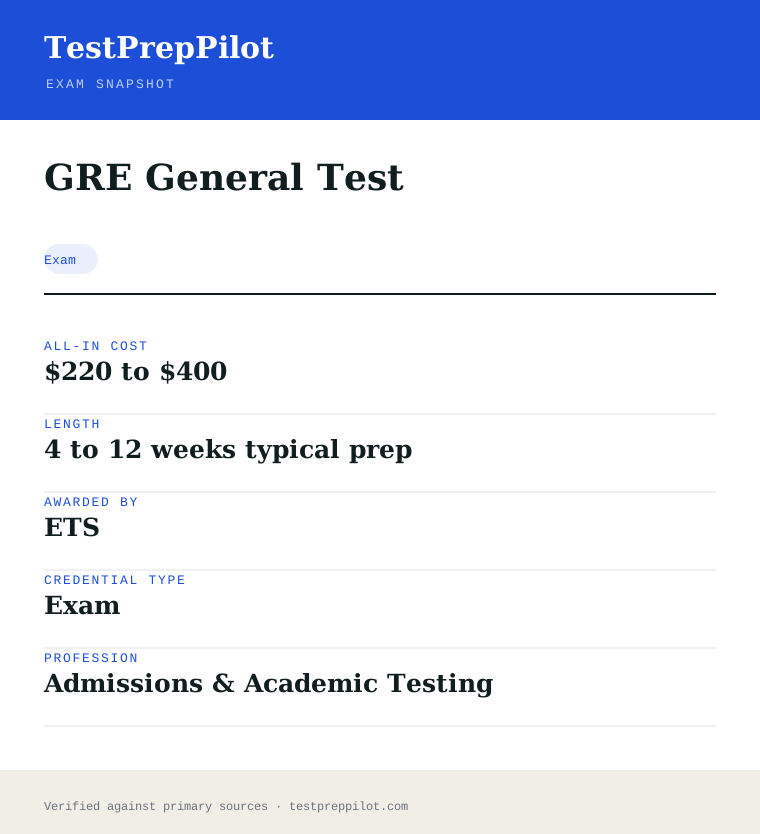
For the GRE General Test, the exam fee is $220; the all-in cost is typically $220 to $400; most candidates spend 4 to 12 weeks typical prep preparing.
Cost breakdown
| Exam fee (US) | $220 |
|---|---|
| Additional score reports | $35 each |
| Typical total | $220 to $400 |
At-home testing may add a small regional fee in some countries.
Timeline
- Study 4 to 12 weeks
- Test Under 2 hours
- Scores 8 to 10 days
Typical prep: 4 to 12 weeks typical prep
The path
How do you register for the GRE General Test?
- 1
Read your state requirements page20 minutes
Open hiset.org and select your state or jurisdiction. Age minimums, residency rules, whether you must enrol in an adult education programme first, and the exact fees are all set locally.
- 2
Create a myHiSET account15 minutes
Sign up through the state requirements page to generate your HiSET number, which you need for scheduling, score access and any state paperwork.
- 3
Take the official practice tests1 to 2 hours per subtest
HiSET publishes free and low-cost official practice tests for each subtest. Unlike the GED at-home route, HiSET does not require a practice-test pass before you can schedule.
- 4
Schedule subtests one at a time10 minutes each
Book any of the five subtests in any order, on paper or computer at a test centre or through HiSET@Home online proctoring where your state allows it.
- 5
Test with valid photo ID65 to 120 minutes per subtest
Bring a current government-issued photo ID showing your name, date of birth, signature and photograph. At-home testers need a private room, a webcam and a stable connection.
- 6
Check scores and claim your credential1 to 2 weeks
Multiple-choice results typically post within about five to seven days and essay results within about seven to ten days. Once all five subtests pass, your state issues the credential.
The fine print
What are the retake and renewal rules for the GRE General Test?
- Proctoring & delivery
- HiSET is offered in three ways: paper-based at a test centre, computer-based at a test centre and HiSET@Home under live online proctoring, with availability depending on the state. Calculators and formula sheets are supplied at test centres. The full battery in English or Spanish is permitted, and several states allow candidates to mix languages across subtests.
- Retake policy
- Retake rules are set per state, but a common pattern allows three attempts per subtest in a calendar year, sometimes extending to six. Several states use a favourable pricing structure in which the full fee is charged only on the first and fourth attempts while the second and third cost only the test centre or proctor fee.
- Score reporting
- Each of the five subtests is scored 1 to 20. To pass you must score at least 8 on every subtest, at least 2 out of 6 on the Language Arts Writing essay, and at least 45 out of 100 in total across the five. A score of 15 or higher on a subtest is treated as HiSET honours-level performance in several states.
- Recertification
- The credential a state issues on the strength of a passing HiSET battery is permanent and needs no renewal. Passing subtest scores are carried forward within a state-defined window while you complete the remaining subjects.
- Refunds & rescheduling
- Refund and reschedule windows are administered by PSI and vary by state and test centre; most centres require cancellation at least 24 hours before the appointment. Registering by phone rather than online attracts an additional fee in some states.
Context
HiSET subtests at a glance
| Subtest | Questions | Time | |
|---|---|---|---|
| Language Arts - Reading | About 40 to 50 multiple choice | 65 minutes | |
| Language Arts - Writing | About 50 multiple choice plus 1 essay | 120 minutes | |
| Mathematics | About 50 multiple choice | 90 minutes | |
| Science | About 50 multiple choice | 80 minutes | |
| Social Studies | About 50 multiple choice | 70 minutes |
What it pays
How much does this credential pay?
The GRE gates graduate access: master’s-degree median weekly earnings were $1,732 in 2024 (BLS)
The GRE General Test is a graduate-admissions test, not a job credential, so no BLS SOC code corresponds to a score. The economic case runs through the advanced degrees the test helps secure, and the BLS evidence is direct: in 2024, full-time workers age 25 and older with a master’s degree earned median weekly wages of $1,732, versus $1,543 with a bachelor’s degree and $1,109 with an associate degree - an annualized master’s-level median of roughly $90,000. The GRE matters to this picture because it is used by thousands of graduate programs in the US and internationally, including master’s, doctoral and professional programs across the humanities, social sciences, and many STEM fields (though a growing number of programs are test-optional or have dropped the requirement). For many candidates the score directly affects admission and funding decisions - assistantships and fellowships often hinge on the application package that includes the GRE - so the test can influence both the credential earned and the cost of earning it. It is equally true that the landscape is shifting: law and medical school admissions use other tests, many business schools now accept the GMAT or GRE interchangeably, and a substantial share of graduate programs no longer require the GRE. The honest framing is the same as for any admissions test: prepare seriously when target programs use the score, and understand that the wage payoff the data supports runs through the graduate degree, not the score itself. BLS classifies workers by occupation and education, not test scores, so no GRE percentile maps to a salary.
| Measure | Figure | Source / note |
|---|---|---|
| Master’s-degree median weekly earnings, 2024 | $1,732 | BLS, workers 25+, full time |
| Bachelor-degree median weekly earnings, 2024 | $1,543 | BLS, workers 25+, full time |
| Associate-degree median weekly earnings, 2024 | $1,109 | BLS, workers 25+, full time |
| GRE score range | 260-340 (Verbal+Quant) | ETS, plus Analytical Writing 0-6 |
Job growth.BLS projects 3 percent overall employment growth from 2024 to 2034; the wage-by-education gradient is the relevant comparison.
Your odds
What are the pass rates?
The GRE has no pass/fail line; Verbal and Quantitative run 130-170 each and targets are set by each program
ETS publishes no pass rate for the GRE General Test because there is no passing score. Under the shortened format that took effect in September 2023, the test runs about 1 hour 58 minutes and contains: an Analytical Writing section (one Issue essay, 30 minutes), two Verbal Reasoning sections (12 questions each, 18 minutes each), and two Quantitative Reasoning sections (12 questions each, 21 minutes each); the sections are adaptive at the section level - the second Verbal and Quant sections are routed by performance on the first. Verbal and Quantitative each score 130-170 in one-point increments, and Analytical Writing scores 0-6 in half-point increments; the reported total is the Verbal+Quant sum (260-340). What candidates compare against are program percentiles and each program’s stated or typical score ranges; competitive STEM doctoral programs often expect Quant in the 160s, while humanities programs weigh Verbal and Analytical Writing more heavily, and many programs publish average scores for admitted cohorts. The September 2023 format cut the test from about 3 hours 45 minutes and removed the two long essays, which changed pacing substantially, so candidates must practice the current format rather than older materials. There is no limit on retakes, but ETS requires at least 21 days between attempts and candidates may take the test at most five times in any rolling 12-month period. Scores are reported 8-10 days after the test, and ScoreSelect lets candidates send only their best scores. The honest takeaway: build the target from program averages and percentiles, not from a pass line that does not exist.
Read this before quoting the number.No pass rate exists; targets come from program averages and percentiles. Practice the current shortened format (since Sept 2023).
Source: ETS GRE General Test information
Your schedule
How long should I study for it?
80-150 hours over 8-16 weeks of focused study
A serious GRE plan runs 80-150 hours over 8-16 weeks. The current test is about 1 hour 58 minutes: Analytical Writing (1 Issue essay, 30 minutes), two Verbal sections (12 questions each, 18 minutes each), and two Quantitative sections (12 questions each, 21 minutes each), with section-level adaptivity. Week 1: take the free official POWERPREP test and record Verbal, Quant and Writing scores plus an error log. Weeks 2-5: build Quant foundations - the test covers arithmetic, algebra, geometry and data analysis at a level below calculus, and most candidates lose points on careless errors and pacing rather than missing concepts; drill the four Quant question types (multiple choice with one answer, multiple choice with several answers, numeric entry, quantitative comparison). Weeks 5-8: Verbal - build vocabulary in context (the test’s Text Completion and Sentence Equivalence items reward word knowledge plus logic), and drill Reading Comprehension strategies, which favor structured reading over speed. Weeks 9-11: Analytical Writing - study the scoring rubric for the Issue essay, practice outlining and writing one essay weekly, and get feedback; the essay is scored by a mix of human raters and e-rater. Weeks 12-14: timed full tests weekly using POWERPREP, which replicates the adaptivity. Weeks 15-16: taper, error retakes, and test-day logistics. Candidates should confirm each target program’s GRE policy, because a growing number of programs are test-optional and the hours are better spent elsewhere if no target program requires the score.
- Week 16
Baseline
- Official POWERPREP test
- Score and error log
- Weeks 2-540
Quant foundations
- Four question types
- Quantitative comparison drills
- Weeks 5-840
Verbal
- Vocabulary in context
- Reading Comprehension strategies
- Weeks 9-1118
Analytical Writing
- Rubric study
- Weekly essay with feedback
- Weeks 12-1424
Timed full tests
- Weekly POWERPREP tests
- Target weak sections
- Weeks 15-1616
Taper and logistics
- Two final tests
- Retake missed items
Adjusting the pace
Test-optional programs.A growing share of graduate programs do not require the GRE; confirm the policy before investing hundreds of hours.
GMAT vs GRE.Many business schools accept either; the choice depends on whether you want the GMAT’s Data Insights weighting or the GRE’s Verbal weighting.
How to study
How do I prepare most effectively?
The GRE rewards a handful of high-leverage habits. Strategy one: learn Quantitative Comparison cold - it is a GRE-specific question type (compare two quantities, decide which is larger, equal, or indeterminate) and it rewards reasoning over calculation; practicing it is the fastest Quant gain for most candidates. Strategy two: build vocabulary through reading and context rather than raw lists, because the Text Completion and Sentence Equivalence items reward knowing usage and logic; a curated list of high-frequency GRE words is still useful, but the words must be learned with example sentences. Strategy three: train Reading Comprehension as structured reading - the test rewards identifying the passage’s purpose, structure and author attitude - and practice on real passages, because the item style differs from ordinary reading tests. Strategy four: for Analytical Writing, study the rubric and write to a timer; the Issue essay is scored on task response, organization and language, and candidates who outline before writing consistently beat those who free-write. Strategy five: use official ETS materials first - POWERPREP tests replicate the section-level adaptivity, and the official guide and question bank are the accuracy standard; third-party materials drift from the style and cannot replicate the adaptive scoring. Strategy six: respect the 21-day retake rule and the five-tests-per-12-months limit, and use ScoreSelect to send only the best score. Finally, verify each program’s requirement before spending hours, because test-optional programs change the calculus entirely.
Mine Quantitative Comparison
The GRE-specific type rewards reasoning over calculation.
Learn vocabulary in context
Text Completion and Sentence Equivalence reward usage and logic.
Read for structure
Purpose, structure and attitude drive GRE Reading items.
Write to the rubric
Outline-then-write beats free-writing for the Issue essay.
Respect the retake rules
21-day spacing, 5 tests per 12 months, ScoreSelect for best scores.
What to buy
Which study resources are worth paying for?
The GRE prep market has a clear official core: ETS publishes the only materials that replicate the section-level adaptivity, and they dominate the recommendation list. The free POWERPREP practice tests (two full-length tests in the current format) are the single most important resource and the only free tests that reproduce the adaptive scoring. The Official GRE Super Power Pack (about $50-60, with the official guide, the quantitative reasoning practice questions and the verbal reasoning practice questions) and the official question bank provide the rest of the official item pool. Commercial prep books ($20-$40) and courses ($200-$2,000) add structure and practice volume, and tutoring ($60-$200/hour) is most defensible for candidates with a specific weak section or a high target gap; the major test-prep companies’ adaptive platforms can be useful for Quant practice volume. Free vocabulary resources and the ETS “Math Review” PDF cover the Quant content review. The honest ranking: POWERPREP first, the official Super Power Pack second, a commercial platform for practice volume, and tutoring only for targeted gaps. Prices here are current as of 2025-26 and change annually.
| Resource | Price | Format | Best for |
|---|---|---|---|
| POWERPREP practice tests | Free (2 tests) | Online | The only free adaptive-format tests |
| Official GRE Super Power Pack | $50-$60 | Print/ebook | The official question pool |
| ETS Math Review | Free PDF | Downloadable | Quant content review |
| Commercial prep book/course | $20-$2,000 | Print/online | Structure and practice volume |
| Tutor | $60-$200/hr | 1:1 | Targeted section gaps |
Prices dated 2025-26; ETS materials are the accuracy standard. No commission-based ranking.
Avoid these
What mistakes do candidates most often make?
The most common GRE mistakes are format-specific. Mistake one: practicing with pre-2023 materials; the shortened format has different section lengths (12 questions per Verbal and Quant section), and pacing practice on the old 20-question sections misleads. Mistake two: grinding vocabulary lists without context; Sentence Equivalence and Text Completion reward usage and logic, and memorized definitions misfire on nuance. Mistake three: skipping Quantitative Comparison practice; it is the most unusual question type and the one most candidates under-train, yet it typically forms a large share of the Quant section. Mistake four: free-writing the Issue essay; candidates who outline first and write to the rubric consistently score higher than those who draft spontaneously, and the essay counts toward applications even when programs say they "consider" it. Mistake five: ignoring the section-level adaptivity - the second Verbal and Quant sections are routed by the first, so careless errors in the first section cap the achievable score. Mistake six: overlooking the retake rules (21-day spacing, five tests per 12 months) when planning application timelines; candidates who assume unlimited quick retakes can get stuck. Finally, candidates should not assume every program requires the GRE; verifying each program’s policy before the investment is the single biggest time-saver.
✕Practicing the old format
✓Use current-format materials (12 questions per section).
✕Vocabulary without context
✓Learn words in sentences; the items test usage.
✕Skipping Quantitative Comparison
✓It is a large share of Quant and the most trainable type.
✕Free-writing the essay
✓Outline first; write to the rubric.
✕Ignoring the 21-day retake rule
✓Plan application timelines around the retake spacing.
What you'll face
What question types will I see?
The GRE General Test (current format) has three measures. Analytical Writing: one Issue essay in 30 minutes, scored 0-6 in half-points by a mix of human raters and e-rater. Verbal Reasoning: two sections of 12 questions each (18 minutes each), covering Text Completion, Sentence Equivalence, and Reading Comprehension (multiple choice, select-all, and sentence-selection types). Quantitative Reasoning: two sections of 12 questions each (21 minutes each), covering arithmetic, algebra, geometry and data analysis with four types - multiple choice (one answer), multiple choice (several answers), numeric entry, and Quantitative Comparison. Verbal and Quant each score 130-170; the total is 260-340. Sections are adaptive: the second Verbal and Quant sections are routed by first-section performance. Samples below are editor-written illustrations of the published test specifications, not live exam items.
Issue essay, scored 0-6.
Text Completion, Sentence Equivalence, Reading.
Four types including Quantitative Comparison.
Try these
Q1Text Completion: "The committee’s report was so ______ that even the project’s strongest supporters could not find a single actionable recommendation in it."
Answer:B
The clause "could not find a single actionable recommendation" signals a lack of specificity, so "vague" fits; the other choices contradict the clue.
Q2Quantitative Comparison: Quantity A: the value of x if 2x + 5 = 13. Quantity B: 4.
Answer:C
Solving 2x + 5 = 13 gives x = 4, so the quantities are equal.
Q3Reading Comprehension: The passage argues that urban renewal programs of the 1960s "displaced the very communities they claimed to serve." The author’s primary purpose is to ______.
Answer:B
The quoted claim is evaluative and negative, indicating the purpose is to criticize the programs’ community impact.
Samples are editor-written illustrations of the published test specifications, not live exam items.
The big day
What should I expect on exam day?
The GRE General Test is delivered at authorized ETS test centers and in a proctored at-home format. At a test center, arrive 30 minutes early with a valid ID (the requirements vary by country; check ETS’s ID policy), and personal electronics are stored; the test is computer-adaptive and runs about 1 hour 58 minutes with one optional 10-minute break between the second and third sections. For the at-home version, complete the equipment check ahead of time, use a quiet private room, and follow the proctor’s rules (no phones, notes or second monitors). Scores are reported 8-10 days after the test, and the report includes Verbal, Quant and Analytical Writing scores plus percentiles. Candidates may take the test at most five times in 12 months with at least 21 days between attempts, and ScoreSelect allows sending only the best scores to programs. Afterwards, send scores to target programs before deadlines (four free score reports on test day; additional reports cost a fee), confirm each program’s policy, and if a retake is needed, target the weakest measure with current-format practice.
Bring
- Valid ID per ETS country requirements
- Appointment confirmation
- At-home version: verified system and quiet room
- Optional approved items for the break (center-dependent)
Leave at home
- Phone, smartwatch, and personal electronics
- Notes or study materials
- Second monitors or devices for the at-home version
How the day runs
Rules in the room
- Valid ID is mandatory; personal electronics are prohibited.
- The test is computer-adaptive at the section level.
- Maximum 5 tests per 12 months with 21 days between attempts.
- ScoreSelect lets you send only your best scores.
Afterwards.Send scores before deadlines (4 free reports on test day), verify each program’s policy, and plan any retake with current-format practice on the weakest measure.
Reference
What are the key facts about the GRE General Test?
GRE General Test is a exam credential; awarded by ETS; the exam fee is $220; typical preparation is 4 to 12 weeks typical prep; holders typically earn Graduate-access benchmark: master's-degree median ~$90,000/yr (BLS 2024).
| Credential | GRE General Test |
|---|---|
| Abbreviation | GRE |
| Type | Exam |
| Profession | Admissions & Academic Testing |
| Specialty | Graduate & Professional Admissions |
| Awarded by | ETS |
| Difficulty | Moderate |
| Typical prep time | 4 to 12 weeks typical prep |
| All-in cost | $220 to $400 |
| Typical salary range | Graduate-access benchmark: master's-degree median ~$90,000/yr (BLS 2024) |
| Scoring | Verbal and Quant 130 to 170; Writing 0 to 6 |
| Score choice | Send only the attempt you choose at no extra cost |
| Validity | Five years from the test year |
| Retake | Once every 21 days, up to five times a year |
| Scope | National / Multi-state |
Real questions
Frequently asked questions about the GRE General Test
How hard is the GRE General Test?
Most takers rate it moderate. The quantitative section is the main hurdle for humanities applicants, while the verbal section challenges non-native English speakers. Adaptive delivery means difficulty tracks your performance.
How long should I study?
A typical plan is four to twelve weeks of regular practice, with full-length PowerPrep exams in the final month to build stamina and timing.
Does the GRE expire?
There is no passing score - targets come from program averages and percentiles; the shortened format (since Sept 2023) runs about 1 hr 58 min.
Is the at-home GRE accepted by schools?
Yes, the at-home and test-centre versions use identical content and scoring. A small number of programs state a preference, so verify on each admissions page.
Can I retake the GRE?
You may retake it once every 21 days, up to five times in any rolling 12-month period, and choose which score to send to schools.
Is HiSET run by ETS or by PSI?
Both. ETS develops the HiSET test content and PSI delivers it operationally, following the ETS acquisition of PSI in January 2024. In practice you register and schedule through myHiSET on the PSI platform.
Do I have to live in a HiSET state to test?
Usually not. Several HiSET states, including Georgia and Oklahoma, explicitly allow non-residents to test, though you generally must pass your final subtest in the state whose credential you want.
Is HiSET easier than the GED?
They are set to comparable standards but structured differently: HiSET has five subtests with reading and writing separated, while the GED combines them into one Reasoning Through Language Arts test. HiSET is more widely available on paper, which some candidates prefer.
In short
Is the GRE General Test worth it?
- Computer-adaptive graduate admissions exam of about 1 hour 58 minutes
- Verbal and Quant scored 130 to 170; Analytical Writing 0 to 6
- Scores valid five years; four free score reports included
Same awarding body
What other credentials does ETS award?
Trust
Where does this information come from?
Everything above is taken from the awarding body's own published material. Fees, question counts and domain weights are revised regularly — check the official page before you pay.
- ETS Awarding body
- Official GRE General Test exam page Exam page
Research confidence: high · Last reviewed 2026-08