The short version
What is the ACT and is it worth it?
The Enhanced ACT is a 1 to 36 college-admission test covering English, Math and Reading as the core, with optional Science and an optional Writing essay; it is accepted at every US four-year college and is shorter and more flexible from fall 2025.
- Accepted by all US four-year colleges, with no preference for the SAT over the ACT
- Science is now optional so students can tailor the test to their strengths
- Straightforward 1 to 36 scale that maps cleanly to high-school coursework
- Free, official full-length practice tests and a built-in test-day calculator policy
What is it?
What exactly is the ACT?
The Enhanced ACT is a 1 to 36 college-admission test covering English, Math and Reading, with optional Science and Writing, accepted at every US four-year college.
The ACT is a curriculum-based college-admission test measuring the English, math, reading and science skills that students build across high school. From September 2025 the Enhanced ACT keeps the familiar 1 to 36 scale but shortens the test, makes Science optional, and reports a core Composite from English, Math and Reading with Science added only when a student sits it. The optional Writing essay remains a separate 2 to 12 score. The ACT is accepted by every four-year college in the US and is the preferred admissions test in much of the Midwest and South, and it also feeds state accountability testing in several states.
The path in brief
- Benchmark with PreACT in grade 10
- Take a first ACT in the spring of grade 11
- Retake in the autumn of grade 12 to superscore
- Send scores with free score choice after viewing
- Enroll in college the following autumn
Before you book
Who is eligible to sit the ACT?
Typically 11th-12th graders applying to college
Who it is for: High-school juniors and seniors applying to US four-year colleges
The test itself
What is the format of the ACT?
The ACT is administered by ACT, Inc. and runs 2 hr 55 min and contains 215 (multiple choice) questions.
| Administered by | ACT, Inc. |
|---|---|
| Questions | 215 (multiple choice) |
| Time limit | 2 hr 55 min |
| Pass mark | No pass mark; 1 to 36 Composite and sections |
| Exam fee | ~$68-$93 |
| Format | Digital or paper; multiple choice plus one optional essay |
Content outline
What topics are on the ACT?
The ACT is weighted across 4 domains; the largest are English (25%), Mathematics (25%), Reading (25%).
Weightings come from the official exam outline. Study time is best allocated in roughly these proportions rather than evenly across domains.
- English 25%
50 questions in 35 minutes on grammar, usage, punctuation and rhetoric.
- Mathematics 25%
45 questions in 50 minutes; calculator allowed throughout.
- Reading 25%
36 questions in 40 minutes across four single passages.
- Science (optional) 25%
40 questions in 40 minutes on data, research and conflicting viewpoints.
Money & time
How much does the ACT cost?
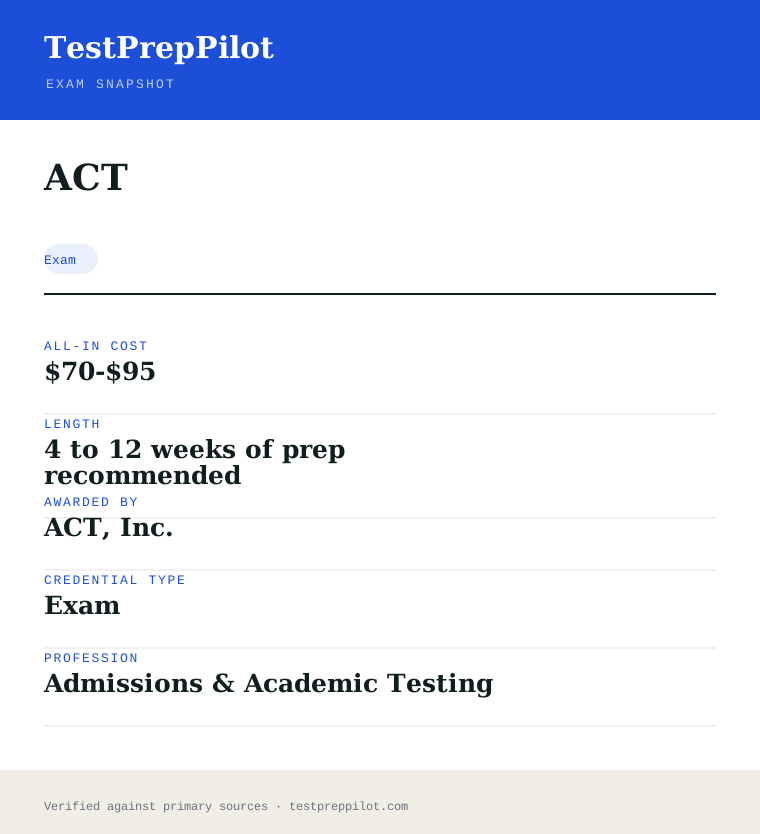
For the ACT, the exam fee is ~$68-$93; the all-in cost is typically $70-$95; most candidates spend 4 to 12 weeks of prep recommended preparing.
Cost breakdown
| ACT without Writing (national, 2025-26) | $70 |
|---|---|
| ACT with Writing (national, 2025-26) | $95 |
| Late registration | $42 |
| Test centre change | $49 |
| Additional score reports after free window | $20 each |
| Typical total | $70-$95 |
Enhanced ACT fees took effect with the September 2025 launch; international and accommodated-testing fees differ.
Timeline
- First sitting spring of grade 11
- Superscore retake autumn of grade 12
- Scores valid no expiry; colleges set recency rules
Typical prep: 4 to 12 weeks of prep recommended
The path
How do you register for the ACT?
- 1
Create a MyACT account10 minutes
Set up a free account at my.act.org using your legal name as printed on the photo ID you will present at the test centre.
- 2
Pick a national test date and format15 minutes
Choose one of the national Saturday dates and decide whether to test online or on paper at the centre. Both formats deliver the same enhanced ACT.
- 3
Decide on the science and writing add-ons10 minutes
The core English, math and reading test is 70 dollars. Science adds 5 dollars and writing adds 25 dollars; both can be added or removed up to the late deadline. Check whether your target colleges require a science score before deciding.
You cannot suppress a section score after the fact; if you sit science, colleges will see it.
- 4
Upload a photo and get your ticket10 minutes
MyACT requires a recognisable head-and-shoulders photo that is printed on your admission ticket. Registrations without a valid photo can be cancelled.
- 5
Prepare with free official practice6 to 12 weeks
ACT publishes free full-length practice tests, a scoring key and the TestNav online practice platform so you can rehearse the enhanced question counts and timings.
- 6
Test and collect scorestest day
Multiple-choice scores typically post to MyACT about two weeks after the test date, with writing following a little later.
The fine print
What are the retake and renewal rules for the ACT?
- Proctoring & delivery
- The ACT is delivered at authorised national test centres, on paper or online in TestNav, and on school days through state and district contracts. You must present a current official photo ID in hard plastic card format; paper and electronic IDs are refused. A permitted non-CAS calculator may be used on the whole math section.
- Retake policy
- There is no lifetime cap on ACT attempts; students simply register for another national date. Superscoring across sittings is supported by ACT and accepted by many, though not all, colleges. A change of test date, test form or test centre costs 49 dollars, and late registration adds 42 dollars.
- Score reporting
- Each section is scored 1 to 36. The enhanced Composite is the average of English, math and reading only. If you take science you receive a separate science score and a STEM score averaging math and science; the optional essay is scored 2 to 12 and never affects the Composite. Four score reports are included in the registration fee.
- Recertification
- ACT scores do not expire and require no renewal. Colleges set their own recency rules, and because the score scale and benchmarks were unchanged by the 2025 enhancements, legacy Composite scores remain directly comparable to new ones.
- Refunds & rescheduling
- Standby testing costs 75 dollars and is refunded if you are turned away at the centre. Score reports to fifth and sixth college choices cost 20 dollars each, additional reports 20 dollars, and score verification 67 dollars per test.
Context
Enhanced ACT section structure
| Section | Questions | Minutes | In Composite? | |
|---|---|---|---|---|
| English | 50 | 35 | Yes | |
| Mathematics | 45 | 50 | Yes | |
| Reading | 36 | 40 | Yes | |
| Science (optional) | 40 | 40 | No, reported separately | |
| Writing (optional) | 1 essay | 40 | No, scored 2 to 12 |
What it pays
How much does this credential pay?
The ACT gates college access: bachelor-degree median weekly earnings were $1,543 in 2024, versus $998 with a high-school diploma (BLS)
The ACT is an admissions test, not a job credential, so there is no BLS SOC code attached to a score. The economic case runs through college completion, and the BLS evidence is direct: in 2024, full-time workers age 25 and older with a bachelor degree earned median weekly wages of $1,543, versus $1,109 with an associate degree and $998 with a high-school diploma alone - an annualized bachelor-level median of roughly $80,000 against a diploma-level median of about $52,000. The ACT matters to this picture because it remains one of the two dominant admissions tests in the US, used by thousands of colleges for admission, course placement, and merit-aid formulas, and a strong score can materially reduce the net cost of college through scholarship programs. It is equally true that the landscape has shifted: many colleges are test-optional, and some state university systems have moved away from requiring standardized tests, so the ACT is a lever rather than a universal gate. The honest framing is the same as for any admissions test: prepare seriously when your target schools use the score for admission or aid, and understand that the wage payoff the data actually supports is degree completion, not the score itself. BLS classifies workers by occupation and education, not test scores, so no ACT composite maps to a salary; the connection runs through the college outcomes the score helps produce. Families comparing the ACT and SAT should also know the tests differ in structure - the ACT includes a Science section and an optional essay - but the economic logic is identical.
| Measure | Figure | Source / note |
|---|---|---|
| Bachelor-degree median weekly earnings, 2024 | $1,543 | BLS, workers 25+, full time |
| Associate-degree median weekly earnings, 2024 | $1,109 | BLS, workers 25+, full time |
| High-school diploma median weekly earnings, 2024 | $998 | BLS, workers 25+, full time |
| ACT composite score range | 1-36 | ACT, Inc. |
Job growth.BLS projects 3 percent overall employment growth from 2024 to 2034; the wage-by-education gradient is the relevant comparison.
Your odds
What are the pass rates?
The ACT has no pass/fail line; composites run 1-36 and targets are set by each college’s admitted-student profile
ACT, Inc. publishes no pass rate for the ACT because there is no passing score. The composite is the average of four section scores (English, Math, Reading, Science), each on a 1-36 scale, rounded to the nearest whole number, plus an optional Writing test (scored 2-12 separately, not included in the composite). What students compare against are national percentiles (ACT publishes them annually) and each college’s middle-50% range of admitted students. A composite around 20 is commonly cited as roughly the national average, while competitive four-year colleges often admit students in the 24-30 band, and highly selective programs routinely see 31-34. ACT also reports college-readiness benchmarks (English 18, Math 22, Reading 22, Science 23 under the standard benchmark set), which estimate the likelihood of success in entry-level college courses. The exam currently runs about 2 hours 55 minutes for the multiple-choice portion (English 45 minutes/75 items, Math 60 minutes/60 items, Reading 35 minutes/40 items, Science 35 minutes/40 items) plus an optional 40-minute essay; ACT has announced format changes rolling out from 2025, so candidates must verify the current structure on ACT.org before registering. There is no limit on retakes, and ACT’s superscoring allows students to combine the best section scores across sittings. The honest takeaway: set a target from your college list and ACT’s percentile tables, not from a pass line that does not exist, and confirm the current test format before you prepare.
Read this before quoting the number.No pass rate exists; targets come from college middle-50% ranges and national percentiles. Verify the current format on ACT.org, which is changing from 2025.
Source: ACT official test information
Your schedule
How long should I study for it?
60-100 hours over 8-12 weeks of focused study
A serious ACT plan runs 60-100 hours over 8-12 weeks. The current test is about 2 hours 55 minutes of multiple choice: English (75 items, 45 minutes - grammar, usage, punctuation, rhetoric), Math (60 items, 60 minutes - pre-algebra through trigonometry, all concepts through Algebra II), Reading (40 items, 35 minutes - four passages: prose fiction, social science, humanities, natural science), and Science (40 items, 35 minutes - data representation, research summaries, conflicting viewpoints), plus an optional 40-minute essay. Week 1: take an official full-length practice test (ACT offers a free online test) and record section scores and a skill-tagged error log. Weeks 2-4: drill English and Math, the two most trainable sections - English rewards learning the fixed grammar rules, and Math rewards practicing the timing on the last 10 items, which are the hardest. Weeks 5-7: Reading and Science - both are pace-driven; Reading rewards passage-type-specific strategies (the four passage types behave differently), and Science is a reading/analysis test in disguise, so practice extracting data from graphs and tables rather than reviewing science content. Weeks 8-10: full timed sections and a second full test; ACT timing is unforgiving, so practice the 35-60 minute section blocks exactly. Weeks 11-12: two full tests per week, error retakes, and logistics (calculator policy, breaks, essay if required). Students should confirm the 2025-format changes on ACT.org before investing hours, since ACT has announced structural updates.
- Week 16
Baseline
- Official full practice test
- Section scores and error log
- Weeks 2-430
English and Math
- Grammar rule drills
- Math timing on the final 10 items
- Weeks 5-724
Reading and Science
- Passage-type strategies
- Graph and table extraction
- Weeks 8-1024
Full timed sections
- Section blocks at exact timing
- Second full test
- Weeks 11-1216
Full tests and logistics
- Two full tests per week
- Error retakes; calculator and essay plans
Adjusting the pace
2025 format change.ACT has announced a shorter test with fewer items rolling out from 2025; verify the current structure on ACT.org before preparing.
Essay (optional).Some colleges require the Writing test; if any target school does, take it and practice the 40-minute essay.
How to study
How do I prepare most effectively?
The ACT rewards a small set of high-leverage habits. Strategy one: pace train from the start. The ACT gives far less time per question than the SAT - 36 seconds per English item and 52 seconds per Science item - so every practice session should be timed, and untimed practice should be reserved for diagnosing error types. Strategy two: mine the English section, which is the most trainable on the test; the 75 items test a finite set of grammar and punctuation rules plus rhetorical skills, and most students can gain 3-5 composite points from English alone. Strategy three: treat Science as a reading test; the content is not advanced science, and the highest scorers are those who read graphs, tables and experimental designs quickly and accurately. Strategy four: use official ACT materials first - the free official practice test, the official ACT prep guide, and the released-form tests - because third-party banks drift from ACT’s item style, and the timing must be practiced on realistic items. Strategy five: use ACT’s superscoring to your advantage by planning multiple sittings and targeting the weakest section each time; ACT reports the best composite across section bests for most score sends. Strategy six: for Math, master the calculator policy and the built-in formula-free expectation (no formula sheet), and practice the hardest final items under time pressure. Finally, confirm the current format on ACT.org, because ACT has announced structural changes from 2025.
Train pacing from day one
36-52 seconds per item demands timed practice every session.
Mine the English section
Fixed grammar rules make it the most trainable section.
Treat Science as a reading test
Graph and table extraction, not science content review.
Use official materials
Released forms match ACT style and timing.
Exploit superscoring
Multiple sittings, target the weakest section each time.
What to buy
Which study resources are worth paying for?
The ACT prep market has a strong official core and a large paid periphery. Free and official first: the ACT official full-length practice test on the ACT website, the official ACT Prep Guide (about $35-45, includes retired tests and answer explanations), and the released-form tests ACT publishes. The major test-prep companies sell books ($15-$40) and courses ($200-$2,000) whose main value is structure and pacing practice; because ACT’s timing is its defining challenge, coached practice can help students who struggle with the 35-60 minute blocks. Many school districts offer free in-school ACT prep and fee waivers for low-income students, which cover the test fee and free practice materials; students should ask their counselor. Tutoring ($50-$200/hour) is most defensible for students with a specific weak section or a high target gap. The honest ranking: official free test and Prep Guide first, a commercial book for structure, a course or tutor only when pacing or accountability justifies the cost. Prices here are current as of the 2025-26 testing year and change annually.
| Resource | Price | Format | Best for |
|---|---|---|---|
| Official full practice test | Free | Online | Baseline and format familiarity |
| Official ACT Prep Guide | $35-$45 | Print/ebook | Retired tests with explanations |
| Commercial prep book | $15-$40 | Structure and drills | |
| Course or tutor | $200-$2,000 | Live/on-demand/1:1 | Pacing work and accountability |
Prices dated 2025-26; ACT is the only official source of retired tests. No commission-based ranking.
Avoid these
What mistakes do candidates most often make?
The most common ACT mistakes are timing-driven. Mistake one: practicing untimed. The ACT’s 36-second English average and 35-minute Reading section punish untrained pacing, and students who drill content without clocks routinely run out of time on test day. Mistake two: studying Science as content; the section tests data interpretation and experimental reasoning, and reviewing biology and chemistry facts wastes hours that graph-reading practice would repay. Mistake three: reading Reading passages slowly and carefully; the section rewards strategic skimming - the questions point to specific lines, and efficient students read for structure first. Mistake four: skipping the hardest Math items entirely out of panic; the ACT Math scale rewards attempting all items, and educated guessing on the final items is better than leaving them blank (there is no guessing penalty). Mistake five: ignoring the English section’s weight; at 75 items it is the largest section, and grammar rule mastery is the single fastest composite gain. Mistake six: preparing without confirming the current format; ACT has announced structural changes from 2025, and students using outdated materials practice the wrong test. Finally, students who take the optional essay without any target college requiring it waste 40 minutes of stamina; check requirements first.
✕Practicing untimed
✓Time every session; pacing is the ACT’s core challenge.
✕Reviewing science content
✓Practice graph and data extraction instead.
✕Reading passages slowly
✓Skim for structure; use the questions as a map.
✕Panicking on hard Math items
✓Attempt all items; there is no guessing penalty.
✕Preparing with outdated format
✓Confirm the 2025-format changes on ACT.org.
What you'll face
What question types will I see?
The ACT has four multiple-choice sections plus an optional essay. English: 75 items in 45 minutes, testing usage and mechanics (grammar, punctuation, sentence structure) and rhetorical skills (organization, style, word choice). Math: 60 items in 60 minutes, covering pre-algebra, elementary algebra, intermediate algebra, coordinate geometry, plane geometry, and trigonometry through Algebra II. Reading: 40 items in 35 minutes across four passage types (prose fiction, social science, humanities, natural science), testing main idea, detail, inference, and author technique. Science: 40 items in 35 minutes across data representation, research summaries, and conflicting viewpoints, testing interpretation and reasoning rather than content recall. The optional Writing test is one essay in 40 minutes scored 2-12. Each section scores 1-36; the composite is the rounded average. Samples below are editor-written illustrations of the published test specifications, not live exam items.
Usage/mechanics and rhetorical skills.
Pre-algebra through trigonometry.
Four passage types; no calculator.
Data interpretation and reasoning.
Try these
Q1English section item: "The committee has decided to postpone the vote until next week, [and] the members will use the time to review the new evidence." The bracketed word is being evaluated for correctness.
Answer:A
Two complete sentences joined with a comma and coordinating conjunction is correct; the other choices misplace punctuation.
Q2Math item: If 2x + 5 = 17, what is the value of x?
Answer:B
Subtract 5 from both sides: 2x = 12; divide by 2: x = 6.
Q3Reading item (natural science passage about glacier movement): The passage implies that the glacier’s "surge" is best understood as which of the following?
Answer:B
The passage describes surges as dramatic but temporary accelerations of ice movement, distinct from the glacier’s normal advance.
Samples are editor-written illustrations of the published test specifications, not live exam items.
The big day
What should I expect on exam day?
The ACT is administered on national test dates, typically seven per year (September, October, December, February, April, June, July), at high schools and test centers; registration closes about five weeks before each date, with late registration for a fee. On test day, students check in with an admission ticket and a valid photo ID, and calculators are permitted for the Math section under ACT’s approved-calculator policy (no CAS or phone calculators). The multiple-choice portion runs about 2 hours 55 minutes plus the optional 40-minute essay, with a short break after the Math section; total time with instructions and breaks is roughly 4 hours (or about 4 hours 40 minutes with the essay). Phones and smartwatches are not permitted. Students with documented disabilities must have ACT accommodations approved in advance through the ACT accommodations process, which the school coordinates. Scores post online about two to eight weeks after the test date (most candidates see scores within two to three weeks), and ACT’s superscoring means colleges typically receive the best section scores across sittings. Afterwards, send scores to target colleges before deadlines, verify each college’s essay requirement and superscore policy, and plan any retake around the weakest section.
Bring
- Admission ticket
- Valid photo ID
- Approved calculator for the Math section
- Sharpened No. 2 pencils (ACT is paper-based)
Leave at home
- Phone, smartwatch, and personal electronics
- Notes, books, or formula sheets
- Any device not on the ACT approved-calculator list
How the day runs
Rules in the room
- The ACT is paper-based; fill in bubbles with No. 2 pencils.
- Approved calculators only; no CAS or phone calculators.
- Personal electronics are not permitted in the testing room.
- Accommodations must be pre-approved through ACT.
Afterwards.Scores post online in 2-8 weeks; send scores before deadlines, verify superscore and essay policies, and target the weakest section for any retake.
Reference
What are the key facts about the ACT?
ACT is a exam credential; awarded by ACT, Inc.; the exam fee is ~$68-$93; typical preparation is 4 to 12 weeks of prep recommended; holders typically earn College-path benchmark: bachelor-degree median ~$80,000/yr (BLS 2024).
| Credential | ACT |
|---|---|
| Abbreviation | ACT |
| Type | Exam |
| Profession | Admissions & Academic Testing |
| Specialty | College Admissions |
| Awarded by | ACT, Inc. |
| Difficulty | Moderate to high |
| Typical prep time | 4 to 12 weeks of prep recommended |
| All-in cost | $70-$95 |
| Typical salary range | College-path benchmark: bachelor-degree median ~$80,000/yr (BLS 2024) |
| Core sections | English, Math and Reading form the 1 to 36 Composite |
| Science | Optional; reported separately when taken |
| Writing | Optional essay scored 2 to 12, never in the Composite |
| Score release | About two weeks after the test date |
| Score choice | Free to pick which sittings to send |
| Scope | National / Multi-state |
| Also known as | American College Test, Enhanced ACT |
Real questions
Frequently asked questions about the ACT
What changed with the Enhanced ACT in 2025?
The test got shorter, Science became optional, and the Composite is now built from English, Math and Reading, with Science reported separately when taken. The 1 to 36 scale and the optional Writing essay stayed.
Does the Composite include Science now?
Only if you take Science. The core Composite is the average of English, Math and Reading; students who add Science get a Composite that includes it. Either way the section scores are itemized on the report.
Which is easier, the ACT or the SAT?
There is no passing score - targets come from college middle-50% ranges, and ACT superscoring combines your best section scores across sittings.
How many times should I take the ACT?
Most students take it twice, in the spring of junior year and again in the autumn of senior year. ACT superscores, so retaking to raise one section is common and low risk.
Is the ACT accepted everywhere?
Yes. Every four-year college in the US accepts the ACT, and test-optional schools accept it on equal footing with the SAT when submitted.
Should I still take the ACT science section?
Take it if you are applying to STEM or health-science programmes, if a college requires or recommends it, or if science is a personal strength. It costs only 5 dollars extra and produces a separate science and STEM score that cannot drag your Composite down.
Are old ACT scores still comparable?
Yes. ACT kept the 1 to 36 scale and the College and Career Readiness Benchmarks unchanged through the enhancement, and its research found removing science from the Composite made very little difference to average scores.
Paper or online, which should I choose?
Both deliver identical content and scoring. Online scores are usually released a little sooner; paper suits students who prefer to annotate passages by hand.
In short
Is the ACT worth it?
- Enhanced ACT from September 2025: shorter, Science optional, 1 to 36 scale unchanged
- Core Composite from English, Math and Reading; Science adds on when taken
- Optional Writing essay scored 2 to 12, reported separately
- $70 without Writing, $95 with Writing for 2025-26 national dates
Worth comparing
How does the ACT compare with similar credentials?
Trust
Where does this information come from?
Everything above is taken from the awarding body's own published material. Fees, question counts and domain weights are revised regularly — check the official page before you pay.
- ACT, Inc. Awarding body
- Official ACT exam page Exam page
- ACT, Inc. certification programme Programme rules
Research confidence: high · Last reviewed 2026-08