Admissions & Academic Testing • Certification
ACT WorkKeys Assessments
The workplace-skills tests that earn the National Career Readiness Certificate.
Researched and maintained by TestPrepPilot Editorial BoardWorkforce readiness & career-certification desk · Figures last verified August 2026
The short version
What is the ACT WorkKeys Assessments and is it worth it?
ACT WorkKeys measures Applied Math, Graphic Literacy and Workplace Documents; scoring Level 3 or higher on all three earns the NCRC. It is open to anyone through test centers or online, often free when a state or employer sponsors it.
- Earns the portable NCRC credential
- Four levels: Bronze, Silver, Gold, Platinum
- Accepted by employers and some colleges for credit
- Often free through state or employer sponsorship
What is it?
What exactly is the ACT WorkKeys Assessments?
The workplace-skills tests that earn the National Career Readiness Certificate.
ACT WorkKeys is a family of workplace-skills assessments in Applied Math, Graphic Literacy and Workplace Documents. Scoring Level 3 or higher on all three earns the ACT WorkKeys National Career Readiness Certificate (NCRC) at the Bronze, Silver, Gold or Platinum level. Employers and states use the NCRC to signal foundational job skills, and some colleges grant credit for Silver and above.
The path in brief
- Find a WorkKeys center or online seat
- Take the three skill assessments
- Reach Level 3+ on all three
- Receive your NCRC level
- Share it with employers or colleges
Before you book
Who is eligible to sit the ACT WorkKeys Assessments?
None - open to job seekers and students
Who it is for: Job seekers and career-technical students.
The test itself
What is the format of the ACT WorkKeys Assessments?
The ACT WorkKeys Assessments is administered by Authorized test centers and online proctoring and runs 50-55 min per assessment, contains 34-35 per assessment questions and requires Level 3 earns Bronze NCRC; 4 Silver, 5 Gold, 6 Platinum to pass.
| Administered by | Authorized test centers and online proctoring |
|---|---|
| Questions | 34-35 per assessment |
| Time limit | 50-55 min per assessment |
| Pass mark | Level 3 earns Bronze NCRC; 4 Silver, 5 Gold, 6 Platinum |
| Exam fee | ~$10-$20 per assessment |
| Format | Multiple choice, online or paper |
Content outline
What topics are on the ACT WorkKeys Assessments?
The ACT WorkKeys Assessments covers 3 content domains.
Weightings come from the official exam outline. Study time is best allocated in roughly these proportions rather than evenly across domains.
- Applied Math
Real-world math problem solving
- Graphic Literacy
Reading and using workplace graphics
- Workplace Documents
Reading and using written information
Study materials
Which study guide should you use for the ACT WorkKeys Assessments?
Start with the exam sponsor's official content outline. If you also want one structured resource to work through, these are the Mometrix titles that match this exam.

Affiliate links We may earn a commission if you buy through these links, at no extra cost to you. Mometrix has no say in what our exam guides cover. How we make money.
Money & time
How much does the ACT WorkKeys Assessments cost?
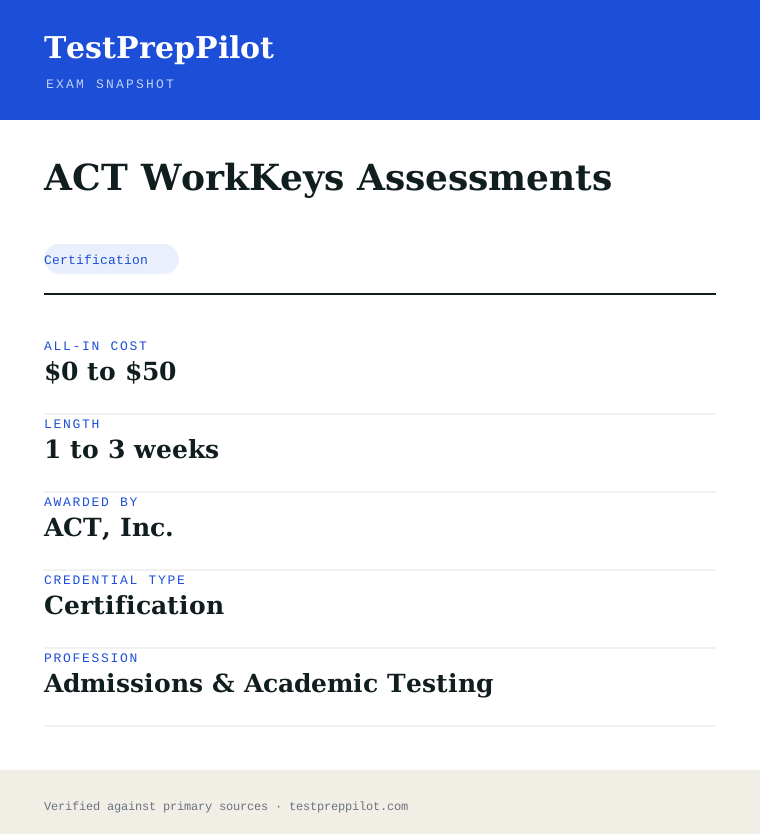
For the ACT WorkKeys Assessments, the exam fee is ~$10-$20 per assessment; the all-in cost is typically $0 to $50; most candidates spend 1 to 3 weeks preparing.
Cost breakdown
| Assessment fee | $0 to $50 |
|---|---|
| Typical total | $0 to $50 |
Many states and employers cover the full cost, so check whether your sponsor offers it free before paying.
Timeline
- Register varies
- Prepare 1 to 3 weeks
- Test about 3 hours total
- NCRC after scoring
Typical prep: 1 to 3 weeks
The path
How do you register for the ACT WorkKeys Assessments?
- 1
Create a MyACT account10 minutes
Set up a free account at my.act.org using your legal name as printed on the photo ID you will present at the test centre.
- 2
Pick a national test date and format15 minutes
Choose one of the national Saturday dates and decide whether to test online or on paper at the centre. Both formats deliver the same enhanced ACT.
- 3
Decide on the science and writing add-ons10 minutes
The core English, math and reading test is 70 dollars. Science adds 5 dollars and writing adds 25 dollars; both can be added or removed up to the late deadline. Check whether your target colleges require a science score before deciding.
You cannot suppress a section score after the fact; if you sit science, colleges will see it.
- 4
Upload a photo and get your ticket10 minutes
MyACT requires a recognisable head-and-shoulders photo that is printed on your admission ticket. Registrations without a valid photo can be cancelled.
- 5
Prepare with free official practice6 to 12 weeks
ACT publishes free full-length practice tests, a scoring key and the TestNav online practice platform so you can rehearse the enhanced question counts and timings.
- 6
Test and collect scorestest day
Multiple-choice scores typically post to MyACT about two weeks after the test date, with writing following a little later.
The fine print
What are the retake and renewal rules for the ACT WorkKeys Assessments?
- Proctoring & delivery
- The ACT is delivered at authorised national test centres, on paper or online in TestNav, and on school days through state and district contracts. You must present a current official photo ID in hard plastic card format; paper and electronic IDs are refused. A permitted non-CAS calculator may be used on the whole math section.
- Retake policy
- There is no lifetime cap on ACT attempts; students simply register for another national date. Superscoring across sittings is supported by ACT and accepted by many, though not all, colleges. A change of test date, test form or test centre costs 49 dollars, and late registration adds 42 dollars.
- Score reporting
- Each section is scored 1 to 36. The enhanced Composite is the average of English, math and reading only. If you take science you receive a separate science score and a STEM score averaging math and science; the optional essay is scored 2 to 12 and never affects the Composite. Four score reports are included in the registration fee.
- Recertification
- ACT scores do not expire and require no renewal. Colleges set their own recency rules, and because the score scale and benchmarks were unchanged by the 2025 enhancements, legacy Composite scores remain directly comparable to new ones.
- Refunds & rescheduling
- Standby testing costs 75 dollars and is refunded if you are turned away at the centre. Score reports to fifth and sixth college choices cost 20 dollars each, additional reports 20 dollars, and score verification 67 dollars per test.
Context
Enhanced ACT section structure
| Section | Questions | Minutes | In Composite? | |
|---|---|---|---|---|
| English | 50 | 35 | Yes | |
| Mathematics | 45 | 50 | Yes | |
| Reading | 36 | 40 | Yes | |
| Science (optional) | 40 | 40 | No, reported separately | |
| Writing (optional) | 1 essay | 40 | No, scored 2 to 12 |
What it pays
How much does this credential pay?
NCRC is a skills signal, not a job license: median weekly earnings for full-time workers with a high-school diploma were $998 in 2024 (BLS)
The ACT WorkKeys system produces the National Career Readiness Certificate (NCRC), a portable credential that certifies foundational workplace skills rather than a specific occupation. Because the NCRC is not tied to a single job, there is no BLS SOC code that maps directly to it, and no salary figure can be attributed to the certificate alone. What the research evidence does show is that employers treat the NCRC as a screening signal: many large employers, staffing agencies and state workforce systems require or prefer it for entry-level roles, and states including Indiana, South Carolina and Kansas have integrated WorkKeys into their economic-development and school-accountability programs. The honest salary framing has two parts. First, BLS data show that full-time workers age 25 and older with a high-school diploma earned median weekly wages of $998 in 2024, which is the baseline population that most NCRC holders come from; the certificate is most valuable at the hiring margin, where it can distinguish a candidate for a job that pays closer to the occupation median than to the 10th percentile. Second, for specific occupations, the wage that a qualified candidate can expect is the occupation’s own BLS median: for example, customer service representatives (43-4051) had a May 2024 median of about $41,000, and general office clerks and material movers sit near the overall office-and-administrative-support median of $46,320. The NCRC does not change those numbers; it changes the probability of being hired for them, and some programs tie it to tuition-free training pathways that lead to higher-paying licensed trades.
| Measure | Figure | Source / note |
|---|---|---|
| High-school diploma median weekly earnings, 2024 | $998 | BLS, workers 25+, full time |
| Office and administrative support occupations median, May 2024 | $46,320 | BLS OEWS occupational group |
| Customer service representatives median, May 2024 | ~$41,000 | BLS OEWS, SOC 43-4051 |
| All-occupation median, May 2024 | $49,500 | BLS OEWS |
Job growth.Employment in office and administrative support is projected to decline slightly by 2034, so credentials that sharpen hireability at the entry level have added weight.
Your odds
What are the pass rates?
WorkKeys is scored on a 1-7 scale per assessment; the NCRC tiers (Bronze/Silver/Gold/Platinum) are the recognized outcomes
ACT does not publish a single national pass rate for WorkKeys because there is no single passing score. Each of the three core assessments - Applied Math, Graphic Literacy, and Workplace Documents - is scored on a scale of 1 to 7, and the NCRC is awarded in four tiers based on the lowest of the three scores. A Bronze certificate requires at least a score of 3 on all three assessments; Silver requires 4; Gold requires 5; and Platinum requires 6. For context, ACT publishes score descriptors: a 3 indicates ability to apply a limited number of basic skills, a 4 indicates the ability to apply broader problem-solving skills to more complex situations, a 5 indicates the ability to apply additional reasoning to work-related problems, and 6-7 indicate progressively advanced application. Because the certificate is defined by minimum scores rather than a percentage of a cohort, pass-rate-style statistics are not meaningful in the way they are for licensure exams. What ACT does publish is usage data: the assessments are administered in all 50 states and to several million examinees per year through schools, workforce boards and employer testing centers. Test takers receive a score report with per-assessment scores, an NCRC tier when earned, and a personal skills profile; retaking a single assessment to raise one low score is common and is the fastest way to upgrade a tier from Silver to Gold. The practical takeaway is to target a tier that matches the hiring requirements of the employers in your region, because regional demand for Bronze versus Silver varies.
Read this before quoting the number.ACT does not publish a cohort pass rate; outcomes are tier-based (Bronze through Platinum).
Source: ACT WorkKeys official NCRC tiers
Your schedule
How long should I study for it?
15-25 hours over 4-6 weeks of focused study
WorkKeys preparation is unusually tractable because the three assessments test applied skills rather than memorized content, and ACT publishes official practice materials with realistic item styles. A focused plan runs 15-25 hours over 4-6 weeks for an adult learner, and less for a student who has recently taken algebra and done workplace reading. Applied Math is the most studied assessment: it covers basic arithmetic, fractions, decimals, percentages, ratios, unit conversion, area and perimeter, and interpreting data in tables and charts, all in workplace scenarios such as inventory counts, invoicing, and measurement on a job site. Graphic Literacy tests reading of workplace graphics: charts, graphs, forms, diagrams, floor plans and instrument displays, at levels from finding a single value to synthesizing multiple data series. Workplace Documents tests reading of memos, emails, policies, manuals and notices, with items that move from locating information to drawing conclusions and applying instructions to new situations. The plan: week 1 take the official practice tests for all three assessments to establish a baseline score in the 1-7 scale for each; weeks 2-4 drill the lowest assessment first using ACT’s official sample questions and the free WorkKeys curriculum, with 30-minute daily sessions; week 5 retest; week 6 focus on the single lowest score because one assessment caps the tier. Test takers should be aware that the assessments are timed (55 minutes for Applied Math, 55 minutes for Graphic Literacy, 50-55 minutes for Workplace Documents depending on the form) and computer-delivered at ACT-authorized centers.
- Week 14
Baseline all three assessments
- Take official practice tests for Applied Math, Graphic Literacy, Workplace Documents
- Record 1-7 scores for each
- Weeks 2-49
Drill the weakest assessment
- Official sample questions daily
- Focus on workplace-scenario problem types
- Week 54
Retest and verify tier
- Retake the practice battery
- Confirm which single score caps your NCRC tier
- Week 68
Target the capping score
- Intensive work on the lowest assessment only
- Take the real assessments at an authorized center
Adjusting the pace
School-administered.Many high schools administer WorkKeys as part of career-readiness programs; pacing follows the school calendar.
Adult/job-seeker path.Workforce boards often offer free or subsidized testing and prep classes tied to state programs.
How to study
How do I prepare most effectively?
The most effective WorkKeys strategy is to identify which single assessment caps your NCRC tier and put most of your effort there, because the certificate is awarded at the lowest of the three scores. Strategy one: take all three official practice assessments before studying anything, and accept the uncomfortable baseline; effort is wasted when it goes to an assessment you already pass at the target tier. Strategy two: practice with official ACT materials only for question style, because the workplace-scenario phrasing is distinctive and third-party banks drift from it. Strategy three: in Applied Math, always convert the scenario into a labeled arithmetic setup before calculating, because most errors come from misreading what the question asks (total versus per unit, net versus gross). Strategy four: in Graphic Literacy, read the axes and units before the question; items deliberately test whether you can extract the right value from a chart with multiple series or a floor plan with mixed units. Strategy five: in Workplace Documents, answer from the document text rather than workplace intuition, and practice "apply the instruction to a new case" items, which are the highest-difficulty type. Strategy six: manage the timing by checking the question count before starting each section and setting checkpoints; the assessments are paced for comfortable completion, so a systematic read-then-answer rhythm prevents careless late-section errors.
Find the capping score first
The tier is the lowest of three scores; target the weakest assessment.
Use official materials
ACT item phrasing is distinctive; third-party banks misrepresent it.
Label setups in Applied Math
Write the units and quantities before calculating.
Read axes before questions
Graphic Literacy rewards careful data reading over speed.
Answer from the document
Workplace Documents tests text evidence, not intuition.
What to buy
Which study resources are worth paying for?
The WorkKeys resource market is dominated by ACT itself, which is good news for cost control. The official ACT WorkKeys practice tests are available for a small fee on the ACT website and are the single most accurate preparation resource; the free WorkKeys curriculum materials and sample questions published by ACT and by state workforce partners cover the skill content thoroughly. Many public workforce development boards and community colleges offer free WorkKeys prep classes, free testing vouchers, and one-on-one coaching through state programs such as Indiana’s WorkOne or South Carolina’s readySC; job seekers should check with the local American Job Center before paying for anything. Commercial prep books and courses exist from the major test-prep publishers and cost roughly $20-$300, but their value is practice volume rather than unique content, since the skill domains are publicly documented. Some employers administer WorkKeys on-site as part of hiring, in which case the assessment is free to the candidate; in that situation, prepare with the official practice tests and skip paid courses entirely. The honest ranking: free state-provided prep first, official ACT practice tests second, commercial courses only for accountability. Prices here are current as of 2025-26 and change annually.
| Resource | Price | Format | Best for |
|---|---|---|---|
| ACT official practice tests | ~$10-$20 per assessment | Online timed tests | The most accurate format and scoring |
| State workforce prep programs | Free (many states) | In-person/online classes | Subsidized testing and coaching |
| ACT sample questions and curriculum | Free | PDF/web materials | Skill review before paid practice |
| Commercial prep book/course | $20-$300 | Print/online | Practice volume and structure |
Prices dated 2025-26; ACT is the only official source of items. No commission-based ranking.
Avoid these
What mistakes do candidates most often make?
The most common WorkKeys mistake is spreading preparation evenly across all three assessments when a single low score caps the certificate. Test takers who enter at Gold on Applied Math and Workplace Documents but Bronze on Graphic Literacy spend weeks polishing the two strong areas and never move the tier; the correct move is to ignore the strong areas and grind the capping assessment. Mistake two: doing third-party practice exclusively. The workplace-scenario phrasing in official items is distinctive, and candidates who train on generic math or reading questions are surprised by the applied format. Mistake three: in Applied Math, reading the question once and calculating immediately; a large share of errors come from missing the unit conversion (feet to inches, dozens to units) or answering the wrong quantity. Mistake four: in Graphic Literacy, jumping to the chart before reading its title, axes and legend, then selecting a plausible but wrong series. Mistake five: treating the assessments as speed tests and rushing; the pacing is generous, and careless errors on a 1-7 scale can drop a score a full point, which can cost a tier. Mistake six: assuming the NCRC is accepted everywhere; hiring managers and programs vary, so candidates should confirm the tier their target employers actually require before aiming at Platinum over Gold.
✕Studying all three assessments equally
✓Find the capping score and put 70% of effort there.
✕Training only on third-party questions
✓Use official ACT items for question style.
✕Calculating before labeling units
✓Write units and target quantity before doing math.
✕Reading charts without axes and legend
✓Read title, axes, units, legend before answering.
✕Rushing like a speed test
✓Pace for accuracy; one point can change the tier.
What you'll face
What question types will I see?
Each WorkKeys assessment is multiple choice with four answer options, delivered on a computer. Applied Math contains 34 questions to answer in 55 minutes; items present workplace scenarios (ordering supplies, calculating pay, measuring materials) that require arithmetic, ratios, percentages, unit conversion, and interpreting data in tables. Graphic Literacy contains 35 questions in 55 minutes; items reference charts, graphs, forms, diagrams, floor plans and instrument displays, with difficulty rising from locating a single value to synthesizing information across multiple displays. Workplace Documents contains 35 questions in 50-55 minutes; items present memos, emails, policies, manuals, bulletins and notices, and ask test takers to locate information, identify meaning, and apply instructions to new situations. Scores run 1-7 per assessment. Samples below are editor-written illustrations of the published skill levels, not live exam items.
Workplace arithmetic, ratios, percentages, unit conversion.
Reading charts, graphs, forms, diagrams, displays.
Reading memos, policies, manuals; applying instructions.
Try these
Q1A warehouse ships cases of bottled water in cartons that hold 24 bottles each. An order requires 720 bottles. How many cartons are needed?
Answer:C
Divide the total bottles by bottles per carton: 720 / 24 = 30 cartons.
Q2The bar chart shows monthly sales for two store locations from January through March. The chart title reads "First-Quarter Sales by Location." Which statement is best supported by the chart?
Answer:C
This item type tests reading the aggregate across series. The correct reading of the displayed data is that the two series together peak in March; distractors misstate per-month comparisons.
Q3Company policy states: "All expense reports must be submitted within 10 business days of the travel end date. Reports submitted later require a written supervisor approval." An employee traveled May 1-3. By which date must the report normally be submitted?
Answer:B
Travel ended May 3; counting 10 business days forward from May 3 (skipping weekends) lands on May 17. The item tests applying a stated instruction to a new case.
Samples are editor-written illustrations of the published skill levels, not live exam items.
The big day
What should I expect on exam day?
WorkKeys assessments are administered at ACT-authorized test centers, which include community colleges, workforce development offices, high schools and employer sites; testing is computer-based and most centers allow scheduling by appointment. On the day, bring a valid government-issued photo ID and any authorization or voucher number provided by the sponsoring program; arrive 15 minutes early. Calculators are allowed for Applied Math (a four-function or scientific calculator is typical; check the center policy), but phone calculators are never allowed, and phones and smartwatches must be stowed. The three assessments may be taken in any order and can be scheduled on separate days, which is a practical advantage: many candidates take them in separate visits to concentrate preparation. Each assessment runs 50-55 minutes with a maximum of 35 questions, so the total testing time for all three is about three hours when taken together, plus breaks. Scores are reported electronically; official score reports are usually available within a few days to two weeks, and the NCRC tier is issued once scores are recorded by ACT. If a candidate wants to raise a tier, ACT allows retaking individual assessments - and only the capping assessment needs to be retaken. Afterwards, the candidate should obtain the official score report and NCRC certificate (electronic and printed), and note that many employers verify the NCRC electronically through the ACT WorkKeys National Registry, so the candidate should not need to provide paper proof in most hiring processes.
Bring
- Valid government-issued photo ID
- Authorization or voucher number
- Approved calculator for Applied Math
- Any required masking or site-specific documents
Leave at home
- Phone, smartwatch, and personal electronics
- Study notes or formula sheets
- Unofficial score printouts from practice tests
How the day runs
Rules in the room
- Photo ID required; testing is by appointment at authorized centers.
- Phone calculators and personal electronics are not allowed.
- Assessments may be taken on separate days; retakes are per-assessment.
- The NCRC tier is set by your lowest score.
Afterwards.Scores post in days to two weeks; ACT issues the NCRC tier electronically, and employers can verify it through the WorkKeys National Registry. Retake only the capping assessment to upgrade the tier.
Reference
What are the key facts about the ACT WorkKeys Assessments?
ACT WorkKeys Assessments is a certification credential; awarded by ACT, Inc.; the exam fee is ~$10-$20 per assessment; typical preparation is 1 to 3 weeks; holders typically earn $30,000-$60,000 (entry office and support roles).
| Credential | ACT WorkKeys Assessments |
|---|---|
| Abbreviation | WorkKeys |
| Type | Certification |
| Profession | Admissions & Academic Testing |
| Specialty | Standardized State & National Assessments |
| Awarded by | ACT, Inc. |
| Difficulty | Moderate |
| Typical prep time | 1 to 3 weeks |
| All-in cost | $0 to $50 |
| Typical salary range | $30,000-$60,000 (entry office and support roles) |
| NCRC levels | Bronze 3, Silver 4, Gold 5, Platinum 6 |
| Validity | NCRC valid 2 years |
| Credit | ACE recommends college credit at Silver and above |
| Cost | $0 to about $50; sponsors often cover it |
| Scope | National / Multi-state |
| Also known as | National Career Readiness Certificate, NCRC |
Real questions
Frequently asked questions about the ACT WorkKeys Assessments
What NCRC level do I need?
A Silver NCRC (Level 4 on all three assessments) aligns with the foundational skills for about two-thirds of jobs; Gold and Platinum open more doors, and some colleges grant credit at Silver and above.
How long is the NCRC valid?
Two years. Retake the assessments to renew or raise your level.
Is WorkKeys free?
The NCRC tier is set by your lowest of the three assessment scores - Bronze 3, Silver 4, Gold 5, Platinum 6 - so retake only the capping assessment to upgrade.
What is the NCRC?
WorkKeys yields the National Career Readiness Certificate at Bronze, Silver, Gold or Platinum, based on scale scores of 3 to 6.
Should I still take the ACT science section?
Take it if you are applying to STEM or health-science programmes, if a college requires or recommends it, or if science is a personal strength. It costs only 5 dollars extra and produces a separate science and STEM score that cannot drag your Composite down.
Are old ACT scores still comparable?
Yes. ACT kept the 1 to 36 scale and the College and Career Readiness Benchmarks unchanged through the enhancement, and its research found removing science from the Composite made very little difference to average scores.
Paper or online, which should I choose?
Both deliver identical content and scoring. Online scores are usually released a little sooner; paper suits students who prefer to annotate passages by hand.
In short
Is the ACT WorkKeys Assessments worth it?
- WorkKeys yields the portable NCRC workplace credential
- Levels run Bronze (3) to Platinum (6) on three assessments
- NCRC is valid two years and may earn college credit
- Often free through a state or employer sponsor
Same awarding body
What other credentials does ACT, Inc. award?
Trust
Where does this information come from?
Everything above is taken from the awarding body's own published material. Fees, question counts and domain weights are revised regularly — check the official page before you pay.
- ACT, Inc. Awarding body
- ACT, Inc. certification programme Programme rules
Research confidence: high · Last reviewed 2026-08