Admissions & Academic Testing • Exam
CLEP Introductory Psychology
Test out of introductory psychology with three broad credits.
Researched and maintained by TestPrepPilot Editorial BoardCollege admissions & credit-by-exam desk · Figures last verified August 2026
The short version
What is the CLEP Introductory Psychology and is it worth it?
CLEP Introductory Psychology is a ~95-question, 90-minute exam matching a one-semester intro course. ACE recommends a score of 50 for three semester hours at accepting schools.
- Replaces a semester of introductory psychology for ~$97 plus a fee
- Broad coverage across the whole field
- Year-round at test centers and online with remote proctoring
- One of the most accepted CLEP exams
What is it?
What exactly is the CLEP Introductory Psychology?
Test out of introductory psychology with three broad credits.
The CLEP Introductory Psychology exam covers the facts, concepts, and accepted principles of a one-semester introductory psychology course, from biological bases and learning to disorders and social psychology. It uses DSM-5 terminology and asks you to apply knowledge to new situations. It is one of the most popular CLEP exams for general-education credit.
The path in brief
- Confirm your school’s psychology policy
- Register and pay the $97 fee
- Book a test center or remote-proctoring slot
- Review major subfields and disorders
- Score 50+ for three credits
Before you book
Who is eligible to sit the CLEP Introductory Psychology?
The test itself
What is the format of the CLEP Introductory Psychology?
The CLEP Introductory Psychology is administered by CLEP test center or CLEP with Remote Proctoring and runs 90 minutes and requires 50 (ACE credit-granting score) to pass.
| Administered by | CLEP test center or CLEP with Remote Proctoring |
|---|---|
| Questions | ~95 multiple choice |
| Time limit | 90 minutes |
| Pass mark | 50 (ACE credit-granting score) |
| Exam fee | $97 (2025–26) + test-center fee |
| Format | Multiple choice |
Content outline
What topics are on the CLEP Introductory Psychology?
The CLEP Introductory Psychology is weighted across 5 domains; the largest are History, Approaches, and Methods (11%–12%), Biological Bases and Sensation/Perception (8%–9% / 7%–8%), Learning, Cognition, Motivation/Emotion (8%–9% each).
Weightings come from the official exam outline. Study time is best allocated in roughly these proportions rather than evenly across domains.
- History, Approaches, and Methods 11%–12%
Perspectives, research
- Biological Bases and Sensation/Perception 8%–9% / 7%–8%
Brain, senses
- Learning, Cognition, Motivation/Emotion 8%–9% each
Key processes
- Developmental, Personality, Disorders 8%–9% / 7%–8% / 8%–9%
Lifespan and abnormality
- Treatment and Social Psychology 6%–7% / 9%–10%
Therapies, groups
Study materials
Which study guide should you use for the CLEP Introductory Psychology?
Start with the exam sponsor's official content outline. If you also want one structured resource to work through, these are the Mometrix titles that match this exam.

This links to Mometrix's CLEP range rather than a single CLEP Introductory Psychology title. Check that it lists an edition for CLEP Introductory Psychology before you buy.
Affiliate links We may earn a commission if you buy through these links, at no extra cost to you. Mometrix has no say in what our exam guides cover. How we make money.
The path
How do you register for the CLEP Introductory Psychology?
- 1
Create a College Board account10 minutes
Register at collegeboard.org with your legal name exactly as it appears on the photo ID you will bring on test day. One account covers the SAT, the PSAT-related assessments, AP and BigFuture.
- 2
Choose a weekend SAT date or let your school register you20 minutes
The SAT is booked directly by the student for weekend national administrations. PSAT 8/9, PSAT 10 and the PSAT/NMSQT are ordered and scheduled by the school, so for those you speak to your counselor rather than registering yourself.
- 3
Pay the fee or claim a fee waiver5 minutes
The US SAT registration fee is 68 dollars; international test takers add a regional fee of 43 dollars and, at some centres, a further test centre fee. Eligible US students get the SAT free through a counsellor-issued fee waiver, which also unlocks unlimited free score sends.
- 4
Install Bluebook and complete exam setup30 minutes
Download the free Bluebook app to your own laptop or tablet, or use a school-managed device, then run exam setup in the five days before test day to download the test and get your admission ticket.
Students who skip exam setup can be turned away or delayed at check-in.
- 5
Practise with Bluebook full-length tests and Khan Academy4 to 12 weeks
Six free adaptive full-length practice tests sit inside Bluebook, and Official Digital SAT Prep on Khan Academy is free and keyed to the same content domains.
- 6
Test, then review scores onlinetest day
Arrive with your admission ticket, acceptable photo ID and a charged device. Scores post to your College Board account, typically within about two weeks for weekend SAT dates.
The fine print
What are the retake and renewal rules for the CLEP Introductory Psychology?
- Proctoring & delivery
- All SAT Suite tests are taken in Bluebook on a laptop or tablet, in a school or an authorised weekend test centre, under a live human proctor. There is no at-home option. Bluebook locks the device, and a built-in Desmos graphing calculator and formula sheet are available throughout the Math section; you may also bring your own approved non-CAS calculator.
- Retake policy
- There is no limit on SAT attempts and no mandatory waiting period beyond the eight national dates offered each year. The PSAT-related assessments are given once per school year per grade band and are not retaken on demand. Most selective colleges superscore across SAT sittings, taking your best Reading and Writing score and your best Math score.
- Score reporting
- The SAT reports a 400 to 1600 total built from two 200 to 800 section scores. The PSAT/NMSQT and PSAT 10 report 320 to 1520 with 160 to 760 sections, and the PSAT 8/9 reports 240 to 1440 with 120 to 720 sections, so results across the suite sit on one comparable scale. PSAT/NMSQT reports also carry an NMSC Selection Index of 48 to 228.
- Recertification
- SAT Suite scores do not expire and never need renewal, but colleges commonly ask for a score from within the last five years and most students test in the spring of eleventh grade and again in the autumn of twelfth grade. Only a PSAT/NMSQT taken in eleventh grade enters the National Merit competition.
- Refunds & rescheduling
- Cancelling an SAT registration by the change deadline costs 34 dollars; cancelling after the deadline but before test day costs 44 dollars. Changing test centre costs 34 dollars, and late registration costs 38 dollars. Fee-waiver students are not charged for cancellation or late registration.
Context
The digital SAT Suite compared
| Assessment | Grades | Score scale | Length | |
|---|---|---|---|---|
| PSAT 8/9 | 8 and 9 | 240 to 1440 | 2h 14m | |
| PSAT 10 | 10 (spring) | 320 to 1520 | 2h 14m | |
| PSAT/NMSQT | 10 and 11 (autumn) | 320 to 1520 | 2h 14m | |
| SAT | 11 and 12 | 400 to 1600 | 2h 14m |
What it pays
How much does this credential pay?
No direct occupation — a CLEP Introductory Psychology score of 50 earns 3 semester hours of college credit, and the payoff is the education-return premium: bachelor’s-degree holders earn $1,493/week vs $1,059 for associate and $899 for high-school-only (BLS, 2023)
The direct answer is that CLEP Introductory Psychology has no BLS occupation of its own — it is a credit-by-examination assessment whose payoff is the college credit it earns and the tuition and time it saves — so the salary story is the education-return premium that CLEP credit accelerates for degree completion. The relevant reference points from BLS: in 2023, workers with a bachelor’s degree earned a median weekly wage of about $1,493 versus about $1,059 for associate-degree holders and about $899 for high-school-diploma-only workers, and the May 2024 median wage across all occupations was $49,500. A score of 50 or higher on the 20-to-80 CLEP scale earns the ACE-recommended credit of three semester hours for CLEP Introductory Psychology, which the ACE National Guide equates to a one-semester introductory psychology course, and colleges that accept CLEP credit typically grant the three hours under their own policies, with some requiring a higher score. The practical financial value is that a $93 exam can replace a three-credit course — at in-state public tuition that is often several hundred dollars — and for general-education requirements the psychology credit clears a distribution requirement without a semester of class time. The exam is one of the most popular in the CLEP catalogue, and its content — history and methods, biological bases of behaviour, learning, cognition, development, personality, disorders and treatment, and social psychology — transfers directly to careers in psychology, education, counselling, and social services, occupations whose earnings rise with education. The honest framing is that the value is measured in credits, tuition saved, and time-to-degree, not in a salary line tied to the exam itself, and for a student deciding whether to sit it, the investment is the exam fee, roughly $93 plus a test-centre fee, and the preparation hours.
| Measure | Figure | Source / note |
|---|---|---|
| Reference: median wage, all occupations | $49,500 | BLS Occupational Outlook Handbook, May 2024 |
| Reference: bachelor’s degree, median weekly earnings | $1,493 | BLS Education Pays, 2023 ($77,636/yr equivalent) |
| Reference: associate degree, median weekly earnings | $1,059 | BLS Education Pays, 2023 ($55,068/yr equivalent) |
| The exam itself | No direct occupation | A credit-by-examination test; ACE recommends 3 semester hours for a score of 50+ |
| ACE credit-granting score | 50 (on a 20-80 scale) | ACE National Guide; individual colleges set their own policies |
Job growth.BLS does not project growth for a CLEP exam; the relevant projections follow the occupations the earned degree feeds into, and the value is the three credit hours, tuition savings and time-to-degree it buys.
Source: BLS Education Pays
Your odds
What are the pass rates?
The College Board publishes no CLEP pass rate — it publishes only the 20-80 score scale and the ACE recommendation (50 for 3 semester hours); the civilian pass-rate figures circulating online are a stale 2017 release, not current official data
The core fact is that the College Board does not publish pass rates for CLEP Introductory Psychology or any CLEP exam, and it has not published civilian pass-rate statistics since 2017 — so the percentages you see on prep sites are either that stale 2017 release being passed around or a vendor’s count of its own paying customers, neither of which is an official statistic. The only genuine institutional pass-rate data that exists is published by DANTES, the Department of Defense agency, and it covers military test takers only — a funded, self-selected population that is not a national sample, so we do not present it as one. What the College Board does publish and verify is the scoring structure: CLEP scores run on a scaled range of 20 to 80, the American Council on Education recommends a credit-granting score of 50, and the ACE National Guide equates that score to three semester hours of introductory psychology, with individual colleges setting their own credit policies. The exam itself is approximately 95 multiple-choice questions answered in 90 minutes, covering the content of a one-semester introductory course — history, approaches and methods (11–12 percent), biological bases of behaviour (8–9 percent), sensation and perception, states of consciousness, learning, cognition, motivation and emotion, developmental psychology, personality, psychological disorders and health, treatment, social psychology, and statistics, tests and measurement — and questions follow the terminology of the fifth edition of the Diagnostic and Statistical Manual of Mental Disorders (DSM-5). There is no penalty for guessing. Because the pass line is not published, the practical planning rule is to confirm your college’s credit policy first, then prepare until you are consistently at or above the ACE-recommended 50 on full timed practice exams, because that is the only score threshold that is officially on the record.
Read this before quoting the number.The College Board publishes no CLEP pass rate and no current civilian score distribution; the last civilian pass-rate release was 2017 and the figures online are stale or vendor-reported. DANTES publishes military-only pass-rate data that is not a national figure. What is published and verifiable is the 20-80 score scale, the ACE credit-granting score of 50 (3 semester hours), and the approximately 95-question, 90-minute format.
Your schedule
How long should I study for it?
50-80 hours over 6-10 weeks (or a 3-4 week review after a recent intro course) of focused study
Plan for 6 to 10 weeks and 50 to 80 hours of study if psychology is new or rusty, or a 3-to-4-week structured review if you have taken a recent introductory course, because CLEP Introductory Psychology samples a full one-semester syllabus in approximately 95 multiple-choice questions over 90 minutes and rewards breadth of recall over depth in any one topic. The content is distributed across the published percentages: history, approaches and methods (11–12 percent), biological bases of behaviour (8–9 percent), sensation and perception (7–8 percent), states of consciousness (5–6 percent), learning (8–9 percent), cognition (8–9 percent), motivation and emotion (5–6 percent), developmental psychology across the lifespan (8–9 percent), personality (7–8 percent), psychological disorders and health (8–9 percent), treatment (6–7 percent), social psychology (9–10 percent), and statistics, tests and measurement (3–4 percent). The most effective sequence is: first, take a full timed practice exam against the 20-to-80 scale to baseline, and log every miss by topic; second, build the two largest knowledge clusters — history, approaches and methods, and social psychology — because together they are roughly a fifth of the paper and they reward memorising the schools of thought and the classic studies; third, master learning and cognition, where classical and operant conditioning, reinforcement schedules, memory processes and problem-solving appear repeatedly; fourth, work the disorders and treatment block, which follows DSM-5 classifications and is a dependable share of the paper; fifth, cover the remaining smaller topics — consciousness, motivation and emotion, and statistics — which are easy points once learned; and sixth, in the final two weeks, take two or three more full timed exams and re-study the topics that still drag. Confirm your college’s CLEP credit policy before investing the hours, and note the exam fee is roughly $93 plus a separate test-centre administration fee.
- Week 17-9 hrs
Baseline and history/methods
- Take a full timed practice exam and log every miss by topic
- Study the history of psychology: the major schools and their founders
- Learn research methods: experimental, correlational and clinical
- Weeks 2-38-10 hrs/week
Learning, cognition and biological bases
- Master classical and operant conditioning, reinforcement schedules, observational learning
- Study cognition: memory processes, language, thinking and problem-solving
- Cover the biological bases: nervous system, endocrine system, genetics, neuroanatomy
- Weeks 4-58-10 hrs/week
Development, personality, disorders and treatment
- Study developmental theories across the lifespan (Piaget, Erikson, attachment)
- Cover personality theories and assessment
- Work the DSM-5 disorder categories and the major treatment approaches
- Week 67-9 hrs
Social psychology and the smaller blocks
- Study social psychology: attitudes, attribution, conformity, aggression, prosocial behaviour
- Cover motivation and emotion, sensation and perception, states of consciousness
- Close statistics, tests and measurement — the smallest block but cheap points
- Weeks 7-88-10 hrs/week
Full timed exams and taper
- Two or three full timed practice exams under real timing
- Re-lab every miss and re-study those topics
- Final pass over the schools of thought, the conditioning schedules and DSM-5 categories
Adjusting the pace
Recent intro course or AP Psychology.Three to four weeks. Your course covers most of the blueprint; focus on the CLEP format (approximately 95 questions in 90 minutes), the DSM-5 terminology the exam uses, and two or three full timed practice exams.
Working full-time.Stretch the plan to 10-12 weeks at 6-8 hours a week, and use a spaced-repetition tool for the memorisation-heavy clusters — the schools of thought, the conditioning schedules and the disorder categories.
Re-learning after years away.Plan 12 weeks and 80-100 hours. Rebuild the foundation with a structured resource first, then move to exam-format practice, because practice exams against a weak foundation just measure the gap.
How to study
How do I prepare most effectively?
The strategy that reliably passes CLEP Introductory Psychology is "weight the two largest clusters, memorise the named theorists and studies, and run full timed practice exams," because the exam samples the whole syllabus and roughly a fifth of the paper sits in history/approaches/methods and social psychology, where the questions reward recognising who did what. The single highest-yield habit is building a name-to-idea chart of the major schools and theorists — Wundt, James, Freud, Watson, Skinner, Rogers, Maslow, Piaget, Erikson — because matching a theorist to his idea appears across the paper. A second proven approach is mastering the learning cluster properly: classical versus operant conditioning, the reinforcement schedules, and observational learning are a dependable block of items, and the scenario questions reward understanding which conditioning process a described behaviour fits. Third, treat the DSM-5 disorder section as a classification exercise: know each major category and one defining feature, because disorder questions follow DSM-5 terminology directly. Fourth, drill the smaller topics — motivation and emotion, states of consciousness, and statistics, tests and measurement — which are a minority share but easy points once learned, and candidates routinely skip them and then lose a quiet 10 percent. Fifth, take full timed practice exams in the real format from the start, because roughly 95 questions in 90 minutes is under a minute per question and the recall speed is itself a tested skill. Finally, remember there is no guessing penalty, so answer every question and never leave a blank — an educated guess costs nothing and can move a borderline scaled score across the 50 line.
Build a name-to-idea chart
Match each major theorist and school to its core idea — Wundt, James, Freud, Watson, Skinner, Rogers, Maslow, Piaget, Erikson. This matching style recurs across the paper and is the cheapest cluster of points to bank.
Master the learning cluster
Classical versus operant conditioning, the reinforcement schedules, and observational learning are a dependable block. Scenario items test which process a described behaviour fits, so study the differences, not just the definitions.
Learn DSM-5 disorders by category
Disorder questions follow DSM-5 classifications. Know each major category — anxiety, affective, dissociative, personality, psychotic — and one defining feature of each, rather than trying to memorise every diagnostic criterion.
Do not skip the small blocks
Motivation and emotion, states of consciousness, and statistics, tests and measurement together are roughly 15 percent of the paper. They are easy points once learned, and candidates who skip them lose a quiet share of the score.
Run timed practice from the start
About 95 questions in 90 minutes is under a minute per question. Take full timed exams early so the pacing and recall speed are rehearsed before the real sitting.
Never leave a blank
There is no penalty for guessing on CLEP. Answer every question — an educated guess costs nothing and can move a borderline score across the ACE-recommended 50 line.
What to buy
Which study resources are worth paying for?
CLEP Introductory Psychology preparation is unusual in that the highest-value resources are free and the commercial options are mostly structured delivery of the same content, so the total budget should be small: the College Board CLEP page defines the exact format and the published topic percentages, the ACE National Guide confirms the three-hour credit, and free resources like OpenStax Psychology, the Modern States free CLEP course, and Crash Course Psychology cover the content to a standard well above what the exam requires. The cost structure to plan against is the exam fee — roughly $93 paid to College Board plus a separate test-centre administration fee that varies by location, commonly $15 to $40 — and a candidate who uses the free resources and timed practice exams can keep total spending under about $150 including the exam itself. The Modern States course is worth calling out specifically because it is a free, self-paced video course mapped to the CLEP syllabus, and Modern States has historically offered free exam vouchers to students who complete its courses, which removes even the $93 fee for eligible candidates. The comparison below separates the official and free resources from the modest paid options, with prices current to this review. The rule that works: build the content with free resources, rehearse the 90-minute timed format with practice exams until you score at or above 50 consistently, and spend money on a structured course only if self-study has already failed to reach the ACE-recommended 50 target — for a breadth-based, multiple-choice credit exam like this one, the free path is normally sufficient.
| Resource | Price | Format | Best for |
|---|---|---|---|
| College Board CLEP Introductory Psychology page and exam description | Free | Official content outline and scoring facts | The authoritative syllabus — the topic percentages and format |
| The CLEP exam itself | ~$93 plus a test-centre administration fee | Computer-delivered at a CLEP test centre | Required — the credit-earning event |
| OpenStax Psychology and Modern States free CLEP course | Free | Open textbook and free video course | Building the content to a solid standard |
| CLEP practice-exam banks and review books | ~$10-50 | Online timed practice or printed book | Format calibration on the 90-minute timing |
| Structured CLEP psychology courses | ~$50-150 | Video course with practice | Only if self-study has not reached the 50 target; the content is otherwise free |
Prices approximate and dated to this review; the exam is offered year-round by appointment, and the test-centre administration fee is separate from the ~$93 exam fee. We do not rank by commission.
Avoid these
What mistakes do candidates most often make?
The most common mistake is studying for recognition rather than recall, then discovering that approximately 95 questions in 90 minutes rewards fast, specific answers — under a minute per question — so a candidate who can recognise a concept in a list but cannot produce it from memory loses the pacing race. The second is ignoring the published topic percentages and over-studying favourite areas: many candidates spend hours on the disorders and treatment content because it is more interesting, while the history/approaches/methods cluster (11–12 percent) and the social psychology cluster (9–10 percent), which together outrank every other area, go under-revised. A third recurring error is memorising DSM-5 categories without their defining features, which fails the distinguishing-feature style of the disorder items. Candidates also routinely skip the small blocks — statistics, tests and measurement (3–4 percent), motivation and emotion (5–6 percent), and states of consciousness (5–6 percent) — and lose a quiet share of the score that a few focused hours would bank. Many sit the exam without confirming their college’s credit policy, discovering that a 50 earns nothing at a school that requires a higher score or caps CLEP credit. Finally, some students treat the unverified pass-rate figures online as a difficulty signal and either over-prepare or rush; the honest target is the ACE-recommended 50 on a 20-80 scale, and the only reliable measure of readiness is a timed practice exam.
✕Studying for recognition, not recall
✓About 95 questions in 90 minutes is under a minute per question. Use spaced-repetition drills and timed practice so you can answer from memory, not just recognise the right idea in a list.
✕Ignoring the published percentages
✓History, approaches and methods (11-12%) and social psychology (9-10%) together outrank every other cluster. Weight your hours to the published topic percentages rather than your favourite areas.
✕Memorising disorders without defining features
✓Disorder items follow DSM-5 classifications and reward knowing one defining feature of each major category. Learn the categories as a classification exercise, not as a list of symptoms.
✕Skipping the small blocks
✓Statistics, tests and measurement, motivation and emotion, and states of consciousness are a quiet ~15% of the paper. A few focused hours bank those points.
✕Sitting without checking the credit policy
✓Confirm your college’s CLEP policy before investing the hours: some schools require a score above 50, and some limit how many CLEP credits they accept. A 50 that earns nothing is the most expensive outcome on this list.
✕Trusting online pass-rate figures
✓No current official CLEP pass rate exists — the numbers online are a stale 2017 release or vendor self-reporting. Plan against the 50 target and your college’s policy, measured by timed practice exams, not a rumoured percentage.
What you'll face
What question types will I see?
The CLEP Introductory Psychology exam is approximately 95 multiple-choice questions answered in 90 minutes, scored on a 20-to-80 scale with the ACE credit-granting score at 50 for three semester hours, and there is no penalty for guessing. Questions follow DSM-5 terminology for the disorders content and draw from the published topic percentages, and the mix is roughly two-thirds knowledge-and-terminology items and one-third applied items that present a scenario or a described behaviour and ask you to identify the concept, the process or the theorist. The content clusters are history, approaches and methods (11–12 percent), biological bases (8–9 percent), sensation and perception (7–8 percent), states of consciousness (5–6 percent), learning (8–9 percent), cognition (8–9 percent), motivation and emotion (5–6 percent), developmental psychology (8–9 percent), personality (7–8 percent), disorders and health (8–9 percent), treatment (6–7 percent), social psychology (9–10 percent), and statistics, tests and measurement (3–4 percent). The pacing implication is direct: at roughly 95 questions in 90 minutes, candidates have under a minute per question, which means recognition speed and the skip-and-return discipline matter as much as the content. The samples below are editor-written illustrations of the published blueprint, not live exam items.
Identify definitions, theorists, research findings and the vocabulary of the field. The schools of thought, the conditioning processes and the DSM-5 categories are the highest-density clusters.
A described behaviour or situation asks you to identify the psychological concept at work — which reinforcement schedule, which theorist, which emotion theory, which defence mechanism. These reward understanding the processes, not just the terms.
Try these
Q1A researcher observes that a rat presses a lever more frequently when food is delivered only sometimes, on a variable schedule, than when it is delivered after every press. This behaviour is best explained by which principle of learning?
Answer:B
B is correct because responding is stronger and more resistant to extinction under partial (intermittent) reinforcement than under continuous reinforcement — the classic finding behind why behaviours rewarded intermittently persist. A is wrong because classical conditioning pairs stimuli rather than linking a behaviour to a consequence. C is wrong because the rat is learning by direct experience, not by observing a model. D is wrong because habituation is a decrease in responding to a repeated stimulus, the opposite of the increased pressing described.
Q2Which theorist is most closely associated with the hierarchy of needs and the concept of self-actualisation?
Answer:B
B is correct — Maslow proposed the hierarchy of needs, with self-actualisation at the top, in his humanistic theory of motivation. A is wrong because Skinner is the behaviourist associated with operant conditioning and reinforcement. C is wrong because Erikson is known for the psychosocial stages of development across the lifespan. D is wrong because Bandura is known for social learning theory and observational learning, including the Bobo doll studies.
Q3According to DSM-5 classifications, which disorder is characterised by persistent, excessive worry about many different topics that is difficult to control?
Answer:B
B is correct — generalised anxiety disorder is defined by chronic, excessive worry across multiple domains that the person finds difficult to control. A is wrong because major depressive disorder centres on depressed mood and loss of interest, not generalised worry. C is wrong because panic disorder is defined by recurrent unexpected panic attacks. D is wrong because obsessive-compulsive disorder involves obsessions and compulsions rather than free-floating worry about many topics. This is the distinguishing-feature style the DSM-5-based items use.
Samples are editor-written illustrations of the published blueprint, not live exam items.
The big day
What should I expect on exam day?
The CLEP Introductory Psychology exam is a 90-minute, approximately 95-question computer-delivered test taken by appointment at a CLEP test centre, with the score reported immediately on a 20-to-80 scale and the ACE credit-granting score at 50. The first thing to confirm is your test-centre administration fee, because CLEP charges roughly $93 for the exam plus a separate centre fee that varies by location — commonly $15 to $40 — and the second is your college’s credit policy, so you know the score you need before you sit. Bring a valid government-issued photo ID matching your CLEP account name exactly, and leave phones, smartwatches, study materials and any personal calculators at home — no calculator is used on this exam, and the centre provides scratch paper. Arrive at least 30 minutes early so check-in and the tutorial are complete before the clock starts. When the exam begins, work at a pace of just under one minute per question — bank the knowledge-and-terminology items quickly, flag the applied scenario items that take longer, and keep moving rather than freezing, because there is no penalty for guessing and every question must be answered. Budget the final minutes to revisit your flagged items and submit before the clock expires. Your score appears on screen the moment you submit, and the official report posts to your CLEP account within a few business days, after which you order the score to your registrar if your school requires an official copy — and keep a note of the score in case you need it before the report posts.
Bring
- Valid government-issued photo ID matching your CLEP account name exactly
- Your CLEP registration confirmation and scheduling details
- Payment for any test-centre administration fee due at the site
- A full night’s sleep — the recall speed of roughly 95 questions in 90 minutes is a stamina factor
Leave at home
- Phones, smartwatches and earbuds
- All notes, formula sheets and study materials — the centre provides scratch paper
- Personal calculators — none is used on this exam
- Bags and coats beyond what the test centre permits
How the day runs
Rules in the room
- The exam is approximately 95 multiple-choice questions in 90 minutes, computer-delivered at a CLEP test centre.
- Scoring is on a 20-80 scale; the ACE credit-granting score is 50 for 3 semester hours, and individual colleges set their own policies.
- There is no penalty for guessing — answer every question.
- The exam fee is roughly $93 plus a separate test-centre administration fee.
- Personal calculators are not permitted — none is used on this exam.
- The score appears on screen immediately; the official report posts within a few business days.
Afterwards.Your score appears on screen the moment you submit and the official report posts to your CLEP account within a few business days, and a score of 50 or higher earns the ACE-recommended three semester hours of introductory psychology credit — which most colleges accept under their own policies, some requiring a higher score, so the immediate next step is checking your program’s CLEP policy and ordering the score report to the registrar if an official copy is required. For a degree plan that needs a general-education social-science credit, those three hours replace a full semester course, which shortens time-to-degree and clears a distribution requirement without a semester of class time. If you fell short of 50, re-sit only after the practice scores genuinely clear the line — the exam rewards breadth of recall, so the gap is usually a coverage gap in one of the larger clusters, and the fix is re-studying the topic percentages rather than repeating the same material. The natural context is the credit-by-exam path itself: for students building a degree economically, CLEP is one of the cheapest credit sources available, and Introductory Psychology is among the most-taken exams in the catalogue because it is a common distribution requirement that a motivated candidate can clear in a few focused weeks.
Reference
What are the key facts about the CLEP Introductory Psychology?
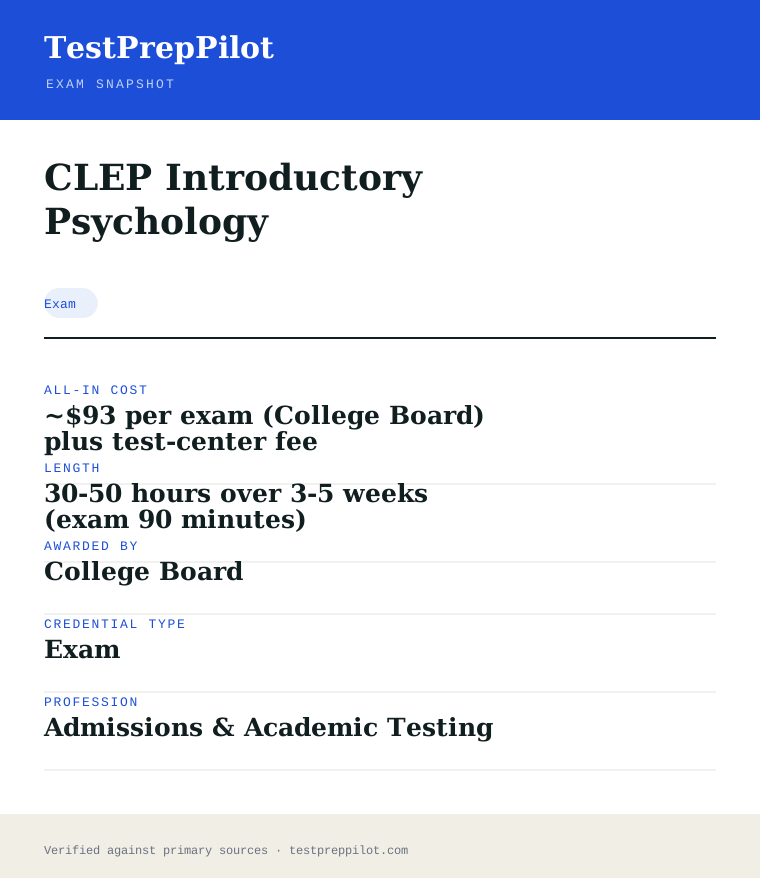
CLEP Introductory Psychology is a exam credential; awarded by College Board; the exam fee is $97 (2025–26) + test-center fee; typical preparation is 30-50 hours over 3-5 weeks (exam 90 minutes); holders typically earn College credit outcomes vary by school (ACE recommends 50).
| Credential | CLEP Introductory Psychology |
|---|---|
| Type | Exam |
| Profession | Admissions & Academic Testing |
| Specialty | CLEP & Credit by Exam |
| Awarded by | College Board |
| Typical prep time | 30-50 hours over 3-5 weeks (exam 90 minutes) |
| All-in cost | ~$93 per exam (College Board) plus test-center fee |
| Typical salary range | College credit outcomes vary by school (ACE recommends 50) |
| Credit | ACE recommends 3 semester hours at score 50 |
| Score scale | 20–80 scaled |
| Retake | 3-month wait; full fee each attempt |
| Framework | Uses DSM-5 terminology |
| Scope | National / Multi-state |
Real questions
Frequently asked questions about the CLEP Introductory Psychology
How many credits does Introductory Psychology grant?
ACE recommends three semester hours at a score of 50, commonly satisfying a general psychology requirement.
Is this enough for a psychology major?
It usually covers the introductory course; upper-level majors still take methods, statistics, and specialized courses for a grade.
What topics are emphasized?
A little of everything — biological bases, learning, development, disorders, and social psychology each appear, with no single area above about 12 percent.
Can I take it online?
Yes, via CLEP with Remote Proctoring or at a test center, with the same 20–80 scaled score.
Why do all four SAT Suite tests take the same 2 hours 14 minutes?
Since the digital transition every assessment in the suite uses the same blueprint: 54 Reading and Writing questions in two 32-minute modules and 44 Math questions in two 35-minute modules. Difficulty is calibrated to the grade band rather than by adding or removing time.
Can I take an SAT Suite test at home?
No. Unlike some other admissions tests, every College Board digital assessment must be taken in a supervised school or test centre, even though it runs on your own device.
How do fee waivers work?
US students in eleventh or twelfth grade who meet income eligibility get SAT fee waivers from their school counsellor. A waiver covers the registration fee, waives cancellation and late fees, and gives unlimited free score reports to colleges.
In short
Is the CLEP Introductory Psychology worth it?
- Equivalent to a one-semester intro psychology course
- ~95 questions in 90 minutes; score 50 for 3 credits
- Even coverage across the major subfields
- Uses DSM-5 terminology
Same awarding body
What other credentials does College Board award?
Trust
Where does this information come from?
Everything above is taken from the awarding body's own published material. Fees, question counts and domain weights are revised regularly — check the official page before you pay.
- College Board Awarding body
- Official CLEP Introductory Psychology exam page Exam page
Research confidence: high · Last reviewed 2026-08