Admissions & Academic Testing • Exam
CLEP Spanish Language
Demonstrate one to two years of Spanish for up to nine credits.
Researched and maintained by TestPrepPilot Editorial BoardCollege admissions & credit-by-exam desk · Figures last verified August 2026
The short version
What is the CLEP Spanish Language and is it worth it?
CLEP Spanish Language is a ~121-question, 90-minute exam of listening and reading. ACE recommends 50 for six semester hours (Level 1) and 63 for nine hours (Level 2).
- One exam can yield six or nine semester hours
- Tests listening and reading, not speaking
- Year-round at test centers and online with remote proctoring
- Efficient path through language requirements
What is it?
What exactly is the CLEP Spanish Language?
Demonstrate one to two years of Spanish for up to nine credits.
The CLEP Spanish Language exam measures listening and reading ability equivalent to one to two years of college Spanish. Both levels sit in one exam, and your score determines Level 1 (six hours) or Level 2 (nine hours) credit. Like the other language exams, it tests comprehension rather than speaking or writing.
The path in brief
- Confirm your school’s language policy
- Register and pay the $97 fee
- Book a test center or remote-proctoring slot
- Practice listening and reading
- Score 50+ for Level 1, 63+ for Level 2
Before you book
Who is eligible to sit the CLEP Spanish Language?
The test itself
What is the format of the CLEP Spanish Language?
The CLEP Spanish Language is administered by CLEP test center or CLEP with Remote Proctoring and runs 90 minutes and requires 50 (Level 1); 63 (Level 2) to pass.
| Administered by | CLEP test center or CLEP with Remote Proctoring |
|---|---|
| Questions | ~121 multiple choice |
| Time limit | 90 minutes |
| Pass mark | 50 (Level 1); 63 (Level 2) |
| Exam fee | $97 (2025–26) + test-center fee |
| Format | Multiple choice (listening + reading) |
Content outline
What topics are on the CLEP Spanish Language?
The CLEP Spanish Language is weighted across 5 domains; the largest are Listening: Dialogues and Narratives (25%), Reading: Passages (24%), Reading: Cloze Passages (20%).
Weightings come from the official exam outline. Study time is best allocated in roughly these proportions rather than evenly across domains.
- Listening: Rejoinders 15%
Short exchanges
- Listening: Dialogues and Narratives 25%
Longer selections
- Reading: Discrete Sentences 16%
Vocabulary and structure
- Reading: Cloze Passages 20%
Context completion
- Reading: Passages 24%
Reading comprehension
Study materials
Which study guide should you use for the CLEP Spanish Language?
Start with the exam sponsor's official content outline. If you also want one structured resource to work through, these are the Mometrix titles that match this exam.

This links to Mometrix's CLEP range rather than a single CLEP Spanish Language title. Check that it lists an edition for CLEP Spanish Language before you buy.
Affiliate links We may earn a commission if you buy through these links, at no extra cost to you. Mometrix has no say in what our exam guides cover. How we make money.
The path
How do you register for the CLEP Spanish Language?
- 1
Create a College Board account10 minutes
Register at collegeboard.org with your legal name exactly as it appears on the photo ID you will bring on test day. One account covers the SAT, the PSAT-related assessments, AP and BigFuture.
- 2
Choose a weekend SAT date or let your school register you20 minutes
The SAT is booked directly by the student for weekend national administrations. PSAT 8/9, PSAT 10 and the PSAT/NMSQT are ordered and scheduled by the school, so for those you speak to your counselor rather than registering yourself.
- 3
Pay the fee or claim a fee waiver5 minutes
The US SAT registration fee is 68 dollars; international test takers add a regional fee of 43 dollars and, at some centres, a further test centre fee. Eligible US students get the SAT free through a counsellor-issued fee waiver, which also unlocks unlimited free score sends.
- 4
Install Bluebook and complete exam setup30 minutes
Download the free Bluebook app to your own laptop or tablet, or use a school-managed device, then run exam setup in the five days before test day to download the test and get your admission ticket.
Students who skip exam setup can be turned away or delayed at check-in.
- 5
Practise with Bluebook full-length tests and Khan Academy4 to 12 weeks
Six free adaptive full-length practice tests sit inside Bluebook, and Official Digital SAT Prep on Khan Academy is free and keyed to the same content domains.
- 6
Test, then review scores onlinetest day
Arrive with your admission ticket, acceptable photo ID and a charged device. Scores post to your College Board account, typically within about two weeks for weekend SAT dates.
The fine print
What are the retake and renewal rules for the CLEP Spanish Language?
- Proctoring & delivery
- All SAT Suite tests are taken in Bluebook on a laptop or tablet, in a school or an authorised weekend test centre, under a live human proctor. There is no at-home option. Bluebook locks the device, and a built-in Desmos graphing calculator and formula sheet are available throughout the Math section; you may also bring your own approved non-CAS calculator.
- Retake policy
- There is no limit on SAT attempts and no mandatory waiting period beyond the eight national dates offered each year. The PSAT-related assessments are given once per school year per grade band and are not retaken on demand. Most selective colleges superscore across SAT sittings, taking your best Reading and Writing score and your best Math score.
- Score reporting
- The SAT reports a 400 to 1600 total built from two 200 to 800 section scores. The PSAT/NMSQT and PSAT 10 report 320 to 1520 with 160 to 760 sections, and the PSAT 8/9 reports 240 to 1440 with 120 to 720 sections, so results across the suite sit on one comparable scale. PSAT/NMSQT reports also carry an NMSC Selection Index of 48 to 228.
- Recertification
- SAT Suite scores do not expire and never need renewal, but colleges commonly ask for a score from within the last five years and most students test in the spring of eleventh grade and again in the autumn of twelfth grade. Only a PSAT/NMSQT taken in eleventh grade enters the National Merit competition.
- Refunds & rescheduling
- Cancelling an SAT registration by the change deadline costs 34 dollars; cancelling after the deadline but before test day costs 44 dollars. Changing test centre costs 34 dollars, and late registration costs 38 dollars. Fee-waiver students are not charged for cancellation or late registration.
Context
The digital SAT Suite compared
| Assessment | Grades | Score scale | Length | |
|---|---|---|---|---|
| PSAT 8/9 | 8 and 9 | 240 to 1440 | 2h 14m | |
| PSAT 10 | 10 (spring) | 320 to 1520 | 2h 14m | |
| PSAT/NMSQT | 10 and 11 (autumn) | 320 to 1520 | 2h 14m | |
| SAT | 11 and 12 | 400 to 1600 | 2h 14m |
What it pays
How much does this credential pay?
No direct occupation — a CLEP Spanish Language score of 50 earns 6 semester hours of college credit (Level 1) and 63 earns 9 (Level 2), and the payoff is the education-return premium: bachelor’s-degree holders earned $1,493/week vs $1,059 for associate and $899 for high-school-only (BLS, 2023)
The direct answer is that CLEP Spanish Language has no BLS occupation of its own — it is a credit-by-examination assessment whose payoff is the college credit it earns, the tuition and time it saves, and the language proficiency it certifies on a transcript — so the salary story is the education-return premium that CLEP credit accelerates for degree completion, plus the modest labour-market value of demonstrable Spanish proficiency for workers who use it on the job. The relevant reference points from BLS: in 2023, workers with a bachelor’s degree earned a median weekly wage of about $1,493 versus about $1,059 for associate-degree holders and about $899 for high-school-diploma-only workers, and the May 2024 median wage across all occupations was $49,500. The credit mathematics are the most concrete part of the story: on the 20-to-80 CLEP scale, the American Council on Education recommends a score of 50 for Level 1 credit of 6 semester hours — typically two semesters of college Spanish — and a score of 63 for Level 2 credit of 9 semester hours, typically three to four semesters, and colleges that accept CLEP credit grant those hours under their own policies, some requiring a higher score or restricting how the credit applies. The practical financial value is significant: a roughly $93 exam can replace two to four semesters of college foreign-language coursework, which at most institutions is worth well over a thousand dollars in tuition and a semester or more of time-to-degree. The honest framing is that the value is measured in credits, tuition saved and language proficiency on the transcript, not in a salary line tied to the exam itself — and for candidates deciding whether to sit it, the investment is the exam fee of roughly $93 plus a test-centre administration fee, and preparation hours that scale with current proficiency, from a short refresher for a heritage or experienced speaker to months of study for a rusty former student.
| Measure | Figure | Source / note |
|---|---|---|
| Reference: median wage, all occupations | $49,500 | BLS Occupational Outlook Handbook, May 2024 |
| Reference: bachelor’s degree, median weekly earnings | $1,493 | BLS Education Pays, 2023 ($77,636/yr equivalent) |
| Reference: associate degree, median weekly earnings | $1,059 | BLS Education Pays, 2023 ($55,068/yr equivalent) |
| The exam itself | No direct occupation | A credit-by-examination test; ACE recommends 6 semester hours for a score of 50 (Level 1) and 9 for 63 (Level 2) |
| ACE credit-granting scores | 50 (Level 1) and 63 (Level 2) | On a 20-80 scale; individual colleges set their own policies |
Job growth.BLS does not project growth for a CLEP exam; the relevant projections follow the occupations the earned degree feeds into, and the value is the credit hours, tuition savings and certified language proficiency the exam buys.
Source: BLS Education Pays
Your odds
What are the pass rates?
The College Board publishes no CLEP pass rate — it publishes the 20-80 score scale and the ACE recommendations (50 for Level 1 credit, 63 for Level 2), so the honest target is the credit your college grants, not a pass percentage
The core fact is that the College Board does not publish pass rates for CLEP Spanish Language or any CLEP exam, and it has not published civilian pass-rate statistics since 2017 — so the percentages you see on prep sites are either that stale 2017 release being passed around or a vendor’s count of its own paying customers, neither of which is an official statistic. The only genuine institutional pass-rate data that exists is published by DANTES, the Department of Defense agency, and it covers military test takers only — a funded, self-selected population that is not a national sample, so we do not present it as one. What the College Board does publish and verify is the scoring structure: CLEP scores run on a scaled range of 20 to 80, and for Spanish Language the American Council on Education recommends a credit-granting score of 50 for Level 1 credit of 6 semester hours — the equivalent of two semesters of college Spanish — and a score of 63 for Level 2 credit of 9 semester hours, the equivalent of three to four semesters, with individual colleges setting their own credit policies and some requiring a higher score. The exam itself is approximately 121 multiple-choice questions answered in about 90 minutes, with a listening section of roughly 30 minutes — covering rejoinders (15 percent) and dialogues and narratives (25 percent) — and a reading section of roughly 60 minutes — covering discrete sentences (16 percent), short cloze passages (20 percent), and reading passages with authentic stimulus materials (24 percent). Because the pass line is not published, the practical planning rule is to confirm your college’s credit policy first — including whether a 50 clears Level 1 or a 63 is needed for Level 2 — then prepare until you are consistently at or above the relevant ACE-recommended score on full timed practice exams, because those are the only score thresholds officially on the record.
Read this before quoting the number.The College Board publishes no CLEP pass rate and no current civilian score distribution; the last civilian pass-rate release was 2017 and the figures online are stale or vendor-reported. DANTES publishes military-only pass-rate data that is not a national figure. What is published and verifiable is the 20-80 score scale, the ACE recommendations of 50 (Level 1, 6 semester hours) and 63 (Level 2, 9 semester hours), and the approximately 121-question, 90-minute format with listening and reading sections.
Your schedule
How long should I study for it?
20-80 hours depending on current proficiency (a 2-4 week refresher to a 10-12 week rebuild) of focused study
The study plan for CLEP Spanish Language is proficiency-driven rather than syllabus-driven, because the exam measures listening and reading comprehension — not grammar knowledge in isolation — so the plan ranges from a 2-to-4-week refresher for a heritage or experienced speaker to 10 to 12 weeks for a rusty former student, and the hours should be spent on input, not on memorising verb tables. The structure to plan against is published: approximately 121 multiple-choice questions in about 90 minutes, with a listening component of roughly 30 minutes — rejoinders (15 percent) where you choose the most appropriate response to a spoken prompt, and dialogues and narratives (25 percent) where you answer comprehension questions about longer spoken selections, with audio played once and no replay — followed by a reading component of roughly 60 minutes covering discrete sentences (16 percent), short cloze passages (20 percent), and reading passages with authentic materials (24 percent). The most effective sequence: first, take a full timed practice exam to baseline, and log every miss by category — rejoinders, dialogues, discrete grammar items, cloze, or reading comprehension — because the categories you miss reveal whether the gap is listening fluency, reading vocabulary, or specific grammar; second, build daily listening input, because the listening sections are the most distinctively demanding part — podcasts, news and series in Spanish, actively replayed for detail, train the ear in a way that flashcards cannot; third, refresh the grammar that appears in discrete and cloze items — verb tenses and moods including the subjunctive, por versus para, gender and agreement — but always in context rather than as isolated conjugation drills; fourth, build reading stamina on authentic materials — notices, articles and multi-paragraph passages — because the reading section is 60 percent of the exam and the passages are genuine texts; and fifth, rehearse the exact 90-minute format twice in the final week, because the once-only listening audio and the pacing between sections are real and trainable. Confirm your college’s credit policy and the score needed for Level 1 versus Level 2 before investing the hours, and note the exam fee is roughly $93 plus a test-centre administration fee.
- Day 1-33-5 hrs
Baseline and gap diagnosis
- Take a full timed practice exam and log every miss by category — rejoinders, dialogues, discrete grammar, cloze, reading comprehension
- Identify whether the gap is listening fluency, reading vocabulary, or specific grammar points
- Confirm your college’s credit policy and whether you need Level 1 (50) or Level 2 (63)
- Weeks 1-25-8 hrs/week
Listening input and grammar refresh
- Daily listening: 20-30 minutes of podcasts, news or series in Spanish, replayed for detail
- Refresh the high-frequency grammar in context: preterite versus imperfect, the subjunctive, por versus para, agreement
- Practise rejoinders — choosing the natural spoken response — daily
- Weeks 3-45-8 hrs/week
Reading and cloze work
- Read authentic materials daily: notices, articles, short multi-paragraph texts
- Work cloze passages to practise choosing the word or form that fits the context
- Drill the discrete-sentence items: vocabulary and structure in single sentences
- Weeks 5-66-8 hrs/week
Integrated timed practice
- Take two or three full timed practice exams with the real 90-minute format
- Re-drill the weakest categories from the error log
- Rehearse the once-only listening audio: no replays, answer under the on-screen timing
- Final week3-5 hrs
Taper and logistics
- One full timed exam early in the week
- Light review of the error log and the high-frequency grammar only
- Confirm registration, the test-centre administration fee, and the photo ID requirement
Adjusting the pace
Heritage or experienced speaker.Two to four weeks. Your comprehension is usually strong; focus on formal register and written Spanish — the reading section’s authentic materials and the discrete grammar items — and on the listening rejoinders, which reward natural spoken responses rather than book grammar.
Rusty former student (2-4 years since study).Eight to twelve weeks. Split time evenly between rebuilding listening fluency with daily input and refreshing the grammar in context, then compress with timed practice in the final month.
Working full-time.Stretch the plan to 12-14 weeks at 4-6 hours a week, and make the daily 20-30 minute listening session the non-negotiable habit — it is the one component that cannot be compressed.
How to study
How do I prepare most effectively?
The strategy that reliably raises a CLEP Spanish Language score is "daily listening input, grammar in context, and full timed practice," because the exam measures comprehension rather than book knowledge — 40 percent listening and 60 percent reading — and the listening sections, with audio played once and no replay, are the part of the exam where unprepared candidates lose the most points. The single highest-yield habit is daily listening: 20 to 30 minutes of Spanish podcasts, news or series, replayed for detail, because the dialogues-and-narratives items require sustained comprehension of spoken Spanish at a natural pace and the rejoinders require you to produce the natural conversational response — skills that only exposure builds. Second, practise the listening format exactly as delivered: the audio plays once with no pause or replay, and the rejoinders allow only a few seconds to choose after hearing the responses, so run listening practice under the same constraint rather than replaying generously. Third, refresh grammar in context rather than as isolated conjugation drills: the discrete-sentence and cloze items test verb tenses and moods — especially preterite versus imperfect and the subjunctive — por versus para, and agreement, and the fastest way to own them is to notice them in the reading and listening you are already consuming. Fourth, build reading stamina on authentic materials, because the reading section is 60 percent of the exam and the passages are genuine Spanish texts — notices, articles and multi-paragraph selections — not graded textbook prose. Fifth, run full timed practice exams with the real 90-minute format, because the pacing between the listening sections and the 60-minute reading block is trainable and surprises candidates who only drilled sections. Finally, remember there is no guessing penalty on CLEP, so answer every question, and set the target against your college’s policy — a 50 for Level 1 or a 63 for Level 2 — rather than a rumoured pass percentage that no official source publishes.
Make daily listening the anchor
20-30 minutes of Spanish podcasts, news or series every day, replayed for detail. The exam is 40 percent listening and the audio plays once, so listening fluency — not grammar recall — is the skill most worth building.
Rehearse the once-only listening constraint
In the real exam the audio plays once with no replay, and rejoinders give you only a few seconds to choose after the responses. Practise under the same constraint, or the format itself will cost you points you could answer.
Learn grammar in context, not by conjugation drills
The discrete and cloze items test preterite versus imperfect, the subjunctive, por versus para, and agreement. Own them by noticing them in the reading and listening you consume, then verify with targeted practice — context-first beats table-memorisation on a comprehension exam.
Read authentic material daily
The reading section is 60 percent of the exam and uses genuine Spanish texts — notices, articles, multi-paragraph passages. Daily reading of real material builds the vocabulary and speed that textbook excerpts cannot.
Run the full 90-minute format twice before exam day
The pacing between the two listening sections and the 60-minute reading block is real and trainable. Full timed exams reveal whether you run out of time in the reading section and let you fix it.
Set the target from your college, not a pass rate
No official CLEP pass rate exists. Confirm whether your college needs a 50 for Level 1 credit or a 63 for Level 2, and prepare until timed practice scores clear that number — those are the thresholds that matter.
What to buy
Which study resources are worth paying for?
CLEP Spanish Language preparation is cheap relative to the credit it earns, and the buying logic is dominated by free and low-cost resources: the College Board CLEP page defines the exact format and the section weights, the ACE National Guide confirms the Level 1 and Level 2 credit recommendations, and the best listening practice — Spanish-language podcasts, news and streaming — is free, because the exam measures comprehension of real spoken and written Spanish rather than a specific textbook. The cost structure to plan against is the exam fee — roughly $93 paid to College Board plus a separate test-centre administration fee that varies by location, commonly $15 to $40 — and the Modern States free CLEP Spanish course is worth calling out because it is mapped to the exam and Modern States has historically offered free exam vouchers to students who complete its courses, removing even the $93 fee for eligible candidates. The paid options worth considering are practice-exam banks and review books, roughly $10 to $50, which add timed format calibration and grammar-in-context drilling, and structured courses, roughly $50 to $150, which help a rusty speaker rebuild systematically — but a heritage or currently active speaker often needs nothing beyond free listening input, free reading material and a practice exam or two. The honest rule: build the input with free resources, rehearse the real 90-minute format with practice exams until you clear your college’s required score, and spend money on a structured course only if self-study has already failed to reach the Level 1 or Level 2 target — for a proficiency-based comprehension exam with a fully public format, the free path is normally sufficient, and the hours of input matter more than the fee.
| Resource | Price | Format | Best for |
|---|---|---|---|
| College Board CLEP Spanish Language page and exam description | Free | Official format, section weights and scoring facts | The authoritative syllabus — listening 40% (rejoinders 15%, dialogues 25%) and reading 60% |
| The CLEP exam itself | ~$93 plus a test-centre administration fee | Computer-delivered at a CLEP test centre | Required — the credit-earning event |
| Spanish podcasts, news and streaming | Free | Daily listening and reading input | Building comprehension — the core tested skill |
| Modern States free CLEP Spanish course | Free (historically with free exam vouchers for eligible completers) | Structured video course | A taught framework plus possible fee removal |
| Practice-exam banks and review books | ~$10-50 | Online timed practice or printed book | Format calibration on the 90-minute timing and the listening constraint |
| Structured Spanish refresher courses | ~$50-150 | Video course with practice | Rusty speakers who need systematic rebuilding; otherwise the free path is usually enough |
Prices approximate and dated to this review; the exam is offered year-round by appointment, and the test-centre administration fee is separate from the ~$93 exam fee. We do not rank by commission.
Avoid these
What mistakes do candidates most often make?
The most common mistake on CLEP Spanish Language is preparing for the wrong exam — drilling grammar tables as if it were a written grammar test when the exam is 40 percent listening and 60 percent reading comprehension, and the listening sections, with audio played once and no replay, punish candidates who never trained the ear at all. The second is memorising verb conjugations in isolation when the discrete and cloze items test grammar in context — preterite versus imperfect, the subjunctive, por versus para and agreement — and context-first practice beats table recall. A third recurring error is ignoring the rejoinders, the 15 percent of the exam where you hear a spoken prompt and choose the natural response within seconds; candidates who study only reading underestimate how distinct that skill is. Candidates also routinely neglect the cloze passages and the authentic reading materials, treating the reading section as vocabulary when it is genuine Spanish texts that require sustained reading stamina. Many candidates fail to rehearse the real format — the once-only listening audio and the pacing between sections — and are surprised on exam day. Finally, some students set their target from stale online pass-rate figures or a generic "50 is passing" line, without confirming whether their college needs a 63 for Level 2 credit, and then discover the credit they banked on was never theirs at the score they earned. A further habit that costs points is studying with materials aimed at a different proficiency target — grammar-heavy Spanish courses designed for classroom writing rather than the listening-and-reading comprehension the exam actually measures — leaving candidates strong in conjugation but slow at the spoken dialogues and the authentic reading passages that make up most of the paper.
✕Drilling grammar tables instead of comprehension
✓The exam is 40 percent listening and 60 percent reading comprehension, not a written grammar test. Spend most of your hours on input — daily listening and reading — and use grammar practice to support comprehension, not as the main activity.
✕Ignoring the rejoinders section
✓Rejoinders are 15 percent of the exam: you hear a spoken prompt and choose the natural conversational response within seconds. Practise this format specifically — it is a distinct skill from reading comprehension and a dependable source of points.
✕Never practising under the once-only listening rule
✓In the real exam the audio plays once with no replay. Run your listening practice under the same constraint — no generous replays — or the format will cost you points you could answer with full comprehension.
✕Treating reading as vocabulary alone
✓The reading section uses authentic Spanish materials — notices, articles and multi-paragraph passages — and tests sustained comprehension. Read real material daily so the passages on exam day feel like ordinary reading, not a shock.
✕Skipping full-format timed practice
✓Take two or three full 90-minute practice exams before the real one. The pacing between the listening sections and the 60-minute reading block is trainable, and full rehearsals are the only way to discover it before test day.
✕Setting the target from stale pass rates or a generic 50
✓No official CLEP pass rate exists, and colleges set their own credit policies — many require a 63 for Level 2 credit. Confirm the score your college needs for the credit you want, and prepare until timed practice clears that number.
What you'll face
What question types will I see?
The CLEP Spanish Language exam is approximately 121 multiple-choice questions answered in about 90 minutes, scored on a 20-to-80 scale with ACE recommendations of 50 for Level 1 credit (6 semester hours) and 63 for Level 2 credit (9 semester hours), and there is no penalty for guessing. The exam splits into a listening component of roughly 30 minutes — 40 percent of the score — and a reading component of roughly 60 minutes — 60 percent of the score. The listening side has two formats: rejoinders (15 percent), where you hear a short spoken prompt and must choose the most natural conversational response, and dialogues and narratives (25 percent), where you listen to longer spoken selections — conversations, announcements, narratives — and answer comprehension questions on main idea, detail and inference; the audio plays once with no replay. The reading side has three formats: Part A discrete sentences (16 percent), testing vocabulary and structure in a single sentence; Part B short cloze passages (20 percent), where words have been deleted from a short paragraph and you choose what fits; and Part C reading passages with authentic stimulus materials (24 percent), where you read genuine Spanish texts and answer main-idea, detail, inference and vocabulary-in-context questions. The practical pacing implication is roughly 45 seconds per question across the whole exam, with the listening sections consuming their own fixed time, so recognition speed and the skip-and-return discipline matter. The samples below are editor-written illustrations of the published blueprint, not live exam items.
A spoken prompt followed by response options; choose the most natural conversational continuation. Seconds are available to answer, and the audio plays once.
Longer spoken selections — conversations, announcements, narratives — with comprehension questions on main idea, detail and inference. The audio plays once.
Vocabulary and structure tested in single sentences — verb tenses and moods, por versus para, agreement, word choice.
Short paragraphs with deleted words; choose the word or grammatical form that best fits the context.
Genuine Spanish texts — notices, articles, multi-paragraph selections — with questions on main idea, detail, inference and vocabulary in context.
Try these
Q1You hear: "Perdone, ¿dónde está la biblioteca?" Which response is the most natural continuation?
Answer:A
The speaker is asking where the library is, so the natural response gives directions: "Yes, it is two blocks away, turning right." A is the rejoinder format — a short spoken prompt followed by choosing the natural conversational reply. B answers an implied question about reading tastes, C reports an unrelated event, and D answers a question about a past meal; none responds to a request for directions. The rejoinder items test whether you produce the expected social response, which is why options that are grammatically correct Spanish but conversationally off-topic are the standard traps.
Q2A short passage describes a family’s visit to a market where the vendor explains how the fruit was grown on a nearby farm. What is the main purpose of the passage?
Answer:B
The passage’s main purpose is to tell the story of how the fruit came to the market from a nearby farm — the vendor’s explanation is the substance of the narrative, so B captures the main idea. A is wrong because there is no sales advertising in the described passage. C is wrong because cooking is not mentioned. D is wrong because only one market appears. This is a main-idea item from the dialogues-and-narratives or reading-passage format, where the correct answer summarises the selection’s central content rather than a detail or an inference about something outside it.
Q3Select the word or form that best completes the sentence: "Ayer, cuando él ______ a casa, empezó a llover."
Answer:B
The sentence describes a completed event in the past — "yesterday, when he arrived home, it started to rain" — so the preterite llegó is correct: the arrival is a completed action at a specific past moment. A (llegaba, the imperfect) would suggest an ongoing or habitual action and is the classic trap for candidates who over-apply the imperfect rule. C (llegará, future) and D (llegara, a past subjunctive form) do not fit the temporal frame of a completed yesterday event. This is a discrete-sentence grammar item from Part A, testing preterite versus imperfect in context — exactly the high-frequency distinction the exam rewards.
Samples are editor-written illustrations of the published blueprint, not live exam items.
The big day
What should I expect on exam day?
The CLEP Spanish Language exam is a 90-minute, approximately 121-question computer-delivered test taken by appointment at a CLEP test centre, with the score reported immediately on a 20-to-80 scale, the ACE credit recommendations at 50 (Level 1, 6 semester hours) and 63 (Level 2, 9 semester hours), and individual colleges setting their own policies. The first thing to confirm is your test-centre administration fee, because CLEP charges roughly $93 for the exam plus a separate centre fee that varies by location — commonly $15 to $40 — and the second is your college’s credit policy, so you know whether you need a 50 or a 63 before you sit. Bring a valid government-issued photo ID matching your CLEP account name exactly, and leave phones, smartwatches, study materials and headphones at home — the exam provides its own audio through the computer, and personal electronics are prohibited. Arrive at least 30 minutes early so check-in and the tutorial are complete before the clock starts. When the exam begins, remember the listening sections come first: the audio plays once with no replay, so listen actively the first time, and for the rejoinders answer within the seconds available rather than second-guessing; then settle into the 60-minute reading section at roughly 45 seconds per question, flagging anything that runs long and returning to it, because there is no guessing penalty and every question must be answered. Budget the final minutes to revisit flagged items and submit before the clock expires. Your score appears on screen the moment you submit, and the official report posts to your CLEP account within a few business days, after which you order the score to your registrar if your school requires an official copy — and note that a 63 buys nine semester hours, so the difference between Level 1 and Level 2 credit is worth confirming in advance.
Bring
- Valid government-issued photo ID matching your CLEP account name exactly
- Your CLEP registration confirmation and scheduling details
- Payment for any test-centre administration fee due at the site
- A clear head — the listening audio plays once, so alertness in the opening sections decides a large share of the score
Leave at home
- Phones, smartwatches and earbuds — the exam delivers its own audio
- All notes, dictionaries and study materials — no reference materials are permitted
- Personal headphones or audio devices
- Bags and coats beyond what the test centre permits
How the day runs
Rules in the room
- The exam is approximately 121 multiple-choice questions in 90 minutes, computer-delivered at a CLEP test centre.
- The listening audio plays once with no replay; rejoinders allow only a few seconds to answer.
- Scoring is on a 20-80 scale; ACE recommends 50 for Level 1 credit (6 semester hours) and 63 for Level 2 (9 semester hours), and individual colleges set their own policies.
- There is no penalty for guessing — answer every question.
- Personal electronics, headphones and reference materials are not permitted.
- The exam fee is roughly $93 plus a separate test-centre administration fee.
Afterwards.Your score appears on screen the moment you submit and the official report posts to your CLEP account within a few business days, and a score of 50 or higher earns the ACE-recommended Level 1 credit of 6 semester hours — two semesters of college Spanish — while 63 or higher earns Level 2 credit of 9 semester hours, three to four semesters, with most colleges granting the hours under their own policies and some requiring a higher score or restricting how the credit applies, so the immediate next step is checking your program’s CLEP policy and ordering the score report to the registrar if an official copy is required. The practical value is the tuition and time saved: a roughly $93 exam replacing two to four semesters of foreign-language coursework is among the highest-return credit options in the CLEP catalogue, and the certified Spanish proficiency is a useful transcript line for candidates in education, healthcare, business and public service. If you fell short of the score your college needs, re-sit only after timed practice clears the target — the gap is usually a listening or reading-fluency gap, so increase daily input in the weaker modality and rehearse the once-only listening format specifically, because that is the section where unprepared candidates lose the most.
Reference
What are the key facts about the CLEP Spanish Language?
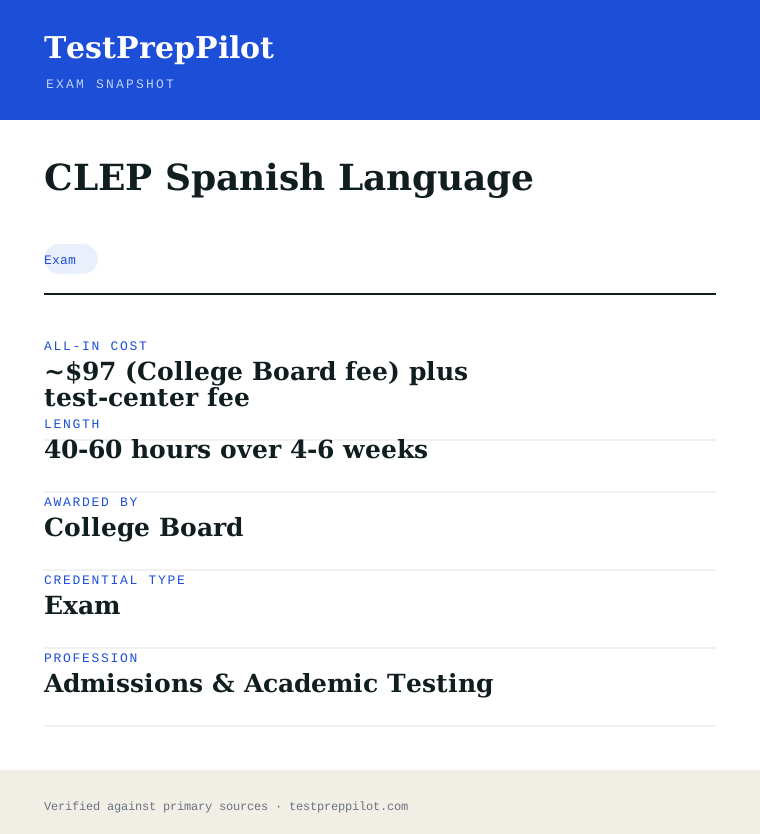
CLEP Spanish Language is a exam credential; awarded by College Board; the exam fee is $97 (2025–26) + test-center fee; typical preparation is 40-60 hours over 4-6 weeks; holders typically earn College credit outcomes vary by school (ACE recommends 50).
| Credential | CLEP Spanish Language |
|---|---|
| Type | Exam |
| Profession | Admissions & Academic Testing |
| Specialty | CLEP & Credit by Exam |
| Awarded by | College Board |
| Typical prep time | 40-60 hours over 4-6 weeks |
| All-in cost | ~$97 (College Board fee) plus test-center fee |
| Typical salary range | College credit outcomes vary by school (ACE recommends 50) |
| Credit | Level 1: 6 SH at 50; Level 2: 9 SH at 63 |
| Score scale | 20–80 scaled |
| Retake | 3-month wait; full fee each attempt |
| Skills tested | Listening and reading only |
| Scope | National / Multi-state |
Real questions
Frequently asked questions about the CLEP Spanish Language
How many credits can I earn?
ACE recommends six semester hours at 50 (Level 1) and nine at 63 (Level 2). Your college decides which level it grants.
Is there a speaking section?
No. The exam evaluates listening and reading comprehension only.
How long is the exam?
About 121 questions in 90 minutes across three separately timed sections; audio plays once.
Can I take it online?
Yes, via CLEP with Remote Proctoring or at a test center, with the same 20–80 scaled score.
Why do all four SAT Suite tests take the same 2 hours 14 minutes?
Since the digital transition every assessment in the suite uses the same blueprint: 54 Reading and Writing questions in two 32-minute modules and 44 Math questions in two 35-minute modules. Difficulty is calibrated to the grade band rather than by adding or removing time.
Can I take an SAT Suite test at home?
No. Unlike some other admissions tests, every College Board digital assessment must be taken in a supervised school or test centre, even though it runs on your own device.
How do fee waivers work?
US students in eleventh or twelfth grade who meet income eligibility get SAT fee waivers from their school counsellor. A waiver covers the registration fee, waives cancellation and late fees, and gives unlimited free score reports to colleges.
In short
Is the CLEP Spanish Language worth it?
- Equivalent to 1–2 years of college Spanish
- ~121 questions in 90 minutes; 50 = 6 SH, 63 = 9 SH
- Listening 40%, reading 60%
- No speaking or writing required
Same awarding body
What other credentials does College Board award?
Trust
Where does this information come from?
Everything above is taken from the awarding body's own published material. Fees, question counts and domain weights are revised regularly — check the official page before you pay.
- College Board Awarding body
- Official CLEP Spanish Language exam page Exam page
Research confidence: high · Last reviewed 2026-08