Admissions & Academic Testing • Exam
AP English Literature and Composition
Close-read poetry, prose, and drama for college literature credit.
Researched and maintained by TestPrepPilot Editorial BoardCollege admissions & AP assessments desk · Figures last verified August 2026
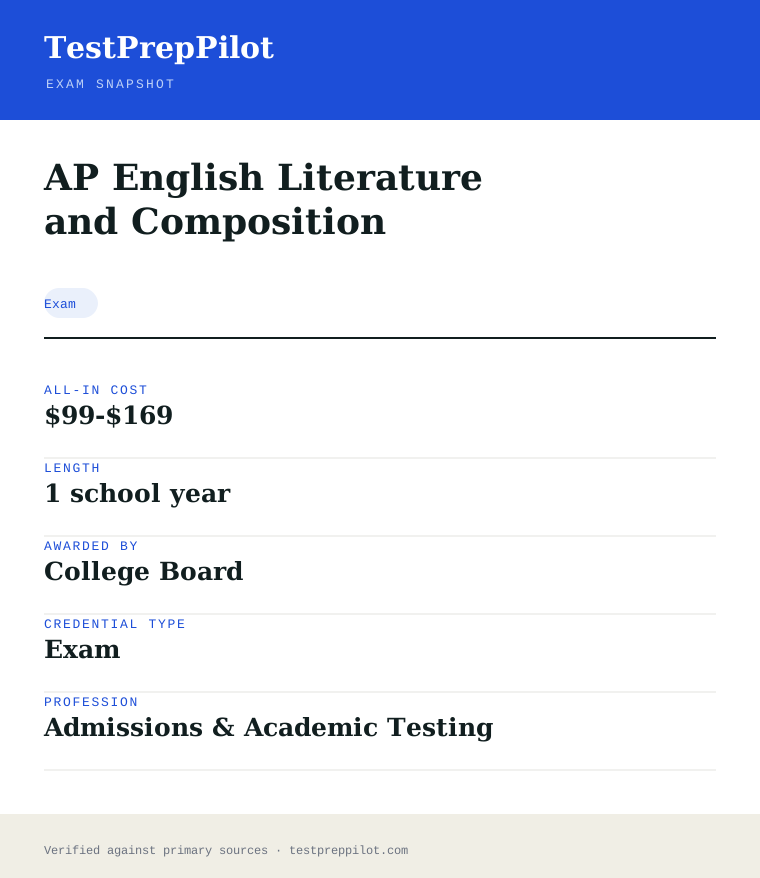
The short version
What is the AP English Literature and Composition and is it worth it?
AP English Literature and Composition is a fully digital exam: 55 multiple-choice questions in 60 minutes and three free-response essays in 120 minutes. Scored 1-5, a 3 generally earns introductory literature credit.
- Equivalent to a college introduction to literature
- Trains close reading of poetry, prose, and drama
- Fully digital in Bluebook
- Strong preparation for humanities majors
What is it?
What exactly is the AP English Literature and Composition?
Close-read poetry, prose, and drama for college literature credit.
AP English Literature and Composition is a fully digital exam centered on close reading of fiction, poetry, and drama. It pairs 55 multiple-choice questions on literary passages with three free-response essays that analyze a poem, a prose passage, and a chosen work of literary merit. A 3 typically earns credit for an introductory college literature course.
The path in brief
- Join AP Lit via My AP
- Read widely across genres
- Practice prose, poetry, and open essays
- Use AP Classroom progress checks
- Sit the fully digital exam in May
Before you book
Who is eligible to sit the AP English Literature and Composition?
Who it is for: High-school students pursuing literature or humanities credit
The test itself
What is the format of the AP English Literature and Composition?
The AP English Literature and Composition is administered by School-administered via Bluebook and runs 3 hours, contains 55 multiple choice + 3 free response questions and requires 3 (1-5 scale) to pass.
| Administered by | School-administered via Bluebook |
|---|---|
| Questions | 55 multiple choice + 3 free response |
| Time limit | 3 hours |
| Pass mark | 3 (1-5 scale) |
| Exam fee | $99 (US) / $129 (intl) |
| Format | Fully digital |
Content outline
What topics are on the AP English Literature and Composition?
The AP English Literature and Composition is weighted across 5 domains; the largest are Short Fiction (Narrative Prose) (42-49%), Poetry (36-45%), Long Fiction or Drama (15-18%).
Weightings come from the official exam outline. Study time is best allocated in roughly these proportions rather than evenly across domains.
- Short Fiction (Narrative Prose) 42-49%
Novels, short stories
- Poetry 36-45%
Forms, devices, voice
- Long Fiction or Drama 15-18%
Plays and longer works
- Reading Skill: Character Skill
Motivation, development
- Reading Skill: Setting and Structure Skill
Form and function
Study materials
Which study guide should you use for the AP English Literature and Composition?
Start with the exam sponsor's official content outline. If you also want one structured resource to work through, these are the Mometrix titles that match this exam.

This links to Mometrix's AP range rather than a single AP English Literature and Composition title. Check that it lists an edition for AP English Literature and Composition before you buy.
Affiliate links We may earn a commission if you buy through these links, at no extra cost to you. Mometrix has no say in what our exam guides cover. How we make money.
Money & time
How much does the AP English Literature and Composition cost?
For the AP English Literature and Composition, the exam fee is $99 (US) / $129 (intl); the all-in cost is typically $99-$169; most candidates spend 1 school year preparing.
Cost breakdown
| AP exam fee (US, territories, Canada, DoDEA) | $99 |
|---|---|
| AP exam fee (international) | $129 |
| Late order or unused/canceled exam | $40 |
| Fee reduction for eligible students | -$37 |
| Prep materials (optional) | $0-$40 |
| Typical total | $99 US / $129 intl (eligible students pay ~$53 / ~$83); late or canceled adds $40 |
Fees are the 2025-26 AP charges. Schools may add a local administrative fee; the College Board fee reduction lowers the base by $37.
Timeline
- Enroll in the AP course Fall
- Read across genres with annotation Aug-May
- Practice the three essays 2-3 months
- Take the digital exam May
- Receive scores Early July
Typical prep: 1 school year
The path
How do you register for the AP English Literature and Composition?
- 1
Create a College Board account10 minutes
Register at collegeboard.org with your legal name exactly as it appears on the photo ID you will bring on test day. One account covers the SAT, the PSAT-related assessments, AP and BigFuture.
- 2
Choose a weekend SAT date or let your school register you20 minutes
The SAT is booked directly by the student for weekend national administrations. PSAT 8/9, PSAT 10 and the PSAT/NMSQT are ordered and scheduled by the school, so for those you speak to your counselor rather than registering yourself.
- 3
Pay the fee or claim a fee waiver5 minutes
The US SAT registration fee is 68 dollars; international test takers add a regional fee of 43 dollars and, at some centres, a further test centre fee. Eligible US students get the SAT free through a counsellor-issued fee waiver, which also unlocks unlimited free score sends.
- 4
Install Bluebook and complete exam setup30 minutes
Download the free Bluebook app to your own laptop or tablet, or use a school-managed device, then run exam setup in the five days before test day to download the test and get your admission ticket.
Students who skip exam setup can be turned away or delayed at check-in.
- 5
Practise with Bluebook full-length tests and Khan Academy4 to 12 weeks
Six free adaptive full-length practice tests sit inside Bluebook, and Official Digital SAT Prep on Khan Academy is free and keyed to the same content domains.
- 6
Test, then review scores onlinetest day
Arrive with your admission ticket, acceptable photo ID and a charged device. Scores post to your College Board account, typically within about two weeks for weekend SAT dates.
The fine print
What are the retake and renewal rules for the AP English Literature and Composition?
- Proctoring & delivery
- All SAT Suite tests are taken in Bluebook on a laptop or tablet, in a school or an authorised weekend test centre, under a live human proctor. There is no at-home option. Bluebook locks the device, and a built-in Desmos graphing calculator and formula sheet are available throughout the Math section; you may also bring your own approved non-CAS calculator.
- Retake policy
- There is no limit on SAT attempts and no mandatory waiting period beyond the eight national dates offered each year. The PSAT-related assessments are given once per school year per grade band and are not retaken on demand. Most selective colleges superscore across SAT sittings, taking your best Reading and Writing score and your best Math score.
- Score reporting
- The SAT reports a 400 to 1600 total built from two 200 to 800 section scores. The PSAT/NMSQT and PSAT 10 report 320 to 1520 with 160 to 760 sections, and the PSAT 8/9 reports 240 to 1440 with 120 to 720 sections, so results across the suite sit on one comparable scale. PSAT/NMSQT reports also carry an NMSC Selection Index of 48 to 228.
- Recertification
- SAT Suite scores do not expire and never need renewal, but colleges commonly ask for a score from within the last five years and most students test in the spring of eleventh grade and again in the autumn of twelfth grade. Only a PSAT/NMSQT taken in eleventh grade enters the National Merit competition.
- Refunds & rescheduling
- Cancelling an SAT registration by the change deadline costs 34 dollars; cancelling after the deadline but before test day costs 44 dollars. Changing test centre costs 34 dollars, and late registration costs 38 dollars. Fee-waiver students are not charged for cancellation or late registration.
Context
The digital SAT Suite compared
| Assessment | Grades | Score scale | Length | |
|---|---|---|---|---|
| PSAT 8/9 | 8 and 9 | 240 to 1440 | 2h 14m | |
| PSAT 10 | 10 (spring) | 320 to 1520 | 2h 14m | |
| PSAT/NMSQT | 10 and 11 (autumn) | 320 to 1520 | 2h 14m | |
| SAT | 11 and 12 | 400 to 1600 | 2h 14m |
What it pays
How much does this credential pay?
No direct occupation — AP English Literature scores earn college credit and strengthen admissions, and the payoff is the degree-completion premium: bachelor’s-degree holders earned a median of $1,493/week vs $899 for high-school-only workers (BLS, 2023)
The direct answer is that the AP English Literature and Composition exam has no BLS occupation of its own — it is a college-level assessment whose scores can earn college credit and strengthen admission applications — so the salary story is the education-return premium that AP credit accelerates. The relevant reference points from BLS: the May 2024 median wage across all occupations was $49,500; workers with a bachelor’s degree earned a median weekly wage of about $1,493 in 2023, versus about $899 for workers with only a high school diploma; and associate-degree holders sat between them at about $1,059. A score of 3 or higher on an AP exam is accepted for credit by the vast majority of four-year colleges, which can shorten time-to-degree and reduce tuition — the practical financial value of AP English Literature is the credit hours it buys and the admissions signal it sends. AP English Literature is one of the most-taken AP exams in the country, with hundreds of thousands of administrations each year, and its skills — close reading of fiction, poetry, and drama, building a textually supported interpretation, and writing an analytical essay under a deadline — transfer directly to college humanities courses and to careers in writing, law, publishing, teaching, and communications, occupations with above-median earnings, though no single BLS code corresponds to the exam. The honest framing is that AP’s value is twofold: the admissions signal colleges reward for demonstrated college-level rigor, and the credit each qualifying score earns, often replacing a 3-credit literature or composition course. For students deciding whether to take the exam, the investment is the exam fee and preparation time, and the payoff is measured in credits, admissions advantage, and the analytical writing skills that transfer to college and career.
| Measure | Figure | Source / note |
|---|---|---|
| Reference: median wage, all occupations | $49,500 | BLS Occupational Outlook Handbook, May 2024 |
| Reference: bachelor’s degree, median weekly earnings | $1,493 | BLS Education Pays, 2023 ($77,636/yr equivalent) |
| Reference: high school diploma only, median weekly earnings | $899 | BLS Education Pays, 2023 |
| Reference: associate degree, median weekly earnings | $1,059 | BLS Education Pays, 2023 ($55,068/yr equivalent) |
| The exam itself | No direct occupation | A college-level credit exam, not a credential of record |
Job growth.BLS does not project growth for an AP exam; relevant projections follow the occupations the skills feed into.
Source: BLS Education Pays
Your odds
What are the pass rates?
College Board publishes annual score distributions — about 72% of AP English Literature candidates scored 3 or higher in 2024, and the exam is scored 1-5 with 3 considered qualifying at most colleges
The core fact is that AP score data is published: the College Board reports annual score distributions for every AP subject, and the 2024 administration of AP English Literature and Composition saw roughly 72 percent of candidates score 3 or higher, with about 13 percent scoring 5, 27 percent scoring 4, and 32 percent scoring 3. The exam is scored on a 1-5 scale, and a score of 3 or higher is considered "qualified" and accepted for credit by the majority of four-year institutions, though each college sets its own credit and placement policy — many require a 4 or 5, and credit amounts vary. The exam itself is 3 hours, delivered fully digital in the College Board Bluebook app: Section I has 55 multiple-choice questions in 1 hour (45 percent), built around five sets of 8-13 questions tied to passages of prose fiction, drama, or poetry, and Section II has 3 free-response essays in 2 hours (55 percent) — a poetry analysis, a prose fiction analysis, and a literary argument in which you choose a work to write about. The published distributions are useful for planning: candidates who complete the AP course and a structured review with full-length timed practice sit within the range of the published qualifying rates. The honest advice is to treat the essays as the differentiator — they carry 55 percent of the score, and candidates who practise the three essay formats with the published analytic rubrics outperform those who focus on multiple choice alone. Exams are offered once per year in May, and scores arrive in July.
Read this before quoting the number.College Board publishes annual score distributions; the figures above are the 2024 administration and change each year.
Source: College Board — AP English Literature and Composition
Your schedule
How long should I study for it?
60-100 study hours over 8-12 weeks (or 4-6 week review after the AP course) of focused study
Plan for 8 to 12 weeks and 60 to 100 hours of study if the exam is outside an AP course, or a 4-to-6-week structured review if you are taking the AP course, weighted to the three essays — they carry 55 percent of the score. The exam is 3 hours, delivered fully digital in the Bluebook app: 55 multiple-choice questions in 1 hour (45 percent) and 3 essays in 2 hours (55 percent): a poetry analysis, a prose fiction analysis, and a literary argument in which you choose a work from the published list or your own reading. The most effective sequence is: first, take a full-length practice exam to baseline; second, master the multiple-choice analysis skills — identifying how characters, setting, structure, narration, word choice, imagery, and symbolism create meaning across prose, drama, and poetry; third, drill the three essay formats, since the essays carry the majority of the score and are scored with analytic rubrics rather than the old holistic ones; fourth, practise the 40-minute essay pacing and essay planning; and fifth, take two more full-length timed practice exams in the final two weeks. The highest-yield habit is timed essay practice: the poetry analysis rewards a thesis that presents an interpretation backed by textual evidence, the prose analysis does the same for a fiction passage, and the literary argument rewards selecting an appropriate work and building an evidence-based analysis of the given concept. Budget the essays the most time, since candidates who practise them score measurably higher. The exam is offered once per year in May, so plan the review backward from the exam date and confirm your target colleges’ credit policies so you know the score you need.
- Weeks 1-220
Baseline + close reading
- Take a full-length practice exam
- Master multiple-choice close reading across prose, drama, and poetry
- Log weak question types
- Weeks 3-640
Essay formats
- Drill the poetry analysis essay
- Practise the prose fiction analysis essay
- Build a list of literary works for the literary argument essay
- Weeks 7-1030
Timed practice
- Take two full-length practice exams
- Re-study weak areas and question types
- Practise 40-minute essay pacing and planning
- Final weeks10
Taper
- Light review of rubrics and close-reading skills
- Confirm exam logistics and device readiness
- Rest
Adjusting the pace
AP English Language & Composition.The rhetoric-and-nonfiction sibling exam, focusing on argument and rhetorical analysis rather than literary interpretation.
College credit policies.Each college sets its own AP credit and placement policy; check your target schools’ published AP charts.
How to study
How do I prepare most effectively?
The strategy that reliably moves AP English Literature scores is "weight the three essays, practise close reading, and run full-length timed exams," and the single biggest error is focusing on multiple choice while the essays carry 55 percent of the score. A second proven approach is learning the three essay formats with the published analytic rubrics: the poetry analysis rewards a thesis that presents a poetic interpretation backed by textual evidence, the prose analysis does the same for a passage of fiction, and the literary argument rewards choosing an appropriate work and building an evidence-based analysis of the given concept. Third, practise close reading deliberately — as you read, name how the narrator or speaker, word choice, imagery, symbolism, and structure create meaning, because the multiple-choice section and both analysis essays reward exactly that skill. Fourth, use the full-length practice exam as the calibration tool: the 3-hour format is a stamina test, and practice scores are the honest readiness signal. Fifth, master the pacing: roughly a minute per multiple-choice question and about 40 minutes per essay, with a few minutes of planning built into each. Finally, prepare a short list of substantial literary works you know deeply for the literary argument essay, and confirm your target colleges’ credit policies early so you know whether you need a 3, 4, or 5.
Weight the three essays
The free-response section carries 55 percent of the score; drill all three formats.
Learn the analytic rubrics
The poetry analysis, prose analysis, and literary argument rubrics define what earns points.
Practise close reading
Name how narrator, word choice, imagery, symbolism, and structure create meaning as you read.
Build your literary argument list
Know a handful of substantial works deeply so you can handle the open essay promptly.
Run full-length timed exams
The 3-hour format is a stamina test; rehearse it at least twice.
Master the 40-minute essay pace
Finish all three essays with developed arguments; plan for a few minutes before writing.
What to buy
Which study resources are worth paying for?
AP English Literature preparation is dominated by free official resources — the College Board exam page, the Course and Exam Description, sample questions, past free-response questions with scoring guidelines, and the published list of works for the literary argument — with the exam fee (about $98, with fee reductions available for qualifying students) as the main cost. The comparison below separates official and commercial resources, with prices current to this review. The buying rule is to use the free official resources first, and treat commercial review books as structured supplements; for the literary argument essay, the best "resource" is the list of works you have actually read closely in your AP course.
| Resource | Price | Format | Best for |
|---|---|---|---|
| College Board exam page & Course and Exam Description | Free | Official PDFs and sample questions | The authoritative syllabus |
| College Board past free-response questions & scoring guidelines | Free | PDF archive | Essay-format practice with official rubrics |
| AP exam registration | ~$98 | May exam administration | The exam itself |
| Review books (e.g. Princeton Review, Barron’s) | ~$20-35 | Printed book + online | Structured review and close-reading practice |
| Full-length practice exams | ~$10-40 | Online or book | Format calibration under real timing |
Prices approximate and dated to this review (2026-08); the exam is offered once per year in May, with fee reductions available for qualifying students.
Avoid these
What mistakes do candidates most often make?
The most common mistake is focusing on multiple choice while the essays carry 55 percent of the score; the second is writing essays without practising the published analytic rubrics, losing points on thesis and evidence requirements. A third recurring error is mismanaging the 2-hour essay section — spending too long on the first essay and rushing the literary argument. Candidates also routinely write interpretations without tying them to textual evidence, and many choose a work for the literary argument that they remember vaguely rather than one they know deeply. Finally, many skip the full-length practice exams and fail on stamina, and some ignore their target colleges’ credit policies and aim for a 3 when their schools require a 4 or 5.
✕Multiple-choice focus
✓The essays carry 55 percent of the score; weight practice accordingly.
✕Writing without the rubrics
✓Learn what each analytic rubric rewards: thesis, textual evidence, and interpretation.
✕Poor essay pacing
✓Practise 40 minutes per essay; finish all three.
✕Interpretation without evidence
✓Anchor every claim about meaning to specific textual evidence.
✕Choosing a work you barely remember
✓Build a short list of substantial works you have read closely and can analyse from memory.
✕Ignoring college credit policies
✓Check target schools; some require 4 or 5 for credit.
What you'll face
What question types will I see?
The AP English Literature and Composition exam is 3 hours, delivered fully digital in the College Board Bluebook app, and scored on the 1-5 scale with 3 considered qualifying at most colleges. Section I is 55 multiple-choice questions in 1 hour (45 percent), built around five sets of 8-13 questions, each set tied to a passage of prose fiction, drama, or poetry — the section always includes at least 2 prose fiction passages (which may include drama) and at least 2 poetry passages. Section II is 3 free-response essays in 2 hours (55 percent): a poetry analysis, a prose fiction analysis, and a literary argument in which you select a work from the published list or your own reading. The essays are scored with analytic rubrics, and there is no penalty for wrong answers on the multiple-choice section, so answer everything. The samples below are editor-written illustrations of the published question styles, not live exam items.
Sets of questions tied to a prose fiction or drama passage; rewards analysis of narration, character, structure, and word choice.
Sets of questions tied to a poem; rewards analysis of speaker, imagery, symbolism, form, and sound.
A thesis-driven interpretation of a given poem backed by textual evidence.
A thesis-driven interpretation of a given prose passage backed by textual evidence.
An analysis of a given concept applied to a literary work the student selects.
Try these
Q1When analysing a poem for the poetry analysis essay, the strongest thesis would:
Answer:B
The poetry analysis rubric rewards a thesis that presents a poetic interpretation and is supported by analysis of the poem’s techniques and textual evidence. B does both. A is summary, which earns no interpretation credit; C imports a value judgment the rubric does not reward; and D substitutes biography for the close reading the prompt demands.
Q2A multiple-choice question asks how the phrase "as if carved from oak" affects the description of a character. The best answer identifies that it:
Answer:A
The phrase "as if carved from oak" is a simile, and the exam rewards naming the literary technique and its effect — here, conveying rigidity, strength, or endurance. B is a literal misreading, C confuses figurative language with fact, and D denies the analytical work the question asks for.
Q3For the literary argument essay, which of the following is the best basis for choosing a text?
Answer:A
The literary argument rewards selecting an appropriate work and building an evidence-based analysis of the given concept; the published list of roughly 40 works is a guide, and a general rule is to use a work similar in quality to those read in an AP course. A is the only option that describes deep knowledge. B optimises for length rather than suitability, C relies on summary rather than analysis, and D ignores that the work must support a real argument.
Samples are editor-written illustrations of the published question styles, not live exam items.
The big day
What should I expect on exam day?
The AP English Literature and Composition exam is administered once per year in May and is fully digital, delivered in the College Board Bluebook app on a school-issued device, with responses submitted automatically when time ends. The total time is 3 hours, split into Section I (55 multiple-choice questions in 1 hour) and Section II (3 essays in 2 hours), with a 10-minute scheduled break between the sections. The core rules: bring a photo ID and your admission ticket; no calculator is needed, and no outside texts or notes are permitted. Scores are released in July on the 1-5 scale, and you will see your score in your College Board account. The most useful exam-day habits: pace the multiple choice at about a minute per question and answer everything, since there is no guessing penalty; give the essay section its full 2 hours, roughly 40 minutes per essay with a few minutes of planning before each; and make sure every essay has a clear thesis tied to textual evidence, because the analytic rubrics reward that structure. If you are aiming for credit, confirm your target schools’ policies before the exam so you know the score you need, and note that AP scores can be sent to colleges through your College Board account after the July release.
Bring
- Photo ID
- Admission ticket
- A charged school-issued device with the Bluebook app installed (per your school’s digital administration policy)
- Water and snacks for the break (per school policy)
Leave at home
- Phone and smartwatch (per testing rules)
- Study materials and notes (not allowed in the testing room)
- Outside books or texts (the exam provides all passages)
How the day runs
Rules in the room
- Once per year in May
- 3 hours total
- Fully digital in the College Board Bluebook app
- Scored 1-5; 3 considered qualifying at most colleges
- No penalty for wrong answers on multiple choice
- Essays scored with analytic rubrics
Afterwards.Your AP score can earn college credit and strengthen applications; send scores to colleges through your College Board account after the July release. If you plan a retake, practise with current-format digital material, since the exam moved fully to the Bluebook app in 2025.
Reference
What are the key facts about the AP English Literature and Composition?
AP English Literature and Composition is a exam credential; awarded by College Board; the exam fee is $99 (US) / $129 (intl); typical preparation is 1 school year; holders typically earn College credit and placement outcomes vary by school.
| Credential | AP English Literature and Composition |
|---|---|
| Abbreviation | AP Lit |
| Type | Exam |
| Profession | Admissions & Academic Testing |
| Specialty | Advanced Placement |
| Awarded by | College Board |
| Difficulty | Moderate |
| Typical prep time | 1 school year |
| All-in cost | $99-$169 |
| Typical salary range | College credit and placement outcomes vary by school |
| Score scale | 1 to 5 |
| Credit | 3+ typically earns literature credit |
| Essays | Poetry, prose, open question |
| Delivery | Fully digital in Bluebook |
| Exam timing | Early May |
| Scope | National / Multi-state |
Real questions
Frequently asked questions about the AP English Literature and Composition
How many credits is AP Lit worth?
Most colleges grant three credits for a 3 or higher toward a literature or English requirement. Selective schools may require 4 or 5.
Is AP Lit hard?
It rewards careful reading and evidence-based writing under time pressure. Students who read widely and practice timed essays find it manageable.
What is on the open essay?
The third free-response question asks you to analyze a work of literary merit you choose, so many students prepare a few familiar books in advance.
What score do I need for credit?
A 3 is the typical threshold; many universities want 4 or 5 for placement out of introductory literature.
Can I self-study?
Yes, by reading broadly and writing practice essays on past prompts. Register for the exam through a school.
Why do all four SAT Suite tests take the same 2 hours 14 minutes?
Since the digital transition every assessment in the suite uses the same blueprint: 54 Reading and Writing questions in two 32-minute modules and 44 Math questions in two 35-minute modules. Difficulty is calibrated to the grade band rather than by adding or removing time.
Can I take an SAT Suite test at home?
No. Unlike some other admissions tests, every College Board digital assessment must be taken in a supervised school or test centre, even though it runs on your own device.
How do fee waivers work?
US students in eleventh or twelfth grade who meet income eligibility get SAT fee waivers from their school counsellor. A waiver covers the registration fee, waives cancellation and late fees, and gives unlimited free score reports to colleges.
In short
Is the AP English Literature and Composition worth it?
- College-level introduction to literature
- 55 multiple-choice plus three free-response essays
- Fully digital in Bluebook
- Scored 1-5; a 3 generally earns literature credit
Same awarding body
What other credentials does College Board award?
Worth comparing
How does the AP English Literature and Composition compare with similar credentials?
Trust
Where does this information come from?
Everything above is taken from the awarding body's own published material. Fees, question counts and domain weights are revised regularly — check the official page before you pay.
- College Board Awarding body
- Official AP English Literature and Composition exam page Exam page
Research confidence: high · Last reviewed 2026-08