Admissions & Academic Testing • Exam
PSAT 10
The PSAT 10 is the spring tenth-grade SAT Suite test that gives a 320 to 1520 baseline without National Merit stakes.
Researched and maintained by TestPrepPilot Editorial BoardCollege admissions & standardized-testing desk · Figures last verified August 2026
The short version
What is the PSAT 10 and is it worth it?
The PSAT 10 is the spring test for tenth graders that mirrors the SAT format and 320 to 1520 scale but carries no National Merit stakes, giving a low-pressure baseline and SAT rehearsal; your school administers it.
- Same format and scale as the SAT for a true midpoint baseline
- No National Merit pressure, so it is a relaxed rehearsal
- Score report pinpoints strengths before junior-year testing
- Low school price, often free to the student
What is it?
What exactly is the PSAT 10?
The PSAT 10 is the spring tenth-grade SAT Suite test that gives a 320 to 1520 baseline without National Merit stakes.
The PSAT 10 is the SAT Suite assessment given in the spring of tenth grade. It uses the identical digital, adaptive 98-question blueprint as the SAT and the PSAT/NMSQT and shares the same 320 to 1520 score scale, which makes it a clean midpoint check on college readiness before junior year. Unlike the PSAT/NMSQT, the PSAT 10 does not enter the National Merit competition, so it carries no scholarship stakes and serves purely as a stress-free baseline and a preview of the SAT experience in Bluebook.
The path in brief
- Take the PSAT 8/9 in grade 8 or 9 for an earlier baseline
- Sit the PSAT 10 in the spring of grade 10
- Review the subscore report for skill gaps
- Next step: PSAT/NMSQT in autumn of grade 11
- Then the SAT itself in junior or senior year
Before you book
Who is eligible to sit the PSAT 10?
10th graders (school administration)
Who it is for: Tenth graders wanting a midpoint college-readiness baseline
The test itself
What is the format of the PSAT 10?
The PSAT 10 is administered by College Board and runs 2 hr 14 min and contains 152 questions.
| Administered by | College Board |
|---|---|
| Questions | 152 |
| Time limit | 2 hr 14 min |
| Pass mark | No pass mark; 320 to 1520 total |
| Exam fee | ~$18 |
| Format | Digital, adaptive, two modules per section, on Bluebook |
Content outline
What topics are on the PSAT 10?
The PSAT 10 is weighted across 8 domains; the largest are Math: Algebra (35%), Math: Advanced Math (35%), Reading and Writing: Craft and Structure (28%).
Weightings come from the official exam outline. Study time is best allocated in roughly these proportions rather than evenly across domains.
- Reading and Writing: Information and Ideas 26%
Central ideas, evidence and inference
- Reading and Writing: Craft and Structure 28%
Vocabulary, purpose and cross-text connections
- Reading and Writing: Expression of Ideas 20%
Transitions and rhetorical synthesis
- Reading and Writing: Standard English Conventions 26%
Sentence boundaries, punctuation, agreement
- Math: Algebra 35%
Linear equations, functions, systems
- Math: Advanced Math 35%
Quadratics and nonlinear expressions
- Math: Problem-Solving and Data Analysis 15%
Ratios, percentages, statistics
- Math: Geometry and Trigonometry 15%
Area, volume, triangles, circles
Study materials
Which study guide should you use for the PSAT 10?
Start with the exam sponsor's official content outline. If you also want one structured resource to work through, these are the Mometrix titles that match this exam.

Affiliate links We may earn a commission if you buy through these links, at no extra cost to you. Mometrix has no say in what our exam guides cover. How we make money.
Money & time
How much does the PSAT 10 cost?
For the PSAT 10, the exam fee is ~$18; the all-in cost is typically $0-$16; most candidates spend No dedicated preparation needed preparing.
Cost breakdown
| List price to schools, 2026-27 | $16 |
|---|---|
| Official Digital SAT Prep on Khan Academy | Free |
| Typical total | $0-$16 to the student |
Schools and districts often absorb the fee, so students frequently pay nothing.
Timeline
- School testing window spring of grade 10
- Score release a few weeks later
- Next step PSAT/NMSQT in autumn of grade 11
Typical prep: No dedicated preparation needed
The path
How do you register for the PSAT 10?
- 1
Create a College Board account10 minutes
Register at collegeboard.org with your legal name exactly as it appears on the photo ID you will bring on test day. One account covers the SAT, the PSAT-related assessments, AP and BigFuture.
- 2
Choose a weekend SAT date or let your school register you20 minutes
The SAT is booked directly by the student for weekend national administrations. PSAT 8/9, PSAT 10 and the PSAT/NMSQT are ordered and scheduled by the school, so for those you speak to your counselor rather than registering yourself.
- 3
Pay the fee or claim a fee waiver5 minutes
The US SAT registration fee is 68 dollars; international test takers add a regional fee of 43 dollars and, at some centres, a further test centre fee. Eligible US students get the SAT free through a counsellor-issued fee waiver, which also unlocks unlimited free score sends.
- 4
Install Bluebook and complete exam setup30 minutes
Download the free Bluebook app to your own laptop or tablet, or use a school-managed device, then run exam setup in the five days before test day to download the test and get your admission ticket.
Students who skip exam setup can be turned away or delayed at check-in.
- 5
Practise with Bluebook full-length tests and Khan Academy4 to 12 weeks
Six free adaptive full-length practice tests sit inside Bluebook, and Official Digital SAT Prep on Khan Academy is free and keyed to the same content domains.
- 6
Test, then review scores onlinetest day
Arrive with your admission ticket, acceptable photo ID and a charged device. Scores post to your College Board account, typically within about two weeks for weekend SAT dates.
The fine print
What are the retake and renewal rules for the PSAT 10?
- Proctoring & delivery
- All SAT Suite tests are taken in Bluebook on a laptop or tablet, in a school or an authorised weekend test centre, under a live human proctor. There is no at-home option. Bluebook locks the device, and a built-in Desmos graphing calculator and formula sheet are available throughout the Math section; you may also bring your own approved non-CAS calculator.
- Retake policy
- There is no limit on SAT attempts and no mandatory waiting period beyond the eight national dates offered each year. The PSAT-related assessments are given once per school year per grade band and are not retaken on demand. Most selective colleges superscore across SAT sittings, taking your best Reading and Writing score and your best Math score.
- Score reporting
- The SAT reports a 400 to 1600 total built from two 200 to 800 section scores. The PSAT/NMSQT and PSAT 10 report 320 to 1520 with 160 to 760 sections, and the PSAT 8/9 reports 240 to 1440 with 120 to 720 sections, so results across the suite sit on one comparable scale. PSAT/NMSQT reports also carry an NMSC Selection Index of 48 to 228.
- Recertification
- SAT Suite scores do not expire and never need renewal, but colleges commonly ask for a score from within the last five years and most students test in the spring of eleventh grade and again in the autumn of twelfth grade. Only a PSAT/NMSQT taken in eleventh grade enters the National Merit competition.
- Refunds & rescheduling
- Cancelling an SAT registration by the change deadline costs 34 dollars; cancelling after the deadline but before test day costs 44 dollars. Changing test centre costs 34 dollars, and late registration costs 38 dollars. Fee-waiver students are not charged for cancellation or late registration.
Context
The digital SAT Suite compared
| Assessment | Grades | Score scale | Length | |
|---|---|---|---|---|
| PSAT 8/9 | 8 and 9 | 240 to 1440 | 2h 14m | |
| PSAT 10 | 10 (spring) | 320 to 1520 | 2h 14m | |
| PSAT/NMSQT | 10 and 11 (autumn) | 320 to 1520 | 2h 14m | |
| SAT | 11 and 12 | 400 to 1600 | 2h 14m |
What it pays
How much does this credential pay?
PSAT 10 is a rehearsal with no scholarship stakes: the payoff is readiness, and degree-level earnings remain the wage event (BLS, 2024)
PSAT 10 is administered to 10th-grade students in schools and is deliberately designed as a checkpoint on the path to the SAT and to college. Unlike the PSAT/NMSQT taken by juniors, PSAT 10 carries no National Merit Scholarship qualification and no direct admissions consequence; its official purpose, as College Board describes it, is to measure readiness for college-level work and to give students and schools a preview of the digital SAT format and scoring scale. Because it is an assessment rather than a credential, there is no BLS SOC code tied to it, and no score maps to a wage. The economic context that matters comes from BLS education data: in 2024, full-time workers age 25 and older with a bachelor degree earned median weekly wages of $1,543, versus $1,109 with an associate degree and $998 with a high-school diploma alone. PSAT 10 sits at the start of the pipeline that produces those outcomes: it identifies students who are on track, flags gaps that can be remediated while there is still time before the SAT and the college-application cycle, and unlocks free practice tools. For many students the practical value is early calibration - a tenth grader who sees an 1100 baseline with a weak Math subscore has a year of runway to fix it. BLS classifies workers by occupation, not test scores, so the honest statement is that PSAT 10 predicts readiness, not income; the income follows the college completion that readiness makes more likely.
| Measure | Figure | Source / note |
|---|---|---|
| Bachelor-degree median weekly earnings, 2024 | $1,543 | BLS, workers 25+, full time |
| Associate-degree median weekly earnings, 2024 | $1,109 | BLS, workers 25+, full time |
| High-school diploma median weekly earnings, 2024 | $998 | BLS, workers 25+, full time |
| PSAT 10 score range | 320-1520 | College Board, digital PSAT suite |
Job growth.BLS projects 3 percent overall employment growth from 2024 to 2034; the wage-by-education gradient is the relevant comparison.
Your odds
What are the pass rates?
PSAT 10 is not pass/fail; it is scored 320-1520 and reported with readiness benchmarks and percentiles
College Board publishes no pass rate for PSAT 10 because the test has no passing score. The digital PSAT 10 is scored on the same 320-1520 scale as the PSAT/NMSQT, with Reading and Writing and Math each reported 160-760. What students and families receive is a score report with section scores, national percentiles, and two kinds of benchmarks: grade-level readiness benchmarks (which estimate whether a student is on track for college-level work) and, for comparison, the SAT-suite benchmark bands. The test is adaptive: each section’s second module is routed by first-module performance, exactly like the digital SAT, which is why College Board positions PSAT 10 as a format rehearsal as much as a knowledge check. Because there is no cut score, no scholarship linkage, and no admissions use, the score report’s real value is diagnostic: the skill breakdown (Information and Ideas, Craft and Structure, Expression of Ideas, Standard English Conventions, Algebra, Advanced Math, Problem-Solving and Data Analysis, Geometry and Trigonometry) tells a 10th grader and their school exactly which domains to work on before the junior-year PSAT/NMSQT and the SAT. Schools receive aggregated reports for planning, and College Board links scores to free Khan Academy Official Digital SAT Prep, which generates a personalized practice plan from the score. The honest summary: treat PSAT 10 as a diagnostic with a score, not a pass/fail event; the score report is the deliverable, and the benchmark bands define "on track" for the student’s grade.
Read this before quoting the number.No pass rate exists; outcomes are scale scores, percentiles and readiness benchmarks.
Your schedule
How long should I study for it?
10-20 hours over 4-6 weeks of focused study
PSAT 10 preparation should be modest and diagnostic, because the test carries no scholarship or admissions consequence and its main job is to identify gaps. The digital PSAT 10 mirrors the SAT structure: about 2 hours 14 minutes, 98 Reading and Writing questions across two 32-minute modules, and 54 Math questions across two 35-minute modules, all in the Bluebook app with adaptive routing. For most 10th graders the right plan is 10-20 hours spread across 4-6 weeks, focused on the skill breakdown from a first official practice test. Week 1: take the official PSAT 10 practice test in Bluebook and record the per-domain breakdown. Weeks 2-4: work the two weakest domains using Khan Academy’s free Official Digital SAT Prep, which accepts the PSAT score and builds a personalized plan; the most common gaps at this stage are Standard English Conventions (punctuation and grammar) and linear-equation word problems, both of which are highly trainable. Weeks 5-6: one more full practice test under timed conditions and a focused retake of every missed item. Students should not over-prepare: because PSAT 10 does not count toward anything, the hours are better spent building the same skills through coursework and reading. The exception is students who will take the PSAT/NMSQT as juniors and want the National Merit pathway; for them, PSAT 10 is a free full-dress rehearsal, and they should treat the Bluebook interface, adaptive pacing and time pressure as the training target. Schools administer PSAT 10 in the spring (typically February-April) on a College Board testing window.
- Week 14
Baseline
- Official Bluebook PSAT 10 practice test
- Record per-domain breakdown
- Weeks 2-410
Two weakest domains
- Khan Academy Official Digital SAT Prep plan
- Grammar and algebra drills
- Weeks 5-66
Timed retest
- Full timed practice test
- Retake every missed item
Adjusting the pace
Future National Merit path.Juniors-to-be use PSAT 10 as a full-dress rehearsal for the NMSQT; practice interface and pacing seriously.
Accommodations.Students with documented needs use College Board SSD approvals; schools manage requests.
How to study
How do I prepare most effectively?
Because PSAT 10 is a no-stakes diagnostic, the smartest strategies are about extraction of information rather than maximum score. Strategy one: use the official Bluebook practice test first and let the skill breakdown set the agenda; students who study before testing spend hours on domains they already pass. Strategy two: learn the interface properly - annotation tools, the Desmos calculator, module timers, adaptive routing - because the format rehearsal is the test’s main purpose, and juniors who coast through PSAT 10 without mastering Bluebook carry that weakness into the NMSQT. Strategy three: fix the two most trainable weaknesses first: Standard English Conventions (fixed grammar rules, fastest gains) and linear-equation word problems (most common Math error source). Strategy four: use Khan Academy’s free personalized plan, which is built from the actual score report; it removes all planning effort. Strategy five: practice the reading passages the way the digital test demands - shorter passages with single questions - rather than the long-passage habits of older paper tests. Strategy six: debrief with the school counselor after scores arrive; the aggregated school report and the individual benchmark bands are the reason schools administer the test, and the follow-up conversation is where the value lands.
Test first, then study
The score report’s skill breakdown should set the agenda.
Master Bluebook now
The interface rehearsal is the test’s main purpose for future NMSQT takers.
Fix trainable gaps
Grammar conventions and linear-equation word problems first.
Feed the score into Khan Academy
The free personalized plan is built from the real report.
What to buy
Which study resources are worth paying for?
PSAT 10 preparation costs essentially nothing because the official resources dominate. Bluebook contains the official PSAT 10 practice test, which is free and is the only material that exactly matches the adaptive digital format. Khan Academy’s Official Digital SAT Prep is free, built with College Board, and generates a personalized practice plan from the PSAT score report, making it the primary instructional resource. The College Board website adds the PSAT 10 Student Guide (free PDF) and a practice-question bank. Because the test is diagnostic and no-stakes, commercial prep books and courses ($20-$2,000) are rarely justified for PSAT 10 itself; the exception is a student who is also training for the SAT or the National Merit pathway, in which case the SAT-oriented course serves both goals. Many schools provide free in-school preparation sessions and administer PSAT 10 at no charge or a nominal fee (typically about $18, set by the district). The honest ranking: Bluebook + Khan Academy free plan, the official guide, and paid resources only when they double as SAT or NMSQT preparation. Prices here are current as of the 2025-26 testing year and change annually.
| Resource | Price | Format | Best for |
|---|---|---|---|
| Bluebook PSAT 10 practice test | Free | Digital adaptive app | Exact format rehearsal |
| Khan Academy Official Digital SAT Prep | Free | Web/mobile | Personalized plan from the score report |
| College Board Student Guide | Free PDF | Downloadable | Format and benchmark explanation |
| Commercial prep book/course | $20-$2,000 | Print/online | Only if it doubles as SAT/NMSQT prep |
Prices dated 2025-26; official free resources are sufficient for most students. No commission-based ranking.
Avoid these
What mistakes do candidates most often make?
The most common PSAT 10 mistakes come from treating it as either trivial or high-stakes. Mistake one: skipping the official practice test and walking in cold; the adaptive digital format is unfamiliar to most 10th graders, and interface confusion costs points that the diagnostic should not miss. Mistake two: over-preparing. Because PSAT 10 has no scholarship or admissions stakes, hours spent on intensive test prep are usually better spent on coursework; the test is a snapshot, not a gate. Mistake three: ignoring the benchmark bands. The score report’s grade-level benchmarks (on-track versus below-track for college readiness) are the diagnostic heart of the test, and families who only look at the total score miss the signal that matters. Mistake four: not feeding the score into Khan Academy, which turns the report into a free personalized plan; skipping that step discards the main actionable output. Mistake five: using old paper-format practice materials; the digital test has shorter passages and adaptive routing, and paper practice teaches the wrong habits. Mistake six: for future NMSQT candidates, treating PSAT 10 as disposable; juniors who did not use it as a full-dress Bluebook rehearsal arrive at the NMSQT without interface fluency, and that costs real National Merit points.
✕Walking in without the practice test
✓Take the official Bluebook test first; learn the interface.
✕Over-preparing for a no-stakes test
✓Keep prep modest and diagnostic; spend hours on coursework.
✕Ignoring benchmark bands
✓Read the on-track benchmarks, not just the total score.
✕Skipping the Khan Academy plan
✓Feed the score report in; it generates the free study plan.
✕Practicing on paper format
✓Train on the digital adaptive format exclusively.
What you'll face
What question types will I see?
PSAT 10 uses the same two-section structure as the digital SAT. Reading and Writing: 98 questions in 64 minutes (two 32-minute modules), covering Information and Ideas, Craft and Structure, Expression of Ideas, and Standard English Conventions, with shorter passages and single-question items typical of the digital format. Math: 54 questions in 70 minutes (two 35-minute modules), spanning Algebra, Advanced Math, Problem-Solving and Data Analysis, and Geometry and Trigonometry; the Desmos calculator is built into Bluebook. All items are four-option multiple choice, sections are adaptive, and the score range is 320-1520. Samples below are editor-written illustrations of the published skill domains, not live exam items.
Information, Craft & Structure, Expression, Conventions.
Algebra, Advanced Math, Problem-Solving & Data, Geometry.
Try these
Q1The author of the passage argues that public libraries "purchase privacy" for patrons who cannot afford internet access. Which statement best captures the meaning of "purchase privacy" as it is used in the passage?
Answer:B
The phrase is used metaphorically: the library’s free services give low-income patrons a private internet environment that buying their own access would cost money to provide.
Q2A bakery sells muffins in boxes of 6. If the bakery produces 342 muffins in a day and fills as many full boxes as possible, how many muffins are left over?
Answer:A
342 divided by 6 equals 57 exactly, so 57 full boxes use all muffins and none are left over.
Q3Neither of the reports ______ been filed, so the committee cannot review the findings this week. Which choice completes the text so that it conforms to the conventions of Standard English?
Answer:B
The subject is "neither of the reports," which is singular, so the singular verb "has" is required.
Samples are editor-written illustrations of the published skill domains, not live exam items.
The big day
What should I expect on exam day?
PSAT 10 is administered in schools during the College Board testing window (typically February through April), on a weekday determined by the school, using the Bluebook app on school-provided or student-provided devices as the school directs. There is no individual registration fee for students in most districts; the district pays a per-test cost (typically about $18) and sets the administration date. On the day, students check in through their school’s process, bring a fully charged device if using their own, and follow the school’s electronics policy; phones and smartwatches are not permitted in the testing room. The total testing time is about 2 hours 14 minutes plus breaks and instructions, so students should expect a half-day commitment. No calculator is required because Desmos is built into Bluebook; a permitted handheld calculator is allowed if the school permits it. Students with documented disabilities must have College Board SSD accommodations arranged through the school, which handles the application. Scores post in the student’s College Board account typically within two to four weeks, and the school receives an aggregated report; families should review the skill breakdown and benchmark bands together. Afterwards, the student should feed the score into Khan Academy’s free personalized plan and, if they plan to pursue the National Merit pathway, schedule the junior-year PSAT/NMSQT sitting when registration opens in the spring of 11th grade.
Bring
- School-issued check-in information
- Fully charged device if using a personal one
- Sharpened pencils if the school requires them
- Approved calculator if desired (Desmos is built in)
Leave at home
- Phone, smartwatch, and personal electronics
- Notes or study materials
- Any food or drink beyond what the school allows
How the day runs
Rules in the room
- Administered in schools on the College Board testing window.
- The exam runs in Bluebook; answers are entered digitally.
- Personal electronics are not permitted in the testing room.
- Accommodations are arranged through the school via College Board SSD.
Afterwards.Scores post in 2-4 weeks with skill breakdowns and grade-level benchmarks; feed the score into Khan Academy’s free plan and schedule the junior-year NMSQT if pursuing National Merit.
Reference
What are the key facts about the PSAT 10?
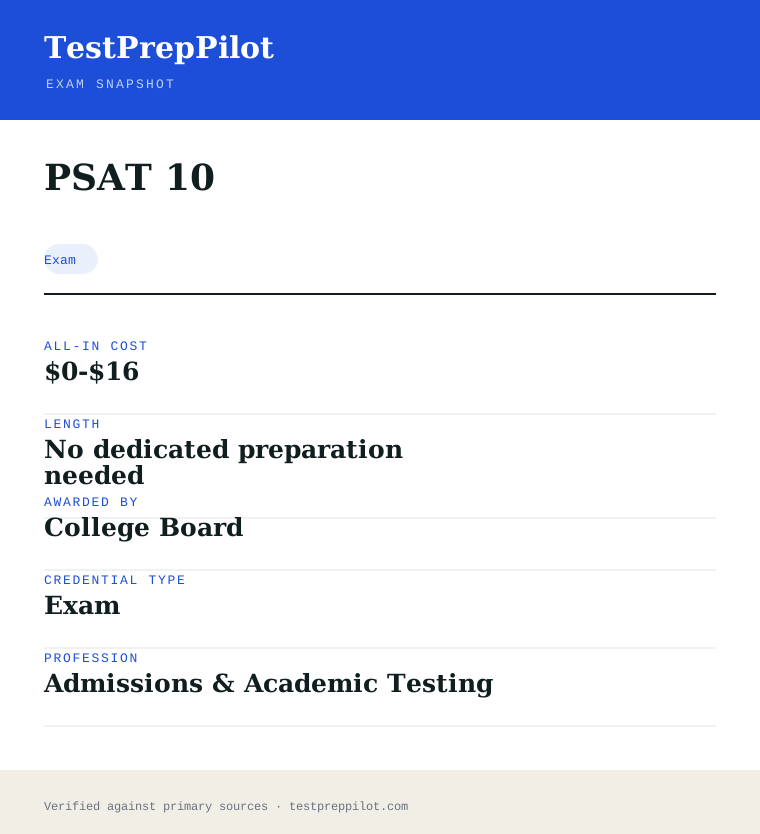
PSAT 10 is a exam credential; awarded by College Board; the exam fee is ~$18; typical preparation is No dedicated preparation needed; holders typically earn Diagnostic - readiness benchmark, no direct wage mapping.
| Credential | PSAT 10 |
|---|---|
| Type | Exam |
| Profession | Admissions & Academic Testing |
| Specialty | College Admissions |
| Awarded by | College Board |
| Difficulty | Moderate |
| Typical prep time | No dedicated preparation needed |
| All-in cost | $0-$16 |
| Typical salary range | Diagnostic - readiness benchmark, no direct wage mapping |
| Format | Digital and adaptive, delivered in Bluebook at school |
| Score scale | 320 to 1520 total; sections 160 to 760 |
| National Merit | Not eligible; diagnostic only |
| Admin | Ordered and administered by the school in spring |
| Score release | About two to three weeks after testing |
| Scope | National / Multi-state |
Real questions
Frequently asked questions about the PSAT 10
Does the PSAT 10 affect college admission?
No. Colleges never see PSAT 10 scores and it carries no scholarships. It is a baseline and a rehearsal for the SAT.
How is the PSAT 10 different from the PSAT/NMSQT?
Same format and 320 to 1520 scale, but the PSAT 10 is given in the spring of tenth grade and does not enter National Merit. The PSAT/NMSQT is the autumn junior-year test that does.
How do I sign up?
PSAT 10 is a no-stakes diagnostic with no scholarship or admissions use - the score report's skill breakdown sets the study agenda for the SAT.
Should my child prepare for the PSAT 10?
Beyond a run through the Bluebook practice interface, no. The point is an honest baseline before junior year.
What comes after the PSAT 10?
Most students take the PSAT/NMSQT in eleventh grade for National Merit, then the SAT. Because all share one scale, progress is directly measurable.
Why do all four SAT Suite tests take the same 2 hours 14 minutes?
Since the digital transition every assessment in the suite uses the same blueprint: 54 Reading and Writing questions in two 32-minute modules and 44 Math questions in two 35-minute modules. Difficulty is calibrated to the grade band rather than by adding or removing time.
Can I take an SAT Suite test at home?
No. Unlike some other admissions tests, every College Board digital assessment must be taken in a supervised school or test centre, even though it runs on your own device.
How do fee waivers work?
US students in eleventh or twelfth grade who meet income eligibility get SAT fee waivers from their school counsellor. A waiver covers the registration fee, waives cancellation and late fees, and gives unlimited free score reports to colleges.
In short
Is the PSAT 10 worth it?
- Spring tenth-grade SAT Suite test, same 2h 14m format
- Scored 320 to 1520, no National Merit stakes
- School-administered; register through your counselor
- About 16 dollar list price, often free to the student
Same awarding body
What other credentials does College Board award?
Worth comparing
How does the PSAT 10 compare with similar credentials?
Trust
Where does this information come from?
Everything above is taken from the awarding body's own published material. Fees, question counts and domain weights are revised regularly — check the official page before you pay.
- College Board Awarding body
- Official PSAT 10 exam page Exam page
Research confidence: high · Last reviewed 2026-08