The short version
What is the SAT and is it worth it?
The SAT is a digital, adaptive college-admission test of reading, writing and math, scored 400 to 1600, taken on a laptop or tablet at a school or weekend test centre, accepted by every US four-year college and used for admission, placement and scholarships.
- Accepted by every four-year college in the US and recognised by many abroad
- Fully digital and adaptive, so it finishes in a shorter 2 hours 14 minutes
- Built-in Desmos calculator and formula sheet remove the memorisation tax
- Free, official full-length practice inside Bluebook and on Khan Academy
What is it?
What exactly is the SAT?
The digital, adaptive SAT is the most widely used US college admissions test, scored 400 to 1600 across Evidence-Based Reading and Writing and Math.
The SAT is the most widely taken college-admission test in the United States, owned by the College Board and delivered digitally and adaptively through the Bluebook application since spring 2024. It measures the reading, writing and math skills built across high school using 98 questions split into two sections, each delivered in two adaptive modules that adjust difficulty to the test taker. The SAT reports a 400 to 1600 total built from a 200 to 800 Evidence-Based Reading and Writing section and a 200 to 800 Math section, and most selective colleges now accept it test-optional while still using strong scores for admission, placement, scholarships and merit aid. Scores are valid indefinitely, although colleges usually prefer a result from within the last five years.
The path in brief
- Build reading and math fundamentals in grades 9 and 10
- Take the PSAT/NMSQT in grade 11 for a National Merit baseline
- Register for a weekend SAT date in the spring of grade 11
- Retake in the autumn of grade 12 to superscore
- Send four free score reports, then additional sends as needed
Before you book
Who is eligible to sit the SAT?
Typically 11th-12th graders applying to college
Who it is for: High-school juniors and seniors applying to college
The test itself
What is the format of the SAT?
The SAT is administered by College Board and runs 2 hr 14 min and contains 152 questions.
| Administered by | College Board |
|---|---|
| Questions | 152 |
| Time limit | 2 hr 14 min |
| Pass mark | No pass mark; 400 to 1600 total |
| Exam fee | $69 |
| Format | Digital, adaptive, two modules per section, on Bluebook |
Content outline
What topics are on the SAT?
The SAT is weighted across 8 domains; the largest are Reading and Writing: Craft and Structure (28%), Reading and Writing: Information and Ideas (26%), Reading and Writing: Standard English Conventions (26%).
Weightings come from the official exam outline. Study time is best allocated in roughly these proportions rather than evenly across domains.
- Reading and Writing: Craft and Structure 28%
Words in context, text structure and purpose, cross-text connections
- Reading and Writing: Information and Ideas 26%
Central ideas, command of textual and quantitative evidence, inferences
- Reading and Writing: Standard English Conventions 26%
Boundaries, form, structure and sense
- Reading and Writing: Expression of Ideas 20%
Transitions and rhetorical synthesis
- Math: Algebra 35%
Linear equations, functions, systems and inequalities
- Math: Advanced Math 35%
Equivalent expressions, nonlinear equations and functions
- Math: Problem-Solving and Data Analysis 15%
Ratios, percentages, distributions, probability, inference
- Math: Geometry and Trigonometry 15%
Area and volume, lines and angles, right triangles, circles
Money & time
How much does the SAT cost?
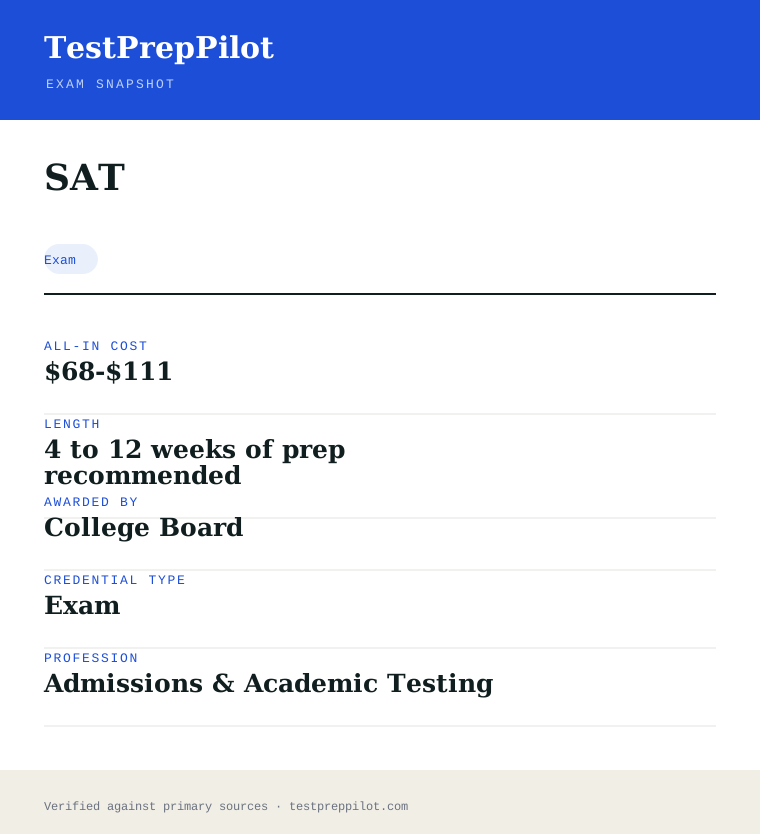
For the SAT, the exam fee is $69; the all-in cost is typically $68-$111; most candidates spend 4 to 12 weeks of prep recommended preparing.
Cost breakdown
| SAT registration (US) | $68 |
|---|---|
| International regional fee | $43 |
| Late registration | $38 |
| Change of test centre | $34 |
| Additional score reports | $14 each |
| Typical total | $68-$111 in the US |
Fee-waiver students in the US register free and get unlimited free score sends.
Timeline
- First sitting spring of grade 11
- Superscore retake autumn of grade 12
- Scores valid no expiry; colleges prefer within 5 years
Typical prep: 4 to 12 weeks of prep recommended
The path
How do you register for the SAT?
- 1
Create a College Board account10 minutes
Register at collegeboard.org with your legal name exactly as it appears on the photo ID you will bring on test day. One account covers the SAT, the PSAT-related assessments, AP and BigFuture.
- 2
Choose a weekend SAT date or let your school register you20 minutes
The SAT is booked directly by the student for weekend national administrations. PSAT 8/9, PSAT 10 and the PSAT/NMSQT are ordered and scheduled by the school, so for those you speak to your counselor rather than registering yourself.
- 3
Pay the fee or claim a fee waiver5 minutes
The US SAT registration fee is 68 dollars; international test takers add a regional fee of 43 dollars and, at some centres, a further test centre fee. Eligible US students get the SAT free through a counsellor-issued fee waiver, which also unlocks unlimited free score sends.
- 4
Install Bluebook and complete exam setup30 minutes
Download the free Bluebook app to your own laptop or tablet, or use a school-managed device, then run exam setup in the five days before test day to download the test and get your admission ticket.
Students who skip exam setup can be turned away or delayed at check-in.
- 5
Practise with Bluebook full-length tests and Khan Academy4 to 12 weeks
Six free adaptive full-length practice tests sit inside Bluebook, and Official Digital SAT Prep on Khan Academy is free and keyed to the same content domains.
- 6
Test, then review scores onlinetest day
Arrive with your admission ticket, acceptable photo ID and a charged device. Scores post to your College Board account, typically within about two weeks for weekend SAT dates.
The fine print
What are the retake and renewal rules for the SAT?
- Proctoring & delivery
- All SAT Suite tests are taken in Bluebook on a laptop or tablet, in a school or an authorised weekend test centre, under a live human proctor. There is no at-home option. Bluebook locks the device, and a built-in Desmos graphing calculator and formula sheet are available throughout the Math section; you may also bring your own approved non-CAS calculator.
- Retake policy
- There is no limit on SAT attempts and no mandatory waiting period beyond the eight national dates offered each year. The PSAT-related assessments are given once per school year per grade band and are not retaken on demand. Most selective colleges superscore across SAT sittings, taking your best Reading and Writing score and your best Math score.
- Score reporting
- The SAT reports a 400 to 1600 total built from two 200 to 800 section scores. The PSAT/NMSQT and PSAT 10 report 320 to 1520 with 160 to 760 sections, and the PSAT 8/9 reports 240 to 1440 with 120 to 720 sections, so results across the suite sit on one comparable scale. PSAT/NMSQT reports also carry an NMSC Selection Index of 48 to 228.
- Recertification
- SAT Suite scores do not expire and never need renewal, but colleges commonly ask for a score from within the last five years and most students test in the spring of eleventh grade and again in the autumn of twelfth grade. Only a PSAT/NMSQT taken in eleventh grade enters the National Merit competition.
- Refunds & rescheduling
- Cancelling an SAT registration by the change deadline costs 34 dollars; cancelling after the deadline but before test day costs 44 dollars. Changing test centre costs 34 dollars, and late registration costs 38 dollars. Fee-waiver students are not charged for cancellation or late registration.
Context
The digital SAT Suite compared
| Assessment | Grades | Score scale | Length | |
|---|---|---|---|---|
| PSAT 8/9 | 8 and 9 | 240 to 1440 | 2h 14m | |
| PSAT 10 | 10 (spring) | 320 to 1520 | 2h 14m | |
| PSAT/NMSQT | 10 and 11 (autumn) | 320 to 1520 | 2h 14m | |
| SAT | 11 and 12 | 400 to 1600 | 2h 14m |
What it pays
How much does this credential pay?
The SAT gates college access, and degree-level earnings dominate the data: bachelor-degree median weekly earnings were $1,543 in 2024 (BLS)
The SAT is an admissions test, not a job credential, so no BLS SOC code corresponds to a score. The earnings case runs through college completion, and the BLS evidence is unambiguous: in 2024, full-time workers age 25 and older with a bachelor degree earned median weekly wages of $1,543, versus $1,109 with an associate degree and $998 with a high-school diploma alone. Annualized, the bachelor-level median is roughly $80,000, and the gap compounds over a career. The SAT matters to this picture because it is the most widely used standardized measure in undergraduate admissions, and for many students it directly affects both admission outcomes and merit-aid packages: thousands of colleges use SAT scores in scholarship formulas, and a strong score can reduce net cost by tens of thousands of dollars over four years. It is equally true that the admissions landscape has shifted: hundreds of colleges are test-optional, and the University of California system does not use the SAT at all, so the test is a lever rather than a universal gate. The honest framing for families is that the SAT is worth preparing for seriously when target schools use it for admission or aid, and that the economic payoff the data actually supports is degree completion, not the score itself. BLS classifies workers by occupation and credential, not test scores, so no SAT percentile maps to a salary; the connection runs through the college outcomes the score helps produce.
| Measure | Figure | Source / note |
|---|---|---|
| Bachelor-degree median weekly earnings, 2024 | $1,543 | BLS, workers 25+, full time |
| Associate-degree median weekly earnings, 2024 | $1,109 | BLS, workers 25+, full time |
| High-school diploma median weekly earnings, 2024 | $998 | BLS, workers 25+, full time |
| SAT score range | 400-1600 | College Board, digital SAT |
Job growth.BLS projects 3 percent overall employment growth from 2024 to 2034; the wage-by-education gradient remains the relevant comparison.
Your odds
What are the pass rates?
The SAT has no pass/fail line; scores run 400-1600, and "good" is defined by each college’s admitted-student profile
The College Board publishes no pass rate for the SAT because there is no passing score. The digital SAT is scored on a 400-1600 scale, with Reading and Writing and Math each reported 200-800. What students actually compare against are percentiles (College Board publishes national percentiles by cohort) and each college’s middle-50% score range, which is the band spanning the 25th to 75th percentile of admitted students. A commonly cited benchmark is 1050 (roughly the national median), while competitive four-year colleges typically admit students with middle-50% ranges from about 1200 to 1450, and highly selective programs often see 1450-1550. College Board also provides benchmark scores linked to college readiness (evidence-based reading/writing and math benchmarks tied to first-year course success). Because the score scale is stable, students can set targets by researching their target schools’ published ranges rather than by chasing an arbitrary number. The exam is adaptive: each section’s second module routes to harder or easier items based on first-module performance, which means the difficulty a student sees varies while the score scale stays comparable. There is also no "fail and wait" retake penalty beyond the practical rule that most students take the SAT two or three times; College Board does not impose a limit on the number of sittings, and score choice lets students send only their best scores to most colleges. The honest takeaway: prepare for a target score derived from your college list, not for a pass line that does not exist.
Read this before quoting the number.No pass rate exists; targets come from college middle-50% ranges and national percentiles.
Your schedule
How long should I study for it?
60-100 hours over 8-12 weeks of focused study
The digital SAT runs about 2 hours 14 minutes and contains 98 Reading and Writing questions (two 32-minute modules) and 54 Math questions (two 35-minute modules), all delivered in the Bluebook app with adaptive routing. A serious plan runs 60-100 hours over 8-12 weeks for students starting near the national median and aiming for competitive colleges. Week 1: take the official full-length practice test in Bluebook to establish a baseline and a skill-tagged error log. Weeks 2-4: drill the highest-yield Reading and Writing domains - Standard English Conventions (grammar and punctuation, the most trainable score), Expression of Ideas (transitions and rhetorical synthesis), and Craft and Structure (words in context and text structure) - using Khan Academy’s free Official Digital SAT Prep, which is built in partnership with College Board. Weeks 5-7: shift to Math, covering Algebra (linear equations and systems), Advanced Math (quadratics and exponentials), Problem-Solving and Data Analysis (ratios, percentages, statistics), and Geometry and Trigonometry, with daily Desmos calculator fluency practice because the built-in calculator is always available. Weeks 8-10: timed section practice with full-length tests in Bluebook; the adaptive design means students must learn to protect accuracy in module 1, which determines module-2 difficulty. Weeks 11-12: two full timed tests per week, error retakes, and test-day logistics (sleep, check-in, Bluebook device setup). Students should also confirm whether their target schools are test-optional and whether they superscore, because that changes how many sittings to budget.
- Week 16
Baseline
- Official Bluebook practice test
- Skill-tagged error log
- Weeks 2-424
Reading & Writing domains
- Standard English Conventions drills
- Craft and Structure practice
- Weeks 5-730
Math domains
- Algebra and Advanced Math
- Desmos calculator fluency
- Weeks 8-1024
Timed sections
- Full timed sections weekly
- Adaptive module pacing
- Weeks 11-1216
Full tests and logistics
- Two full tests per week
- Error retakes and logistics
Adjusting the pace
Test-optional strategy.If target schools do not require scores, weigh the score’s likely aid value before investing hundreds of hours.
Accommodations.Students with documented needs apply through the College Board SSD portal well before registration deadlines.
How to study
How do I prepare most effectively?
The digital SAT rewards a small number of high-leverage habits. Strategy one: train in Bluebook from day one. The adaptive routing, built-in Desmos calculator, annotation tools and module timers are part of the test; students who practice on paper or third-party apps learn the wrong pacing. Strategy two: win module 1. Because module 2 difficulty is set by module 1 performance, careless errors in module 1 cap the achievable score; accuracy in the first module is worth more than speed in the second. Strategy three: exploit the grammar trainability of Standard English Conventions. These items (subject-verb agreement, verb tense, pronoun reference, punctuation, parallel structure) follow fixed rules and are the fastest score gains in the whole test. Strategy four: use official materials almost exclusively - Bluebook practice tests and Khan Academy’s Official Digital SAT Prep - because only College Board items match the question style; third-party banks over-represent easy items and misrepresent the adaptive format. Strategy five: manage the selection of sittings strategically; most students improve most between tests 1 and 2, and many colleges superscore, so plan two or three sittings and send only the best score. Strategy six: protect sleep and build a fixed pre-test routine, since a 2-hour 14-minute adaptive test is an endurance event as much as a knowledge test.
Practice only in Bluebook
The adaptive app is the test; paper practice teaches the wrong pacing.
Protect module 1 accuracy
Module-1 performance sets module-2 difficulty and your ceiling.
Mine the grammar section
Standard English Conventions are the most trainable items on the exam.
Use official materials
Khan Academy + Bluebook; third-party banks drift from the real style.
Plan multiple sittings
Most gains come between tests 1 and 2; superscoring favors retakes.
What to buy
Which study resources are worth paying for?
The digital SAT prep market has a clear official core and a noisy paid periphery. Free and official first: Bluebook contains full-length adaptive practice tests, and Khan Academy’s Official Digital SAT Prep is free, built with College Board, skill-tagged, and the single best instructional resource; together they cover format, content and practice. The College Board website adds a free practice-question bank and the SAT Student Guide PDF. On the paid side, the major test-prep companies sell books ($15-$40) and courses ($200-$2,000) whose main value is structure and accountability rather than content, since the official question pool is owned by College Board. Many school districts offer free in-school SAT prep or fee waivers for low-income students, including free official practice tests and free college applications through College Board’s fee-waiver program, which also waives the SAT fee itself. Tutoring ($50-$200/hour) is most defensible for students with a specific weak domain or high target-score gap. The honest ranking: official free resources first, a book for structure, a course or tutor only when accountability or a specific weakness justifies the cost. Prices here are current as of the 2025-26 testing year and change annually.
| Resource | Price | Format | Best for |
|---|---|---|---|
| Bluebook official practice tests | Free | Digital adaptive app | The exact interface; use 4+ tests |
| Khan Academy Official Digital SAT Prep | Free | Web/mobile course | Skill-by-skill instruction and drills |
| Official practice-question bank | Free | Online | Targeted domain practice |
| Commercial prep book | $15-$40 | Structure and review | |
| Course or tutor | $200-$2,000 | Live/on-demand/1:1 | Accountability and targeted gaps |
Prices dated 2025-26; College Board and Khan Academy provide the only official digital-prep content. No commission-based ranking.
Avoid these
What mistakes do candidates most often make?
The most common SAT mistakes are format-driven. Mistake one: practicing on paper or third-party apps and never learning Bluebook’s adaptive routing; students routinely lose points on module 2 that their skill level should have earned because they misjudge pacing in the real interface. Mistake two: treating the calculator as an afterthought; the built-in Desmos tool is always available, and fumbling with it during the exam is a silent time leak. Mistake three: grinding vocabulary lists; the digital test emphasizes words in context, and memorized definitions misfire on nuance questions. Mistake four: ignoring the grammar domain because it feels like a small share of the test; Standard English Conventions are the most trainable items and typically repay hours better than any reading strategy. Mistake five: over-relying on a single sitting; most students improve meaningfully between test 1 and test 2, and score choice plus superscoring make retakes a rational strategy. Mistake six: ignoring the research that many target schools are test-optional; families who assume the SAT is mandatory sometimes over-invest, while families who ignore it sometimes leave merit aid on the table - the right move is to check each college’s policy before deciding how many hours to spend.
✕Practicing off-interface
✓Do timed practice in Bluebook from the first week.
✕Ignoring the Desmos calculator
✓Practice the built-in tool in every session.
✕Grinding vocabulary lists
✓Practice words in context through Craft and Structure items.
✕Skipping grammar drills
✓Standard English Conventions are the fastest score gains.
✕Assuming one sitting is enough
✓Plan 2-3 sittings; superscoring rewards retakes.
What you'll face
What question types will I see?
The digital SAT has two sections. Reading and Writing: 98 questions in 64 minutes (two 32-minute modules), testing Information and Ideas (main idea, inference, evidence support), Craft and Structure (words in context, text structure, cross-text connections), Expression of Ideas (transitions, rhetorical synthesis), and Standard English Conventions (grammar, punctuation, usage). Math: 54 questions in 70 minutes (two 35-minute modules), spanning Algebra, Advanced Math, Problem-Solving and Data Analysis, and Geometry and Trigonometry; a calculator is allowed throughout, and the Desmos graphing calculator is built into Bluebook. All items are four-option multiple choice, and both sections use adaptive routing. The total score runs 400-1600. Samples below are editor-written illustrations of the published skill domains, not live exam items.
Information, Craft & Structure, Expression, Conventions.
Algebra, Advanced Math, Problem-Solving & Data, Geometry.
Try these
Q1The passage describes a tidepool ecosystem in which sea stars keep mussel populations in check. Which finding would most directly challenge the author’s claim that sea stars are the keystone species?
Answer:B
The claim is that sea stars are the keystone control on mussels. Finding B weakens the claim by showing other predators share that role, so the keystone status is not exclusive.
Q2If 5x - 2 = 3x + 8, what is the value of x?
Answer:B
Subtract 3x from both sides: 2x - 2 = 8. Add 2: 2x = 10. Divide by 2: x = 5.
Q3The researchers found that the new process cut energy use by 18 percent, yet the plant manager questioned whether the savings were ______ because the test ran for only one week. Which choice completes the text with the most logical and precise word?
Answer:A
The manager’s concern is that a one-week test may not prove the savings persist; "durable" captures that concern most precisely.
Samples are editor-written illustrations of the published skill domains, not live exam items.
The big day
What should I expect on exam day?
The digital SAT is administered on scheduled national test dates, typically seven per year (August, October, November, December, March, May, June), at school and testing-center sites, and registration closes about four weeks before each date with late registration available for a fee. On test day, students check in with a printed or digital admission ticket and a valid photo ID; the exam runs on Bluebook, so students must bring a fully charged laptop or approved device with the Bluebook app installed, or use a school-provided device where offered. No calculator is required because Desmos is built in, but a permitted handheld calculator is allowed. Phones, smartwatches and all personal electronics must be powered off and stored in a bag at the front of the room. The total testing time is about 2 hours 14 minutes plus breaks, and check-in can add 30-45 minutes, so students should arrive by the time printed on the ticket. Students with documented disabilities must have an approved College Board SSD accommodation, applied for well in advance. Scores post in the student’s College Board account roughly two weeks after the test date, and students can choose which scores to send to colleges (score choice), with most colleges also superscoring across sittings. Afterwards, students should review the score report’s skill breakdown to plan any retake, and verify each college’s score-sending and superscore policy.
Bring
- Printed or digital admission ticket
- Valid photo ID
- Fully charged device with Bluebook installed
- Approved calculator if desired (Desmos is built in)
Leave at home
- Phone, smartwatch, and personal electronics
- Notes, books, or formula sheets
- Food and drink (site-dependent breaks)
How the day runs
Rules in the room
- The exam runs in Bluebook; answers are entered digitally.
- Personal electronics must be powered off and stowed.
- Desmos is built into Bluebook; handheld calculators are optional.
- Accommodations must be pre-approved through College Board SSD.
Afterwards.Scores post in about 2 weeks with skill breakdowns; use score choice and verify each college’s superscore policy, then plan any retake.
Reference
What are the key facts about the SAT?
SAT is a exam credential; awarded by College Board; the exam fee is $69; typical preparation is 4 to 12 weeks of prep recommended; holders typically earn College-path benchmark: bachelor-degree median ~$80,000/yr (BLS 2024).
| Credential | SAT |
|---|---|
| Abbreviation | SAT |
| Type | Exam |
| Profession | Admissions & Academic Testing |
| Specialty | College Admissions |
| Awarded by | College Board |
| Difficulty | Moderate to high |
| Typical prep time | 4 to 12 weeks of prep recommended |
| All-in cost | $68-$111 |
| Typical salary range | College-path benchmark: bachelor-degree median ~$80,000/yr (BLS 2024) |
| Format | Digital and adaptive, taken on a laptop or tablet in Bluebook under a live proctor |
| Sections | Reading and Writing (200 to 800) and Math (200 to 800) |
| Score scale | 400 to 1600 total, with subscores and cross-test scores reported |
| Score release | About two weeks after a weekend test date |
| Score sends | Four free reports at registration, then a fee per extra send |
| Scope | National / Multi-state |
| Also known as | Digital SAT, Scholastic Assessment Test |
Real questions
Frequently asked questions about the SAT
Is the SAT still required for college?
Most US colleges are test-optional, meaning you choose whether to submit scores, but a strong SAT still helps with admission, placement, scholarships and some state aid. Submit it when it strengthens your application.
How is the digital SAT different from the old paper one?
It is shorter (2 hours 14 minutes), taken on a device in Bluebook, adaptive by module, and includes a built-in Desmos calculator and formula sheet for Math. The 400 to 1600 scale is unchanged.
What is a good SAT score?
There is no passing score - targets come from each college's admitted-student range, and Score Choice lets you send only your best scores.
Can I superscore the SAT?
Yes. Most colleges superscore, taking your best Reading and Writing and best Math scores across sittings to form a highest possible total.
Should I take the SAT or the ACT?
Both are accepted equally. Do a timed practice of each; the digital SAT gives more time per question and allows a calculator throughout Math, while the ACT has a faster pace and, in its enhanced form, optional science.
Why do all four SAT Suite tests take the same 2 hours 14 minutes?
Since the digital transition every assessment in the suite uses the same blueprint: 54 Reading and Writing questions in two 32-minute modules and 44 Math questions in two 35-minute modules. Difficulty is calibrated to the grade band rather than by adding or removing time.
Can I take an SAT Suite test at home?
No. Unlike some other admissions tests, every College Board digital assessment must be taken in a supervised school or test centre, even though it runs on your own device.
How do fee waivers work?
US students in eleventh or twelfth grade who meet income eligibility get SAT fee waivers from their school counsellor. A waiver covers the registration fee, waives cancellation and late fees, and gives unlimited free score reports to colleges.
In short
Is the SAT worth it?
- Digital, adaptive, 98 questions, 2 hours 14 minutes on Bluebook
- Scored 400 to 1600 from two 200 to 800 section scores
- Accepted by every US four-year college and many abroad
- $68 in the US; free for eligible waiver students
Worth comparing
How does the SAT compare with similar credentials?
Trust
Where does this information come from?
Everything above is taken from the awarding body's own published material. Fees, question counts and domain weights are revised regularly — check the official page before you pay.
- College Board Awarding body
- Official SAT exam page Exam page
Research confidence: high · Last reviewed 2026-08