Admissions & Academic Testing • Exam
AP European History
Cover European history from 1450 to today for college history credit.
Researched and maintained by TestPrepPilot Editorial BoardAdvanced Placement & college-credit desk · Figures last verified August 2026
The short version
What is the AP European History and is it worth it?
AP European History is a fully digital exam: 55 multiple-choice questions, three short-answer questions, a document-based question, and a long essay. Scored 1-5, a 3 generally earns European-history credit.
- Equivalent to a college survey of European history
- Builds document analysis and essay skills
- Fully digital in Bluebook
- Strong humanities and pre-law preparation
What is it?
What exactly is the AP European History?
Cover European history from 1450 to today for college history credit.
AP European History is a fully digital exam spanning roughly 1450 to the present. It pairs 55 multiple-choice questions and three short-answer questions with a document-based question and a long essay that test historical reasoning. A 3 typically earns credit for a Western-civilization or European-history survey at public universities.
The path in brief
- Join AP Euro via My AP
- Study the 9 units chronologically
- Practice DBQ and LEQ essays
- Use AP Classroom progress checks
- Sit the fully digital exam in May
Before you book
Who is eligible to sit the AP European History?
Who it is for: High-school students interested in history and the humanities
The test itself
What is the format of the AP European History?
The AP European History is administered by School-administered via Bluebook and runs 3 hours 15 minutes, contains 55 MCQ + 3 SAQ + DBQ + LEQ questions and requires 3 (1-5 scale) to pass.
| Administered by | School-administered via Bluebook |
|---|---|
| Questions | 55 MCQ + 3 SAQ + DBQ + LEQ |
| Time limit | 3 hours 15 minutes |
| Pass mark | 3 (1-5 scale) |
| Exam fee | $99 (US) / $129 (intl) |
| Format | Fully digital |
Content outline
What topics are on the AP European History?
The AP European History is weighted across 9 domains; the largest are Unit 1: Renaissance and Exploration (10-15%), Unit 2: Age of Reformation (10-15%), Unit 3: Absolutism to Enlightenment (10-15%).
Weightings come from the official exam outline. Study time is best allocated in roughly these proportions rather than evenly across domains.
- Unit 1: Renaissance and Exploration 10-15%
c. 1450-1648
- Unit 2: Age of Reformation 10-15%
c. 1450-1648
- Unit 3: Absolutism to Enlightenment 10-15%
c. 1648-1815
- Unit 4: 19th-Century Revolution 10-15%
c. 1815-1914
- Unit 5: Conflict and Crisis 10-15%
c. 1914-1950
- Unit 6: Cold War and Unification 10-15%
c. 1945-2000
- Unit 7: 20th-Century Culture 10-15%
c. 1914-2000
- Unit 8: 21st Century 10-15%
c. 2000-present
- Unit 9: Global Interactions 10-15%
Cross-unit themes
Study materials
Which study guide should you use for the AP European History?
Start with the exam sponsor's official content outline. If you also want one structured resource to work through, these are the Mometrix titles that match this exam.

This links to Mometrix's AP range rather than a single AP European History title. Check that it lists an edition for AP European History before you buy.
Affiliate links We may earn a commission if you buy through these links, at no extra cost to you. Mometrix has no say in what our exam guides cover. How we make money.
Money & time
How much does the AP European History cost?
For the AP European History, the exam fee is $99 (US) / $129 (intl); the all-in cost is typically $99-$169; most candidates spend 1 school year preparing.
Cost breakdown
| AP exam fee (US, territories, Canada, DoDEA) | $99 |
|---|---|
| AP exam fee (international) | $129 |
| Late order or unused/canceled exam | $40 |
| Fee reduction for eligible students | -$37 |
| Prep materials (optional) | $0-$40 |
| Typical total | $99 US / $129 intl (eligible students pay ~$53 / ~$83); late or canceled adds $40 |
Fees are the 2025-26 AP charges. Schools may add a local administrative fee; the College Board fee reduction lowers the base by $37.
Timeline
- Enroll in the AP course Fall
- Study the nine units in order Aug-May
- Practice DBQ and LEQ essays 2-3 months
- Take the digital exam May
- Receive scores Early July
Typical prep: 1 school year
The path
How do you register for the AP European History?
- 1
Create a College Board account10 minutes
Register at collegeboard.org with your legal name exactly as it appears on the photo ID you will bring on test day. One account covers the SAT, the PSAT-related assessments, AP and BigFuture.
- 2
Choose a weekend SAT date or let your school register you20 minutes
The SAT is booked directly by the student for weekend national administrations. PSAT 8/9, PSAT 10 and the PSAT/NMSQT are ordered and scheduled by the school, so for those you speak to your counselor rather than registering yourself.
- 3
Pay the fee or claim a fee waiver5 minutes
The US SAT registration fee is 68 dollars; international test takers add a regional fee of 43 dollars and, at some centres, a further test centre fee. Eligible US students get the SAT free through a counsellor-issued fee waiver, which also unlocks unlimited free score sends.
- 4
Install Bluebook and complete exam setup30 minutes
Download the free Bluebook app to your own laptop or tablet, or use a school-managed device, then run exam setup in the five days before test day to download the test and get your admission ticket.
Students who skip exam setup can be turned away or delayed at check-in.
- 5
Practise with Bluebook full-length tests and Khan Academy4 to 12 weeks
Six free adaptive full-length practice tests sit inside Bluebook, and Official Digital SAT Prep on Khan Academy is free and keyed to the same content domains.
- 6
Test, then review scores onlinetest day
Arrive with your admission ticket, acceptable photo ID and a charged device. Scores post to your College Board account, typically within about two weeks for weekend SAT dates.
The fine print
What are the retake and renewal rules for the AP European History?
- Proctoring & delivery
- All SAT Suite tests are taken in Bluebook on a laptop or tablet, in a school or an authorised weekend test centre, under a live human proctor. There is no at-home option. Bluebook locks the device, and a built-in Desmos graphing calculator and formula sheet are available throughout the Math section; you may also bring your own approved non-CAS calculator.
- Retake policy
- There is no limit on SAT attempts and no mandatory waiting period beyond the eight national dates offered each year. The PSAT-related assessments are given once per school year per grade band and are not retaken on demand. Most selective colleges superscore across SAT sittings, taking your best Reading and Writing score and your best Math score.
- Score reporting
- The SAT reports a 400 to 1600 total built from two 200 to 800 section scores. The PSAT/NMSQT and PSAT 10 report 320 to 1520 with 160 to 760 sections, and the PSAT 8/9 reports 240 to 1440 with 120 to 720 sections, so results across the suite sit on one comparable scale. PSAT/NMSQT reports also carry an NMSC Selection Index of 48 to 228.
- Recertification
- SAT Suite scores do not expire and never need renewal, but colleges commonly ask for a score from within the last five years and most students test in the spring of eleventh grade and again in the autumn of twelfth grade. Only a PSAT/NMSQT taken in eleventh grade enters the National Merit competition.
- Refunds & rescheduling
- Cancelling an SAT registration by the change deadline costs 34 dollars; cancelling after the deadline but before test day costs 44 dollars. Changing test centre costs 34 dollars, and late registration costs 38 dollars. Fee-waiver students are not charged for cancellation or late registration.
Context
The digital SAT Suite compared
| Assessment | Grades | Score scale | Length | |
|---|---|---|---|---|
| PSAT 8/9 | 8 and 9 | 240 to 1440 | 2h 14m | |
| PSAT 10 | 10 (spring) | 320 to 1520 | 2h 14m | |
| PSAT/NMSQT | 10 and 11 (autumn) | 320 to 1520 | 2h 14m | |
| SAT | 11 and 12 | 400 to 1600 | 2h 14m |
What it pays
How much does this credential pay?
AP European History has no direct salary outcome — its value is college credit and placement, and the earnings impact flows through the bachelor’s-degree premium and the writing, analysis and research skills the humanities majors it feeds into reward in the labour market.
The direct salary answer for AP European History is the college-credit story shared by every AP exam: the BLS does not publish a wage for AP scores because the AP program is a college-credit and placement system, not a job credential, so the earnings context is the education-return premium — workers with a bachelor’s degree earn substantially more over a career than high-school-only workers — plus the specific value of clearing a college history or social-science requirement before arriving on campus. AP European History covers roughly 575 years of European history from c. 1450 to the present, organised into nine units across four chronological periods, and a qualifying score of 3 or higher commonly earns credit toward or placement out of an introductory European-history or Western-civilization survey course, which matters for students in the humanities, social sciences, international relations, law-track and education programs that either require or reward the course. The exam itself is 3 hours 15 minutes: 55 multiple-choice questions in 55 minutes, 3 short-answer questions in 40 minutes, a document-based question in 60 minutes and a long-essay question in 40 minutes, scored 1-5. The honest caveat is the usual one: credit policies vary by college, with some selective schools capping or declining AP history credit and a few awarding it only for a 4 or 5, so the score’s value depends on the specific institution’s AP credit table, which candidates should check before banking on credit. The exam also rewards the source-analysis and essay-writing skills that transfer directly to college humanities work, which is part of its real value beyond the credit line.
| Measure | Figure | Source / note |
|---|---|---|
| Score scale | 1-5 | 3+ typically qualifies for credit; 4-5 at selective schools |
| Exam length | 3h15m | 55 MC (55 min) + 3 SAQs (40 min) + DBQ (60 min) + LEQ (40 min) |
| Content span | c. 1450-present | Nine units across four chronological periods |
| Salary impact | Indirect | College credit and placement; humanities writing and analysis skills |
Job growth.AP European History volume tracks the growth of the AP program, and the exam remains one of the most-taken history APs; the College Board reports multi-million total AP administrations per year.
Your odds
What are the pass rates?
The College Board publishes AP European History score distributions, not pass rates; in the 2025 administration 72% of test-takers scored 3 or higher, with the 5 rate at 13% — one of the lowest of any AP exam.
The direct answer on pass rates requires precision: the College Board does not publish a "pass rate" for AP exams because scores are reported on a 1-5 scale and each college defines what score qualifies for credit, but it does publish the annual score distribution, and that is the closest published statistic. For AP European History, the 2025 distribution was 13% scoring 5, 35% scoring 4, 24% scoring 3, 19% scoring 2 and 9% scoring 1, which puts 72% of test-takers at 3 or higher — a healthy qualifying rate but one carried by the very large 4 band, while the 5 rate of 13% is among the lowest of any AP exam and reflects an essay-heavy paper that rewards sustained source-analysis and writing skill. The structure is fixed and published: 3 hours 15 minutes total, with 55 multiple-choice questions in 55 minutes (40 percent of the score), 3 short-answer questions in 40 minutes (20 percent), a document-based question in 60 minutes (25 percent) and a long-essay question chosen from three prompts in 40 minutes (15 percent). The practical read on difficulty: the essay sections decide the top scores, and candidates who practise the DBQ’s source-analysis structure — thesis, use of the documents, outside evidence and reasoning — score measurably higher than candidates who know the content but write unstructured essays. Because the credit value depends on the college’s policy, check the target institutions’ AP credit tables before deciding whether a 3 suffices or a 4 or 5 is required, and drill the past free-response questions with their scoring guidelines, since the essays carry 60 percent of the exam.
Read this before quoting the number.The College Board publishes score distributions, not pass rates; whether a 3, 4, or 5 "passes" depends on each college’s AP credit policy. The 2025 figures above are 13/35/24/19/9 with 72% at 3+, and percentages shift by year — the College Board’s annual report is authoritative.
Source: College Board AP score distribution report and AP European History exam description
Your schedule
How long should I study for it?
60-90 hours over 10-14 weeks of focused study
An efficient AP European History study plan is 60-90 hours over 10-14 weeks, because the exam is a content-heavy breadth test with an essay component, and the fastest score gains come from building a chronological narrative across the four periods while drilling the DBQ and long-essay formats that carry 40 percent of the score. The College Board course and exam description is the scope map: nine units across four periods — c. 1450-1648 (Renaissance, Reformation), c. 1648-1815 (absolutism, the Scientific Revolution, the Enlightenment and the French Revolution), c. 1815-1914 (industrialization and 19th-century politics) and c. 1914-present (the world wars, the Cold War and contemporary Europe) — with the exam splitting into 55 multiple-choice questions in 55 minutes, 3 short-answer questions in 40 minutes, a document-based question in 60 minutes and a long-essay question in 40 minutes. The study window should split into chronological coverage (weeks 1-6), essay-format drilling (weeks 7-10) and full practice exams (weeks 11-14): candidates who take the course in school can move faster through coverage and weight time toward the essays, while self-studying candidates need the full narrative-building sequence. The DBQ rewards a specific structure — a clear thesis, explicit use of the seven documents, at least one piece of outside evidence and reasoning that connects evidence to the argument — and candidates who rehearse it against past prompts with scoring guidelines score measurably higher than candidates who describe documents without an argument. The final three weeks should be full practice exams at the real format, because the pacing across 55 questions in 55 minutes and the writing load of four essays are the two things candidates underestimate most.
- Weeks 1-37-9 hrs/week
Period 1: 1450-1648
- Build the Renaissance, exploration and the Reformation into a narrative
- Study the Wars of Religion, absolutism’s early forms and the print revolution
- Write one short timeline of causes and consequences per topic
- Weeks 4-68-10 hrs/week
Period 2: 1648-1815
- Cover absolutism versus constitutionalism, the Scientific Revolution and the Enlightenment
- Study the French Revolution, Napoleon and the Congress of Vienna
- Practise connecting Enlightenment ideas to revolutionary events
- Weeks 7-88-10 hrs/week
Period 3: 1815-1914
- Master industrialization, socialism, nationalism and 19th-century politics
- Study the unification of Germany and Italy, imperialism and the causes of 1914
- Compare isms: liberalism, conservatism, nationalism and socialism
- Weeks 9-108-10 hrs/week
Period 4: 1914-present
- Study the world wars, totalitarianism and the Holocaust
- Cover the Cold War, the welfare state, decolonization and contemporary Europe
- Link the century’s conflicts back to the earlier periods
- Weeks 11-128-10 hrs/week
DBQ and essay drilling
- Drill the DBQ structure: thesis, seven documents, outside evidence and reasoning
- Practise the long essay across all four periods using past prompts
- Drill the three SAQ types: short answers with a document, a concept and a comparison
- Weeks 13-146-8 hrs/week
Full exams and readiness
- Take two full practice exams at the real 3h15m format
- Re-lab every missed period and essay structure until clean
- Confirm exam-day logistics and registration
Adjusting the pace
Taking the course in school.Budget the lower end and weight time toward the DBQ and long-essay formats plus full practice exams, which classroom work covers least.
Self-study.Budget the upper end and add a structured review book or course; the four-period narrative is easier to build with an ordered sequence of lessons.
Strong writer, weak on content.Add two weeks of chronological coverage before the essay block; the DBQ and LEQ reward specific evidence, and general writing skill cannot substitute for knowing the period.
How to study
How do I prepare most effectively?
The dominant prep strategy for AP European History is building the chronological narrative and drilling the essay structures, because the exam rewards the ability to use specific evidence in a structured argument, and candidates who rehearse the DBQ and long-essay formats score higher than candidates who only memorise facts. First, use the College Board course and exam description as the checklist: the nine units, the four periods and the exam formats are published, and the past free-response questions with scoring guidelines show exactly how the essays are graded. Second, build the narrative period by period rather than topic by topic, because the exam rewards connecting causes and consequences across the four chronological periods — knowing why the Reformation followed the Renaissance, or how the Enlightenment fed the French Revolution, earns more than isolated facts. Third, master the DBQ structure deliberately: a clear thesis, explicit use of the seven documents with attribution, at least one piece of outside evidence and reasoning that ties each document to the argument, because that structure is the single most rehearsable high-value skill on the paper. Fourth, practise the long essay across all four periods using the past prompts, since the LEQ asks for a defensible thesis, specific evidence and reasoning without documents. Fifth, drill the three short-answer types, which reward concise, direct responses to a document, a concept and a comparison in roughly 13 minutes each. Finally, run full practice exams at the real timing and confirm the target colleges’ AP credit policies, because whether the goal is a 3 or a 5 depends on where the score is being sent.
Build the four-period narrative
Learn the chronology as a story of causes and consequences across 1450 to the present, not as isolated facts; the essays reward connecting periods.
Master the DBQ structure
Thesis, explicit use of the seven documents, outside evidence and reasoning — drill the structure against past prompts until it is automatic.
Practise the long essay across periods
The LEQ rewards a defensible thesis, specific evidence and reasoning without documents; rehearse all four periods using past prompts.
Drill the three SAQ types
Short answers on a document, a concept and a comparison, about 13 minutes each; practise concise, direct responses.
Use past FRQs and scoring guidelines
College Board materials show exactly how the essays are scored, and what separates a 3 from a 4 from a 5.
What to buy
Which study resources are worth paying for?
AP European History prep resources split into the College Board official set, review books and online courses, and the buying logic is anchored by the official materials because the College Board publishes the course and exam description, past free-response questions, scoring guidelines and sample questions for free. The official free set — the CED and the past DBQs, LEQs and SAQs with scoring guidelines — defines the content and the essay-standards precisely and should anchor every plan. Review books from major publishers, roughly $20-40, add structured period-by-period coverage and practice exams, which helps both course-takers and self-studiers, and the well-regarded options track the current nine-unit framework. Online courses and question banks, $30-100, add video instruction and document-analysis drilling, which helps self-studying candidates who want a guided narrative. The footnote that anchors the comparison: prices below are list prices as of mid-2026 and change frequently, and we rank nothing by commission. The exam fee is about $99 per AP exam, with fee reductions available for eligible students, so the total cost of AP European History is modest relative to the tuition value of the credit it can earn. A cheap readiness check is the free sample questions and one past DBQ set from the College Board before buying anything, because candidates who took the course often need only the review book plus full practice exams. Candidates should also verify the school’s AP registration process and deadline, since late-registration fees are a common avoidable cost, and confirm whether the target college grants credit for the score they are realistically aiming at.
| Resource | Price | Format | Best for |
|---|---|---|---|
| College Board official materials | Free | CED + past DBQs, LEQs and SAQs + scoring guides | The authoritative content and essay standards |
| AP European History review book | $20-40 | Book with period-by-period coverage and practice | Structured coverage for any candidate |
| Online course / question bank | $30-100 | Video + document-analysis drilling | Self-studiers wanting a guided narrative |
| AP exam registration | ~$99 | School/College Board | The real exam; fee reductions available |
List prices as of mid-2026 and change frequently; we rank nothing by commission. The AP exam fee is about $99 with reductions for eligible students.
Avoid these
What mistakes do candidates most often make?
The most common mistake on AP European History is studying facts without the chronological narrative, because the exam rewards connecting causes and consequences across the four periods, and candidates who memorise isolated names and dates lose the synthesis the essays demand. The second is writing a DBQ that describes the documents without an argument, when the scoring rewards a clear thesis supported by explicit use of the documents, outside evidence and reasoning — a document dump earns little credit. A third recurring error is skipping the outside-evidence element of the DBQ, or using evidence so vague that it does not connect to the argument. Candidates also routinely mis-time the essays, spending the whole 60-minute DBQ window on reading and then rushing the writing, when the plan should reserve most of the window for drafting the argument. Another pattern is answering the long essay with a general overview rather than a defensible thesis with specific evidence, which the LEQ scoring explicitly rewards. Finally, some candidates never run a full practice exam at the real 3h15m format, so the pace of 55 questions in 55 minutes and the writing load of four essays surprise them on test day. A further recurring error is treating the multiple-choice section as a trivia test and under-reading the stimulus passages, when roughly half the items require using the provided source to answer. A few candidates also sit without checking the target college’s credit policy, assuming a 3 is enough when the school they plan to attend requires a 4 or 5 for history credit, which turns a passing score into a wasted fee.
✕Memorising facts without the narrative
✓Build the chronology as causes and consequences across the four periods; the essays reward connecting the Reformation to the Renaissance and the Enlightenment to the French Revolution.
✕Writing a DBQ without an argument
✓Every DBQ needs a clear thesis, explicit use of the seven documents, outside evidence and reasoning; a document dump earns little credit.
✕Skipping specific outside evidence
✓The DBQ rewards at least one concrete outside-evidence point tied to the argument; rehearse attaching a named event or figure to each essay.
✕Mis-budgeting the essay windows
✓Reserve most of each essay window for drafting the argument and leave minutes for proofreading; reading the documents should not eat the writing time.
✕Answering the LEQ as an overview
✓The long essay rewards a defensible thesis with specific evidence and reasoning; practise a thesis-plus-evidence structure against past prompts.
What you'll face
What question types will I see?
The AP European History exam is 3 hours 15 minutes and scored 1-5. Section I has two parts: 55 multiple-choice questions in 55 minutes (40 percent of the score), many of them stimulus-based on passages, maps, images and data, and 3 short-answer questions in 40 minutes (20 percent) that ask for concise written responses on a document, a concept and a comparison. Section II has the two essays: a document-based question in 60 minutes (25 percent) that supplies seven documents and asks for an argument using them plus outside evidence, and a long-essay question in 40 minutes (15 percent) chosen from three prompts, answered without documents. The samples below illustrate three formats: a stimulus-based MC item, an SAQ illustration and a DBQ illustration. The sample items are editor-written illustrations of the published format, not live test items. The exam is fully digital in the current administration — all multiple-choice and free-response work is completed in the Bluebook testing app — so candidates should rehearse reading and writing on screen, including the document sources that appear in the DBQ window. Because the essays carry 60 percent of the score, candidates who practise the DBQ and LEQ structures against the past-FRQ materials with scoring guidelines find the written section predictable on test day, and the source-analysis skills the exam rewards — identifying the author, the point of view and the purpose of a document — transfer directly to the college humanities work the credit unlocks. The multiple-choice section also rewards period-context knowledge, so building the four-period narrative before drilling formats is the sequencing that produces the highest composite.
Passages, maps, images and data with questions that reward using the source to answer; about 60 seconds per question.
Concise written answers on a document, a concept and a comparison, about 13 minutes each.
Seven documents with a prompt; argue with a thesis, explicit document use, outside evidence and reasoning in 60 minutes.
A defensible thesis with specific evidence and reasoning, no documents, chosen from three period-based prompts in 40 minutes.
Try these
Q1A 1789 pamphlet argues that the Third Estate is "nothing, and should be something" in the French social order. Which political idea does the pamphlet most directly express?
Answer:B
The famous pamphlet of 1789 by Emmanuel-Joseph Sieyès argues that the Third Estate, the 97 percent of the population outside the clergy and nobility, was excluded from power despite carrying the nation’s productive work — a direct attack on the privilege system of the estates and a founding document of the revolutionary demand for equality, which is exactly option B. A is wrong because absolutism is the concentration of power in a monarch, the very system the pamphlet challenges. C is the opposite idea, the claim that royal authority comes from God. D is an economic policy of the old regime, not the social grievance the pamphlet voices. This item tests the connection between Enlightenment ideas and the French Revolution that the course rewards across periods.
Q2SAQ (illustrated): "Answer parts A, B and C: (A) Explain one cause of the Protestant Reformation. (B) Explain one way the Reformation changed the political order of Europe. (C) Explain one response of the Catholic Church to the Reformation."
Answer:B
The short-answer questions are scored part by part, and the scoring rewards separate, concise responses to each of A, B and C with specific evidence — for example, the sale of indulgences as a cause, the Peace of Augsburg’s recognition of territorial churches as a political change, and the Council of Trent as the Church’s response. Option B is the structure the scoring expects. A buries the three parts in one response, which loses the per-part scoring. C forfeits two-thirds of the credit. D lacks the specific evidence the SAQs require.
Q3DBQ (illustrated): "Evaluate the extent to which the Industrial Revolution changed the social structure of Europe in the period 1760 to 1850." (Seven documents are provided, including factory inspectors’ reports, middle-class observers’ writings, workers’ petitions and population data.)
Answer:B
The DBQ scoring rewards a defensible thesis about the extent of social change, explicit use of the documents with attribution to their authors, at least one piece of outside evidence and reasoning that ties the evidence to the argument — option B. Option A is the classic document dump, which earns little credit because it never argues. C ignores the documents that define the task. D misreads the sources and argues against the weight of the evidence, which the reasoning requirement punishes.
Samples are editor-written illustrations of the published blueprint, not live exam items.
The big day
What should I expect on exam day?
The AP European History exam is a fully digital test administered at your school on the College Board’s May AP schedule, and the direct exam-day answer is that you will complete 55 multiple-choice questions in 55 minutes, 3 short-answer questions in 40 minutes, a document-based question in 60 minutes and a long-essay question in 40 minutes — all in the Bluebook testing app — for a 3h15m exam scored 1-5, with scores released in July. Arrive with your school-issued AP admission ticket, a government-issued or school photo ID, and the permitted materials; because the exam is fully digital, all responses are typed in Bluebook and no answer booklet is needed, though notes and electronic devices other than the testing device are not permitted. Confirm with your AP coordinator whether you bring your own device for Bluebook or use a school-provided one, and charge whatever device you will use; the proctor distributes scratch paper for planning essays. In the multiple-choice section, pace to about 60 seconds per question and use the provided sources, since roughly half the items require reading the stimulus; in the short-answer section, answer each part separately and concisely. For the essays, the pacing plan is the most important skill on exam day: in the DBQ window, spend the first part reading the seven documents and planning, then write the thesis and argument with time to spare; in the long-essay window, pick the prompt you can evidence best and budget about 30 minutes to write. Expect a controlled testing environment, follow the proctor’s instructions exactly, and know that the College Board’s security rules are strict. Scores are released online in July and can be sent to colleges; if the score falls short of the target colleges’ credit policy, the exam can be retaken the following year.
Bring
- School-issued AP admission ticket
- Photo ID (school or government issued)
- A fully charged device if your school requires you to bring one for Bluebook
- Confirm the current College Board rules for scratch paper and any permitted materials
Leave at home
- Notes, electronic devices and study materials (prohibited)
- Personal stationery — scratch paper is provided by the proctor
- Any item on the College Board prohibited list
- Pre-written essay templates or outlines
How the day runs
Rules in the room
- Fully digital exam: all responses are completed in the Bluebook testing app
- No notes, electronic devices or study materials in the testing room
- Scratch paper for planning is provided by the proctor
- Strict proctor-enforced timing on all four sections
- The DBQ and LEQ are typed, and essays are scored against the published guidelines
Afterwards.Receive the 1-5 score in July, send it to colleges through the College Board, and check each college’s AP credit and history-placement policy. The exam can be retaken the following year if the score falls short.
Reference
What are the key facts about the AP European History?
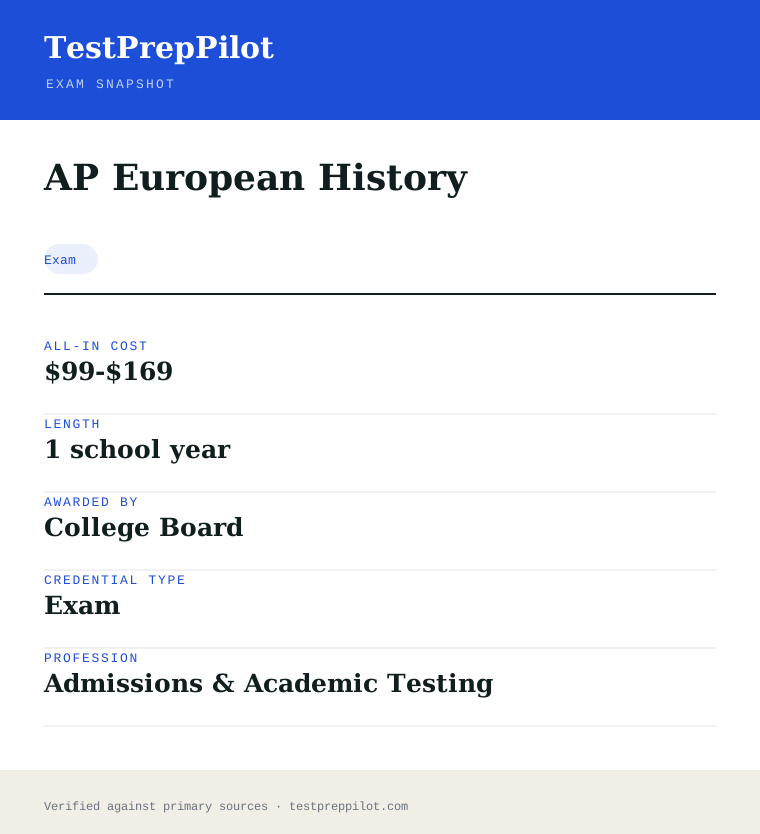
AP European History is a exam credential; awarded by College Board; the exam fee is $99 (US) / $129 (intl); typical preparation is 1 school year.
| Credential | AP European History |
|---|---|
| Abbreviation | AP Euro |
| Type | Exam |
| Profession | Admissions & Academic Testing |
| Specialty | Advanced Placement |
| Awarded by | College Board |
| Difficulty | Moderate |
| Typical prep time | 1 school year |
| All-in cost | $99-$169 |
| Score scale | 1 to 5 |
| Credit | 3+ typically earns European-history credit |
| Essays | DBQ and long essay (LEQ) |
| Delivery | Fully digital in Bluebook |
| Exam timing | Early May |
| Scope | National / Multi-state |
Real questions
Frequently asked questions about the AP European History
How many credits is AP Euro worth?
Most colleges grant three to six credits for a 3 or higher toward a history or Western-civilization requirement. Selective schools may require 4 or 5.
Is AP European History hard?
The content volume is large, but the essay rubrics are consistent. Students who practice the DBQ and LEQ formats do well.
What is the DBQ?
The document-based question gives you seven sources and asks you to build an argument using them, demonstrating historical reasoning under a time limit.
What score do I need for credit?
A 3 is the typical threshold; many universities want 4 or 5 for placement out of introductory history.
Can I self-study?
Yes, with a timeline-based review book and past DBQ/LEQ practice. Register for the exam through a school.
Why do all four SAT Suite tests take the same 2 hours 14 minutes?
Since the digital transition every assessment in the suite uses the same blueprint: 54 Reading and Writing questions in two 32-minute modules and 44 Math questions in two 35-minute modules. Difficulty is calibrated to the grade band rather than by adding or removing time.
Can I take an SAT Suite test at home?
No. Unlike some other admissions tests, every College Board digital assessment must be taken in a supervised school or test centre, even though it runs on your own device.
How do fee waivers work?
US students in eleventh or twelfth grade who meet income eligibility get SAT fee waivers from their school counsellor. A waiver covers the registration fee, waives cancellation and late fees, and gives unlimited free score reports to colleges.
In short
Is the AP European History worth it?
- College survey of European history since 1450
- 55 MCQ, 3 SAQ, a DBQ, and a long essay
- Fully digital in Bluebook
- Scored 1-5; a 3 generally earns credit
Same awarding body
What other credentials does College Board award?
Worth comparing
How does the AP European History compare with similar credentials?
Trust
Where does this information come from?
Everything above is taken from the awarding body's own published material. Fees, question counts and domain weights are revised regularly — check the official page before you pay.
- College Board Awarding body
- Official AP European History exam page Exam page
Research confidence: high · Last reviewed 2026-08