Admissions & Academic Testing • Exam
AP Environmental Science
Earn intro environmental-science credit while studying the planet.
Researched and maintained by TestPrepPilot Editorial BoardAdvanced Placement & college-credit desk · Figures last verified August 2026
The short version
What is the AP Environmental Science and is it worth it?
AP Environmental Science is a fully digital exam: 80 multiple-choice questions in 90 minutes and three free-response questions in 70 minutes. Scored 1-5, a 3 generally earns introductory environmental-science credit.
- Interdisciplinary intro course with real-world relevance
- Strong fit for environmental and policy interests
- Fully digital in Bluebook
- Widely accepted for science credit
What is it?
What exactly is the AP Environmental Science?
Earn intro environmental-science credit while studying the planet.
AP Environmental Science is a fully digital exam that integrates biology, chemistry, earth science, and economics to study ecosystems, biodiversity, pollution, energy, and global change. It pairs 80 multiple-choice questions with three free-response questions emphasizing data and quantitative analysis. A 3 typically earns credit for an introductory environmental-science course.
The path in brief
- Join APES via My AP
- Work through the 9 CED units
- Practice data and math FRQs
- Use AP Classroom progress checks
- Sit the fully digital exam in May
Before you book
Who is eligible to sit the AP Environmental Science?
Who it is for: High-school students interested in environment and sustainability
The test itself
What is the format of the AP Environmental Science?
The AP Environmental Science is administered by School-administered via Bluebook and runs 2 hours 40 minutes, contains 80 multiple choice + 3 free response questions and requires 3 (1-5 scale) to pass.
| Administered by | School-administered via Bluebook |
|---|---|
| Questions | 80 multiple choice + 3 free response |
| Time limit | 2 hours 40 minutes |
| Pass mark | 3 (1-5 scale) |
| Exam fee | $99 (US) / $129 (intl) |
| Format | Fully digital |
Content outline
What topics are on the AP Environmental Science?
The AP Environmental Science is weighted across 9 domains; the largest are Unit 9: Global Change (15-20%), Unit 3: Populations (10-15%), Unit 4: Earth Systems (10-15%).
Weightings come from the official exam outline. Study time is best allocated in roughly these proportions rather than evenly across domains.
- Unit 1: The Living World - Ecosystems 6-8%
Energy and nutrient cycles
- Unit 2: The Living World - Biodiversity 6-8%
Speciation, diversity
- Unit 3: Populations 10-15%
Population ecology
- Unit 4: Earth Systems 10-15%
Geology, tectonics
- Unit 5: Land and Water Use 10-15%
Agriculture, forestry
- Unit 6: Energy Resources 10-15%
Fossil and renewable
- Unit 7: Atmospheric Pollution 7-10%
Air quality, climate
- Unit 8: Aquatic and Terrestrial Pollution 7-10%
Waste, toxins
- Unit 9: Global Change 15-20%
Climate, biodiversity loss
Study materials
Which study guide should you use for the AP Environmental Science?
Start with the exam sponsor's official content outline. If you also want one structured resource to work through, these are the Mometrix titles that match this exam.

This links to Mometrix's AP range rather than a single AP Environmental Science title. Check that it lists an edition for AP Environmental Science before you buy.
Affiliate links We may earn a commission if you buy through these links, at no extra cost to you. Mometrix has no say in what our exam guides cover. How we make money.
Money & time
How much does the AP Environmental Science cost?
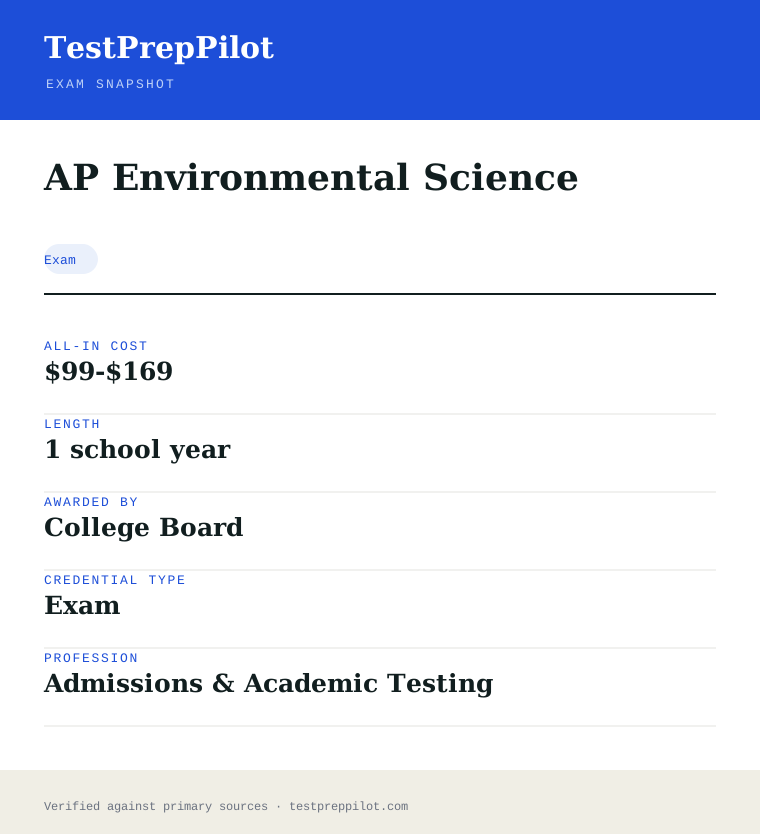
For the AP Environmental Science, the exam fee is $99 (US) / $129 (intl); the all-in cost is typically $99-$169; most candidates spend 1 school year preparing.
Cost breakdown
| AP exam fee (US, territories, Canada, DoDEA) | $99 |
|---|---|
| AP exam fee (international) | $129 |
| Late order or unused/canceled exam | $40 |
| Fee reduction for eligible students | -$37 |
| Prep materials (optional) | $0-$40 |
| Typical total | $99 US / $129 intl (eligible students pay ~$53 / ~$83); late or canceled adds $40 |
Fees are the 2025-26 AP charges. Schools may add a local administrative fee; the College Board fee reduction lowers the base by $37.
Timeline
- Enroll in the AP course Fall
- Study the 9 units Aug-May
- Drill data-analysis FRQs 2-3 months
- Take the digital exam May
- Receive scores Early July
Typical prep: 1 school year
The path
How do you register for the AP Environmental Science?
- 1
Create a College Board account10 minutes
Register at collegeboard.org with your legal name exactly as it appears on the photo ID you will bring on test day. One account covers the SAT, the PSAT-related assessments, AP and BigFuture.
- 2
Choose a weekend SAT date or let your school register you20 minutes
The SAT is booked directly by the student for weekend national administrations. PSAT 8/9, PSAT 10 and the PSAT/NMSQT are ordered and scheduled by the school, so for those you speak to your counselor rather than registering yourself.
- 3
Pay the fee or claim a fee waiver5 minutes
The US SAT registration fee is 68 dollars; international test takers add a regional fee of 43 dollars and, at some centres, a further test centre fee. Eligible US students get the SAT free through a counsellor-issued fee waiver, which also unlocks unlimited free score sends.
- 4
Install Bluebook and complete exam setup30 minutes
Download the free Bluebook app to your own laptop or tablet, or use a school-managed device, then run exam setup in the five days before test day to download the test and get your admission ticket.
Students who skip exam setup can be turned away or delayed at check-in.
- 5
Practise with Bluebook full-length tests and Khan Academy4 to 12 weeks
Six free adaptive full-length practice tests sit inside Bluebook, and Official Digital SAT Prep on Khan Academy is free and keyed to the same content domains.
- 6
Test, then review scores onlinetest day
Arrive with your admission ticket, acceptable photo ID and a charged device. Scores post to your College Board account, typically within about two weeks for weekend SAT dates.
The fine print
What are the retake and renewal rules for the AP Environmental Science?
- Proctoring & delivery
- All SAT Suite tests are taken in Bluebook on a laptop or tablet, in a school or an authorised weekend test centre, under a live human proctor. There is no at-home option. Bluebook locks the device, and a built-in Desmos graphing calculator and formula sheet are available throughout the Math section; you may also bring your own approved non-CAS calculator.
- Retake policy
- There is no limit on SAT attempts and no mandatory waiting period beyond the eight national dates offered each year. The PSAT-related assessments are given once per school year per grade band and are not retaken on demand. Most selective colleges superscore across SAT sittings, taking your best Reading and Writing score and your best Math score.
- Score reporting
- The SAT reports a 400 to 1600 total built from two 200 to 800 section scores. The PSAT/NMSQT and PSAT 10 report 320 to 1520 with 160 to 760 sections, and the PSAT 8/9 reports 240 to 1440 with 120 to 720 sections, so results across the suite sit on one comparable scale. PSAT/NMSQT reports also carry an NMSC Selection Index of 48 to 228.
- Recertification
- SAT Suite scores do not expire and never need renewal, but colleges commonly ask for a score from within the last five years and most students test in the spring of eleventh grade and again in the autumn of twelfth grade. Only a PSAT/NMSQT taken in eleventh grade enters the National Merit competition.
- Refunds & rescheduling
- Cancelling an SAT registration by the change deadline costs 34 dollars; cancelling after the deadline but before test day costs 44 dollars. Changing test centre costs 34 dollars, and late registration costs 38 dollars. Fee-waiver students are not charged for cancellation or late registration.
Context
The digital SAT Suite compared
| Assessment | Grades | Score scale | Length | |
|---|---|---|---|---|
| PSAT 8/9 | 8 and 9 | 240 to 1440 | 2h 14m | |
| PSAT 10 | 10 (spring) | 320 to 1520 | 2h 14m | |
| PSAT/NMSQT | 10 and 11 (autumn) | 320 to 1520 | 2h 14m | |
| SAT | 11 and 12 | 400 to 1600 | 2h 14m |
What it pays
How much does this credential pay?
AP Environmental Science has no direct salary outcome — its value is college credit and placement, and the earnings impact flows through the bachelor’s-degree premium and environmental and STEM career paths.
The salary answer for AP Environmental Science is the college-credit story shared by AP exams with an environmental-career twist: the BLS does not publish a wage for AP scores because the AP program is a college-credit and placement system, but the environmental field carries documented BLS wage profiles — environmental scientists earned a May 2024 median of $80,010 and environmental engineers $103,120 — and a qualifying AP score (3 or higher, depending on the college) earns credit toward introductory environmental-science requirements that many STEM and sustainability majors include. AP Environmental Science is one of the largest AP exams, with roughly 200,000 test-takers per year, and colleges accept it for credit and placement broadly because environmental science is a common general-education requirement. The exam is 2 hours 40 minutes: a multiple-choice section (80 questions, 90 minutes) and a free-response section (3 questions, 70 minutes), scored 1-5, with a scientific or graphing calculator permitted. The honest caveat is that credit policies vary — some science majors prefer in-house lab science credit, and the value depends on the specific college’s policy — so candidates should check the target colleges’ AP credit tables. For a candidate asking whether AP Environmental Science pays, the direct answer is that it pays through credit and placement at colleges that accept it, and it is a broadly accepted AP credit on environmental, sustainability, and general-science pathways. The environmental field reinforces the point: the BLS tracks environmental scientists and specialists ($80,010 median), environmental engineers ($103,120), and the broader conservation and sustainability occupations, all of which require the college-level science foundation the AP credit accelerates — so the score’s value flows through both the tuition savings and the readiness for environmental and STEM majors that carry these documented wage profiles.
| Measure | Figure | Source / note |
|---|---|---|
| Annual test-takers | ~200,000 | One of the largest AP exams (College Board) |
| Score scale | 1-5 | 3+ typically qualifies for credit; 4-5 at selective schools |
| Exam length | 2h40m | 80 MC (90 min) + 3 FRQs (70 min) |
| Salary impact | Indirect | College credit and placement on environmental/STEM pathways |
Job growth.AP Environmental Science volume tracks the growth of the AP program and sustainability interest; it remains a top-15 AP exam.
Your odds
What are the pass rates?
The College Board publishes AP Environmental Science score distributions, not pass rates; in recent cycles roughly half of test-takers scored 3+ (qualifying), with 4 and 5 concentrated in the top quarter.
The direct answer on pass rates requires precision: the College Board does not publish a "pass rate" for AP exams because scores are reported on a 1-5 scale and each college defines what qualifies, but the College Board does publish the annual score distribution for every AP subject, which is the closest published statistic. For AP Environmental Science in recent cycles, roughly half of test-takers scored 3 or higher — the score most colleges treat as qualifying — with the 4 and 5 scores concentrated in the top quarter of test-takers; the exact percentages shift modestly by year, and the College Board’s annual report is the authoritative source. The exam structure is fixed and published: 80 multiple-choice questions in 90 minutes (60 percent of the score) and 3 free-response questions in 70 minutes (40 percent), scored 1-5, with a scientific or graphing calculator permitted. The content covers nine units: The Living World (Ecosystems and Biodiversity), Populations, Earth Systems and Resources, Land and Water Use, Energy Resources and Consumption, Atmospheric Pollution, Aquatic and Terrestrial Pollution, and Global Change. The practical read on difficulty: the exam is content-broad and math-adjacent — the free responses include calculation items (e.g., population growth, energy calculations) and the multiple-choice section includes data and diagram items — and candidates who practice the calculation and data-analysis formats score higher than candidates who only memorize the vocabulary. Because the credit value depends on the college’s policy, the smart approach is to check the target colleges’ AP credit tables and drill the free-response calculation and analysis formats.
Read this before quoting the number.The College Board publishes score distributions, not pass rates; whether a 3, 4, or 5 "passes" depends on each college’s AP credit policy.
Source: College Board AP score distribution report and AP Environmental Science exam description
Your schedule
How long should I study for it?
50-70 hours over 10-14 weeks of focused study
An efficient AP Environmental Science study plan is 50-70 hours over 10-14 weeks, because the exam is a content-broad test with calculation and data-analysis items, and the fastest score gains come from covering the nine units while drilling the free-response formats that carry 40 percent of the score. The College Board course and exam description is the scope map: the nine units from The Living World through Global Change, with the multiple-choice section (80 questions, 90 minutes, 60 percent) and the free-response section (3 questions, 70 minutes, 40 percent) — the free responses include document-based and calculation items. The study window should split into content coverage (weeks 1-8) and free-response and math drilling (weeks 9-12), followed by full practice exams (weeks 13-14): the calculation items (population growth, energy, and pollution math) and the data-analysis items are the difference between a 3 and a 5, and candidates who practice them score higher. Candidates taking the course in school should budget the lower end; self-studying candidates should budget the upper end and add a structured review book or course. A mid-plan checkpoint helps: after the content-coverage weeks, take a section-level multiple-choice set and one free response to measure whether the calculation and data-analysis formats are automatic, because the exam rewards the applied math and the remaining weeks should target the weak formats before the final practice-exam phase, and candidates who keep a one-page formula review during coverage report faster gains in the calculation items. The final two weeks should be full practice exams at the real format — 80 MC in 90 minutes and 3 FRQs in 70 minutes, with the calculator — because the fast MC pace and the calculation writing are the two things candidates underestimate.
- Week 1-420
Ecology and population units
- Study The Living World: ecosystems, biodiversity, and species interactions
- Master Populations: growth models, carrying capacity, and human population
- Cover Earth Systems and Resources: geology, soil, and atmosphere
- Week 5-822
Energy, pollution, and global change
- Study Land/Water Use and Energy Resources and Consumption
- Master Atmospheric, Aquatic, and Terrestrial Pollution
- Cover Global Change: climate, ozone, and sustainability
- Week 9-1116
Free-response and math
- Drill the three FRQs: calculation, data analysis, and document-based
- Practice the math: population growth, energy, and pollution calculations
- Do a full 80-MC + 3-FRQ practice exam
- Week 12-1412
Full exams and readiness
- Take two more full practice exams scoring 3+ then 4+
- Re-drill the missed units and calculation formats until clean
- Confirm the exam-day logistics, calculator, and registration
Adjusting the pace
Taking the course in school.Budget the lower end; weight time toward the free-response calculation and analysis formats.
Self-study.Budget the upper end and add a structured review book or course to cover the nine units.
How to study
How do I prepare most effectively?
The dominant prep strategy for AP Environmental Science is covering the nine units while drilling the calculation and data-analysis formats, because the exam rewards the applied math and analysis the free responses require and the vocabulary alone does not carry the score. First, use the College Board course and exam description as the checklist: the nine units and the exam formats are published, and studying the content in unit order with the list in hand is the highest-yield plan. Second, drill the calculation items deliberately — population growth, energy consumption, and pollution math appear across the free responses, and candidates who practice the formulas and unit conversions score higher than candidates who skip the math. Third, practice the data-analysis and document-based formats: the free responses include interpreting data and applying the course concepts to a real-world environmental issue, and practicing that structure against past College Board FRQs with scoring guidelines is the fastest way to raise the FRQ score. Fourth, build the vocabulary and the concept connections — the exam tests the links between the units (e.g., energy use to pollution to climate change), and candidates who can explain the chains handle the applied items better. Fifth, run full practice exams at the real timing — 80 MC in 90 minutes and 3 FRQs in 70 minutes, with the calculator — because the fast MC pace is the constraint most candidates underestimate. Finally, confirm the target colleges’ AP credit policies, because the value of a 3 vs a 5 depends on where the score is sent. A further high-yield tactic is to build a one-page math review during study — the formulas (growth rate, energy, and pollution math) and their units — because the calculation items are the most coachable scored skill and the review sheet becomes the final checklist.
Use the CED as the checklist
The nine units and formats are published; study in order.
Drill the calculation items
Population growth, energy, and pollution math appear in the free responses.
Practice data and document analysis
Interpret data and apply concepts to real-world issues in the FRQ formats.
Build the concept connections
The exam tests the links between units — energy to pollution to climate change.
Build a one-page math review
The formulas and units are the most coachable scored skill; make it the final checklist.
What to buy
Which study resources are worth paying for?
AP Environmental Science prep resources split into the College Board official set, review books, and online courses, and the buying logic is anchored by the official materials because the College Board publishes the course and exam description, past free-response questions, scoring guidelines, and sample questions for free. The official free set — the CED and the past FRQs with scoring guidelines — defines the content and the analysis standards precisely. Review books from major publishers, roughly $20-40, add structured unit coverage and practice exams, which helps both course-takers and self-studiers; the well-regarded options track the current course framework, and candidates should prefer an edition published after the most recent course update, because the exam content shifts with the framework. Online courses and question banks, $30-100, add video instruction and drilling, which helps self-studying candidates, and the online courses that include past-FRQ calculation analysis add the most value because the math and data formats are where the score is won, and the free official materials should always come first before any purchase. The footnote that anchors the comparison: prices below are list prices as of mid-2026 and change frequently, and we rank nothing by commission. The exam fee is about $99 per AP exam (plus any school or state fees), with fee reductions available for eligible students. A cheap readiness check is the free sample questions and one past FRQ set from the College Board before buying anything, because candidates who took the course often need only the review book and full practice exams. Candidates should also verify the school’s AP exam registration process and deadline, because late registration fees are a common avoidable cost.
| Resource | Price | Format | Best for |
|---|---|---|---|
| College Board official materials | Free | CED + past FRQs + scoring guides | The authoritative content and scoring standards |
| AP Environmental Science review book | $20-40 | Book with unit reviews and practice | Structured coverage for any candidate |
| Online course / question bank | $30-100 | Video + drilling | Self-studiers wanting structure |
| AP exam registration | ~$99 | School/College Board | The real exam; fee reductions available |
List prices as of mid-2026 and change frequently; we rank nothing by commission. The AP exam fee is ~$99 with reductions for eligible students.
Avoid these
What mistakes do candidates most often make?
The most common mistake on AP Environmental Science is memorizing the vocabulary without practicing the calculation and data-analysis formats, because the free responses include population, energy, and pollution math and candidates who skip the math lose the most coachable points; the second is mis-pacing the 80-question multiple-choice section in 90 minutes. A third recurring error is writing vague free responses without the required structure — the calculation, data-analysis, and document-based formats each reward a specific response shape, and candidates who do not practice them write answers that earn partial credit at best. Candidates also routinely neglect the unit connections, treating the nine units as isolated topics when the exam tests the chains (energy use to pollution to climate change). Another pattern is skipping the calculator practice, underusing the permitted scientific or graphing calculator on the calculation items. A further recurring error is answering the calculation items without showing the units and reasoning, when the scoring rewards the work rather than the number, and some candidates write conclusions that do not connect to the data in the graph or table, when the scoring rewards claims explicitly tied to the evidence. Finally, some candidates never run a full practice exam at the real 2h40m format, so the fast MC pace and the writing load surprise them on test day. A further recurring error is answering the calculation items without showing the units and reasoning, when the scoring rewards the work rather than the number; others write conclusions that do not connect to the data in the graph or table, when the scoring rewards claims explicitly tied to the evidence. Candidates who run full practice exams at the real 2h40m timing find that the fast multiple-choice pace is manageable when the calculation and data-analysis formats are drilled, and the concept-chain review converts the isolated-unit losses into applied-item points.
✕Skipping the calculation practice
✓Drill the population, energy, and pollution math; it is the most coachable scored skill.
✕Mis-pacing the MC section
✓Practice 80 questions in 90 minutes; the pace is the constraint.
✕Writing unstructured FRQs
✓Practice the calculation, data-analysis, and document-based formats against past FRQs.
✕Treating the units as isolated
✓Build the concept chains — energy to pollution to climate change.
✕Underusing the calculator
✓Practice the calculation items with the permitted calculator and show units.
What you'll face
What question types will I see?
The AP Environmental Science exam is 2 hours 40 minutes: 80 multiple-choice questions in 90 minutes (60 percent) and 3 free-response questions in 70 minutes (40 percent), scored 1-5, with a scientific or graphing calculator permitted. The free-response section includes a document-based question, a data-analysis question, and a calculation question. The multiple-choice section presents discrete and stimulus-based items, with data tables, diagrams, and maps used across the nine units, and the three free responses each have their own response structure — the document-based question applies the course concepts to a real-world issue, the data-analysis question interprets data and supports a claim with evidence, and the calculation question shows the math with units and reasoning. The calculation and data-analysis formats are the most coachable scored skills, so candidates should drill them against the past-FRQ materials with the scoring guidelines. The samples below illustrate three formats — a concept MC item, a calculation FRQ, and a data-analysis FRQ. The sample items are editor-written illustrations of the published format, not live test items. The multiple-choice section presents discrete and stimulus-based items, with data tables, diagrams, and maps used across the nine units; the three free responses are the document-based question, the data-analysis question, and the calculation question, each with its own response structure. The document-based question applies the course concepts to a real-world environmental issue, the data-analysis question interprets data and supports a claim with evidence, and the calculation question shows the math with units and reasoning. The calculation and data-analysis formats are the most coachable scored skills, so candidates should drill them against the past-FRQ materials with the scoring guidelines.
Vocabulary, data, and diagrams across the nine units.
Population, energy, or pollution math with units and reasoning.
Interpret data or a document and apply the course concepts.
Try these
Q1Which process is the primary cause of the enhanced greenhouse effect?
Answer:A
The enhanced greenhouse effect is driven by rising concentrations of greenhouse gases, chiefly CO2 from burning fossil fuels, which trap more infrared radiation. Ozone depletion, sea-ice expansion, and evaporation are different processes.
Q2Calculation FRQ (illustrated): "A population of 1,000 deer grows at a rate of 2% per year. Calculate the population size after one year, showing your work."
Answer:A
Growth = 1,000 × 0.02 = 20 deer, so the population after one year is 1,020. The FRQ rewards showing the calculation and units, not just the number.
Q3Data-analysis FRQ (illustrated): "A graph shows atmospheric CO2 rising steadily since 1960. Describe the trend and propose one human activity that contributes to it."
Answer:A
The data-analysis FRQ rewards describing the trend accurately (steady rise since 1960) and proposing a reasoned human contributor (fossil-fuel combustion, deforestation). Partial answers earn partial credit.
Samples are editor-written illustrations of the published format, not live test items.
The big day
What should I expect on exam day?
The AP Environmental Science exam is a paper-and-pencil test administered at your school on the College Board’s AP exam schedule, and the direct exam-day answer is that you will sit 80 multiple-choice questions in 90 minutes, then 3 free-response questions in 70 minutes, for a 2h40m exam scored 1-5, with scores released in July. Arrive with your school-issued admission ticket, a government-issued or school photo ID, and the permitted materials — No. 2 pencils for the multiple-choice section, black or blue pens for the free-response section, and an approved scientific or graphing calculator, per the College Board’s current rules; no notes or electronic devices are permitted. The exam begins with the multiple-choice section, then a brief break, then the free-response section; the proctor enforces strict timing, and the calculator is permitted. Expect a controlled testing environment with other AP candidates; follow the proctor’s instructions exactly. In the multiple-choice section, the 80-question/90-minute pace is fast, so move steadily and mark items for review; in the free-response section, budget roughly 23 minutes per question and write the calculation, data-analysis, and document-based structures the scoring expects, with the calculation work shown with units and the data conclusions written in full sentences. Scores are released online in July through the College Board account, and the score report can be sent to colleges; the July score release should be checked against each college’s AP credit table. If the score falls short of the target colleges’ credit policy, the exam can be retaken the following year — AP exams are offered once per year.
Bring
- School-issued AP admission ticket
- Photo ID (school or government issued)
- No. 2 pencils and black/blue pens per College Board rules
- Approved scientific or graphing calculator
Leave at home
- Notes and electronic devices (prohibited)
- Study materials
- Personal stationery (the booklet and materials are provided)
- Any item on the College Board prohibited list
How the day runs
Rules in the room
- No notes or electronic devices
- No. 2 pencils for multiple choice; black/blue pens for free response
- Calculator permitted; confirm the current policy
- Strict proctor-enforced timing on both sections
Afterwards.Receive the 1-5 score in July, send it to colleges through the College Board, and check each college’s AP credit policy. The exam can be retaken the following year if the score falls short.
Reference
What are the key facts about the AP Environmental Science?
AP Environmental Science is a exam credential; awarded by College Board; the exam fee is $99 (US) / $129 (intl); typical preparation is 1 school year; holders typically earn College credit outcomes vary by school (3+ typically qualifies).
| Credential | AP Environmental Science |
|---|---|
| Abbreviation | APES |
| Type | Exam |
| Profession | Admissions & Academic Testing |
| Specialty | Advanced Placement |
| Awarded by | College Board |
| Difficulty | Moderate |
| Typical prep time | 1 school year |
| All-in cost | $99-$169 |
| Typical salary range | College credit outcomes vary by school (3+ typically qualifies) |
| Score scale | 1 to 5 |
| Credit | 3+ typically earns intro environmental-science credit |
| Math | Quantitative analysis expected |
| Delivery | Fully digital in Bluebook |
| Exam timing | Early May |
| Scope | National / Multi-state |
Real questions
Frequently asked questions about the AP Environmental Science
How many credits is APES worth?
Most colleges grant three to four credits for a 3 or higher toward a science or environmental requirement. Selective schools may require 4 or 5.
Is AP Environmental Science hard?
It is interdisciplinary and includes math on the free-response section, but the concepts are concrete. Students who practice quantitative problems do well.
Can I self-study APES?
Yes, using the CED and practice exams. Register for the exam through a school and keep up with current environmental examples.
What score do I need for credit?
A 3 is the usual threshold; some schools want 4 or 5 for upper-level placement.
Does it count as a lab science?
Many colleges accept it as a science credit, though some require a lab component; policies vary by institution.
Why do all four SAT Suite tests take the same 2 hours 14 minutes?
Since the digital transition every assessment in the suite uses the same blueprint: 54 Reading and Writing questions in two 32-minute modules and 44 Math questions in two 35-minute modules. Difficulty is calibrated to the grade band rather than by adding or removing time.
Can I take an SAT Suite test at home?
No. Unlike some other admissions tests, every College Board digital assessment must be taken in a supervised school or test centre, even though it runs on your own device.
How do fee waivers work?
US students in eleventh or twelfth grade who meet income eligibility get SAT fee waivers from their school counsellor. A waiver covers the registration fee, waives cancellation and late fees, and gives unlimited free score reports to colleges.
In short
Is the AP Environmental Science worth it?
- Interdisciplinary introductory environmental science
- 80 multiple-choice plus three free-response questions
- Fully digital in Bluebook
- Scored 1-5; a 3 generally earns credit
Same awarding body
What other credentials does College Board award?
Worth comparing
How does the AP Environmental Science compare with similar credentials?
Trust
Where does this information come from?
Everything above is taken from the awarding body's own published material. Fees, question counts and domain weights are revised regularly — check the official page before you pay.
- College Board Awarding body
- Official AP Environmental Science exam page Exam page
Research confidence: high · Last reviewed 2026-08