Admissions & Academic Testing • Exam
CLEP College Composition
Earn composition credit through multiple choice plus two scored essays.
Researched and maintained by TestPrepPilot Editorial BoardCollege Board CLEP & college-credit desk · Figures last verified August 2026
The short version
What is the CLEP College Composition and is it worth it?
CLEP College Composition is a 125-minute exam: 50 multiple-choice questions plus two essays. ACE recommends a score of 50 for about six semester hours at accepting schools.
- Commonly awards six semester hours — high credit for one exam
- Tests real writing: argument, synthesis, and source use
- Year-round at test centers and online with remote proctoring
- Satisfies many first-year writing requirements
What is it?
What exactly is the CLEP College Composition?
Earn composition credit through multiple choice plus two scored essays.
The CLEP College Composition exam pairs multiple-choice questions on rhetoric and usage with two handwritten-then-typed essays scored by college faculty. It covers analysis, argumentation, synthesis, and source use — the skills of a first-year writing course. Because essays are scored centrally, scores take one to two weeks, but the credit (often six hours) is substantial.
The path in brief
- Confirm your school’s writing-credit policy
- Register and pay the $97 fee
- Book a test center or remote-proctoring slot
- Practice timed essays with sources
- Score 50+ for six credits
Before you book
Who is eligible to sit the CLEP College Composition?
The test itself
What is the format of the CLEP College Composition?
The CLEP College Composition is administered by CLEP test center or CLEP with Remote Proctoring and runs 125 minutes, contains 50 multiple choice + 2 essays questions and requires 50 (ACE credit-granting score) to pass.
| Administered by | CLEP test center or CLEP with Remote Proctoring |
|---|---|
| Questions | 50 multiple choice + 2 essays |
| Time limit | 125 minutes |
| Pass mark | 50 (ACE credit-granting score) |
| Exam fee | $97 (2025–26) + test-center fee |
| Format | Multiple choice and typed essays |
Content outline
What topics are on the CLEP College Composition?
The CLEP College Composition is weighted across 4 domains; the largest are Revision Skills (40%), Use of Source Materials (25%), Rhetorical Analysis (25%).
Weightings come from the official exam outline. Study time is best allocated in roughly these proportions rather than evenly across domains.
- Conventions of Standard Written English 10%
Syntax, grammar, usage
- Revision Skills 40%
Organization, evidence, coherence
- Use of Source Materials 25%
Research, integration, citation
- Rhetorical Analysis 25%
Appeals, tone, purpose
Study materials
Which study guide should you use for the CLEP College Composition?
Start with the exam sponsor's official content outline. If you also want one structured resource to work through, these are the Mometrix titles that match this exam.

This links to Mometrix's CLEP range rather than a single CLEP College Composition title. Check that it lists an edition for CLEP College Composition before you buy.
Affiliate links We may earn a commission if you buy through these links, at no extra cost to you. Mometrix has no say in what our exam guides cover. How we make money.
The path
How do you register for the CLEP College Composition?
- 1
Create a College Board account10 minutes
Register at collegeboard.org with your legal name exactly as it appears on the photo ID you will bring on test day. One account covers the SAT, the PSAT-related assessments, AP and BigFuture.
- 2
Choose a weekend SAT date or let your school register you20 minutes
The SAT is booked directly by the student for weekend national administrations. PSAT 8/9, PSAT 10 and the PSAT/NMSQT are ordered and scheduled by the school, so for those you speak to your counselor rather than registering yourself.
- 3
Pay the fee or claim a fee waiver5 minutes
The US SAT registration fee is 68 dollars; international test takers add a regional fee of 43 dollars and, at some centres, a further test centre fee. Eligible US students get the SAT free through a counsellor-issued fee waiver, which also unlocks unlimited free score sends.
- 4
Install Bluebook and complete exam setup30 minutes
Download the free Bluebook app to your own laptop or tablet, or use a school-managed device, then run exam setup in the five days before test day to download the test and get your admission ticket.
Students who skip exam setup can be turned away or delayed at check-in.
- 5
Practise with Bluebook full-length tests and Khan Academy4 to 12 weeks
Six free adaptive full-length practice tests sit inside Bluebook, and Official Digital SAT Prep on Khan Academy is free and keyed to the same content domains.
- 6
Test, then review scores onlinetest day
Arrive with your admission ticket, acceptable photo ID and a charged device. Scores post to your College Board account, typically within about two weeks for weekend SAT dates.
The fine print
What are the retake and renewal rules for the CLEP College Composition?
- Proctoring & delivery
- All SAT Suite tests are taken in Bluebook on a laptop or tablet, in a school or an authorised weekend test centre, under a live human proctor. There is no at-home option. Bluebook locks the device, and a built-in Desmos graphing calculator and formula sheet are available throughout the Math section; you may also bring your own approved non-CAS calculator.
- Retake policy
- There is no limit on SAT attempts and no mandatory waiting period beyond the eight national dates offered each year. The PSAT-related assessments are given once per school year per grade band and are not retaken on demand. Most selective colleges superscore across SAT sittings, taking your best Reading and Writing score and your best Math score.
- Score reporting
- The SAT reports a 400 to 1600 total built from two 200 to 800 section scores. The PSAT/NMSQT and PSAT 10 report 320 to 1520 with 160 to 760 sections, and the PSAT 8/9 reports 240 to 1440 with 120 to 720 sections, so results across the suite sit on one comparable scale. PSAT/NMSQT reports also carry an NMSC Selection Index of 48 to 228.
- Recertification
- SAT Suite scores do not expire and never need renewal, but colleges commonly ask for a score from within the last five years and most students test in the spring of eleventh grade and again in the autumn of twelfth grade. Only a PSAT/NMSQT taken in eleventh grade enters the National Merit competition.
- Refunds & rescheduling
- Cancelling an SAT registration by the change deadline costs 34 dollars; cancelling after the deadline but before test day costs 44 dollars. Changing test centre costs 34 dollars, and late registration costs 38 dollars. Fee-waiver students are not charged for cancellation or late registration.
Context
The digital SAT Suite compared
| Assessment | Grades | Score scale | Length | |
|---|---|---|---|---|
| PSAT 8/9 | 8 and 9 | 240 to 1440 | 2h 14m | |
| PSAT 10 | 10 (spring) | 320 to 1520 | 2h 14m | |
| PSAT/NMSQT | 10 and 11 (autumn) | 320 to 1520 | 2h 14m | |
| SAT | 11 and 12 | 400 to 1600 | 2h 14m |
What it pays
How much does this credential pay?
CLEP College Composition has no direct salary outcome — its value is college credit earned by examination, and the earnings impact flows through the bachelor’s-degree wage premium.
CLEP College Composition has no direct salary outcome, because CLEP is a credit-by-examination program rather than a job certification, so the BLS publishes no wage for a CLEP score; the earnings story runs through the college credit it earns and the degree it accelerates. The American Council on Education (ACE) recommends 6 semester hours of lower-division English Composition credit for a score of 50 or higher on the 20-80 scaled score, and roughly 2,900 colleges and universities set their own credit-granting policies around that recommendation, with most accepting 50 and more selective programs requiring 55-60. The real wage context is the BLS college-earnings premium: workers with a bachelor’s degree earn substantially more over a career than workers with a high-school diploma alone, and every credit earned by examination at $97 shrinks the tuition bill for the same credit purchased in a classroom, which is the economic case for CLEP. The practical value is concrete: a first-year composition course at a public university typically costs several hundred to several thousand dollars depending on the school and tuition structure, so passing College Composition can save that amount directly, and for adult learners, military servicemembers (who take CLEP for free through DANTES funding), and homeschool students, the exam is a fast, low-cost way to satisfy a graduation requirement without a semester of seat time. The honest caveat is that credit policy varies by college: some schools award 6 hours, some 3, some require a higher cut score, and some writing-intensive programs decline the credit and require the in-house course, so the score’s value depends entirely on the target school’s CLEP policy, which candidates should confirm before registering. The other caveat is that this exam includes a required, hand-typed essay section, so it is not a pure multiple-choice credit grab — it rewards actual writing skill. So the direct answer for a candidate asking whether CLEP College Composition pays is: it pays through direct tuition savings on a required course at colleges that accept the ACE-recommended 50, and the cost is $97 plus a small test-center fee.
| Measure | Figure | Source / note |
|---|---|---|
| ACE credit recommendation | 6 semester hours | English Composition, lower-division, for a score of 50+ on the 20-80 scale |
| Score scale | 20-80 | College Board reports a single combined scaled score; no separate section scores |
| Exam length | 125 minutes | 50 MC (55 min) + 2 essays (70 min), both required |
| Exam fee | $97 | College Board CLEP fee; test centers charge an additional admin fee; free for many U.S. military via DANTES |
| Salary impact | Indirect | Direct tuition savings on a required composition course via credit-by-exam |
Job growth.CLEP is the most widely used credit-by-examination program in the U.S., accepted at roughly 2,900 colleges; volume is driven by adult learners, military servicemembers, and degree-completion programs rather than by high school enrollment.
Your odds
What are the pass rates?
The College Board publishes no pass rates and no score distributions for individual CLEP exams — including College Composition — so no verified pass rate exists; what is published is the 20-80 scaled-score scale, the ACE-recommended credit score of 50, and each college’s own cut score.
The direct answer on pass rates is that there is no published pass rate for CLEP College Composition, and we state that plainly because it is the most common place where candidates get misled: the College Board does not publish score distributions or pass percentages for individual CLEP exams the way it does for AP exams, and no credible secondary source provides them, so any website quoting a CLEP pass rate is quoting an unverifiable figure. What the College Board does publish is the scoring mechanics: the exam is scored on a scale of 20 to 80, the multiple-choice section and the essay section are weighted approximately equally and combined into a single scaled score, no separate section scores are reported, and there is no penalty for incorrect answers. The credit benchmark is set by the American Council on Education, which recommends 6 semester hours of English Composition credit for a score of 50 or higher, and individual colleges then set their own cut scores — commonly 50, sometimes 55 or 60 — so the effective "passing" number differs by school and by student. Because the essays are mandatory and centrally scored by college English faculty (each essay read by at least two readers and scored 0-6), the exam cannot be prepared for as a pure multiple-choice test, and because the two sections are weighted roughly equally, a weak essay section can drag a strong multiple-choice performance below a college’s cut score. The practical implications follow from the scoring model rather than from any pass statistic: aim for a scaled score at least as high as your target school’s published cut score plus margin, practise the two essay formats under a timer, and treat the 50-60 range as the zone that determines credit at most schools.
Read this before quoting the number.No pass rate or score distribution is published for individual CLEP exams by the College Board; whether a score of 50, 55, or 60 "passes" depends on each college’s published CLEP credit policy, and the ACE recommendation is a benchmark, not a universal passing score.
Your schedule
How long should I study for it?
30-50 hours over 4-8 weeks of focused study
A realistic CLEP College Composition study plan runs 30-50 hours over 4-8 weeks, because the exam measures writing and editing skills that most candidates already partly possess, and the fastest score gains come from drilling the revision and rhetorical-analysis multiple-choice topics and rehearsing the two timed essays, which together decide the scaled score. The College Board exam page is the scope map: the exam is 125 minutes, with 50 multiple-choice questions in 55 minutes and 2 essays in 70 minutes, and the multiple-choice content splits into Conventions of Standard Written English (10 percent), Revision Skills (40 percent), Ability to Use Source Materials (25 percent), and Rhetorical Analysis (25 percent) — so roughly two-thirds of the multiple-choice section is about revising and analysing drafts rather than memorising grammar rules. The study window should split into diagnostics (week 1), the four multiple-choice topic areas (weeks 2-5), and essay rehearsal plus full timed exams (weeks 6-8): the first essay gives 30 minutes to take a position on a statement and support it from reading, observation, or experience, and the second gives 40 minutes to synthesise and cite two provided sources, and both must be typed on the computer at the test center, so rehearsing with a timer and a keyboard is essential. Candidates who write regularly in their work or studies should budget the lower end; candidates who are years away from formal writing should budget the upper end and add a review book or course. The final two weeks should be full timed rehearsals of the complete 125-minute exam, because the shift from 55 minutes of multiple choice to 70 minutes of continuous essay typing is the pacing challenge most candidates underestimate, and the two essays are weighted roughly equally with the multiple-choice section, so neither can be neglected.
- Week 16-8 hrs
Diagnostic and scope
- Take a full-length practice exam to establish a baseline scaled score
- Read the College Board exam page and the two essay directions
- Identify the multiple-choice topic area where you lost the most points
- Weeks 2-39-10 hrs/week
Revision and conventions
- Drill Revision Skills: organisation, thesis, coherence, tone, transitions
- Cover Conventions of Standard Written English: syntax, agreement, punctuation
- Practise identifying sentence-level errors in draft passages
- Weeks 4-59-10 hrs/week
Source materials and rhetoric
- Study Ability to Use Source Materials: evaluating and citing sources
- Cover Rhetorical Analysis: appeals, tone, structure, evidence evaluation
- Work through passage-based question sets on research and rhetoric
- Weeks 6-78-9 hrs/week
Essay rehearsal
- Practise the 30-minute first essay: position, reasons, examples from experience
- Practise the 40-minute second essay: synthesise and cite two sources
- Write each essay typed on a computer with a hard timer
- Week 88-10 hrs
Full exams and readiness
- Take two full 125-minute practice exams, typed under exam conditions
- Re-drill the multiple-choice topics where you still lose points
- Confirm the test center, the $97 fee, and the registration process
Adjusting the pace
Recent composition student.Budget the lower end and put most time into the second essay’s source-synthesis format and timed rehearsal; the content is largely familiar.
Years away from formal writing.Budget the upper end and add a review book plus a writing refresher; practise typed essays weekly from week one.
How to study
How do I prepare most effectively?
The dominant prep strategy for CLEP College Composition is to treat the two essays as equal half of the score and rehearse them under a timer, because the multiple-choice section and the essay section are weighted approximately equally, and candidates who prepare only for the multiple choice routinely underestimate the typing pace and the source-synthesis format. First, use the College Board exam page as the checklist: the 50-question/55-minute and 2-essay/70-minute format, the four multiple-choice topic areas, and the essay scoring guide (0-6) are all published, and studying the topic weights tells you that Revision Skills at 40 percent is the largest single multiple-choice block. Second, drill revision-style questions rather than grammar memorisation: the bulk of the multiple-choice section asks you to evaluate drafts, organisation, tone, and evidence, and the highest-yield practice is working through passage-based revision and rhetorical-analysis sets. Third, rehearse both essay formats weekly with a hard timer: the first essay rewards a clear position with specific reasons and examples, and the second rewards synthesising and citing the two provided sources — paraphrasing or quoting them by author or title — so practise the citation habit even though it feels formal for a placement exam. Fourth, type your practice essays on a computer, because the exam is delivered on a computer at the test center and keyboard fluency under time pressure is a real factor. Fifth, run full timed rehearsals of the complete 125-minute exam at least twice, because the transition from multiple choice to continuous essay typing is the pacing challenge most candidates underestimate. Finally, confirm the target college’s CLEP credit policy and cut score before registering, because a 50 that earns credit at one school may fall short at another, and that target score should shape how much margin you build. A further high-yield tactic is to practise the source-synthesis essay with two short passages under 40 minutes, because it is the most format-specific and therefore the most coachable part of the exam.
Treat the essays as half the score
The multiple-choice and essay sections are weighted approximately equally; rehearse both essay formats under a timer from early in the plan.
Drill revision and rhetoric, not grammar rules
Revision Skills (40%) and Rhetorical Analysis (25%) dominate the multiple-choice section; work passage-based sets rather than memorising rules.
Rehearse the source-synthesis essay
The second essay requires synthesising and citing two provided sources; practise the citation habit under a 40-minute timer.
Type your practice essays
The exam is computer-delivered; build keyboard fluency under time pressure.
Confirm the target college’s cut score
Credit cut scores commonly range from 50 to 60; the target score determines how much margin you need to build.
What to buy
Which study resources are worth paying for?
CLEP College Composition prep resources split into the official College Board set, free prep programs, review books, and question banks, and the buying logic is anchored by the official materials because the College Board publishes the full exam description, the essay directions, and the essay scoring guide for free. Two free resources matter more here than for most exams: the College Board’s own CLEP practice materials, and Modern States, a nonprofit that offers a free College Composition prep course and then issues a voucher that covers the $97 College Board exam fee — a genuinely free route that makes any paid course a choice rather than a necessity. Review books from major publishers, roughly $20-40, add structured coverage of the four multiple-choice topic areas and practice essays, which helps candidates who want a single organised reference. Online question banks and video courses, roughly $30-100, add drilling and essay feedback, which helps candidates who want structured practice, though essay feedback from automated services is limited compared with having a human reader score your work. The footnote that anchors the comparison: prices below are approximate list prices as of mid-2026 and change frequently, we rank nothing by commission, and every candidate also pays the test center’s separate administration fee, typically $15-40, plus the $97 College Board fee unless a Modern States or military voucher covers it. A cheap readiness check is the free practice questions before buying anything, because candidates who write regularly often need only timed essay rehearsal and one review book. Candidates should also confirm the test center’s scheduling process, because the essays mean College Composition scores are returned one to two weeks after the test date rather than immediately.
| Resource | Price | Format | Best for |
|---|---|---|---|
| College Board official materials | Free | Exam description + practice questions + essay scoring guide | The authoritative content and scoring standards |
| Modern States free course + voucher | Free | Video course; voucher covers the $97 exam fee | Candidates who want a genuinely free route to the exam |
| CLEP review book | $20-40 | Book with topic reviews and practice essays | Structured coverage for any candidate |
| Online question bank / course | $30-100 | Video + drilling | Candidates wanting structured practice |
| CLEP exam registration | $97 + test-center fee | College Board + test center | The real exam; military and Modern States vouchers available |
Prices are approximate list prices as of mid-2026 and change frequently; we rank nothing by commission. The $97 College Board fee does not include the test center’s separate administration fee (typically $15-40), and College Composition scores are returned one to two weeks after the test date.
Avoid these
What mistakes do candidates most often make?
The most common mistake on CLEP College Composition is preparing only for the multiple-choice section, because the two essays are weighted approximately equally with it, and candidates who never rehearse the typed, timed essay formats lose points they could have earned. The second is assuming the first essay can be written without a position: the 30-minute essay asks you to discuss the extent to which you agree or disagree with a statement and support it with specific reasons and examples, and essays that merely restate the prompt or drift without concrete support score in the 2-3 band. A third recurring error is failing to cite the sources in the second essay, which requires synthesising and citing the two provided passages — paraphrasing or quoting them by author or title — because candidates who summarise the sources without attribution lose credit even when the content is on point. Candidates also routinely misjudge the pacing: spending the whole 55-minute multiple-choice window on hard items leaves no time to adjust, and then the 70-minute essay block becomes a rush, when the plan should be roughly 30 minutes on the first essay and 40 on the second, with no pause to catch breath between them. Another pattern is treating the exam as a pure grammar test and ignoring Revision Skills and Rhetorical Analysis, which together make up 65 percent of the multiple-choice section. Finally, some candidates register without checking the target college’s cut score and credit award, only to discover after the exam that their 50 earns 3 credits instead of 6, or nothing at all at that school.
✕Preparing only for the multiple-choice section
✓Rehearse both typed, timed essays weekly; they are weighted approximately equally with the multiple choice.
✕Writing the first essay without a position
✓Take a clear agree-or-disagree stance and support it with specific reasons and examples from reading, observation, or experience.
✕Summarising the sources without citing them
✓In the second essay, paraphrase or quote each of the two provided sources and identify them by author or title.
✕Misjudging the pacing
✓Budget about 30 minutes on the first essay and 40 on the second, and practise the full 125 minutes as one continuous sit.
✕Treating it as a pure grammar test
✓Revision Skills (40%) and Rhetorical Analysis (25%) dominate the multiple-choice section; drill passage-based revision sets.
✕Registering without checking the cut score
✓Confirm the target college’s CLEP credit policy — cut scores and credit awards range widely — before registering.
What you'll face
What question types will I see?
The CLEP College Composition exam is 125 minutes: 50 multiple-choice questions in 55 minutes plus 2 mandatory essays in 70 minutes, all typed on a computer at a test center, with the two sections weighted approximately equally and combined into a single scaled score on the 20-80 scale. The multiple-choice section covers four topic areas — Conventions of Standard Written English (10 percent), Revision Skills (40 percent), Ability to Use Source Materials (25 percent), and Rhetorical Analysis (25 percent) — and is dominated by passage-based items that ask you to evaluate drafts, organisation, tone, and evidence rather than to recite grammar rules. The first essay allows 30 minutes to discuss the extent to which you agree or disagree with a provided statement, supported by specific reasons and examples; the second allows 40 minutes to read two sources and write an argument that synthesises and cites both. Each essay is scored 0-6 by at least two readers, and the combined essay score is weighted approximately equally with the multiple-choice score to produce the single reported scaled score, with scores returned one to two weeks after the test date. The multiple-choice and essay sections are weighted approximately equally into the single scaled score, and the essays are typed on the computer at the test center and scored later by at least two readers each. Because the score is reported as one number on the 20-80 scale, a weak essay section can pull a strong multiple-choice performance below a college’s cut score, which is why both halves need rehearsal rather than just the multiple-choice questions. The samples below illustrate three of the recurring formats — a revision item, a rhetorical-analysis item, and an essay-direction prompt. The sample items are editor-written illustrations of the published blueprint, not live exam items.
Evaluate organisation, thesis, topic sentences, coherence, transitions, and sentence-level errors in drafts in progress.
Passage-based items on appeals, tone, structure, purpose, audience, and evaluation of evidence.
Use of reference materials, evaluation and integration of sources, and documentation styles (MLA, APA, Chicago).
30-minute position essay plus 40-minute source-synthesis essay with citation; both typed and scored 0-6 by at least two readers.
Try these
Q1Consider this sentence from a draft: "The new policy will help many students, and it will be hard for some schools to implement it." Which revision is most effective?
Answer:A
Option A uses "but" to signal the contrast between the policy’s benefit and its implementation difficulty, and it removes the weak pronoun "it" that dangles at the end of the original. Option B preserves the wordy construction, option C is defensible but shifts the emphasis to implementation, and option D keeps the original problem. Revision items reward recognising the clearest, most economical way to express the intended relationship.
Q2A passage argues that public libraries should stay open later, using statistics about evening foot traffic and quotes from library patrons. The author most likely makes this case to appeal to the reader’s sense of:
Answer:B
Statistics about foot traffic and patron quotes are evidence-based appeals to reason: the author builds the case through data and testimony rather than tradition, fear, or the endorsement of an authority. Rhetorical-analysis items reward naming the type of appeal and connecting it to the specific evidence the passage actually uses, and the common error is choosing an appeal that sounds plausible but is not present in the described text.
Q3The 40-minute second essay provides two short passages on a topic and asks you to write an argument in response. Which approach best satisfies the assignment?
Answer:B
The assignment requires synthesis: develop your own position and incorporate both sources, citing them by author, title, or another identifying reference, whether paraphrasing or quoting. Option A summarises without taking a position, option C avoids the required source use, and option D ignores the materials entirely. This item illustrates the citation habit that candidates most often under-prepare.
Samples are editor-written illustrations of the published blueprint, not live exam items.
The big day
What should I expect on exam day?
The CLEP College Composition exam is 125 minutes, delivered on a computer at a CLEP test center, and the direct exam-day answer is that you will answer 50 multiple-choice questions in 55 minutes, then type two essays in 70 minutes — 30 minutes for the first and 40 minutes for the second — with the two sections weighted approximately equally into a single scaled score on the 20-80 scale, and scores returned one to two weeks later rather than immediately. Arrive at the test center with your CLEP registration ticket and a government-issued photo ID; you will pay any outstanding test-center administration fee at the center, and the $97 College Board fee is paid at registration unless a Modern States or military voucher covers it. The exam begins with the multiple-choice section, then the two essays, and the essays must be typed on the computer — there is no paper option — and scored later by college English faculty, so expect to wait one to two weeks for the result. Use the multiple-choice section at about 65 seconds per item, flag hard items rather than dwelling, and keep the essay block fresh: after the multiple choice ends, the 70-minute essay block runs continuously, so budget about 30 minutes for the first essay and 40 for the second, including reading the two sources for the synthesis essay. No calculators, notes, phones, or study materials are permitted in the room, and the test center will store personal items; security rules are strict and any violation can invalidate the score. If the scaled score falls short of your target college’s cut score, CLEP allows retesting — the College Board allows a retake after a waiting period, and each attempt costs the full fee again, so confirm the college’s cut score and your margin before paying for a second sit.
Bring
- CLEP registration ticket (printed or electronic)
- Government-issued photo ID (driver’s license, passport, state or military ID)
- Payment for the test center’s administration fee if not prepaid
Leave at home
- Notes, phones, smartwatches, earbuds, and study materials (prohibited)
- Calculators (not needed for this exam)
- Personal stationery — the exam is entirely computer-based
How the day runs
Rules in the room
- No notes, phones, or study materials; personal items are stored in a locker
- The exam is entirely computer-based; the essays must be typed
- No calculators are needed or permitted
- The two essays are each scored 0-6 by at least two readers; results take one to two weeks
- The two sections are weighted approximately equally into the single 20-80 scaled score
Afterwards.Receive the scaled score in the College Board account one to two weeks after the test date, order the official score report to the target college, and verify that the score meets that college’s published CLEP cut score and credit award. If it falls short, CLEP allows retesting after the published waiting period, at the full fee again — so confirm the cut score before re-registering.
Reference
What are the key facts about the CLEP College Composition?
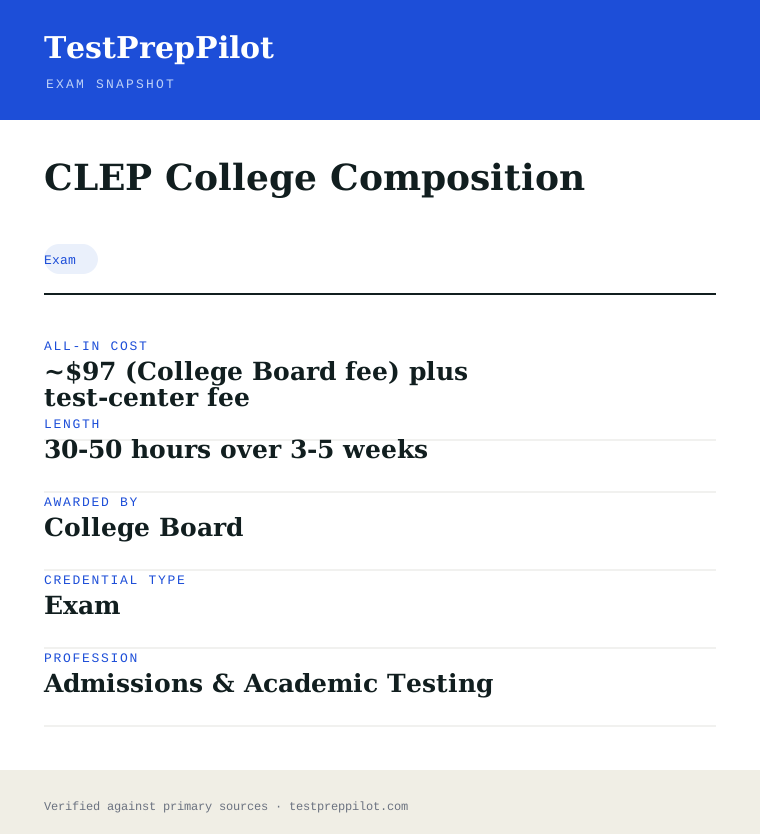
CLEP College Composition is a exam credential; awarded by College Board; the exam fee is $97 (2025–26) + test-center fee; typical preparation is 30-50 hours over 3-5 weeks; holders typically earn College credit outcomes vary by school (ACE recommends 50).
| Credential | CLEP College Composition |
|---|---|
| Type | Exam |
| Profession | Admissions & Academic Testing |
| Specialty | CLEP & Credit by Exam |
| Awarded by | College Board |
| Typical prep time | 30-50 hours over 3-5 weeks |
| All-in cost | ~$97 (College Board fee) plus test-center fee |
| Typical salary range | College credit outcomes vary by school (ACE recommends 50) |
| Credit | ACE recommends ~6 semester hours at score 50 |
| Score scale | 20–80 scaled |
| Scoring delay | Scores in 1–2 weeks (essays hand-scored) |
| Retake | 3-month wait; full fee each attempt |
| Scope | National / Multi-state |
Real questions
Frequently asked questions about the CLEP College Composition
How many credits does College Composition grant?
ACE recommends about six semester hours for a score of 50. Most colleges grant credit for a first-year composition or English course.
Why are scores delayed?
The two essays are read and scored by college English faculty twice a month, so scores arrive one to two weeks after the test date rather than immediately.
How is the essay scored?
Each essay is read by at least two faculty readers using a 0–6 rubric; the combined essay score is weighted equally with the multiple-choice score.
Can I take it online?
Yes, via CLEP with Remote Proctoring or at a test center, with the same 20–80 scaled score.
Why do all four SAT Suite tests take the same 2 hours 14 minutes?
Since the digital transition every assessment in the suite uses the same blueprint: 54 Reading and Writing questions in two 32-minute modules and 44 Math questions in two 35-minute modules. Difficulty is calibrated to the grade band rather than by adding or removing time.
Can I take an SAT Suite test at home?
No. Unlike some other admissions tests, every College Board digital assessment must be taken in a supervised school or test centre, even though it runs on your own device.
How do fee waivers work?
US students in eleventh or twelfth grade who meet income eligibility get SAT fee waivers from their school counsellor. A waiver covers the registration fee, waives cancellation and late fees, and gives unlimited free score reports to colleges.
In short
Is the CLEP College Composition worth it?
- Equivalent to first-year college composition
- 50 questions + 2 essays in 125 minutes; score 50 for ~6 credits
- Revision and rhetoric make up 65% of the multiple choice
- Essays are faculty-scored; allow 1–2 weeks for results
Same awarding body
What other credentials does College Board award?
Trust
Where does this information come from?
Everything above is taken from the awarding body's own published material. Fees, question counts and domain weights are revised regularly — check the official page before you pay.
- College Board Awarding body
- Official CLEP College Composition exam page Exam page
Research confidence: high · Last reviewed 2026-08