Admissions & Academic Testing • Exam
ACCUPLACER Arithmetic
The foundational math placement test on whole numbers, fractions, decimals and percentages.
Researched and maintained by TestPrepPilot Editorial BoardCollege readiness & admissions assessments desk · Figures last verified August 2026
The short version
What is the ACCUPLACER Arithmetic and is it worth it?
ACCUPLACER Arithmetic is an untimed, computer-adaptive test of about 20 questions on whole numbers, fractions, decimals, percentages and value comparisons. It scores 200 to 300 and helps your college place you into the right starting math course rather than acting as a pass or fail exam.
- Confirms foundational numeracy before college math
- Untimed and adaptive for a fair placement
- Quick, usually finished in well under an hour
- Flags remedial needs early so you save time
What is it?
What exactly is the ACCUPLACER Arithmetic?
The foundational math placement test on whole numbers, fractions, decimals and percentages.
ACCUPLACER Arithmetic is the Next-Generation computer-adaptive placement test for basic math skills, covering whole numbers, fractions, decimals, percentages and comparisons of values in different formats. It uses about 20 questions, is untimed, and reports a 200 to 300 score that colleges use to decide whether a student needs remedial arithmetic support before college-level work. It is the most fundamental of the five main ACCUPLACER tests.
The path in brief
- Ask your college which tests to take
- Review fractions and percentages
- Use the free study app
- Test at the college center
- Review placement with an advisor
Before you book
Who is eligible to sit the ACCUPLACER Arithmetic?
Who it is for: Students establishing baseline math placement
The test itself
What is the format of the ACCUPLACER Arithmetic?
The ACCUPLACER Arithmetic is administered by Administered by the institution testing center and runs Untimed.
| Administered by | Administered by the institution testing center |
|---|---|
| Questions | About 20 multiple-choice, computer-adaptive |
| Time limit | Untimed |
| Pass mark | No pass mark; institution sets placement |
| Exam fee | $0 to $50, set by the institution |
| Format | Computer-adaptive multiple-choice |
Content outline
What topics are on the ACCUPLACER Arithmetic?
The ACCUPLACER Arithmetic covers 4 content domains.
Weightings come from the official exam outline. Study time is best allocated in roughly these proportions rather than evenly across domains.
- Whole number operations
- Fractions
- Decimals
- Percentages and comparisons
Study materials
Which study guide should you use for the ACCUPLACER Arithmetic?
Start with the exam sponsor's official content outline. If you also want one structured resource to work through, these are the Mometrix titles that match this exam.

Affiliate links We may earn a commission if you buy through these links, at no extra cost to you. Mometrix has no say in what our exam guides cover. How we make money.
Money & time
How much does the ACCUPLACER Arithmetic cost?
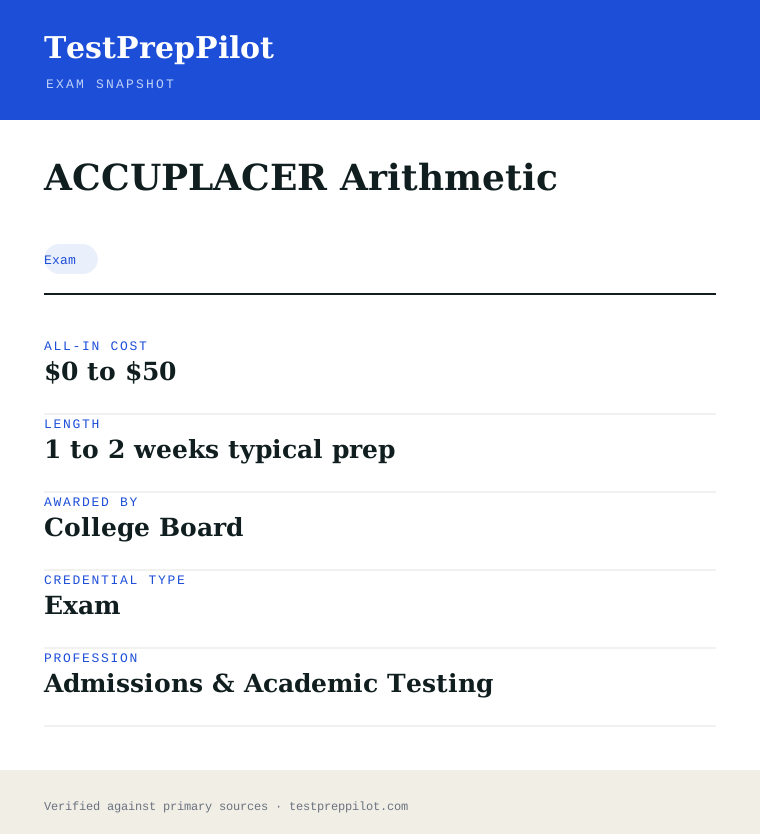
For the ACCUPLACER Arithmetic, the exam fee is $0 to $50, set by the institution; the all-in cost is typically $0 to $50; most candidates spend 1 to 2 weeks typical prep preparing.
Cost breakdown
| Institution fee | $0 to $50 |
|---|---|
| Typical total | $0 to $50 |
The College Board does not bill students directly; your school sets the fee.
Timeline
- Study 1 to 2 weeks
- Test Untimed
- Placement Same day
Typical prep: 1 to 2 weeks typical prep
The path
How do you register for the ACCUPLACER Arithmetic?
- 1
Create a College Board account10 minutes
Register at collegeboard.org with your legal name exactly as it appears on the photo ID you will bring on test day. One account covers the SAT, the PSAT-related assessments, AP and BigFuture.
- 2
Choose a weekend SAT date or let your school register you20 minutes
The SAT is booked directly by the student for weekend national administrations. PSAT 8/9, PSAT 10 and the PSAT/NMSQT are ordered and scheduled by the school, so for those you speak to your counselor rather than registering yourself.
- 3
Pay the fee or claim a fee waiver5 minutes
The US SAT registration fee is 68 dollars; international test takers add a regional fee of 43 dollars and, at some centres, a further test centre fee. Eligible US students get the SAT free through a counsellor-issued fee waiver, which also unlocks unlimited free score sends.
- 4
Install Bluebook and complete exam setup30 minutes
Download the free Bluebook app to your own laptop or tablet, or use a school-managed device, then run exam setup in the five days before test day to download the test and get your admission ticket.
Students who skip exam setup can be turned away or delayed at check-in.
- 5
Practise with Bluebook full-length tests and Khan Academy4 to 12 weeks
Six free adaptive full-length practice tests sit inside Bluebook, and Official Digital SAT Prep on Khan Academy is free and keyed to the same content domains.
- 6
Test, then review scores onlinetest day
Arrive with your admission ticket, acceptable photo ID and a charged device. Scores post to your College Board account, typically within about two weeks for weekend SAT dates.
The fine print
What are the retake and renewal rules for the ACCUPLACER Arithmetic?
- Proctoring & delivery
- All SAT Suite tests are taken in Bluebook on a laptop or tablet, in a school or an authorised weekend test centre, under a live human proctor. There is no at-home option. Bluebook locks the device, and a built-in Desmos graphing calculator and formula sheet are available throughout the Math section; you may also bring your own approved non-CAS calculator.
- Retake policy
- There is no limit on SAT attempts and no mandatory waiting period beyond the eight national dates offered each year. The PSAT-related assessments are given once per school year per grade band and are not retaken on demand. Most selective colleges superscore across SAT sittings, taking your best Reading and Writing score and your best Math score.
- Score reporting
- The SAT reports a 400 to 1600 total built from two 200 to 800 section scores. The PSAT/NMSQT and PSAT 10 report 320 to 1520 with 160 to 760 sections, and the PSAT 8/9 reports 240 to 1440 with 120 to 720 sections, so results across the suite sit on one comparable scale. PSAT/NMSQT reports also carry an NMSC Selection Index of 48 to 228.
- Recertification
- SAT Suite scores do not expire and never need renewal, but colleges commonly ask for a score from within the last five years and most students test in the spring of eleventh grade and again in the autumn of twelfth grade. Only a PSAT/NMSQT taken in eleventh grade enters the National Merit competition.
- Refunds & rescheduling
- Cancelling an SAT registration by the change deadline costs 34 dollars; cancelling after the deadline but before test day costs 44 dollars. Changing test centre costs 34 dollars, and late registration costs 38 dollars. Fee-waiver students are not charged for cancellation or late registration.
Context
The digital SAT Suite compared
| Assessment | Grades | Score scale | Length | |
|---|---|---|---|---|
| PSAT 8/9 | 8 and 9 | 240 to 1440 | 2h 14m | |
| PSAT 10 | 10 (spring) | 320 to 1520 | 2h 14m | |
| PSAT/NMSQT | 10 and 11 (autumn) | 320 to 1520 | 2h 14m | |
| SAT | 11 and 12 | 400 to 1600 | 2h 14m |
What it pays
How much does this credential pay?
Placement outcome, not pay: your Arithmetic score decides whether you start in credit-bearing or developmental math — and remedial load is one of the strongest predictors of degree completion and lifetime earnings
The direct answer is that ACCUPLACER Arithmetic is a placement test, not a job credential, so no BLS occupation corresponds to it and the salary story is about what the placement result unlocks. The test decides, usually before your first semester, whether you place directly into college-level math or are assigned to a developmental (non-credit) arithmetic or pre-algebra course — and that assignment is one of the strongest predictors of whether you graduate. Research published by the Community College Research Center (CCRC) has repeatedly found that a large share of community-college entrants are placed into developmental coursework and that students who skip remediation complete credentials at substantially higher rates. The reference point for interpreting all of this is BLS: the May 2024 median wage across all occupations was $49,500, while workers with an associate degree earned a median weekly wage of about $1,059 (2023 data) versus about $899 for high-school-diploma-only workers — the completion premium is real and compounding. A student placed into one or two semesters of non-credit arithmetic is measurably more likely to drop out before earning any credential, while a student who clears the placement gate and completes a degree moves toward the higher half of the distribution. Colleges increasingly use multiple measures — high school GPA and course history alongside the placement score — precisely because a single cut score misplaces students at both margins. The practical takeaway: treat the Arithmetic subtest as a high-stakes placement decision, prepare deliberately, and if the result assigns you to remediation, ask about retest policy and multiple-measures review rather than accepting the placement silently.
| Measure | Figure | Source / note |
|---|---|---|
| Reference: median wage, all occupations | $49,500 | BLS Occupational Outlook Handbook, May 2024 |
| Reference: associate degree, median weekly earnings | $1,059 | BLS Education Pays, 2023 ($55,068/yr equivalent) |
| Reference: high school diploma, median weekly earnings | $899 | BLS Education Pays, 2023 ($46,748/yr equivalent) |
| The exam itself | No direct occupation | A placement subtest, not a credential of record |
Job growth.BLS does not project growth for a placement test; relevant projections follow the occupations students are placed toward.
Source: BLS OOH — Pay overview
Your odds
What are the pass rates?
There is no official pass rate — ACCUPLACER Arithmetic is a scaled placement instrument scored 200-300, and only your college’s cut scores matter
The core fact to internalize is that ACCUPLACER Arithmetic has no pass/fail threshold at the national level, so any claim of a "pass rate" describes something that does not exist. Each subtest is scored on a 200-300 scale, and every college sets its own cut scores that determine placement into developmental math, college-level math, or a specific course. Two students can receive identical scores at different institutions and be placed differently, which is exactly why practice vendors cannot quote a defensible pass rate. What is published is the score scale and, at many schools, the placement table that maps score bands onto course assignments; these tables are public on most college websites but differ by campus. The Arithmetic subtest is a 20-question computer-adaptive test with no time limit by default (most colleges allow up to two hours), covering whole numbers, fractions, decimals, percentages, and applications. Because the test is adaptive, your score reflects a statistical estimate of ability rather than a simple percentage correct, and early answers set the difficulty ceiling. The practical implication is that your preparation target must be defined locally: ask your specific institution for its placement chart and aim comfortably above the cut score for the course you want. Colleges also vary in retake policy — some allow immediate retests, others impose a waiting period or fee, and some let you contest the placement through a multiple-measures review using high school GPA or transcripts.
Read this before quoting the number.No official pass rate exists; only per-college cut scores are published, and they vary by institution.
Your schedule
How long should I study for it?
12-20 hours (Arithmetic subtest) of focused study
Plan for two to four weeks and roughly 12 to 20 hours of study for the Arithmetic subtest, and expect the exam to reward fluent mastery of basic arithmetic — whole numbers, fractions, decimals, percentages, and word-problem setup — not advanced algebra. The Arithmetic subtest is a 20-question adaptive test with no default time limit (most colleges allow up to two hours), and it is the most fundamental of the math placement subtests: students who score at the bottom of the Arithmetic band are typically placed into developmental arithmetic itself. Week one should be a diagnostic pass: take the official College Board practice test, log which question types you miss, and map each miss to a skill (fractions operations, decimal conversions, percentage change, ratio and proportion). Week two is targeted skill work on your weakest two or three areas, using the free official question bank and limiting drills to those skills. Week three, if you have it, is for full-length timed practice and stamina — even without a clock on the real exam, practising in 90-minute blocks keeps you fresh. Week four is a light taper: one more official practice test, review of the error log, and rest. The single most useful habit is learning to move on quickly from items you cannot solve, because on an adaptive test the time spent stuck on one item degrades the whole session. Budget hours in proportion to your diagnostic score: someone near the bottom should expect the full 20 hours, while a student already clearing college-level items may need only 6 to 8.
- Week 14
Diagnostic baseline
- Take the official College Board Arithmetic practice test
- Log every missed item by skill
- Map misses to the published test description
- Week 27
Targeted skill repair
- Drill fractions, decimals, and percent operations
- Practise word-problem setup
- Re-test only the weak skills
- Week 36
Full-length stamina
- Two full-length practice sessions in one sitting
- Review the error log patterns
- Confirm your college’s cut scores
- Week 43
Taper and confirm
- One final official practice test
- Light review of the error log
- Check retest and multiple-measures policy
Adjusting the pace
Quantitative Reasoning, Algebra & Statistics (QAS).The next subtest up the placement ladder; adds algebra and statistics content.
Advanced Algebra & Functions (AAF).The highest math placement subtest, used for STEM-track placement.
How to study
How do I prepare most effectively?
The strategy that reliably moves Arithmetic scores is "skill-mapped practice on official items, then adaptive-order simulation," and the single highest-leverage move is obtaining your college’s placement table before you study. Most candidates waste hours reviewing material far above or below their actual band; the placement table tells you exactly which band you need to clear, so you can tune difficulty. Because the test is adaptive, practise in the same mode: use platforms that feed progressively harder items after correct answers, because the real exam punishes dwelling on answered items. A second proven approach is mastering the fraction-decimal-percent conversions cold, since they underpin most Arithmetic items and are the skill that decays fastest without practice. Third, translate word problems into arithmetic setup language early — most items are story problems, and candidates who practise writing the calculation from prose outperform those who jump straight to computing. Fourth, keep an error log organized by skill category rather than question number; patterns show up by category. Fifth, treat the first five items as the most consequential: on an adaptive test, early answers set the difficulty ceiling, so slow down at the start. Finally, never leave preparation until the week of registration; placement happens at orientation and retakes are often limited.
Get the placement table first
Obtain your college’s cut scores before studying so you calibrate difficulty to your target band.
Practise adaptively
Use adaptive-order practice so the difficulty progression matches the live test.
Master fraction-decimal-percent fluency
Conversions underpin most items and decay fastest without practice.
Write the math out of word problems
Most items are story problems; practise setting up the calculation.
Protect the opening items
Adaptive tests set difficulty from early answers; slow down at the start.
What to buy
Which study resources are worth paying for?
The best-value ACCUPLACER Arithmetic preparation is almost entirely free, because College Board publishes official practice questions and a full sample test that mirror the adaptive engine better than any third-party bank. The comparison below separates official resources from commercial practice banks and live tutoring, with prices current to this review. Note that College Board periodically updates subtest naming, so verify that a resource references the current Arithmetic subtest rather than retired versions.
| Resource | Price | Format | Best for |
|---|---|---|---|
| College Board official practice questions & sample test | Free | Web-based practice + downloadable PDF | The closest match to the real adaptive engine |
| Khan Academy arithmetic & pre-algebra courses | Free | Video + practice | Rebuilding weak fundamentals |
| ACCUPLACER prep books (e.g. Mometrix, Barron’s) | ~$25-45 | Printed book + online bank | Structured review for self-studiers |
| Commercial practice apps with adaptive mode | ~$10-30/mo | Mobile drills | Daily short practice sessions |
| College readiness tutors | ~$40-90/hr | 1:1 sessions | Candidates stuck after self-study |
Prices approximate and dated to this review; College Board official materials are free and updated with the current subtest set.
Avoid these
What mistakes do candidates most often make?
The most expensive mistake candidates make is studying the wrong difficulty level — drilling algebra content when the Arithmetic band rewards basic fluency — and the second is ignoring their college’s cut scores entirely. A close third is treating ACCUPLACER like a knowledge test when it is an adaptive placement instrument: pacing matters, early items matter disproportionately, and dwelling on one hard item can cap the whole session. Candidates also routinely lose points on fraction and decimal operations through rusty arithmetic, and many underestimate the word-problem share of the Arithmetic paper, arriving unprepared to translate prose into a calculation. Another recurring error is registering at orientation cold, having done zero practice, and then accepting a developmental placement without asking about retake policy or multiple-measures review. Finally, many students fail to confirm whether their school even uses ACCUPLACER or a competing placement test — preparing for the wrong instrument is the most avoidable failure mode of all.
✕Studying the wrong difficulty band
✓Get your college’s placement table and drill exactly the skills in your target band.
✕Ignoring the adaptive nature
✓Practise with adaptive-order items and slow down on the opening questions.
✕Rusty fraction and decimal fluency
✓Drill conversions and operations; they underpin most items.
✕Skipping word-problem translation
✓Practise setting up calculations from prose.
✕Registering cold at orientation
✓Take one official practice test at least two weeks before placement.
What you'll face
What question types will I see?
The Arithmetic subtest contains 20 adaptive multiple-choice questions with no default time limit, drawn from the published skill areas: operations with whole numbers, fractions and mixed numbers, decimals, percentages, and applications. Because the test is computer-adaptive, question difficulty adjusts to your performance, and each candidate’s question set is unique. The highest-yield preparation is knowing the skill areas and the item style — calculation-light, reasoning-heavy items dominate the upper branch of the scale. The samples below are editor-written illustrations of the published blueprint, not live exam items.
Addition, subtraction, multiplication, and division with applications.
Operations, equivalence, and applications.
Operations, conversions, and rounding.
Percent change, discounts, and applications.
Word problems requiring setup and computation.
Try these
Q1What is 3/4 + 1/8?
Answer:B
Convert 3/4 to 6/8, then add: 6/8 + 1/8 = 7/8.
Q2A shirt costs $40 and is discounted 25%. What is the sale price?
Answer:A
25% of $40 is $10; $40 − $10 = $30.
Q3What is 0.75 expressed as a fraction in simplest form?
Answer:A
0.75 = 75/100, which simplifies to 3/4.
Samples are editor-written illustrations of the published blueprint, not live exam items.
The big day
What should I expect on exam day?
ACCUPLACER Arithmetic is administered at your college or a testing center, typically during orientation or a scheduled placement session, and is untimed by default — most colleges allow up to two hours per subtest, so pacing pressure is minimal but stamina still matters. The core rules are straightforward: bring a government-issued photo ID and your college-issued registration information, leave calculators at home (an on-screen calculator is built into applicable questions), and expect to be asked to store personal items. There is no cost at most colleges, though retakes may carry a fee, and you will usually see your placement result before you leave. The biggest behavioural trap is finishing in a rush out of habit — there is no clock advantage to speed on an untimed test, so work deliberately, especially on the opening adaptive items. After the session, your score report shows scaled scores and the placement recommendation; if the placement assigns you to developmental coursework and you believe it is wrong, immediately ask about the retest schedule and any multiple-measures review process using your high school record.
Bring
- Government-issued photo ID
- College registration/confirmation info
- Confirmation of your target placement band
- Patience for an untimed, adaptive session
Leave at home
- Calculator (on-screen one is provided where applicable)
- Phone and smartwatch (stored with testing staff)
- Notes or study materials
How the day runs
Rules in the room
- Untimed by default — speed earns nothing
- Photo ID required
- Personal items and devices stored
- Retakes may require a waiting period or fee
Afterwards.Your scaled score maps to your college’s placement table; a low placement is not final — check retest windows and multiple-measures review before enrolling in non-credit coursework.
Reference
What are the key facts about the ACCUPLACER Arithmetic?
ACCUPLACER Arithmetic is a exam credential; awarded by College Board; the exam fee is $0 to $50, set by the institution; typical preparation is 1 to 2 weeks typical prep; holders typically earn Placement tests determine course level, not salary.
| Credential | ACCUPLACER Arithmetic |
|---|---|
| Type | Exam |
| Profession | Admissions & Academic Testing |
| Specialty | College Placement |
| Awarded by | College Board |
| Difficulty | Easy |
| Typical prep time | 1 to 2 weeks typical prep |
| All-in cost | $0 to $50 |
| Typical salary range | Placement tests determine course level, not salary |
| Scoring | 200 to 300 |
| Timing | Untimed |
| Level | Most foundational ACCUPLACER math test |
| Purpose | Course placement, not admission |
| Scope | National / Multi-state |
Real questions
Frequently asked questions about the ACCUPLACER Arithmetic
Is the Arithmetic test hard?
It covers foundational skills, so most students find it straightforward, but brushing up on fractions and percentages helps avoid unnecessary remedial placement.
How long does it take?
ACCUPLACER is untimed and Arithmetic is about 20 questions, so most students finish in well under an hour.
What score do I need?
There is no universal pass mark. Your college sets the band, and a stronger Arithmetic result can move you out of remedial math.
Do I pay the College Board directly?
No. Your institution administers ACCUPLACER and may charge a small fee, typically between 0 and 50 dollars.
Why do all four SAT Suite tests take the same 2 hours 14 minutes?
Since the digital transition every assessment in the suite uses the same blueprint: 54 Reading and Writing questions in two 32-minute modules and 44 Math questions in two 35-minute modules. Difficulty is calibrated to the grade band rather than by adding or removing time.
Can I take an SAT Suite test at home?
No. Unlike some other admissions tests, every College Board digital assessment must be taken in a supervised school or test centre, even though it runs on your own device.
How do fee waivers work?
US students in eleventh or twelfth grade who meet income eligibility get SAT fee waivers from their school counsellor. A waiver covers the registration fee, waives cancellation and late fees, and gives unlimited free score reports to colleges.
In short
Is the ACCUPLACER Arithmetic worth it?
- Untimed adaptive test of about 20 basic-math questions
- Scores 200 to 300 for foundational placement
- No pass or fail; college sets the cut
Same awarding body
What other credentials does College Board award?
Worth comparing
How does the ACCUPLACER Arithmetic compare with similar credentials?
Trust
Where does this information come from?
Everything above is taken from the awarding body's own published material. Fees, question counts and domain weights are revised regularly — check the official page before you pay.
- College Board Awarding body
- Official ACCUPLACER Arithmetic exam page Exam page
Research confidence: high · Last reviewed 2026-08