Admissions & Academic Testing • Exam
Duolingo English Test
The one-hour, at-home English test accepted by thousands of colleges.
Researched and maintained by TestPrepPilot Editorial BoardEnglish-language assessment desk · Figures last verified August 2026
The short version
What is the Duolingo English Test and is it worth it?
The DET is a one-hour, at-home adaptive English test scored 10 to 160. It is accepted by thousands of schools, costs about $70, and you may take it up to three times in 30 days. Results arrive within two days.
- Taken at home in about one hour
- Accepted by thousands of institutions
- Low cost, about $70
- Results in two days; up to 3 tests per month
What is it?
What exactly is the Duolingo English Test?
The one-hour, at-home English test accepted by thousands of colleges.
The Duolingo English Test (DET) is an adaptive English-proficiency exam taken entirely at home in about an hour. It is accepted for admission by thousands of colleges and universities in the United States and abroad as a convenient, lower-cost alternative to center-based tests. The test adapts to the candidate, requires the webcam on, and is reviewed by both software and humans.
The path in brief
- Create a DET account
- Verify your ID and environment
- Take the test in one sitting
- Receive results in two days
- Send scores to your schools
Before you book
Who is eligible to sit the Duolingo English Test?
Who it is for: International and English-learner college applicants.
The test itself
What is the format of the Duolingo English Test?
The Duolingo English Test is administered by At home with webcam and AI plus human review and runs about 1 hour and requires 10 to 160; schools set minimums (often 105+) to pass.
| Administered by | At home with webcam and AI plus human review |
|---|---|
| Questions | Adaptive, roughly 45 to 60 items |
| Time limit | about 1 hour |
| Pass mark | 10 to 160; schools set minimums (often 105+) |
| Exam fee | $70 (lower with subscription) |
| Format | Adaptive, online, one sitting |
Content outline
What topics are on the Duolingo English Test?
The Duolingo English Test covers 4 content domains.
Weightings come from the official exam outline. Study time is best allocated in roughly these proportions rather than evenly across domains.
- Literacy
Reading and writing subscore
- Comprehension
Listening and reading subscore
- Conversation
Speaking and listening subscore
- Production
Speaking and writing subscore
Money & time
How much does the Duolingo English Test cost?
For the Duolingo English Test, the exam fee is $70 (lower with subscription); the all-in cost is typically $70; most candidates spend 2 to 4 weeks preparing.
Cost breakdown
| Test fee | $70 |
|---|---|
| Typical total | $70 |
A subscription plan lowers the per-test price; a small fee applies to send a certificate. Verify the school minimum before booking.
Timeline
- Account and ID 10 minutes
- Study 2 to 4 weeks
- Test about 1 hour
- Results 2 days
Typical prep: 2 to 4 weeks
The path
How do you register for the Duolingo English Test?
- 1
Create a DET account5 minutes
Sign up on the Duolingo English Test site and confirm the school list that should receive your score.
- 2
Verify your identity5 minutes
Upload a government ID and complete the photo and environment checks before the test opens.
- 3
Take the test at homeabout 1 hour
Complete the adaptive test in one sitting with your camera on; the system records the session for review.
- 4
Receive and send resultswithin 2 days
Get your certified score within two days and forward it to the schools you selected.
The fine print
What are the retake and renewal rules for the Duolingo English Test?
- Proctoring & delivery
- Taken at home with the webcam on; an automated system plus human reviewers check the session for integrity, and the test must be completed in one uninterrupted sitting.
- Retake policy
- You may take the test up to three times within any 30-day window, as long as each attempt is certified.
- Score reporting
- The overall score runs from 10 to 160 in one-point increments, with subscore bands for literacy, comprehension, conversation and production.
- Recertification
- The DET is a proficiency exam, not a certification, but scores are valid for two years from the test date.
What it pays
How much does this credential pay?
The Duolingo English Test has no direct salary outcome — it is a proficiency gate for university admissions and migration, and its value is access to higher education and jobs that require English verification.
The salary answer for the Duolingo English Test is indirect: the BLS does not publish a wage for English-proficiency scores, because DET is not an occupation credential but a computer-adaptive English-proficiency test used primarily for university admissions, visa applications, and employer English verification. The earnings story is the education-access premium: DET is accepted by thousands of universities worldwide, including many institutions in the United States, the United Kingdom, Canada, Australia, and Europe, and a strong score is a precondition for admission to degree programs whose graduates earn significantly more than non-degree earners — the BLS college-education earnings gap is the largest single wage differential in the US labor market. The test is scored on a 10-to-160 scale aligned to the Common European Framework of Reference (CEFR), with institutions setting their own cut scores — commonly 105-120 for undergraduate admissions and 120-135 for graduate programs at selective schools. The practical advantages of DET over proctored-center tests are speed and access: the test is taken at home on a computer, costs about $65, lasts about one hour, and returns results within about two days, which makes it the fastest English-proficiency option for application deadlines. The honest caveat is that acceptance is institution-specific — a candidate should verify that the target school or program accepts DET and check the program’s cut score before investing, because not every institution accepts it, and some programs still require a proctored test such as TOEFL or IELTS. For a candidate asking whether DET pays, the direct answer is that it pays through the doors it opens: as an admission gate to degree programs and visa processes, the score is a cheap, fast credential whose earnings impact is measured in the lifetime wage difference between degree and non-degree employment.
| Measure | Figure | Source / note |
|---|---|---|
| Score scale | 10-160 | Aligned to CEFR (A1-C2) |
| Typical cut scores | 105-135 | Institution-set; graduate programs often require 120+ |
| Test length | ~1 hour | Computer-adaptive, taken at home |
| Salary impact | Indirect | Admission access to degree programs and visa processes |
Job growth.DET adoption has grown rapidly since its 2020 expansion; thousands of institutions now accept it, making it one of the fastest-growing English-proficiency tests.
Your odds
What are the pass rates?
The Duolingo English Test has no published pass rate — it reports a 10-160 score with no pass/fail standard, and each institution sets its own cut line.
The direct answer on pass rates is that none exists to publish: DET is scored on a 10-to-160 scale with no pass/fail threshold, so the program does not report pass rates the way certification bodies do. Instead, each accepting institution defines its own cut score, which is why the same 120 score can satisfy one school and fall short at another. What is published and stable is the test format: DET is a computer-adaptive test taken online at home under remote proctoring, lasting about one hour, and it measures integrated English skills through a mix of adaptive multiple-choice items and production tasks — reading, listening, writing, and speaking are assessed through item types such as read-and-select, listen-and-type, complete the sentences, interactive reading, writing samples, and speaking prompts. The adaptive engine adjusts item difficulty to the candidate’s performance, and the final score on the 10-160 scale maps to the CEFR bands from A1 to C2, with sub-scores reported for literacy, comprehension, conversation, and production. The certification cost is about $65 per test, and results are delivered within roughly two days of the test, which is the fastest reporting window among major English-proficiency tests. The practical read on difficulty: because the test is adaptive and integrated, candidates who are strong in reading but weak in speaking see the production tasks pull their score down, so preparation should cover all four skills rather than drilling one format; the official free practice test on the DET site is the best readiness check because it returns a predicted score band. Because there is no pass/fail, the smart approach is to identify the target institution’s cut score first, then practice until the free practice-test score clears it with margin, then sit the real test — and the ability to retake with new scores, subject to the program’s retake rules, makes the test low-risk to attempt.
Read this before quoting the number.DET publishes no pass rate because the test has no pass/fail standard; institution cut scores on the 10-160 scale define what counts as acceptable.
Source: Duolingo English Test official test format and scoring
Your schedule
How long should I study for it?
40-60 hours over 4-8 weeks of focused study
An efficient DET study plan is 4-8 weeks of about 40-60 total hours, because the test is a computer-adaptive, integrated-skills exam that rewards balanced proficiency across reading, listening, writing, and speaking, and the fastest score gains come from taking the official free practice test first and then targeting the weakest sub-skill. The first step is the official practice test on the DET site, which returns a predicted score band and identifies the production sub-skills (writing and speaking) that most often lag behind comprehension; candidates who are strong in reading but weak at typing their answers or speaking under time pressure see the production score drag down the total, and that gap is the study target. The study window should split into skill building (weeks 1-4) and adaptive-format rehearsal (weeks 5-8): the production tasks — typing responses and speaking prompts — need deliberate daily practice because they are timed and on-screen, and the adaptive reading and listening items reward exposure to a broad vocabulary range. Candidates applying to programs with a 105-120 cut should budget the lower end if their English is already intermediate; candidates at the beginner-intermediate boundary targeting 120+ should budget the upper end and add daily integrated practice. The final two weeks should be full-length practice sessions using the official test and reputable third-party simulations, because the one-hour adaptive format and the on-screen typing pace are the two things candidates underestimate, and the score ceiling on DET comes from production fluency, not from recognizing more vocabulary. Because the adaptive engine samples a wide difficulty range, candidates should also practice slightly above their comfortable level — if the free practice test predicts a 110, drilling materials at the 120-130 band prepares the adaptive climb, and the production prompts should be rehearsed at the same difficulty the target band requires, so the timed typing and speaking feel familiar rather than surprising on test day.
- Week 16
Diagnostic
- Take the official DET free practice test
- Record the predicted score band and sub-scores
- Identify the weakest sub-skill (literacy, comprehension, conversation, production)
- Week 2-314
Comprehension building
- Drill the adaptive reading and listening item types
- Build academic and everyday vocabulary by topic
- Practice read-and-select, listen-and-type, and completion items
- Week 4-516
Production skills
- Practice on-screen typing responses under time limits
- Drill the speaking prompts: describe, summarize, and answer
- Work the writing-sample prompts and self-edit
- Week 6-712
Full-length rehearsal
- Take a full DET practice session each week
- Log every miss by sub-skill and re-study the target
- Re-take the official practice test to measure movement
- Week 88
Readiness
- Take one more full practice session above the target cut
- Re-drill the miss log until clean
- Confirm the testing environment, computer, and ID requirements
Adjusting the pace
Targeting a specific program cut.Identify the institution’s cut score (often published on the admissions page) and practice until the predicted score clears it with margin.
Weak production skills.Weight time toward the writing and speaking prompts; production sub-scores most often lag comprehension.
How to study
How do I prepare most effectively?
The dominant prep strategy for the Duolingo English Test is balanced-skill practice with heavy emphasis on the production tasks, because the test is adaptive and integrated and the writing and speaking sub-scores most often pull down an otherwise strong total. First, take the official free practice test before any study: it returns a predicted score band and the sub-score breakdown, which tells you exactly where the points are lost. Second, drill the adaptive item types deliberately — read-and-select, listen-and-type, complete-the-sentences, and the interactive reading passages — because the adaptive engine adjusts difficulty and candidates who only practice static materials underperform on the on-screen formats. Third, practice the production tasks under time pressure every day: the typing responses and the speaking prompts are timed, and candidates who can think and type in English fluently outperform those who can recognize English but not produce it. Fourth, use the official free practice test weekly as the progress measure, because its predicted band is the most reliable readiness check and it is free to retake. Fifth, build vocabulary breadth deliberately — DET samples academic and everyday language across a wide range, and the adaptive engine rewards knowing more words at each band. Finally, check the target institution’s acceptance and cut score before registering, because not every school accepts DET and the cut varies; then book the real test for a date that lands after the practice-score progression. A further high-yield tactic is to rehearse the test-day environment itself: DET is taken at home with remote proctoring, so practice in the same quiet room with the same computer and camera setup, and verify the system requirements and ID rules in advance, because environment-related disqualifications are the most avoidable cause of a wasted attempt.
Diagnose with the official practice test
It returns a predicted band and sub-scores — the roadmap for study.
Drill the adaptive item types
Read-and-select, listen-and-type, and completion items reward on-screen format fluency.
Practice production daily
Timed typing responses and speaking prompts are where most candidates lose points.
Rehearse the test-day environment
Take DET at home with proctoring; practice in the same room, computer, and camera setup.
Verify the target cut score first
Institution acceptance and cut scores vary; check the admissions page before registering.
What to buy
Which study resources are worth paying for?
DET prep resources are unusual because the official program provides a free practice test that returns a predicted score band, which makes the official materials the anchor of every plan and reduces the need for paid resources. The official free practice test on the DET site is the single highest-value resource — it is free, mirrors the real adaptive format, and returns a predicted band and sub-scores — and candidates should take it before buying anything. Third-party DET prep courses and question banks, typically $30-120, add structured practice and volume, which helps candidates who need more reps than the free test provides or who want skill-specific drills; reputable providers are the ones that reference the current test format. General English-proficiency courses, $50-200, help candidates whose fundamentals are weak, but they are a complement because DET’s adaptive and production format needs format-specific rehearsal. The footnote that anchors the comparison: prices below are list prices as of mid-2026 and change frequently, and we rank nothing by commission. The test fee itself is about $65 per certification, which makes DET by far the cheapest major English-proficiency test, and results arrive within about two days, so a retake after a short study burst is affordable and fast. A cheap readiness check is the free official practice test before any purchase, because candidates within a few band points of the target cut often need only targeted production practice, not a paid course. Candidates should also confirm the program’s retake rules, because the ability to send new scores to institutions is subject to the current policy, and institutions see the score reports they are sent, not every attempt.
| Resource | Price | Format | Best for |
|---|---|---|---|
| Official free practice test | Free | Online, adaptive, predicted band | The roadmap — take it first |
| Third-party DET prep course | $30-120 | Online, skill drills | Extra reps beyond the free test |
| General English course | $50-200 | Online or classroom | Candidates with weak fundamentals |
| DET certification | ~$65 | Online, remote-proctored | The actual test; results in ~2 days |
List prices as of mid-2026 and change frequently; we rank nothing by commission. Confirm the current DET fee and retake policy on the official site.
Avoid these
What mistakes do candidates most often make?
The most common mistake on the Duolingo English Test is preparing for a traditional static test instead of DET’s adaptive, integrated format, because the on-screen item types and the production tasks behave differently from paper-style English exams and candidates who drill only reading and listening arrive at the writing and speaking prompts cold; the second is ignoring the sub-score breakdown and studying all skills equally, when the production sub-scores most often drag down an otherwise strong total. A third recurring error is treating the test like a pass/fail and aiming at a generic score, when the real target is the specific institution cut score — a 115 might admit to one program and fall short at another. Candidates also routinely neglect the test-day environment: DET is taken at home with remote proctoring, and an unstable internet connection, an incorrect camera setup, or a room with prohibited materials can invalidate the attempt. Another pattern is skipping the free official practice test and buying paid materials first, when the free test is the most reliable diagnostic. Finally, some candidates wait until the application deadline, forgetting that the score report is valid and sendable only per the program’s current rules and that institutions review scores within their own windows. A further recurring error is typing answers slowly, because the production tasks are timed on screen and candidates who are accurate but slow leave responses incomplete; others speak too quietly or too quickly in the speaking prompts, and the automated scoring rewards clear, natural pacing. Some candidates also skip the weekly practice-test retake and lose the trend measurement, and a few ignore the system-check requirements until the real attempt, risking an environment-related invalidation.
✕Preparing for a static test format
✓Drill DET’s adaptive item types and the timed production tasks; the format is part of the score.
✕Studying all skills equally
✓Use the practice-test sub-scores and weight time toward the weakest sub-skill, usually production.
✕Aiming at a generic score
✓Identify the target institution’s cut score and practice until the predicted band clears it.
✕Neglecting the home-test environment
✓Verify internet, computer, camera, and room requirements; practice in the same setup.
✕Waiting until the deadline
✓Check the program’s current retake and score-sending rules and plan the test around the application window.
What you'll face
What question types will I see?
The Duolingo English Test is a computer-adaptive test taken online at home under remote proctoring, lasting about one hour, and it reports a 10-160 score aligned to the CEFR with sub-scores for literacy, comprehension, conversation, and production. The adaptive engine mixes item types across skills: read-and-select, listen-and-type, complete-the-sentences, interactive reading passages, writing-sample prompts, and speaking prompts, with the difficulty adjusting to performance. The samples below illustrate three of the core item types — a read-and-select item, a completion item, and a writing-style prompt — using the real format. The sample items are editor-written illustrations of the published format, not live test items. The read-and-select items present a grid of words and ask which are real English, testing vocabulary breadth under speed; the completion items test grammar in context; the interactive reading passages add comprehension questions across a paragraph set; and the production prompts — a writing sample and speaking responses — are scored on the CEFR-aligned sub-skills, so candidates should practice producing complete, natural responses rather than fragments. The read-and-select items present a grid of words and ask which are real English, testing vocabulary breadth under speed; the completion items test grammar in context; the interactive reading passages add comprehension questions across a paragraph set; and the production prompts — a writing sample and speaking responses — are scored on the CEFR-aligned sub-skills. Candidates should practice producing complete, natural responses rather than fragments, because the production sub-scores most often lag comprehension, and the free official practice test is the best way to measure which item types pull down the overall band.
Select the real English words from a set; tests vocabulary breadth.
Choose the word that completes a sentence correctly; tests grammar in context.
Passages with questions plus timed writing and speaking prompts.
Try these
Q1Read-and-select item (illustrated): Which of the following are real English words?
Answer:A, C
"Beautiful" and "knowledge" are real English words. "Teplid" and "flurish" are not — they resemble words (tepid, flourish) but are not real vocabulary, and the item type tests exactly this distinction.
Q2Complete the sentence: "The report needs to be ___ before the meeting on Friday."
Answer:A
"Needs to be" requires the past participle, so "finished" is correct: "the report needs to be finished." The other forms do not fit the passive construction.
Q3Writing-style prompt (illustrated): "Write about a time you had to work with a team to solve a problem. What did you do, and what was the result?"
Answer:B
The production tasks reward a developed response: a short paragraph with specific details and a clear outcome demonstrates the writing sub-skill. One-sentence or repeated-prompt answers underperform on the scoring rubric.
Samples are editor-written illustrations of the published format, not live test items.
The big day
What should I expect on exam day?
The Duolingo English Test is taken online at home on a computer under remote proctoring, and the direct exam-day answer is that the adaptive test lasts about one hour, costs about $65, and reports a 10-160 score within about two days, with no pass/fail — the target is the institution’s cut score. Before the test, complete the system check on the official site: a working camera, microphone, and stable internet connection are required, and the proctoring rules require a quiet, private room with no other people, no headphones in most configurations, and no prohibited materials on the desk. Have the required photo ID and a clear workspace ready, because the proctor reviews the environment and the ID at the start. The test opens with the proctoring setup and ID verification, then the adaptive items run continuously for about an hour; the production tasks are timed, so pace the typing and speaking responses, and remember that the writing and speaking prompts have their own time limits. Expect no scheduled breaks — the test runs straight through — and keep your eyes on the screen, because proctoring software flags unusual behavior and a flagged attempt can be invalidated. The score and sub-scores appear in the DET account within about two days, and candidates can send the score to institutions through the account; check the program’s current score-sending and retake rules, because they have changed across program versions, and institutions see the reports they are sent. If the score falls short of the target cut, the test can be retaken, and the sub-score breakdown shows which skill to improve before the next attempt.
Bring
- Government-issued photo ID for proctoring verification
- A quiet, private room with no other people
- A working computer with camera and microphone
- A stable internet connection and a clear desk
Leave at home
- Phone and other electronics (out of reach during the test)
- Headphones, if the current program rules prohibit them
- Notes and printed materials (remove from the desk)
- Other people in the room
How the day runs
Rules in the room
- Quiet, private room required; no other people visible
- Camera and microphone required for remote proctoring
- No prohibited materials on the desk; follow the current program rules
- The test runs straight through with no scheduled breaks
Afterwards.Receive the 10-160 score and sub-scores within about two days, send them to institutions through the DET account, and retake if the score falls short of the target cut — the sub-score breakdown shows which skill to improve.
Reference
What are the key facts about the Duolingo English Test?
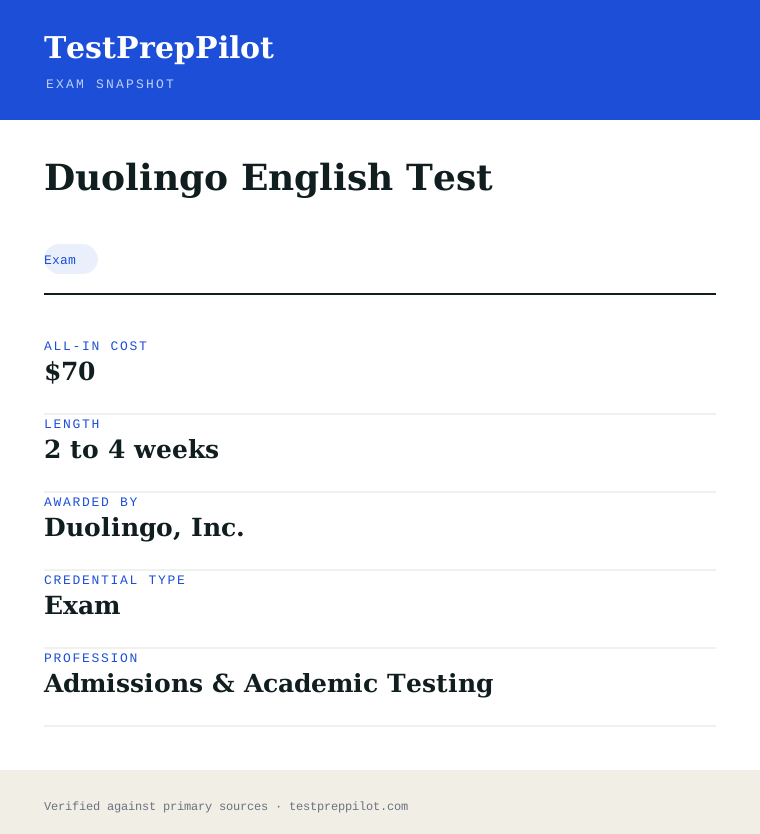
Duolingo English Test is a exam credential; awarded by Duolingo, Inc.; the exam fee is $70 (lower with subscription); typical preparation is 2 to 4 weeks; holders typically earn No direct salary outcome (admission gate; 10-160 score).
| Credential | Duolingo English Test |
|---|---|
| Abbreviation | DET |
| Type | Exam |
| Profession | Admissions & Academic Testing |
| Specialty | English Proficiency |
| Awarded by | Duolingo, Inc. |
| Difficulty | Moderate |
| Typical prep time | 2 to 4 weeks |
| All-in cost | $70 |
| Typical salary range | No direct salary outcome (admission gate; 10-160 score) |
| Score | 10 to 160 overall |
| Attempts | Up to 3 certified tests per 30 days |
| Validity | 2 years |
| Results | Within about 2 days |
| Scope | National / Multi-state |
Real questions
Frequently asked questions about the Duolingo English Test
How many times can I take the Duolingo English Test?
Up to three certified tests within any 30-day window. Each attempt is scored, and you choose which results to send.
Is the DET accepted for admission?
Yes, by thousands of institutions, though each school sets its own minimum. Verify the required score with the admission office before booking.
How long is a DET score valid?
Two years from the test date. Results are typically available within two days.
How many times can I take the DET?
Up to three certified attempts within any 30-day window, and each attempt carries the standard fee.
How many times can I take the Duolingo English Test?
Up to three certified tests in any 30-day period. Each attempt is scored, and you choose which results to send.
Is the Duolingo English Test accepted for admission?
Yes, by thousands of institutions, though each school sets its own minimum. Verify the required score with the admission office before booking.
In short
Is the Duolingo English Test worth it?
- The DET is a one-hour at-home adaptive English test
- Scored 10 to 160; schools set their own minimum
- About $70 and up to three tests per month
- Results in roughly two days
Trust
Where does this information come from?
Everything above is taken from the awarding body's own published material. Fees, question counts and domain weights are revised regularly — check the official page before you pay.
- Duolingo, Inc. Awarding body
Research confidence: high · Last reviewed 2026-08