The short version
What is the TOEFL iBT and is it worth it?
The TOEFL iBT is a computer-delivered academic English test of about two hours covering reading, listening, speaking and writing, each scored 0 to 30 for a total of 0 to 120. The US registration fee is about 245 dollars and scores are valid for two years.
- Accepted by most US universities and many schools worldwide
- Tests integrated academic skills, not isolated grammar
- Delivered at centres and at home with live proctoring
- Four free score reports included with registration
- Scores valid two years for admission and visa use
What is it?
What exactly is the TOEFL iBT?
The leading academic English test for university admission, scored 0 to 120 across four skills.
The TOEFL iBT is ETS internet-based academic English test lasting about two hours and measuring reading, listening, speaking and writing through integrated academic tasks. It is accepted by the vast majority of US universities and by institutions across more than 150 countries for admission and sometimes visa purposes. Each section contributes 0 to 30 points to a total of 0 to 120, and institutions set their own minimum requirements rather than a universal pass mark.
The path in brief
- Confirm school minimums
- Register via ETS
- Practice with TOEFL Practice Online
- Test in about two hours
- Send four free reports
Before you book
Who is eligible to sit the TOEFL iBT?
None - open to all
Who it is for: International applicants to English-medium universities
The test itself
What is the format of the TOEFL iBT?
The TOEFL iBT is administered by ETS test centres and at-home online proctoring and runs ~2 hours and contains 4 sections (Reading, Listening, Speaking, Writing) questions.
| Administered by | ETS test centres and at-home online proctoring |
|---|---|
| Questions | 4 sections (Reading, Listening, Speaking, Writing) |
| Time limit | ~2 hours |
| Pass mark | No pass mark; institutions set their own minimums |
| Exam fee | ~$235 |
| Format | Computer-delivered, integrated academic tasks |
Content outline
What topics are on the TOEFL iBT?
The TOEFL iBT covers 4 content domains.
Weightings come from the official exam outline. Study time is best allocated in roughly these proportions rather than evenly across domains.
- Reading
- Listening
- Speaking
- Writing
Money & time
How much does the TOEFL iBT cost?
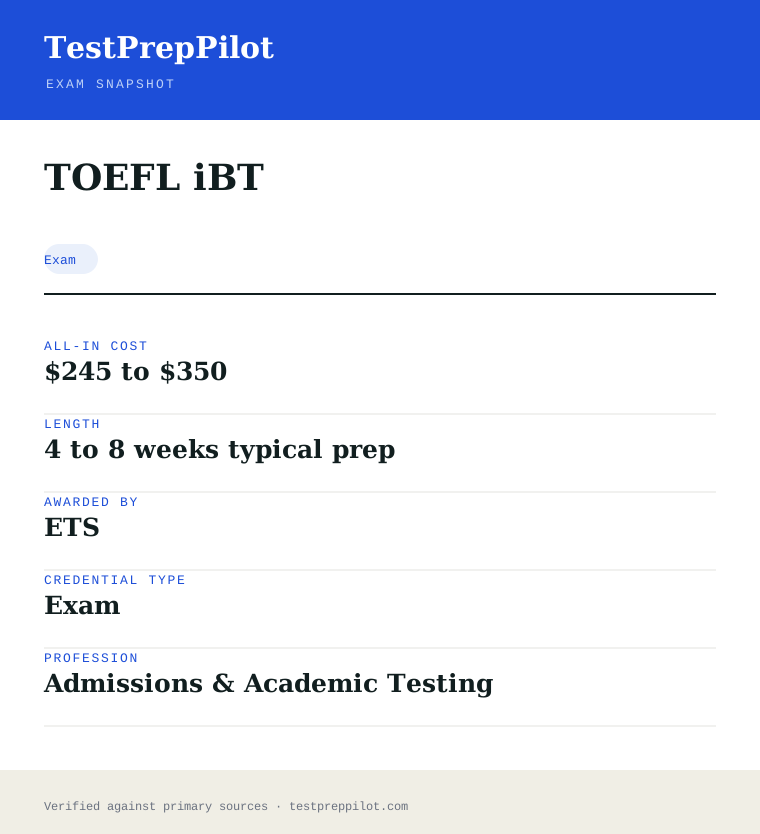
For the TOEFL iBT, the exam fee is ~$235; the all-in cost is typically $245 to $350; most candidates spend 4 to 8 weeks typical prep preparing.
Cost breakdown
| Exam fee (US) | $245 |
|---|---|
| Extra score reports | per recipient |
| Typical total | $245 to $350 |
Fees differ by country; at-home testing may add a small regional charge.
Timeline
- Study 4 to 8 weeks
- Test ~2 hours
- Scores about 6 days
Typical prep: 4 to 8 weeks typical prep
The path
How do you register for the TOEFL iBT?
- 1
Read your state requirements page20 minutes
Open hiset.org and select your state or jurisdiction. Age minimums, residency rules, whether you must enrol in an adult education programme first, and the exact fees are all set locally.
- 2
Create a myHiSET account15 minutes
Sign up through the state requirements page to generate your HiSET number, which you need for scheduling, score access and any state paperwork.
- 3
Take the official practice tests1 to 2 hours per subtest
HiSET publishes free and low-cost official practice tests for each subtest. Unlike the GED at-home route, HiSET does not require a practice-test pass before you can schedule.
- 4
Schedule subtests one at a time10 minutes each
Book any of the five subtests in any order, on paper or computer at a test centre or through HiSET@Home online proctoring where your state allows it.
- 5
Test with valid photo ID65 to 120 minutes per subtest
Bring a current government-issued photo ID showing your name, date of birth, signature and photograph. At-home testers need a private room, a webcam and a stable connection.
- 6
Check scores and claim your credential1 to 2 weeks
Multiple-choice results typically post within about five to seven days and essay results within about seven to ten days. Once all five subtests pass, your state issues the credential.
The fine print
What are the retake and renewal rules for the TOEFL iBT?
- Proctoring & delivery
- HiSET is offered in three ways: paper-based at a test centre, computer-based at a test centre and HiSET@Home under live online proctoring, with availability depending on the state. Calculators and formula sheets are supplied at test centres. The full battery in English or Spanish is permitted, and several states allow candidates to mix languages across subtests.
- Retake policy
- Retake rules are set per state, but a common pattern allows three attempts per subtest in a calendar year, sometimes extending to six. Several states use a favourable pricing structure in which the full fee is charged only on the first and fourth attempts while the second and third cost only the test centre or proctor fee.
- Score reporting
- Each of the five subtests is scored 1 to 20. To pass you must score at least 8 on every subtest, at least 2 out of 6 on the Language Arts Writing essay, and at least 45 out of 100 in total across the five. A score of 15 or higher on a subtest is treated as HiSET honours-level performance in several states.
- Recertification
- The credential a state issues on the strength of a passing HiSET battery is permanent and needs no renewal. Passing subtest scores are carried forward within a state-defined window while you complete the remaining subjects.
- Refunds & rescheduling
- Refund and reschedule windows are administered by PSI and vary by state and test centre; most centres require cancellation at least 24 hours before the appointment. Registering by phone rather than online attracts an additional fee in some states.
Context
HiSET subtests at a glance
| Subtest | Questions | Time | |
|---|---|---|---|
| Language Arts - Reading | About 40 to 50 multiple choice | 65 minutes | |
| Language Arts - Writing | About 50 multiple choice plus 1 essay | 120 minutes | |
| Mathematics | About 50 multiple choice | 90 minutes | |
| Science | About 50 multiple choice | 80 minutes | |
| Social Studies | About 50 multiple choice | 70 minutes |
What it pays
How much does this credential pay?
TOEFL iBT is an academic-access gate, not a job credential: bachelor-degree median weekly earnings were $1,543 in 2024 (BLS)
The TOEFL iBT measures English proficiency for academic admission and professional registration; it does not certify an occupation, so no BLS SOC code corresponds to a score. The salary story runs through the access the test provides: more than 12,000 universities and agencies in over 160 countries accept TOEFL scores, and for international students the score is a required input to admission at US and other English-medium institutions, which is where the BLS earnings gradient matters. In 2024, full-time workers age 25 and older with a bachelor degree earned median weekly wages of $1,543, versus $1,109 with an associate degree and $998 with a high-school diploma alone; for international graduates who remain in the US labor market, the relevant comparison is between the occupations those degrees unlock and the alternatives available without the credential. The test also serves professional contexts - nursing and medical boards, aviation authorities and licensing bodies use TOEFL for credential verification - and in those cases the salary that follows belongs to the licensed occupation itself (for example, registered nurses earned a $93,600 median in May 2024, per BLS). BLS classifies workers by occupation and education, not by test scores, so no TOEFL band maps to a wage; the connection runs through the admission, degree completion and licensing that the score enables. The honest framing is that a TOEFL score is infrastructure: it buys access to the pipeline whose wage outcomes BLS documents, and its value is measured by the programs it unlocks, not by a salary table.
| Measure | Figure | Source / note |
|---|---|---|
| Bachelor-degree median weekly earnings, 2024 | $1,543 | BLS, workers 25+, full time |
| Registered nurses median, May 2024 | $93,600 | BLS OEWS, SOC 29-1141 |
| All-occupation median, May 2024 | $49,500 | BLS OEWS |
| TOEFL iBT score range | 0-120 | ETS, four sections of 30 |
Job growth.BLS projects 3 percent overall employment growth from 2024 to 2034; access to credential-bearing occupations drives the test’s economic role.
Your odds
What are the pass rates?
TOEFL iBT has no pass/fail line; institutions set their own cut scores, typically 70-100 on the 120-point scale
ETS publishes no pass rate for the TOEFL iBT because there is no universal passing score. Each institution or agency sets its own cut score, and the range is wide: community colleges often accept 65-79, four-year universities commonly require 80-95, graduate programs frequently ask for 90-100 or higher, and licensing bodies vary by profession. The test is scored 0-120 across four sections (Reading, Listening, Speaking, Writing, each 0-30), with an integrated-skills design in which tasks combine reading plus listening, or listening plus speaking. ETS reports each section separately and a total, and ETS’s own score descriptors classify proficiency bands (for example, scores above roughly 100 correspond to "advanced" proficiency, 80-99 to "high-intermediate," and 60-79 to "intermediate"). The practical effect is that candidates must research the exact requirement of each target program, because a score that is comfortably passing for one university is below the threshold for another. Scores are reported about 4-13 days after the test (ETS has been reporting at the faster end for most administrations), and the test is delivered at authorized test centers on paper-free computers, with a Home Edition available that is proctored online. Candidates may retake the test as often as they wish, though ETS recommends four-day spacing between attempts (a new attempt may begin every 3 days after the prior test). The honest summary: define your target by looking up program requirements, then treat the four-section breakdown as the diagnostic for what to retrain.
Read this before quoting the number.No pass rate exists; cut scores are set by each institution, commonly 70-100.
Your schedule
How long should I study for it?
60-120 hours over 8-16 weeks of focused study
The TOEFL iBT runs about 2 hours (since the July 2023 shortening) and contains four timed sections: Reading (2 passages, 20 questions, 35 minutes), Listening (28 questions, 36 minutes), Speaking (4 tasks, 16 minutes), and Writing (2 tasks, about 29 minutes). A serious preparation plan runs 60-120 hours over 8-16 weeks depending on starting proficiency. Week 1: take a full official practice test (ETS offers two free TOEFL iBT practice tests) and record the four section scores and the total. Weeks 2-4: build Reading and Listening accuracy with daily 30-45 minute blocks using official ETS TOEFL iBT practice sets; academic vocabulary and note-taking are the two highest-yield skills, because both Reading and Listening reward structured notes. Weeks 5-7: Speaking, the section most candidates underestimate - record yourself on all four task types (independent and integrated), transcribe your answers, and fix grammar and pacing; pronunciation matters less than intelligibility and completeness. Weeks 8-10: Writing - practice the integrated essay (read + listen + write, 20 minutes) and the academic-discussion essay (10 minutes), and build a template library for both. Weeks 11-12: full timed practice tests weekly and targeted retakes of weak sections. Weeks 13-16: taper to two full tests and test-day logistics, including the Home Edition technology check if that is your delivery method. The most common pattern is a candidate who scores 85 with a weak Speaking section; the plan should weight the weakest section heavily because universities often impose per-section minimums.
- Week 16
Baseline
- Official full practice test
- Record four section scores
- Weeks 2-424
Reading and Listening
- Official practice sets daily
- Academic vocabulary and note-taking
- Weeks 5-724
Speaking
- Record all 4 task types
- Transcribe and fix grammar and pacing
- Weeks 8-1024
Writing
- Integrated and discussion essays
- Build template library
- Weeks 11-1218
Full timed tests
- Weekly full tests
- Target weak sections
- Weeks 13-1614
Taper and logistics
- Two final full tests
- Test-center or Home Edition check
Adjusting the pace
Test center vs Home Edition.The Home Edition is online-proctored; verify system requirements and run the equipment check well before test day.
Per-section minimums.Many programs require minimums per section, not just a total; plan around the weakest section.
How to study
How do I prepare most effectively?
The highest-leverage TOEFL strategies target the integrated-skill design. Strategy one: master note-taking, because Reading, Listening, and both Writing tasks reward structured notes, and the integrated tasks deliberately combine sources. Strategy two: use official ETS materials almost exclusively for question style - the free official practice tests and the TOEFL iBT Practice Sets - because third-party materials routinely misrepresent the integrated task structure. Strategy three: for Speaking, record and transcribe every practice answer; the biggest gains come from fixing incomplete answers and grammar slips, not from accent work, since ETS scores delivery, language use and topic development. Strategy four: build a response template for each Writing task type (the integrated essay and the academic-discussion essay) and a flexible outline for the independent Speaking tasks, because templates reduce in-test planning time and protect against the time pressure that sinks most candidates. Strategy five: practice under the exact timing of the shortened format - two passages in Reading, not three - so pacing matches the current test. Strategy six: if you need a specific score for a specific program, research the per-section minimums first and allocate prep hours by the gap between your current and required section scores rather than by the total gap. Finally, take the test early enough to have a retake window before application deadlines, because most candidates improve measurably between attempts.
Make note-taking automatic
Integrated tasks reward structured notes; practice summarizing every passage.
Use official ETS materials
Third-party banks misrepresent integrated tasks; ETS practice sets are the standard.
Record and transcribe Speaking
Fix incomplete answers and grammar; intelligibility over accent.
Build Writing templates
Templates cut planning time on both essay tasks.
Match current-format timing
Practice the shortened format with two Reading passages.
What to buy
Which study resources are worth paying for?
ETS owns the only fully official TOEFL materials, which makes the resource decision simple at the top: the free official practice tests (two full tests) and the TOEFL iBT Practice Sets are the highest-fidelity preparation available and cost nothing. The TOEFL iBT Interactive Sampler (free) and the Official Guide to the TOEFL iBT Test (about $25-45) add structured review. Beyond official materials, the market divides into commercial courses ($100-$2,000), live tutors ($40-$150/hour), and free community resources such as English-language media for listening practice and exchange partners for speaking practice. For candidates whose weakness is academic vocabulary, free resources like corpus-based word lists and reading practice on academic texts are effective. For the Writing and Speaking sections, where feedback matters most, a tutor or a paid writing-evaluation service can be worth the cost because ETS-style scoring feedback is hard to self-assess. The honest ranking: official free practice first, the Official Guide for structure, then paid services only for feedback on Speaking and Writing. Candidates using the Home Edition should also budget time for the free ETS equipment check, which is part of the official process. Prices here are current as of 2025-26 and change annually.
| Resource | Price | Format | Best for |
|---|---|---|---|
| Official practice tests | Free (2 full tests) | Online | Highest-fidelity format and scoring |
| TOEFL iBT Practice Sets | Free | Online | Per-section targeted practice |
| Official Guide to the TOEFL iBT | $25-$45 | Print/ebook | Structured review and strategy |
| Commercial course | $100-$2,000 | Live/on-demand | Structure and accountability |
| Speaking/Writing feedback service | $20-$150 | 1:1 or scored review | The hardest sections to self-assess |
Prices dated 2025-26; ETS official materials are the accuracy standard. No commission-based ranking.
Avoid these
What mistakes do candidates most often make?
The most common TOEFL mistakes flow from underestimating the integrated-skill design. Mistake one: practicing Reading and Listening in isolation and ignoring the integrated tasks, which combine sources and appear in Speaking and Writing as well; candidates who only drill discrete skills are surprised by the synthesis demands. Mistake two: writing essays without templates or outlines, then running out of time mid-essay; the writing section is short, and planning structure in advance is the difference between a complete and a partial response. Mistake three: treating Speaking as a pronunciation contest; ETS scores delivery, language use and topic development, and candidates who chase accent perfection while giving incomplete answers lose points on completeness. Mistake four: skipping note-taking practice and trying to hold passage details in memory for integrated tasks. Mistake five: using outdated third-party materials that still show the old three-passage Reading format or 20-minute essay; the format shortened in 2023, and pacing practice must match the current structure. Mistake six: ignoring per-section minimums - a candidate can hit the total target and still be rejected by a program that requires a Speaking minimum of 24, so the weakest section must be the priority. Finally, international candidates frequently underestimate the Home Edition’s logistics; failing the equipment check or proctoring rules wastes a paid attempt.
✕Isolating skills from integrated tasks
✓Practice read+listen+speak/write combinations from the start.
✕Writing without templates
✓Build outlines for both essay types before test day.
✕Chasing accent perfection
✓Maximize completeness, delivery and language use.
✕Ignoring note-taking
✓Summarize every practice passage to build the habit.
✕Using pre-2023 format materials
✓Practice the shortened format with two Reading passages.
What you'll face
What question types will I see?
The TOEFL iBT (current shortened format) has four sections: Reading (2 academic passages, 20 questions, 35 minutes - item types include vocabulary, reference, sentence simplification, and insert-text), Listening (28 questions, 36 minutes - lectures and conversations with multiple-choice, multi-select, and reorder tasks), Speaking (4 tasks, 16 minutes - one independent task and three integrated tasks combining reading and/or listening), and Writing (2 tasks, about 29 minutes - an integrated essay based on a reading passage plus a lecture, and a 10-minute academic-discussion essay). Each section is scored 0-30 for a total of 120. Samples below are editor-written illustrations of the published task types, not live exam items.
Two academic passages; vocabulary, inference, sentence-insertion.
Lectures and conversations; main idea, detail, inference, reorder.
One independent, three integrated (read+listen+speak).
Integrated essay and 10-minute academic discussion.
Try these
Q1Reading passage: "Some species of bats use echolocation to navigate, but the detail of how they process returning echoes remains debated. Recent work suggests the brain filters clutter by comparing echoes across successive calls." The professor then discusses how new research using high-speed recording shows the filtering happens before the brain’s auditory cortex. What does the lecture suggest about the processing described in the passage?
Answer:B
The lecture provides new evidence that filtering occurs before the auditory cortex, which is earlier in the processing chain than the passage’s "successive comparisons" description suggests - a partial contradiction.
Q2Summarize the point of a university notice about library hours: "Beginning next Monday, the main library will open at 7:30 a.m. on weekdays and close at midnight; weekend hours are unchanged." Speaking task: the student then explains why the new hours matter for evening classes.
Answer:B
A strong integrated response states the key change (earlier opening, later close) and connects it to the student’s situation (evening classes), which the response framework rewards.
Q3Academic discussion essay task: "Professor: Many argue that cities should replace parking lots with green spaces. What is your view, and why?" Write a response of about 100 words using the opinions in the discussion where relevant.
Answer:A
The task requires a clear position supported by reasons and examples, engaging the discussion; restating, describing, or listing data without a position earns a low score.
Samples are editor-written illustrations of the published task types, not live exam items.
The big day
What should I expect on exam day?
The TOEFL iBT is delivered at authorized ETS test centers worldwide and in a proctored Home Edition. At a test center, arrive 30-45 minutes early with a valid passport (the standard ID for international candidates; check the ETS ID requirements for your country), leave personal electronics in a locker, and expect a check-in that includes a photo and a signature; the test is fully computer-based, so only your ID is used at the computer. The test lasts about 2 hours with a 10-minute break between Listening and Speaking (the break is optional and on-screen). For the Home Edition, complete the ETS equipment check days ahead, use a quiet private room, and follow the proctor’s instructions - no phones, notes, or second monitors, and the room must be clear. Scores are reported about 4-13 days after the test in the ETS account, and score reports can be sent to up to four institutions free within the reporting window; additional reports cost a fee. Candidates may retake the test every 3 days after a prior attempt, with no limit, and ETS offers a score-review service for Speaking and Writing (paid). Afterwards, send scores to every target program before deadlines, confirm each program’s per-section minimums, and if a retake is needed, target the weakest section explicitly rather than retaking the whole test with the same preparation.
Bring
- Valid passport or approved photo ID (per ETS country rules)
- Test-center appointment confirmation
- Home Edition: verified system and quiet room
- Optional approved notes for the break (center-dependent)
Leave at home
- Phone, smartwatch, and all personal electronics
- Notes or study materials (prohibited at the computer)
- Second monitors or devices for the Home Edition
How the day runs
Rules in the room
- Photo ID is mandatory; personal electronics are prohibited at the computer.
- The Home Edition requires a verified system, private room, and online proctor.
- The optional break is 10 minutes and on-screen.
- Retakes are allowed every 3 days after a prior attempt.
Afterwards.Scores post in 4-13 days; send reports to all target programs, verify per-section minimums, and retake with a section-focused plan if below target.
Reference
What are the key facts about the TOEFL iBT?
TOEFL iBT is a exam credential; awarded by ETS; the exam fee is ~$235; typical preparation is 4 to 8 weeks typical prep; holders typically earn $40,000-$90,000+ (academic and professional access).
| Credential | TOEFL iBT |
|---|---|
| Type | Exam |
| Profession | Admissions & Academic Testing |
| Specialty | English Proficiency |
| Awarded by | ETS |
| Difficulty | Moderate |
| Typical prep time | 4 to 8 weeks typical prep |
| All-in cost | $245 to $350 |
| Typical salary range | $40,000-$90,000+ (academic and professional access) |
| Scoring | 0 to 30 per section, 0 to 120 total |
| Validity | Two years from test date |
| Score reports | Four free; extra reports paid per recipient |
| Retake | Every 12 days |
| Scope | National / Multi-state |
| Also known as | Test of English as a Foreign Language |
Real questions
Frequently asked questions about the TOEFL iBT
How hard is the TOEFL iBT?
Most test takers find it moderate, with speaking and integrated writing the trickiest parts. A score of 100-plus opens most US universities, while highly selective schools look for 110 or more.
How long should I prepare?
Plan four to eight weeks of regular practice, focusing on note-taking for listening and structured responses for speaking and writing.
Does the TOEFL iBT expire?
There is no passing score - each institution sets its own cut score, commonly 70-100 on the 120-point scale, so research your target programs' requirements.
Is the at-home TOEFL accepted?
Yes, the at-home and test-centre versions share content and scoring, though a few institutions state a delivery preference.
What score do I need?
There is no universal pass mark. Each school publishes its own minimum, commonly 80 to 100 for general admission and higher for competitive programs.
Is HiSET run by ETS or by PSI?
Both. ETS develops the HiSET test content and PSI delivers it operationally, following the ETS acquisition of PSI in January 2024. In practice you register and schedule through myHiSET on the PSI platform.
Do I have to live in a HiSET state to test?
Usually not. Several HiSET states, including Georgia and Oklahoma, explicitly allow non-residents to test, though you generally must pass your final subtest in the state whose credential you want.
Is HiSET easier than the GED?
They are set to comparable standards but structured differently: HiSET has five subtests with reading and writing separated, while the GED combines them into one Reasoning Through Language Arts test. HiSET is more widely available on paper, which some candidates prefer.
In short
Is the TOEFL iBT worth it?
- Computer-delivered academic English test of about two hours
- Scored 0 to 120; most US universities accept it
- Results valid two years; four free score reports included
Same awarding body
What other credentials does ETS award?
Trust
Where does this information come from?
Everything above is taken from the awarding body's own published material. Fees, question counts and domain weights are revised regularly — check the official page before you pay.
- ETS Awarding body
- Official TOEFL iBT exam page Exam page
Research confidence: high · Last reviewed 2026-08