Teaching & Education • Exam
Praxis Principles of Learning and Teaching: Grades 5-9 (5623)
Praxis Principles of Learning and Teaching: Grades 5-9 (5623) — Education & Teaching credential from ETS
Researched and maintained by TestPrepPilot Editorial BoardTeacher licensure & Praxis desk · Figures last verified August 2026
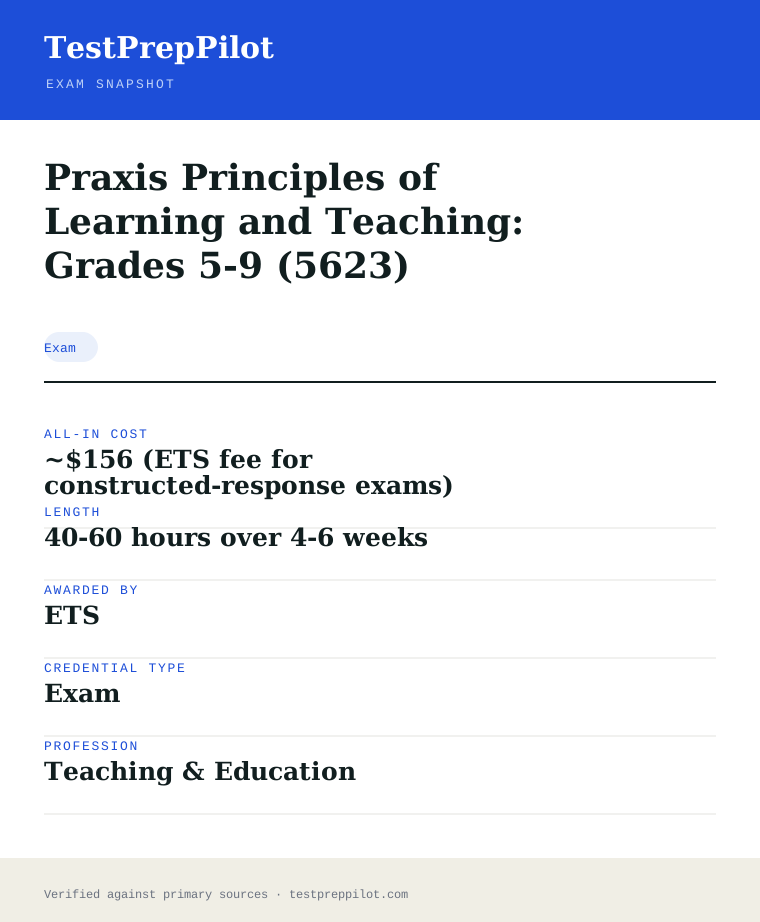
The short version
What is the Praxis Principles of Learning and Teaching: Grades 5-9 (5623) and is it worth it?
Praxis Principles of Learning and Teaching: Grades 5-9 (5623) is a professional credential administered by ETS. It validates job-ready knowledge and skills in the Education & Teaching field and is used for career entry, advancement, or compliance.
- Recognized credential from ETS
- Demonstrates verified competence in Education & Teaching
- Supports career advancement and may satisfy licensing or employer requirements
What is it?
What exactly is the Praxis Principles of Learning and Teaching: Grades 5-9 (5623)?
Praxis Principles of Learning and Teaching: Grades 5-9 (5623) — Education & Teaching credential from ETS
Middle grades pedagogy test covering adolescent development, instructional planning, assessment and professional responsibilities. Offered by ETS, it is designed for candidates who need to demonstrate verified competence in the Education & Teaching field. The credential is commonly used for career entry, advancement, regulatory compliance, or employer requirements. Candidates should review the official handbook for eligibility, exam format, and scoring before registering.
The path in brief
- Confirm you meet any eligibility or prerequisites
- Review the official handbook and study materials
- Register and pay through the awarding body or authorized provider
- Schedule and take the exam (test center or online proctoring)
- Receive your score and, if passed, your credential
Before you book
Who is eligible to sit the Praxis Principles of Learning and Teaching: Grades 5-9 (5623)?
Eligibility varies; many credentials are open to all, while others require coursework, work experience, or sponsorship.
Who it is for: Professionals and candidates seeking to validate Education & Teaching competence.
The test itself
What is the format of the Praxis Principles of Learning and Teaching: Grades 5-9 (5623)?
The Praxis Principles of Learning and Teaching: Grades 5-9 (5623) is administered by ETS and runs 2 hours and contains 70 SR + 4 constructed-response questions.
| Administered by | ETS |
|---|---|
| Questions | 70 SR + 4 constructed-response |
| Time limit | 2 hours |
| Pass mark | Passing score set by the awarding body; see the official score report |
| Exam fee | ~$156 |
| Format | Proctored, computer-based (test center or online remote proctoring) |
Content outline
What topics are on the Praxis Principles of Learning and Teaching: Grades 5-9 (5623)?
The Praxis Principles of Learning and Teaching: Grades 5-9 (5623) covers 4 content domains.
Weightings come from the official exam outline. Study time is best allocated in roughly these proportions rather than evenly across domains.
- Subject content
Topic area tested on the exam; see the official blueprint for the detailed breakdown.
- Instruction & pedagogy
Topic area tested on the exam; see the official blueprint for the detailed breakdown.
- Assessment
Topic area tested on the exam; see the official blueprint for the detailed breakdown.
- Classroom management
Topic area tested on the exam; see the official blueprint for the detailed breakdown.
Study materials
Which study guide should you use for the Praxis Principles of Learning and Teaching: Grades 5-9 (5623)?
Start with the exam sponsor's official content outline. If you also want one structured resource to work through, these are the Mometrix titles that match this exam.

This links to Mometrix's Praxis subject-test range rather than a single Praxis Principles of Learning and Teaching: Grades 5-9 (5623) title. Check that it lists an edition for Praxis Principles of Learning and Teaching: Grades 5-9 (5623) before you buy.
Affiliate links We may earn a commission if you buy through these links, at no extra cost to you. Mometrix has no say in what our exam guides cover. How we make money.
The path
How do you register for the Praxis Principles of Learning and Teaching: Grades 5-9 (5623)?
- 1
Read your state requirements page20 minutes
Open hiset.org and select your state or jurisdiction. Age minimums, residency rules, whether you must enrol in an adult education programme first, and the exact fees are all set locally.
- 2
Create a myHiSET account15 minutes
Sign up through the state requirements page to generate your HiSET number, which you need for scheduling, score access and any state paperwork.
- 3
Take the official practice tests1 to 2 hours per subtest
HiSET publishes free and low-cost official practice tests for each subtest. Unlike the GED at-home route, HiSET does not require a practice-test pass before you can schedule.
- 4
Schedule subtests one at a time10 minutes each
Book any of the five subtests in any order, on paper or computer at a test centre or through HiSET@Home online proctoring where your state allows it.
- 5
Test with valid photo ID65 to 120 minutes per subtest
Bring a current government-issued photo ID showing your name, date of birth, signature and photograph. At-home testers need a private room, a webcam and a stable connection.
- 6
Check scores and claim your credential1 to 2 weeks
Multiple-choice results typically post within about five to seven days and essay results within about seven to ten days. Once all five subtests pass, your state issues the credential.
The fine print
What are the retake and renewal rules for the Praxis Principles of Learning and Teaching: Grades 5-9 (5623)?
- Proctoring & delivery
- HiSET is offered in three ways: paper-based at a test centre, computer-based at a test centre and HiSET@Home under live online proctoring, with availability depending on the state. Calculators and formula sheets are supplied at test centres. The full battery in English or Spanish is permitted, and several states allow candidates to mix languages across subtests.
- Retake policy
- Retake rules are set per state, but a common pattern allows three attempts per subtest in a calendar year, sometimes extending to six. Several states use a favourable pricing structure in which the full fee is charged only on the first and fourth attempts while the second and third cost only the test centre or proctor fee.
- Score reporting
- Each of the five subtests is scored 1 to 20. To pass you must score at least 8 on every subtest, at least 2 out of 6 on the Language Arts Writing essay, and at least 45 out of 100 in total across the five. A score of 15 or higher on a subtest is treated as HiSET honours-level performance in several states.
- Recertification
- The credential a state issues on the strength of a passing HiSET battery is permanent and needs no renewal. Passing subtest scores are carried forward within a state-defined window while you complete the remaining subjects.
- Refunds & rescheduling
- Refund and reschedule windows are administered by PSI and vary by state and test centre; most centres require cancellation at least 24 hours before the appointment. Registering by phone rather than online attracts an additional fee in some states.
Context
HiSET subtests at a glance
| Subtest | Questions | Time | |
|---|---|---|---|
| Language Arts - Reading | About 40 to 50 multiple choice | 65 minutes | |
| Language Arts - Writing | About 50 multiple choice plus 1 essay | 120 minutes | |
| Mathematics | About 50 multiple choice | 90 minutes | |
| Science | About 50 multiple choice | 80 minutes | |
| Social Studies | About 50 multiple choice | 70 minutes |
What it pays
How much does this credential pay?
$64,580 median for high school teachers (BLS SOC 25-2031, May 2024)
The Praxis PLT: Grades 5-9 is a licensure test for teachers of middle grades, and the closest BLS occupation is High School Teachers under SOC code 25-2031, which is the category BLS uses for teachers of grades 9-12 and the standard comparison for this family of exams on this site. The May 2024 median was $64,580 a year, with the lowest 10 percent earning less than $47,330 and the highest 10 percent more than $104,670; the 25th percentile sat near $57,800 and the 75th near $83,010. BLS reported employment of 1,094,500 jobs in 2024 and projected a 2 percent decline from 2024 to 2034, with about 66,200 openings a year — a figure driven entirely by replacement need as teachers retire or leave the field. The honest reading of these numbers is that teacher pay is set by district salary schedules driven by years of service and education level, not by certification, so the PLT does not change the wage — it is the gate into a job whose compensation varies enormously by district, state and cost of living, and public-school pay is published and transparent rather than negotiated per hire. The PLT specifically is one of the pedagogical tests many states require alongside a subject-matter test, so its career value is eligibility: without the passing score the state sets, a candidate cannot be licensed to teach grades 5-9 in that state. Middle school teachers as a separate BLS category earned a $62,970 median in May 2024, slightly below the high-school figure, and we have used the 25-2031 series specified for this exam family. The growth story is flat but stable — decline in employment with tens of thousands of annual openings from turnover — which makes the licensure step the practical bottleneck rather than the demand for teachers.
| Measure | Figure | Source / note |
|---|---|---|
| Median annual wage, high school teachers | $64,580 | BLS Occupational Outlook Handbook, May 2024 |
| Lowest 10 percent | less than $47,330 | BLS OOH Pay tab, May 2024 |
| Highest 10 percent | more than $104,670 | BLS OOH Pay tab, May 2024 |
| Employment, 2024 | 1,094,500 jobs | BLS OOH Quick Facts, 2024 |
| Projected annual openings | ~66,200 per year | BLS OOH Job Outlook, 2024-34 - all from replacement need |
Job growth.-2% projected change 2024-34 (decline), with about 66,200 openings a year, all from replacement need; teacher pay is set by district schedules and varies widely by state and cost of living.
Source: BLS Occupational Outlook Handbook - High School Teachers
Your odds
What are the pass rates?
ETS publishes no Praxis pass rate — for PLT: Grades 5-9, the published facts are the exam structure and a passing score set by each certifying state
ETS does not publish pass rates for Praxis tests, and it never has — anyone quoting a PLT pass rate is guessing, because the test is criterion-referenced and the passing score is not set by ETS at all but by each certifying state. What is published and verifiable is the exam structure and the scoring model, and both are what this section covers. PLT: Grades 5-9 (5623) is two hours long with 70 selected-response questions and 4 constructed-response questions; the selected-response items cover four content categories — Students as Learners (22.5 percent), Instructional Process (22.5 percent), Assessment (15 percent), and Professional Development, Leadership and Community (15 percent) — and the four constructed-response questions make up the fifth category, Analysis of Instructional Scenarios (25 percent), built around two case histories. Raw scores convert to a scaled score on the Praxis reporting scale, and each state sets its own required scaled score, typically in the mid-160s for PLT tests but varying from state to state; ETS publishes the state requirements on its website, and the required score can differ even between neighbouring states using the same test. Because the passing bar is a state decision, the practical meaning of "passing" is entirely local: a candidate who clears their state’s threshold has passed for licensure purposes, while the same score might be a fail in a state that set the bar higher. The constructed-response questions are a meaningful share of the score and are scored by trained raters against published rubrics, so preparation for the written portion matters as much as the selected-response content. We have deliberately left the pass-rate table empty and covered the published structure, scoring model and state-set standard instead.
Read this before quoting the number.ETS publishes no Praxis pass rate. The passing score for PLT: Grades 5-9 is set by each certifying state, and ETS publishes the state requirements. We have not invented a pass rate and instead covered the published structure and scoring model.
Source: ETS Praxis - PLT: Grades 5-9 (5623) Study Companion and state requirements
Your schedule
How long should I study for it?
40-60 hours over 6-8 weeks of focused study
A realistic study plan for PLT: Grades 5-9 (5623) is 40-60 hours over six to eight weeks, because the test is a two-hour, 74-question paper that covers five content categories — three of them purely conceptual, one of them a written analysis of case histories that carries a quarter of the score — and the fastest gains come from mastering the case-study constructed-response format while covering the selected-response categories in proportion to their weight. The structure is 70 selected-response questions in roughly 70 minutes and 4 constructed-response questions in roughly 50 minutes, per the Study Companion’s pacing guidance. The selected-response content breaks into Students as Learners (22.5 percent) — human development, learning processes, diverse learners, motivation and learning environments; Instructional Process (22.5 percent) — planning, instructional strategies, questioning and communication; Assessment (15 percent) — evaluation strategies and tools; and Professional Development, Leadership and Community (15 percent) — professional practices, research and reflective practice, collaboration, and the teacher’s role in the community. The remaining 25 percent is the Analysis of Instructional Scenarios category: four constructed-response questions tied to two case histories, asking you to apply the conceptual content to a realistic classroom situation. Because the conceptual categories overlap heavily with teacher-preparation coursework, candidates coming straight from an education program should budget the lower end and weight time toward the constructed-response format; career changers or candidates without recent coursework should budget the upper end and add a structured review. The final two weeks should be full two-hour practice exams and written practice of the case-study questions under a timer, because the written portion is where most candidates lose points they could have banked.
- Weeks 1-29-11 hrs/week
Students as Learners and Instructional Process (45% of the selected-response score)
- Student development and learning processes: cognitive, social, emotional and physical development in grades 5-9, and how learning happens
- Diverse learners: differentiation, English learners, students with exceptionalities, and culturally responsive practice
- Motivation and learning environment: intrinsic and extrinsic motivation, classroom climate and management
- Instructional process: planning instruction, instructional strategies, questioning techniques and communication
- Weeks 3-48-10 hrs/week
Assessment and Professional Development, Leadership and Community (30% of the selected-response score)
- Assessment: formative and summative evaluation, assessment tools, grading and using assessment data
- Professional development and reflective practice: self-assessment, research and its implications for teaching
- Collaboration and community: working with colleagues, families and the school community; the teacher’s leadership role
- Complete one full selected-response practice section and tag every miss to a category
- Weeks 5-69-11 hrs/week
Analysis of Instructional Scenarios — the constructed-response category (25%)
- Learn the case-study format: two case histories, four written responses across Students as Learners and Instructional Process with some Assessment and Professional topics
- Practise writing structured responses with a clear judgment, evidence from the case, and a rationale tied to theory
- Use the ETS sample constructed-response questions and scoring explanations to calibrate what a full-credit answer looks like
- Write two full case-history responses under the 50-minute timing each week
- Weeks 7-88-10 hrs/week
Full practice exams and gap closing
- Two full two-hour practice exams with both sections under real timing
- Re-tag every miss and re-drill the weakest selected-response category plus the case-study format
- Run the official ETS study companion practice questions as the final calibration
- Confirm the registration, the state’s required passing score, and the test-centre or at-home logistics
Adjusting the pace
Recent education-program graduate.Four to five weeks. The conceptual categories are fresh from coursework; spend the recovered time on the constructed-response format and full practice exams, which program classes prepare you for least.
Career changer with no recent coursework.Eight to ten weeks. Add a structured review of the four selected-response categories before touching the case-study format, and budget extra weeks for the developmental-psychology content that underpins half the paper.
Teacher already in the classroom adding the PLT.Four to six weeks. Your classroom experience is the case-study advantage; focus on converting that experience into rubric-aligned written answers and on the specific terminology the selected-response items use.
How to study
How do I prepare most effectively?
The dominant preparation strategy for PLT: Grades 5-9 is to treat the constructed-response section as a separate, coachable skill rather than an afterthought, because the Analysis of Instructional Scenarios category is 25 percent of the score and is where candidates lose points they could have banked — the four written responses are scored by trained raters against published rubrics that reward a clear judgment, evidence from the case, and a rationale tied to theory. Second, cover the four selected-response categories in proportion to their weight, with Students as Learners and Instructional Process (22.5 percent each) ahead of Assessment and Professional Development (15 percent each), and use the ETS Study Companion as the scope map because it lists the exact topics within each category. Third, learn the vocabulary of the field precisely — developmental stages, learning theories, differentiation, formative versus summative assessment, culturally responsive practice — because the selected-response items test terminology as much as concepts, and using the same vocabulary in the written answers signals rubric alignment. Fourth, practise the constructed-response format with the ETS sample questions and their scoring explanations, which show what a full-credit answer contains and how partial credit is awarded; writing timed answers to case histories is the highest-yield single activity for this test. Fifth, run full two-hour practice exams under real timing so the 70-minute and 50-minute section splits are familiar, because candidates who write long case-study answers routinely crowd out the selected-response section. Finally, look up your state’s required passing score on the ETS state-requirements page before studying, because the target determines how much leeway the written section can afford you.
Make the constructed-response section a separate study subject
The four case-history responses are 25 percent of the score and are rubric-scored by trained raters. Practise the format explicitly: a clear judgment about the scenario, specific evidence from the case, and a rationale tied to educational theory. Candidates who treat the essays as an afterthought give away a quarter of the paper.
Cover the selected-response categories by their weights
Students as Learners and Instructional Process are 22.5 percent each; Assessment and Professional Development are 15 percent each. Use the ETS Study Companion topic lists as the scope map and allocate hours proportionally, because the conceptual content is broad and the highest-weight categories deserve the most time.
Learn the field’s vocabulary precisely
The items test terminology — developmental stages, learning theories, differentiation, formative and summative assessment — as much as concepts, and the same vocabulary appears in the scoring rubrics. Precise terminology improves both sections at once.
Use ETS sample questions and scoring explanations
The Study Companion includes sample constructed-response questions with explanations of what a full-credit answer contains. Study those before writing any of your own, then write timed answers to case histories and compare them against the rubric. This is the highest-yield practice activity on the test.
Run full two-hour practice exams
The section split is about 70 minutes for selected-response and 50 minutes for constructed-response. Full-length rehearsal teaches you to pace the written section so it does not crowd out the multiple choice, which is the most common pacing failure on this test.
Confirm your state’s required score before studying
Each state sets its own passing scaled score for PLT 5623. Look yours up on the ETS state-requirements page first, because the target determines how much margin the written section must provide and whether a 3-out-of-4 essay is enough.
What to buy
Which study resources are worth paying for?
PLT: Grades 5-9 preparation is anchored by the free official ETS materials, because the Study Companion for 5623 contains the full content outline, the section timing, sample selected-response questions and constructed-response questions with scoring explanations — everything needed to understand the test before spending on anything. The exam itself costs $156 under the ETS fee schedule for tests containing constructed-response items, computer-delivered at a test centre or at home, and is offered year-round; there are no separate mandatory materials, and fee waivers are available to eligible students. Beyond the official set, the main paid options are review books from major publishers at roughly $30-50, which add structured coverage of the four conceptual categories and practice questions; online courses at roughly $50-200, which add video instruction and pacing practice; and question banks or practice-test subscriptions at roughly $30-100, which add volume and, in the better products, written-response scoring practice. The buying logic mirrors the exam structure: because 25 percent of the score is written analysis of case histories, the resource that actually grades or models constructed responses is worth more than another selected-response bank, and most candidates need one review book or course for the content plus timed practice for the format rather than a stack of materials. The footnote that anchors the comparison: prices below are list prices as of mid-2026 and change frequently, we rank nothing by commission, and the free official Study Companion should be the first download for every candidate, because it makes most of the paid products redundant at the margin. Candidates should also confirm the state’s required passing score before choosing how much to spend, since the target affects how much practice is enough.
| Resource | Price | Format | Best for |
|---|---|---|---|
| ETS Praxis Study Companion (5623) official | Free | PDF: outline, timing, sample questions, scoring explanations | The authoritative scope map and format guide — download first |
| PLT: Grades 5-9 exam (ETS) | $156 | Computer-delivered, test centre or at home | The real exam; fee waivers available to eligible students |
| Review book (major publisher) | ~$30-50 | Print + eBook with practice questions | Structured coverage of the four conceptual categories |
| Online course | ~$50-200 | Video instruction plus practice | Candidates wanting the content taught rather than read |
| Question bank / practice-test subscription | ~$30-100 | Online timed practice | Volume plus constructed-response scoring practice close to the exam |
Prices checked 2026-08 in USD before tax and change frequently; we rank nothing by commission. The ETS fee for Praxis tests containing constructed-response items is $156, and fee waivers are available to eligible students. Confirm the state-required passing score before choosing how much to spend.
Avoid these
What mistakes do candidates most often make?
The failures on PLT: Grades 5-9 are almost never about not knowing teaching — they are about misallocating the two-hour paper and under-preparing the written section, which is 25 percent of the score and the most common source of lost points. The single biggest mistake is treating the four constructed-response questions as an afterthought: candidates who spend their preparation on selected-response drilling alone walk into a case-history section they have never practised under a timer, write unstructured answers, and give away a quarter of the paper. The second is writing case-study responses without structure — stating an opinion without evidence from the case and without a rationale tied to theory — when the rubric rewards exactly that judgment-evidence-rationale structure. The third is mismanaging the section timing, letting the written section run long and crowding out the selected-response questions, or rushing the written answers to protect the multiple choice; both are pacing failures that a single full practice exam reveals. The fourth is studying the conceptual categories equally, spending hours on the 15 percent Assessment category while under-preparing Students as Learners and Instructional Process at 22.5 percent each. The fifth is memorising definitions without learning the vocabulary as it is used in scenarios, when the items test terminology applied to classroom situations. And the sixth is never checking the state’s required passing score, so a candidate aims at the wrong target entirely — the same scaled score that passes in one state fails in another. None of these are knowledge gaps in education; every one is correctable with rubric-aligned written practice and a single full rehearsal of the format.
✕Treating the constructed-response section as an afterthought
✓The four case-history questions are 25 percent of the score. Practise the written format with the ETS sample questions and scoring explanations until a rubric-aligned answer — judgment, evidence, rationale — comes naturally under a timer.
✕Writing unstructured case-study answers
✓The rubric rewards a clear judgment, specific evidence from the case, and a rationale tied to theory. Write every practice response in that structure, and compare it against the ETS scoring explanations to see what partial credit looks like.
✕Mismanaging the section split
✓The selected-response section runs about 70 minutes and the constructed-response about 50. Practise the full two-hour format so neither section crowds out the other; the pacing failure is usually the written section running long.
✕Studying the categories equally
✓Students as Learners and Instructional Process are 22.5 percent each; Assessment and Professional Development are 15 percent each. Allocate hours by weight, and give the two high-weight conceptual categories the time they deserve.
✕Memorising definitions without applied scenarios
✓The items test terminology as it is used in classroom situations. Learn each concept with its application — what differentiation looks like, what formative assessment is used for — because the stem describes a classroom, not a glossary entry.
✕Never checking the state’s required passing score
✓Each state sets its own passing scaled score for PLT 5623, and ETS publishes the state requirements. Look yours up before studying, because the target determines how much margin the written section must provide.
What you'll face
What question types will I see?
PLT: Grades 5-9 (5623) is a two-hour, computer-delivered test with 70 selected-response questions and 4 constructed-response questions, split into roughly 70 minutes for the selected-response section and 50 minutes for the constructed-response section. The selected-response questions are conventional multiple choice testing the first four content categories — Students as Learners (22.5 percent), Instructional Process (22.5 percent), Assessment (15 percent), and Professional Development, Leadership and Community (15 percent) — and they reward both conceptual understanding of human development and learning theory and the applied vocabulary of classroom practice; distractors are usually plausible-sounding but less precise options, so precise terminology is the discriminator. The constructed-response section is the fifth category, Analysis of Instructional Scenarios, worth 25 percent: two case histories describing realistic middle-grades classroom situations, each followed by two written questions asking you to apply the conceptual content — typically one question drawing on Students as Learners, one on Instructional Process, and others touching Assessment and Professional Development. The written responses are scored by trained raters against published rubrics that reward a clear judgment, specific evidence from the case, and a rationale tied to educational theory, and partial credit is possible, so a structured answer that hits the rubric earns points even when imperfect. Raw scores convert to a scaled score on the Praxis reporting scale, and the passing score is set by the candidate’s certifying state rather than by ETS. The pacing guidance in the Study Companion is the practical limit: about a minute per selected-response item and about 12 minutes per constructed-response question. The three samples below illustrate a conceptual selected-response item, an applied selected-response item, and the constructed-response format; they are editor-written to the published Study Companion and are not live test items.
Test definitions and theories — developmental stages, learning processes, motivation, assessment types. Precise terminology separates the right answer from plausible distractors.
A classroom situation is described and you choose the best response — the strategy, the assessment, the communication move. These test the vocabulary in action.
Two case histories, each with two written questions. Scored by trained raters against rubrics rewarding judgment, evidence from the case, and theory-based rationale.
Try these
Q1A teacher notices that a student who performs well on class discussions consistently performs poorly on timed multiple-choice quizzes. Which consideration is most important in interpreting this pattern?
Answer:A
This item tests understanding that assessment format influences performance. A student can demonstrate understanding through discussion while struggling with a timed, multiple-choice format for reasons related to the format itself — reading speed, anxiety, or preference for verbal expression — rather than a lack of knowledge, and a thoughtful teacher interprets the pattern before acting. B overreacts without evidence and misreads a format effect as an ability deficit. C is false — multiple measures, including discussion, are part of sound assessment practice. D is false for the same reason; discussions are a legitimate assessment of understanding. The item rewards the assessment-literacy principle that performance on one format is not a pure measure of understanding, which is core PLT content.
Q2A middle school teacher is planning a unit for a class that includes English learners and students with reading difficulties. Which planning approach best supports all students’ access to the content?
Answer:B
Scaffolding — vocabulary support, visuals, and structured discussion — gives all students access to grade-level content without lowering expectations, which is the defining practice of differentiating instruction for English learners and struggling readers. A provides no in-class support and pushes the burden to after-school tutoring, which is not differentiation. C lowers the cognitive demand and denies access to the curriculum, the opposite of what scaffolded instruction does. D separates English learners and simplifies the work, which reduces both access and the opportunity to learn with peers. The item tests the applied principle that differentiation means varied pathways to the same content, not different content or lower standards — a high-frequency PLT concept.
Q3Constructed-response item (illustrated): A seventh-grade teacher uses cooperative learning groups for a social studies project. One student in each group is doing most of the work, while two students contribute little. Describe one likely reason the participation is uneven, and propose one instructional strategy the teacher could use to improve it. Support your response with a rationale tied to principles of motivation and learning.
Answer:B
The full-credit response names a likely cause — for example, social loafing or unclear role assignment, both of which let effort slip when individual contribution is not visible — proposes a specific strategy such as structured group roles with individual accountability (each member holds a defined responsibility and reports on it), and ties the rationale to motivation theory, where individual accountability and perceived contribution sustain effort and prevent diffusion of responsibility. A earns partial credit at best because it lacks the strategy and rationale; C describes without analysing; D is off-scope and rejects the strategy category the prompt is built around. This sample illustrates how the case-history rubric distributes credit across judgment, evidence and theory — the structure candidates should practise writing.
Samples are editor-written illustrations of the published blueprint, not live exam items.
The big day
What should I expect on exam day?
PLT: Grades 5-9 (5623) is a two-hour, computer-delivered test taken at a Praxis test centre or at home through ETS online proctoring, and the direct exam-day answer is that you will sit 70 selected-response questions in roughly 70 minutes, then 4 constructed-response questions in roughly 50 minutes, and your score is released after ETS completes scoring — written responses take longer, so results post within a few weeks rather than on screen. Arrive with your admission ticket and a valid photo ID whose name matches your Praxis registration exactly; a mismatch means no test and a forfeited fee. At the test centre, personal items, phones and study materials go in a locker; for at-home testing, the ETS Secure Test Browser, a webcam and a private room are required, and the proctor verifies identity and scans the room before the exam begins. Manage the section split deliberately: work the selected-response items at about a minute each, flag and return to uncertain ones if the interface allows, and reserve the constructed-response time so the written section is not rushed. For each case-history question, write a structured answer — a clear judgment, evidence from the case, and a rationale tied to theory — because the rubric rewards structure and partial credit is possible. You may skip questions within a section and return before submitting the section, but once the selected-response section is submitted you move to the constructed-response section, so respect the timing. Expect a controlled environment with other test-takers at a centre or a single proctor at home, and follow the proctor’s instructions exactly, because ETS security rules are strict and violations can invalidate the score. Confirm the state’s required passing score before the day, because that number, not the two-hour format, defines what passing means for you.
Bring
- Admission ticket from your ETS Praxis account
- A valid photo ID (driver’s license, passport or school ID accepted per Praxis rules) with a name matching your registration
- For at-home testing: a computer with the ETS Secure Test Browser, a webcam, a microphone and a private room
- Prescription glasses if needed; the test centre provides a locker for everything else
Leave at home
- Phones, smartwatches, fitness trackers and any electronic device — locked at the centre, out of the room for at-home testing
- All notes, books and study materials; the centre provides note-taking material if any is allowed
- Bags, coats and food or drink beyond what the test centre permits
- For at-home testing: any other person, second monitor or unapproved device in the room
How the day runs
Rules in the room
- Two hours total: roughly 70 minutes for 70 selected-response questions and 50 minutes for 4 constructed-response questions.
- The passing score is set by the certifying state, not by ETS; confirm your state’s required scaled score before the exam.
- Photo ID with a name matching your Praxis registration exactly is required, or you are turned away and the fee is forfeited.
- No personal items in the room; no calculators, notes or study materials.
- For at-home testing, the ETS Secure Test Browser, a webcam and a private room are required, and the room is scanned by the proctor.
- You can skip and return within a section, but sections are submitted in order, so manage the 70/50 split deliberately.
Afterwards.Results for tests with constructed-response items post to your ETS Praxis account after human scoring is complete, typically within a few weeks, and your score report shows your scaled score plus a performance breakdown by content category. On a score at or above your state’s requirement, your score is sent to the designated score recipients and becomes part of your licensure file — the PLT is a licensure step, not the license itself, so continue with the remaining certification steps in your state. On a score below the requirement, you can retake the test after ETS’s 28-day waiting rule, paying the full $156 fee each time, and there is no limit on attempts. Use the score report as the diagnosis: it shows raw points earned versus available by category, so it tells you exactly whether the loss was in the selected-response content or the written section. If the written section dragged the score down, spend the retake window practising rubric-aligned case-history answers with the ETS scoring explanations; if it was a conceptual category, re-drill that content specifically. Candidates who retake after closing the specific gap rather than re-reading everything are the ones who pass on the next attempt.
Reference
What are the key facts about the Praxis Principles of Learning and Teaching: Grades 5-9 (5623)?
Praxis Principles of Learning and Teaching: Grades 5-9 (5623) is a exam credential; awarded by ETS; the exam fee is ~$156; typical preparation is 40-60 hours over 4-6 weeks; holders typically earn $40,000-$85,000 (25-2031 median $64,580).
| Credential | Praxis Principles of Learning and Teaching: Grades 5-9 (5623) |
|---|---|
| Abbreviation | PLT 5-9 |
| Type | Exam |
| Profession | Teaching & Education |
| Specialty | Praxis Pedagogy & Middle School |
| Awarded by | ETS |
| Difficulty | Mixed |
| Typical prep time | 40-60 hours over 4-6 weeks |
| All-in cost | ~$156 (ETS fee for constructed-response exams) |
| Typical salary range | $40,000-$85,000 (25-2031 median $64,580) |
| Credential | Praxis Principles of Learning and Teaching: Grades 5-9 (5623) |
| Awarding body | ETS |
| Exam format | Proctored, computer-based |
| Validity | State-set passing score; score validity varies by state |
| Languages | Varies — see awarding body |
| Scope | National / Multi-state |
| Also known as | 5623 |
Real questions
Frequently asked questions about the Praxis Principles of Learning and Teaching: Grades 5-9 (5623)
How do I register for the Praxis Principles of Learning and Teaching: Grades 5-9 (5623) exam?
Register through ETS's official portal or an authorized test provider (e.g., Pearson VUE or Prometric where applicable). Create an account, select the exam, pay the fee, and schedule a date.
How much does the exam cost?
Fees vary by location and currency. Confirm the current fee on the official registration page before scheduling.
How long is the credential valid, and how do I renew?
Validity varies by credential (commonly 2–3 years). Renewal usually requires continuing education or a recertification exam — see ETS's policy.
What if I do not pass?
Most bodies allow retakes after a waiting period and payment of the full or partial fee. Check ETS's retake policy before rescheduling.
Is HiSET run by ETS or by PSI?
Both. ETS develops the HiSET test content and PSI delivers it operationally, following the ETS acquisition of PSI in January 2024. In practice you register and schedule through myHiSET on the PSI platform.
Do I have to live in a HiSET state to test?
Usually not. Several HiSET states, including Georgia and Oklahoma, explicitly allow non-residents to test, though you generally must pass your final subtest in the state whose credential you want.
Is HiSET easier than the GED?
They are set to comparable standards but structured differently: HiSET has five subtests with reading and writing separated, while the GED combines them into one Reasoning Through Language Arts test. HiSET is more widely available on paper, which some candidates prefer.
In short
Is the Praxis Principles of Learning and Teaching: Grades 5-9 (5623) worth it?
- Praxis Principles of Learning and Teaching: Grades 5-9 (5623) is awarded by ETS.
- Validates job-ready competence in Education & Teaching.
- Registration is through the awarding body or an authorized test provider.
- Renewal and retake policies vary — confirm before scheduling.
Same awarding body
What other credentials does ETS award?
Worth comparing
How does the Praxis Principles of Learning and Teaching: Grades 5-9 (5623) compare with similar credentials?
Trust
Where does this information come from?
Everything above is taken from the awarding body's own published material. Fees, question counts and domain weights are revised regularly — check the official page before you pay.
- ETS Awarding body
Research confidence: medium · Last reviewed 2026-08