Admissions & Academic Testing • Exam
HiSET Exam
HiSET is a five-subtest high-school equivalency exam scored 0 to 20 per subtest plus a 0 to 6 essay; you need 8 per subtest, 2 on the essay and 45 total. Developed by ETS and delivered by PSI.
Researched and maintained by TestPrepPilot Editorial BoardHigh school equivalency & adult education desk · Figures last verified August 2026
The short version
What is the HiSET Exam and is it worth it?
HiSET is a five-subtest high-school equivalency exam (Reading, Writing with essay, Math, Science, Social Studies) scored 0 to 20 per subtest plus a 0 to 6 essay; you need at least 8 per subtest, a 2 on the essay, and a 45 total to pass. It was developed by ETS and is delivered by PSI, with fees set by each state.
- Five separate subtests let you test one subject at a time
- Offered in paper, computer and online-proctored formats by state
- Accepted as a diploma equivalent by states and employers that recognize it
- Available in English and Spanish, and in large-print and audio formats
What is it?
What exactly is the HiSET Exam?
HiSET is a five-subtest high-school equivalency exam scored 0 to 20 per subtest plus a 0 to 6 essay; you need 8 per subtest, 2 on the essay and 45 total. Developed by ETS and delivered by PSI.
The HiSET is a high-school equivalency exam available in five subtests: Language Arts Reading, Language Arts Writing, Mathematics, Science and Social Studies. The Writing subtest includes a separate essay scored 0 to 6 in addition to the multiple-choice questions. Each subtest is scored 0 to 20 and the essay 0 to 6, and a candidate must average at least 45 across the five subtests while scoring at least 8 on every subtest and at least 2 on the essay. HiSET was developed by Educational Testing Service and, after ETS acquired the delivery business in early 2024, is delivered through PSI; it is offered by paper, computer and online proctoring depending on the state.
The path in brief
- Confirm your state offers HiSET at hiset.org
- Create a myHiSET account and take practice tests
- Schedule the five subtests one at a time
- Pass all five to earn your credential
- Request the credential from your state
Before you book
Who is eligible to sit the HiSET Exam?
Who it is for: Adults without a high-school diploma in states that offer HiSET
The test itself
What is the format of the HiSET Exam?
The HiSET Exam is administered by ETS, delivered by PSI and runs About 7 hours total across the five subtests and requires At least 8 per subtest, 2 on the essay, and 45 total across five to pass.
| Administered by | ETS, delivered by PSI |
|---|---|
| Questions | About 60 multiple-choice questions per subtest plus one essay |
| Time limit | About 7 hours total across the five subtests |
| Pass mark | At least 8 per subtest, 2 on the essay, and 45 total across five |
| Exam fee | Set by each state; commonly $10 to $25 per subtest plus an ETS fee |
| Format | Paper, computer, or online proctored, by state |
Content outline
What topics are on the HiSET Exam?
The HiSET Exam is weighted across 5 domains; the largest are Language Arts - Reading (20%), Language Arts - Writing (20%), Mathematics (20%).
Weightings come from the official exam outline. Study time is best allocated in roughly these proportions rather than evenly across domains.
- Language Arts - Reading 20%
Scored 0 to 20; reading comprehension across literary and informational texts.
- Language Arts - Writing 20%
Multiple choice scored 0 to 20 plus a separate 0 to 6 essay.
- Mathematics 20%
Scored 0 to 20; number operations, algebra, geometry, data and probability.
- Science 20%
Scored 0 to 20; life, physical and earth science with data analysis.
- Social Studies 20%
Scored 0 to 20; history, civics, economics and geography.
Study materials
Which study guide should you use for the HiSET Exam?
Start with the exam sponsor's official content outline. If you also want one structured resource to work through, these are the Mometrix titles that match this exam.

Affiliate links We may earn a commission if you buy through these links, at no extra cost to you. Mometrix has no say in what our exam guides cover. How we make money.
Money & time
How much does the HiSET Exam cost?
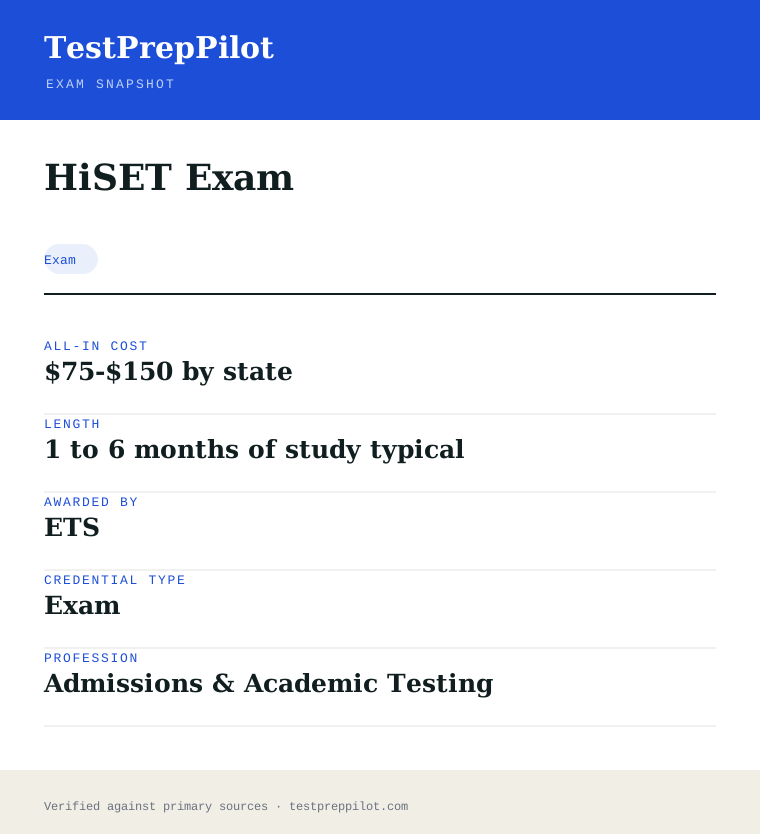
For the HiSET Exam, the exam fee is Set by each state; commonly $10 to $25 per subtest plus an ETS fee; the all-in cost is typically $75-$150 by state; most candidates spend 1 to 6 months of study typical preparing.
Cost breakdown
| Per-subtest fee (typical range) | $10-$25 |
|---|---|
| ETS fee per subtest (typical) | about $10.75 |
| PSI test-centre fee (where charged) | $2.50-$15 |
| Full five-subtest total (typical) | $75-$150 |
| Typical total | $75-$150 depending on state |
HiSET pricing is set by each state or jurisdiction and includes ETS and PSI components; confirm current fees on the official HiSET scheduling page for your location.
Timeline
- Practice and scheduling before testing
- Pass five subtests at your own pace
- Credential issued once all five pass
Typical prep: 1 to 6 months of study typical
The path
How do you register for the HiSET Exam?
- 1
Read your state requirements page20 minutes
Open hiset.org and select your state or jurisdiction. Age minimums, residency rules, whether you must enrol in an adult education programme first, and the exact fees are all set locally.
- 2
Create a myHiSET account15 minutes
Sign up through the state requirements page to generate your HiSET number, which you need for scheduling, score access and any state paperwork.
- 3
Take the official practice tests1 to 2 hours per subtest
HiSET publishes free and low-cost official practice tests for each subtest. Unlike the GED at-home route, HiSET does not require a practice-test pass before you can schedule.
- 4
Schedule subtests one at a time10 minutes each
Book any of the five subtests in any order, on paper or computer at a test centre or through HiSET@Home online proctoring where your state allows it.
- 5
Test with valid photo ID65 to 120 minutes per subtest
Bring a current government-issued photo ID showing your name, date of birth, signature and photograph. At-home testers need a private room, a webcam and a stable connection.
- 6
Check scores and claim your credential1 to 2 weeks
Multiple-choice results typically post within about five to seven days and essay results within about seven to ten days. Once all five subtests pass, your state issues the credential.
The fine print
What are the retake and renewal rules for the HiSET Exam?
- Proctoring & delivery
- HiSET is offered in three ways: paper-based at a test centre, computer-based at a test centre and HiSET@Home under live online proctoring, with availability depending on the state. Calculators and formula sheets are supplied at test centres. The full battery in English or Spanish is permitted, and several states allow candidates to mix languages across subtests.
- Retake policy
- Retake rules are set per state, but a common pattern allows three attempts per subtest in a calendar year, sometimes extending to six. Several states use a favourable pricing structure in which the full fee is charged only on the first and fourth attempts while the second and third cost only the test centre or proctor fee.
- Score reporting
- Each of the five subtests is scored 1 to 20. To pass you must score at least 8 on every subtest, at least 2 out of 6 on the Language Arts Writing essay, and at least 45 out of 100 in total across the five. A score of 15 or higher on a subtest is treated as HiSET honours-level performance in several states.
- Recertification
- The credential a state issues on the strength of a passing HiSET battery is permanent and needs no renewal. Passing subtest scores are carried forward within a state-defined window while you complete the remaining subjects.
- Refunds & rescheduling
- Refund and reschedule windows are administered by PSI and vary by state and test centre; most centres require cancellation at least 24 hours before the appointment. Registering by phone rather than online attracts an additional fee in some states.
Context
HiSET subtests at a glance
| Subtest | Questions | Time | |
|---|---|---|---|
| Language Arts - Reading | About 40 to 50 multiple choice | 65 minutes | |
| Language Arts - Writing | About 50 multiple choice plus 1 essay | 120 minutes | |
| Mathematics | About 50 multiple choice | 90 minutes | |
| Science | About 50 multiple choice | 80 minutes | |
| Social Studies | About 50 multiple choice | 70 minutes |
What it pays
How much does this credential pay?
No direct occupation — the HiSET is the high-school-equivalency key to jobs and college, and the payoff is the credential gap: workers with a high school diploma earned a median of $899/week vs $706 for those without one (BLS, 2023)
The direct answer is that the HiSET is not a job credential with its own BLS occupation — it is one of the accepted pathways to a high school equivalency credential that is recognised in place of a high school diploma by employers, colleges, and the military — so the salary story is the education-return gap that the credential closes. The relevant reference points from BLS Education Pays: in 2023 workers with a high school diploma earned a median weekly wage of about $899, versus about $706 for workers with less than a high school diploma — a roughly $10,000-a-year gap that an equivalency credential is designed to close — and the earnings ladder continues upward, with associate-degree holders at about $1,059 and bachelor’s-degree holders at about $1,493 per week. The HiSET, developed by ETS, has been operating since January 2014 and is accepted by the states and jurisdictions that offer it as a high school equivalency pathway; ETS reports on the order of 50,000 HiSET exam attempts per year, a smaller footprint than the GED because fewer states and jurisdictions use it. Because the credential stands in for a high school diploma, its financial value is best read as the difference between the earnings of high-school completers and non-completers, plus the door it opens to postsecondary education, apprenticeship, and occupational training programs. The honest framing is that the HiSET itself does not create the wage premium — the follow-on step does. A holder who stops there captures only the high-school-completer premium; one who uses the credential to enter college or training captures the larger returns of the next credential. The HiSET’s own scoring adds a useful benchmark: a subtest score of 15 or higher with a 4 or better on the writing essay indicates college and career readiness, meaning the credential carries a built-in signal about whether you are ready for credit-bearing coursework.
| Measure | Figure | Source / note |
|---|---|---|
| Reference: high school diploma, median weekly earnings | $899 | BLS Education Pays, 2023 ($46,748/yr equivalent) |
| Reference: less than high school diploma, median weekly earnings | $706 | BLS Education Pays, 2023 ($36,712/yr equivalent) |
| Reference: associate degree, median weekly earnings | $1,059 | BLS Education Pays, 2023 ($55,068/yr equivalent) |
| Reference: bachelor’s degree, median weekly earnings | $1,493 | BLS Education Pays, 2023 ($77,636/yr equivalent) |
| The credential itself | No direct occupation | A high school equivalency credential, not a licence or certification |
Job growth.BLS does not project growth for an equivalency credential; the relevant projections follow the education and training the HiSET unlocks.
Source: BLS Education Pays
Your odds
What are the pass rates?
ETS publishes the passing rules but no recent national pass rate — the five subtests require a score of 8+ on each (on a 1-20 scale), 2+ on the writing essay (out of 6), and a combined total of 45+ across the battery
The core fact is that the HiSET’s passing rules are fully published while its pass rate is not: ETS sets the cut scores and reports program statistics in its annual statistical reports, but it has not published a current national pass rate for recent cycles, so any number quoted by a third-party site is not an official HiSET figure. What is verifiable is the scoring rule, which has three independent requirements you must meet on the same test date: a score of at least 8 on each of the five subtests, at least 2 out of 6 on the essay portion of the writing subtest, and a combined score of at least 45 out of 100 across the full battery. Each subtest is scored on a 1-20 scale, and some states set higher passing scores than the ETS minimum, so check your state. The five subtests are Language Arts-Reading (40 multiple-choice questions, 65 minutes), Language Arts-Writing (50 multiple-choice questions plus one essay, 120 minutes), Mathematics (50 questions, 90 minutes), Science (50 questions, 80 minutes), and Social Studies (50 questions, 70 minutes), for roughly 240 questions across about 7.5 hours; the test is available on computer and, in most jurisdictions, paper. ETS also publishes a college and career readiness benchmark: a score of 15 or higher on a subtest and 4 or higher on the essay indicates readiness for credit-bearing college coursework. The practical reading of the three-part passing rule is that it is exacting: a total of 45 with one subtest at 7 still fails, and the writing essay has its own floor, so candidates must prepare all five areas rather than leaning on strengths.
Read this before quoting the number.ETS publishes passing cut scores and program-level statistical reports but no current single national pass rate; the 8/45/2 essay rules above are the published passing requirements.
Your schedule
How long should I study for it?
40-80 hours over 8-14 weeks for the full battery (or 10-20 hours per subtest) of focused study
Plan for 8 to 14 weeks and 40 to 80 hours of study for the full battery, or a 2-to-4-week sprint per subtest if you are sitting them one at a time, weighted to the writing subtest — it is the one with an essay floor (2 of 6) that many candidates underestimate. The HiSET has five subtests — Language Arts-Reading (40 questions, 65 minutes), Language Arts-Writing (50 multiple-choice questions plus one essay, 120 minutes), Mathematics (50 questions, 90 minutes), Science (50 questions, 80 minutes), and Social Studies (50 questions, 70 minutes) — each scored 1-20, and you must score at least 8 on every subtest, at least 2 of 6 on the essay, and 45 or more combined. The most effective sequence is: first, take a full-length practice test or a released subtest set to baseline; second, study the lowest-scoring subtest first, because the 8-per-subtest floor means a single weak area fails the battery; third, drill the writing essay, since the 2-of-6 essay floor is where candidates unexpectedly lose the credential; fourth, build the cross-cutting skills the exam rewards — reading informational text and interpreting graphs, charts, and tables, which appear across science, social studies, and mathematics; and fifth, take timed full-length practice subtests in the final weeks. The highest-yield habit is practising the essay: ETS scores it out of 6 against a writing rubric, and a practised essay structure reliably clears the 2-point floor. Budget time to every subtest rather than to your favourite subjects, because the combined 45-point floor and the individual 8-point floors work together to punish uneven preparation.
- Weeks 1-212
Baseline + writing
- Take practice subtests across all five areas to baseline
- Drill the writing essay structure — the 2-of-6 essay floor fails many candidates
- Log weak subtests
- Weeks 3-515
Mathematics and Reading
- Drill arithmetic, algebra, geometry, and data analysis
- Practise reading-comprehension items across prose and informational text
- Practise calculator-free and calculator-permitted math pacing
- Weeks 6-815
Science and Social Studies
- Practise interpreting graphs, tables, charts, and maps
- Review life, physical, and earth/space science content
- Practise analysing primary and secondary source documents
- Weeks 9-1012
Writing and full-length practice
- Write one timed essay per week and self-score against the rubric
- Take timed full-length practice subtests
- Re-study only the areas where you miss points
- Weeks 11-1410
Subtest-by-subtest test-taking
- Schedule subtests one at a time in your strongest-to-weakest order
- Retake any failed subtest — check your state’s retake rules
- Confirm your state’s age, residency, and fee rules before booking
Adjusting the pace
Taking the paper-based format.Several states still offer the HiSET on paper; check your state, and confirm the longer score-posting timeline (several business days).
English-language learner.The HiSET is available in English and Spanish; allow extra time for the reading-heavy subtests and the essay.
Test-taker under 18.Most states require an age waiver and prior approval; start the process early because it can take weeks.
How to study
How do I prepare most effectively?
The strategy that reliably earns the HiSET is "practise the essay, protect every subtest’s 8-point floor, and use the official practice materials," and the single biggest error is over-preparing the subjects you like while a weak area silently fails the battery. A second proven approach is treating the reading-heavy subtests as reading comprehension: the science, social studies, and mathematics subtests all reward interpreting graphs, tables, charts, and passages, so building that skill lifts three subtests at once. Third, master the writing essay deliberately — ETS scores it out of 6 with a published rubric, and a practised structure reliably clears the 2-point floor, while an unpractised candidate often scores 1 and fails the writing subtest outright. Fourth, use the official practice tests and released items as the calibration tool, since third-party apps do not always match the item style. Fifth, respect the three-part passing rule when scheduling: because the 8-per-subtest, essay, and 45-total requirements must all be met, sit each subtest only when a practice run shows it above the floor. Finally, manage the logistics — fees and retake rules are set by your state, most states allow you to take subtests on separate days, and confirm whether your state uses the computer or paper format before booking.
Practise the essay
The writing subtest has a 2-of-6 essay floor; a practised structure reliably clears it, an unpractised one often scores 1.
Protect every subtest’s 8-point floor
The passing rule demands 8+ on all five subtests, so study your weakest area first rather than your favourite.
Build the graph-and-chart skill
Interpreting tables, graphs, charts, and maps lifts the science, social studies, and mathematics subtests together.
Use official practice materials
ETS practice tests and released items are the reliable calibration tool; third-party apps vary in item style.
Respect the three-part passing rule
All three requirements — 8+ per subtest, 2+ essay, 45+ total — must be met; sit each subtest only when a practice run clears the floor.
Confirm your state’s format and fees
Fees, retake rules, and the computer-versus-paper format are set by your state; confirm before booking.
What to buy
Which study resources are worth paying for?
HiSET preparation is dominated by official and low-cost resources — ETS provides the HiSET program site, a practice test, and the Test at a Glance documents for each subtest — with the subtest fees (commonly $10-20 each, set by your state) as the main cost. The comparison below separates official and commercial resources, with prices current to this review. The buying rule is to use the official practice materials first, especially the free practice test and Test at a Glance documents, and treat commercial apps and books as supplements for repetition and content review.
| Resource | Price | Format | Best for |
|---|---|---|---|
| ETS HiSET practice test | Free to low-cost | Online, official | The reliable calibration tool for the real format |
| ETS Test at a Glance documents | Free | PDF for each subtest | Authoritative descriptions of content, item counts, and timing |
| HiSET subtest fees | ~$10-20 per subtest by state | Computer-based or paper, at an approved centre | The five subtests — full battery commonly $50-100 |
| Adult education classes (often free) | Free to low-cost via state programs | Classroom or online | Structure, a teacher, and funded practice testing |
| HiSET prep books and apps | ~$15-30 | Print or mobile app | Extra repetition and content review once the official materials are clean |
Prices approximate and dated to this review (2026-08); subtest fees are set by each state and commonly run $10-20 each. Many states subsidise or waive fees through adult education programs — check with your local program before paying.
Avoid these
What mistakes do candidates most often make?
Nearly every avoidable failure on the HiSET comes from one of three roots: underestimating the writing essay, preparing the strong subjects and neglecting a weak subtest, or missing the interaction between the three passing requirements. Candidates also routinely treat the reading-heavy subtests as pure content exams and ignore the graph-and-chart items, and many skip the official practice materials in favour of apps whose item style does not match. Finally, some test-takers ignore the state-set logistics — age waivers, fees, the computer-versus-paper format, and retake rules — and lose a booking to paperwork.
✕Underestimating the writing essay
✓The 2-of-6 essay floor fails many candidates; practise the essay structure against the published rubric.
✕Preparing only the strong subjects
✓The passing rule demands 8+ on all five subtests; study the weakest subtest first.
✕Ignoring the three-part passing rule
✓8+ per subtest, 2+ on the essay, and 45+ total must all be met on the same test date; schedule around all three.
✕Treating science and social studies as pure content
✓Much of each subtest is reading comprehension and graph-and-table interpretation; practise those skills.
✕Relying on non-official apps
✓Use the ETS practice test and Test at a Glance documents as the baseline; third-party items vary in style.
✕Ignoring state logistics
✓Fees, age waivers, format, and retake rules are set by your state; confirm them before paying, especially if you are under 18.
What you'll face
What question types will I see?
The HiSET is five subtests — Language Arts-Reading, Language Arts-Writing, Mathematics, Science, and Social Studies — totalling roughly 240 questions over about 7.5 hours, available on computer and, in most jurisdictions, paper. Each subtest is scored on a 1-20 scale, and you must score at least 8 on each, at least 2 of 6 on the writing essay, and 45 or more combined. The item mix is almost entirely multiple choice — 40 questions on the reading subtest and 50 each on writing (plus the essay), mathematics, science, and social studies — with the writing essay the only open-response item. There is no penalty for wrong answers, so answer everything. The samples below are editor-written illustrations of the published item styles, not live exam items.
The dominant format on all five subtests; the science and social studies versions are heavily reading comprehension over content, with many items built around graphs, charts, tables, or maps.
A single writing task scored against the ETS rubric; a 2-of-6 floor applies, and the essay score contributes to the writing subtest’s 1-20 scale.
Items that present a passage, graph, or table and ask you to draw a conclusion or identify the correct interpretation.
Arithmetic, algebra, geometry, and data analysis in both computation and applied form; a calculator is permitted on part of the subtest.
Try these
Q1A subtest presents a table of a city’s monthly rainfall. A question asks which month had the least rain. The correct approach is to:
Answer:B
The HiSET science and social studies subtests reward extracting information directly from the presented graphic or table. Locating the minimum value and reading its label answers the question exactly. A ignores the evidence provided, C answers a different question, and D forfeits a question the table answers directly.
Q2For the Language Arts-Writing essay, a response that earns the top score band would:
Answer:A
The ETS writing rubric rewards a focused response: a clear position, organised structure, and developed support with control of language. A matches that description. B lacks organisation and a clear claim, C provides no developed argument, and D forfeits the essay floor entirely, which fails the writing subtest regardless of the multiple-choice score.
Q3On the mathematics subtest, a problem asks for the area of a rectangle 6 units long and 4 units wide. The correct calculation is:
Answer:B
Area of a rectangle is length times width, so 6 x 4 = 24 square units. A computes the sum of the sides, D computes the perimeter, and C computes the ratio — each is a real but different quantity, which is exactly how the distractors are built on the HiSET.
Samples are editor-written illustrations of the published item styles, not live exam items.
The big day
What should I expect on exam day?
The HiSET is taken at an approved test centre — a school, college, or adult education site — either on a computer or on paper, depending on your state, and the five subtests can be scheduled across different days. Each subtest is scored 1-20, and your results post to your HiSET account, typically within about three business days for multiple-choice subtests and five for the writing subtest. The two things that go wrong most often are paperwork and essay neglect: candidates either arrive without the identity documents and age-waiver approval their state requires, or they reach the writing subtest unpractised and fall below the 2-of-6 essay floor. Build your day around confirming your booking, bringing a valid unexpired government-issued photo ID, and budgeting time — 65 minutes for reading, 120 for writing, 90 for mathematics, 80 for science, and 70 for social studies. On the mathematics subtest, check whether your state permits a calculator and which model; on paper-based administrations, bring the permitted calculator. On a pass of all five, your state issues the high school equivalency credential; on a fail of a single subtest, check your state’s retake rules and rebook after targeted study.
Bring
- Valid, unexpired government-issued photo ID (name must match your HiSET account)
- Confirmation of your booking and any state-required age-waiver approval
- A permitted calculator for the mathematics subtest, if your state allows one
- Corrective lenses if you need them for reading
Leave at home
- Phones, smartwatches, and earbuds — secured before entering the testing area
- Notes and study materials (not allowed in the testing room)
- Bags and coats beyond what the centre permits
How the day runs
Rules in the room
- Five subtests scored 1-20; passing requires 8+ on each, 2+ of 6 on the essay, and 45+ combined
- Subtests can be scheduled on separate days
- Computer-based in most states, with paper-based administrations still available in some
- No penalty for wrong answers
- Valid government-issued photo ID required, matching your HiSET account
- College and career readiness benchmark: 15+ on a subtest and 4+ on the essay
Afterwards.On a pass of all five subtests, your state issues the high school equivalency credential, and your comprehensive score report is your official record. On a fail, check your state’s retake rules and rebook the failed subtest after targeted study — the 8-point per-subtest floor means a single weak area fails the battery, so study the failed subtest specifically. If your scores reach the college and career readiness benchmark (15+ on a subtest, 4+ on the essay), mention it when you talk to colleges, since it signals readiness for credit-bearing coursework.
Reference
What are the key facts about the HiSET Exam?
HiSET Exam is a exam credential; awarded by ETS; the exam fee is Set by each state; commonly $10 to $25 per subtest plus an ETS fee; typical preparation is 1 to 6 months of study typical; holders typically earn High-school-equivalent credential; earnings vary by job.
| Credential | HiSET Exam |
|---|---|
| Abbreviation | HiSET |
| Type | Exam |
| Profession | Admissions & Academic Testing |
| Specialty | High School Equivalency |
| Awarded by | ETS |
| Difficulty | Moderate to high |
| Typical prep time | 1 to 6 months of study typical |
| All-in cost | $75-$150 by state |
| Typical salary range | High-school-equivalent credential; earnings vary by job |
| Score scale | 0 to 20 per subtest, 0 to 6 essay |
| Passing rules | 8 per subtest, 2 on essay, 45 total |
| Developer | ETS develops the content |
| Delivery | PSI delivers, in paper, computer or online by state |
| Languages | English and Spanish |
| Scope | National / Multi-state |
| Also known as | High School Equivalency Test |
Real questions
Frequently asked questions about the HiSET Exam
What do I need to pass the HiSET?
You must score at least 8 out of 20 on each of the five subtests, at least 2 out of 6 on the Writing essay, and average at least 45 across all five subtests. Missing any one of those three rules means you retake the affected subtest.
Who runs the HiSET now?
HiSET was developed by ETS, which after acquiring the delivery business in early 2024 operates it with PSI as the test delivery partner. You schedule through the official HiSET scheduling system.
How much does HiSET cost?
It is set by each state. Expect roughly 10 to 25 dollars per subtest plus an ETS fee of about 10.75 dollars and, where charged, a PSI centre fee, for a typical total of 75 to 150 dollars across all five.
Is HiSET accepted like the GED?
It is a recognized high-school equivalency credential in the states that offer it and is accepted by colleges and employers there, but it is not available in every state. Check whether your state and your intended college accept it.
Can I take HiSET online?
Some states offer online proctoring through PSI in addition to paper and computer testing at centres. Availability depends on your state rules.
Is HiSET run by ETS or by PSI?
Both. ETS develops the HiSET test content and PSI delivers it operationally, following the ETS acquisition of PSI in January 2024. In practice you register and schedule through myHiSET on the PSI platform.
Do I have to live in a HiSET state to test?
Usually not. Several HiSET states, including Georgia and Oklahoma, explicitly allow non-residents to test, though you generally must pass your final subtest in the state whose credential you want.
Is HiSET easier than the GED?
They are set to comparable standards but structured differently: HiSET has five subtests with reading and writing separated, while the GED combines them into one Reasoning Through Language Arts test. HiSET is more widely available on paper, which some candidates prefer.
In short
Is the HiSET Exam worth it?
- Five subtests scored 0 to 20 plus a 0 to 6 Writing essay
- Pass requires 8 per subtest, 2 on the essay, and 45 total
- Developed by ETS and delivered by PSI after the 2024 acquisition
- Fees set by state, typically 75 to 150 dollars for all five
Same awarding body
What other credentials does ETS award?
Worth comparing
How does the HiSET Exam compare with similar credentials?
Trust
Where does this information come from?
Everything above is taken from the awarding body's own published material. Fees, question counts and domain weights are revised regularly — check the official page before you pay.
- ETS Awarding body
- Official HiSET Exam exam page Exam page
Research confidence: high · Last reviewed 2026-08