The short version
What is the GED Test and is it worth it?
The GED is a four-subject high-school equivalency test (Reasoning Through Language Arts, Math, Science, Social Studies) scored 100 to 200 per subtest with a 145 passing standard; it is accepted by nearly all US colleges and employers and by most international ones, and fees are set state by state.
- Accepted by nearly every US college, employer and the military as equivalent to a diploma
- Four independent subtests you can schedule and pay for one at a time
- College Ready and College Ready Plus Credit bands can earn tuition-saving credit
- Offered year-round at test centres and, in some states, online with a proctor
What is it?
What exactly is the GED Test?
The GED is the most widely accepted US high-school equivalency credential: four computer-based subtests scored 100 to 200, passing at 145 each.
The GED is the most widely accepted US high-school equivalency credential and is earned by passing four computer-based subtests: Reasoning Through Language Arts, Mathematical Reasoning, Science and Social Studies. Each subtest is scored 100 to 200, and 145 is the passing standard, so a candidate needs 580 across the four subjects with no subtest below 145. Scores of 165 to 174 are marked College Ready and 175 to 200 College Ready Plus Credit, which can earn actual college credit at participating schools. The GED is administered by GED Testing Service, a joint venture of Pearson and the American Council on Education, at official test centres and through online proctoring in some states.
The path in brief
- Check your state eligibility and fees at ged.com
- Create a free GED account and take GED Ready practice
- Schedule and pass the four subtests at your own pace
- Receive your credential once all four pass
- Use College Ready scores for credit and placement
Before you book
Who is eligible to sit the GED Test?
Who it is for: Adults without a high-school diploma seeking a recognized equivalency credential
The test itself
What is the format of the GED Test?
The GED Test is administered by GED Testing Service (Pearson and the ACE) and runs About 7.5 hours total; RLA 150, Math 115, Science 90, Social Studies 70 min and requires 145 per subtest and 580 total; 165 College Ready, 175 College Ready Plus Credit to pass.
| Administered by | GED Testing Service (Pearson and the ACE) |
|---|---|
| Questions | About 50 to 75 questions plus tasks per subtest |
| Time limit | About 7.5 hours total; RLA 150, Math 115, Science 90, Social Studies 70 min |
| Pass mark | 145 per subtest and 580 total; 165 College Ready, 175 College Ready Plus Credit |
| Exam fee | Set by each state; commonly $32 to $46 per subtest |
| Format | Computer-based, four subtests, with an essay in RLA |
Content outline
What topics are on the GED Test?
The GED Test is weighted across 4 domains; the largest are Reasoning Through Language Arts (25%), Mathematical Reasoning (25%), Science (25%).
Weightings come from the official exam outline. Study time is best allocated in roughly these proportions rather than evenly across domains.
- Reasoning Through Language Arts 25%
150 minutes including a 45-minute essay; reading and writing across texts.
- Mathematical Reasoning 25%
115 minutes; quantitative and algebraic problem solving, calculator allowed.
- Science 25%
90 minutes; life, earth and physical science with data analysis.
- Social Studies 25%
70 minutes; civics, US history, economics and geography.
Money & time
How much does the GED Test cost?
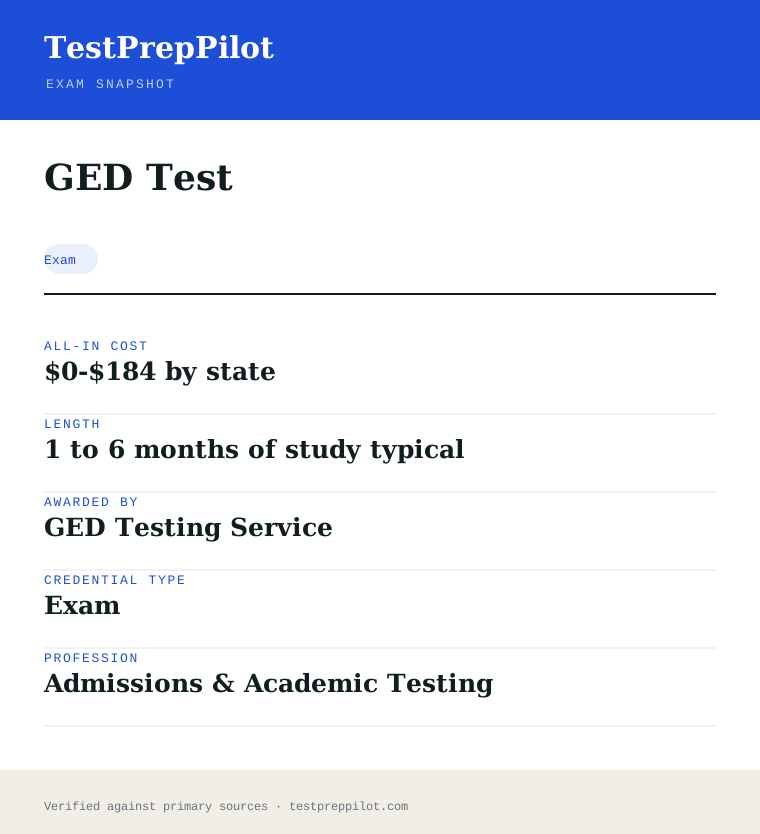
For the GED Test, the exam fee is Set by each state; commonly $32 to $46 per subtest; the all-in cost is typically $0-$184 by state; most candidates spend 1 to 6 months of study typical preparing.
Cost breakdown
| Per-subtest fee (typical range) | $32-$46 |
|---|---|
| Full four-subtest total (typical) | $128-$184 |
| Retake (many states discount the first two) | Often $10-$20 |
| Some states (New York, Maine, West Virginia, DC) | Free or heavily subsidized |
| Typical total | $0-$184 depending on state |
GED fees are set by the state or jurisdiction, not nationally, and change often; always confirm the current price on GED.com for your location.
Timeline
- Eligibility and GED Ready before scheduling
- Pass four subtests at your own pace
- Credential issued once all four pass
Typical prep: 1 to 6 months of study typical
The path
How do you register for the GED Test?
- 1
Create a free account at ged.com15 minutes
Register with your legal name and postcode. The site uses your location to show your state fees, age rules and whether online at-home testing is permitted where you live.
- 2
Check your state eligibility rules20 minutes
Age minimums, residency requirements and any prerequisite adult education enrolment are set by each state, not by GED Testing Service. Most states allow testing at 18, with a waiver route at 16 or 17.
- 3
Take GED Ready practice tests1 to 2 hours per subject
GED Ready is a short official half-length practice test per subject that returns a Likely to Pass or Not Likely to Pass verdict calibrated against real outcomes. Some states and the at-home option require a Likely to Pass result before you can book.
- 4
Schedule one subject at a time10 minutes each
The four subject tests are booked and paid for separately, so you can spread them over months and only sit a subject when you are ready.
- 5
Test at a centre or online70 to 150 minutes per subject
At a Pearson VUE centre bring valid government photo ID. For online testing you need a webcam, a private quiet room and the secure browser, and a live proctor watches throughout.
- 6
Collect scores and order your credentialsame day to 1 week
Scores usually appear in your ged.com account within about three to twenty-four hours. Once all four subjects are passed, your state issues the diploma or equivalency certificate.
The fine print
What are the retake and renewal rules for the GED Test?
- Proctoring & delivery
- GED subject tests are delivered on computer at Pearson VUE authorised test centres, and in most states also online from home under live remote proctoring. A few large states, including California and Texas, have historically required in-person testing, so check ged.com for the current rule where you live. An on-screen calculator is provided and your own TI-30XS is allowed at a centre.
- Retake policy
- You may retake a failed subject immediately in most states; after three attempts on the same subject in a calendar year you must wait 60 days. Many states offer discounted retakes for the second and third attempt. You can also retake a subject you already passed if you want a higher score, subject to state approval.
- Score reporting
- Each subject is scored 100 to 200. A score of 145 or above passes. Scores of 165 to 174 earn the GED College Ready designation, which can waive college placement testing, and 175 to 200 earns GED College Ready plus Credit, which can be worth up to ten college credit hours.
- Recertification
- A GED credential is a permanent state-issued qualification and never expires or needs renewal. Individual subject scores can, however, age out of a state score-carryover window, so finishing all four subjects within a couple of years is sensible.
Context
GED subject tests at a glance
| Subject | Time | Notes | |
|---|---|---|---|
| Reasoning Through Language Arts | 150 minutes | Three parts including a 45-minute extended response and a 10-minute break | |
| Mathematical Reasoning | 115 minutes | Two parts; calculator allowed on part 2 | |
| Science | 90 minutes | Single continuous section, no break | |
| Social Studies | 70 minutes | Single continuous section, no break |
What it pays
How much does this credential pay?
No direct occupation — the GED is the high-school-equivalency key to jobs and college, and the payoff is the credential gap: workers with a high school diploma earned a median of $899/week vs $706 for those without one (BLS, 2023)
The direct answer is that the GED is not a job credential with its own BLS occupation — it is the pathway to a high school equivalency credential that is accepted in place of a high school diploma by virtually all U.S. colleges, employers, and the military — so the salary story is the education-return gap that the credential closes. The relevant reference points from BLS Education Pays: in 2023 workers with a high school diploma earned a median weekly wage of about $899, versus about $706 for workers with less than a high school diploma — a roughly $10,000-a-year gap that the GED is designed to close — and the earnings ladder continues upward, with associate-degree holders at about $1,059 and bachelor’s-degree holders at about $1,493 per week. The GED is the most widely recognised high school equivalency credential in the United States: the program has operated since 1942, more than 21 million people have earned it, and GED Testing Service reports it serves over 700,000 learners a year across more than 100 countries. Because the credential stands in for a high school diploma, its financial value is best read as the difference between the earnings of high-school completers and non-completers, plus the door it opens to postsecondary education and training programs that feed higher-paying occupations. The honest framing is that the GED itself does not create the wage premium — the follow-on step does. A GED holder who stops there captures only the high-school-completer premium; one who uses the credential to enter college, an apprenticeship, or occupational training captures the larger returns of the next credential. For the roughly 40 million U.S. adults without a high school diploma, the GED is the cheapest and most portable gateway to both paths.
| Measure | Figure | Source / note |
|---|---|---|
| Reference: high school diploma, median weekly earnings | $899 | BLS Education Pays, 2023 ($46,748/yr equivalent) |
| Reference: less than high school diploma, median weekly earnings | $706 | BLS Education Pays, 2023 ($36,712/yr equivalent) |
| Reference: associate degree, median weekly earnings | $1,059 | BLS Education Pays, 2023 ($55,068/yr equivalent) |
| Reference: bachelor’s degree, median weekly earnings | $1,493 | BLS Education Pays, 2023 ($77,636/yr equivalent) |
| The credential itself | No direct occupation | A high school equivalency credential, not a licence or certification |
Job growth.BLS does not project growth for an equivalency credential; the relevant projections follow the education and training the GED unlocks.
Source: BLS Education Pays
Your odds
What are the pass rates?
GED Testing Service reports roughly 75% of candidates who complete the four-subject battery pass it, on a 100-200 scale with 145 the passing score on each subtest
The core fact is that the GED is passed subject by subject, and the published program-level numbers show roughly three-quarters of candidates who complete all four subtests earning the credential. In its FY 2022-23 program data, GED Testing Service reported 272,598 test-takers, 863,746 individual subtest sittings, 165,373 completers who finished all four subtests, and 123,830 passers — a 75 percent pass rate calculated against completers. The rate is calculated against completers, not test-takers, because many candidates sit subtests one at a time and some never finish the battery, so a "GED pass rate" computed against all test-takers would look much lower and would be measuring persistence as much as achievement. Each subtest is scored on a 100-200 scale and requires a minimum of 145 to pass; scores of 165-174 earn the "GED College Ready" designation, and 175-200 earn "GED College Ready + Credit," which some colleges treat as worth up to three credits in each subject. The four subtests are Reasoning Through Language Arts (about 150 minutes), Mathematical Reasoning (about 115 minutes), Science (about 90 minutes), and Social Studies (about 70 minutes), all computer-based. The honest reading of the volume data is that the GED is a persistence test as much as a knowledge test: candidates who space the subtests, use the official GED Ready practice tests to know whether they are prepared, and retake a failed subtest rather than abandoning the battery sit comfortably within the published completion-and-pass band. There is no waiting period before the first three attempts on a subject; after three attempts, a 60-day wait applies.
Read this before quoting the number.GED Testing Service publishes program-level volume and pass data rather than a simple national pass rate; the 75 percent figure is FY 2022-23 passers divided by completers and changes each year.
Your schedule
How long should I study for it?
40-80 hours over 8-14 weeks for the full battery (or 10-20 hours per subject) of focused study
Plan for 8 to 14 weeks and 40 to 80 hours of study for the full battery, or a 2-to-4-week sprint per subject if you are sitting subtests one at a time, weighted to your weakest subject as shown by the official GED Ready practice tests. The GED has four computer-based subtests — Reasoning Through Language Arts (about 150 minutes), Mathematical Reasoning (about 115 minutes), Science (about 90 minutes), and Social Studies (about 70 minutes) — each scored 100-200 with a 145 passing minimum. The most effective sequence is: first, take the official GED Ready practice tests for all four subjects to baseline and identify which subjects are exam-ready; second, study the lowest-scoring subjects first, because you must pass all four to earn the credential; third, build the two cross-cutting skills the test actually rewards — reading informational text and extracting data from tables, graphs, and charts, which appear across the science and social studies subtests; fourth, master the mathematical reasoning skills (algebra, geometry, data analysis, and calculator use on the embedded TI-30XS); and fifth, retake GED Ready in the week before each subtest until you are scoring above 145. The highest-yield habit is timed practice in the actual test format: the RLA subtest includes an extended response (essay), and practising it matters because many candidates lose the subtest to pacing rather than to reading ability. Budget your time toward the subtests you have not yet passed — GED Testing Service data shows candidates who complete all four subtests pass about 75 percent of the time, so the difference between earning the credential and not is usually persistence across the four sittings.
- Weeks 1-212
Baseline + RLA
- Take the four official GED Ready practice tests
- Study the two weakest subjects first
- Master reading informational text and the RLA extended response
- Weeks 3-515
Mathematical Reasoning
- Drill algebra, geometry, and data analysis
- Practise with the embedded TI-30XS calculator
- Work the grid and drop-down item formats
- Weeks 6-815
Science and Social Studies
- Practise reading passages and interpreting graphs, tables, and charts
- Review life, physical, and earth/space science content
- Learn to locate information and understand source documents in social studies
- Weeks 9-1012
Full-length timed practice
- Take timed full-length practice subtests
- Re-study only the areas where you miss points
- Retake GED Ready on subjects that still sit near 145
- Weeks 11-1410
Subject-by-subject test-taking
- Schedule subtests one at a time in your strongest-to-weakest order
- Retake any failed subject promptly — no waiting before the third attempt
- Confirm your state’s age, residency, and fee rules before booking
Adjusting the pace
High school graduate retaking a failed subject.A focused 2-4 weeks on the single subject. GED Ready is the diagnostic; retest once you score comfortably above 145.
English-language learner.The GED is offered in English and Spanish, with accommodations available; allow extra time for the reading-heavy RLA and social studies subtests.
Test-taker under 18.Most states require an age waiver and prior approval; start the waiver process early because it can take weeks.
How to study
How do I prepare most effectively?
The strategy that reliably earns the GED is "use the official practice tests, study your weakest subjects first, and space the four subtests," and the single biggest error is cramming all four subjects at once and sitting them back-to-back. A second proven approach is building the cross-cutting skills the exam actually rewards: the science and social studies subtests are largely reading comprehension over content, so practising informational-text reading and graph-and-table interpretation lifts scores across three subtests at once. Third, master the mathematical reasoning subtest with the embedded TI-30XS calculator — the calculator is built into the testing software, so practise with an equivalent tool rather than doing everything by hand. Fourth, take the official GED Ready practice tests as the calibration tool: they are the closest predictor of your real score and cost a fraction of a full subtest. Fifth, treat the RLA extended response seriously — it is scored as part of the subtest, and practising the essay structure prevents a pacing failure on an otherwise passing subtest. Finally, manage the logistics: fees and retake rules are set by your state, most states allow you to take subtests on separate days, and after three attempts on one subject a 60-day wait applies, so scheduling each subtest when you are actually ready is cheaper than rushing.
Use GED Ready, not guesswork
The official practice test is the closest predictor of your real score; take it for each subject before booking.
Study your weakest subjects first
You must pass all four subtests, so attack the lowest GED Ready score first rather than the easiest subject.
Build the cross-cutting skills
Informational-text reading and graph-and-table interpretation lift the science and social studies subtests together.
Practise with the embedded calculator
The TI-30XS is built into the software; rehearse with an equivalent tool so calculator use is not a first-time event.
Practise the RLA extended response
The essay is scored as part of the subtest; practising it prevents a pacing failure on an otherwise passing subtest.
Space the four subtests
Sit subjects one at a time as you pass GED Ready; most states allow separate days, and the 60-day retest wait applies after three attempts on a subject.
What to buy
Which study resources are worth paying for?
GED preparation is dominated by free and low-cost official resources — GED.com hosts the official study tools, the GED Ready practice tests, and free study guides for each subtest — with the test fees (commonly $30-40 per subtest, set by your state) as the main cost. The comparison below separates official and commercial resources, with prices current to this review. The buying rule is to use the official practice tests first and treat commercial apps and books as supplements for repetition and content review, not as the syllabus.
| Resource | Price | Format | Best for |
|---|---|---|---|
| GED.com study tools & free guides | Free | Web, official | The authoritative baseline for every subtest |
| GED Ready official practice test | ~$7 per subject (varies) | Online, official | The closest predictor of your real score |
| GED subtest fees | ~$30-40 per subtest by state | Computer-based at an authorised test centre or online proctored | The four subtests — full battery commonly $120-160 |
| Adult education classes (often free) | Free to low-cost via state programs | Classroom or online | Structure, a teacher, and funded GED Ready vouchers |
| Commercial prep apps (e.g. Essential Education, GED Academy) | Free tier; ~$10-25/mo | Mobile app with practice questions | Extra repetition and spaced practice |
| GED review books (e.g. Kaplan, McGraw-Hill) | ~$20-30 | Print + eBook | Portable structured content review |
Prices approximate and dated to this review (2026-08); subtest fees are set by each state and commonly run $30-40 per subject. Many states subsidise or waive fees through adult education programs — check with your local program before paying.
Avoid these
What mistakes do candidates most often make?
Nearly every avoidable failure on the GED comes from one of three roots: sitting a subtest before the official practice test says you are ready, treating the four subjects as one giant exam, or neglecting the cross-cutting skills. Candidates also routinely skip the RLA extended response practice and fail that subtest on pacing, and many misunderstand the score scale, confusing a GED score with a percentage. Finally, some test-takers ignore the state-set logistics — age waivers, fees, and retake waits — and lose a booking to paperwork.
✕Booking a subtest before GED Ready says you are ready
✓Take the official GED Ready practice test for the subject first; rebook only once you score above 145.
✕Cramming all four subjects at once
✓The GED is four separate subtests you must all pass; space them and study the weakest first.
✕Skipping the RLA extended response practice
✓The essay is scored as part of the subtest; practise the structure under timing or lose the subtest to pacing.
✕Misreading the score scale
✓A 145 is a scaled passing score on a 100-200 range, not a percentage; aim for GED Ready "likely to pass" before booking.
✕Ignoring state logistics
✓Fees, age waivers, and retake rules are set by your state; confirm them before paying, especially if you are under 18.
✕Neglecting the 60-day retest wait
✓After three attempts on one subject, a 60-day wait applies; use GED Ready between attempts rather than burning retries.
What you'll face
What question types will I see?
The GED is four computer-based subtests, each scored 100-200 with 145 passing, administered through Pearson VUE at authorised test centres or, in many states, online with remote proctoring. Reasoning Through Language Arts runs about 150 minutes and includes multiple-choice items plus an extended response; Mathematical Reasoning runs about 115 minutes with a section where a calculator is not allowed on the first questions; Science runs about 90 minutes; and Social Studies about 70 minutes. Item formats include standard multiple choice, drag-and-drop, fill-in-the-blank, hot spot (selecting an area of a graphic), drop-down, and the short-answer/extended response, and the calculator (TI-30XS) is embedded in the software for the subjects that use it. There is no penalty for wrong answers, so answer everything. The samples below are editor-written illustrations of the published item styles, not live exam items.
A stem with one correct answer; the science and social studies versions are largely reading comprehension over content.
Type or select the correct number or phrase; scoring is exact, so transcription errors cost the item.
Select a region of a graphic, table, or chart in response to the question.
Move items into a sequence or category; scoring is all-or-nothing for the arrangement.
A scored essay on a given prompt; practising the structure prevents a pacing failure on the subtest.
Try these
Q1A town’s population grew from 10,000 in 2010 to 12,000 in 2020. What was the percentage increase over the decade?
Answer:B
Percentage change is the change divided by the original value: (12,000 - 10,000) / 10,000 = 2,000 / 10,000 = 0.20 = 20 percent. A confuses the new total with the change, C drops a zero from the arithmetic, and D adds the growth rate to the original 10 percent denominator incorrectly.
Q2The science subtest presents a bar chart of rainfall by month. A question asks which month had the highest rainfall. The best strategy is to:
Answer:B
The science subtest rewards extracting information directly from the presented graphic. The tallest bar represents the highest value, so locating it and reading its label answers the question. A ignores the evidence provided, C answers a different question, and D is false — charts are precisely the data source the question expects you to use.
Q3For the Reasoning Through Language Arts extended response, the strongest essay will:
Answer:A
The RLA extended response is scored on building an argument: a clear claim, evidence from the provided source texts, and organised reasoning. A does exactly that. B provides no argument, C ignores the evidence the task supplies, and D summarises without analysing, which cannot earn a developed-response score.
Samples are editor-written illustrations of the published item styles, not live exam items.
The big day
What should I expect on exam day?
The GED is taken on a computer at an authorised Pearson VUE test centre or, in participating states, online with remote proctoring, and the four subtests can be scheduled on separate days. Each subtest is scored 100-200 with 145 passing, and you receive your score at the end of each sitting. The two things that go wrong most often are paperwork and pacing: candidates either arrive without the photo ID and age-waiver documents their state requires, or they run out of time on the RLA extended response and the math subtest. Build your day around confirming your booking, bringing a valid unexpired government-issued photo ID, and budgeting time — roughly 150 minutes for RLA, 115 for math, 90 for science, and 70 for social studies. On the math subtest, the first questions are answered without a calculator and the TI-30XS is embedded in the software for the rest, so do not bring your own. On a pass, your credential is issued by your state; on a fail, you can retake the single failed subtest, with no waiting before your third attempt and a 60-day wait after three attempts on the same subject. Scores are available quickly, typically at the end of each subtest sitting.
Bring
- Valid, unexpired government-issued photo ID (name must match your GED.com account)
- Confirmation of your booking and any state-required age-waiver approval
- Corrective lenses if you need them for reading the screen
- Water and a snack for between subtests (per test centre policy)
Leave at home
- Phones, smartwatches, and earbuds — stored before entering the testing area
- Notes, study materials, and your own calculator (the TI-30XS is embedded in the software)
- Bags and coats beyond what the centre permits
How the day runs
Rules in the room
- Four computer-based subtests, scored 100-200 with 145 passing
- Subtests can be scheduled on separate days
- Calculator is embedded in the software; a non-calculator section opens the math subtest
- No penalty for wrong answers
- No waiting period before the third attempt on a subject; 60-day wait after three attempts
- Valid government-issued photo ID required, matching your GED.com account
Afterwards.On a pass of all four subtests, your state issues the high school equivalency credential, and GED Testing Service offers the transcript and diploma ordering through your MyGED account. On a fail of a single subject, retake it promptly — the no-wait rule before your third attempt makes the credential a persistence problem more than a knowledge one. Use the GED College Ready (165-174) and College Ready + Credit (175-200) score bands when you talk to colleges, since some award placement or credit on those bands.
Reference
What are the key facts about the GED Test?
GED Test is a exam credential; awarded by GED Testing Service; the exam fee is Set by each state; commonly $32 to $46 per subtest; typical preparation is 1 to 6 months of study typical; holders typically earn High-school-equivalent credential; earnings vary by job.
| Credential | GED Test |
|---|---|
| Abbreviation | GED |
| Type | Exam |
| Profession | Admissions & Academic Testing |
| Specialty | High School Equivalency |
| Awarded by | GED Testing Service |
| Difficulty | Moderate to high |
| Typical prep time | 1 to 6 months of study typical |
| All-in cost | $0-$184 by state |
| Typical salary range | High-school-equivalent credential; earnings vary by job |
| Score scale | 100 to 200 per subtest |
| Passing standard | 145 per subtest and 580 total |
| College Ready | 165 to 174; Plus Credit at 175 to 200 |
| Formats | Test centre or online proctoring in some states |
| Languages | English and Spanish |
| Scope | National / Multi-state |
| Also known as | General Educational Development |
Real questions
Frequently asked questions about the GED Test
What score do I need to pass the GED?
You need 145 on each of the four subtests and a total of at least 580 across them. A 165 to 174 score is College Ready, and 175 to 200 is College Ready Plus Credit, which can grant actual college credit.
How much does the GED cost?
It is set by your state, not nationally. Per-subtest fees commonly run 32 to 46 dollars, but several states such as New York, Maine, West Virginia and DC make it free or heavily subsidized. Check GED.com for your location.
Can I take the GED online?
In many states yes, through GED Testing Service online proctoring, after passing a GED Ready practice test. Other states require in-person testing at an official centre.
Do colleges accept the GED?
Yes. Nearly every US college and university accepts the GED as equivalent to a diploma, and the College Ready Plus Credit bands can place you out of or into credit-bearing courses.
How is the GED different from HiSET and TASC?
All three are high-school equivalency credentials. The GED is the most widely accepted and has four subtests. HiSET has five subtests including a separate essay, and TASC was discontinued at the end of 2021, after which New York moved to the GED.
How much does the GED cost?
The price is set state by state, so there is no single national figure. Many states charge roughly 30 to 45 dollars per subject, some subsidise it heavily, and New York currently offers the test at no cost to the candidate. International test takers pay 90 dollars per subject.
Do I have to take all four subjects at once?
No, and you should not. Each subject is booked, paid for and passed independently, so most adults work through them one at a time over several months around work and family commitments.
Is the GED accepted the same as a high school diploma?
Colleges, employers and the US military generally treat the GED credential as equivalent to a high school diploma. A minority of selective colleges and certain military enlistment tracks apply extra conditions, so check specific requirements before relying on it.
In short
Is the GED Test worth it?
- Four subtests on a 100 to 200 scale; 145 to pass each, 580 total
- College Ready (165) and College Ready Plus Credit (175) bands earn credit
- Fees set state by state, from free in some states to about 46 dollars per subtest
- Accepted by nearly all US colleges, employers and the military
Trust
Where does this information come from?
Everything above is taken from the awarding body's own published material. Fees, question counts and domain weights are revised regularly — check the official page before you pay.
- GED Testing Service Awarding body
- Official GED Test exam page Exam page
- GED Testing Service certification programme Programme rules
Research confidence: high · Last reviewed 2026-08