Admissions & Academic Testing • Exam
Dental Admission Test
The computer-based admissions test for US dental schools covering science, perceptual ability and reasoning.
Researched and maintained by TestPrepPilot Editorial BoardHealth-profession admissions testing desk · Figures last verified August 2026
The short version
What is the Dental Admission Test and is it worth it?
The DAT is the required admissions test for most US dental schools, taken at a Prometric centre over about five hours and fifteen minutes. It covers natural sciences, perceptual ability, reading and quantitative reasoning, uses a 200 to 600 scale, and costs 580 dollars for 2026 with score reports included.
- Required by most US dental schools
- Standardised science and perceptual measure
- Score reports included in the fee
- Clear 200 to 600 section scale
- Taken year-round at Prometric
What is it?
What exactly is the Dental Admission Test?
The computer-based admissions test for US dental schools covering science, perceptual ability and reasoning.
The Dental Admission Test (DAT) is the computer-based admissions exam required by the large majority of US dental schools. It covers survey of natural sciences, perceptual ability, reading comprehension and quantitative reasoning across about five hours and fifteen minutes at a Prometric centre. Since March 2025 the DAT reports a 200 to 600 scale per section. The 2026 fee is 580 dollars and includes official score reports to the schools you select.
The path in brief
- Get a DENTPIN
- Schedule at Prometric
- Pay the 580 dollar fee
- Prepare with the ADA guide
- Test and send scores
Before you book
Who is eligible to sit the Dental Admission Test?
None (dental school applicants)
Who it is for: US dental school applicants
The test itself
What is the format of the Dental Admission Test?
The Dental Admission Test is administered by American Dental Association and runs ~4.5 hours.
| Administered by | American Dental Association |
|---|---|
| Questions | ~280 across six sections |
| Time limit | ~4.5 hours |
| Pass mark | No pass mark; 200 to 600 per section (since Mar 2025) |
| Exam fee | ~$525 |
| Format | Computer-based at Prometric |
Content outline
What topics are on the Dental Admission Test?
The Dental Admission Test covers 4 content domains.
Weightings come from the official exam outline. Study time is best allocated in roughly these proportions rather than evenly across domains.
- Survey of Natural Sciences
- Perceptual Ability
- Reading Comprehension
- Quantitative Reasoning
Study materials
Which study guide should you use for the Dental Admission Test?
Start with the exam sponsor's official content outline. If you also want one structured resource to work through, these are the Mometrix titles that match this exam.

Affiliate links We may earn a commission if you buy through these links, at no extra cost to you. Mometrix has no say in what our exam guides cover. How we make money.
Money & time
How much does the Dental Admission Test cost?
For the Dental Admission Test, the exam fee is ~$525; the all-in cost is typically $580; most candidates spend 2 to 4 months typical prep preparing.
Cost breakdown
| Exam fee (2026) | $580 |
|---|---|
| Additional score reports | Included |
| Typical total | $580 |
The fee includes official score reports to the schools you select at registration.
Timeline
- Study 2 to 4 months
- Test About 5h 15m
- Scores Shortly after
Typical prep: 2 to 4 months typical prep
The path
How do you register for the Dental Admission Test?
- 1
Create a DENTPIN10 minutes
Apply for a Dental Admission Test Program Identifier Number (DENTPIN) through the ADA before scheduling either exam.
- 2
Schedule the exam15 minutes
Book a Prometric centre date for the DAT or OAT after receiving eligibility; OAT candidates may schedule once the DENTPIN is active.
- 3
Pay the exam fee5 minutes
The DAT fee is 580 dollars for 2026 and the OAT fee is 520 dollars; both include official score reports to the schools you select.
- 4
Prepare with official guides2 to 4 months
Use the ADA candidate guides and practice tests that describe the section timing and content for each exam.
- 5
Test and receive scorestest day
Sit the exam at Prometric; unofficial DAT scores print at the centre and official scores post soon after.
The fine print
What are the retake and renewal rules for the Dental Admission Test?
- Proctoring & delivery
- Both exams are delivered at Prometric test centres under standard security, with photo ID and biometric check-in. There is no at-home option.
- Retake policy
- Each exam requires a 60-day wait between attempts and a maximum of four attempts in any 12-month period; after three attempts a candidate needs special permission to continue.
- Score reporting
- The DAT moved to a 200 to 600 scale per section starting in March 2025; the OAT remains on a 200 to 400 scale. Both report an academic average and a total science average.
- Recertification
- Scores are valid for two to three years depending on the professional school; they are not renewed, but a retest updates the record.
Context
ADA admissions exams
| Exam | For | Length | Score | |
|---|---|---|---|---|
| DAT | Dental school | About 5h 15m | 200 to 600 | |
| OAT | Optometry school | About 4h 40m | 200 to 400 |
What it pays
How much does this credential pay?
The DAT gates dental-school admission: dentists earned a $179,210 median in May 2024 (BLS)
The Dental Admission Test (DAT) is the standardized admissions test for dental school, required by nearly all US dental schools, and it is one component of the dental-school application alongside GPA, coursework, interviews and the application essay. It is an admissions test, not a job credential, so no BLS SOC code corresponds to a score; the salary story runs through the dental career it helps unlock. BLS reported that dentists (SOC 29-1021) earned a median of $179,210 in May 2024, projected to grow 6 percent from 2024 to 2034, with substantial variation by specialty, setting and practice type (general dentists vs specialists, private practice vs employed). The DAT matters to this picture because dental school is the sole pathway to the profession, admission is competitive, and the DAT is one of the strongest predictors schools weigh alongside the GPA; a strong score widens admission options and can affect scholarship and school choice. BLS classifies workers by occupation and education, not test scores, so no DAT score maps to a salary; the connection runs through dental-school admission, completion and licensure. The honest framing is the same as for any admissions test: prepare seriously because the score shapes admission outcomes, and understand that the wage payoff the data supports runs through the degree and the license, not the score itself. The DAT runs about 4.5 hours, costs about $525, and is scored on a 1-30 scale.
| Measure | Figure | Source / note |
|---|---|---|
| Dentists median, May 2024 | $179,210 | BLS OEWS, SOC 29-1021 |
| All-occupation median, May 2024 | $49,500 | BLS OEWS |
| DAT score range | 1-30 per section | ADA, standardized scale |
| DAT length | ~4.5 hours | ADA |
Job growth.Dentist employment is projected to grow 6 percent from 2024 to 2034 per BLS; dental-school admission remains competitive.
Your odds
What are the pass rates?
The DAT has no pass/fail line; sections score 1-30 and schools weigh scores against their applicant pools
The ADA publishes no pass rate for the DAT because there is no passing score. The DAT is scored on a 1-30 standardized scale per section (the scale is normalized so a 15-16 is roughly average), and the key numbers are the Academic Average (the average of the Biology, General Chemistry, Organic Chemistry, Reading Comprehension and Quantitative Reasoning sections) and the Perceptual Ability (PAT) score, which schools weigh against their applicant pools. There is no universal target: competitive dental schools commonly report Academic Averages in the 20-23 range for admitted classes, while the applicant pool average sits in the high teens to low 20s depending on the cycle. The test runs about 4.5 hours and contains six sections: Survey of the Natural Sciences (100 questions: Biology 40, General Chemistry 30, Organic Chemistry 30), Perceptual Ability Test (90 questions), Reading Comprehension (50 questions), and Quantitative Reasoning (40 questions). The exam is computer-based, delivered by Prometric, and costs about $525 (verify the current fee); candidates may retake after a 90-day wait, with a limit of three attempts (and a fourth with a special request). Scores are reported to the ADA and to dental schools through AADSAS. The honest takeaway: build the target from each school’s admitted-class averages, not from a pass line that does not exist, and plan the testing timeline around dental-school application cycles.
Read this before quoting the number.No pass rate exists; targets come from school admitted-class averages. Retake rules: 90-day wait, 3-attempt limit.
Source: ADA DAT official information
Your schedule
How long should I study for it?
200-350 hours over 3-6 months of focused study
A serious DAT plan runs 200-350 hours over 3-6 months, and the natural-sciences section dominates the prep. The test has six sections: Survey of the Natural Sciences (Biology 40 questions, General Chemistry 30, Organic Chemistry 30 - 100 questions total), Perceptual Ability Test (90 questions), Reading Comprehension (50 questions), and Quantitative Reasoning (40 questions), running about 4.5 hours. Month 1: establish the baseline with a full practice test, and start the Biology content review (cellular and molecular biology, genetics, anatomy and physiology, evolution and ecology) - the largest single section. Months 2-3: General Chemistry and Organic Chemistry content review with daily practice questions, and start the PAT training - the PAT (angle ranking, hole punching, cube counting, pattern folding) is a trainable skill that many candidates under-prepare, and daily PAT practice is essential because the sections are unlike anything in coursework. Month 4: Reading Comprehension strategy (the passages are scientific and time-pressured) and Quantitative Reasoning review (math through algebra, some trig), with daily question volume across all sections. Month 5: full timed practice tests weekly, targeted review of the weakest sections, and taper. The dominant resources are the official DAT practice tests (ADA materials and the Prometric practice test), the major DAT prep books and question banks, and the study apps; the honest expectation is that most successful candidates use a structured prep program or book series.
- Month 160
Baseline and Biology
- Full practice test
- Biology content review
- Months 2-3140
Chemistry and PAT
- Gen Chem and O Chem with daily Qs
- Daily PAT practice
- Month 480
Reading and Quant
- Reading strategy
- Quantitative review; daily volume
- Month 560
Full tests and taper
- Weekly full timed tests
- Target weak sections
Adjusting the pace
Timeline.Most candidates take the DAT in the spring or summer before the AADSAS application cycle; plan the retake buffer.
Retake rules.90-day wait between attempts with a 3-attempt limit; a strong first-attempt plan matters.
How to study
How do I prepare most effectively?
The most effective DAT strategies treat the natural sciences as the foundation and the PAT as a trainable skill. Strategy one: weight the Survey of the Natural Sciences heavily - it is 100 questions and the largest block, and Biology is the single largest section, so the content review must be deep and systematic; a structured prep book or course is the standard approach because the content spans three sciences. Strategy two: train the PAT daily - angle ranking, hole punching, cube counting and pattern folding are unlike anything in coursework, and the sections are trainable with daily practice; candidates who skip PAT training lose an entire testable skill set. Strategy three: practice with official materials for the format - the ADA practice test and the Prometric practice exam match the computer-based delivery, and timing rehearsal matters in a 4.5-hour exam. Strategy four: master the timing per section - the natural sciences allow about 90 minutes, PAT 60, Reading 60 and Quant 45 - and practice section blocks under time, because pacing is the silent failure mode. Strategy five: build the biology depth first, because it is the largest section and the content is memorization-heavy; chemistry follows with problem practice. Strategy six: manage the retake reality - the 90-day wait and the 3-attempt limit mean the first attempt should come after a full-length practice-test score at or above the target.
Weight the natural sciences
100 questions and the largest block; Biology is the biggest section.
Train the PAT daily
Angle ranking, hole punching, cube counting are trainable.
Rehearse the section timing
4.5-hour pacing is a silent failure mode.
Use official practice tests
The computer-based format matches the real delivery.
Plan for the retake rules
90-day wait, 3-attempt limit - make the first attempt count.
What to buy
Which study resources are worth paying for?
The DAT resource market has a clear official core and a well-developed commercial field. The official ADA DAT practice test and the Prometric practice exam (about $50-100 combined) match the computer-based format and are the accuracy standard for calibration. Commercial prep dominates the study hours: the major DAT prep books ($50-$100 each for the full series) and online question banks and courses ($300-$1,000+) provide the content review, question volume and PAT training that the official materials do not fully cover; the most popular prep programs are the standard investment for serious candidates. Free resources include the ADA DAT guide (free PDF) and free PAT practice apps, which are useful supplements. The exam fee is about $525 (verify current pricing), and candidates should budget for the full prep investment. The honest ranking: the official practice tests for calibration, a structured prep book series or course for content, a question bank for volume, and free PAT apps for daily training. Prices here are current as of 2025-26 and change annually.
| Resource | Price | Format | Best for |
|---|---|---|---|
| Official ADA practice test | $50-$100 | Online | Format calibration |
| DAT prep book series | $50-$100 per book | Print/ebook | Content review across the sciences |
| Prep course / question bank | $300-$1,000+ | Online | Structure, volume, and PAT training |
| Free PAT practice apps | Free | Mobile | Daily perceptual-ability training |
| ADA DAT guide | Free PDF | Downloadable | Format and scoring information |
Prices dated 2025-26; the DAT exam fee is ~$525. No commission-based ranking.
Avoid these
What mistakes do candidates most often make?
The most common DAT mistakes come from mis-weighting the sections and under-preparing the PAT. Mistake one: under-preparing the PAT; the perceptual-ability sections are unlike anything in coursework and are trainable, but candidates who skip daily PAT practice leave an entire skill set untrained. Mistake two: studying chemistry at the expense of Biology, the largest single section; the Biology content (cellular biology, genetics, anatomy, evolution) rewards depth, and candidates who shortchange it lose the biggest block. Mistake three: ignoring the timing; the 4.5-hour exam with six sections rewards section-block rehearsal, and candidates who practice untimed misjudge pacing. Mistake four: walking into the first attempt without a full practice test at or above the target; the 90-day wait and 3-attempt limit make a calibrated first attempt valuable. Mistake five: using outdated materials; the DAT content and delivery have evolved, and candidates should match the current format. Mistake six: ignoring the reading-comprehension section as "easy"; the scientific passages are time-pressured, and untrained candidates lose points on a section that strategy improves. Finally, candidates should plan the timeline around the application cycle, because a late score narrows school options.
✕Under-preparing the PAT
✓Daily PAT training; the sections are trainable.
✕Shortchanging Biology
✓It is the largest single section; study it deep.
✕Practicing untimed
✓Rehearse the section blocks under time.
✕Uncalibrated first attempt
✓Hit the target on a full practice test first.
✕Ignoring the timeline
✓Plan around the dental-school application cycle.
What you'll face
What question types will I see?
The DAT is a computer-based exam of about 4.5 hours with six sections: Survey of the Natural Sciences (Biology 40, General Chemistry 30, Organic Chemistry 30 - 100 questions, ~90 minutes), Perceptual Ability Test (90 questions, ~60 minutes), Reading Comprehension (50 questions, ~60 minutes), and Quantitative Reasoning (40 questions, ~45 minutes). Sections score 1-30; the Academic Average and PAT are the key reported numbers. The exam is delivered by Prometric and costs about $525. Samples below are editor-written illustrations of the published test specifications, not live exam items.
Cellular and molecular, genetics, anatomy, evolution, ecology.
General chemistry and organic reactions and mechanisms.
Angle ranking, hole punching, cube counting, pattern folding.
Scientific passages; math through algebra and some trig.
Try these
Q1Biology item: Which organelle is primarily responsible for ATP production in eukaryotic cells?
Answer:B
The mitochondrion carries out cellular respiration and produces most ATP; the other organelles serve protein synthesis, modification and digestion roles.
Q2General chemistry item: What is the pH of a solution with a hydrogen ion concentration of 1 × 10⁻³ M?
Answer:B
pH = -log[H+]; for 1 × 10⁻³ M, the pH is 3.
Q3Quantitative item: If 2x + 3 = 15, what is the value of x?
Answer:B
Subtract 3 from both sides: 2x = 12; divide by 2: x = 6.
Samples are editor-written illustrations of the published test specifications, not live exam items.
The big day
What should I expect on exam day?
The DAT is administered by Prometric at authorized test centers, on scheduled testing dates throughout the year (candidates select a date when registering). On the day, arrive 30 minutes early with the admission letter and a valid government-issued photo ID; the exam is computer-based, about 4.5 hours including a scheduled break, and personal electronics are not permitted; a calculator function is built into the software for the Quantitative section (no personal calculators). The ADA requires candidates to take the exam under the current testing protocols; scores are reported to the ADA and released to the candidate and dental schools through the AADSAS application system, typically within several weeks. Candidates may retake after a 90-day wait, with a limit of three attempts (a fourth requires a special request to the ADA). Afterwards, send scores to target schools through AADSAS before deadlines, and use the section breakdown to plan any retake; the DAT score is part of the dental-school application package alongside GPA, coursework, interviews and the personal statement.
Bring
- Admission letter
- Valid government-issued photo ID
- Appointment confirmation
- A rested morning for the 4.5-hour exam
Leave at home
- Phone, smartwatch, and personal electronics
- Personal calculators or notes
- Anything requiring lockers - plan to stow it
How the day runs
Rules in the room
- Valid ID and the admission letter are mandatory.
- Personal electronics and calculators are not permitted.
- The exam is computer-based with a built-in calculator for Quant.
- Retake: 90-day wait, 3-attempt limit.
Afterwards.Send scores to target schools through AADSAS before deadlines, and use the section breakdown to plan any retake.
Reference
What are the key facts about the Dental Admission Test?
Dental Admission Test is a exam credential; awarded by American Dental Association; the exam fee is ~$525; typical preparation is 2 to 4 months typical prep; holders typically earn Dentists $179,210 median (BLS May 2024) - career path.
| Credential | Dental Admission Test |
|---|---|
| Abbreviation | DAT |
| Type | Exam |
| Profession | Admissions & Academic Testing |
| Specialty | Graduate & Professional Admissions |
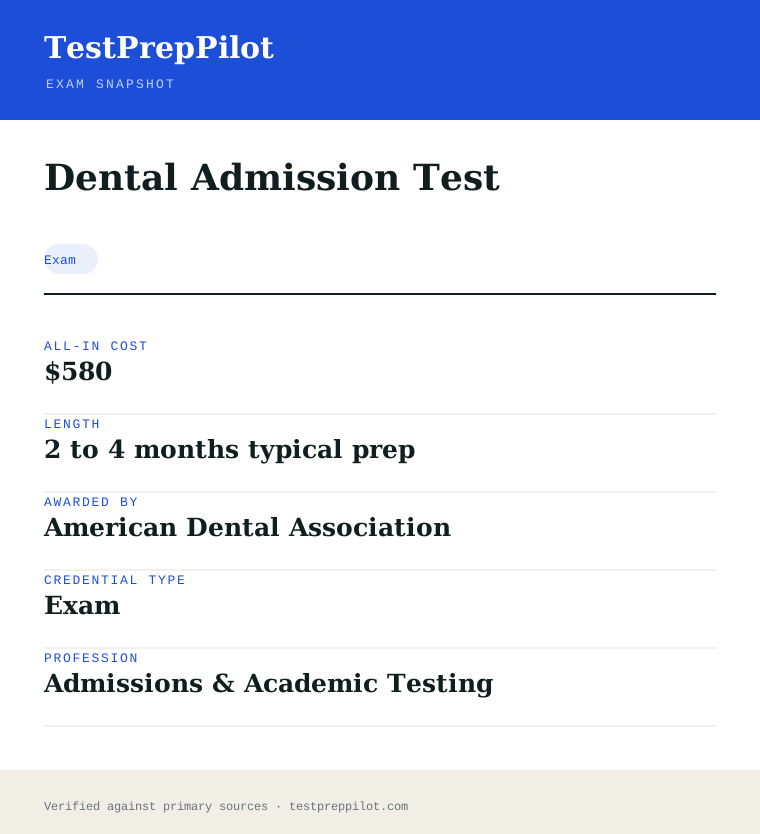
| Awarded by | American Dental Association |
| Difficulty | Hard |
| Typical prep time | 2 to 4 months typical prep |
| All-in cost | $580 |
| Typical salary range | Dentists $179,210 median (BLS May 2024) - career path |
| Sections | SNS, PAT, RC, QR |
| Scale | 200 to 600 per section |
| Fee | $580 (2026) |
| Retake | 60-day wait, max 4 per 12 months |
| Scope | National / Multi-state |
Real questions
Frequently asked questions about the Dental Admission Test
How much does the DAT cost?
The DAT fee is 580 dollars for 2026 and includes the score reports sent to the schools you choose at registration.
How is the DAT scored now?
Since March 2025 the DAT reports a 200 to 600 scale per section, replacing the older 1 to 30 scale.
How many times can I take the DAT?
The DAT is scored 1-30 per section with no pass/fail line - schools weigh the Academic Average and PAT against their applicant pools; retakes have a 90-day wait and 3-attempt limit.
Where do I take the DAT?
At a Prometric test centre; there is no at-home option.
How much does the DAT cost?
The DAT fee is 580 dollars for 2026 and includes the score reports sent to the schools you choose at registration.
How many times can I take the OAT?
You may retake the OAT after a 60-day wait, up to four times within 12 months, with additional attempts requiring ADA approval.
In short
Is the Dental Admission Test worth it?
- Required for most US dental schools
- About 5h 15m, four sections, 200 to 600 scale
- 580 dollars for 2026, reports included
Worth comparing
How does the Dental Admission Test compare with similar credentials?
Trust
Where does this information come from?
Everything above is taken from the awarding body's own published material. Fees, question counts and domain weights are revised regularly — check the official page before you pay.
- American Dental Association Awarding body
Research confidence: high · Last reviewed 2026-08