The short version
What is the Medical College Admission Test and is it worth it?
The MCAT is the 7.5-hour medical school admissions exam with 230 questions across four sections, scored 472 to 528 (each section 118 to 132). The standard US fee is 355 dollars plus a 130 dollar international surcharge, and scores are valid for two to three years by school policy.
- Required by nearly every US and Canadian MD program
- Tests science and reasoning, not just memorization
- Uniform metric across very different applicants
- Fee Assistance Program cuts the cost to 145 dollars
What is it?
What exactly is the Medical College Admission Test?
The seven-and-a-half-hour medical school admissions exam scored 472 to 528 across four sections.
The Medical College Admission Test (MCAT) is the AAMC standardized exam required by virtually all US and Canadian medical schools, measuring biological, chemical, psychological and social foundations of behavior plus critical analysis and reasoning. It runs 7.5 hours with 230 multiple-choice questions across four sections, each scored 118 to 132 for a total of 472 to 528. The standard US fee is 355 dollars with a 130 dollar international surcharge, and scores are valid for two to three years depending on the school.
The path in brief
- Build pre-med coursework
- Register via the MCAT system
- Study 3 to 6 months with AAMC prep
- Test at a Pearson VUE center
- Send 472 to 528 scores
Before you book
Who is eligible to sit the Medical College Admission Test?
Who it is for: Medical and health-professions school applicants
The test itself
What is the format of the Medical College Admission Test?
The Medical College Admission Test is administered by Pearson VUE test centers and runs 7.5 hours total (about 6h15m testing) and contains 230 multiple-choice questions.
| Administered by | Pearson VUE test centers |
|---|---|
| Questions | 230 multiple-choice |
| Time limit | 7.5 hours total (about 6h15m testing) |
| Pass mark | No pass mark; schools set expectations |
| Exam fee | $355 (US); plus $130 international |
| Format | Computer-based at Pearson VUE centers |
Content outline
What topics are on the Medical College Admission Test?
The Medical College Admission Test covers 4 content domains.
Weightings come from the official exam outline. Study time is best allocated in roughly these proportions rather than evenly across domains.
- Chemical and Physical Foundations of Biological Systems
- Critical Analysis and Reasoning Skills (CARS)
- Biological and Biochemical Foundations of Living Systems
- Psychological, Social and Biological Foundations of Behavior
Money & time
How much does the Medical College Admission Test cost?
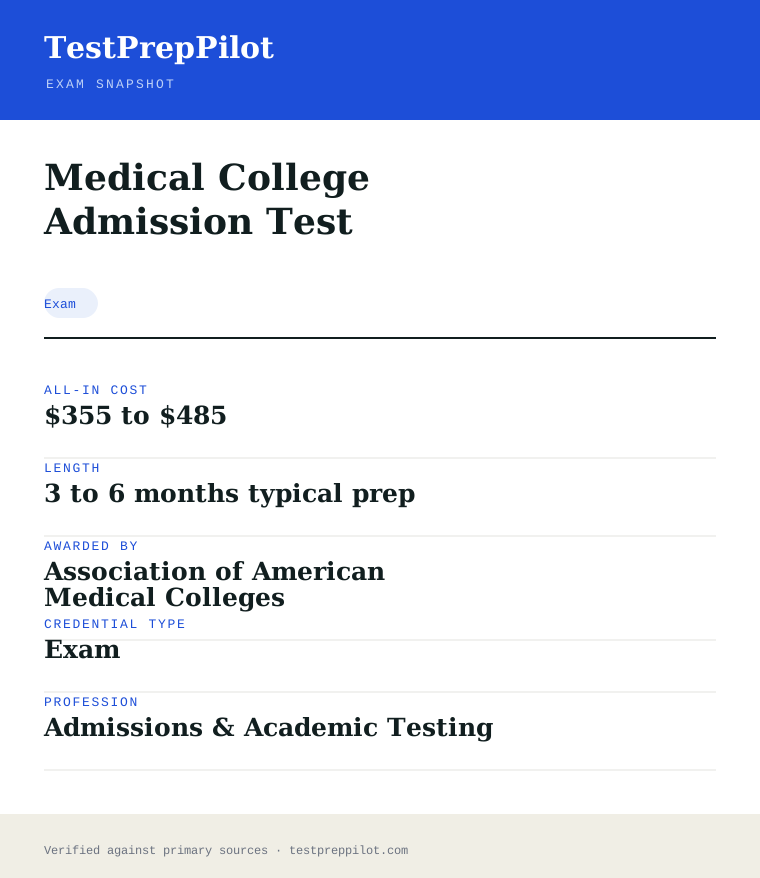
For the Medical College Admission Test, the exam fee is $355 (US); plus $130 international; the all-in cost is typically $355 to $485; most candidates spend 3 to 6 months typical prep preparing.
Cost breakdown
| Standard registration | $355 |
|---|---|
| International surcharge | $130 |
| AAMC Official Prep | optional, ~$300 bundle |
| Typical total | $355 to $485 |
Reschedule and cancellation fees apply by deadline; FAP reduces the base fee to 145 dollars.
Timeline
- Study 3 to 6 months
- Test 7.5 hours
- Scores 30 to 35 days
Typical prep: 3 to 6 months typical prep
The path
How do you register for the Medical College Admission Test?
- 1
Create an AAMC account10 minutes
Register at aamc.org with a name matching your ID; this single account covers MCAT and PREview scheduling.
- 2
Register for the MCAT20 minutes
Use the MCAT Registration System to pick a date and Pearson VUE test center, then pay the standard or international fee.
- 3
Register for PREview separately15 minutes
PREview is booked through its own portal for a two-day testing window from April through October if a target school requires or recommends it.
- 4
Prepare with official prep3 to 6 months
Use AAMC Official Prep products, free PREview practice scenarios and full-length MCAT practice exams.
- 5
Test and await scorestest day
MCAT is taken at a Pearson VUE center; PREview is remotely proctored. Scores release about 30 days after the window.
The fine print
What are the retake and renewal rules for the Medical College Admission Test?
- Proctoring & delivery
- The MCAT is delivered at Pearson VUE test centers under standard security. PREview is a remotely proctored online exam with check-in and identity verification through the AAMC portal.
- Retake policy
- MCAT limits are three times in a testing year, four in two consecutive years and seven in a lifetime. PREview allows up to two attempts per testing year and four in a lifetime.
- Score reporting
- The MCAT totals 472 to 528, built from four sections each scored 118 to 132. PREview reports a total score of 1 to 9 with a confidence band and percentile rank.
- Recertification
- MCAT scores are valid for two to three years depending on the medical school; PREview scores are used for the application cycle and are not renewed. Neither requires continuing education.
Context
AAMC medical admissions exams
| Exam | Measures | Length | Score | |
|---|---|---|---|---|
| MCAT | Science and reasoning | 7.5 hours | 472 to 528 | |
| PREview | Professional judgment | 75 minutes | 1 to 9 |
What it pays
How much does this credential pay?
≥$239,200 median for physicians and surgeons (BLS OOH, May 2024) — the end-state salary the MCAT gates.
The salary answer for the MCAT is the physician occupation it gates: the BLS reports a median annual wage for physicians and surgeons of $239,200 or greater in May 2024 — the BLS suppresses exact medians above $239,200 for statistical-confidentiality reasons, so the published figure is a floor rather than a precise median — and physicians are among the highest-paid occupations in the economy, in an occupation group with 839,000 jobs in 2024. The honest context is that this headline number comes after a long, expensive pipeline: a four-year bachelor’s degree, the MCAT, four years of medical school, and three to nine years of residency and fellowship, and the BLS notes that the wage applies to physicians and surgeons as a broad occupation rather than to a single specialty, with mean wages ranging from roughly $222,340 for general pediatricians to $450,810 for pediatric surgeons in the May 2024 data. For the exam itself, the AAMC reports that roughly 95,000 people take the MCAT per year, with about 51,900 applying to U.S. MD programs in the 2024-25 cycle and about 23,200 enrolling, so the exam is a competitive filter where the salary distribution sits well behind an uncertain admission outcome. The BLS projects employment of physicians and surgeons to grow 3 percent from 2024 to 2034, about as fast as the average for all occupations, with about 23,600 openings per year, mostly from replacement need. The practical takeaway for an MCAT candidate is that the salary headline is real but remote: the score’s immediate value is admission and scholarship leverage, not a wage, and the relevant comparison is not the physician median but the average MCAT and GPA of matriculants at the schools you are targeting.
| Measure | Figure | Source / note |
|---|---|---|
| Median annual wage, physicians and surgeons | ≥$239,200 | BLS OOH, May 2024 ($115.00/hr floor; exact median suppressed above $239,200) |
| Employment, 2024 | 839,000 jobs | BLS OOH Quick Facts |
| Projected annual openings | ~23,600 per year | BLS OOH Job Outlook, 2024-34 (3% growth) |
| MCAT administrations per year | ~95,000 | AAMC; some analyses of 2022-24 data put the annual figure near 98,000 |
| Typical entry path | BS + MCAT + MD + 3-9 yrs residency | The physician wage is earned years after the MCAT |
Job growth.3% projected change 2024-34 (about as fast as average), with ~23,600 openings a year; admission competition, not wage growth, is the binding constraint for MCAT candidates.
Source: BLS Occupational Outlook Handbook — Physicians and Surgeons
Your odds
What are the pass rates?
The MCAT has no pass rate — it is scored 118-132 per section (472-528 total) and read by percentile; the AAMC reports a mean total score near 500.5, MD applicants in 2024-25 averaged 506.1, and enrolling students averaged 511.8.
The direct answer on pass rates is that the MCAT has no pass rate, and we state that plainly because it is the single most common misunderstanding about this exam: the AAMC does not set a passing score, every section and the total are reported as scaled scores — 118 to 132 per section, summed to a total of 472 to 528 — and the score’s meaning comes entirely from percentile rank and from how each medical school uses it, so there is no threshold that converts the exam into a pass-fail event. What the AAMC does publish is the distribution: the mean total score for recent examinees is about 500.5, which corresponds to roughly the 50th percentile by design, and in the 2024-25 MD admissions cycle, applicants averaged 506.1 while students who enrolled averaged 511.8 — a reminder that the relevant target is not a passing score but a score competitive at your target schools. The exam itself is fixed and published in the AAMC MCAT Essentials: four sections — Chemical and Physical Foundations of Biological Systems (59 questions, 95 minutes), Critical Analysis and Reasoning Skills or CARS (53 questions, 90 minutes), Biological and Biochemical Foundations of Living Systems (59 questions, 95 minutes), and Psychological, Social, and Biological Foundations of Behavior (59 questions, 95 minutes) — for 6 hours 15 minutes of testing within a roughly 7.5-hour test-center day, with 230 total questions and no calculator permitted. Scores are reported 30-35 days after the test date, are typically valid for two to three years depending on the school, and retake limits are published: up to three attempts per calendar year, four in any two consecutive years, and seven in a lifetime. The practical read on difficulty: the MCAT is a reasoning-and-endurance exam as much as a content exam, and the competitive interpretation of any score comes from the percentile table and the admissions statistics of your target programs.
Read this before quoting the number.The MCAT has no passing score and no published pass rate; scores are scaled per section (118-132) and read by percentile, with the meaning of any score determined by each medical school’s admissions use of it.
Source: AAMC — About the MCAT exam
Your schedule
How long should I study for it?
300-400 hours over 12-16 weeks of focused study
A realistic MCAT study plan runs 300-400 hours over 12-16 weeks, because the exam tests four sections of college-level science and reading comprehension and the published evidence is that top scorers spend roughly 300-350 hours, and the largest score gains come from a content-review phase followed by a long phase of AAMC official practice and full-length exams. The AAMC MCAT Essentials is the scope map: the four sections — Chemical and Physical Foundations, CARS, Biological and Biochemical Foundations, and Psychological, Social, and Biological Foundations — map to undergraduate courses in general chemistry, organic chemistry, physics, biochemistry, biology, psychology, and sociology, and the AAMC publishes the exact content outline, the Foundational Concepts and Skill Categories, and the number of questions and minutes per section, so the plan should be built backward from that document. The study window should split into a content-review phase (weeks 1-6) covering the undergraduate prerequisites in section order, a practice-and-analysis phase (weeks 7-12) built around the AAMC question packs, section banks, and official full-length exams, and a final two weeks of timed full-length rehearsals under test-day conditions. The AAMC’s own practice materials are the highest-value resources and should anchor the practice phase, because third-party materials vary in fidelity and the official full-length exams are the closest approximation of the real thing. Candidates should schedule the exam against the application cycle — most take it in spring or summer of the year before applying, with scores released 30-35 days later — and should build a daily CARS habit from week one because reading speed and reasoning improve slowly. The final two weeks should replicate the 7.5-hour test-center day, including the optional-break schedule, because stamina and the no-calculator arithmetic habit are the two things candidates underestimate most.
- Weeks 1-220-25 hrs/week
Chem/Phys content review
- Review general chemistry and organic chemistry from the AAMC content outline
- Review physics and kinematics content relevant to the section
- Start the daily CARS reading-and-reasoning habit
- Weeks 3-420-25 hrs/week
Bio/Biochem content review
- Review biology: cells, genetics, organ systems, and metabolism
- Cover biochemistry: amino acids, enzymes, pathways
- Do untimed practice on content you just reviewed
- Weeks 5-620-25 hrs/week
Psych/Soc and CARS
- Review psychology and sociology content from the outline
- Practise passage-based CARS sets daily with error analysis
- Take the AAMC diagnostic or first half-length to set a baseline
- Weeks 7-1025-30 hrs/week
AAMC practice phase
- Work through AAMC section banks and question packs by section
- Analyse every miss: content gap, reasoning error, or reading error
- Take an AAMC full-length every week and review it fully
- Weeks 11-1225-30 hrs/week
Targeted gap closing
- Re-drill the two or three content areas generating most misses
- Practise no-calculator arithmetic and data-graph reading
- Take another AAMC full-length and compare section scores
- Weeks 13-1620-25 hrs/week
Full-length rehearsals and readiness
- Take the remaining AAMC full-lengths under exact test-day timing and breaks
- Replicate the 7.5-hour day, including the void-decision practice
- Light review only in the final week; confirm registration and ID requirements
Adjusting the pace
Working full time or in school.Extend the plan to 5-6 months at 12-18 hours a week; protect the CARS daily habit and the weekly AAMC full-length even when content review slips.
Strong recent science background.Compress content review to 3-4 weeks and move into the AAMC practice phase early; recent biology and chemistry coursework is the strongest base.
Re-taker.Skip full re-review and go straight to AAMC practice plus targeted section-bank work on the lowest section, because the second attempt is won by analysis, not by re-reading content.
How to study
How do I prepare most effectively?
The dominant prep strategy for the MCAT is to make AAMC official materials the core of the practice phase and to treat every question as data about your weaknesses, because the AAMC writes the real exam and its question packs, section banks, and full-length exams are the closest available approximation of the test-day experience. First, anchor the plan to the AAMC MCAT Essentials and the content outline: the Foundational Concepts and Skill Categories define the tested scope, and studying the undergraduate prerequisites against that outline prevents both over-studying and blind spots. Second, start a daily CARS habit in week one and never stop it, because reading speed and reasoning improve slowly and the CARS section is the one most resistant to last-minute cramming. Third, do no-calculator arithmetic in your review from the start, because the MCAT permits no calculator and the science sections assume fast, accurate mental arithmetic and unit handling. Fourth, analyse every practice miss into one of three buckets — content gap, reasoning error, or reading error — because the three buckets demand different fixes and candidates who re-read content for a reasoning error waste their most valuable hours. Fifth, take AAMC full-length exams on the same schedule as the real day — roughly the same start time, the same optional-break structure, the same total 7.5 hours — because stamina and section fatigue are measurable and trainable. Finally, register early and pick a test date with score release before your earliest application deadline, because seats in popular cities fill and the 30-35-day score window sets the real deadline. A further high-yield tactic is to keep a running error log by section and by bucket and to re-attempt every missed question after a two-week gap, because retrieving the fix proves you learned it rather than saw it.
Make AAMC materials the core
Question packs, section banks, and full-length exams from the AAMC are the closest approximation of the real test; schedule them into the plan before any third-party content.
Start a daily CARS habit in week one
Reading speed and reasoning improve slowly; the CARS section resists cramming more than any other.
Practise no-calculator arithmetic
No calculator is permitted; train fast mental arithmetic and unit handling in the science sections from the start.
Bucket every miss
Classify each error as content gap, reasoning error, or reading error; the three buckets demand different fixes.
Replicate the full 7.5-hour day
Take full-lengths at the same start time with the same breaks; stamina is measurable and trainable.
Register early against score release
Scores arrive 30-35 days after the test; choose a date that releases before your earliest application deadline.
What to buy
Which study resources are worth paying for?
MCAT prep resources split into the AAMC official set, commercial course-and-bank platforms, and free materials, and the buying logic is anchored by the AAMC official set because it is written by the organisation that makes the real exam: the Question Packs, Section Banks, and Official Full-Length Exams are the closest available approximation of test-day content and are the resources prep experts consistently rank first. Commercial platforms — the major course vendors and question banks — add structured content review, video lessons, and scoring analytics, and their role in a strong plan is content review and drilling before and alongside the AAMC practice phase; prices typically run from roughly $100-250 for a self-paced question bank up to $1,500-3,500 for a live or in-person course, with frequent sales on self-paced options. The AAMC Fee Assistance Program reduces the MCAT registration fee to $145 (from $355) for eligible students and includes free access to official prep materials, which makes the official set free for qualifying candidates. Third-party free resources — pre-made Anki decks, study-group materials, and YouTube lectures — are useful for content gaps but should not replace AAMC practice, because fidelity to the real exam is the highest-value property a resource can have. The footnote that anchors the comparison: prices below are approximate as of mid-2026 and change frequently, we rank nothing by commission, and the $355 standard registration fee (plus $130 international fee for examinees testing outside the U.S., Canada, or U.S. territories) is separate from any prep purchase. A cheap readiness check is the AAMC free official prep materials and one full-length exam before buying anything, because the diagnostic tells you whether you need a full course or just a question bank.
| Resource | Price | Format | Best for |
|---|---|---|---|
| AAMC official prep materials | $0-350 depending on bundle; free with Fee Assistance | Question packs, section banks, official full-lengths | The highest-fidelity practice — anchors every strong plan |
| MCAT registration | $355 standard; $145 with Fee Assistance | Pearson VUE test center | The real exam; $130 extra international fee |
| Commercial question bank | ~$100-250, often on sale | Online drilling with analytics | Content review and drilling before the AAMC phase |
| Live or in-person course | ~$1,500-3,500 | Instructor-led, structured | Candidates who need external structure and scheduling |
| Free third-party resources | Free | Anki decks, lectures, study groups | Filling content gaps — not a replacement for AAMC practice |
Prices are approximate as of mid-2026 and change frequently; we rank nothing by commission. The standard 2026 MCAT registration fee is $355 ($145 with approved Fee Assistance, plus $130 for examinees testing outside the U.S., Canada, or U.S. territories), separate from any prep purchase.
Avoid these
What mistakes do candidates most often make?
The most common mistake on the MCAT is spending the majority of study hours on content review and too few on timed AAMC practice, because the exam is a reasoning-and-endurance test and candidates who finish content review late rarely recover the practice-and-analysis phase that drives score improvement. The second is using third-party practice as a substitute for AAMC official practice, because fidelity to the real exam is the highest-value property of any resource, and inflated or deflated third-party scores distort readiness estimates. A third recurring error is doing practice untimed, when the pacing discipline — roughly 95 seconds per science question, 100 seconds per CARS passage question — is itself a tested skill. Candidates also routinely fail to replicate the 7.5-hour test-center day in rehearsal, so section fatigue on the final sections surprises them on test day, and the no-calculator arithmetic habit is neglected until the real exam, where every science section punishes it. Another pattern is ignoring the section score distribution in favour of a single total score: medical schools read the section breakdown, and a 505 built on a weak CARS section is a different application than a 505 with a balanced profile. Finally, some candidates retake too quickly after a disappointing score without a gap analysis, wasting attempts under the published limits — three per calendar year, four in two consecutive years, and seven lifetime. A final pattern is treating the exam as an isolated event and ignoring the application timeline around it: scores release 30-35 days after the test date, and the AMCAS cycle rewards early submission, so a score that arrives late can cap the school list regardless of its number.
✕Over-investing in content review
✓Cap content review around weeks 1-6 of a 12-16-week plan and reserve the majority of hours for timed AAMC practice and analysis.
✕Substituting third-party practice for AAMC practice
✓Use third-party materials for drilling and content, but anchor readiness to AAMC question packs, section banks, and full-lengths.
✕Practising untimed
✓Train to the real pacing — ~95 sec per science question, ~100 sec per CARS question — from mid-plan onward.
✕Never replicating the 7.5-hour day
✓Take full-lengths at the real start time with the real break structure; stamina on the last sections is trainable.
✕Chasing one total score
✓Track the section breakdown; medical schools read it, and a balanced 505 beats a lopsided one.
✕Retaking without a gap analysis
✓Retakes are limited (3/year, 4/two years, 7/lifetime); re-sit only after an AAMC-practice-based plan for the lowest sections.
✕Scheduling too late in the application cycle
✓Pick a test date whose 30-35-day score release lands before your earliest application deadline, and leave room for a retake within the annual attempt limits.
✕Neglecting the research and data-reasoning skills
✓Drill experimental-design and data-interpretation items across all three science sections; the skill category is trainable and appears throughout the exam.
What you'll face
What question types will I see?
The MCAT is a computer-based, multiple-choice exam of 230 questions across four sections — Chemical and Physical Foundations of Biological Systems (59 questions, 95 minutes), CARS (53 questions, 90 minutes), Biological and Biochemical Foundations of Living Systems (59 questions, 95 minutes), and Psychological, Social, and Biological Foundations of Behavior (59 questions, 95 minutes) — for 6 hours 15 minutes of testing within a roughly 7.5-hour test-center day, with no calculator and no formula sheet. The overwhelming majority of items are passage-based: each section presents passages with attached question sets, and the science sections also include discrete standalone questions; the four sections share four tested Skill Categories — knowledge of scientific concepts and principles, scientific reasoning and problem solving, reasoning about the design and execution of research, and data-based and statistical reasoning — while CARS adds passage comprehension and reasoning about ethics, philosophy, culture, and social science texts. Every item has four answer choices, scoring is scaled per section from 118 to 132, and the total is the sum, 472 to 528, with the raw-to-scaled conversion set by the AAMC after each administration so that equivalent performance yields equivalent scaled scores across different forms. The scaled score is set by equating across administrations, so the same scaled score represents the same level of performance regardless of form difficulty, and the AAMC publishes percentile tables that show how any total score ranks among recent examinees. Because CARS is the only section without science content, it is also the section most resistant to cramming and the one most worth practising daily. The samples below illustrate three of the recurring formats — a discrete science item, a data-reading item, and a CARS-style reasoning item. The sample items are editor-written illustrations of the published blueprint, not live exam items.
A scientific passage followed by 4-7 items on concepts, research design, and data; the core MCAT format.
Single items with no passage, testing core concepts directly; appear at intervals within each science section.
Nine passages from ethics, philosophy, literature, and social science with 4-7 reasoning items each; no science content required.
Interpret graphs and tables, evaluate experimental design, and reason about statistics; the Skill Category most often under-practised.
Try these
Q1Which of the following best explains why a nonpolar molecule such as methane has a low boiling point relative to a polar molecule of similar molar mass?
Answer:B
Intermolecular forces determine boiling point: methane’s only significant intermolecular attractions are dispersion (London) forces, which are weak, so little thermal energy is needed to separate the molecules into a gas. Option A describes hydrogen bonding, which methane cannot form; option C reverses the relationship between mass and boiling point; and option D invents ionisation that does not occur. This is a discrete Chem/Phys item testing intermolecular forces.
Q2In an experiment, a researcher measures the rate of an enzyme-catalysed reaction at increasing substrate concentrations and observes that the rate plateaus at high substrate concentration. Which conclusion is best supported by the data?
Answer:B
A rate plateau at high substrate concentration is the classic signature of enzyme saturation: when essentially all active sites are occupied, adding more substrate cannot increase the rate. Option A confuses the plateau with denaturation, option C confuses rate with a separate variable, and option D misunderstands enzyme catalysis, in which enzymes are not consumed. This item tests data-based reasoning about the enzyme-substrate model from the Bio/Biochem content.
Q3CARS-style prompt: An author argues that a city’s decision to close public libraries to balance its budget treats reading as a private luxury rather than a public good. Which of the following, if true, would most strengthen the author’s argument?
Answer:B
The author’s claim is that the closure wrongly treats reading as a private luxury rather than a public good. Evidence that the heaviest users are residents who cannot afford books directly supports that claim, because it shows the library provides something the market does not. Option A undermines the argument, option C is about future plans rather than the author’s claim, and option D about other cities is irrelevant to the reasoning. This item illustrates the CARS strengthen-the-argument format.
Samples are editor-written illustrations of the published blueprint, not live exam items.
The big day
What should I expect on exam day?
The MCAT test-center day is about 7.5 hours — 6 hours 15 minutes of testing across four sections plus the tutorial, the optional breaks, and the end-of-exam void decision — and the direct exam-day answer is that you will work through Chemical and Physical Foundations (59 questions, 95 minutes), CARS (53 questions, 90 minutes), Biological and Biochemical Foundations (59 questions, 95 minutes), and Psychological, Social, and Biological Foundations (59 questions, 95 minutes) in that order, with no calculator, no notes, and no formula sheet. Arrive at least 30 minutes early with your original, unexpired government-issued photo ID matching your registration exactly, because check-in includes identity verification, palm-vein scanning at many centers, and storage of personal items in a locker; phones, smartwatches, bags, and study materials are not allowed in the room. The optional breaks come between sections and total up to 30 minutes if you take all of them — 10 minutes between sections and a 30-minute lunch after the second section — and the clock does not stop during the tutorial, which should be skipped quickly if you do not need it. During the exam, pace by the published section time: roughly 95 seconds per science question and 100 seconds per CARS question, flagging hard items and returning rather than dwelling. At the end, the exam asks whether you want to void your score before it is scored; voiding is permanent and the seat and fee are spent, so the only rational void is for a genuine emergency or computer failure, not for feeling you scored badly. Scores are released 30-35 days later at 5:00 p.m. ET on the published release date, and there is no score preview or partial cancellation window for standard administrations — the decision to cancel or keep is the end-of-exam void choice.
Bring
- Original, unexpired government-issued photo ID matching your registration name exactly
- Approved comfort items if pre-approved (check the AAMC comfort-aid list)
- Snacks and water for the optional breaks (kept in your locker, not the room)
Leave at home
- Phones, smartwatches, fitness trackers, and earbuds — locker only
- Notes, highlighters, and study materials (prohibited)
- Calculators and formula sheets (no calculator is permitted)
- Bags and coats beyond what the test center allows in the room
How the day runs
Rules in the room
- No calculator, no notes, and no formula sheet; arithmetic must be done by hand
- Original, unexpired government-issued photo ID is required; the name must match your registration
- Phones and smartwatches are prohibited in the room and stored in a locker
- The clock does not stop during the tutorial or for breaks you choose to skip
- The end-of-exam void decision is final; voided scores are permanently discarded and the fee is not refunded
Afterwards.Receive your score about 30-35 days after the test date at 5:00 p.m. ET, review the section breakdown against your target schools’ published averages, and submit scores through the AMCAS application to the schools you designate. If you retake, the AAMC publishes score-autofill rules — many schools see all attempts — so retake only with a gap-analysis plan, and remember the limits of three attempts per calendar year, four in two consecutive years, and seven lifetime.
Reference
What are the key facts about the Medical College Admission Test?
Medical College Admission Test is a exam credential; awarded by Association of American Medical Colleges; the exam fee is $355 (US); plus $130 international; typical preparation is 3 to 6 months typical prep; holders typically earn $150,000-$300,000+ (29-1210 Physicians).
| Credential | Medical College Admission Test |
|---|---|
| Abbreviation | MCAT |
| Type | Exam |
| Profession | Admissions & Academic Testing |
| Specialty | Graduate & Professional Admissions |
| Awarded by | Association of American Medical Colleges |
| Difficulty | Hard |
| Typical prep time | 3 to 6 months typical prep |
| All-in cost | $355 to $485 |
| Typical salary range | $150,000-$300,000+ (29-1210 Physicians) |
| Scoring | 472 to 528; 118 to 132 per section |
| Median | About 500 (50th percentile) |
| Limits | 3 per year, 4 in two years, 7 lifetime |
| FAP fee | 145 dollars with fee assistance |
| Scope | National / Multi-state |
Real questions
Frequently asked questions about the Medical College Admission Test
How hard is the MCAT?
It is widely considered hard because it combines broad science knowledge with data analysis and CARS reading under a long testing day. A competitive score is often 510 or higher, with top schools looking for 515 plus.
How long should I study?
Most applicants spend three to six months and 300 to 500 hours, finishing with full-length AAMC practice exams to build stamina for the 7.5-hour day.
What is a good MCAT score?
The median is about 500. A 510 is competitive for many MD programs, while 515 or above strengthens applications to selective schools.
How long are scores valid?
Medical schools generally accept MCAT scores for two to three years, though each sets its own policy, so time your test within the validity window for your applications.
Can I retake the MCAT?
Yes, up to three times in a testing year, four times within two consecutive years and seven times in a lifetime, with a 355 dollar fee each attempt unless fee assistance applies.
Do I need both the MCAT and PREview?
The MCAT is required by virtually every US and Canadian MD program. PREview is required or recommended by roughly 30 schools, so check each admissions page.
Is there fee assistance?
Yes. The AAMC Fee Assistance Program cuts the MCAT fee to 145 dollars and waives the first PREview registration for eligible applicants.
In short
Is the Medical College Admission Test worth it?
- 7.5-hour medical admissions exam, 230 questions
- Scored 472 to 528; median about 500
- Standard fee 355 dollars plus 130 international
Worth comparing
How does the Medical College Admission Test compare with similar credentials?
Trust
Where does this information come from?
Everything above is taken from the awarding body's own published material. Fees, question counts and domain weights are revised regularly — check the official page before you pay.
- Association of American Medical Colleges Awarding body
- Official Medical College Admission Test exam page Exam page
Research confidence: high · Last reviewed 2026-08