The short version
What is the GMAT Focus Edition and is it worth it?
The GMAT Focus Edition is the current GMAT for MBA and masters admission, taken at a Pearson VUE centre or online in about two hours and fifteen minutes. It covers Quantitative, Verbal and Data Insights, scores 205 to 805, costs 275 dollars at a centre or 300 dollars online, and allows five attempts per year.
- Accepted by thousands of business programs
- Focused 2h 15m format with three sections
- Score review before sending to schools
- Scores valid for five years
- Centre and online delivery available
What is it?
What exactly is the GMAT Focus Edition?
The current GMAT with Quantitative, Verbal and Data Insights sections and a 205 to 805 total.
The GMAT Focus Edition is the current Graduate Management Admission Test used by thousands of MBA and business master programs worldwide. It measures Quantitative Reasoning, Verbal Reasoning and Data Insights in three 45-minute sections over about two hours and fifteen minutes, and it reports a total score from 205 to 805 in 10-point increments. Scores are valid for five years, and you may send them to schools with score review available after the test.
The path in brief
- Create a GMAC account
- Book a centre or online slot
- Use the official starter kit
- Test in 2h 15m
- Send scores to schools
Before you book
Who is eligible to sit the GMAT Focus Edition?
None - open to all business-school applicants
Who it is for: MBA and business master applicants
The test itself
What is the format of the GMAT Focus Edition?
The GMAT Focus Edition is administered by Graduate Management Admission Council and runs 2 hr 15 min and contains 64 questions.
| Administered by | Graduate Management Admission Council |
|---|---|
| Questions | 64 |
| Time limit | 2 hr 15 min |
| Pass mark | No pass mark; total 205 to 805 |
| Exam fee | $275-$350 |
| Format | Computer-delivered at Pearson VUE or online |
Content outline
What topics are on the GMAT Focus Edition?
The GMAT Focus Edition covers 3 content domains.
Weightings come from the official exam outline. Study time is best allocated in roughly these proportions rather than evenly across domains.
- Quantitative Reasoning
- Verbal Reasoning
- Data Insights
Money & time
How much does the GMAT Focus Edition cost?
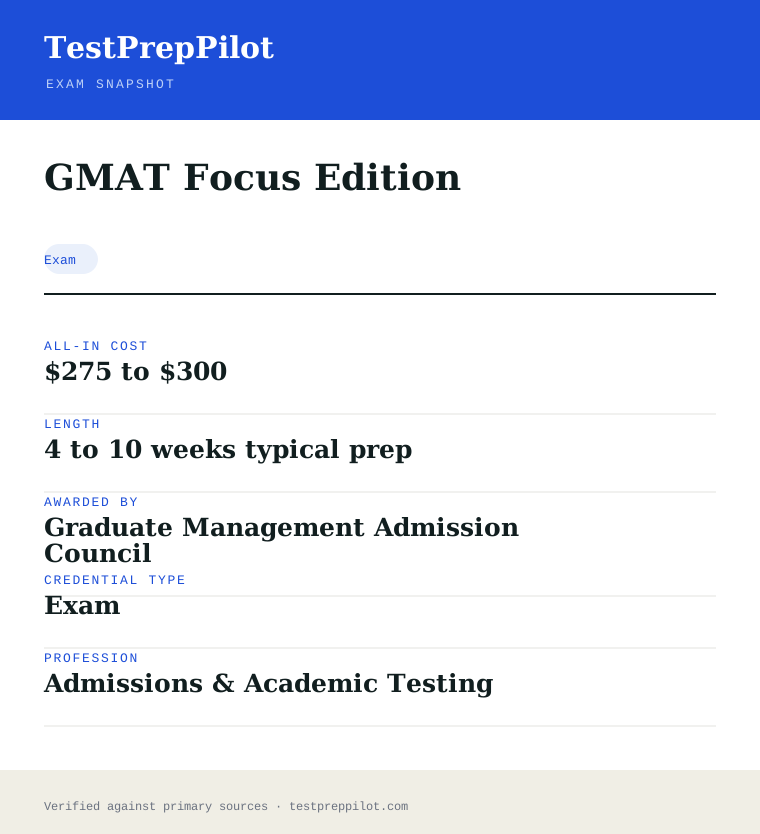
For the GMAT Focus Edition, the exam fee is $275-$350; the all-in cost is typically $275 to $300; most candidates spend 4 to 10 weeks typical prep preparing.
Cost breakdown
| Exam fee (centre) | $275 |
|---|---|
| Exam fee (online) | $300 |
| Additional score reports | Included |
| Typical total | $275 to $300 |
A 16-day gap applies between attempts; some reschedule and cancellation fees may apply.
Timeline
- Study 4 to 10 weeks
- Test 2h 15m
- Scores Same or next day
Typical prep: 4 to 10 weeks typical prep
The path
How do you register for the GMAT Focus Edition?
- 1
Create a GMAC account10 minutes
Register at mba.com with a name matching your ID; this account handles both the GMAT Focus Edition and the Executive Assessment.
- 2
Book the exam15 minutes
Pick a Pearson VUE centre or the online version, then choose a date; the GMAT Focus Edition and the Executive Assessment have separate portals.
- 3
Pay the fee5 minutes
The GMAT Focus Edition is 275 dollars at a centre or 300 dollars online; the Executive Assessment is 350 dollars.
- 4
Prepare with official prep4 to 10 weeks
Use the free GMAT Focus Official Starter Kit and the Executive Assessment official guide for practice.
- 5
Test and send scorestest day
Sit the exam and send official reports to your selected programs; score review differs by exam.
The fine print
What are the retake and renewal rules for the GMAT Focus Edition?
- Proctoring & delivery
- Both exams are delivered at Pearson VUE centres or online with live proctoring. Online test takers complete an equipment and room scan before starting.
- Retake policy
- The GMAT Focus Edition requires a 16-day gap and allows up to five attempts in 12 months and eight in a lifetime. The Executive Assessment allows a maximum of two attempts.
- Score reporting
- The GMAT Focus Edition totals 205 to 805 in 10-point increments across Quantitative, Verbal and Data Insights. The Executive Assessment totals 100 to 200, with each section scored 0 to 20.
- Recertification
- Scores are valid for five years from the test date and are not renewed; older scores age out of the reporting system.
Context
GMAC business admissions exams
| Exam | For | Length | Score | |
|---|---|---|---|---|
| GMAT Focus Edition | MBA and masters | 2h 15m | 205 to 805 | |
| Executive Assessment | Executive MBA | 90 minutes | 100 to 200 |
What it pays
How much does this credential pay?
The GMAT gates MBA access: master’s-degree median weekly earnings were $1,732 in 2024 (BLS)
The GMAT Focus Edition is a business-school admissions test, not a job credential, so no BLS SOC code corresponds to a score. The economic case runs through the MBA and other graduate business degrees the test helps secure, and the BLS evidence is direct: in 2024, full-time workers age 25 and older with a master’s degree earned median weekly wages of $1,732, versus $1,543 with a bachelor’s degree - an annualized master’s-level median of roughly $90,000. For MBA graduates specifically, the earnings premium is well documented by GMAC’s annual corporate recruiters survey and by BLS data for management occupations (management occupations carried a $122,090 median in May 2024), though the MBA’s value varies enormously by school, industry and pre-MBA compensation. The GMAT matters to this picture because it remains one of the two dominant tests for MBA admission alongside the GRE, and a strong score directly affects admission and scholarship outcomes at many programs; top-ranked programs routinely report GMAT score averages in the 700s (on the 205-805 Focus scale, the highest-achieving schools cluster at the top of the range). It is equally true that the landscape has shifted: a growing number of business schools are test-optional or accept the GRE or the Executive Assessment, so the GMAT is a lever rather than a universal gate. The honest framing is the same as for any admissions test: prepare seriously when target programs use the score, and understand that the wage payoff the data supports runs through the degree and the career transition it enables, not the score itself. BLS classifies workers by occupation and education, not test scores, so no GMAT score maps to a salary.
| Measure | Figure | Source / note |
|---|---|---|
| Master’s-degree median weekly earnings, 2024 | $1,732 | BLS, workers 25+, full time |
| Bachelor-degree median weekly earnings, 2024 | $1,543 | BLS, workers 25+, full time |
| Management occupations median, May 2024 | $122,090 | BLS OEWS occupational group |
| GMAT Focus score range | 205-805 | GMAC, total across three sections |
Job growth.BLS projects 3 percent overall employment growth from 2024 to 2034; the wage-by-education gradient and management-occupation medians frame the MBA case.
Your odds
What are the pass rates?
The GMAT Focus has no pass/fail line; totals run 205-805 and targets are set by each program’s admitted-class profile
GMAC publishes no pass rate for the GMAT Focus Edition because there is no passing score. The GMAT Focus Edition, which fully replaced the classic GMAT in early 2024, is scored 205-805 in 5-point increments, with three section scores (Quantitative Reasoning 60-90, Verbal Reasoning 60-90, Data Insights 60-90) and a total that is the weighted sum. The test runs 2 hours 15 minutes with 64 questions: Quantitative Reasoning (21 questions, 45 minutes), Verbal Reasoning (23 questions, 45 minutes), and Data Insights (20 questions, 45 minutes); the sections are not adaptive in the classic computer-adaptive sense - question difficulty adapts within the test - and candidates can select question order and have two optional 8-minute breaks. What candidates compare against are program-reported averages and percentiles: top-tier MBA programs commonly report GMAT totals in the high 700s (on the Focus scale, roughly 695-715+ for the most selective schools), while many strong regional programs admit students in the 600s. GMAC publishes percentile tables and the Official Guide includes score interpretations. There is no limit on retakes, but GMAC allows a maximum of five GMAT attempts in any rolling 12-month period and eight lifetime attempts; candidates may cancel a score at the test center and choose which scores to send (up to five free reports, with score selectivity). Scores are available immediately on a screen at the test center and officially reported within 24 hours. The honest takeaway: build the target from program averages, not from a pass line that does not exist, and confirm each program’s test policy because many now accept the GRE or are test-optional.
Read this before quoting the number.No pass rate exists; targets come from program-reported averages and percentiles.
Your schedule
How long should I study for it?
100-200 hours over 8-16 weeks of focused study
A serious GMAT Focus plan runs 100-200 hours over 8-16 weeks, and the structure follows the three sections. Quantitative Reasoning (21 questions, 45 minutes) tests arithmetic, algebra, geometry and word problems at a level below calculus; most candidates’ Quant gaps are in data-sufficiency-style reasoning and careless errors rather than missing concepts. Verbal Reasoning (23 questions, 45 minutes) tests Reading Comprehension and Critical Reasoning (the classic Sentence Correction was removed in the Focus Edition, replaced by the integrated Data Insights weighting); Critical Reasoning rewards structured argument analysis and is the most trainable Verbal skill. Data Insights (20 questions, 45 minutes) is the Focus Edition’s signature section, combining data sufficiency, multi-source reasoning, table analysis, graphics interpretation and two-part analysis, and it is the section most candidates under-prepare. Week 1: take the free official GMAT Focus practice test (mba.com offers a free official practice exam) and record the three section scores and the total. Weeks 2-5: build Quantitative foundations and the data-sufficiency logic. Weeks 5-8: Verbal - Critical Reasoning drills and Reading Comprehension strategy. Weeks 9-11: Data Insights, the highest-yield training target because it is new and most candidates are unpracticed. Weeks 12-14: timed full tests weekly using official mba.com practice exams. Weeks 15-16: taper, error retakes, and test-day logistics. Candidates should confirm each target program’s policy - many schools accept the GRE or the Executive Assessment - before investing hours.
- Week 16
Baseline
- Official free practice test
- Three section scores and error log
- Weeks 2-550
Quantitative Reasoning
- Arithmetic, algebra, geometry
- Data-sufficiency logic drills
- Weeks 5-840
Verbal Reasoning
- Critical Reasoning argument analysis
- Reading Comprehension strategy
- Weeks 9-1136
Data Insights
- All six question formats
- Table and graphics interpretation
- Weeks 12-1430
Timed full tests
- Weekly official practice exams
- Target weak sections
- Weeks 15-1618
Taper and logistics
- Two final tests
- Question-order and break planning
Adjusting the pace
Test-optional programs.A growing share of business schools do not require a test; confirm the policy before investing hours.
GRE vs GMAT.Many schools accept either; choose by whether the Data Insights weighting or the GRE’s Verbal weighting fits your profile.
How to study
How do I prepare most effectively?
The GMAT Focus rewards a handful of high-leverage habits. Strategy one: train Data Insights deliberately - it is the Focus Edition’s new signature section, most candidates are unpracticed at its six formats, and it carries a large share of the total score; practice with official questions because third-party materials misrepresent the formats. Strategy two: master the data-sufficiency logic, which appears in Data Insights and is the most unusual reasoning skill on the test; the key is deciding whether the statements provide enough information before solving. Strategy three: learn Critical Reasoning as structured argument analysis - identify premise, conclusion and assumption, and pre-phrase the answer before reading the choices - because it is the most trainable Verbal skill and repeats across the test. Strategy four: use official GMAC materials first - the free practice test, the Official Guide (now the GMAT Official Guide with Focus content), and the official question banks - because only GMAC materials match the item style and the scoring algorithm. Strategy five: exploit the flexibility features - select question order, take the optional breaks, and cancel or send scores selectively - by practicing with a planned order and timing. Strategy six: respect the retake limits (five tests per 12 months, eight lifetime) and plan retakes around the weakest section. Finally, verify each program’s policy before investing, because test-optional programs change the calculus entirely.
Train Data Insights hard
The new signature section is the highest-yield training target.
Master data-sufficiency logic
Decide sufficiency before solving; it is the most unusual skill.
Learn Critical Reasoning structure
Premise, conclusion, assumption; pre-phrase before reading choices.
Use official GMAC materials
Only GMAC matches the item style and scoring algorithm.
Plan the flexibility features
Question order, breaks, and selective score sending.
What to buy
Which study resources are worth paying for?
The GMAT Focus prep market has a strong official core. The free official GMAT Focus practice test on mba.com is the most important resource - it is the only free test that runs on the official platform and reflects the Focus scoring. The GMAT Official Guide (about $35-45, with Focus content and answer explanations) and the official question banks (paid subscriptions on mba.com) provide the official item pool, which matters because the Focus Edition’s Data Insights formats are not well represented by third-party materials. Commercial prep books ($20-$40), courses ($200-$2,000) and tutoring ($60-$250/hour) add structure and practice volume; the major companies’ adaptive platforms can be useful, but candidates should verify that the content is updated to the Focus Edition, because classic-GMAT materials over-weight Sentence Correction, which no longer exists. GMAC’s free "GMAT Official Starter Kit" includes practice questions and a test. The honest ranking: the free official test, the Official Guide, an official question-bank subscription for volume, and a course or tutor only for specific gaps. Prices here are current as of 2025-26 and change annually.
| Resource | Price | Format | Best for |
|---|---|---|---|
| Official GMAT Focus practice test | Free (1 test) | Online | The official platform and scoring |
| GMAT Official Guide | $35-$45 | Print/ebook | The official item pool |
| Official question bank subscription | ~$25-$250 | Online | Practice volume on official items |
| Commercial prep book/course | $20-$2,000 | Print/online | Structure; verify Focus-format content |
| Tutor | $60-$250/hr | 1:1 | Targeted section gaps |
Prices dated 2025-26; GMAC materials are the accuracy standard. Verify third-party content is Focus Edition. No commission-based ranking.
Avoid these
What mistakes do candidates most often make?
The most common GMAT Focus mistakes come from preparing with classic-GMAT habits. Mistake one: using pre-Focus materials; the classic GMAT’s Sentence Correction no longer exists, and its Analytical Writing essay is gone, so candidates who practice old content waste hours and train the wrong skills. Mistake two: under-preparing Data Insights; it is the new signature section, most candidates are unpracticed at its six formats, and it carries a large share of the total, so skipping it caps the score. Mistake three: solving data-sufficiency items before deciding sufficiency; the question type rewards a sufficiency decision first, and candidates who rush to compute miss the logic. Mistake four: reading Critical Reasoning choices immediately; candidates who pre-phrase the expected answer before reading choices score measurably better. Mistake five: ignoring the retake limits (five per 12 months, eight lifetime) when planning application timelines; candidates who assume unlimited retakes can run out of attempts. Mistake six: missing the flexibility features - question order and breaks are selectable, and practicing with a fixed order that ignores the option wastes an advantage. Finally, candidates should confirm each program’s policy before investing hundreds of hours, because a growing number of schools are test-optional or accept the GRE.
✕Preparing with classic-GMAT content
✓Use Focus Edition materials; Sentence Correction is gone.
✕Under-preparing Data Insights
✓Train all six formats; it is a large share of the total.
✕Computing before deciding sufficiency
✓Decide sufficiency first; it is the question’s logic.
✕Reading choices before pre-phrasing
✓Pre-phrase the expected answer in Critical Reasoning.
✕Ignoring the retake limits
✓Plan around 5 tests/12 months and 8 lifetime.
What you'll face
What question types will I see?
The GMAT Focus Edition has three sections, each 45 minutes. Quantitative Reasoning (21 questions): problem-solving items covering arithmetic, algebra, geometry and word problems. Verbal Reasoning (23 questions): Reading Comprehension and Critical Reasoning (argument analysis); Sentence Correction was removed in the Focus Edition. Data Insights (20 questions): data sufficiency, multi-source reasoning, table analysis, graphics interpretation, two-part analysis, and data insights problem-solving. The total score is 205-805 in 5-point increments, with section scores of 60-90 each. Candidates may select question order and take two optional 8-minute breaks. Samples below are editor-written illustrations of the published test specifications, not live exam items.
Problem solving; arithmetic through geometry.
Reading Comprehension and Critical Reasoning.
Data sufficiency, multi-source, table, graphics, two-part.
Try these
Q1Data sufficiency item: Is x greater than 10? (1) x is a multiple of 5. (2) x is greater than 8.
Answer:C
Statement (1) gives x = 5, 10, 15... which is not decisive; statement (2) gives x > 8, not decisive alone. Together, x is a multiple of 5 greater than 8 (10, 15...), which still does not guarantee x > 10 (x could be 10). So together they are still not sufficient: E is correct for the logic illustrated here (with x=10 satisfying both but not greater than 10).
Q2Critical Reasoning: "The city’s new recycling program increased recycling rates by 15 percent, but critics note that the program also raised collection costs. Which of the following, if true, most weakens the critics’ concern about costs?"
Answer:A
The critics’ concern is that costs rose. Finding A weakens the cost concern by showing a cost they would have incurred anyway (higher landfill fees), so the program may not be the cause of the increase.
Q3Two-part analysis item: A store sells 100 units at $10 each. If the price increases by 10 percent and quantity sold falls by 10 percent, the revenue (A) increases / (B) decreases, by approximately (C) 1% / (D) 10%.
Answer:B
New price = $11, new quantity = 90; new revenue = $990 versus $1,000, a decrease of 1 percent.
Samples are editor-written illustrations of the published test specifications, not live exam items.
The big day
What should I expect on exam day?
The GMAT Focus Edition is delivered at authorized Pearson VUE test centers and online (GMAT Online with a proctor). At a test center, arrive 30 minutes early with a valid ID (the requirements vary by country; check mba.com), and personal electronics are stored; the test runs 2 hours 15 minutes with two optional 8-minute breaks, and candidates select their question order before starting. For the online version, complete the system check ahead of time, use a quiet private room, and follow the proctor’s rules. Scores appear on screen immediately after the test, and the official score report follows within 24 hours; candidates may cancel the score at the center and may choose which scores to send (up to five free reports). There are limits of five GMAT attempts per rolling 12-month period and eight lifetime attempts. Afterwards, send scores to target programs before deadlines (score reports are valid for five years), confirm each program’s test policy, and if a retake is needed, target the weakest section with Focus-format practice.
Bring
- Valid ID per mba.com country requirements
- Appointment confirmation
- Online version: verified system and quiet room
- Optional approved items for breaks
Leave at home
- Phone, smartwatch, and personal electronics
- Notes or study materials
- Second monitors or devices for the online version
How the day runs
Rules in the room
- Valid ID is mandatory; personal electronics are prohibited.
- Question order is selectable; two optional 8-minute breaks.
- Maximum 5 tests per 12 months and 8 lifetime attempts.
- Scores are valid for 5 years; cancel or send selectively.
Afterwards.Send scores before deadlines (5-year validity), verify each program’s policy, and plan any retake with Focus-format practice on the weakest section.
Reference
What are the key facts about the GMAT Focus Edition?
GMAT Focus Edition is a exam credential; awarded by Graduate Management Admission Council; the exam fee is $275-$350; typical preparation is 4 to 10 weeks typical prep; holders typically earn MBA-path benchmark: master's-degree median ~$90,000/yr (BLS 2024).
| Credential | GMAT Focus Edition |
|---|---|
| Abbreviation | GMAT |
| Type | Exam |
| Profession | Admissions & Academic Testing |
| Specialty | Graduate & Professional Admissions |
| Awarded by | Graduate Management Admission Council |
| Difficulty | Challenging |
| Typical prep time | 4 to 10 weeks typical prep |
| All-in cost | $275 to $300 |
| Typical salary range | MBA-path benchmark: master's-degree median ~$90,000/yr (BLS 2024) |
| Sections | Quant, Verbal, Data Insights, 45 min each |
| Scoring | 205 to 805 in 10-point steps |
| Attempts | Up to 5 per 12 months, 8 lifetime |
| Validity | 5 years |
| Scope | National / Multi-state |
Real questions
Frequently asked questions about the GMAT Focus Edition
How many times can I take the GMAT Focus Edition?
You may retake it after a 16-day wait, up to five times in 12 months and eight times in a lifetime.
How is it scored?
It reports a total score of 205 to 805 in 10-point increments, built from the three section scores.
How much does it cost?
There is no passing score - totals run 205-805 and targets come from program-reported averages; retakes are limited to 5 per 12 months and 8 lifetime.
How long are scores valid?
GMAT Focus Edition scores are valid for five years from the test date.
How many times can I take the GMAT Focus Edition?
You may retake it after a 16-day wait, up to five times in 12 months and eight times in a lifetime.
What is the Executive Assessment for?
It is a shorter 90-minute test designed for experienced professionals applying to executive MBA programs, with a limit of two attempts.
In short
Is the GMAT Focus Edition worth it?
- Current GMAT for MBA and masters admission
- Three 45-minute sections, 205 to 805 total
- 275 to 300 dollars, valid five years
Worth comparing
How does the GMAT Focus Edition compare with similar credentials?
Trust
Where does this information come from?
Everything above is taken from the awarding body's own published material. Fees, question counts and domain weights are revised regularly — check the official page before you pay.
- Graduate Management Admission Council Awarding body
Research confidence: high · Last reviewed 2026-08