Admissions & Academic Testing • Exam
PTE Academic
A fully computer-scored English test with results in about two days for university admission.
Researched and maintained by TestPrepPilot Editorial BoardEnglish-language assessment desk · Figures last verified August 2026
The short version
What is the PTE Academic and is it worth it?
PTE Academic is a fully computer-scored English test lasting about two hours at a Pearson VUE centre or at home, with results usually in two days. It is accepted by many US universities and governments for visas, and it reports a single overall score from 10 to 90 that is valid for two years.
- Results typically within two days
- Fully computer-scored for consistent grading
- Accepted by thousands of universities and visa bodies
- Single 10 to 90 score scale is easy to read
- Centre and at-home delivery are available
What is it?
What exactly is the PTE Academic?
A fully computer-scored English test with results in about two days for university admission.
PTE Academic is Pearson computer-based English proficiency test for study, work and migration, completed in about two hours at a Pearson VUE centre or at home. All speaking, writing, reading and listening items are scored by automated speech and writing engines, so results are typically available within two days. It is accepted by thousands of universities, including many US institutions, and by a range of governments for visa purposes, and it pairs a fast turnaround with a single 10 to 90 score scale.
The path in brief
- Check the school accepts PTE Academic
- Book a centre or at-home slot
- Take the official scored practice test
- Test in about two hours
- Send scores to institutions
Before you book
Who is eligible to sit the PTE Academic?
Who it is for: University and visa English-proficiency applicants
The test itself
What is the format of the PTE Academic?
The PTE Academic is administered by Pearson VUE centres and at home and runs 2 hours.
| Administered by | Pearson VUE centres and at home |
|---|---|
| Questions | About 70 to 91 items across three timed parts |
| Time limit | 2 hours |
| Pass mark | No pass mark; score 10 to 90 |
| Exam fee | $215 to $250 (US); varies by country |
| Format | Computer-delivered, integrated speaking and writing |
Content outline
What topics are on the PTE Academic?
The PTE Academic covers 3 content domains.
Weightings come from the official exam outline. Study time is best allocated in roughly these proportions rather than evenly across domains.
- Speaking and Writing
- Reading
- Listening
Money & time
How much does the PTE Academic cost?
For the PTE Academic, the exam fee is $215 to $250 (US); varies by country; the all-in cost is typically $215 to $250; most candidates spend About 2 hours on the test day preparing.
Cost breakdown
| Test fee (US) | $215 to $250 |
|---|---|
| Additional score reports | Most included free |
| Typical total | $215 to $250 |
Fees vary by country and currency; some locations add a centre surcharge.
Timeline
- Book Online
- Test 2 hours
- Results About 2 days
Typical prep: About 2 hours on the test day
The path
How do you register for the PTE Academic?
- 1
Confirm the assessment your school requiresper school
Ask the admissions or gifted office which Pearson instrument it accepts, since ability and achievement tests differ by age and purpose.
- 2
Locate a qualified administratorvaries
For KBIT-2, WISC-V, WPPSI-IV and similar tools, book a licensed psychologist or school psychologist; schools usually handle NNAT3, OLSAT and Stanford 10 directly.
- 3
Schedule the administrationvaries
Book a testing appointment or wait for the school testing window; PTE Academic is booked through the test taker Pearson account.
- 4
Prepare as advisedvaries
Ability tests need little study; PTE Academic benefits from the official scored practice test and sample questions.
- 5
Receive the reportafter testing
The examiner or school issues a written report with standard scores and percentiles that you submit to the admissions office.
The fine print
What are the retake and renewal rules for the PTE Academic?
- Proctoring & delivery
- Ability and achievement instruments are administered by qualified examiners or school staff under standard conditions; PTE Academic is taken at a Pearson VUE centre or at home with online proctoring.
- Retake policy
- Most ability and achievement tests are given once per admissions cycle and retaken only if the school permits a later administration. PTE Academic may be retaken with no fixed lifetime limit, subject to a short waiting period between attempts.
- Score reporting
- Scores are reported as standard scores, indexes or scales with age- or grade-based percentiles depending on the instrument; PTE Academic uses a 10 to 90 overall scale.
- Recertification
- These are diagnostic or admissions assessments rather than certifications, so there is no recertification; scores reflect performance on the test date.
Context
Selected Pearson admissions and ability tests
| Test | Used for | Length | Score | |
|---|---|---|---|---|
| KBIT-2 | Brief ability screen | 15 to 30 min | Standard score 100 | |
| WISC-V | Full IQ evaluation | 45 to 65 min | FSIQ 100 | |
| PTE Academic | English proficiency | 2 hours | 10 to 90 |
What it pays
How much does this credential pay?
PTE Academic has no direct salary outcome — it is a computer-based English-proficiency gate for university admissions and migration, and its value is access to education and English-speaking employment.
The salary answer for PTE Academic is indirect, like all English-proficiency tests: the BLS does not publish a wage for proficiency scores because PTE is not an occupation credential but a computer-based English test used for university admissions, visa applications, and professional registration in English-speaking countries. The earnings story is the education and migration access premium: PTE is accepted by thousands of institutions in Australia, New Zealand, the United Kingdom, Canada, and the United States, and it is one of the approved English tests for Australian, New Zealand, and UK visa purposes, so a strong score is a precondition for degree programs and work visas whose earnings impact is measured in the lifetime wage difference between degree and non-degree employment and between visa-eligible and ineligible candidates. The test is scored on a 10-to-90 scale aligned to the Global Scale of English, with institutions and visa programs setting their own cut scores — commonly 50-58 for undergraduate admission, 58-65 for graduate programs, and 65+ for visa categories with higher language requirements. The practical advantages of PTE are speed and objectivity: the test is fully computer-based, including the speaking section, which is scored by AI rather than human raters, results arrive within about two days, and the test can be taken at Pearson test centers worldwide. The honest caveat is that acceptance is institution- and visa-program-specific, so a candidate should verify that the target school or visa category accepts PTE and check the cut score before investing; some programs still require a specific test, and visa categories have published score bands that change. For a candidate asking whether PTE pays, the direct answer is that it pays through the doors it opens: as a fast, objective admission and migration gate, the score is a credential whose earnings impact flows through the degree and the visa, not through the score itself.
| Measure | Figure | Source / note |
|---|---|---|
| Score scale | 10-90 | Aligned to the Global Scale of English |
| Typical cut scores | 50-65 | Institution/visa-set; graduate and visa bands are higher |
| Score delivery | ~2 days | Fully computer-scored, including speaking |
| Salary impact | Indirect | Admission and visa access for education and employment |
Job growth.PTE volumes track study-abroad and migration demand across Australia, New Zealand, the UK, and Canada; it is one of the fastest-growing major English tests.
Your odds
What are the pass rates?
PTE Academic has no published pass rate because it has no pass/fail standard — candidates receive a 10-90 score and institutions and visa programs set their own cut lines.
The direct answer on pass rates is that none exists to publish: PTE Academic reports a score on the 10-to-90 Global Scale of English and has no pass/fail threshold, so Pearson does not report pass rates the way certification bodies do. Instead, each score user — a university, a college, a visa program — defines what score is acceptable for a given purpose, which is why the same 58 score can satisfy one program and fall short at another. What is published and stable is the test structure: PTE Academic is a fully computer-based test lasting about 2 hours, covering four skills — speaking, writing, reading, and listening — through about 20 integrated item types such as read-aloud, repeat-sentence, describe-image, summarize-written-text, essay, multiple-choice, re-order-paragraphs, fill-in-the-blanks, and write-from-dictation, with the speaking answers recorded and scored by Pearson’s automated scoring engine rather than human raters. The test is delivered at Pearson test centers worldwide, and the score report, which includes the overall score and communicative-skills sub-scores, is typically available within about two days. The practical read on difficulty: because the test is integrated and computer-scored, the speaking and writing items carry real weight and reward clear, well-paced responses — candidates who are strong readers but produce hesitant speaking or underdeveloped essays see the overall score pulled down, and the item types such as write-from-dictation and repeat-sentence reward listening accuracy and short-term memory. Because there is no pass/fail, the smart approach is to identify the target institution’s or visa category’s cut score, take the official scored practice test to establish the current band, study toward the specific gap, and sit the real test when the practice score clears the target with margin — and the fast score delivery makes a retake cycle quick if the first attempt falls short.
Read this before quoting the number.PTE publishes no pass rate because the test has no pass/fail standard; institution and visa cut scores on the 10-90 scale define what counts as acceptable.
Source: Pearson PTE Academic official test format and scoring
Your schedule
How long should I study for it?
60-90 hours over 6-10 weeks of focused study
An efficient PTE Academic study plan is 6-10 weeks of about 60-90 total hours, because the test is an integrated, computer-scored exam with about 20 item types, and the fastest score gains come from taking an official scored practice test first and then drilling the item types that pull down the communicative-skills sub-scores. The first step is the official scored practice test, which returns an overall score and sub-scores (speaking, writing, reading, listening) — the roadmap for study, because a candidate whose reading is strong but whose speaking fluency lags needs a different plan from one whose writing is the weak skill. The study window should split into skill building (weeks 1-4) and item-type mastery (weeks 5-8), followed by full-length timed practice (weeks 9-10): the speaking item types (read-aloud, repeat-sentence, describe-image) need daily recorded practice because the automated scoring rewards clear pronunciation and pacing, and the writing types (summarize-written-text, essay) need timed on-screen practice because the word-count and time limits are strict. Candidates targeting a 50-58 undergraduate cut should budget the lower end if their English is already intermediate; candidates targeting a 65+ graduate or visa band should budget the upper end and add daily integrated practice. The final two weeks should be full-length timed tests using the official practice tests, because the 2-hour integrated format and the on-screen typing and speaking pace are the two things candidates underestimate, and the score ceiling on PTE comes from item-type fluency across all four skills, not from vocabulary alone. The weekly plan should also include a recorded speaking session reviewed against the fluency and pronunciation the scoring rewards, and a timed writing block that mirrors the essay and summarize formats, because the production sub-scores respond to deliberate practice rather than passive study, and candidates who rehearse the full 2-hour format at least three times report the steadiest overall-score movement toward the target band.
- Week 18
Diagnostic
- Take the official scored PTE practice test
- Record the overall score and four sub-scores
- Identify the weakest communicative skill and item types
- Week 2-318
Speaking and listening
- Drill read-aloud, repeat-sentence, and describe-image daily with recordings
- Practice the listening item types: fill-in-the-blanks, multiple-choice, write-from-dictation
- Build listening accuracy with daily English audio practice
- Week 4-624
Reading and writing
- Drill re-order-paragraphs, fill-in-the-blanks, and multiple-choice reading items
- Practice summarize-written-text and the essay under word-count limits
- Build academic vocabulary and grammar-in-context
- Week 7-816
Timed full tests
- Take a full 2-hour practice test each week
- Log every miss by item type and re-study the skill
- Re-take a scored practice test to measure band movement
- Week 9-1014
Pacing and readiness
- Take two more full timed tests scoring above the target band
- Re-drill the miss log until clean
- Confirm the Pearson test-center booking and ID requirements
Adjusting the pace
Targeting a visa score band.Check the exact visa category band (e.g., 50, 58, or 65) and practice until the scored practice test clears it with margin.
Weak speaking or writing.Weight time toward the production item types; the computer-scored speaking and writing carry real weight.
How to study
How do I prepare most effectively?
The dominant prep strategy for PTE Academic is item-type mastery across all four skills with heavy practice on the computer-scored production tasks, because the test is integrated and the speaking and writing items carry real weight in the overall score. First, take the official scored practice test before any study: it returns the overall score and the four communicative-skill sub-scores, which is the roadmap, because a candidate whose speaking sub-score lags needs daily recorded speaking practice while a candidate whose writing lags needs timed on-screen writing drills. Second, drill every item type deliberately — PTE has about 20 types, and the highest-yield ones for score movement are write-from-dictation, repeat-sentence, describe-image, summarize-written-text, and the fill-in-the-blanks items, which appear across skills and reward integrated fluency. Third, practice the speaking items with recordings and self-review: the automated scoring engine rewards clear pronunciation, natural pacing, and complete responses, and candidates who rehearse the format aloud outperform those who only study written material. Fourth, run full-length timed practice tests weekly in the final month, because the 2-hour integrated format and the on-screen typing pace are the constraints candidates underestimate. Fifth, build the vocabulary and grammar the item types assume — academic vocabulary, collocations, and sentence-level accuracy — because the fill-in-the-blanks and summarize items test them directly. Finally, confirm the target institution’s or visa category’s cut score before registering, because acceptance and bands vary, and book the test for a date that lands after the practice-score progression. A further high-yield tactic is to practice write-from-dictation daily, because it is one of the most consistently scored item types and rewards the listening-accuracy-plus-typing-speed combination that also lifts other item types.
Diagnose with the official scored practice test
The overall score and four sub-scores are the roadmap for study.
Drill every item type
Write-from-dictation, repeat-sentence, describe-image, and summarize tasks move scores fastest.
Practice speaking with recordings
The AI scoring rewards clear pronunciation, pacing, and complete responses.
Run full-length timed tests
The 2-hour integrated format and typing pace are the constraints candidates underestimate.
Practice write-from-dictation daily
It is a consistently scored type that lifts listening, typing, and accuracy together.
What to buy
Which study resources are worth paying for?
PTE prep resources are anchored by the official Pearson set, because Pearson publishes scored practice tests that mirror the real test and return a predicted score, which makes the official materials the highest-value resource in every plan. The official scored practice tests, roughly $30-60 per test, are the standard purchase: they use the real item types, the automated scoring, and return an overall score and sub-scores, which is the most reliable readiness check. The official PTE course and test-taker guides add structured lessons, and third-party PTE prep courses and question banks, typically $40-150, add volume and item-type drills; reputable providers are the ones that reference the current test format and the integrated item types. General English courses, $50-200, help candidates with weak fundamentals but are a complement, because PTE’s integrated, computer-scored format needs format-specific rehearsal. The footnote that anchors the comparison: prices below are list prices as of mid-2026 and change frequently, and we rank nothing by commission. The test fee itself is set by the Pearson test center or country program, commonly $200-250 in most markets and varying by region, so candidates should confirm the local fee when booking. A cheap readiness check is the free PTE sample questions on the Pearson site before buying anything, because candidates close to the target band often need only the scored practice tests and targeted item-type drilling, not a full course. Candidates should also confirm the target institution’s or visa category’s acceptance and cut score first, because not every program accepts PTE and the bands vary.
| Resource | Price | Format | Best for |
|---|---|---|---|
| Official scored practice tests | $30-60 | Online, real item types + AI scoring | The closest thing to the real test |
| Third-party PTE course/bank | $40-150 | Online, item-type drills | Volume and structured lessons |
| General English course | $50-200 | Online or classroom | Candidates with weak fundamentals |
| PTE Academic test | ~$200-250 | Pearson test center | The real test; results in ~2 days |
List prices as of mid-2026 and change frequently; we rank nothing by commission. Confirm the local Pearson PTE fee when booking.
Avoid these
What mistakes do candidates most often make?
The most common mistake on PTE Academic is studying reading and listening only and neglecting the computer-scored production tasks, because the speaking and writing items carry real weight in the overall score and candidates who never rehearse them aloud or on-screen underperform; the second is skipping the scored practice test and sitting cold, when the diagnostic is the cheapest way to target the exact item types that pull down the sub-scores. A third recurring error is treating the test like a pass/fail and aiming at a generic score, when the real target is the specific institution or visa band — a 58 might clear one program and fall short of a 65 visa category. Candidates also routinely underestimate the typing and speaking pace: the on-screen essay and the recorded speaking items have strict time limits, and candidates who only study written material arrive at the production tasks cold. Another pattern is ignoring the integrated item types such as write-from-dictation and repeat-sentence, which reward listening accuracy plus speed and appear consistently across tests. Finally, some candidates wait until the application deadline, forgetting that the score is valid per the institution’s policy and that a retake cycle adds days, so the test date should be planned against the deadline. A further recurring error is hesitating in the speaking items, because the AI scoring rewards continuous, natural responses and silence or restarts cost points; others type slowly in the writing items and leave summaries under the word-count target. Some candidates also skip the integrated item types that link skills — such as summarize-spoken-text and write-from-dictation — and a few register without checking the target institution’s acceptance and band, wasting an attempt on a program that uses a different test.
✕Neglecting the production tasks
✓Practice the speaking and writing item types aloud and on-screen daily; they carry real score weight.
✕Skipping the scored diagnostic
✓Take the official scored practice test first; the sub-scores target the study plan.
✕Aiming at a generic score
✓Identify the specific institution or visa band and practice until the scored test clears it.
✕Underestimating typing and speaking pace
✓Run timed on-screen production drills; the limits are strict.
✕Planning against the deadline
✓Check the target’s validity and score-reporting window and book the test early.
What you'll face
What question types will I see?
PTE Academic is a fully computer-based test lasting about 2 hours, scored on the 10-90 Global Scale of English, with about 20 integrated item types across speaking, writing, reading, and listening — including read-aloud, repeat-sentence, describe-image, re-tell-lecture, summarize-written-text, essay, multiple-choice, re-order-paragraphs, fill-in-the-blanks, and write-from-dictation — with the speaking answers scored by automated AI. The samples below illustrate three of the core types — a read-aloud prompt, a fill-in-the-blanks item, and a write-from-dictation item. The sample items are editor-written illustrations of the published format, not live test items. The reading types include multiple-choice single and multiple answer, re-order paragraphs, and reading fill-in-the-blanks; the listening types include multiple-choice, highlight-correct-summary, and write-from-dictation; and the integrated types such as re-tell-lecture and summarize-spoken-text combine listening with speaking or writing. The AI scoring engine evaluates the production responses on content, fluency, pronunciation, and grammatical range, so complete, natural answers outperform fragmented ones. The reading types include multiple-choice single and multiple answer, re-order paragraphs, and reading fill-in-the-blanks; the listening types include multiple-choice, highlight-correct-summary, and write-from-dictation; and the integrated types such as re-tell-lecture and summarize-spoken-text combine listening with speaking or writing. The AI scoring engine evaluates the production responses on content, fluency, pronunciation, and grammatical range, so complete, natural answers outperform fragmented ones, and candidates who drill the integrated types find the score movement faster than skill-by-skill study alone. The fill-in-the-blanks items appear in both the reading and listening sections with different scaffolds, and the highlight-summary types reward identifying the key content in the audio or text, so candidates should drill the cross-section patterns rather than treating each item type in isolation, which is how the integrated score improves fastest.
Read a short passage aloud; scored by AI for pronunciation and fluency.
Choose the word that completes a sentence or transcript; tests vocabulary and grammar.
Type the sentence you hear; rewards listening accuracy and typing speed.
Try these
Q1Read-aloud prompt (illustrated): "The university library will close early on Friday for a staff training session. Students are asked to return borrowed books before the end of the week."
Answer:B
The read-aloud type asks the candidate to read the displayed passage aloud; the AI scores pronunciation and fluency. The other options describe different item types.
Q2Fill in the blank: "The report was ___ by the finance department before it was sent to the board."
Answer:A
The passive construction "was ___ by" requires the past participle "reviewed." The other forms do not fit the passive voice.
Q3Write-from-dictation item (illustrated): You hear: "The results of the experiment will be published in the next issue of the journal." Which response is correct?
Answer:A
The write-from-dictation type asks for the exact sentence heard, typed correctly. Summaries or partial transcriptions lose marks for missing words.
Samples are editor-written illustrations of the published format, not live test items.
The big day
What should I expect on exam day?
PTE Academic is a fully computer-based test delivered at Pearson test centers, and the direct exam-day answer is that you will sit about 2 hours of integrated speaking, writing, reading, and listening items scored on the 10-90 scale, with the speaking answers recorded and AI-scored, and the score report delivered within about two days. Arrive with the required government-issued photo ID matching your registration, and follow the test-center confirmation for check-in rules, because Pearson centers enforce strict identification procedures. The test opens with a short introduction, then the sections run continuously with the speaking items recorded through a headset microphone — speak clearly and at a natural pace, because the automated scoring rewards clear pronunciation and complete responses. There is no scheduled break in the standard test, so manage the 2-hour endurance; the on-screen typing for essays and summaries has strict time limits, so pace the production items. Expect a quiet, proctored environment with controlled entry and strict anti-cheating rules; the headset and microphone are provided. The score report, showing the overall score on the 10-90 scale and the communicative-skills sub-scores, is delivered online within about two days, and candidates who need the score for an application or visa deadline should verify the reporting window before booking. If the score falls short of the target cut, the test can be retaken — Pearson’s retake rules allow rebooking — and the sub-score breakdown shows which skill to improve before the next attempt. The headset check is part of the process, and candidates should speak at a normal volume and pace once the recording starts; the test center provides the equipment, and the 2-hour test runs without a scheduled break, so the endurance plan matters as much as the content preparation.
Bring
- Government-issued photo ID matching your registration
- Pearson test-center confirmation and booking reference
- Approved glasses or hearing aids if used
- Snacks for before the test (not in the test room)
Leave at home
- Phone, smartwatch, and other electronics (stored per center rules)
- Study materials and notes
- Personal stationery and headphones (the center provides them)
- Any item on the test-center prohibited list
How the day runs
Rules in the room
- Valid photo ID required; it must match the registration
- The speaking section is recorded and AI-scored — speak clearly
- No scheduled break in the standard test
- No personal electronics in the test room
Afterwards.Receive the 10-90 score and sub-scores within about two days, compare them to the target institution or visa band, and retake per Pearson’s rules if needed — the sub-score breakdown shows which skill to improve.
Reference
What are the key facts about the PTE Academic?
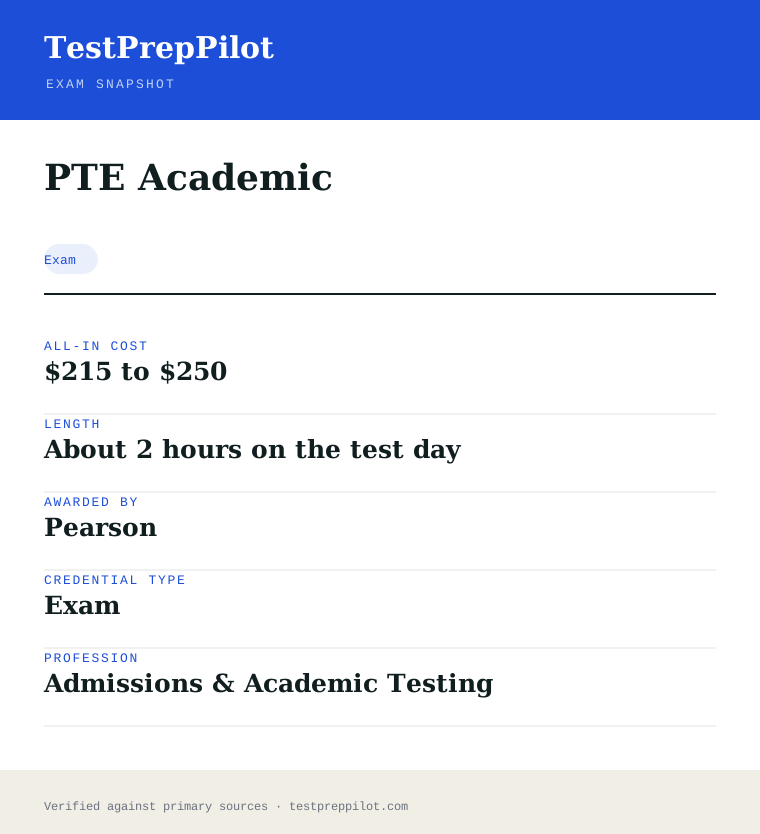
PTE Academic is a exam credential; awarded by Pearson; the exam fee is $215 to $250 (US); varies by country; typical preparation is About 2 hours on the test day; holders typically earn No direct salary outcome (admission/migration gate; 10-90 score).
| Credential | PTE Academic |
|---|---|
| Type | Exam |
| Profession | Admissions & Academic Testing |
| Specialty | English Proficiency |
| Awarded by | Pearson |
| Difficulty | Moderate |
| Typical prep time | About 2 hours on the test day |
| All-in cost | $215 to $250 |
| Typical salary range | No direct salary outcome (admission/migration gate; 10-90 score) |
| Score scale | 10 to 90 overall |
| Results | Typically within 2 days |
| Validity | 2 years |
| Delivery | Centre or at home |
| Scope | National / Multi-state |
| Also known as | Pearson Test of English Academic |
Real questions
Frequently asked questions about the PTE Academic
How fast are PTE Academic results?
Most test takers receive scores within two days because all items are scored by automated engines rather than by human raters.
Is PTE Academic accepted by US universities?
Yes, a large and growing number of US institutions accept PTE Academic for admission, but you should confirm the minimum score on each school admissions page.
How long is the score valid?
PTE Academic scores are valid for two years from the test date, which matches the typical English-test validity used by universities and visa offices.
Can I take it at home?
Yes. PTE Academic is offered at Pearson VUE centres and as an online at-home version with identity verification and proctoring.
Can I book a Pearson ability test directly?
The publisher restricts ability and achievement instruments to qualified purchasers, so families usually arrange administration through a school or licensed psychologist rather than booking on their own.
Is PTE Academic the same as the school ability tests?
No. PTE Academic is an English-proficiency exam that any adult can book individually, while KBIT-2, WISC-V and similar tools are clinically administered assessments.
In short
Is the PTE Academic worth it?
- Two-hour computer-scored English test
- Results usually within two days, score 10 to 90
- Accepted by many US universities and visa programs
Same awarding body
What other credentials does Pearson award?
Worth comparing
How does the PTE Academic compare with similar credentials?
Trust
Where does this information come from?
Everything above is taken from the awarding body's own published material. Fees, question counts and domain weights are revised regularly — check the official page before you pay.
- Pearson Awarding body
- Official PTE Academic exam page Exam page
Research confidence: high · Last reviewed 2026-08