Admissions & Academic Testing • Exam
SSAT Upper Level
The SSAT level for grades eight through eleven, scored 500 to 800 per section and required by most boarding schools.
Researched and maintained by TestPrepPilot Editorial BoardSchool admissions & independent-school testing desk · Figures last verified August 2026
The short version
What is the SSAT Upper Level and is it worth it?
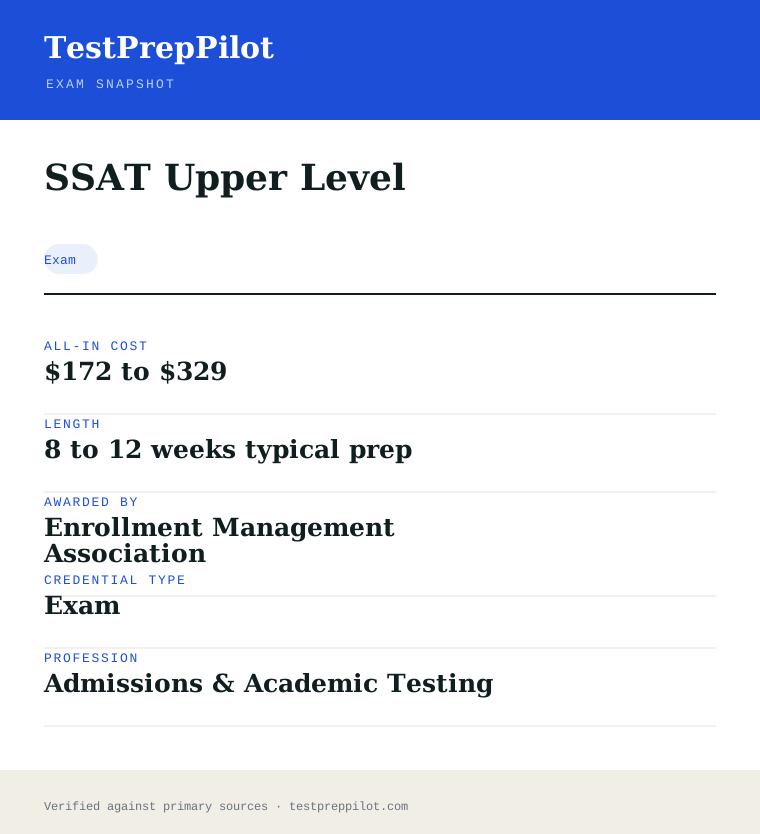
The SSAT Upper Level is for grades 8 to 11 and runs about three hours. It scales 500 to 800 per section and 1500 to 2400 total, penalises wrong answers, and costs about 172 dollars at a US Standard date, 242 at Prometric, 258 at home and 329 internationally. It is the main test for boarding school admission.
- Required by most US boarding schools
- Percentiles benchmark against recent cohorts
- Multiple delivery options including at home
- Writing sample sent to schools
- Up to six Standard dates per year
What is it?
What exactly is the SSAT Upper Level?
The SSAT level for grades eight through eleven, scored 500 to 800 per section and required by most boarding schools.
The SSAT Upper Level is the version of the Secondary School Admission Test for students in grades eight through eleven and is required by most US boarding schools and many day independent schools. It includes an unscored writing sample, two quantitative sections, one reading section and one verbal section plus an experimental section, with a guessing penalty for wrong answers. Scores scale 500 to 800 per section and 1500 to 2400 total, with percentiles based on the past three admission-year cohorts.
The path in brief
- Create the SSAT account
- Pick Upper Level
- Choose Standard, Prometric or at-home
- Use official practice
- Route scores to schools
Before you book
Who is eligible to sit the SSAT Upper Level?
Grades 8-11 applicants
Who it is for: Families of grades 8 to 11 applicants
The test itself
What is the format of the SSAT Upper Level?
The SSAT Upper Level is administered by Enrollment Management Association and runs ~3 hr 5 min.
| Administered by | Enrollment Management Association |
|---|---|
| Questions | ~150 scored + unscored essay |
| Time limit | ~3 hr 5 min |
| Pass mark | No pass mark; 500 to 800 per section |
| Exam fee | ~$135 |
| Format | Multiple-choice plus unscored writing sample |
Content outline
What topics are on the SSAT Upper Level?
The SSAT Upper Level covers 4 content domains.
Weightings come from the official exam outline. Study time is best allocated in roughly these proportions rather than evenly across domains.
- Quantitative (Math)
- Verbal
- Reading
- Writing sample (unscored)
Study materials
Which study guide should you use for the SSAT Upper Level?
Start with the exam sponsor's official content outline. If you also want one structured resource to work through, these are the Mometrix titles that match this exam.

Affiliate links We may earn a commission if you buy through these links, at no extra cost to you. Mometrix has no say in what our exam guides cover. How we make money.
Money & time
How much does the SSAT Upper Level cost?
For the SSAT Upper Level, the exam fee is ~$135; the all-in cost is typically $172 to $329; most candidates spend 8 to 12 weeks typical prep preparing.
Cost breakdown
| US Standard registration | $172 |
|---|---|
| Prometric centre | $242 |
| At Home | $258 |
| International | $329 |
| Typical total | $172 to $329 |
Flex, late and change fees apply; fee waivers are available through member schools.
Timeline
- Study 8 to 12 weeks
- Test About 3 hours
- Scores A few days to weeks
Typical prep: 8 to 12 weeks typical prep
The path
How do you register for the SSAT Upper Level?
- 1
Create an SSAT account10 minutes
Parents open a free SSAT account and add the student, using a name that matches the test-day identification.
- 2
Choose a level and date15 minutes
Select Elementary, Middle or Upper Level and a Standard test date at a school or Prometric centre, or a Flex date by arrangement.
- 3
Pay the registration fee5 minutes
Fees vary by level, location and delivery; a fee waiver is available for eligible families through the member school.
- 4
Add the Character Skills Snapshot5 minutes
Opt in to the Snapshot so the student completes the online questionnaire alongside the SSAT if the schools request it.
- 5
Test and send scorestest day
Sit the exam and route score reports to chosen schools; Snapshot results post to the same account.
The fine print
What are the retake and renewal rules for the SSAT Upper Level?
- Proctoring & delivery
- Standard SSAT administrations are supervised at member schools and authorised Prometric centres; at-home testing uses online proctoring. The Character Skills Snapshot is an unsupervised online questionnaire.
- Retake policy
- Middle and Upper Level may be taken up to six Standard administrations plus one Flex test per testing year; Elementary Level is limited to three administrations per year. The Snapshot may be taken once per testing year.
- Score reporting
- Middle Level scales 440 to 710 per section and 1320 to 2130 total; Upper Level scales 500 to 800 per section and 1500 to 2400 total, with percentiles based on the past three admission-year cohorts.
- Recertification
- SSAT scores are used for the admission cycle and are not renewed; the Snapshot is a single annual read of student preferences and attitudes.
Context
SSAT levels compared
| Level | Grades | Section scale | Total scale | |
|---|---|---|---|---|
| Elementary | 3 to 4 | No scaled total | Raw only | |
| Middle | 5 to 7 | 440 to 710 | 1320 to 2130 | |
| Upper | 8 to 11 | 500 to 800 | 1500 to 2400 |
What it pays
How much does this credential pay?
The SSAT gates independent-school admission: bachelor-degree median weekly earnings were $1,543 in 2024 (BLS)
The SSAT (Secondary School Admission Test) is an admissions test for independent and private schools, and it is used by hundreds of schools across the US and internationally for admission to grades 3-12 (the Upper Level serves grades 8-11 applicants). It is an admissions test, not a job credential, so no BLS SOC code corresponds to a score; the economic case runs through the educational pathway the test helps open. The independent-school pipeline leads to college, and the earnings evidence BLS documents is the same gradient that frames all admissions testing: in 2024, full-time workers age 25 and older with a bachelor degree earned median weekly wages of $1,543, versus $1,109 with an associate degree and $998 with a high-school diploma alone. The honest framing, which the research literature supports, is that the SSAT predicts school performance and admission outcomes within the schools that use it, but the wage payoff belongs to the educational attainment the placements enable, not to the test itself. BLS classifies workers by occupation and education, not test scores, so no SSAT percentile maps to a salary. For families, the practical value is access: schools weigh the SSAT alongside grades, interviews, recommendations and school reports, and a strong score widens admission options at the schools that require it. The SSAT also offers the Character Skills Snapshot (a separate, non-cognitive assessment some schools request) and score-choice options that let families choose which scores to send; the Upper Level scores run 1500-2400 (500-800 per section).
| Measure | Figure | Source / note |
|---|---|---|
| Bachelor-degree median weekly earnings, 2024 | $1,543 | BLS, workers 25+, full time |
| Associate-degree median weekly earnings, 2024 | $1,109 | BLS, workers 25+, full time |
| High-school diploma median weekly earnings, 2024 | $998 | BLS, workers 25+, full time |
| SSAT Upper Level score range | 1500-2400 | EMA/SSAT, 500-800 per section |
Job growth.BLS projects 3 percent overall employment growth from 2024 to 2034; the wage-by-education gradient is the relevant comparison.
Your odds
What are the pass rates?
The SSAT has no pass/fail line; scores run 1500-2400 and each school sets its own expectations
The SSAT organization does not publish a pass rate because there is no passing score. The SSAT Upper Level is scored 1500-2400, with each of three sections (Quantitative, Verbal, Reading) scored 500-800; the total is the sum. Scores are reported with percentiles by grade and gender, and schools use the scores as one input alongside grades, interviews, recommendations and school reports. Because each school weighs the SSAT differently, there is no universal target; families research each school’s typical admitted range and stated policy. The SSAT offers Score Choice, which lets families send only their best scores (or specific sittings), and the "Flex" testing option in addition to the standard testing dates. The test itself runs about 3 hours 5 minutes for the Upper Level: Writing Sample (25 minutes, unscored but sent to schools), Quantitative (2 sections of 25 questions, 30 minutes each), Verbal (60 questions, 30 minutes), Reading (40 questions, 40 minutes), plus a break and an experimental section. The Writing Sample is not scored but is forwarded to schools. The SSAT also reports the Character Skills Snapshot separately when the family opts in, and some schools require it. The honest takeaway: define the target from each school’s admitted range and policy, not from a pass line that does not exist, and use Score Choice to manage which scores schools see.
Read this before quoting the number.No pass rate exists; targets come from each school’s admitted range and weighting.
Your schedule
How long should I study for it?
40-80 hours over 6-12 weeks of focused study
A realistic SSAT Upper Level plan runs 40-80 hours over 6-12 weeks. The test has three scored sections: Quantitative (50 questions across two 30-minute sections, testing arithmetic, elementary algebra, geometry and word problems), Verbal (60 questions in 30 minutes - 30 synonyms and 30 analogies), and Reading (40 questions in 40 minutes across passages). Week 1: take an official SSAT practice test and record the three section scores. Weeks 2-5: build vocabulary - the Verbal section’s synonyms and analogies reward a broad vocabulary, and a systematic word list plus daily reading is the highest-yield investment; most Upper Level candidates need hundreds of words. Weeks 4-7: Quantitative practice, focusing on the question types and on careless-error reduction; the math content is below the level of the school curriculum for many applicants, so accuracy and timing dominate. Weeks 6-9: Reading - practice passage strategies (main idea, inference, vocabulary-in-context) under the 40-minute timing. Weeks 10-12: timed full tests weekly, error review, and test-day logistics. The official SSAT materials (the SSAT.org practice tests and the Official Guide) are the accuracy standard; third-party materials vary in fidelity. Families should also confirm the Character Skills Snapshot requirement at target schools and schedule the SSAT sitting with enough lead time for the application deadlines (fall/winter sittings for spring application cycles).
- Week 16
Baseline
- Official SSAT practice test
- Section scores and error log
- Weeks 2-530
Verbal and vocabulary
- Systematic word list
- Synonym and analogy drills, daily reading
- Weeks 4-724
Quantitative
- Question-type drills
- Accuracy and timing
- Weeks 6-916
Reading
- Passage strategies
- Timed passage sets
- Weeks 10-1218
Full timed tests
- Weekly full tests
- Error review and logistics
Adjusting the pace
Grade-specific percentiles.Percentiles are reported by grade and gender; compare against the target school’s admitted range for your grade.
Character Skills Snapshot.Some schools request the separate non-cognitive Snapshot; confirm the requirement before registering.
How to study
How do I prepare most effectively?
The most effective SSAT strategies target the Verbal section’s vocabulary load and the test’s timing. Strategy one: build vocabulary systematically - the Verbal section rewards word knowledge more than any other single factor, and a structured word list plus daily reading is the highest-return preparation; synonyms and analogies both depend on it. Strategy two: learn the analogy logic - the SSAT analogies test specific relationships (synonym, antonym, part-whole, cause-effect), and practicing the relationship types converts vocabulary into scores. Strategy three: practice the Quantitative sections under the two 30-minute blocks, because the content is often below the applicant’s current math class and the real challenge is accuracy under time; careless errors are the main score leak. Strategy four: use official SSAT materials for practice tests - the official practice tests and Official Guide match the format and scoring, while third-party materials vary in fidelity and can mislead on the Writing Sample’s role. Strategy five: use Score Choice strategically - families can choose which sittings to send, so planning two sittings and sending the best reduces stress and risk. Strategy six: manage the day itself - the test runs over three hours with an unscored Writing Sample and experimental section, so stamina and a rested morning matter; the Writing Sample is sent to schools even though unscored, so it should be taken seriously.
Build vocabulary daily
The Verbal section rewards word knowledge above all else.
Learn analogy relationships
Synonym, antonym, part-whole, cause-effect types.
Practice Quant under timing
The content is often below the curriculum; accuracy under time is the test.
Use official practice tests
Only official materials match the format and scoring.
Plan Score Choice
Two sittings with the best score sent reduces risk.
What to buy
Which study resources are worth paying for?
The SSAT resource market is anchored by the official SSAT.org materials, which are the accuracy standard. The official SSAT practice tests (available on ssat.org, including a free practice test and paid practice packs around $20-50) and the Official Guide to the SSAT (about $25-40) match the format and scoring; using them is the recommended baseline. The free official resources include a practice test and format information. Commercial SSAT prep books ($15-$40) and courses ($200-$2,000) provide structure and practice volume; the major publishers’ books are serviceable, and courses are most defensible for students needing pacing or vocabulary accountability. Tutoring ($60-$200/hour) is common in competitive markets where families target specific schools. The Character Skills Snapshot requires no preparation (it is a non-cognitive measure). The honest ranking: official practice tests and Official Guide first, a commercial book for volume, and courses or tutoring only when structure or specific gaps justify the cost. Prices here are current as of the 2025-26 admission cycle and change annually.
| Resource | Price | Format | Best for |
|---|---|---|---|
| Official SSAT practice tests | Free test; paid packs $20-$50 | Online | Format and scoring fidelity |
| Official Guide to the SSAT | $25-$40 | Print/ebook | Structure and strategy |
| Commercial prep book | $15-$40 | Practice volume | |
| Course or tutor | $200-$2,000 | Live/online/1:1 | Structure and targeted gaps |
Prices dated 2025-26; ssat.org official materials are the accuracy standard. No commission-based ranking.
Avoid these
What mistakes do candidates most often make?
The most common SSAT mistakes come from vocabulary gaps and timing miscalculation. Mistake one: neglecting the Verbal section’s vocabulary load; candidates who focus on math while ignoring synonyms and analogies lose the most trainable points, because vocabulary builds slowly and must start early. Mistake two: guessing wildly on analogies; learning the relationship types converts blind guessing into educated elimination. Mistake three: practicing quantitative without the two-30-minute-block timing; the SSAT’s math content is often below the applicant’s grade level, so the real failure mode is careless errors under time pressure, not missing concepts. Mistake four: ignoring the Writing Sample because it is unscored; it is sent to schools, and a careless sample undermines an otherwise strong application. Mistake five: using third-party practice tests that misrepresent the format; the score can be misleading and wastes preparation. Mistake six: forgetting the Character Skills Snapshot and the school-specific requirements; some schools require the Snapshot or a specific testing window, and missing them complicates the application. Finally, families should plan the testing timeline around application deadlines - fall and winter sittings for spring cycles - because late scores narrow options.
✕Neglecting vocabulary
✓Start the word list early; it builds slowly.
✕Guessing on analogies
✓Learn the relationship types for educated elimination.
✕Practicing Quant untimed
✓Train the two 30-minute blocks for accuracy under time.
✕Ignoring the Writing Sample
✓It is unscored but sent to every school.
✕Misplanning the timeline
✓Sit early enough for application deadlines.
What you'll face
What question types will I see?
The SSAT Upper Level has three scored sections: Quantitative (50 questions in two 30-minute sections - arithmetic, elementary algebra, geometry, word problems), Verbal (60 questions in 30 minutes - 30 synonyms and 30 analogies), and Reading (40 questions in 40 minutes across prose and poetry passages). The total scores 1500-2400 (500-800 per section), plus an unscored Writing Sample (25 minutes, sent to schools) and an experimental section. Scores are reported with grade- and gender-based percentiles. Samples below are editor-written illustrations of the published test specifications, not live exam items.
Arithmetic, elementary algebra, geometry, word problems.
30 synonyms and 30 analogies.
Prose and poetry passages.
One prompt, sent to schools.
Try these
Q1Synonym: Which word is closest in meaning to "abundant"?
Answer:B
"Abundant" means existing in large quantities; "plentiful" is the closest match, while "scarce" is the antonym.
Q2Analogy: "Brush is to painting as chisel is to ______."
Answer:A
A brush is a tool used in painting as a chisel is a tool used in sculpture; the relationship is tool-to-activity.
Q3Quantitative: If 3x + 4 = 19, what is the value of x?
Answer:B
Subtract 4 from both sides: 3x = 15; divide by 3: x = 5.
Samples are editor-written illustrations of the published test specifications, not live exam items.
The big day
What should I expect on exam day?
The SSAT Upper Level is administered on standard national testing dates (typically eight per year, fall through spring) at approved test centers, plus Flex testing arranged by schools on alternative dates. On the day, students check in with an admission ticket and a valid photo ID; the test is paper-based, so bring sharpened No. 2 pencils. The total testing time is about 3 hours 5 minutes for the scored sections plus the Writing Sample and break, so plan for a full morning. Phones, smartwatches and calculators are not permitted (no calculator use on the SSAT). Students with documented disabilities apply for accommodations through the SSAT organization in advance. Scores post online about two weeks after the test, and Score Choice lets families choose which sittings to send to schools. Afterwards, send the score and the Writing Sample to target schools before deadlines, verify each school’s weighting and any Character Skills Snapshot requirement, and plan any retake around the school’s superscore or score-choice policy.
Bring
- Admission ticket
- Valid photo ID
- Sharpened No. 2 pencils
- A rested morning
Leave at home
- Phone, smartwatch, and personal electronics
- Calculator (not permitted on the SSAT)
- Notes or study materials
How the day runs
Rules in the room
- The SSAT is paper-based; fill in bubbles with No. 2 pencils.
- Calculators are not permitted.
- Personal electronics are not permitted in the testing room.
- Accommodations must be pre-approved through the SSAT organization.
Afterwards.Send scores and the Writing Sample before deadlines, verify each school’s weighting and Snapshot requirement, and plan any retake with Score Choice.
Reference
What are the key facts about the SSAT Upper Level?
SSAT Upper Level is a exam credential; awarded by Enrollment Management Association; the exam fee is ~$135; typical preparation is 8 to 12 weeks typical prep; holders typically earn Independent-school path; no direct wage mapping.
| Credential | SSAT Upper Level |
|---|---|
| Type | Exam |
| Profession | Admissions & Academic Testing |
| Specialty | K-12 Private School Admissions |
| Awarded by | Enrollment Management Association |
| Difficulty | Challenging |
| Typical prep time | 8 to 12 weeks typical prep |
| All-in cost | $172 to $329 |
| Typical salary range | Independent-school path; no direct wage mapping |
| Grades | 8 to 11 |
| Scoring | 500 to 800 per section, 1500 to 2400 total |
| Penalty | Wrong answers are penalised |
| Retake | Up to 6 Standard plus 1 Flex per year |
| Scope | National / Multi-state |
Real questions
Frequently asked questions about the SSAT Upper Level
How many times can my child take the Upper Level SSAT?
Upper Level students may take up to six Standard administrations and one Flex test per testing year.
Is there a guessing penalty?
Yes. Wrong answers are penalised on the Upper and Middle Levels, so strategic guessing matters more than on the Elementary Level.
What score do boarding schools want?
There is no passing score - schools weigh the SSAT with grades, interviews and recommendations, and Score Choice lets you send only your best sittings.
Can my child take it at home?
Yes. The Upper Level is offered at schools, Prometric centres and as an online at-home version with proctoring.
How many times can my child take the SSAT?
Middle and Upper Level students may sit up to six Standard and one Flex test per year; Elementary Level students may take the test up to three times per year.
What is the Character Skills Snapshot?
It is an online questionnaire that complements the SSAT by reporting a student preferences, attitudes and beliefs to participating admission teams; it is not a right-or-wrong test.
In short
Is the SSAT Upper Level worth it?
- SSAT for grades 8 to 11, about three hours
- Scaled 500 to 800 per section, 1500 to 2400 total
- Main test for US boarding school admission
Trust
Where does this information come from?
Everything above is taken from the awarding body's own published material. Fees, question counts and domain weights are revised regularly — check the official page before you pay.
- Enrollment Management Association Awarding body
Research confidence: high · Last reviewed 2026-08