Admissions & Academic Testing • Exam
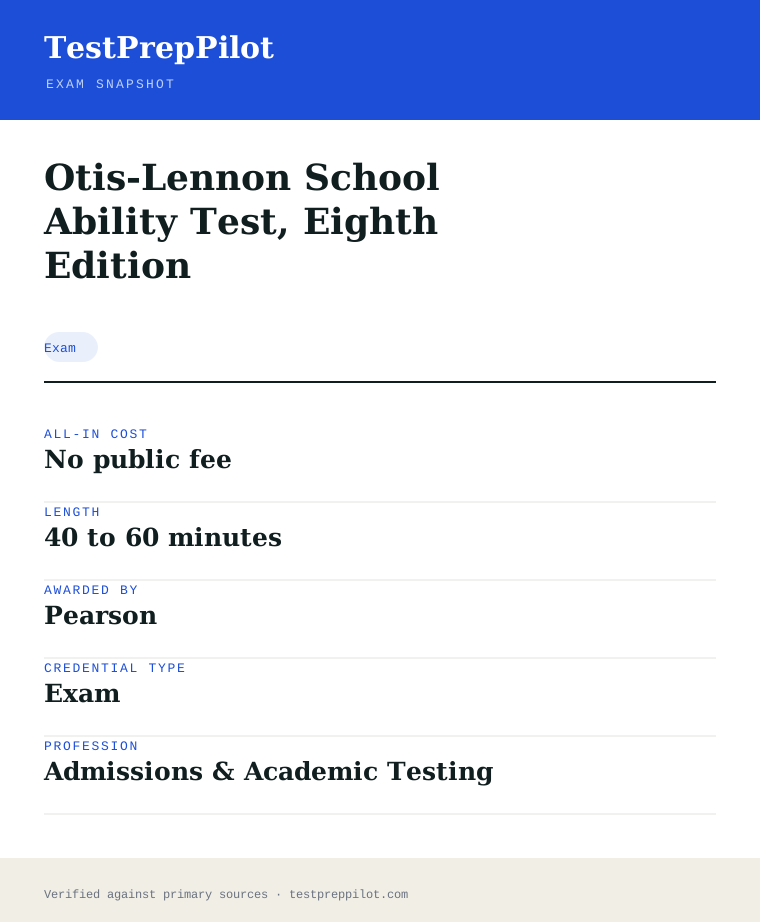
Otis-Lennon School Ability Test, Eighth Edition
A group-administered school ability test for verbal and nonverbal reasoning used in gifted admissions.
Researched and maintained by TestPrepPilot Editorial BoardSchool admissions & gifted-education testing desk · Figures last verified August 2026
The short version
What is the Otis-Lennon School Ability Test, Eighth Edition and is it worth it?
The OLSAT 8 is a group-administered school ability test covering verbal and nonverbal reasoning for students in kindergarten through grade 12. Schools use it for gifted identification and some private-school admission, it takes about 40 to 60 minutes, and it reports a School Ability Index with percentiles rather than a pass mark.
- Group administration keeps school testing efficient
- Measures reasoning, not just achievement
- Commonly accepted for gifted identification
- Reports a School Ability Index and percentiles
- Spans kindergarten through grade 12
What is it?
What exactly is the Otis-Lennon School Ability Test, Eighth Edition?
A group-administered school ability test for verbal and nonverbal reasoning used in gifted admissions.
The Otis-Lennon School Ability Test, Eighth Edition (OLSAT 8) is a group-administered measure of verbal and nonverbal reasoning given by schools from kindergarten through grade 12. Large districts use it for gifted and talented identification and some private schools review it for admission. It estimates a student general reasoning ability relative to age peers through a School Ability Index rather than measuring achievement or learned content, which makes it a common companion to achievement batteries.
The path in brief
- Confirm the school requires OLSAT 8
- Note the testing window
- Review sample item types
- School administers the test
- Receive the ability report
Before you book
Who is eligible to sit the Otis-Lennon School Ability Test, Eighth Edition?
Grade-level school administration
Who it is for: K-12 students screened for gifted or admission
The test itself
What is the format of the Otis-Lennon School Ability Test, Eighth Edition?
The Otis-Lennon School Ability Test, Eighth Edition is administered by Pearson; given by schools and runs ~60-75 min.
| Administered by | Pearson; given by schools |
|---|---|
| Questions | Verbal and nonverbal sections |
| Time limit | ~60-75 min |
| Pass mark | No pass mark; School Ability Index mean 100, SD 16 |
| Exam fee | District-paid |
| Format | Group-administered, multiple-choice |
Content outline
What topics are on the Otis-Lennon School Ability Test, Eighth Edition?
The Otis-Lennon School Ability Test, Eighth Edition covers 5 content domains.
Weightings come from the official exam outline. Study time is best allocated in roughly these proportions rather than evenly across domains.
- Verbal comprehension
- Verbal reasoning
- Pictorial reasoning
- Figural reasoning
- Quantitative reasoning
Money & time
How much does the Otis-Lennon School Ability Test, Eighth Edition cost?
For the Otis-Lennon School Ability Test, Eighth Edition, the exam fee is District-paid; the all-in cost is typically No public fee; most candidates spend 40 to 60 minutes preparing.
Cost breakdown
| Administered by the school | No public fee |
|---|---|
| Typical total | No public fee |
Schools license OLSAT 8; families are not billed by Pearson for the administration.
Timeline
- School administers 40 to 60 minutes
- Scoring Automated
- Report To family per school
Typical prep: 40 to 60 minutes
The path
How do you register for the Otis-Lennon School Ability Test, Eighth Edition?
- 1
Confirm the assessment your school requiresper school
Ask the admissions or gifted office which Pearson instrument it accepts, since ability and achievement tests differ by age and purpose.
- 2
Locate a qualified administratorvaries
For KBIT-2, WISC-V, WPPSI-IV and similar tools, book a licensed psychologist or school psychologist; schools usually handle NNAT3, OLSAT and Stanford 10 directly.
- 3
Schedule the administrationvaries
Book a testing appointment or wait for the school testing window; PTE Academic is booked through the test taker Pearson account.
- 4
Prepare as advisedvaries
Ability tests need little study; PTE Academic benefits from the official scored practice test and sample questions.
- 5
Receive the reportafter testing
The examiner or school issues a written report with standard scores and percentiles that you submit to the admissions office.
The fine print
What are the retake and renewal rules for the Otis-Lennon School Ability Test, Eighth Edition?
- Proctoring & delivery
- Ability and achievement instruments are administered by qualified examiners or school staff under standard conditions; PTE Academic is taken at a Pearson VUE centre or at home with online proctoring.
- Retake policy
- Most ability and achievement tests are given once per admissions cycle and retaken only if the school permits a later administration. PTE Academic may be retaken with no fixed lifetime limit, subject to a short waiting period between attempts.
- Score reporting
- Scores are reported as standard scores, indexes or scales with age- or grade-based percentiles depending on the instrument; PTE Academic uses a 10 to 90 overall scale.
- Recertification
- These are diagnostic or admissions assessments rather than certifications, so there is no recertification; scores reflect performance on the test date.
Context
Selected Pearson admissions and ability tests
| Test | Used for | Length | Score | |
|---|---|---|---|---|
| KBIT-2 | Brief ability screen | 15 to 30 min | Standard score 100 | |
| WISC-V | Full IQ evaluation | 45 to 65 min | FSIQ 100 | |
| PTE Academic | English proficiency | 2 hours | 10 to 90 |
What it pays
How much does this credential pay?
OLSAT-8 gates access to gifted programs and selective schools: bachelor-degree median weekly earnings were $1,543 in 2024 (BLS)
The OLSAT-8 (Otis-Lennon School Ability Test, Eighth Edition) is a group-administered ability test used by school districts for gifted-and-talented program placement and by some private and magnet schools for admissions; it measures verbal and nonverbal reasoning rather than achievement. It is not a job credential, so no BLS SOC code corresponds to a score. The economic case runs through the educational pathways the test can open: gifted programs, accelerated coursework, and selective school admissions are access points to the academic pipeline whose outcomes BLS documents - in 2024, full-time workers age 25 and older with a bachelor degree earned median weekly wages of $1,543, versus $1,109 with an associate degree and $998 with a high-school diploma alone. The honest framing, which the research literature supports, is that OLSAT scores predict school performance and placement outcomes within the programs that use them, but the wage payoff belongs to the educational attainment the placements enable, not to the test itself. BLS classifies workers by occupation and education, not test scores, so no OLSAT percentile maps to a salary. For families, the practical value of the test is access: districts use a score threshold (often the 90th or 95th percentile on a composite) for gifted-program eligibility, and private schools use it alongside achievement tests for admission decisions, so a strong score widens options, while the long-term earnings evidence runs through the schooling those options provide. The test also has a diagnostic role: the verbal/nonverbal split identifies reasoning strengths and weaknesses that schools use to tailor instruction.
| Measure | Figure | Source / note |
|---|---|---|
| Bachelor-degree median weekly earnings, 2024 | $1,543 | BLS, workers 25+, full time |
| Associate-degree median weekly earnings, 2024 | $1,109 | BLS, workers 25+, full time |
| High-school diploma median weekly earnings, 2024 | $998 | BLS, workers 25+, full time |
| Typical OLSAT-8 eligibility threshold | ~90th-95th percentile | Set by each school district; varies widely |
Job growth.BLS projects 3 percent overall employment growth from 2024 to 2034; the wage-by-education gradient is the relevant comparison.
Your odds
What are the pass rates?
OLSAT-8 is not pass/fail; districts set gifted-placement thresholds, commonly around the 90th percentile
The OLSAT-8 publisher (Pearson) does not publish a pass rate, and there is no universal passing score because the test is a norm-referenced ability measure. Scores are reported as a School Ability Index (SAI) with a mean of 100 and standard deviation of 16, plus percentile ranks by age group; the percentile, not the raw score, is what districts use. Gifted-and-talented eligibility thresholds are set by each district and vary widely - many use the 90th percentile on the composite or a specific subtest, some require the 95th or 97th, and others use a multi-measure system combining the OLSAT with achievement tests, teacher ratings and portfolios. Because the test is normed on a national age cohort, roughly 10 percent of students score at or above the 90th percentile, so the "pass rate" for gifted placement is definitionally about 10 percent or less wherever the 90th percentile threshold applies - but that is a property of the norming, not a test result. The OLSAT-8 is group-administered in schools (also individually when needed) with verbal and nonverbal items read aloud for the earliest grades, and the publisher recommends testing within a specific grade-level window. The honest summary for families is to ask the district for the exact eligibility criteria before the test, because the threshold and the weighting of the OLSAT within the overall placement process are the numbers that actually determine the outcome, and those vary by district and by program.
Read this before quoting the number.No pass rate exists; gifted thresholds are set by each district, commonly the 90th-95th percentile, and often combined with other measures.
Your schedule
How long should I study for it?
5-10 hours of light format practice over 3-4 weeks of focused study
The OLSAT-8 measures reasoning ability, and preparation is a contested topic: most districts advise against test prep, while many families use light familiarity practice. The defensible middle ground is a light plan (5-10 hours) focused on format familiarity, because the test is untimed in the sense of being pace-tolerant and the items are unusual (analogies, classification, figural reasoning) compared with classroom work. The test has a Verbal section (verbal comprehension and verbal reasoning - following directions, antonyms, sentence completion, sentence arrangement, verbal classification, analogies) and a Nonverbal section (pictorial and figural reasoning - pictorial classification, pictorial analogies, figural classification, figural analogies, pattern matrices, figural series), with the mix varying by grade level. A sensible plan: week 1, obtain the publisher’s sample questions (free samples are published) and the district’s eligibility criteria, and complete one short practice set; weeks 2-3, practice the item types the student finds hardest, especially the figural reasoning formats, which are unlike schoolwork; week 4, one timed practice session under the district’s reported format, then rest. Families should resist intensive drilling: the test’s purpose is measuring reasoning, over-preparation distorts the placement decision, and districts using multi-measure systems weight classroom achievement and teacher ratings heavily. The highest-return preparation is actually developmental - reading with children, puzzles, and reasoning-rich conversation - which builds the underlying abilities the test samples.
- Week 12
Format and criteria
- Publisher sample questions
- District eligibility criteria
- Weeks 2-35
Hardest item types
- Figural reasoning practice
- Verbal analogy and classification
- Week 43
Timed session and rest
- One timed practice session
- Rest before the test
Adjusting the pace
District policy on prep.Some districts discourage or prohibit test preparation; check the district’s guidance before practicing.
Multi-measure systems.Many districts combine the OLSAT with achievement tests, teacher ratings and portfolios; the OLSAT is one input.
How to study
How do I prepare most effectively?
The most effective OLSAT strategies are about format familiarity and developmental support rather than cramming. Strategy one: learn the item types before the test, because the figural reasoning formats (pattern matrices, figural series, figural analogies) are unlike anything in classroom work, and format confusion measurably depresses scores; the publisher’s free samples cover the types. Strategy two: verify the district’s exact eligibility rules - the percentile threshold, which subscores count (some programs use the nonverbal score alone), and how the OLSAT is weighted against achievement tests and teacher ratings - because the preparation target follows the rule. Strategy three: check whether the district discourages prep; some districts explicitly advise against it, and honoring that guidance respects the placement process. Strategy four: build the underlying abilities developmentally - reading daily, verbal puzzles, analogies in conversation, pattern and sequence games - because the test samples reasoning developed over years, and this is the only preparation with real long-term value. Strategy five: manage the test-day environment - good sleep, a calm morning, and a clear explanation to the child that the test is not graded like schoolwork - because young students’ performance is environment-sensitive. Strategy six: for private-school admissions use, ask the school which score they look at (composite vs verbal/nonverbal) and whether the OLSAT is one of several measures, and keep the practice proportionate to the stakes.
Learn the item types
Figural reasoning formats are unlike schoolwork; know them before the test.
Check the district’s rule
Threshold, subscore use, and weighting vary by district.
Respect prep guidance
Some districts discourage or prohibit prep; follow their policy.
Build abilities developmentally
Reading, puzzles and reasoning-rich conversation have real value.
What to buy
Which study resources are worth paying for?
The OLSAT-8 resource market is smaller and more restrained than the achievement-test market, and much of it sits in a gray zone. The official and appropriate resources are the publisher’s free sample questions and the district’s guidance materials, which are free and sufficient for format familiarity; Pearson publishes a brief OLSAT-8 brochure with sample items, and districts usually provide an information packet. Commercial "OLSAT prep" books and apps ($10-$40) exist and teach the item types, and some families use them for format practice; the honest caution is that intensive commercial prep for an ability test is both of questionable value (the test measures developed reasoning) and discouraged by many districts, and the returns are concentrated in format familiarity, which the free samples already provide. Full test-prep courses ($100-$1,000) for the OLSAT are overkill for most families. The most valuable "resource" is developmental: daily reading, puzzles and reasoning-rich activities that cost nothing. The honest ranking: free publisher samples and district materials, optionally a low-cost book for item-type practice, and nothing more. Prices here are current as of 2025-26 and change annually.
| Resource | Price | Format | Best for |
|---|---|---|---|
| Publisher sample questions | Free | Item-type familiarity | |
| District guidance packet | Free | School materials | Eligibility rules and format |
| Commercial prep book/app | $10-$40 | Print/mobile | Extra item-type practice (optional) |
| Full prep course | $100-$1,000 | Live/online | Overkill for most families |
| Developmental activities | Free | Home | Reading, puzzles, reasoning-rich conversation |
Prices dated 2025-26; official samples and district guidance are sufficient for most families. No commission-based ranking.
Avoid these
What mistakes do candidates most often make?
The most common OLSAT-related mistakes are about expectations and preparation. Mistake one: intensive cramming for an ability test; the OLSAT measures developed reasoning, and heavy drilling both distorts the placement decision and often violates district guidance, while the returns are confined to format familiarity. Mistake two: not learning the item types at all - the opposite failure; a capable student who has never seen figural analogies or pattern matrices can score below their true ability, so at least the free samples are worth doing. Mistake three: focusing on the wrong score; families often chase the composite when the district’s gifted program uses a subscore (some programs weigh the nonverbal score heavily), so the eligibility rule should drive the preparation target. Mistake four: ignoring the multi-measure context; many districts combine the OLSAT with achievement tests and teacher ratings, and a single strong or weak OLSAT score is not the whole decision. Mistake five: treating a lower-than-expected score as a verdict on the child; the test samples one narrow band of reasoning at one point in time, and districts frequently allow appeals or re-testing under specific conditions. Mistake six: testing a tired or anxious child; young students’ performance is environment-sensitive, and a rushed morning can depress a score that shapes placement. Finally, families should ask the district directly what the score will and will not be used for, because assumptions about the test’s role are the most common source of disappointment.
✕Intensive cramming
✓Light format practice; the test measures developed reasoning.
✕Seeing item types cold
✓Review the free samples; figural formats are unfamiliar.
✕Chasing the wrong score
✓Follow the district’s threshold and subscore rule.
✕Ignoring multi-measure systems
✓The OLSAT is often one input among several.
✕Testing a tired child
✓Sleep, calm morning, low-stress framing.
What you'll face
What question types will I see?
The OLSAT-8 has two sections. Verbal: verbal comprehension (following directions, antonyms, sentence completion, sentence arrangement) and verbal reasoning (verbal classification, verbal analogies). Nonverbal: pictorial reasoning (pictorial classification, pictorial analogies) and figural reasoning (figural classification, figural analogies, pattern matrices, figural series). The item mix varies by level; the earliest levels have read-aloud items. Results are reported as a School Ability Index (SAI, mean 100, SD 16) and percentile ranks by age. Samples below are editor-written illustrations of the published item formats, not live exam items.
Following directions, antonyms, sentence completion.
Verbal classification and analogies.
Pictorial classification and analogies.
Figural classification, analogies, matrices, series.
Try these
Q1Verbal analogy: "Hand is to glove as foot is to ______."
Answer:B
A glove covers a hand as a shoe covers a foot; the analogy tests the relationship of covering, with "sock" a close distractor that also covers but is typically worn beneath.
Q2Figural series: The pattern shows a circle, square, circle, square, ______. Which figure comes next?
Answer:A
The series alternates circle and square; after square, the next figure is a circle.
Q3Following directions: "Look at the row of animals: cat, dog, bird. Put a mark on the animal that flies."
Answer:C
The instruction asks for the animal that flies; the bird is the only one, and the item tests careful following of directions.
Samples are editor-written illustrations of the published item formats, not live exam items.
The big day
What should I expect on exam day?
The OLSAT-8 is group-administered at the student’s school on a date the district schedules, typically during the school day, with the earliest levels using read-aloud items. There is no individual registration fee and no private testing in most districts (private schools arrange their own administrations). Parents should ensure the student is well-rested, has eaten, and understands that the test is not graded like schoolwork; the school handles materials, timing and instructions. The publisher recommends a specific testing window by grade level, and the administration typically takes under an hour for the OLSAT itself (total testing time varies by level). Results are returned to the school, which shares them with parents and applies them to the district’s eligibility process; timing varies by district but is commonly within several weeks. Afterwards, families should ask the school to explain the score report (SAI, percentiles, verbal/nonverbal split), confirm how the district uses the result, and - if the outcome is disappointing - ask about the district’s appeal or re-testing policy before assuming the result is final.
Bring
- A well-rested, fed student
- A calm morning and low-stress framing
- Any district-required forms already submitted
Leave at home
- Test-day cramming - the test measures developed reasoning
- Anxiety-inducing framing - treat it like a normal school activity
- Assumptions about the score’s role - ask the district
How the day runs
Rules in the room
- The test is group-administered at school; no individual registration fee.
- Earliest levels use read-aloud items.
- Districts set eligibility thresholds and often combine measures.
- Appeal and re-testing policies vary by district; ask directly.
Afterwards.Review the score report with the school, confirm how the district uses the result, and ask about appeal or re-testing options if the outcome disappoints.
Reference
What are the key facts about the Otis-Lennon School Ability Test, Eighth Edition?
Otis-Lennon School Ability Test, Eighth Edition is a exam credential; awarded by Pearson; the exam fee is District-paid; typical preparation is 40 to 60 minutes; holders typically earn Gifted-placement path; no direct wage mapping.
| Credential | Otis-Lennon School Ability Test, Eighth Edition |
|---|---|
| Abbreviation | OLSAT 8 |
| Type | Exam |
| Profession | Admissions & Academic Testing |
| Specialty | K-12 Private School Admissions |
| Awarded by | Pearson |
| Difficulty | Moderate |
| Typical prep time | 40 to 60 minutes |
| All-in cost | No public fee |
| Typical salary range | Gifted-placement path; no direct wage mapping |
| Levels | A through G (K to grade 12) |
| Scoring | School Ability Index, percentiles |
| Use | Gifted identification, some admissions |
| Administration | Group, by schools |
| Scope | National / Multi-state |
Real questions
Frequently asked questions about the Otis-Lennon School Ability Test, Eighth Edition
Can I register my child for the OLSAT 8?
No. The OLSAT 8 is administered by schools during a testing window, and families do not pay a separate registration fee to Pearson.
Is there a passing score?
No. It reports a School Ability Index and percentile; the school sets any gifted or admission cutoff.
How is it different from the NNAT3?
The OLSAT-8 is a norm-referenced ability test - gifted thresholds are set by each district, commonly the 90th-95th percentile, and often combined with other measures.
Should my child study for it?
Reasoning tests are not knowledge tests, but a short look at sample questions can reduce anxiety on the test day.
Can I book a Pearson ability test directly?
The publisher restricts ability and achievement instruments to qualified purchasers, so families usually arrange administration through a school or licensed psychologist rather than booking on their own.
Is PTE Academic the same as the school ability tests?
No. PTE Academic is an English-proficiency exam that any adult can book individually, while KBIT-2, WISC-V and similar tools are clinically administered assessments.
In short
Is the Otis-Lennon School Ability Test, Eighth Edition worth it?
- Group ability test of verbal and nonverbal reasoning
- Used for K-12 gifted identification and some admissions
- Reports a School Ability Index with percentiles
Same awarding body
What other credentials does Pearson award?
Trust
Where does this information come from?
Everything above is taken from the awarding body's own published material. Fees, question counts and domain weights are revised regularly — check the official page before you pay.
- Pearson Awarding body
Research confidence: high · Last reviewed 2026-08