Admissions & Academic Testing • Exam
PreACT 8/9
PreACT 8/9 is the ACT Inc. practice test for grades 8 and 9, scored on the same 1 to 36 style scale with a career-interest inventory; schools order it.
Researched and maintained by TestPrepPilot Editorial BoardCollege admissions & standardized-testing desk · Figures last verified August 2026
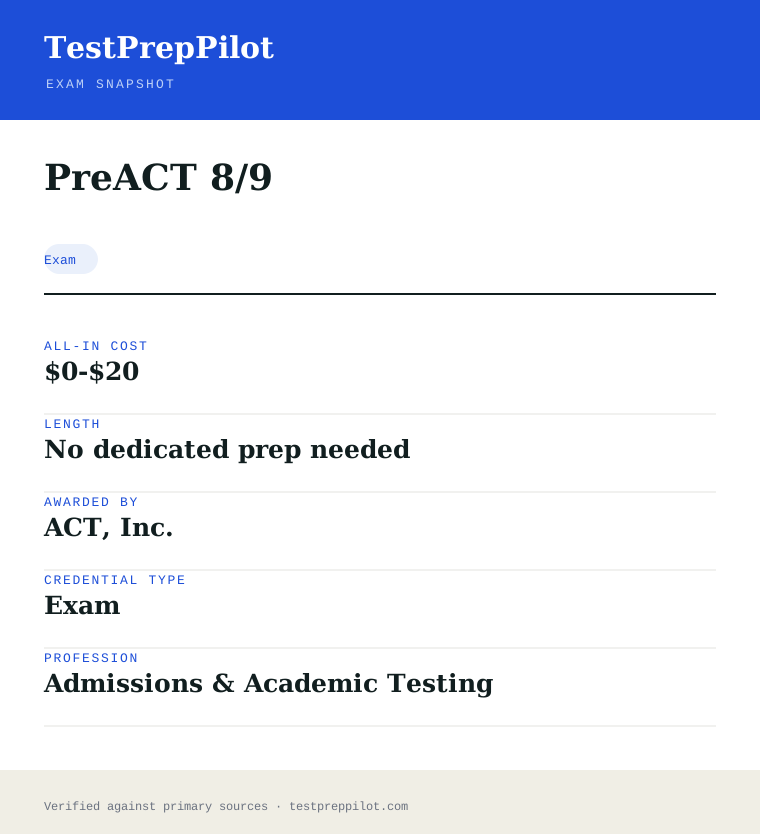
The short version
What is the PreACT 8/9 and is it worth it?
PreACT 8/9 is the ACT Inc. practice test for eighth and ninth graders, scored on the same 1 to 36 style scale with predicted ACT results and a career-interest inventory; schools order it and students register through their counselor.
- Establishes a college-readiness baseline as early as grade 8
- Mirrors the ACT subject areas so the path to the real test is clear
- Includes a career-interest inventory tied to scores
- Low school cost with fee waivers available
What is it?
What exactly is the PreACT 8/9?
PreACT 8/9 is the ACT Inc. practice test for grades 8 and 9, scored on the same 1 to 36 style scale with a career-interest inventory; schools order it.
PreACT 8/9 is the ACT Inc. baseline assessment for eighth and ninth graders. It uses the same four subject areas and the same 1 to 36 reporting style as PreACT and the ACT, but with content pitched to earlier coursework so younger students get a developmentally appropriate prediction of their future ACT score. Schools administer it once a year, usually in the spring, and the report helps counselors and families spot strengths and gaps before high-school testing begins in earnest. Like PreACT, it is school-ordered and not available for individual weekend registration.
The path in brief
- School orders PreACT 8/9 for the spring
- Student tests during a class-period block
- Receive a predicted ACT score and interest profile
- Next step: PreACT in grade 10
Before you book
Who is eligible to sit the PreACT 8/9?
8th-9th graders (school administration)
Who it is for: Eighth and ninth graders establishing an early baseline
The test itself
What is the format of the PreACT 8/9?
The PreACT 8/9 is administered by ACT, Inc. and runs ~2 hours.
| Administered by | ACT, Inc. |
|---|---|
| Questions | Shortened ACT-style sections |
| Time limit | ~2 hours |
| Pass mark | No pass mark; 1 to 36 predicted ACT style scale |
| Exam fee | ~$15 |
| Format | Paper, multiple choice plus interest inventory |
Content outline
What topics are on the PreACT 8/9?
The PreACT 8/9 is weighted across 4 domains; the largest are English (25%), Mathematics (25%), Reading (25%).
Weightings come from the official exam outline. Study time is best allocated in roughly these proportions rather than evenly across domains.
- English 25%
Foundational grammar and rhetoric for early high school.
- Mathematics 25%
Pre-algebra, algebra and geometry appropriate to grades 8-9.
- Reading 25%
Short passages with comprehension questions.
- Science 25%
Introductory data and research-summary reasoning.
Study materials
Which study guide should you use for the PreACT 8/9?
Start with the exam sponsor's official content outline. If you also want one structured resource to work through, these are the Mometrix titles that match this exam.

Affiliate links We may earn a commission if you buy through these links, at no extra cost to you. Mometrix has no say in what our exam guides cover. How we make money.
Money & time
How much does the PreACT 8/9 cost?
For the PreACT 8/9, the exam fee is ~$15; the all-in cost is typically $0-$20; most candidates spend No dedicated prep needed preparing.
Cost breakdown
| PreACT 8/9 list price to schools, 2025-26 | $20 |
|---|---|
| Official ACT prep resources | Free |
| Typical total | $0-$20 to the student |
State and district contracts sometimes cover the cost entirely.
Timeline
- School testing window spring of grade 8 or 9
- Predicted score report a few weeks later
- Next step: PreACT in grade 10 the following year
Typical prep: No dedicated prep needed
The path
How do you register for the PreACT 8/9?
- 1
Create a MyACT account10 minutes
Set up a free account at my.act.org using your legal name as printed on the photo ID you will present at the test centre.
- 2
Pick a national test date and format15 minutes
Choose one of the national Saturday dates and decide whether to test online or on paper at the centre. Both formats deliver the same enhanced ACT.
- 3
Decide on the science and writing add-ons10 minutes
The core English, math and reading test is 70 dollars. Science adds 5 dollars and writing adds 25 dollars; both can be added or removed up to the late deadline. Check whether your target colleges require a science score before deciding.
You cannot suppress a section score after the fact; if you sit science, colleges will see it.
- 4
Upload a photo and get your ticket10 minutes
MyACT requires a recognisable head-and-shoulders photo that is printed on your admission ticket. Registrations without a valid photo can be cancelled.
- 5
Prepare with free official practice6 to 12 weeks
ACT publishes free full-length practice tests, a scoring key and the TestNav online practice platform so you can rehearse the enhanced question counts and timings.
- 6
Test and collect scorestest day
Multiple-choice scores typically post to MyACT about two weeks after the test date, with writing following a little later.
The fine print
What are the retake and renewal rules for the PreACT 8/9?
- Proctoring & delivery
- The ACT is delivered at authorised national test centres, on paper or online in TestNav, and on school days through state and district contracts. You must present a current official photo ID in hard plastic card format; paper and electronic IDs are refused. A permitted non-CAS calculator may be used on the whole math section.
- Retake policy
- There is no lifetime cap on ACT attempts; students simply register for another national date. Superscoring across sittings is supported by ACT and accepted by many, though not all, colleges. A change of test date, test form or test centre costs 49 dollars, and late registration adds 42 dollars.
- Score reporting
- Each section is scored 1 to 36. The enhanced Composite is the average of English, math and reading only. If you take science you receive a separate science score and a STEM score averaging math and science; the optional essay is scored 2 to 12 and never affects the Composite. Four score reports are included in the registration fee.
- Recertification
- ACT scores do not expire and require no renewal. Colleges set their own recency rules, and because the score scale and benchmarks were unchanged by the 2025 enhancements, legacy Composite scores remain directly comparable to new ones.
- Refunds & rescheduling
- Standby testing costs 75 dollars and is refunded if you are turned away at the centre. Score reports to fifth and sixth college choices cost 20 dollars each, additional reports 20 dollars, and score verification 67 dollars per test.
Context
Enhanced ACT section structure
| Section | Questions | Minutes | In Composite? | |
|---|---|---|---|---|
| English | 50 | 35 | Yes | |
| Mathematics | 45 | 50 | Yes | |
| Reading | 36 | 40 | Yes | |
| Science (optional) | 40 | 40 | No, reported separately | |
| Writing (optional) | 1 essay | 40 | No, scored 2 to 12 |
What it pays
How much does this credential pay?
PreACT is a no-stakes readiness check: bachelor-degree median weekly earnings were $1,543 in 2024 (BLS)
PreACT is ACT’s 8th- and 9th-grade readiness assessment, administered in schools, and it carries no admissions or scholarship consequence. It is designed to measure whether a student is on track for college-level work and to preview the ACT format and scoring scale, so it has no direct occupational mapping and no BLS SOC code attaches to it. The economic context is the same one that frames all readiness assessments: BLS reported that in 2024, full-time workers age 25 and older with a bachelor degree earned median weekly wages of $1,543, versus $1,109 with an associate degree and $998 with a high-school diploma alone. PreACT sits at the start of that pipeline - it identifies skill gaps in middle school and early high school, when remediation is cheapest - and its score report links directly to ACT’s college-readiness benchmarks. For schools, the value is aggregate: the assessment shows which cohorts and which domains need instructional attention. For individual students, the value is calibration: a 9th grader who sees a projected ACT range with a weak Math section has several years to fix it before the real ACT matters. BLS classifies workers by occupation and education, not test scores, so no PreACT score maps to a wage; the honest statement is that PreACT predicts readiness, not income, and the income follows the college completion that readiness makes more likely. Families should treat it as a free diagnostic with a projected ACT score attached, not as an event that needs intensive preparation.
| Measure | Figure | Source / note |
|---|---|---|
| Bachelor-degree median weekly earnings, 2024 | $1,543 | BLS, workers 25+, full time |
| Associate-degree median weekly earnings, 2024 | $1,109 | BLS, workers 25+, full time |
| High-school diploma median weekly earnings, 2024 | $998 | BLS, workers 25+, full time |
| PreACT score range | 1-36 (predicted ACT range) | ACT, Inc. |
Job growth.BLS projects 3 percent overall employment growth from 2024 to 2034; the wage-by-education gradient is the relevant comparison.
Your odds
What are the pass rates?
PreACT is not pass/fail; it is scored 1-36 per subject and reports a predicted ACT range and readiness benchmarks
ACT publishes no pass rate for PreACT because the assessment has no passing score. PreACT is scored on the same 1-36 scale per subject as the ACT - English, Math, Reading and Science - and the score report includes a projected ACT score range based on the student’s performance, along with ACT readiness benchmarks that estimate the likelihood of success in entry-level college courses. The assessment is delivered on paper in schools during a testing window ACT sets, and it is deliberately lower-stakes than the ACT: there is no essay, the format is a shortened preview, and the score is diagnostic rather than evaluative. What students and families receive is a score report with per-subject scores, the predicted ACT range, readiness benchmarks, and a skills profile that links to ACT’s free practice resources. Because there is no cut score, no college use, and no consequence, the report’s real value is the diagnosis: which subjects are on track, which domains need work, and what ACT score range to expect if the student took the real exam soon. ACT also administers PreACT 8/9 for 8th and 9th graders and PreACT for 10th graders, with the 10th-grade version being the closer preview of the ACT; the two versions have slightly different score reporting. The honest summary: treat PreACT as a free diagnostic with a projected ACT range; the benchmark bands define "on track," and the skills profile defines what to study, but nothing about the score is pass or fail.
Read this before quoting the number.No pass rate exists; outcomes are 1-36 subject scores, a predicted ACT range, and readiness benchmarks.
Source: ACT PreACT official information
Your schedule
How long should I study for it?
5-10 hours over 2-3 weeks of focused study
PreACT does not justify a heavy preparation plan, because it is a diagnostic with no stakes; the right investment is a light, structured approach that produces an accurate reading. The assessment mirrors the ACT structure in shortened form: English, Math, Reading and Science, scored 1-36 each, delivered on paper in school. A sensible plan is 5-10 hours across 2-3 weeks, focused on format familiarity rather than content cramming. Week 1: take ACT’s free PreACT practice materials or a shortened official ACT practice section to learn the timing and item style; record which subjects feel fast and which feel hard. Week 2: do two targeted practice blocks on the weakest subject - typically Math for most 8th/9th graders, since algebra gaps show up early - using ACT’s free practice resources and the skill profile from any prior readiness testing. Week 3: one more timed practice block and a review of the errors, then take the real assessment at school rested. Students should not treat PreACT as the start of test prep: the assessment is a snapshot, and the hours are better spent in regular coursework, which is the actual driver of readiness at this age. The exception is students whose school uses PreACT scores to place them into honors or acceleration pathways; for those students, the score has a real consequence and a slightly more serious practice block is justified. The main preparation goal is to avoid the two failure modes: walking in cold and letting format confusion distort the score, or over-preparing and turning a diagnostic into a stress event.
- Week 13
Format familiarity
- Free practice materials
- Time the four subjects
- Week 24
Weakest subject
- Two targeted practice blocks
- Use the skill profile
- Week 33
Timed block and review
- One timed practice block
- Review errors; rest before test day
Adjusting the pace
Placement consequence.If the school uses PreACT for honors or acceleration placement, treat the score seriously and prepare accordingly.
PreACT 8/9 vs PreACT.The 8/9 version is for 8th-9th graders; the 10th-grade PreACT is the closer ACT preview.
How to study
How do I prepare most effectively?
The smartest PreACT strategies are about getting an accurate diagnostic rather than maximizing a score. Strategy one: learn the format before test day so the diagnostic measures readiness, not format confusion - a student who has never seen ACT-style timing will score lower than their actual readiness, and that misreads the whole purpose. Strategy two: do not cram content; the assessment is a snapshot of years of learning, and two weeks of cramming will not move it meaningfully, but regular coursework will. Strategy three: use the free ACT practice resources targeted at the skill profile, because the score report’s domain breakdown (not the subject total) tells you what to work on. Strategy four: practice the timing once or twice so pacing feels familiar; ACT-style sections are time-pressured in a way classroom tests are not, and a pacing rehearsal prevents a distorted score. Strategy five: for students whose schools use the score for placement, take the practice blocks more seriously and ask the counselor what the placement thresholds are, because the consequence changes the preparation calculus. Strategy six: after the score arrives, use the predicted ACT range as planning information - it tells a 9th grader how much runway exists before the real ACT, and it should drive course selection (taking Algebra II on time matters more than any test-prep workbook).
Learn the format, not the content
A diagnostic should measure readiness, not format confusion.
Skip the cramming
Coursework is the real driver of readiness at this age.
Use the skill profile
The domain breakdown, not the subject total, sets the agenda.
Rehearse pacing once
ACT-style timing distorts scores if it is a surprise.
Ask about placement use
If the score affects placement, prepare accordingly.
What to buy
Which study resources are worth paying for?
The PreACT resource market is small because the assessment is a school-administered diagnostic with no stakes. The primary resources are free: ACT’s PreACT practice materials and sample questions on the ACT website, and the free ACT Academy (now part of ACT’s free practice platform), which provides skill-tagged practice tied to readiness benchmarks. The score report itself is the most important resource: the skills profile tells students exactly which domains to work on, and ACT links the report to free practice. Commercial test-prep books and courses exist for the ACT, and a PreACT-taker could use a low-cost ACT book for format familiarity, but full courses are overkill for an 8th-9th grader taking a diagnostic; the honest advice is to spend nothing beyond possibly a used ACT prep book for format exposure. School districts sometimes provide free readiness materials and counseling around the score report. The honest ranking: free ACT practice resources, the score report’s skill profile, and a used ACT book at most. Prices here are current as of the 2025-26 testing year and change annually.
| Resource | Price | Format | Best for |
|---|---|---|---|
| ACT free practice resources | Free | Online | Format familiarity and skill practice |
| Score report skills profile | Included | Paper report | The diagnostic that sets the study agenda |
| ACT prep book (used) | $5-$20 | Format exposure at most | |
| Full ACT prep course | $200-$2,000 | Live/on-demand | Overkill for a no-stakes diagnostic |
Prices dated 2025-26; free ACT resources are sufficient. No commission-based ranking.
Avoid these
What mistakes do candidates most often make?
The most common PreACT mistakes come from treating a no-stakes diagnostic as if it were the ACT. Mistake one: walking in cold; students who have never seen ACT-style timing score below their true readiness, and the distorted score misleads families and schools. Mistake two: the opposite failure - weeks of intensive prep for a diagnostic, which spends hours that coursework would repay better and converts a snapshot into a stress event. Mistake three: ignoring the score report’s skill profile and looking only at the projected ACT range; the range is informational, while the domain breakdown is actionable. Mistake four: letting one weak subject define the conversation; the report is a profile, and a single low subject is normal at this age. Mistake five: parents treating the predicted ACT range as a ceiling; ACT’s projected range is based on current readiness and should motivate course-taking, not label a student. Mistake six: schools and families ignoring the placement consequence; if the district uses PreACT for honors or acceleration decisions, families should confirm the policy before test day. Finally, students should not compare PreACT scores competitively with peers; the assessment’s only job is to describe readiness, and the follow-up conversation with the counselor is where its value lands.
✕Walking in cold
✓Practice the format once or twice so timing is familiar.
✕Over-preparing for a diagnostic
✓Light format practice; coursework is the real driver.
✕Ignoring the skill profile
✓Use the domain breakdown, not just the projected range.
✕Treating the range as a ceiling
✓The projection motivates course-taking, not labels.
✕Missing the placement policy
✓Ask the counselor how the score is used.
What you'll face
What question types will I see?
PreACT mirrors the ACT structure in shortened form: English (usage/mechanics and rhetorical skills), Math (pre-algebra through intermediate algebra and coordinate geometry), Reading (four passage types), and Science (data representation, research summaries, conflicting viewpoints), each scored 1-36. The assessment is paper-delivered in schools, and there is no essay on the 8/9 version; the 10th-grade PreACT is the closer preview of the full ACT. The score report includes a projected ACT range based on performance. Samples below are editor-written illustrations of the published test specifications, not live exam items.
Grammar, punctuation, and rhetorical skills.
Pre-algebra through intermediate algebra.
Four passage types; no calculator.
Data interpretation and reasoning.
Try these
Q1English item: "The band practiced every afternoon, [so] the concert went smoothly." Evaluate the bracketed transition.
Answer:A
The relationship is cause and effect, so "so" is correct; the other transitions imply contrast or condition.
Q2Math item: A rectangle has a length of 8 and a width of 5. What is its area?
Answer:C
Area equals length times width: 8 × 5 = 40.
Q3Science item: The table shows the melting points of four substances. Which substance would be liquid at 60°C?
Answer:B
A substance is liquid above its melting point; only substance X, at 45°C, is below 60°C and therefore liquid.
Samples are editor-written illustrations of the published test specifications, not live exam items.
The big day
What should I expect on exam day?
PreACT is administered in schools on a date the school schedules within the ACT testing window (typically a school day in the fall or spring). There is no individual registration fee for students in most districts; the district pays per-student costs and manages logistics. Students check in through the school’s process, bring sharpened No. 2 pencils (the assessment is paper-based), and a calculator is permitted for the Math section under the school’s policy (ACT’s approved-calculator rules apply). The assessment runs about two hours including instructions, shorter than the full ACT because the sections are shortened and there is no essay. Phones and smartwatches are not permitted. Students with documented disabilities should have accommodations arranged through the school in advance. Scores are returned to the school, and families typically receive the score report through the school or the ACT portal; because it is a diagnostic, there is no score-sending process to colleges. Afterwards, the family should review the skill profile and predicted ACT range together, ask the counselor whether the score affects any placement decision, and use the profile to plan coursework and, later, ACT preparation when the student approaches the junior-year testing timeline.
Bring
- Sharpened No. 2 pencils
- Approved calculator for Math (per school policy)
- A rested morning; the assessment runs about 2 hours
Leave at home
- Phone, smartwatch, and personal electronics
- Notes or study materials
- Stress - the assessment is a diagnostic
How the day runs
Rules in the room
- The assessment is paper-based; fill in bubbles with No. 2 pencils.
- Approved calculators only; personal electronics are not permitted.
- Accommodations are arranged through the school in advance.
- No college score-sending process; the report is diagnostic.
Afterwards.Review the skill profile and predicted ACT range with the family and counselor; confirm any placement use, and plan coursework (and later ACT prep) from the domain breakdown.
Reference
What are the key facts about the PreACT 8/9?
PreACT 8/9 is a exam credential; awarded by ACT, Inc.; the exam fee is ~$15; typical preparation is No dedicated prep needed; holders typically earn Diagnostic - readiness benchmark, no direct wage mapping.
| Credential | PreACT 8/9 |
|---|---|
| Type | Exam |
| Profession | Admissions & Academic Testing |
| Specialty | College Admissions |
| Awarded by | ACT, Inc. |
| Difficulty | Moderate for the grade band |
| Typical prep time | No dedicated prep needed |
| All-in cost | $0-$20 |
| Typical salary range | Diagnostic - readiness benchmark, no direct wage mapping |
| Format | Paper, multiple choice, school-administered |
| Score scale | 1 to 36 predicted ACT style scale |
| Extras | Career-interest inventory with the score report |
| Admin | Ordered by the school once per year |
| Scope | National / Multi-state |
Real questions
Frequently asked questions about the PreACT 8/9
Does PreACT 8/9 go on my record?
No. It is practice for grades 8 and 9. Colleges never see it, and it has no bearing on admission.
How does it differ from PreACT and the ACT?
The subjects are the same, but the content is easier and matched to earlier coursework, and the predicted score is meant as a baseline rather than a senior-year forecast.
How do I sign up?
PreACT is a no-stakes diagnostic with a predicted ACT range; the skills profile, not the projected range, sets the study agenda.
What should I do with the results?
Use them to choose courses and start skill work early. A strong reading or math result can guide honors or advanced-track placement.
Should I still take the ACT science section?
Take it if you are applying to STEM or health-science programmes, if a college requires or recommends it, or if science is a personal strength. It costs only 5 dollars extra and produces a separate science and STEM score that cannot drag your Composite down.
Are old ACT scores still comparable?
Yes. ACT kept the 1 to 36 scale and the College and Career Readiness Benchmarks unchanged through the enhancement, and its research found removing science from the Composite made very little difference to average scores.
Paper or online, which should I choose?
Both deliver identical content and scoring. Online scores are usually released a little sooner; paper suits students who prefer to annotate passages by hand.
In short
Is the PreACT 8/9 worth it?
- ACT Inc. baseline for grades 8 and 9 on the same subject model
- Predicted ACT score plus career-interest inventory
- School-ordered; register through your counselor
- About 2 hours, 20 dollar school list price for 2025-26
Same awarding body
What other credentials does ACT, Inc. award?
Worth comparing
How does the PreACT 8/9 compare with similar credentials?
Trust
Where does this information come from?
Everything above is taken from the awarding body's own published material. Fees, question counts and domain weights are revised regularly — check the official page before you pay.
- ACT, Inc. Awarding body
- Official PreACT 8/9 exam page Exam page
- ACT, Inc. certification programme Programme rules
Research confidence: high · Last reviewed 2026-08