Teaching & Education • Exam
Praxis English Language Arts: Content and Analysis (5039)
Praxis English Language Arts: Content and Analysis (5039) — Education & Teaching credential from ETS
Researched and maintained by TestPrepPilot Editorial BoardTeacher licensure & education certifications desk · Figures last verified August 2026
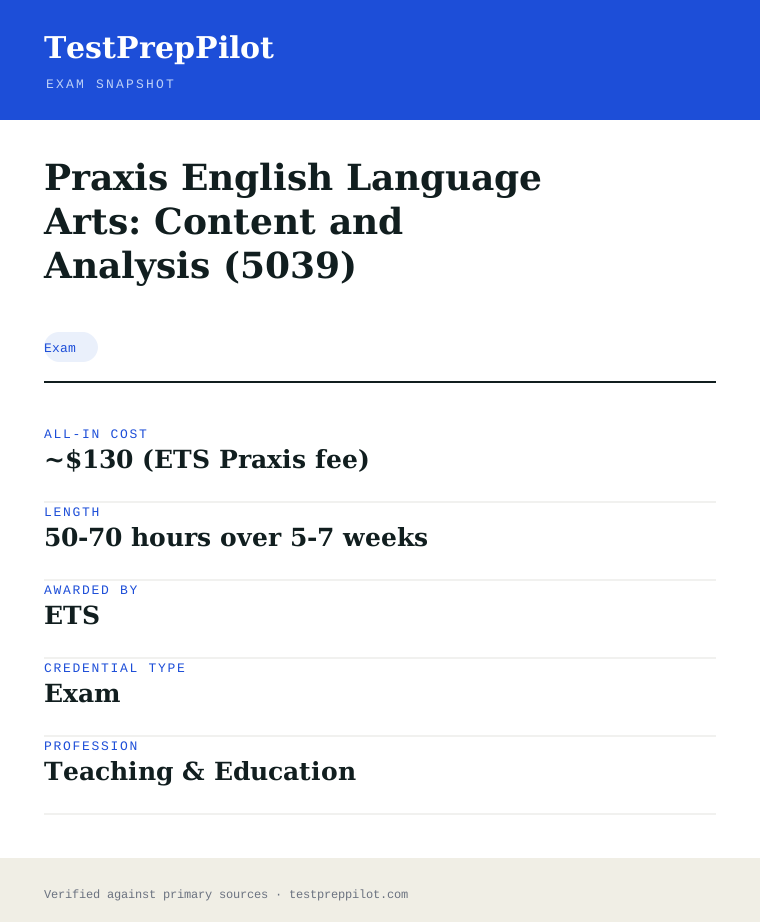
The short version
What is the Praxis English Language Arts: Content and Analysis (5039) and is it worth it?
Praxis English Language Arts: Content and Analysis (5039) is a professional credential administered by ETS. It validates job-ready knowledge and skills in the Education & Teaching field and is used for career entry, advancement, or compliance.
- Recognized credential from ETS
- Demonstrates verified competence in Education & Teaching
- Supports career advancement and may satisfy licensing or employer requirements
What is it?
What exactly is the Praxis English Language Arts: Content and Analysis (5039)?
Praxis English Language Arts: Content and Analysis (5039) — Education & Teaching credential from ETS
English licensure test adding constructed-response literary and rhetorical analysis to the selected-response content knowledge questions. Offered by ETS, it is designed for candidates who need to demonstrate verified competence in the Education & Teaching field. The credential is commonly used for career entry, advancement, regulatory compliance, or employer requirements. Candidates should review the official handbook for eligibility, exam format, and scoring before registering.
The path in brief
- Confirm you meet any eligibility or prerequisites
- Review the official handbook and study materials
- Register and pay through the awarding body or authorized provider
- Schedule and take the exam (test center or online proctoring)
- Receive your score and, if passed, your credential
Before you book
Who is eligible to sit the Praxis English Language Arts: Content and Analysis (5039)?
Eligibility varies; many credentials are open to all, while others require coursework, work experience, or sponsorship.
Who it is for: Professionals and candidates seeking to validate Education & Teaching competence.
The test itself
What is the format of the Praxis English Language Arts: Content and Analysis (5039)?
The Praxis English Language Arts: Content and Analysis (5039) is administered by ETS and runs 2 hours (verify current) and contains 130 questions (verify current) questions.
| Administered by | ETS |
|---|---|
| Questions | 130 questions (verify current) |
| Time limit | 2 hours (verify current) |
| Pass mark | Passing score set by the awarding body; see the official score report |
| Exam fee | ~$130 |
| Format | Proctored, computer-based (test center or online remote proctoring) |
Content outline
What topics are on the Praxis English Language Arts: Content and Analysis (5039)?
The Praxis English Language Arts: Content and Analysis (5039) covers 4 content domains.
Weightings come from the official exam outline. Study time is best allocated in roughly these proportions rather than evenly across domains.
- Subject content
Topic area tested on the exam; see the official blueprint for the detailed breakdown.
- Instruction & pedagogy
Topic area tested on the exam; see the official blueprint for the detailed breakdown.
- Assessment
Topic area tested on the exam; see the official blueprint for the detailed breakdown.
- Classroom management
Topic area tested on the exam; see the official blueprint for the detailed breakdown.
Study materials
Which study guide should you use for the Praxis English Language Arts: Content and Analysis (5039)?
Start with the exam sponsor's official content outline. If you also want one structured resource to work through, these are the Mometrix titles that match this exam.

This links to Mometrix's Praxis subject-test range rather than a single Praxis English Language Arts: Content and Analysis (5039) title. Check that it lists an edition for Praxis English Language Arts: Content and Analysis (5039) before you buy.
Affiliate links We may earn a commission if you buy through these links, at no extra cost to you. Mometrix has no say in what our exam guides cover. How we make money.
The path
How do you register for the Praxis English Language Arts: Content and Analysis (5039)?
- 1
Read your state requirements page20 minutes
Open hiset.org and select your state or jurisdiction. Age minimums, residency rules, whether you must enrol in an adult education programme first, and the exact fees are all set locally.
- 2
Create a myHiSET account15 minutes
Sign up through the state requirements page to generate your HiSET number, which you need for scheduling, score access and any state paperwork.
- 3
Take the official practice tests1 to 2 hours per subtest
HiSET publishes free and low-cost official practice tests for each subtest. Unlike the GED at-home route, HiSET does not require a practice-test pass before you can schedule.
- 4
Schedule subtests one at a time10 minutes each
Book any of the five subtests in any order, on paper or computer at a test centre or through HiSET@Home online proctoring where your state allows it.
- 5
Test with valid photo ID65 to 120 minutes per subtest
Bring a current government-issued photo ID showing your name, date of birth, signature and photograph. At-home testers need a private room, a webcam and a stable connection.
- 6
Check scores and claim your credential1 to 2 weeks
Multiple-choice results typically post within about five to seven days and essay results within about seven to ten days. Once all five subtests pass, your state issues the credential.
The fine print
What are the retake and renewal rules for the Praxis English Language Arts: Content and Analysis (5039)?
- Proctoring & delivery
- HiSET is offered in three ways: paper-based at a test centre, computer-based at a test centre and HiSET@Home under live online proctoring, with availability depending on the state. Calculators and formula sheets are supplied at test centres. The full battery in English or Spanish is permitted, and several states allow candidates to mix languages across subtests.
- Retake policy
- Retake rules are set per state, but a common pattern allows three attempts per subtest in a calendar year, sometimes extending to six. Several states use a favourable pricing structure in which the full fee is charged only on the first and fourth attempts while the second and third cost only the test centre or proctor fee.
- Score reporting
- Each of the five subtests is scored 1 to 20. To pass you must score at least 8 on every subtest, at least 2 out of 6 on the Language Arts Writing essay, and at least 45 out of 100 in total across the five. A score of 15 or higher on a subtest is treated as HiSET honours-level performance in several states.
- Recertification
- The credential a state issues on the strength of a passing HiSET battery is permanent and needs no renewal. Passing subtest scores are carried forward within a state-defined window while you complete the remaining subjects.
- Refunds & rescheduling
- Refund and reschedule windows are administered by PSI and vary by state and test centre; most centres require cancellation at least 24 hours before the appointment. Registering by phone rather than online attracts an additional fee in some states.
Context
HiSET subtests at a glance
| Subtest | Questions | Time | |
|---|---|---|---|
| Language Arts - Reading | About 40 to 50 multiple choice | 65 minutes | |
| Language Arts - Writing | About 50 multiple choice plus 1 essay | 120 minutes | |
| Mathematics | About 50 multiple choice | 90 minutes | |
| Science | About 50 multiple choice | 80 minutes | |
| Social Studies | About 50 multiple choice | 70 minutes |
What it pays
How much does this credential pay?
$64,580 median for high school teachers (BLS, May 2024)
The Praxis English Language Arts: Content and Analysis (5039) is the secondary English-subject licensure gate for teachers in many states, and the wage question belongs to the occupation you enter with it: teaching. The closest official BLS occupation is High School Teachers, SOC 25-2031, which had a May 2024 median wage of $64,580, with the lowest 10 percent under $47,460 and the highest 10 percent above $107,520. BLS counted 1,084,100 high school teacher jobs in 2024 and projects 1 percent growth from 2024 to 2034, with about 65,300 openings a year, almost all replacement demand. Read the median with the standard teacher-market caveats: pay is set by district salary schedules, varies enormously by state, and the exam itself carries no wage premium — it is a subject-content licensure gate. The 5039 differs from the related 5038 in a way that matters to candidates: the 5039 adds two constructed-response essays to the selected-response content, so it measures both content knowledge and written analysis, and it is used by states that want the analysis component as part of the English licensure requirement. Which state you teach in sets everything that matters about this exam — whether it is required, which passing score applies, and what the salary schedule looks like — so the honest framing is that the 5039 unlocks the English-teacher wage in your specific state and district, not a national figure that applies everywhere. Two further points sharpen the story for a 5039 candidate. First, the exam sits at the content-knowledge stage of licensure, so its economic value is indirect: it keeps a candidate on the path to an English-teaching salary, and the wage that ultimately matters is set by the district salary schedule and the candidate’s years of service, not by the exam. Second, the 5039’s constructed-response component is a meaningful differentiator for candidates who can write well under pressure: because two essays worth 25 percent of the score are part of the exam, a candidate with strong written-analysis skills gains a real advantage over a candidate of equal content knowledge who cannot organise an essay in 15 minutes. The teacher labor market is replacement-driven, with about 65,300 high school teacher openings a year across the country, and English is among the more consistently staffed subject areas — which makes the competition for positions and the salary range depend heavily on the state and district in question. Candidates should therefore look up their state’s passing score and salary schedule early, because those two numbers define what the 5039 is for in their specific case.
| Measure | Figure | Source / note |
|---|---|---|
| Median annual wage, high school teachers | $64,580 | BLS OOH, SOC 25-2031, May 2024 |
| Lowest 10 percent | Under $47,460 | BLS OOH, SOC 25-2031, May 2024 |
| Highest 10 percent | Above $107,520 | BLS OOH, SOC 25-2031, May 2024 |
| Projected openings per year | ~65,300 | BLS OOH, SOC 25-2031, 2024-2034 |
Job growth.BLS projects 1 percent growth for high school teachers from 2024 to 2034, about 65,300 openings per year, mostly replacement demand.
Source: BLS Occupational Outlook Handbook - High School Teachers
Your odds
What are the pass rates?
ETS does not publish a national pass rate — the 5039 is 130 selected-response plus 2 constructed-response questions in 3 hours, with each state setting its own passing score
ETS does not publish one national pass rate for the Praxis English Language Arts: Content and Analysis (5039), and any single percentage you see online is a state-specific report or a third-party estimate, so we do not present one as authoritative. What ETS does publish is the reporting model: the 5039 produces a scaled score, and the passing score is set by each state education agency — the same exam has different pass lines in different states, which is exactly why no national pass rate exists. Your target is your state’s published passing score, which you should look up before you study; for this exam the state lines commonly sit in the mid-160s to high-170s on the 100-200 scale, so the margin matters state by state. The exam itself is a computer-delivered test of 3 hours: 130 selected-response (SR) questions in 150 minutes, plus 2 constructed-response (CR) questions in 30 minutes, with the SR section accounting for 75 percent of the total score. The SR questions cover three categories aligned to the Common Core State Standards: Reading — the study of literature and informational texts (about 40 percent); Language Use and Vocabulary (about 19 percent); and Writing, Speaking and Listening (about 41 percent). The two CR questions are short essays: one asks for an analysis of the central idea and key literary elements of a poetry or prose excerpt, and the other for an analysis of the central idea and rhetorical features of a literary essay. The exam fee is $156, and a retake wait of 21 days applies between attempts.
Read this before quoting the number.ETS reports scaled scores and each state sets its own passing score; there is no single national pass rate to quote.
Source: ETS - Praxis English Language Arts: Content and Analysis (5039)
Your schedule
How long should I study for it?
50-80 hours over 5-8 weeks of focused study
The Praxis 5039 is a computer-delivered exam of 130 selected-response questions in 150 minutes plus 2 constructed-response essays in 30 minutes, built on the ETS content categories — Reading, Language Use and Vocabulary, and Writing, Speaking and Listening — so a defensible plan runs 50 to 80 hours over five to eight weeks, weighted to the essays as well as the content. Week 1 is diagnosis: take a practice test covering the SR items and write one timed essay to baseline both halves of the exam. Weeks 2-3 cover the Reading category, the largest block: literary analysis of prose, poetry and drama, the major works and authors, literary terms and devices, and the analysis of informational texts and their rhetorical features. Weeks 3-4 cover Language Use and Vocabulary: grammar, usage, sentence structure and vocabulary in context, drilled with error-recognition patterns. Weeks 5-6 cover Writing, Speaking and Listening — the writing process, modes of writing, research skills, and the teaching and assessment content — and, critically, begin the essay drill: because the 30-minute CR section has two essays, practise writing each type under a hard 15-minute budget, one analyzing a poetry or prose excerpt and one analyzing a literary essay’s argument. Weeks 7-8 are rehearsal: two full timed practice exams at the real 3-hour format, then targeted review of the weak categories. The two planning errors that cost the most are neglecting the essays (they are 25 percent of the score and a distinct skill) and studying only the literature you enjoy (the exam draws from all three categories).
- Week 18
Baseline
- Practice SR test and one timed essay
- Log weak categories against the three content areas
- Look up your state’s passing score
- Weeks 2-318
Reading category
- Literary analysis of prose, poetry and drama
- Major works, authors, terms and devices
- Informational texts and rhetorical analysis
- Weeks 3-414
Language use and vocabulary
- Grammar, usage and sentence structure
- Vocabulary in context
- Error-recognition drilling
- Weeks 5-618
Writing, speaking, listening + essays
- The writing process, modes and research skills
- Teaching and assessment content
- Two timed 15-minute essays: literature analysis and argument analysis
- Weeks 7-816
Timed rehearsal
- Two full practice exams at the real 3-hour format
- Re-lab every miss rather than re-reading it
- Review the weak categories and retake essays
Adjusting the pace
English teacher in practice.The content is familiar; weight the plan to the two constructed-response essays and the exam format rather than content review.
Recent English degree.The content knowledge is fresh; focus on the essay drill and the teaching-and-assessment content you may not have covered.
Coming from the 5038.The 5038 is selected-response only; the 5039 adds the two CR essays and the Writing, Speaking and Listening category, so add essay drill and the extra category to any 5038 study.
How to study
How do I prepare most effectively?
The 5039 rewards broad English-content knowledge plus a distinct written-analysis skill, so the dominant strategy is category-balanced coverage with deliberate essay practice. First, cover all three content categories — Reading, Language Use and Vocabulary, and Writing, Speaking and Listening — because candidates who study only the literature they enjoy miss the language and writing items that form the majority of the SR section. Second, master the essay formats early and drill them under the real 30-minute budget for two essays: the first CR question is an analysis of a poetry or prose excerpt’s central idea and key literary elements, and the second is an analysis of a literary essay’s central idea and rhetorical features, and both are scored on clear thesis, development and textual support — so practise producing a focused, evidence-backed analysis in about 15 minutes. Third, drill the language-use material: grammar, usage and vocabulary-in-context items are a precise, distinct category with predictable patterns. Fourth, learn the informational-text and rhetoric content for the Reading category, because rhetorical analysis of nonfiction is tested in both the SR items and the second essay. Fifth, use the ETS Study Companion as the scope map and its sample questions for item style, and take two full timed practice exams so the 150-minute SR pace and the essay switch are familiar. Finally, look up your state’s passing score early and aim practice above it, since the pass lines for this exam commonly sit in the mid-160s to high-170s. A further strategy is to make the essay section a rehearsed skill rather than a test-day improvisation: practise producing a thesis-driven analysis with direct textual evidence in a hard 15 minutes, once for the literature-excerpt type and once for the argument-essay type, and have a template in mind for each structure so the 30-minute CR block becomes execution rather than invention. On the SR section, learn the additional formats the ETS study companion describes — multiple-selection, order/match, select-in-passage and stimulus items — because candidates who practise only single-selection four-choice items meet those formats cold. Use the ETS Study Companion’s discussion questions as content review prompts, since they are designed to test the knowledge the exam actually measures, and work them aloud or in writing to simulate the reasoning the items require. Finally, on the SR pacing, aim to finish the 150 minutes with time to spare for the essay switch, because the transition from 130 selected-response items to two typed essays is a mental gear-change that rehearsal makes smooth.
Balance the three categories
Reading, Language Use and Vocabulary, and Writing, Speaking and Listening all draw significant SR weight.
Drill the two essays under budget
Two analyses in 30 minutes; practise literature analysis and argument analysis at 15 minutes each.
Master literary analysis
Terms, devices and genre analysis are the largest Reading strand.
Drill language-use items
Grammar, usage and vocabulary in context are precise and predictable.
Learn rhetoric for both SR and essay
Rhetorical analysis of nonfiction appears in both the SR items and the second CR.
Target your state’s cut score
Look up your state’s passing line and aim practice above it.
What to buy
Which study resources are worth paying for?
Praxis 5039 prep is inexpensive because ETS publishes the authoritative materials at low or no cost. The free Study Companion lists the content categories, the SR/CR structure and sample questions, and ETS sells the official interactive practice test and prep eBook (roughly $20-50) that mirror the item style. Third-party ELA content guides ($20-60) and question banks ($20-80) add volume, and a general English-literature reference can supplement the literary content. The exam fee is $156 (confirm at ets.org/praxis), with scheduling-protection and score-reporting options available. Because the 5039 has two constructed responses, resources that include essay practice with scored feedback are worth more here than on selected-response-only Praxis exams — look for practice tests that provide rubric-based essay feedback. A realistic total budget is $200 to $400 including the exam fee and optional materials. Prices below are list prices as of mid-2026 and change frequently; we rank nothing by commission. The buying logic for the 5039 is dominated by the free official core: the Study Companion defines the categories, the SR/CR split and the sample items, so every candidate should start there, and the official practice test is the one paid item that reliably earns its cost because it replicates the two-part format. Third-party guides and question banks add volume, and their value is practice repetition rather than scope that the free material lacks — with the specific caveat that 5039 materials are distinct from 5038 materials, since the 5039 adds the constructed responses and the Writing, Speaking and Listening category. Because the essays are 25 percent of the score, candidates should prioritise any resource that offers rubric-scored essay feedback, since self-scoring an essay against the rubric is unreliable; a practice test with scored feedback is worth more here than on selected-response-only Praxis exams. The $156 exam fee is the main cost, and candidates who can use the free official resources plus one practice test keep the total near $200, while those who add a course and books can spend up to $400. State department-of-education pages are free and settle the two numbers that matter: whether your state requires the 5039 at all, and at what score.
| Resource | Price | Format | Best for |
|---|---|---|---|
| ETS Study Companion (5039) | Free | Official PDF | The authoritative scope and sample items |
| ETS official practice test and prep eBook | ~$20-50 | Online practice / eBook | Official item style, including the essay prompts |
| ELA content guides | ~$20-60 | Printed or digital book | Structured content review across the categories |
| Question banks with essay feedback | ~$20-80 | Online practice items | SR volume plus rubric-based essay practice |
| 5039 exam registration | $156 | ETS computer-delivered | The certification/licensure gate itself |
| State DOE requirement pages | Free | Official state resources | Your state’s passing score and requirements |
List prices as of mid-2026, subject to change; the 5039 exam fee is $156. No commission or affiliate ranking is implied.
Avoid these
What mistakes do candidates most often make?
The most common 5039 mistakes fall into two groups: content balance and the essays. The first is studying only the literature: candidates with an English background focus on the literary content they enjoy and miss the Language Use and Vocabulary and Writing, Speaking and Listening items, which together make up about 60 percent of the SR section. The fix is category-balanced coverage. The second is treating the constructed responses as an afterthought: the two essays are 25 percent of the total score and a distinct timed skill, and candidates who never practise writing an analysis in 15 minutes run out of time on test day. Third, candidates under-prepare the Writing, Speaking and Listening category, treating it as secondary when it carries the largest SR share (about 41 percent). Fourth, some candidates never take a full timed practice exam and misjudge the pace of 130 SR questions in 150 minutes plus the switch to essays. Fifth, candidates who come from the 5038 assume the two exams are interchangeable and skip the essay drill entirely. Finally, candidates who do not look up their state’s passing score study toward a vague target; the state cut line — commonly in the mid-160s to high-170s — is the number that matters. Two further mistakes are specific to the exam’s two-part structure. The first is mishandling the 30-minute CR block: candidates who write a long first essay and leave the second under-developed lose the section, because both essays are scored, and the fix is rehearsing a hard 15-minute budget per essay with a clear thesis and two or three pieces of textual evidence each. The second is practising the SR items untimed and never running the transition to the essays, so test day brings the gear-change cold; a full timed practice exam that includes the essay block eliminates that. Candidates also lose points on the Writing, Speaking and Listening category by assuming it is lighter content when it is the largest SR share at about 41 percent — the writing-process and research-skills items are precise and under-prepared. Finally, 5038 candidates who assume the two exams are interchangeable skip the essay drill entirely; the 5039 is a different test with a different skill balance, and the preparation must follow the 5039 blueprint.
✕Studying literature only
✓Cover all three categories; language and writing items are the SR majority.
✕Treating the essays as an afterthought
✓Practise two 15-minute analyses; the CRs are 25 percent of the score.
✕Under-preparing Writing, Speaking and Listening
✓The largest SR category at ~41%; cover the writing-process and teaching content.
✕Never timing a full exam
✓Run two timed practice exams at the real 3-hour format.
✕Assuming the 5038 prepares you fully
✓The 5039 adds the two essays and an extra category; add both to the plan.
✕Ignoring your state’s cut score
✓Find your state’s passing line and target practice above it.
What you'll face
What question types will I see?
The 5039 is a computer-delivered test of 3 hours: 130 selected-response (SR) questions in 150 minutes, accounting for 75 percent of the total score, plus 2 constructed-response (CR) questions in 30 minutes, accounting for the remaining 25 percent. The SR section uses single-selection four-choice questions with some additional formats — multiple-selection multiple choice, order/match, select-in-passage, and audio/video-stimulus items — across three content categories: Reading (literature and informational texts, about 40 percent of the test), Language Use and Vocabulary (about 19 percent), and Writing, Speaking and Listening (about 41 percent). The two CR questions are short essays: the first asks examinees to analyze the central idea and key literary elements of a poetry or prose excerpt from United States, British or World literature; the second asks examinees to read an excerpt from a literary essay and analyze its central idea and important rhetorical features. Both essays are scored on the clarity of the analysis, the use of evidence from the text, and standard written English. Because the SR section is 75 percent of the score, coverage across all three categories matters more than any single strength. Samples below are editor-written illustrations of the ETS content categories, not live exam items; they show the English-content style of the real items. The two-part structure drives the strategy. In the SR section, the pacing target is roughly 1 minute 9 seconds per question across 130 items in 150 minutes, which means moving steadily and flagging uncertain items rather than dwelling — and because the SR section is 75 percent of the score, balanced coverage across all three categories matters more than any single strength. The CR section then demands a hard gear-change: two typed essays in 30 minutes, about 15 minutes each, each needing a clear thesis and direct evidence from the excerpt, scored on analysis, development and standard English. The stimulus-item formats — multiple-selection, order/match, select-in-passage and audio/video items — appear in the SR section and reward rehearsal, since candidates who have never seen them lose time on test day learning the mechanics. The exam’s design also means the essay skills are trainable in isolation: a candidate who can write a focused analysis of a poem in 15 minutes has already mastered the CR half, and the SR half is a content-and-speed question. The note below is the governing rule: these samples are illustrations, and the real items come from ETS’s bank.
Literary analysis of prose, poetry and drama; informational text analysis and rhetoric.
Grammar, usage, vocabulary in context and standard English conventions.
The writing process, modes of writing, research skills, and teaching content.
Analysis of a literature excerpt and analysis of a literary essay’s argument, in 30 minutes total.
Try these
Q1Which literary device is used in the phrase "the engine coughed and died"?
Answer:A
Personification gives human actions (coughing) to a non-human thing (the engine). A simile uses "like" or "as", alliteration repeats initial consonant sounds, and hyperbole is deliberate exaggeration.
Q2Choose the sentence with correct usage:
Answer:B
"Each" is singular, so the singular possessive "his or her" agrees; "their" (in the singular sense) is increasingly accepted but not the safest choice on a standardized item, and options C and D are grammatically broken.
Q3In a research-based essay, the primary purpose of citing sources is to:
Answer:A
Citations support claims with evidence and acknowledge sources — the purpose of research-based writing. Length, quantity or replacing the writer’s own analysis each misstate the citation’s role.
Q4For the constructed response analyzing a literary essay, which thesis is strongest?
Answer:A
The second CR rewards identifying the central idea and the rhetorical features used to construct the argument. A names both the argumentative structure (contrasting evidence types) and its effect; the others are vague or general.
Samples are editor-written illustrations of the ETS content categories, not live exam items.
The big day
What should I expect on exam day?
The Praxis 5039 is a computer-delivered test at a Pearson VUE centre or through online proctoring, and the format is 3 hours: 150 minutes for the 130 selected-response questions, then 30 minutes for the two constructed-response essays. Bring a valid government-issued photo ID matching your registration name and your appointment confirmation; personal items go in the locker, and no personal electronics or calculator are permitted. Arrive about 30 minutes early; late arrivals forfeit the appointment and fee. The practical pacing plan is fixed by the structure: work the 130 SR questions at roughly a minute each so the 150-minute block finishes on time, use the flag-and-review function for uncertain items, then give each of the two essays about 15 minutes in the 30-minute CR block, structuring each around a clear thesis and textual evidence. The essays are typed on screen. Your scaled score appears on screen immediately after the exam, with the official score report following; ETS score reports show the passing line for the state you selected, and each state receives the report if you designated it as a recipient. On a pass, the score is valid for ten years subject to your state’s acceptance window. If you do not pass, the retake wait is 21 days. The afterwards matters: forward your score to your state’s licensure system through the ETS score-reporting tools and keep the report for your records. The practical rhythm of the day follows the two-part structure: settle into the SR section and hold the roughly one-minute-per-question pace, flagging uncertain items rather than dwelling, and aim to finish the 150 minutes slightly ahead of the clock so the transition to the essays is calm. In the 30-minute CR block, write the first essay to a thesis-and-evidence structure in about 15 minutes, then do the same for the second, leaving the last minute or two to check that each essay has a clear central claim and at least one direct reference to the excerpt. The essays are typed on screen, so typing speed and paragraph organisation are practical skills, not stylistic ones. If the score falls short, the section breakdown on the score report shows which category pulled it down, and the 21-day retake window gives time for targeted re-study of that category plus a fresh essay rehearsal — the report is the plan for the retake, and using it is the difference between a diagnostic retake and a repeat of the same result.
Bring
- Valid government-issued photo ID matching your registration name
- Appointment confirmation
- For online delivery: verified system, webcam and quiet room
- Your ETS account and score-recipient details
Leave at home
- Phone, smartwatch and all electronics
- Notes and study materials
- Personal bags beyond what the centre allows
- Calculators and paper references
How the day runs
Rules in the room
- No personal electronics or calculators in the testing room.
- The SR section is 130 questions in 150 minutes; the CR section is 2 essays in 30 minutes.
- The essays are typed on screen and scored on analysis, evidence and standard English.
- Retakes require a 21-day wait.
- Each state sets its own passing score; ETS reports it on the score report.
Afterwards.On a pass, your score is valid 10 years subject to your state’s window; report it to your state education agency. On a fail, wait 21 days and retake after additional category study.
Reference
What are the key facts about the Praxis English Language Arts: Content and Analysis (5039)?
Praxis English Language Arts: Content and Analysis (5039) is a exam credential; awarded by ETS; the exam fee is ~$130; typical preparation is 50-70 hours over 5-7 weeks; holders typically earn $40,000-$85,000 (25-2031 median $64,580).
| Credential | Praxis English Language Arts: Content and Analysis (5039) |
|---|---|
| Type | Exam |
| Profession | Teaching & Education |
| Specialty | Praxis Humanities & Social Studies |
| Awarded by | ETS |
| Difficulty | Mixed |
| Typical prep time | 50-70 hours over 5-7 weeks |
| All-in cost | ~$130 (ETS Praxis fee) |
| Typical salary range | $40,000-$85,000 (25-2031 median $64,580) |
| Credential | Praxis English Language Arts: Content and Analysis (5039) |
| Awarding body | ETS |
| Exam format | Proctored, computer-based |
| Validity | Passing score set by each state; score validity varies |
| Languages | Varies — see awarding body |
| Scope | National / Multi-state |
| Also known as | 5039 |
Real questions
Frequently asked questions about the Praxis English Language Arts: Content and Analysis (5039)
How do I register for the Praxis English Language Arts: Content and Analysis (5039) exam?
Register through ETS's official portal or an authorized test provider (e.g., Pearson VUE or Prometric where applicable). Create an account, select the exam, pay the fee, and schedule a date.
How much does the exam cost?
Fees vary by location and currency. Confirm the current fee on the official registration page before scheduling.
How long is the credential valid, and how do I renew?
Validity varies by credential (commonly 2–3 years). Renewal usually requires continuing education or a recertification exam — see ETS's policy.
What if I do not pass?
Most bodies allow retakes after a waiting period and payment of the full or partial fee. Check ETS's retake policy before rescheduling.
Is HiSET run by ETS or by PSI?
Both. ETS develops the HiSET test content and PSI delivers it operationally, following the ETS acquisition of PSI in January 2024. In practice you register and schedule through myHiSET on the PSI platform.
Do I have to live in a HiSET state to test?
Usually not. Several HiSET states, including Georgia and Oklahoma, explicitly allow non-residents to test, though you generally must pass your final subtest in the state whose credential you want.
Is HiSET easier than the GED?
They are set to comparable standards but structured differently: HiSET has five subtests with reading and writing separated, while the GED combines them into one Reasoning Through Language Arts test. HiSET is more widely available on paper, which some candidates prefer.
In short
Is the Praxis English Language Arts: Content and Analysis (5039) worth it?
- Praxis English Language Arts: Content and Analysis (5039) is awarded by ETS.
- Validates job-ready competence in Education & Teaching.
- Registration is through the awarding body or an authorized test provider.
- Renewal and retake policies vary — confirm before scheduling.
Same awarding body
What other credentials does ETS award?
Worth comparing
How does the Praxis English Language Arts: Content and Analysis (5039) compare with similar credentials?
Trust
Where does this information come from?
Everything above is taken from the awarding body's own published material. Fees, question counts and domain weights are revised regularly — check the official page before you pay.
- ETS Awarding body
Research confidence: medium · Last reviewed 2026-08