Teaching & Education • Exam
Praxis Professional School Counselor (5422)
Praxis Professional School Counselor (5422) — Education & Teaching credential from ETS
Researched and maintained by TestPrepPilot Editorial BoardTeacher certification & education technology desk · Figures last verified August 2026
The short version
What is the Praxis Professional School Counselor (5422) and is it worth it?
Praxis Professional School Counselor (5422) is a professional credential administered by ETS. It validates job-ready knowledge and skills in the Education & Teaching field and is used for career entry, advancement, or compliance.
- Recognized credential from ETS
- Demonstrates verified competence in Education & Teaching
- Supports career advancement and may satisfy licensing or employer requirements
What is it?
What exactly is the Praxis Professional School Counselor (5422)?
Praxis Professional School Counselor (5422) — Education & Teaching credential from ETS
Licensure test for school counselors covering counseling, consultation, programme delivery, data use and professional practice. Offered by ETS, it is designed for candidates who need to demonstrate verified competence in the Education & Teaching field. The credential is commonly used for career entry, advancement, regulatory compliance, or employer requirements. Candidates should review the official handbook for eligibility, exam format, and scoring before registering.
The path in brief
- Confirm you meet any eligibility or prerequisites
- Review the official handbook and study materials
- Register and pay through the awarding body or authorized provider
- Schedule and take the exam (test center or online proctoring)
- Receive your score and, if passed, your credential
Before you book
Who is eligible to sit the Praxis Professional School Counselor (5422)?
Eligibility varies; many credentials are open to all, while others require coursework, work experience, or sponsorship.
Who it is for: Professionals and candidates seeking to validate Education & Teaching competence.
The test itself
What is the format of the Praxis Professional School Counselor (5422)?
The Praxis Professional School Counselor (5422) is administered by ETS and runs 2 hours (verify current) and contains 120 questions (verify current) questions.
| Administered by | ETS |
|---|---|
| Questions | 120 questions (verify current) |
| Time limit | 2 hours (verify current) |
| Pass mark | Passing score set by the awarding body; see the official score report |
| Exam fee | ~$130 |
| Format | Proctored, computer-based (test center or online remote proctoring) |
Content outline
What topics are on the Praxis Professional School Counselor (5422)?
The Praxis Professional School Counselor (5422) covers 4 content domains.
Weightings come from the official exam outline. Study time is best allocated in roughly these proportions rather than evenly across domains.
- Subject content
Topic area tested on the exam; see the official blueprint for the detailed breakdown.
- Instruction & pedagogy
Topic area tested on the exam; see the official blueprint for the detailed breakdown.
- Assessment
Topic area tested on the exam; see the official blueprint for the detailed breakdown.
- Classroom management
Topic area tested on the exam; see the official blueprint for the detailed breakdown.
Study materials
Which prep course should you use for the Praxis Professional School Counselor (5422)?
Start with the exam sponsor's official content outline. If you also want one structured resource to work through, these are the Mometrix titles that match this exam.
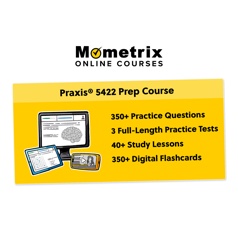
The online course is built for Praxis Professional School Counselor (5422). The study guide and flashcards open Mometrix's wider Praxis subject-test range, so check that they list an edition for this test.
Affiliate links We may earn a commission if you buy through these links, at no extra cost to you. Mometrix has no say in what our exam guides cover. How we make money.
The path
How do you register for the Praxis Professional School Counselor (5422)?
- 1
Read your state requirements page20 minutes
Open hiset.org and select your state or jurisdiction. Age minimums, residency rules, whether you must enrol in an adult education programme first, and the exact fees are all set locally.
- 2
Create a myHiSET account15 minutes
Sign up through the state requirements page to generate your HiSET number, which you need for scheduling, score access and any state paperwork.
- 3
Take the official practice tests1 to 2 hours per subtest
HiSET publishes free and low-cost official practice tests for each subtest. Unlike the GED at-home route, HiSET does not require a practice-test pass before you can schedule.
- 4
Schedule subtests one at a time10 minutes each
Book any of the five subtests in any order, on paper or computer at a test centre or through HiSET@Home online proctoring where your state allows it.
- 5
Test with valid photo ID65 to 120 minutes per subtest
Bring a current government-issued photo ID showing your name, date of birth, signature and photograph. At-home testers need a private room, a webcam and a stable connection.
- 6
Check scores and claim your credential1 to 2 weeks
Multiple-choice results typically post within about five to seven days and essay results within about seven to ten days. Once all five subtests pass, your state issues the credential.
The fine print
What are the retake and renewal rules for the Praxis Professional School Counselor (5422)?
- Proctoring & delivery
- HiSET is offered in three ways: paper-based at a test centre, computer-based at a test centre and HiSET@Home under live online proctoring, with availability depending on the state. Calculators and formula sheets are supplied at test centres. The full battery in English or Spanish is permitted, and several states allow candidates to mix languages across subtests.
- Retake policy
- Retake rules are set per state, but a common pattern allows three attempts per subtest in a calendar year, sometimes extending to six. Several states use a favourable pricing structure in which the full fee is charged only on the first and fourth attempts while the second and third cost only the test centre or proctor fee.
- Score reporting
- Each of the five subtests is scored 1 to 20. To pass you must score at least 8 on every subtest, at least 2 out of 6 on the Language Arts Writing essay, and at least 45 out of 100 in total across the five. A score of 15 or higher on a subtest is treated as HiSET honours-level performance in several states.
- Recertification
- The credential a state issues on the strength of a passing HiSET battery is permanent and needs no renewal. Passing subtest scores are carried forward within a state-defined window while you complete the remaining subjects.
- Refunds & rescheduling
- Refund and reschedule windows are administered by PSI and vary by state and test centre; most centres require cancellation at least 24 hours before the appointment. Registering by phone rather than online attracts an additional fee in some states.
Context
HiSET subtests at a glance
| Subtest | Questions | Time | |
|---|---|---|---|
| Language Arts - Reading | About 40 to 50 multiple choice | 65 minutes | |
| Language Arts - Writing | About 50 multiple choice plus 1 essay | 120 minutes | |
| Mathematics | About 50 multiple choice | 90 minutes | |
| Science | About 50 multiple choice | 80 minutes | |
| Social Studies | About 50 multiple choice | 70 minutes |
What it pays
How much does this credential pay?
$65,140 median for school and career counselors and advisors (BLS, May 2024) — the exam is the licensing gate for the job
The direct answer is that the Praxis School Counselor test has no BLS occupation of its own — it is a licensing exam — but the role it licenses, school and career counselors and advisors (SOC 21-1012), earned a May 2024 median of $65,140, and that is the number most candidates should anchor to. BLS reports the occupation’s lowest 10 percent earning below $46,110 and the highest 10 percent above $104,980, with about 376,300 people employed in 2024 and roughly 31,000 openings projected each year from 2024 to 2034, a 4 percent growth rate that matches the all-occupations average. The distribution matters for a Praxis candidate because school counselors are hired almost entirely by public school districts, whose salary schedules are set by district policy and collective bargaining rather than by the open market: a master’s degree plus the state credential the 5422 exam unlocks is the entry ticket, and each additional step on the district’s salary lane is a real, formulaic raise rather than a negotiation. The federal baseline is also worth reading carefully. BLS classifies this occupation under community and social service rather than education, which sometimes confuses people comparing it to teacher salaries; the practical takeaway is that school counselors typically sit near, but not at, the top of the district instructional salary schedule, and that the credential examined here is a hard requirement in most states before a district will consider you for the role at all. The exam fee and preparation time are small relative to the master’s program most states also require, so the financial decision is usually made upstream of the test, not by it.
| Measure | Figure | Source / note |
|---|---|---|
| Median annual wage, school and career counselors and advisors | $65,140 | BLS OOH, SOC 21-1012, May 2024 ($31.32/hr) |
| Lowest 10 percent | less than $46,110 | BLS OOH Pay tab, May 2024 |
| Highest 10 percent | more than $104,980 | BLS OOH Pay tab, May 2024 |
| Employment, 2024 | 376,300 jobs | BLS OOH Quick Facts, 2024 |
| Projected annual openings | ~31,000 per year | BLS OOH Job Outlook, 2024-34 |
Job growth.4% projected change 2024-34 (about as fast as average); demand driven by schools hiring counselors for academic, career and social-emotional support
Source: BLS Occupational Outlook Handbook — School and Career Counselors and Advisors
Your odds
What are the pass rates?
ETS publishes no pass rate for any Praxis test — what it publishes is state-set passing scores, and 5422 has no national cut
There is no national pass-rate statistic for the Praxis School Counselor (5422) test because ETS does not publish pass rates for Praxis assessments, and there is no single national passing score either: each state licensing agency sets its own cut, and ETS merely administers the test and reports a scaled score to you and to the states you designate. Published state passing scores for 5422 fall in a fairly narrow band — commonly in the low-to-mid 150s on ETS’s 100-200 scaled range, with examples such as 157 and 159 appearing in different states’ requirement tables — so a working target of roughly 155-160 scaled points is the practical planning number, but you must confirm the exact cut for the state where you intend to be licensed, because a score that passes in one state can fail in another. The exam itself is 120 selected-response questions in two hours, computer-delivered at a Prometric center or at home, and it covers four content categories: Define (30 questions, 25 percent), Deliver (48 questions, 40 percent), Manage (24 questions, 20 percent), and Assess (18 questions, 15 percent). Because there is no penalty for wrong answers, the raw score is simply the number correct, converted to the scaled scale; ETS also embeds a small number of unscored pretest items that do not count toward your result, so answering everything is always the right strategy. The honest framing is that 5422 is a knowledge-and-application test rather than a gatekeeper test: candidates who study the ASCA-model content and the four categories in proportion to their weights generally pass on the first attempt, and the real risk is state-specific confusion — registering for the wrong test code or assuming one state’s cut applies to another.
Read this before quoting the number.ETS does not publish pass rates for Praxis tests. The passing score is set by each state licensing agency, not by ETS, and varies by state (commonly in the low-to-mid 150s on a 100-200 scale). Confirm your state’s cut on the ETS state requirements page before registering.
Source: ETS Praxis — School Counselor (5422) test information
Your schedule
How long should I study for it?
50-80 hours over 6-8 weeks of focused study
Plan for 6 to 8 weeks and 50 to 80 hours of study, weighted to the two categories that make up 65 percent of the paper: Deliver (40 percent) and Define (25 percent), with Manage (20 percent) and Assess (15 percent) as the secondary blocks. The exam is 120 selected-response questions in two hours, and the first decision is to confirm which state’s passing score you are aiming at, because that sets the margin you need and removes the ambiguity that causes most last-minute panic. Week 1 is the baseline: take one full-length practice test, score it by content category, and log which of the four categories — Define, Deliver, Manage, Assess — is costing you points. Weeks 2-3 go to Deliver, the single largest category: school counseling interventions at individual, group, classroom and schoolwide level, consultation and collaboration with families and staff, and how ASCA’s National Model and Mindsets & Behaviors translate into practice questions. Weeks 4-5 split between Define and Manage: the role and history of the school counselor, human growth and development theory, ethical and legal principles including the ASCA Ethical Standards, and the day-to-day management tasks of a counseling program. Week 6 covers Assess: analyzing student data and outcome measures, which rewards a comfort with basic interpretation of achievement, attendance and discipline data rather than statistics. Weeks 7-8 are timed rehearsals — two more full-length exams under the two-hour clock, then re-lab every miss back to its category and drill the categories that still drag. The pacing rule is simple: two hours for 120 questions is one minute per question, and scenario-style items on the Deliver category take the longest, so answer everything, flag the long ones, and use your minute budget rather than spending five minutes on any single item.
- Week 18-10 hrs
Baseline and category scoring
- Take one full-length practice test under the two-hour clock
- Score by the four content categories: Define, Deliver, Manage, Assess
- Log every miss back to its category to set the study priorities
- Weeks 2-310-12 hrs/week
Deliver (40%) — interventions and practice
- Study individual, group, classroom and schoolwide counseling interventions
- Learn consultation and collaboration with families, staff and community agencies
- Drill scenario questions that ask what a counselor should do first in a given situation
- Weeks 4-510-12 hrs/week
Define (25%) and Manage (20%)
- Cover the role and history of the school counselor and the ASCA National Model
- Review human growth and development theory across the lifespan
- Study the ASCA Ethical Standards and legal principles; then program management tasks
- Week 68-10 hrs
Assess (15%) — data and outcomes
- Learn how to analyze student achievement, attendance and behavior data
- Practise interpreting outcome measures as they appear in scenario stems
- Drill this small category until it is reliable scoring territory
- Weeks 7-88-10 hrs/week
Timed rehearsals and gap closing
- Take two more full-length practice exams under real timing
- Re-lab every miss to its category and drill the drag categories
- Review the ASCA standards and ethical principles; confirm your state’s passing score and test logistics
Adjusting the pace
Already working in a school or district.Four to five weeks. Your daily context covers a large share of the Deliver and Manage categories; spend the recovered time on the legal, ethical and development-theory items that rarely come up in practice.
Coming from a counseling master’s program.Three to four weeks. The theories and interventions are fresh; what you lack is the exam’s particular vocabulary and its one-minute-per-question pace, so front-load timed practice.
Career changer with no school experience.Eight to ten weeks. Add two weeks on the ASCA model and the role of the counselor, because the exam’s scenarios assume you know what a school counselor actually does and what they are explicitly supposed not to do.
How to study
How do I prepare most effectively?
The strategy that reliably moves a 5422 score is “weight the Deliver category, learn the ASCA framework cold, and rehearse the one-minute-per-question pace,” because 65 percent of the paper sits in Deliver plus Define and both reward recognising the model answer rather than debating alternatives. The single biggest error is studying counselling theory as if this were a licensing exam for clinical practice — it is not: the stem describes a school situation and asks what the counselor should do, and the correct answer is almost always the response that is in the counselor’s scope, within the ASCA model, and collaborative rather than disciplinary. A second proven approach is learning the ASCA National Model and the Mindsets & Behaviors framework well enough to answer without thinking, because the exam’s answer choices are often four defensible-sounding actions that differ in exactly this dimension. Third, use the category weights to allocate study time rather than studying the study-companion topics evenly: 40 percent of the questions are Deliver items, so a full-length practice test scored by category is the single most informative artefact you can produce. Fourth, drill the “what should the counselor do first” scenario format until the pattern is reflex — in a school crisis or disclosure, the correct first action is virtually always to ensure student safety, then inform the appropriate adults within confidentiality limits, and never to act as a disciplinarian or therapist beyond scope. Finally, because there is no wrong-answer penalty, never leave an item blank; a random guess is a better outcome than an empty answer bubble, and the pretest items mean you cannot even tell which questions count.
Weight study by the published category percentages
Deliver is 40 percent and Define is 25 percent — together 65 percent of the paper. Do not study the four categories evenly; a practice test scored by category tells you exactly where the points are being lost.
Learn the ASCA framework as the answer key
The exam is built on the ASCA National Model and Mindsets & Behaviors. When four answers all sound reasonable, the right one is the one that is in the counselor’s role, data-informed, collaborative, and aligned with ASCA — not the disciplinary or therapeutic-sounding option.
Master the “what first” scenario logic
A large share of the Deliver items are crisis, disclosure and intervention scenarios. The pattern to internalise: protect student safety first, follow confidentiality rules and its exceptions, consult and collaborate, and document. Practise the order until it is reflex.
Run full-length timed practice exams
120 questions in 120 minutes is exactly one minute per question. A practice score under real timing is the honest readiness signal; untimed practice overstates readiness and teaches the wrong pacing instinct.
Memorise the scope boundaries
The exam repeatedly tests what a school counselor does not do — discipline, 504 coordination, test coordination, substitute teaching, scheduling, lunch duty. Knowing these exclusions answers a whole family of items and kills several plausible-looking distractors.
Never leave an item blank
There is no penalty for guessing and ETS embeds unscored pretest items you cannot identify. Answer everything, flag the slow ones, and come back only if the clock allows.
What to buy
Which study resources are worth paying for?
Praxis preparation is dominated by official ETS resources, and the buying rule here is to exhaust the free official material before paying for anything else. The ETS Study Companion for 5422 is free and contains the exact content categories, the format, sample questions with answers, and the scoring explanation; the state requirement page on ets.org is the only authoritative place to confirm your state’s passing score; and ETS sells its own full-length practice tests and study plan. The exam registration fee is about $130, with a range depending on state surcharges, and scheduling protection is available. Commercial resources divide into the big test-prep publishers, which sell 5422-specific books and practice tests, and the smaller Praxis-specialist sites whose practice banks mirror the category structure; the difference matters less than the category scoring — any resource that lets you score practice results by the four content categories is usable, and any that does not is hard to plan around. The honest caveat is that no commercial product reproduces the state-specific passing-score question for you, and that is the one fact you genuinely cannot buy.
| Resource | Price | Format | Best for |
|---|---|---|---|
| ETS Study Companion for School Counselor (5422) | Free | Official PDF with content outline, format and sample questions | The authoritative blueprint — start here |
| ETS state requirements page | Free | Official web page per state | Confirming your exact passing score before you register |
| ETS official practice tests and study plan | ~$20-30 per practice test | Full-length timed practice, score reported by category | A realistic readiness check under the one-minute-per-question clock |
| Praxis 5422 registration | ~$130 (varies by state surcharge) | Computer-delivered at a Prometric centre or at home | The exam itself |
| Review books (e.g. Mometrix, ETS-aligned guides) | ~$30-50 | Printed book or eBook with practice questions | Structured content review for candidates who want a single ordered reference |
| Full-length practice question banks | ~$15-40 | Online adaptive practice scored by category | Drilling the Deliver and Define categories until the pattern is reflex |
Prices approximate and dated to this review. Registration fees vary by state, and ETS frequently runs promotions on practice tests; confirm current pricing on ets.org before buying. We do not rank by commission.
Avoid these
What mistakes do candidates most often make?
The two most common 5422 mistakes are structural — preparing without confirming the state passing score, and studying the four categories evenly when Deliver and Define together carry 65 percent of the paper. The rest are content habits: treating the exam like a clinical-therapy licensing test, choosing the disciplinary answer in scope questions, confusing the ASCA categories, skipping timed practice, and leaving items blank in an exam with no guessing penalty. Each one is fixable with a specific change of habit rather than more hours.
✕Assuming one state’s passing score applies everywhere
✓Passing scores for 5422 are set per state and commonly differ. Confirm your target state’s cut on the ETS state requirements page before registering, and aim a few scaled points above it for safety.
✕Studying all four content categories evenly
✓Deliver (40%) and Define (25%) are 65% of the paper. Score a baseline practice test by category, then allocate study hours in proportion to the categories that actually cost you points rather than to the companion’s topic list.
✕Preparing like it is a clinical counselling licensing exam
✓5422 tests school counselling within the ASCA model, not clinical therapy. When an answer sounds like psychotherapy or diagnosis, it is almost certainly out of scope; the right answer is the collaborative, school-based, scope-respecting action.
✕Choosing the disciplinary or administrative answer
✓The exam explicitly tests what a school counselor is not supposed to do — discipline, 504 coordination, test coordination, scheduling. If the stem puts the counselor in a disciplinarian role, the correct answer will redirect to the counselor’s actual responsibilities.
✕Skipping timed full-length practice
✓120 questions in 120 minutes is a hard one-minute-per-question budget, and scenario items run long. Take at least two full-length timed exams; an untimed practice score is not a readiness signal.
✕Leaving items blank
✓There is no penalty for guessing on Praxis tests, and ETS embeds unscored pretest items. Answer every question, flag the slow ones, and return only if the clock allows.
What you'll face
What question types will I see?
The 5422 paper is 120 selected-response questions in two hours, computer-delivered, scored on ETS’s 100-200 scaled scale with the passing cut set by the candidate’s state. The selected-response format includes single-answer multiple choice, multiple-select items, and questions where you enter a short answer in a text box, with a small number of unscored pretest items embedded throughout. Content is distributed across four categories: Define (30 questions, 25%), Deliver (48 questions, 40%), Manage (24 questions, 20%) and Assess (18 questions, 15%). The dominant item style is the scenario: a school situation is described and you select the best response for a school counselor, with distractors that are defensible-sounding actions differing in scope, ethics, or ordering. The samples below are editor-written illustrations of the published content categories and item styles, not live exam items.
A stem followed by four choices; one is best. Most commonly a scenario asking what a school counselor should do, say, or prioritise, with distractors that are plausible but out of scope or out of order.
The stem states how many answers to choose and scoring is all-or-nothing. Common in the Manage and Define categories, where several steps together make up a correct practice.
You type a short answer or fill in a blank rather than choosing from options. ETS’s format description for 5422 lists text-box entry among the possible question types, so treat it as fair game.
Direct questions on the role of the school counselor, ASCA standards, ethical principles, and development theory. These reward knowing the model language exactly.
Try these
Q1A student discloses to the school counselor that they have been considering self-harm. Which action should the counselor take first?
Answer:B
Student safety comes first, and a disclosure of self-harm triggers the confidentiality exceptions in the ASCA Ethical Standards — the counselor must assess the risk and involve the appropriate adults through the school safety protocol. A is wrong twice: confidentiality has limits when a student is in danger, and promising it in this situation is both unsafe and unethical. C moves the student outside the school scope and is also a dual-relationship problem. D may be part of a broader safety plan, but notifying teachers is not the first, or even necessarily an appropriate, step; the protocol and the responsible adults come first.
Q2A school counselor is asked to take over discipline duties during a staffing shortage. According to the ASCA model, the counselor should:
Answer:C
The ASCA National Model is explicit that school counselors are not disciplinarians, and advocating for appropriate role use — including declining non-counseling duties that interfere with the counseling program — is one of the role’s core expectations. A, B and D all accept the assignment, which normalises an out-of-scope duty and reduces time for the direct services the role exists to provide. The correct action is advocacy, not accommodation.
Q3Which source of data would be most useful for evaluating whether a school counseling program’s small-group intervention reduced chronic absenteeism?
Answer:B
The Assess category tests outcome evaluation, and measuring a change in chronic absenteeism requires the attendance data for the students in the intervention, before and after. A is unstructured opinion and not a defensible outcome measure. C measures workload, not outcome. D measures satisfaction, which does not tell you whether absences fell. Comparing the same students’ attendance across the intervention window is the direct, defensible evaluation.
Samples are editor-written illustrations of the published content categories and item styles; they are not live exam items.
The big day
What should I expect on exam day?
The 5422 test is two hours, computer-delivered, at a Prometric test centre or at home with ETS’s online proctoring, and the single most common reason a seat is lost has nothing to do with counselling: the name on your government-issued photo ID must match the name on your ETS registration exactly, and that mismatch cannot be fixed at check-in. At a test centre, arrive 30 minutes early, present the photo ID plus any second form the appointment confirmation requests, and expect a locker for your phone, watch, and bags; at home, you must complete a system check, show your ID to the webcam, and have a cleared room with no other people and no second monitor active. There is no scheduled break in a two-hour exam and the clock does not stop, so the practical plan is to answer every question at roughly one per minute, flag the scenario items that run long, and finish with time to review. ETS does not publish your passing score as a percentage — you will receive a scaled score on the 100-200 range and the state agencies you designated will receive it too, with official reports available in about two to five weeks depending on the score-reporting schedule. The one thing to confirm before the day, and re-confirm the week before, is the exact passing score your state requires, because that is the number that determines whether the test centre visit was a pass or a reschedule.
Bring
- A valid, unexpired government-issued photo ID whose name matches your ETS registration exactly
- Your admission ticket or confirmation, printed or on your phone
- A second form of identification if your appointment confirmation requests one
- For at-home testing: the same government-issued photo ID to show to the webcam
- For at-home testing: a quiet, cleared room, a working webcam and microphone, and the ETS secure browser already installed
Leave at home
- Phones, smartwatches, fitness trackers and earbuds — locker at a test centre, out of reach at home
- Notes, textbooks and study materials — none are permitted
- Your own paper and pens; the test centre provides a noteboard if one is offered
- Bags, coats, food and drink beyond what the centre or at-home rules permit
- At home: any other person in the room and any second monitor
How the day runs
Rules in the room
- 120 selected-response questions in 120 minutes — one minute per question is the pacing target.
- There is no penalty for guessing; answer every question, including ones you do not know.
- Some items are unscored pretest questions; you cannot tell which, so treat every item as scored.
- No scheduled break, and the clock does not stop if you leave the room.
- The passing score is set by your state, not by ETS; confirm it before registering.
- Your photo ID name must match your ETS registration name exactly — mismatches cannot be fixed at check-in.
- No personal items in the testing room; a test centre will require lockers for phones and bags.
Afterwards.Your result is reported as a scaled score on ETS’s 100-200 range, not a percentage, and it is delivered to the state agencies you designated at registration; official score reports are typically available within about two to five weeks of the test date, and you can check them in your ETS account. The number that matters is the cut set by the state where you intend to be licensed, not the national average, so the first action after you receive the report is to compare your scaled score to that specific requirement. On a pass, your score report becomes part of your licensure file and you can proceed with the remaining state requirements — typically the degree and any additional background or practicum steps — with the Praxis component done. On a fail, the same scaled score tells you how far you sat from the line; Praxis candidates may retake, and because ETS does not publish pass rates the useful thing is not the historical statistic but your own category breakdown, which you can use to re-weight the next round of study toward the categories that dragged the score below the cut. Re-check the state requirement page before rescheduling, because cuts do change, and treat the retake window as a specific, category-targeted project rather than a generic re-read of the companion.
Reference
What are the key facts about the Praxis Professional School Counselor (5422)?
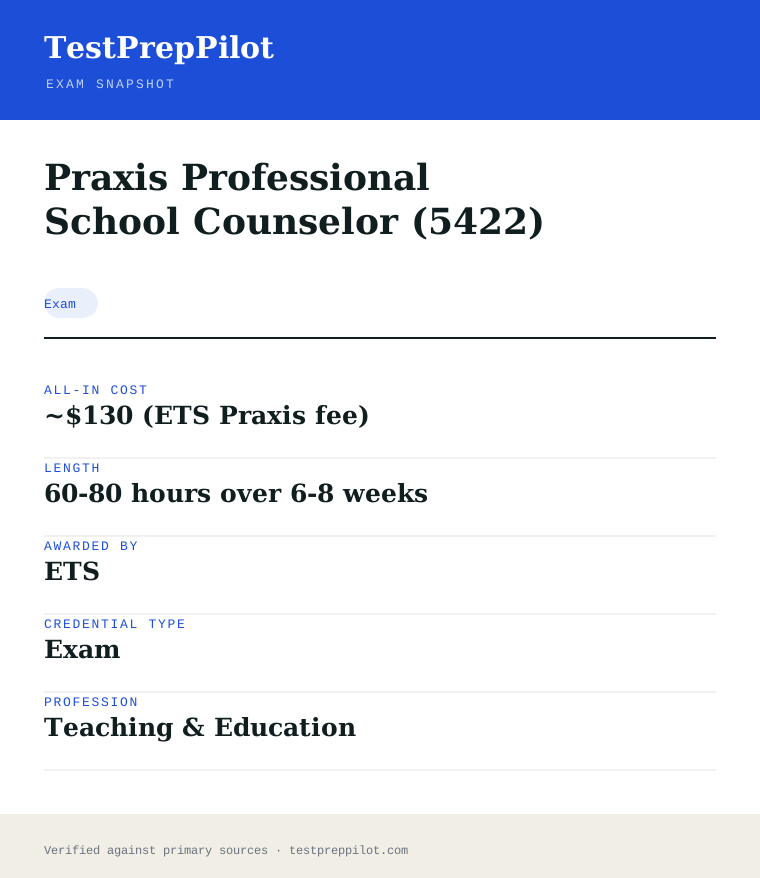
Praxis Professional School Counselor (5422) is a exam credential; awarded by ETS; the exam fee is ~$130; typical preparation is 60-80 hours over 6-8 weeks; holders typically earn $45,000-$85,000 (21-1012 median ~$65,140).
| Credential | Praxis Professional School Counselor (5422) |
|---|---|
| Type | Exam |
| Profession | Teaching & Education |
| Specialty | Praxis School Services & Leadership |
| Awarded by | ETS |
| Difficulty | Mixed |
| Typical prep time | 60-80 hours over 6-8 weeks |
| All-in cost | ~$130 (ETS Praxis fee) |
| Typical salary range | $45,000-$85,000 (21-1012 median ~$65,140) |
| Credential | Praxis Professional School Counselor (5422) |
| Awarding body | ETS |
| Exam format | Proctored, computer-based |
| Validity | Passing score set by each state; score validity varies |
| Languages | Varies — see awarding body |
| Scope | National / Multi-state |
| Also known as | 5422 |
Real questions
Frequently asked questions about the Praxis Professional School Counselor (5422)
How do I register for the Praxis Professional School Counselor (5422) exam?
Register through ETS's official portal or an authorized test provider (e.g., Pearson VUE or Prometric where applicable). Create an account, select the exam, pay the fee, and schedule a date.
How much does the exam cost?
Fees vary by location and currency. Confirm the current fee on the official registration page before scheduling.
How long is the credential valid, and how do I renew?
Validity varies by credential (commonly 2–3 years). Renewal usually requires continuing education or a recertification exam — see ETS's policy.
What if I do not pass?
Most bodies allow retakes after a waiting period and payment of the full or partial fee. Check ETS's retake policy before rescheduling.
Is HiSET run by ETS or by PSI?
Both. ETS develops the HiSET test content and PSI delivers it operationally, following the ETS acquisition of PSI in January 2024. In practice you register and schedule through myHiSET on the PSI platform.
Do I have to live in a HiSET state to test?
Usually not. Several HiSET states, including Georgia and Oklahoma, explicitly allow non-residents to test, though you generally must pass your final subtest in the state whose credential you want.
Is HiSET easier than the GED?
They are set to comparable standards but structured differently: HiSET has five subtests with reading and writing separated, while the GED combines them into one Reasoning Through Language Arts test. HiSET is more widely available on paper, which some candidates prefer.
In short
Is the Praxis Professional School Counselor (5422) worth it?
- Praxis Professional School Counselor (5422) is awarded by ETS.
- Validates job-ready competence in Education & Teaching.
- Registration is through the awarding body or an authorized test provider.
- Renewal and retake policies vary — confirm before scheduling.
Same awarding body
What other credentials does ETS award?
Worth comparing
How does the Praxis Professional School Counselor (5422) compare with similar credentials?
Trust
Where does this information come from?
Everything above is taken from the awarding body's own published material. Fees, question counts and domain weights are revised regularly — check the official page before you pay.
- ETS Awarding body
Research confidence: medium · Last reviewed 2026-08