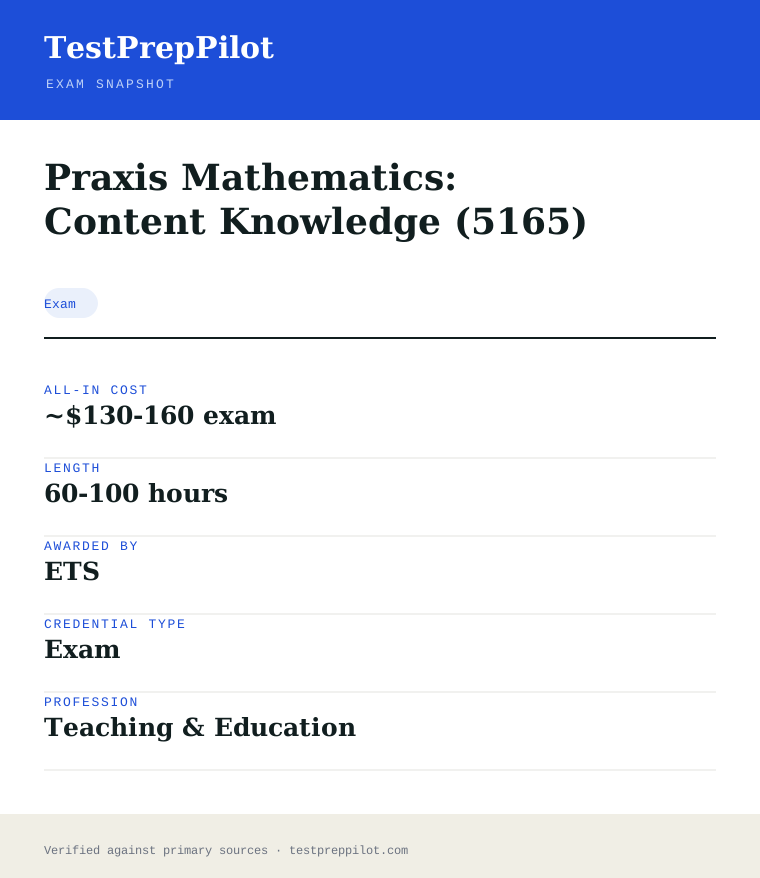
The short version
What is the Praxis Mathematics: Content Knowledge (5165) and is it worth it?
Praxis Mathematics: Content Knowledge (5165) is a professional credential administered by ETS. It validates job-ready knowledge and skills in the Education & Teaching field and is used for career entry, advancement, or compliance.
- Recognized credential from ETS
- Demonstrates verified competence in Education & Teaching
- Supports career advancement and may satisfy licensing or employer requirements
What is it?
What exactly is the Praxis Mathematics: Content Knowledge (5165)?
Praxis Mathematics: Content Knowledge (5165) — Education & Teaching credential from ETS
Secondary mathematics licensure test covering number, algebra, functions, calculus, geometry, probability and statistics. Offered by ETS, it is designed for candidates who need to demonstrate verified competence in the Education & Teaching field. The credential is commonly used for career entry, advancement, regulatory compliance, or employer requirements. Candidates should review the official handbook for eligibility, exam format, and scoring before registering.
The path in brief
- Confirm you meet any eligibility or prerequisites
- Review the official handbook and study materials
- Register and pay through the awarding body or authorized provider
- Schedule and take the exam (test center or online proctoring)
- Receive your score and, if passed, your credential
Before you book
Who is eligible to sit the Praxis Mathematics: Content Knowledge (5165)?
Eligibility varies; many credentials are open to all, while others require coursework, work experience, or sponsorship.
Who it is for: Professionals and candidates seeking to validate Education & Teaching competence.
The test itself
What is the format of the Praxis Mathematics: Content Knowledge (5165)?
The Praxis Mathematics: Content Knowledge (5165) is administered by ETS and runs 150 minutes and contains 80 questions.
| Administered by | ETS |
|---|---|
| Questions | 80 questions |
| Time limit | 150 minutes |
| Pass mark | Passing score set by the awarding body; see the official score report |
| Exam fee | ~$130-160 |
| Format | Proctored, computer-based (test center or online remote proctoring) |
Content outline
What topics are on the Praxis Mathematics: Content Knowledge (5165)?
The Praxis Mathematics: Content Knowledge (5165) covers 4 content domains.
Weightings come from the official exam outline. Study time is best allocated in roughly these proportions rather than evenly across domains.
- Subject content
Topic area tested on the exam; see the official blueprint for the detailed breakdown.
- Instruction & pedagogy
Topic area tested on the exam; see the official blueprint for the detailed breakdown.
- Assessment
Topic area tested on the exam; see the official blueprint for the detailed breakdown.
- Classroom management
Topic area tested on the exam; see the official blueprint for the detailed breakdown.
The path
How do you register for the Praxis Mathematics: Content Knowledge (5165)?
- 1
Read your state requirements page20 minutes
Open hiset.org and select your state or jurisdiction. Age minimums, residency rules, whether you must enrol in an adult education programme first, and the exact fees are all set locally.
- 2
Create a myHiSET account15 minutes
Sign up through the state requirements page to generate your HiSET number, which you need for scheduling, score access and any state paperwork.
- 3
Take the official practice tests1 to 2 hours per subtest
HiSET publishes free and low-cost official practice tests for each subtest. Unlike the GED at-home route, HiSET does not require a practice-test pass before you can schedule.
- 4
Schedule subtests one at a time10 minutes each
Book any of the five subtests in any order, on paper or computer at a test centre or through HiSET@Home online proctoring where your state allows it.
- 5
Test with valid photo ID65 to 120 minutes per subtest
Bring a current government-issued photo ID showing your name, date of birth, signature and photograph. At-home testers need a private room, a webcam and a stable connection.
- 6
Check scores and claim your credential1 to 2 weeks
Multiple-choice results typically post within about five to seven days and essay results within about seven to ten days. Once all five subtests pass, your state issues the credential.
The fine print
What are the retake and renewal rules for the Praxis Mathematics: Content Knowledge (5165)?
- Proctoring & delivery
- HiSET is offered in three ways: paper-based at a test centre, computer-based at a test centre and HiSET@Home under live online proctoring, with availability depending on the state. Calculators and formula sheets are supplied at test centres. The full battery in English or Spanish is permitted, and several states allow candidates to mix languages across subtests.
- Retake policy
- Retake rules are set per state, but a common pattern allows three attempts per subtest in a calendar year, sometimes extending to six. Several states use a favourable pricing structure in which the full fee is charged only on the first and fourth attempts while the second and third cost only the test centre or proctor fee.
- Score reporting
- Each of the five subtests is scored 1 to 20. To pass you must score at least 8 on every subtest, at least 2 out of 6 on the Language Arts Writing essay, and at least 45 out of 100 in total across the five. A score of 15 or higher on a subtest is treated as HiSET honours-level performance in several states.
- Recertification
- The credential a state issues on the strength of a passing HiSET battery is permanent and needs no renewal. Passing subtest scores are carried forward within a state-defined window while you complete the remaining subjects.
- Refunds & rescheduling
- Refund and reschedule windows are administered by PSI and vary by state and test centre; most centres require cancellation at least 24 hours before the appointment. Registering by phone rather than online attracts an additional fee in some states.
Context
HiSET subtests at a glance
| Subtest | Questions | Time | |
|---|---|---|---|
| Language Arts - Reading | About 40 to 50 multiple choice | 65 minutes | |
| Language Arts - Writing | About 50 multiple choice plus 1 essay | 120 minutes | |
| Mathematics | About 50 multiple choice | 90 minutes | |
| Science | About 50 multiple choice | 80 minutes | |
| Social Studies | About 50 multiple choice | 70 minutes |
What it pays
How much does this credential pay?
Expect high-school-teacher pay at a May 2024 median of $64,580 (BLS) — Praxis 5165 is the mathematics licensure gate for secondary math teachers, and math-teacher roles sit at the top of the teaching pay range
The direct answer is that Praxis Mathematics: Content Knowledge (5165) is the licensure test many states require for secondary mathematics teachers, and the occupation it gates, high school teachers (SOC 25-2031), earned a May 2024 median annual wage of $64,580, with the lowest 10 percent under about $48,000 and the highest 10 percent above about $102,000. The honest framing is that the test does not set pay — teaching salaries are set by district salary schedules, unions, and state funding — but mathematics is one of the highest-demand teaching fields, and math teachers are consistently among the harder-to-staff positions, which translates into stronger job prospects, signing bonuses in some districts, and faster pathways through shortage-area incentives in many states. BLS counted about 1,084,100 high school teachers in 2024 and projects about 1 percent decline in employment from 2024 to 2034, with about 67,400 annual openings driven almost entirely by retirement and turnover — the shortage is in replacements, not growth. The practical read: passing 5165 is the credential gate for the profession, and the pay story is about entering a stable, union-protected occupation with the demand-side leverage math teachers hold. The test itself is 80 questions over 2.5 hours, covering number and quantity, algebra, functions, calculus, geometry, statistics and probability, and discrete mathematics, with a passing score set by each state (commonly in the 150 to 170 range of the 100-200 scale). For candidates deciding whether to pursue math teaching, the test is the licensure barrier, and the occupation’s demand dynamics make it one of the more employable teaching credentials.
| Measure | Figure | Source / note |
|---|---|---|
| Median annual wage, high school teachers | $64,580 | BLS Occupational Outlook Handbook, May 2024 (SOC 25-2031) |
| Lowest 10 percent | less than $48,180 | BLS OOH, May 2024 |
| Highest 10 percent | more than $102,000 | BLS OOH, May 2024 |
| Annual openings, 2024-34 | ~67,400 | BLS Employment Projections |
| The test itself | Licensure gate | Passing score set by each state |
Job growth.BLS projects about 1% employment change for high school teachers from 2024 to 2034, with ~67,400 annual openings, mostly from replacement.
Source: BLS OOH — High School Teachers
Your odds
What are the pass rates?
ETS publishes no national pass rate for 5165 — passing scores are set by each state on the 100-200 scale, and ETS reports score information rather than cohort pass data
The core fact is that ETS does not publish a national pass rate for Praxis 5165, because passing standards are set by each state and ETS reports scaled scores rather than cohort pass percentages. What is published is the test structure: 5165 contains 80 selected-response questions with 150 minutes allowed, scored on a 100-200 scale, with each state setting its passing score — for Mathematics: Content Knowledge, state passing scores commonly fall in the 150s to 160s range, though they vary and have changed over time (some states have used different cut scores at different periods). The test covers seven content categories: number and quantity, algebra, functions, calculus, geometry, probability and statistics, and discrete mathematics, weighted across the paper. Because ETS publishes score scales and state passing-score requirements (available through the Praxis State Requirements page), the practical preparation target is your specific state’s passing score, not a national average. The honest advice is to look up your state’s current required score on the ETS site before studying, aim comfortably above it, and use the ETS official practice tests, which mirror the real exam’s content distribution. Note also that ETS reports that passing standards vary — a score that clears one state may not clear another — so candidates moving between states should re-check requirements. The 5165 exam can be retaken after a 21-day waiting period, per Praxis policy.
Read this before quoting the number.ETS publishes no national pass rate; each state sets its own passing score on the 100-200 scale.
Your schedule
How long should I study for it?
60-100 study hours over 6-10 weeks of focused study
Plan for roughly 6 to 10 weeks and 60 to 100 hours of study for Praxis 5165, weighted to the exam’s content categories — algebra, functions, and geometry carry the largest shares — with official ETS practice tests as the calibration tool. The 80-question, 2.5-hour exam covers number and quantity, algebra, functions, calculus, geometry, statistics and probability, and discrete mathematics. The most effective sequence is: first, take the official ETS practice test to locate your weak categories; second, work the highest-weight areas — algebra and functions — until fluency; third, drill geometry and statistics, where many candidates lose points on application items; fourth, review calculus and discrete math to the level the test requires (foundational, not advanced); and fifth, take two more official practice tests under timed conditions in the final two weeks. Because the exam is multiple-choice and rewards fluent, accurate computation, the highest-yield habit is timed practice: 80 questions in 150 minutes is about 1.9 minutes per item, and candidates who rehearse the pace outperform those who study content alone. The common study error is over-investing in calculus, which is a smaller content share, and under-practising statistics and discrete math. Budget the final week for formula review and light practice rather than new content, and confirm your state’s passing score so you know your target margin.
- Weeks 1-220
Diagnostic + algebra/functions
- Take an official practice test
- Drill algebra and functions content
- Log weak categories
- Weeks 3-640
Full content coverage
- Work geometry, statistics, and probability
- Review calculus and discrete math
- Take a second practice test
- Weeks 7-820
Timed practice
- Take official practice tests under timing
- Re-study weak areas
- Confirm state passing score
- Final week10
Taper
- Formula review
- Light practice
- Rest
Adjusting the pace
State-specific passing scores.Passing standards for 5165 vary by state; check the ETS state-requirements page.
Alternative tests.Some states accept other math licensure tests (e.g. Praxis 7003/7004 or state-specific exams).
How to study
How do I prepare most effectively?
The strategy that reliably passes Praxis 5165 is "calibrate with official practice tests, weight study to algebra and functions, and rehearse the 1.9-minute-per-question pace," and the single biggest error is studying content evenly and skipping timed practice. A second proven approach is using the ETS official practice tests as the anchor — they mirror the content distribution and difficulty, and score conversion lets you know your state-target margin. Third, build fluency in the highest-weight categories — algebra and functions — because the exam rewards speed and accuracy there, and candidates who are not fluent run out of time. Fourth, drill the application items in geometry and statistics, which are the categories where candidates lose the most points despite adequate content knowledge. Fifth, keep a formula sheet from the exam’s first practice test and refine it as you study, since the final-week formula review is the highest-yield taper activity. Finally, look up your state’s exact passing score before the exam and know your margin: if your practice scores are within 5 points of the passing line, extend the study plan rather than sitting early.
Anchor on official practice tests
ETS practice tests mirror the content distribution and give score targets.
Weight algebra and functions
The largest content shares reward fluent, accurate computation.
Rehearse the pacing
80 questions in 150 minutes — timed practice is non-negotiable.
Drill geometry and statistics applications
The categories where adequate content still loses points.
Know your state’s passing score
Check the ETS state-requirements page and aim for a real margin.
What to buy
Which study resources are worth paying for?
Praxis 5165 preparation is anchored by the ETS official practice tests (about $20 each) and the free ETS study companion, with commercial courses as optional structured support. The comparison below separates official and commercial resources, with prices current to this review. The buying rule is to spend on the official practice tests first, and treat commercial Q-banks as reinforcement for pacing work.
| Resource | Price | Format | Best for |
|---|---|---|---|
| ETS 5165 Study Companion | Free | PDF with content outline | The authoritative content list |
| ETS official practice test | ~$20 | Online practice exam | Score calibration and pacing |
| ETS state passing-score page | Free | Online lookup | Your exact target score |
| Commercial Praxis math prep (e.g. Mometrix, Praxis Math content) | ~$30-60 | Book or online course | Structured review |
| Math review courses (Khan Academy) | Free | Video + practice | Rebuilding weak content areas |
Prices approximate and dated to this review; retake policy allows re-testing after 21 days.
Avoid these
What mistakes do candidates most often make?
The most common mistake is studying content evenly and skipping timed practice, then running out of time on the 80-question paper; the second is over-investing in calculus and under-practising statistics and discrete math, which flips the exam’s point distribution. A third recurring error is not checking the state-specific passing score and studying without a target margin. Candidates also routinely ignore the application items in geometry and statistics, losing points despite content knowledge, and many sit for the exam before their practice scores clear the passing line. Finally, some candidates rely on general math knowledge from teaching rather than the exam’s specific format, and misjudge the pacing.
✕Skipping timed practice
✓80 questions in 150 minutes demands rehearsal; run timed papers.
✕Over-investing in calculus
✓Weight algebra and functions first; calculus is a smaller share.
✕Ignoring the state cut score
✓Check your state’s passing score and aim for a real margin.
✕Missing application items
✓Drill geometry and statistics application problems.
✕Sitting before practice passes
✓Extend study until practice scores clear the passing line.
What you'll face
What question types will I see?
Praxis 5165 contains 80 selected-response questions over 150 minutes, covering seven content categories: number and quantity, algebra, functions, calculus, geometry, statistics and probability, and discrete mathematics. Item formats include direct computation, conceptual reasoning, and applied problems. The samples below are editor-written illustrations of the published content categories, not live exam items.
Expressions, equations, inequalities, and functions in algebraic form.
Function properties, transformations, and applications.
Plane and coordinate geometry, proofs, and measurement.
Data analysis, distributions, and probability.
Limits, derivatives, and integrals at the foundational level.
Number systems, ratios, and discrete structures.
Try these
Q1If f(x) = 2x² − 3x + 1, what is f(−1)?
Answer:A
f(−1) = 2(1) − 3(−1) + 1 = 2 + 3 + 1 = 6.
Q2A bag contains 4 red and 6 blue marbles. If one marble is drawn at random, what is the probability it is red?
Answer:B
The probability is 4 red marbles out of 10 total, or 4/10 = 2/5.
Q3What is the slope of the line through (1, 3) and (4, 9)?
Answer:A
Slope = (9 − 3)/(4 − 1) = 6/3 = 2.
Samples are editor-written illustrations of the published content categories, not live exam items.
The big day
What should I expect on exam day?
Praxis 5165 is taken on computer at a Pearson VUE testing center: 80 selected-response questions with 150 minutes, scored on the 100-200 scale, with your state’s passing score determining the outcome. The core rules: bring valid photo ID and your admission ticket, arrive 30 minutes early, and follow testing-center rules; a basic on-screen calculator is available (5165 permits a graphing calculator in many versions — confirm the current calculator policy on the ETS site). Scores are typically available within a few weeks, and the passing standard is your state’s cut score. The most useful exam-day habits: pace at about 1.9 minutes per question, flag and return to hard items rather than dwelling, and use the on-screen calculator for computational items. After the exam, results go to your state’s educator-licensure office automatically if you selected it at registration; if you do not pass, the 21-day retake rule applies. The passing score is set by the state, so if you are close, review the ETS score report and target the weak categories for the retake.
Bring
- Valid photo ID
- Admission ticket
- Arrival 30 minutes early
Leave at home
- Phone, smartwatch, and study materials (testing-center rules)
- Personal calculators if the exam provides on-screen tools
How the day runs
Rules in the room
- 80 questions, 150 minutes
- 100-200 score scale
- State-set passing score
- 21-day retake wait
Afterwards.Passing at your state’s cut score satisfies the mathematics licensure requirement for secondary math teachers; results flow to the state educator-licensure office.
Reference
What are the key facts about the Praxis Mathematics: Content Knowledge (5165)?
Praxis Mathematics: Content Knowledge (5165) is a exam credential; awarded by ETS; the exam fee is ~$130-160; typical preparation is 60-100 hours; holders typically earn $64,580 median, high school teachers (BLS May 2024).
| Credential | Praxis Mathematics: Content Knowledge (5165) |
|---|---|
| Type | Exam |
| Profession | Teaching & Education |
| Specialty | Praxis Mathematics & Science |
| Awarded by | ETS |
| Difficulty | Mixed |
| Typical prep time | 60-100 hours |
| All-in cost | ~$130-160 exam |
| Typical salary range | $64,580 median, high school teachers (BLS May 2024) |
| Credential | Praxis Mathematics: Content Knowledge (5165) |
| Awarding body | ETS |
| Exam format | Proctored, computer-based |
| Validity | Score used for state licensure; no expiry on the score |
| Languages | Varies — see awarding body |
| Scope | National / Multi-state |
| Also known as | 5165 |
Real questions
Frequently asked questions about the Praxis Mathematics: Content Knowledge (5165)
How do I register for the Praxis Mathematics: Content Knowledge (5165) exam?
Register through ETS's official portal or an authorized test provider (e.g., Pearson VUE or Prometric where applicable). Create an account, select the exam, pay the fee, and schedule a date.
How much does the exam cost?
Fees vary by location and currency. Confirm the current fee on the official registration page before scheduling.
How long is the credential valid, and how do I renew?
Validity varies by credential (commonly 2–3 years). Renewal usually requires continuing education or a recertification exam — see ETS's policy.
What if I do not pass?
Most bodies allow retakes after a waiting period and payment of the full or partial fee. Check ETS's retake policy before rescheduling.
Is HiSET run by ETS or by PSI?
Both. ETS develops the HiSET test content and PSI delivers it operationally, following the ETS acquisition of PSI in January 2024. In practice you register and schedule through myHiSET on the PSI platform.
Do I have to live in a HiSET state to test?
Usually not. Several HiSET states, including Georgia and Oklahoma, explicitly allow non-residents to test, though you generally must pass your final subtest in the state whose credential you want.
Is HiSET easier than the GED?
They are set to comparable standards but structured differently: HiSET has five subtests with reading and writing separated, while the GED combines them into one Reasoning Through Language Arts test. HiSET is more widely available on paper, which some candidates prefer.
In short
Is the Praxis Mathematics: Content Knowledge (5165) worth it?
- Praxis Mathematics: Content Knowledge (5165) is awarded by ETS.
- Validates job-ready competence in Education & Teaching.
- Registration is through the awarding body or an authorized test provider.
- Renewal and retake policies vary — confirm before scheduling.
Same awarding body
What other credentials does ETS award?
Worth comparing
How does the Praxis Mathematics: Content Knowledge (5165) compare with similar credentials?
Trust
Where does this information come from?
Everything above is taken from the awarding body's own published material. Fees, question counts and domain weights are revised regularly — check the official page before you pay.
- ETS Awarding body
Research confidence: medium · Last reviewed 2026-08