Teaching & Education • Exam
Praxis Government/Political Science (5931)
Praxis Government/Political Science (5931) — Education & Teaching credential from ETS
Researched and maintained by TestPrepPilot Editorial BoardTeacher licensure & education certifications desk · Figures last verified August 2026
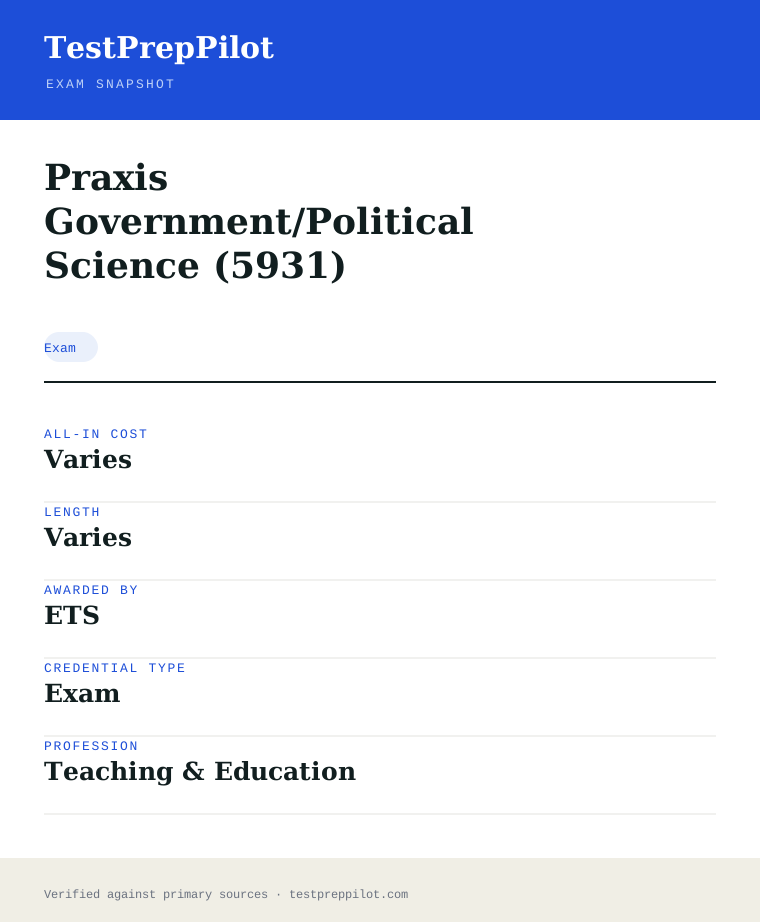
The short version
What is the Praxis Government/Political Science (5931) and is it worth it?
Praxis Government/Political Science (5931) is a professional credential administered by ETS. It validates job-ready knowledge and skills in the Education & Teaching field and is used for career entry, advancement, or compliance.
- Recognized credential from ETS
- Demonstrates verified competence in Education & Teaching
- Supports career advancement and may satisfy licensing or employer requirements
What is it?
What exactly is the Praxis Government/Political Science (5931)?
Praxis Government/Political Science (5931) — Education & Teaching credential from ETS
Content test covering United States government, comparative politics, international relations and political theory for civics teachers. Offered by ETS, it is designed for candidates who need to demonstrate verified competence in the Education & Teaching field. The credential is commonly used for career entry, advancement, regulatory compliance, or employer requirements. Candidates should review the official handbook for eligibility, exam format, and scoring before registering.
The path in brief
- Confirm you meet any eligibility or prerequisites
- Review the official handbook and study materials
- Register and pay through the awarding body or authorized provider
- Schedule and take the exam (test center or online proctoring)
- Receive your score and, if passed, your credential
Before you book
Who is eligible to sit the Praxis Government/Political Science (5931)?
Eligibility varies; many credentials are open to all, while others require coursework, work experience, or sponsorship.
Who it is for: Professionals and candidates seeking to validate Education & Teaching competence.
The test itself
What is the format of the Praxis Government/Political Science (5931)?
The Praxis Government/Political Science (5931) is administered by ETS and runs Varies by exam.
| Administered by | ETS |
|---|---|
| Questions | Varies by exam — see the official handbook |
| Time limit | Varies by exam |
| Pass mark | Passing score set by the awarding body; see the official score report |
| Exam fee | Varies by location and currency — confirm on the official registration page |
| Format | Proctored, computer-based (test center or online remote proctoring) |
Content outline
What topics are on the Praxis Government/Political Science (5931)?
The Praxis Government/Political Science (5931) covers 4 content domains.
Weightings come from the official exam outline. Study time is best allocated in roughly these proportions rather than evenly across domains.
- Subject content
Topic area tested on the exam; see the official blueprint for the detailed breakdown.
- Instruction & pedagogy
Topic area tested on the exam; see the official blueprint for the detailed breakdown.
- Assessment
Topic area tested on the exam; see the official blueprint for the detailed breakdown.
- Classroom management
Topic area tested on the exam; see the official blueprint for the detailed breakdown.
Study materials
Which study guide should you use for the Praxis Government/Political Science (5931)?
Start with the exam sponsor's official content outline. If you also want one structured resource to work through, these are the Mometrix titles that match this exam.

This links to Mometrix's Praxis subject-test range rather than a single Praxis Government/Political Science (5931) title. Check that it lists an edition for Praxis Government/Political Science (5931) before you buy.
Affiliate links We may earn a commission if you buy through these links, at no extra cost to you. Mometrix has no say in what our exam guides cover. How we make money.
The path
How do you register for the Praxis Government/Political Science (5931)?
- 1
Read your state requirements page20 minutes
Open hiset.org and select your state or jurisdiction. Age minimums, residency rules, whether you must enrol in an adult education programme first, and the exact fees are all set locally.
- 2
Create a myHiSET account15 minutes
Sign up through the state requirements page to generate your HiSET number, which you need for scheduling, score access and any state paperwork.
- 3
Take the official practice tests1 to 2 hours per subtest
HiSET publishes free and low-cost official practice tests for each subtest. Unlike the GED at-home route, HiSET does not require a practice-test pass before you can schedule.
- 4
Schedule subtests one at a time10 minutes each
Book any of the five subtests in any order, on paper or computer at a test centre or through HiSET@Home online proctoring where your state allows it.
- 5
Test with valid photo ID65 to 120 minutes per subtest
Bring a current government-issued photo ID showing your name, date of birth, signature and photograph. At-home testers need a private room, a webcam and a stable connection.
- 6
Check scores and claim your credential1 to 2 weeks
Multiple-choice results typically post within about five to seven days and essay results within about seven to ten days. Once all five subtests pass, your state issues the credential.
The fine print
What are the retake and renewal rules for the Praxis Government/Political Science (5931)?
- Proctoring & delivery
- HiSET is offered in three ways: paper-based at a test centre, computer-based at a test centre and HiSET@Home under live online proctoring, with availability depending on the state. Calculators and formula sheets are supplied at test centres. The full battery in English or Spanish is permitted, and several states allow candidates to mix languages across subtests.
- Retake policy
- Retake rules are set per state, but a common pattern allows three attempts per subtest in a calendar year, sometimes extending to six. Several states use a favourable pricing structure in which the full fee is charged only on the first and fourth attempts while the second and third cost only the test centre or proctor fee.
- Score reporting
- Each of the five subtests is scored 1 to 20. To pass you must score at least 8 on every subtest, at least 2 out of 6 on the Language Arts Writing essay, and at least 45 out of 100 in total across the five. A score of 15 or higher on a subtest is treated as HiSET honours-level performance in several states.
- Recertification
- The credential a state issues on the strength of a passing HiSET battery is permanent and needs no renewal. Passing subtest scores are carried forward within a state-defined window while you complete the remaining subjects.
- Refunds & rescheduling
- Refund and reschedule windows are administered by PSI and vary by state and test centre; most centres require cancellation at least 24 hours before the appointment. Registering by phone rather than online attracts an additional fee in some states.
Context
HiSET subtests at a glance
| Subtest | Questions | Time | |
|---|---|---|---|
| Language Arts - Reading | About 40 to 50 multiple choice | 65 minutes | |
| Language Arts - Writing | About 50 multiple choice plus 1 essay | 120 minutes | |
| Mathematics | About 50 multiple choice | 90 minutes | |
| Science | About 50 multiple choice | 80 minutes | |
| Social Studies | About 50 multiple choice | 70 minutes |
What it pays
How much does this credential pay?
$64,580 median for high school teachers (BLS, May 2024)
The Government/Political Science (5931) exam licenses the secondary government and political science teacher, so the directly relevant occupation is High School Teachers (SOC 25-2031), which paid a May 2024 median annual wage of $64,580. The distribution deserves careful reading because secondary-teacher pay is set overwhelmingly by district salary schedules — years of service plus education credits — rather than by market pressure, and geography dominates the spread: the lowest 10 percent earned less than $47,330 and the highest 10 percent more than $104,670, with state-level medians ranging from the high $40,000s to more than $90,000 and the highest-paying states being largely the highest-cost ones such as California, New York, Massachusetts and Washington. BLS counted 1,094,500 high school teachers in 2024 and projects a 2 percent decline in employment from 2024 to 2034, driven mainly by falling secondary enrollment, while still expecting about 66,200 openings a year, almost all of them replacement need from retirement and career change. The practical reading for a 5931 candidate is that this exam is a toll gate on a stable, schedule-driven career rather than a lever on your pay: passing it efficiently matters because it clears the government content-knowledge hurdle toward licensure, but the wage work is done over time by the salary schedule, additional endorsements and experience. Because the 5931 is a single-subject endorsement test rather than a general social studies test, it typically sits alongside a broader social studies credential or serves states that require a specific government endorsement, so check how your state stacks the tests before registering.
| Measure | Figure | Source / note |
|---|---|---|
| Median annual wage, high school teachers | $64,580 | BLS Occupational Outlook Handbook, May 2024 (SOC 25-2031) |
| Lowest 10 percent | less than $47,330 | BLS OOH Pay tab, May 2024 |
| Highest 10 percent | more than $104,670 | BLS OOH Pay tab, May 2024 |
| Employment, 2024 | 1,094,500 jobs | BLS OOH Quick Facts / projections, 2024 |
| Projected annual openings | ~66,200 per year | BLS OOH Job Outlook, 2024-34 — almost all replacement need |
Job growth.-2% projected change 2024-34 (decline driven by falling secondary enrollment), with ~66,200 replacement openings a year. Pay is set by district salary schedules, so experience and geography matter more than the credential.
Source: BLS Occupational Outlook Handbook — High School Teachers
Your odds
What are the pass rates?
ETS publishes no pass rate — the cut score for 5931 is set by each state
ETS does not publish a pass-rate statistic for Praxis 5931 or any other Praxis test, and there is no single national passing score: each state education agency sets its own cut for the exam, and the state requirements vary widely — for a single-subject government test like this one you will commonly see state-set passing scores spread across the 150s and 160s on the 100-200 scaled score scale, with some states also setting different requirements depending on the grade band or on whether the candidate holds a related social studies endorsement. That means the same score can clear licensure in one state and fall short in another, so the first research step — before buying any prep product — is to look up your state’s exact 5931 cut score on the ETS Praxis state requirements page or your state’s educator-certification site. What is uniform and verifiable nationwide is the operational policy: the test is scored on the 100-200 scaled scale, ETS enforces a 21-day waiting period after score release before any retake, there is no limit on attempts, each attempt is paid at full price, and scores are valid for 10 years under ETS policy subject to your state’s acceptance window. A second structural fact matters for planning: because passing scores are state-set per exam, candidates licensed across state lines must re-check the requirement for each new state rather than assuming one passing score travels. The correct planning question is therefore not "what is the pass rate" but "what is my state’s cut score, and how far above it do my practice scores sit" — everything else, including forum anecdotes and prep-vendor pass-rate claims, is noise.
Read this before quoting the number.ETS publishes no pass rate by exam. The 5931 cut score is set independently by each state education agency on the 100-200 scaled score scale; confirm your state’s requirement before registering.
Your schedule
How long should I study for it?
65-85 hours of focused study
The 5931 is a single paper of 120 selected-response questions in 2 hours, covering five content categories: United States Government: Federal, State, and Local Institutions at 28 percent, the United States Constitution at 22 percent, United States Politics at 20 percent, Civil Rights and Civil Liberties: Landmark Court Decisions at 16 percent, and Comparative Politics and International Relations at 14 percent. The structural fact that shapes the schedule is that the Constitution and the institutions categories together carry exactly half the paper, and both are exact-recall-heavy — the framers, the ratification debates, the structure of the three branches, federalism, the amendment process — so a candidate with a strong civics background and a weak comparative-politics section has exactly one repair target, and vice versa. The exam is designed for prospective secondary teachers of government or political science, so it assumes college-level political science content, including the landmark Supreme Court decisions that define civil rights and civil liberties. The plan below runs eight weeks at roughly 8-10 hours a week, with the first three weeks on your two weakest categories, the middle weeks on breadth review and timed sub-drills, and the final week on full-length mock exams at the real one-minute-per-question pace. Because every question is selected-response, the exam is trainable: the payoff of preparation is breadth plus discrimination under time pressure, not essay craft, and the same cycle serves a political science major, a history teacher adding a government endorsement and a returning adult when the category weights are adjusted to the diagnostic.
- Week 18-10 hrs
Diagnostic and state cut-score lookup
- Take one untimed diagnostic pass through all five content categories to rank your starting position
- Look up your state’s exact 5931 cut score on the ETS Praxis state requirements page and write it down
- Confirm 5931 is the exam your state requires for the government or political science endorsement
- Download the ETS Study Companion for 5931 and map its content categories
- Weeks 2-39-11 hrs/week
US Constitution (22%)
- Political theory foundations: the contributions of Locke, Montesquieu, Rousseau and others
- The Articles of Confederation, the Constitutional Convention, and the Federalist versus Anti-Federalist debates
- The structure of the Constitution, the Bill of Rights, and the amendment process
- One timed 45-question drill under 50 minutes to build pace
- Week 49-11 hrs
US Government: Federal, State, and Local Institutions (28%)
- The three branches: Congress, the presidency, the federal courts, and the bureaucracy
- Federalism, and state and local government structures
- Separation of powers and checks and balances in operation
- Re-test the Constitution category once to confirm the repair took
- Weeks 5-69-11 hrs/week
US Politics and landmark court decisions
- United States Politics: parties, interest groups, elections, public opinion, the media and political participation
- Civil Rights and Civil Liberties: landmark Supreme Court decisions and the 14th Amendment incorporation doctrine
- Learn the holdings of the required cases and their constitutional principles
- Two timed 45-question half-exams, rotated so all five categories stay warm
- Week 79-11 hrs
Comparative politics, international relations, and full mocks
- Comparative Politics and International Relations: political systems, ideologies, and global institutions
- Two full 5931 mocks: 120 questions in one 2-hour sitting, no notes, no phone
- Review both by content category — the pattern of misses matters more than the total
- Drill the specific categories that cost points in the mocks
- Week 86-8 hrs
Taper and logistics
- Light review of category checklists and miss lists
- One more timed 45-question half-exam to keep the pace reflex fresh
- Confirm your state cut score, your ID name matches your Praxis account, and your seat
- One quiet day before the exam
Adjusting the pace
Political science major mid-program.Six weeks at 8-10 hrs/week. Your coursework covers the theory and institutions; spend the recovered time on the landmark court cases and comparative politics, the categories where recall of specific holdings matters most.
History teacher adding a government endorsement.Six to eight weeks at 8-10 hrs/week. Your strength inverts the typical profile: the institutional and constitutional content is familiar, so put the bulk of the time into United States Politics and Comparative Politics and International Relations.
Returning adult out of school for years.Ten to twelve weeks at 7-9 hrs/week. Add two weeks before Week 1 for a rapid review of the Constitution, the branches and the landmark cases; the exact-recall content decays badly with disuse.
How to study
How do I prepare most effectively?
The 5931 is an exact-recall-heavy exam: the Constitution, the institutions and the landmark court decisions together are roughly 66 percent of the paper, and the candidates who score highest are the ones who learn specific holdings and specific structures rather than general civics fluency. The strategies below are ordered by score impact, and the first two — build a landmark-cases holdings list and learn the institutional structures as a chart — are the difference between a passing plan and a lucky one. The exam’s scoring reinforces the approach: your raw count of correct answers converts to a scaled score on the 100-200 scale against a state-set cut, there is no penalty for a wrong answer, so answering every question is strictly better than leaving a blank. Because the paper is entirely selected-response, question-volume practice under timing outperforms passive reading, and the fastest gains come from tagging every practice miss to a category and re-drilling the two that leak the most points. The final strategy in the list — knowing your own state’s cut score rather than an average — is easy to skip and matters more than any study technique, because it converts the whole preparation from aiming at a guess to aiming at a number you can verify against a practice scaled score, and because a passing score in one state can be a failing score in the state where you actually intend to teach. And because the exam is computer-delivered with no essay section, the entire strategy set is trainable with question-volume practice under timing, which is why the plan reserves the final two weeks for timed sets and full mocks.
Build a landmark-cases holdings list and drill it
Civil Rights and Civil Liberties: Landmark Court Decisions is 16 percent, but the cases also appear across the institutions and politics categories. Build a one-line holdings list — the case, the constitutional issue, the holding, the principle — covering the required decisions on due process, equal protection, the Bill of Rights and the incorporation doctrine, and drill it until the holdings are reflex. The items reward knowing what each case decided, not just recognizing the case name.
Learn the institutional structures as a chart
US Government: Federal, State, and Local Institutions is the largest category at 28 percent, and it rewards exact structure: the powers of each chamber, the president’s enumerated powers, the structure of the federal courts, the bureaucracy and federalism. Build a one-page chart of the branches, their powers and their checks on each other, and drill against it — the scenario items test which institution has which power.
Drill the Constitution and the founding debates
The Constitution category is 22 percent and covers the Articles of Confederation’s weaknesses, the Convention compromises, the Federalist versus Anti-Federalist positions and the amendment process. This content is exactly recallable and highly testable — build a chronology and a compromise-by-compromise list and drill them in short spaced sessions.
Do the politics category as applied content
United States Politics is 20 percent and covers parties, interest groups, elections, public opinion, the media and participation. Candidates with a civics background often skim this category and then lose the scenario items that test political behavior. Work the scenario items and learn the item language ETS uses for political behavior and linkage institutions.
Rehearse the full 2-hour sitting at least twice
120 questions in 120 minutes is exactly one minute per question with no constructed-response cushion, so pacing is the tactical skill. Two full mocks in Week 7, under exam conditions, tell you exactly where fatigue and over-thinking cost you, and let you rehearse the eliminate-and-move discipline that a selected-response exam demands.
Know your state cut score, not an average
Because the passing score is set per state, a candidate who studies to "beat a 155" may be over- or under-preparing. Look up your state’s requirement in Week 1, aim at it plus a margin, and re-check the week before the exam in case the state changed the cut.
What to buy
Which study resources are worth paying for?
The highest-value resources for the 5931 are the free ETS Study Companion, which contains the exact content categories and sample questions, and ETS’s own Interactive Practice Test, which is the closest thing to the real item style. Third-party subscription courses add structure and drilling volume and are worth it mainly if a specific category needs systematic repair — the comparative politics category for US-focused candidates, or the landmark cases for candidates without a political science background. Because the paper is entirely selected-response and heavily exact-recall, the resource that matters most is one with strong question banks and holdings lists rather than a lecture course that only surveys concepts. The buying decision is really: how much structured remediation do your two weakest categories need? A candidate with a political science degree often needs only the Study Companion, the practice test and a good landmark-cases reference, while a history teacher adding the endorsement or a returning adult benefits from the guided course. The ETS Interactive Practice Test at roughly $20 is the best single readiness check, and running it before buying anything else tells you which categories actually need repair — the information a good buying decision depends on. Budget the exam fee itself ($130, plus a $5 surcharge in Nevada and a 3 percent online service fee) and the $35 additional score reports if you add recipients after registration, because designating your state and program as recipients at registration is free. We do not rank by commission, and all prices below are list prices as of 2026-08.
| Resource | Price | Format | Best for |
|---|---|---|---|
| ETS Study Companion (5931) | Free | PDF content outline with sample questions | The authoritative content map — tag every miss to these categories |
| ETS Praxis Interactive Practice Test (5931) | ~$20 | Timed online practice with immediate scoring | Closest question style to the real exam; the best single readiness check |
| Exam registration (5931) | ~$130 (confirm current fee at ets.org/praxis) | Prometric centre or online proctoring | Required — book only after practice scores clear your state cut with a margin |
| Praxis 5931 subscription course | ~$80-100 per month | Diagnostic plus content-area lessons and practice | Structured repair for the weakest category, especially comparative politics |
| AP Government and Supreme Court case references | ~$15-40 | Print, with case holdings and practice questions | The landmark-cases and institutions content |
| District or university Praxis prep course | Often free or low-cost | In-person or live online with an instructor | Accountability and structured pacing for career changers |
Prices checked 2026-08 in USD before promotions; ETS registration fees are set by ETS and state surcharges may apply (Nevada adds $5 per test). Passing scores are set by state and are not included in any fee. We do not rank by commission.
Avoid these
What mistakes do candidates most often make?
The 5931 failure modes cluster around two roots: studying general civics fluency when the exam rewards exact recall of specific institutions, holdings and structures, and never running a timed full-length mock. The six traps below are the recurring ones in candidate post-mortems, and every one of them is fixable within a single eight-week cycle. Notice that most of them are process errors — recognizing case names without knowing their holdings, skipping the comparative politics category, confusing the branches’ powers, training to a national passing score that does not exist — rather than gaps in any single body of knowledge, which means a changed plan fixes them faster than added hours. The encouraging implication is that the same candidate who would fail by studying only the Constitution passes by adding the institutions, politics, cases and comparative categories to the plan, and the diagnostic in Week 1 is the highest-leverage hour of the schedule. The last trap, ignoring the 21-day retake wait, is the one with the hardest deadline consequences, because it can turn a narrow fail into a missed licensure window — which is exactly why the schedule builds the first attempt around a verified cut score rather than around optimism.
✕Recognizing case names without knowing their holdings
✓The landmark-cases items ask what each decision held and what principle it established, not whether you have heard of the case. Build a one-line holdings list and drill it until the holdings are reflex — the case, the issue, the holding, the principle. Candidates who only skim case names lose the highest-value exact-recall items on the paper.
✕Studying only the Constitution and the branches
✓The Constitution and institutions categories together are 50 percent, but United States Politics (20%), Civil Rights and Civil Liberties (16%) and Comparative Politics and International Relations (14%) make up the other half. Candidates who study only the constitutional core leave half the paper underprepared. Weight by the diagnostic and keep every category warm.
✕Skipping comparative politics and international relations
✓Comparative Politics and International Relations is the smallest category at 14 percent, but it is the one candidates without political science coursework most often skip entirely — and 14 percent is enough to decide a pass near the cut line. Build a checklist of political systems, ideologies and international institutions and drill it in short spaced sessions.
✕Preparing for the wrong exam or the wrong cut score
✓Some states require 5931 for a government endorsement, others accept the broader 5581 social studies test, and each state sets its own passing score — commonly in the 150s-160s on the 100-200 scale. Confirm which exam your state requires and its exact cut score in Week 1, and require your practice mocks to beat that number by a margin.
✕Never running a full-length mock
✓120 questions in 120 minutes is exactly one minute per question, a pacing test as much as a knowledge test. Candidates who never run the full sitting over-think early items and rush the final category. Two full mocks in Week 7 turn pacing from a surprise into a planned discipline.
✕Ignoring the 21-day retake wait
✓ETS enforces a 21-day waiting period after score release before a retake, and each attempt is paid at full price. A candidate who fails and needs the score by a licensure deadline can miss it entirely because of the wait. Treat the first attempt as serious, and use the window for targeted repair rather than a same-knowledge re-sit.
What you'll face
What question types will I see?
The 5931 is 120 selected-response questions in 2 hours, computer-delivered at Prometric centres or via online proctoring, scored on the 100-200 scaled scale against a state-set cut. The paper covers five content categories — United States Government: Federal, State, and Local Institutions (28%), the United States Constitution (22%), United States Politics (20%), Civil Rights and Civil Liberties: Landmark Court Decisions (16%) and Comparative Politics and International Relations (14%) — and every item is selected-response, mostly single-answer multiple choice with four choices, plus a minority of alternative formats such as multiple-selection, matching or order items that ETS uses across its tests. The item mix splits between direct-recall content — the powers of each branch, the holdings of landmark cases, the compromises of the Convention — and scenario items that present a political situation and ask for the correct judgment or the governing principle. ETS notes that some questions on a form are pretest items that do not count toward your score. Because there are no essays and no constructed-response tasks, pacing is the dominant tactical skill: exactly one minute per question, sustained across the whole sitting, with eliminate-and-move as the core discipline — answer confidently, flag genuinely uncertain items for review, and never let a single question eat several minutes. The sample items below illustrate the mix: one institutions item, one landmark-cases item and one comparative-politics item.
Four answer choices across all five categories. Distractors are plausible near-misses from adjacent institutions or holdings, so partial familiarity is punished.
Which branch has which power, what a specific case held, which compromise produced which structure — the paper rewards knowing specifics, not general civics fluency.
A described political situation — an election, an interest group action, a media effect — asking for the correct judgment or governing concept.
Select more than one correct option or place steps in sequence. Scoring is all-or-nothing on these formats, so read the stem’s instruction carefully.
Try these
Q1Which of the following is an accurate statement about the relationship between the federal government and state governments under the United States Constitution?
Answer:B
Under the Constitution, the federal government holds enumerated (delegated) powers, the states retain the reserved powers of the Tenth Amendment, and both levels share concurrent powers such as taxation (B). A inverts the structure — the Constitution delegates powers to the federal government and reserves the rest to the states. C describes the nullification doctrine, which the Supreme Court rejected. D invents a power the federal government does not have. The item tests the federalism content in the institutions category.
Q2In Brown v. Board of Education of Topeka (1954), the Supreme Court held that segregated public schools violated which constitutional guarantee?
Answer:C
Brown held that racial segregation in public schools deprived students of the equal protection of the laws guaranteed by the Fourteenth Amendment, overturning the separate-but-equal doctrine of Plessy v. Ferguson (C). A is wrong — the establishment clause concerns religion and government. B concerns searches and seizures. D is unrelated to the school segregation issue. The item tests the landmark-cases content and the exact holding of a required decision.
Q3A country has a single dominant party, elections that are not considered free and fair by international observers, and no independent judiciary. Which form of government best describes this system?
Answer:B
A system with a single dominant party, unfree elections and no independent judiciary is best described as an authoritarian regime — power is concentrated and unaccountable, and the institutional checks of liberal democracy are absent (B). A constitutional monarchy (A) may be democratic if the monarch’s powers are ceremonial, which the description does not support. A direct democracy (C) requires citizen voting on policy, contradicted by unfree elections. A federal republic (D) requires free elections and divided power. The item tests the comparative-politics content and the classification of political systems.
Samples are editor-written illustrations of the published blueprint, not live exam items.
The big day
What should I expect on exam day?
The 5931 is a single appointment of 2 hours at a Prometric test centre or via online proctoring, containing 120 selected-response questions in one sitting. The most common way a qualified candidate loses the seat is administrative: your government-issued photo ID must match your Praxis account name exactly, and for online proctoring you need a private room, working camera and microphone, and a clean desk. Check your account spelling and your state’s cut score the week before. At the centre you are checked in, photographed and seated at a computer; scratch paper is issued and collected. The testing interface allows flagging and review within the single section, and there are no separately timed subtests — the 2-hour clock runs continuously, so budget exactly one minute per question and keep moving. The practical pacing plan is: clear the items you are confident on, flag genuinely uncertain ones, and use the final minutes to review flags rather than re-reading everything, because at one minute per item there is no time to re-read entire scenarios. There are no scheduled breaks in a 2-hour sitting; unscheduled breaks may be taken but the clock does not stop, so use the restroom before check-in. When you finish, your scaled score appears on screen, and the official score report follows in about five weeks to the recipients you selected at registration — which typically includes your state education agency and teacher-preparation program, so designate them during registration rather than paying $35 per additional report later. If you score below your state’s cut, remember the 21-day retake window and the fact that scores are valid for 10 years once earned.
Bring
- Government-issued photo ID with your name matching your Praxis account exactly
- Your Praxis registration confirmation or candidate ID in case check-in cannot locate the booking
- For online proctoring: a phone for check-in, a private room, and a webcam and microphone already tested on the machine you will use
- Your state’s 5931 cut score, so you can interpret the on-screen result correctly
Leave at home
- Phones, smartwatches, fitness trackers and earbuds — secured in a locker at a centre
- All notes, textbooks and printed study materials — no personal scratch paper is allowed
- Bags, coats, food and drink beyond what the centre permits
- Any other person in the room for online proctoring; the session is recorded
How the day runs
Rules in the room
- 120 selected-response questions in one 2-hour session; scaled score on the 100-200 scale with a state-set cut.
- You may flag items and review them within the single section; there are no separately timed subtests.
- No scheduled breaks in the sitting; unscheduled breaks may be taken but the clock does not stop.
- Scratch paper is issued at a test centre and collected; online proctoring uses a digital whiteboard only.
- Some questions on the form are pretest items that do not count toward your score.
- Retake: ETS requires a 21-day wait after score release; no limit on attempts; each attempt paid in full.
- Scores are valid for 10 years, subject to your state’s acceptance window.
Afterwards.Your scaled score appears on screen when you finish, and the official report follows in about five weeks to the recipients you selected — typically your state education agency and teacher-preparation program. Because the cut score is state-set, read your result against your state’s published 5931 requirement rather than against any number on the report. On a pass, the government content-knowledge hurdle is cleared, your score is banked for 10 years under ETS policy, and you move to the remaining licensure requirements — commonly a pedagogy test and any state-specific components. On a fail, the path is straightforward: wait the 21 days, but use the window deliberately. The most common failure pattern is not missing knowledge overall but a specific category — usually comparative politics for US-focused candidates, or the landmark cases for candidates who studied institutions without the holdings — and that is fixable in one targeted cycle. Do not re-book the same knowledge; spend the window repairing the specific category the score report and your practice history point to, and the second attempt will be a different exam experience.
Reference
What are the key facts about the Praxis Government/Political Science (5931)?
Praxis Government/Political Science (5931) is a exam credential; awarded by ETS; the exam fee is Varies by location and currency — confirm on the official registration page; typical preparation is Varies.
| Credential | Praxis Government/Political Science (5931) |
|---|---|
| Type | Exam |
| Profession | Teaching & Education |
| Specialty | Praxis Humanities & Social Studies |
| Awarded by | ETS |
| Difficulty | Mixed |
| Typical prep time | Varies |
| All-in cost | Varies |
| Credential | Praxis Government/Political Science (5931) |
| Awarding body | ETS |
| Exam format | Proctored, computer-based |
| Validity | Varies by credential (commonly 2–3 years) |
| Languages | Varies — see awarding body |
| Scope | National / Multi-state |
| Also known as | 5931 |
Real questions
Frequently asked questions about the Praxis Government/Political Science (5931)
How do I register for the Praxis Government/Political Science (5931) exam?
Register through ETS's official portal or an authorized test provider (e.g., Pearson VUE or Prometric where applicable). Create an account, select the exam, pay the fee, and schedule a date.
How much does the exam cost?
Fees vary by location and currency. Confirm the current fee on the official registration page before scheduling.
How long is the credential valid, and how do I renew?
Validity varies by credential (commonly 2–3 years). Renewal usually requires continuing education or a recertification exam — see ETS's policy.
What if I do not pass?
Most bodies allow retakes after a waiting period and payment of the full or partial fee. Check ETS's retake policy before rescheduling.
Is HiSET run by ETS or by PSI?
Both. ETS develops the HiSET test content and PSI delivers it operationally, following the ETS acquisition of PSI in January 2024. In practice you register and schedule through myHiSET on the PSI platform.
Do I have to live in a HiSET state to test?
Usually not. Several HiSET states, including Georgia and Oklahoma, explicitly allow non-residents to test, though you generally must pass your final subtest in the state whose credential you want.
Is HiSET easier than the GED?
They are set to comparable standards but structured differently: HiSET has five subtests with reading and writing separated, while the GED combines them into one Reasoning Through Language Arts test. HiSET is more widely available on paper, which some candidates prefer.
In short
Is the Praxis Government/Political Science (5931) worth it?
- Praxis Government/Political Science (5931) is awarded by ETS.
- Validates job-ready competence in Education & Teaching.
- Registration is through the awarding body or an authorized test provider.
- Renewal and retake policies vary — confirm before scheduling.
Same awarding body
What other credentials does ETS award?
Worth comparing
How does the Praxis Government/Political Science (5931) compare with similar credentials?
Trust
Where does this information come from?
Everything above is taken from the awarding body's own published material. Fees, question counts and domain weights are revised regularly — check the official page before you pay.
- ETS Awarding body
Research confidence: medium · Last reviewed 2026-08