Teaching & Education • Exam
Praxis English to Speakers of Other Languages (5362)
Praxis English to Speakers of Other Languages (5362) — Education & Teaching credential from ETS
Researched and maintained by TestPrepPilot Editorial BoardTeacher licensure & Praxis desk · Figures last verified August 2026
The short version
What is the Praxis English to Speakers of Other Languages (5362) and is it worth it?
Praxis English to Speakers of Other Languages (5362) is a professional credential administered by ETS. It validates job-ready knowledge and skills in the Education & Teaching field and is used for career entry, advancement, or compliance.
- Recognized credential from ETS
- Demonstrates verified competence in Education & Teaching
- Supports career advancement and may satisfy licensing or employer requirements
What is it?
What exactly is the Praxis English to Speakers of Other Languages (5362)?
Praxis English to Speakers of Other Languages (5362) — Education & Teaching credential from ETS
ESOL licensure test covering language acquisition, linguistics, instructional planning, assessment and cultural and professional issues. Offered by ETS, it is designed for candidates who need to demonstrate verified competence in the Education & Teaching field. The credential is commonly used for career entry, advancement, regulatory compliance, or employer requirements. Candidates should review the official handbook for eligibility, exam format, and scoring before registering.
The path in brief
- Confirm you meet any eligibility or prerequisites
- Review the official handbook and study materials
- Register and pay through the awarding body or authorized provider
- Schedule and take the exam (test center or online proctoring)
- Receive your score and, if passed, your credential
Before you book
Who is eligible to sit the Praxis English to Speakers of Other Languages (5362)?
Eligibility varies; many credentials are open to all, while others require coursework, work experience, or sponsorship.
Who it is for: Professionals and candidates seeking to validate Education & Teaching competence.
The test itself
What is the format of the Praxis English to Speakers of Other Languages (5362)?
The Praxis English to Speakers of Other Languages (5362) is administered by ETS and runs ~2 hours (verify current).
| Administered by | ETS |
|---|---|
| Questions | ~120 questions (verify current) |
| Time limit | ~2 hours (verify current) |
| Pass mark | Passing score set by the awarding body; see the official score report |
| Exam fee | ~$130 |
| Format | Proctored, computer-based (test center or online remote proctoring) |
Content outline
What topics are on the Praxis English to Speakers of Other Languages (5362)?
The Praxis English to Speakers of Other Languages (5362) covers 4 content domains.
Weightings come from the official exam outline. Study time is best allocated in roughly these proportions rather than evenly across domains.
- Subject content
Topic area tested on the exam; see the official blueprint for the detailed breakdown.
- Instruction & pedagogy
Topic area tested on the exam; see the official blueprint for the detailed breakdown.
- Assessment
Topic area tested on the exam; see the official blueprint for the detailed breakdown.
- Classroom management
Topic area tested on the exam; see the official blueprint for the detailed breakdown.
Study materials
Which study guide should you use for the Praxis English to Speakers of Other Languages (5362)?
Start with the exam sponsor's official content outline. If you also want one structured resource to work through, these are the Mometrix titles that match this exam.

This links to Mometrix's Praxis subject-test range rather than a single Praxis English to Speakers of Other Languages (5362) title. Check that it lists an edition for Praxis English to Speakers of Other Languages (5362) before you buy.
Affiliate links We may earn a commission if you buy through these links, at no extra cost to you. Mometrix has no say in what our exam guides cover. How we make money.
The path
How do you register for the Praxis English to Speakers of Other Languages (5362)?
- 1
Read your state requirements page20 minutes
Open hiset.org and select your state or jurisdiction. Age minimums, residency rules, whether you must enrol in an adult education programme first, and the exact fees are all set locally.
- 2
Create a myHiSET account15 minutes
Sign up through the state requirements page to generate your HiSET number, which you need for scheduling, score access and any state paperwork.
- 3
Take the official practice tests1 to 2 hours per subtest
HiSET publishes free and low-cost official practice tests for each subtest. Unlike the GED at-home route, HiSET does not require a practice-test pass before you can schedule.
- 4
Schedule subtests one at a time10 minutes each
Book any of the five subtests in any order, on paper or computer at a test centre or through HiSET@Home online proctoring where your state allows it.
- 5
Test with valid photo ID65 to 120 minutes per subtest
Bring a current government-issued photo ID showing your name, date of birth, signature and photograph. At-home testers need a private room, a webcam and a stable connection.
- 6
Check scores and claim your credential1 to 2 weeks
Multiple-choice results typically post within about five to seven days and essay results within about seven to ten days. Once all five subtests pass, your state issues the credential.
The fine print
What are the retake and renewal rules for the Praxis English to Speakers of Other Languages (5362)?
- Proctoring & delivery
- HiSET is offered in three ways: paper-based at a test centre, computer-based at a test centre and HiSET@Home under live online proctoring, with availability depending on the state. Calculators and formula sheets are supplied at test centres. The full battery in English or Spanish is permitted, and several states allow candidates to mix languages across subtests.
- Retake policy
- Retake rules are set per state, but a common pattern allows three attempts per subtest in a calendar year, sometimes extending to six. Several states use a favourable pricing structure in which the full fee is charged only on the first and fourth attempts while the second and third cost only the test centre or proctor fee.
- Score reporting
- Each of the five subtests is scored 1 to 20. To pass you must score at least 8 on every subtest, at least 2 out of 6 on the Language Arts Writing essay, and at least 45 out of 100 in total across the five. A score of 15 or higher on a subtest is treated as HiSET honours-level performance in several states.
- Recertification
- The credential a state issues on the strength of a passing HiSET battery is permanent and needs no renewal. Passing subtest scores are carried forward within a state-defined window while you complete the remaining subjects.
- Refunds & rescheduling
- Refund and reschedule windows are administered by PSI and vary by state and test centre; most centres require cancellation at least 24 hours before the appointment. Registering by phone rather than online attracts an additional fee in some states.
Context
HiSET subtests at a glance
| Subtest | Questions | Time | |
|---|---|---|---|
| Language Arts - Reading | About 40 to 50 multiple choice | 65 minutes | |
| Language Arts - Writing | About 50 multiple choice plus 1 essay | 120 minutes | |
| Mathematics | About 50 multiple choice | 90 minutes | |
| Science | About 50 multiple choice | 80 minutes | |
| Social Studies | About 50 multiple choice | 70 minutes |
What it pays
How much does this credential pay?
$64,580 median for high school teachers (BLS SOC 25-2031, May 2024)
The Praxis English to Speakers of Other Languages test is a licensure test for teachers of English learners, and the closest BLS occupation is High School Teachers under SOC code 25-2031, which is the standard comparison for this exam family on this site; the exam itself is a licensure step rather than an occupation, so the wage it affects is the teacher wage, set by district salary schedules rather than by certification. The May 2024 median was $64,580 a year, with the lowest 10 percent earning less than $47,330 and the highest 10 percent more than $104,670; the 25th percentile sat near $57,800 and the 75th near $83,010. BLS reported employment of 1,094,500 jobs in 2024 and projected a 2 percent decline from 2024 to 2034, with about 66,200 openings a year, a figure driven entirely by replacement need. Two things are worth noting for an ESOL candidate specifically. First, there is no separate BLS wage for English-as-a-second-language teachers in K-12; the closest named category, Adult Basic and Secondary Education and ESL Teachers, covers adult programs and earned a $59,950 median in May 2024, but K-12 ESOL teachers are classified within the general teaching occupations and paid on the same district schedules. Second, the demand side for ESOL teachers is driven by district need for English-learner services, which is a staffing decision made locally, not a BLS occupation trend; the teacher employment outlook overall is flat with large turnover-driven openings, so the licensure step remains the practical bottleneck for entering the field. The honest summary is that 5362 opens the door to a stable, schedule-driven teaching career whose pay varies widely by district and state, and the exam does not change the wage — it creates eligibility, which is its entire career value.
| Measure | Figure | Source / note |
|---|---|---|
| Median annual wage, high school teachers | $64,580 | BLS Occupational Outlook Handbook, May 2024 |
| Lowest 10 percent | less than $47,330 | BLS OOH Pay tab, May 2024 |
| Highest 10 percent | more than $104,670 | BLS OOH Pay tab, May 2024 |
| Employment, 2024 | 1,094,500 jobs | BLS OOH Quick Facts, 2024 |
| Projected annual openings | ~66,200 per year | BLS OOH Job Outlook, 2024-34 - all from replacement need |
Job growth.-2% projected change 2024-34 (decline), with about 66,200 openings a year, all from replacement need; K-12 ESOL teachers are paid on district schedules and are not tracked as a separate BLS wage category.
Source: BLS Occupational Outlook Handbook - High School Teachers
Your odds
What are the pass rates?
ETS publishes no Praxis pass rate — for 5362, the published facts are the exam structure and a passing score set by each certifying state
ETS does not publish pass rates for Praxis tests, and it never has — anyone quoting a pass rate for 5362 is guessing, because the test is criterion-referenced and the passing score is set by each certifying state rather than by ETS. What is published and verifiable is the exam structure and the scoring model, and both are what this section covers. English to Speakers of Other Languages (5362) is 120 minutes long with 120 selected-response questions, including questions with an audio component, and the content is organised into six categories: Foundations of Linguistics (18 percent), Foundations of Language Learning (22 percent), Planning and Implementing Instruction (23 percent), Assessment and Evaluation (15 percent), Culture (11 percent), and Professionalism and Advocacy (11 percent). The test is aligned with the TESOL International Association and CAEP standards for initial P-12 ESL teacher education, and it measures the knowledge and skills of a beginning-level K-12 ESOL teacher. Raw scores convert to a scaled score on the Praxis reporting scale, and each state sets its own required scaled score — for this test the state requirements span roughly the mid-140s to the low-160s depending on the state — so the effective passing bar is entirely local: the same scaled score can clear one state’s threshold and fall short in another using the same test. ETS publishes the state requirements on its website, and the required score must be confirmed before studying. Because the exam is selected-response only, scores are machine-scored and reported on the standard Praxis cycle, which is faster than tests with written sections. We have deliberately left the pass-rate table empty and covered the published structure, scoring model and state-set standard instead.
Read this before quoting the number.ETS publishes no Praxis pass rate. The passing score for 5362 is set by each certifying state, and ETS publishes the state requirements. We have not invented a pass rate and instead covered the published structure and scoring model.
Source: ETS Praxis - English to Speakers of Other Languages (5362) and state requirements
Your schedule
How long should I study for it?
50-80 hours over 8-12 weeks of focused study
A realistic study plan for English to Speakers of Other Languages (5362) is 50-80 hours over eight to twelve weeks, because the test is a 120-minute, 120-question selected-response paper covering six distinct content categories — linguistics, language learning, instruction, assessment, culture, and professionalism — and the fastest gains come from covering the categories in proportion to their weight while practising the embedded listening items, which are the format most candidates have never seen before. The category weights are Planning and Implementing Instruction (23 percent, the largest), Foundations of Language Learning (22 percent), Foundations of Linguistics (18 percent), Assessment and Evaluation (15 percent), Culture (11 percent), and Professionalism and Advocacy (11 percent). The linguistics category is the one non-teachers and even many classroom teachers under-prepare: phonetics and the IPA, morphology, syntax, semantics, pragmatics and sociolinguistics are tested at the level a teacher needs to diagnose and support English-learner language development, so a structured review of basic linguistics is essential for candidates without a linguistics background. The language-learning category covers first- and second-language acquisition, the distinction between social and academic language (BICS and CALP), and the factors that affect acquisition, which is the theoretical core of the test. The instruction category is applied pedagogy — methods, instructional models, differentiation, scaffolding, and materials — and rewards candidates who can choose the right teaching move for a described learner. The assessment category covers formal and informal assessment, accommodations, and interpreting assessment data for placement and instruction. The plan below runs through the categories in weight order and reserves the final weeks for full 120-question practice exams, because the listening items and the 60-seconds-per-question pace need rehearsal. Candidates with TESOL coursework or an ESL teaching background should budget the lower end; career changers and classroom teachers without formal linguistics should budget the upper end and add a linguistics primer.
- Weeks 1-28-10 hrs/week
Foundations of Language Learning (22%) and Foundations of Linguistics (18%)
- First- and second-language acquisition, the social-versus-academic language distinction, and the factors affecting acquisition
- Phonetics and the IPA, phonology, morphology, syntax, semantics and pragmatics at the teacher-relevant level
- Sociolinguistics, world Englishes, and the relationship between language and literacy development
- Practise reading phonemic transcription and identifying word-formation patterns — the linguistics items teachers find hardest
- Weeks 3-49-11 hrs/week
Planning and Implementing Instruction (23% — the largest category)
- Methods and approaches for teaching English learners, and the instructional delivery models in US schools
- Planning standards-aligned objectives, designing activities, and integrating the four language domains
- Differentiation, scaffolding, comprehensible input and output, and culturally responsive, age-appropriate materials
- Collaboration with content teachers and using technology to support language development
- Weeks 5-68-10 hrs/week
Assessment and Evaluation (15%) plus Culture (11%)
- Formative and summative assessment, formal and informal measures of receptive and productive language
- Accommodations for state-mandated content-area testing, and adapting classroom assessments for English learners
- Norm-referenced versus criterion-referenced assessment, interpreting data, and using data to plan instruction
- Culture: the interrelationship of language and culture, acculturation versus assimilation, and bias and stereotyping
- Week 78-10 hrs
Professionalism and Advocacy (11%)
- Legal provisions and federal court decisions affecting English learners, and ethical responsibilities
- Differentiating disabilities from language-proficiency development, and collaboration with special education
- Advocacy, family and community collaboration, and professional development for ESOL teachers
- Complete one full practice section and tag every miss to a category
- Weeks 8-109-11 hrs/week
Listening items and full practice exams
- Practise the embedded audio items: listen to a recording and answer the question it supports, replaying as allowed
- Run two full 120-question, 120-minute practice exams under real timing
- Re-tag every miss and re-drill the bottom two categories, especially linguistics if it dragged the score
- Run the official ETS sample questions as the final calibration
- Weeks 11-126-8 hrs/week
Gap closing and logistics
- Final drills on the weakest category until the misses clear
- Confirm the registration, the state’s required passing score, and the test-centre or at-home logistics
- Review the legal and instructional-models content one final time
- One rest day before the exam
Adjusting the pace
ESOL teacher with TESOL preparation.Six to eight weeks. The pedagogy and language-learning content is familiar; spend the recovered time on linguistics review and listening-item practice, which are the categories and formats that still cost points.
Classroom teacher adding ESL endorsement.Eight to ten weeks. Your instruction experience transfers; add a structured linguistics primer and the assessment-accommodation content, which are the two areas general classroom training leaves uncovered.
Career changer new to TESOL.Twelve to fourteen weeks. Budget the full hour range and add a beginning-linguistics course or text, because the linguistics category assumes a base that formal TESOL training provides and self-study does not.
How to study
How do I prepare most effectively?
The dominant preparation strategy for 5362 is to cover the six categories in proportion to their published weights while paying special attention to the two areas that most candidates under-prepare — linguistics and the embedded listening items — because the exam assumes the knowledge base of a beginning-level K-12 ESOL teacher, and candidates who study only the pedagogy categories leave the linguistics and culture content half-covered. The category weights make the plan clear: Planning and Implementing Instruction (23 percent) and Foundations of Language Learning (22 percent) are the two largest, so they deserve the most hours, followed by Foundations of Linguistics (18 percent), which is the category that separates prepared from unprepared candidates because phonetics, the IPA, morphology and syntax are not part of general teaching preparation. Second, practise the listening items explicitly: the test embeds audio questions where you hear a recording and answer what it supports, and while you can replay the prompt, candidates who have never rehearsed the format waste time and focus on test day. Third, learn the applied-pedagogy content as classroom decisions — the instruction items describe a learner or a classroom and ask what a teacher would do, so study methods, scaffolding, differentiation and instructional models as choices with rationales, not definitions. Fourth, drill the assessment content, especially accommodations for state-mandated testing and the difference between a language-proficiency issue and a disability, because these appear across the assessment and professionalism categories. Fifth, run full 120-question, 120-minute practice exams so the one-minute-per-question pace is familiar, since the test is selected-response only and machine-scored, making speed and accuracy the whole game. Finally, confirm your state’s required passing score before studying, because the target determines how much margin the harder categories can afford.
Cover the categories by their published weights
Planning and Implementing Instruction (23%) and Foundations of Language Learning (22%) are the largest categories and deserve the most hours; Culture and Professionalism (11% each) deserve focused but smaller blocks. Study time allocated by weight yields more points per hour than study time allocated by comfort.
Do a structured linguistics review
Phonetics and the IPA, morphology, syntax, semantics and pragmatics are tested at the level a teacher needs, and they are the category general teaching preparation never covers. A structured linguistics primer is the single highest-value addition for candidates without formal TESOL training.
Practise the embedded listening items
The test includes questions with an audio component where you hear a recording and answer what it supports, with replay allowed. Rehearse the format with practice materials so the first time you meet it is not on test day; listening items cost time and focus when they are unfamiliar.
Study instruction as applied classroom decisions
The largest category describes a learner or classroom and asks what a teacher would do. Study methods, scaffolding, differentiation and instructional models as decisions with rationales — comprehensible input, explicit instruction, sheltered instruction — because the items present situations, not glossaries.
Drill assessment and the disability distinction
Accommodations for state-mandated testing, adapting assessments, and telling a language-proficiency issue from a disability are recurring content that appears across the assessment and professionalism categories. These are coachable, high-frequency points that candidates routinely under-prepare.
Confirm your state’s required score before studying
Each state sets its own passing scaled score for 5362, spanning roughly the mid-140s to the low-160s. Look yours up on the ETS state-requirements page first, because the target determines how much margin the linguistics and listening content must provide.
What to buy
Which study resources are worth paying for?
5362 preparation is anchored by the free official ETS materials, because the ETS test page and Study Companion define the six content categories, the question counts and the audio format, and the sample questions show the difficulty more honestly than most third-party products. The exam itself costs $130 under the ETS fee schedule for selected-response-only tests, computer-delivered at a test centre or at home, and is offered year-round; fee waivers are available to eligible students. Beyond the official set, the main paid options are review books from major publishers at roughly $30-50, which add structured coverage of linguistics, language learning and instruction; online courses at roughly $50-200, which add video instruction in the linguistic content that self-studiers find hardest; and question banks or practice-test subscriptions at roughly $30-100, which add volume and, in the better products, listening-item practice. The buying logic follows the exam structure: because linguistics is the category that separates prepared from unprepared candidates and the listening items are the unfamiliar format, the resources that provide linguistics instruction and audio-item practice are worth more than a generic pedagogy review. Most candidates need one review book or course for the linguistics content plus timed practice rather than a stack of materials. The footnote that anchors the comparison: prices below are list prices as of mid-2026 and change frequently, we rank nothing by commission, and the free official materials should be the first download for every candidate. Confirm the state’s required passing score before choosing how much to spend, since the target affects how much practice is enough.
| Resource | Price | Format | Best for |
|---|---|---|---|
| ETS Praxis page and Study Companion (5362) official | Free | Web page + PDF: outline, sample questions | The authoritative scope map and format guide — download first |
| ESOL exam (ETS) | $130 | Computer-delivered, test centre or at home | The real exam; fee waivers available to eligible students |
| Review book (major publisher) | ~$30-50 | Print + eBook with practice questions | Structured coverage of linguistics, language learning and instruction |
| Online course | ~$50-200 | Video instruction plus practice | Candidates needing the linguistics content taught |
| Question bank / practice-test subscription | ~$30-100 | Online timed practice | Volume plus listening-item practice close to the exam |
Prices checked 2026-08 in USD before tax and change frequently; we rank nothing by commission. The ETS fee for selected-response-only Praxis tests is $130, and fee waivers are available to eligible students. Confirm the state-required passing score before choosing how much to spend.
Avoid these
What mistakes do candidates most often make?
The failures on 5362 are rarely about not knowing how to teach English learners — they are about under-preparing the categories and formats that teaching experience never covers. The single most common mistake is skipping the linguistics category: phonetics, the IPA, morphology, syntax and pragmatics are 18 percent of the test and are not part of general teaching preparation, so candidates without formal TESOL training who study only the pedagogy content lose nearly a fifth of the paper. The second is neglecting the embedded listening items, which are a format most candidates have never seen; without rehearsal, the first encounter on test day costs time and focus. The third is studying instruction as definitions rather than classroom decisions, when the largest category describes a learner or a situation and asks what a teacher would do — candidates who memorise method names without their applications choose wrong among plausible options. The fourth is under-preparing the assessment content, especially the accommodations for state-mandated testing and the distinction between a language-proficiency issue and a disability, which recur across two categories. The fifth is misallocating time across the categories, spending hours on the comfortable 11 percent categories while the 23 percent instruction and 22 percent language-learning categories get thin coverage. And the sixth is never running a full 120-question, 120-minute practice exam, so the one-minute-per-question pace surprises them on test day. None of these are knowledge gaps in TESOL pedagogy; every one is correctable with a structured linguistics review and full-length rehearsal, which is why candidates who close the specific gap pass on the retake.
✕Skipping the linguistics category
✓Foundations of Linguistics is 18 percent of the test, and phonetics, the IPA, morphology, syntax and pragmatics are not covered by general teaching preparation. Do a structured linguistics review even if it feels academic — it is the category that separates prepared from unprepared candidates.
✕Neglecting the embedded listening items
✓The test includes audio questions where you hear a recording and answer what it supports, with replay allowed. Rehearse the format in practice so it is familiar on test day; candidates who meet it for the first time lose time and focus in the middle of the exam.
✕Studying instruction as definitions
✓The largest category (23 percent) describes a learner or classroom and asks what a teacher would do. Study methods, scaffolding and differentiation as decisions with rationales — comprehensible input, sheltered instruction, explicit teaching — because the items present situations, not glossaries.
✕Under-preparing the assessment content
✓Accommodations for state-mandated testing, adapting classroom assessments, and distinguishing a language-proficiency issue from a disability appear across two categories. These are coachable, high-frequency points that a focused review converts into easy credit.
✕Misallocating time across the categories
✓Weight your hours by the published percentages: instruction (23%) and language learning (22%) deserve the most, linguistics (18%) next, then assessment (15%) and culture and professionalism (11% each). Studying only the comfortable categories leaves the weighted ones thin.
✕Never running a full timed practice exam
✓The exam is 120 questions in 120 minutes — one minute per question — and it is selected-response only, so speed and accuracy are the whole game. Run at least two full-length practice exams before test day to build the pace and find the categories that need work.
What you'll face
What question types will I see?
English to Speakers of Other Languages (5362) is a 120-minute, computer-delivered test of 120 selected-response questions, scored on the Praxis reporting scale with a passing score set by each certifying state. The exam is selected-response only — every question is multiple choice or a selected-response variant — but it includes questions with an audio component: for the listening items, you hear a recorded prompt and answer the question it supports, and you have the opportunity to listen to the recording multiple times, taking time considerations into account. The content is organised into six categories aligned with TESOL International Association and CAEP standards: Foundations of Linguistics (18 percent) covering phonetics, the IPA, morphology, syntax, semantics, pragmatics and sociolinguistics; Foundations of Language Learning (22 percent) covering first- and second-language acquisition, the social-versus-academic language distinction, and literacy development; Planning and Implementing Instruction (23 percent) covering methods, instructional models, objectives, materials and technology; Assessment and Evaluation (15 percent) covering formal and informal measures, accommodations and data interpretation; Culture (11 percent) covering the relationship of language and culture, acculturation and bias; and Professionalism and Advocacy (11 percent) covering legal provisions, collaboration, advocacy and professional development. Some questions ask you to select more than one answer, which captures the breadth of a candidate’s knowledge, and the test may include unscored pretest questions. Because the exam is selected-response only, it is machine-scored and reported on the standard Praxis cycle, faster than tests with written sections. The pace is about one minute per question, including the audio items, so listening practice matters. The three samples below illustrate a linguistics item, an applied-instruction item, and a listening-style item; they are editor-written to the published blueprint and are not live test items.
Phonetics, the IPA, morphology, syntax, semantics, pragmatics and sociolinguistics. The category general teaching preparation never covers, and the one that separates prepared from unprepared candidates.
First- and second-language acquisition, the social-versus-academic distinction, and the factors and models of acquisition.
A learner or classroom is described and you choose the teaching move — method, scaffold, model, material or technology decision with a rationale.
Accommodations, data interpretation, the language-versus-disability distinction, acculturation, legal provisions and advocacy.
An audio prompt is played and you answer what it supports, with replay allowed. The unfamiliar format that needs explicit rehearsal.
Try these
Q1A beginning English learner consistently says "I goed to the store" instead of "I went to the store." This error is best explained by which phenomenon of second-language acquisition?
Answer:A
The learner is applying the regular past-tense rule — adding "-ed" — to the irregular verb "go", producing "goed". This is overgeneralization, a normal developmental phenomenon in both first- and second-language acquisition where a regular rule is applied beyond its valid set; it is evidence that the learner has acquired the past-tense rule, not that they lack it. B is wrong because the error is not a transfer from another language’s grammar but an internal over-application of an English rule. C is wrong because overgeneralization is not language loss. D is a serious over-response: a single systematic overgeneralization is a normal acquisition pattern, not evidence of impairment, and referring a learner on this basis would be a professional error. The item tests linguistic knowledge applied to real learner production, exactly the foundation-of-linguistics and language-learning content the test rewards.
Q2An English learner reads fluently in their home language and has strong literacy skills. Which instructional approach best leverages this strength for English literacy development?
Answer:B
Connecting cognates and comparing text structures across languages is the practice of transfer, the evidence-based approach for learners with strong home-language literacy: they bring conceptual knowledge of how texts work, and instruction that names the cross-language connections accelerates English literacy development. A overstates automatic transfer — literacy skills transfer partially, but explicit oral language and English-specific instruction are still needed. C is backwards; research shows home-language maintenance and use support, not hinder, English development. D wastes the student’s existing literacy by restarting from the beginning level, which ignores the transferable skills. The item tests the instruction category’s core principle — building on students’ prior knowledge and home-language assets — which is a high-frequency concept on this test.
Q3Listening item (illustrated): You hear a short recording of a teacher giving directions for a science activity: "First, look at the picture on page twelve. Then, with your partner, write down three things you notice. Do not start the experiment until I say go." The listening question asks: Which skill is this activity most directly developing?
Answer:A
The recorded directions require the listener to hold and sequence multiple steps — look, then write, then wait — which is following multi-step oral directions, a receptive-language skill central to academic listening for English learners. B is wrong because the recording is teacher speech to be followed, not student text to be read aloud. C is wrong because the writing task is a short list of observations, not a formal report. D is wrong because the activity targets comprehension and following instructions, not vocabulary memorisation. This sample illustrates the listening-item format: an audio prompt supports a comprehension question, and candidates who have rehearsed the format know to listen for the task being practised rather than the surface topic. On the real exam the audio can be replayed, but efficient first-pass listening still matters at one minute per question.
Samples are editor-written illustrations of the published blueprint, not live exam items.
The big day
What should I expect on exam day?
English to Speakers of Other Languages (5362) is a 120-minute, computer-delivered test taken at a Praxis test centre or at home through ETS online proctoring, and the direct exam-day answer is that you will sit 120 selected-response questions, including embedded listening items with audio, and because the exam is selected-response only, scores are machine-scored and reported on the standard Praxis cycle rather than on screen. Arrive with your admission ticket and a valid photo ID whose name matches your Praxis registration exactly; a mismatch means no test and a forfeited fee. At the test centre, personal items, phones and study materials go in a locker; for at-home testing, the ETS Secure Test Browser, a webcam and a private room are required, and the proctor verifies identity and scans the room before the exam begins. Pace the 120 minutes at about one minute per question, including the listening items, which appear throughout the test — for each audio question you can listen to the recording more than once, but repeated replays eat the clock, so use your first pass efficiently. Some questions ask you to select more than one answer, so read each instruction carefully, and answer every question because there is no penalty for guessing and some items are unscored pretest questions. You may skip and return within the section if the interface allows, but the entire test is one section, so manage the clock globally. Expect a controlled environment and follow the proctor’s instructions exactly, because ETS security rules are strict and violations can invalidate the score. Confirm your state’s required passing score before the day, because that number, not the 120-minute format, defines what passing means for you.
Bring
- Admission ticket from your ETS Praxis account
- A valid photo ID (driver’s license, passport or school ID accepted per Praxis rules) with a name matching your registration
- For at-home testing: a computer with the ETS Secure Test Browser, a webcam, a microphone and a private room
- Prescription glasses if needed; the test centre provides a locker for everything else
Leave at home
- Phones, smartwatches, fitness trackers and any electronic device — locked at the centre, out of the room for at-home testing
- All notes, books and study materials; the centre provides note-taking material if any is allowed
- Bags, coats and food or drink beyond what the test centre permits
- For at-home testing: any other person, second monitor or unapproved device in the room
How the day runs
Rules in the room
- 120 minutes for 120 selected-response questions, including questions with an audio component.
- The passing score is set by the certifying state, not by ETS; confirm your state’s required scaled score before the exam.
- Photo ID with a name matching your Praxis registration exactly is required, or you are turned away and the fee is forfeited.
- No personal items in the room; no calculators, notes or study materials.
- For at-home testing, the ETS Secure Test Browser, a webcam and a private room are required, and the room is scanned by the proctor.
- Some questions require selecting more than one answer, and some items are unscored pretest questions — answer everything.
Afterwards.Because 5362 is selected-response only, it is machine-scored and results post to your ETS Praxis account on the standard cycle, typically within a few weeks, and your score report shows your scaled score plus a performance breakdown by content category. On a score at or above your state’s requirement, your score is sent to the designated recipients and becomes part of your licensure file — 5362 is a licensure step, not the license itself, so continue with the remaining certification steps in your state, which for ESOL teachers may include additional pedagogy or endorsement requirements. On a score below the requirement, you can retake after ETS’s 28-day waiting rule, paying the full $130 fee each time, and there is no limit on attempts. Use the score report as the diagnosis: it shows raw points earned versus available by category, so it tells you exactly whether the loss was in linguistics, language learning, instruction, assessment, culture or professionalism. If linguistics dragged the score down, spend the retake window on a structured linguistics review; if it was the listening items, rehearse the audio format. Candidates who retake after closing the specific gap rather than re-reading everything are the ones who pass on the next attempt.
Reference
What are the key facts about the Praxis English to Speakers of Other Languages (5362)?
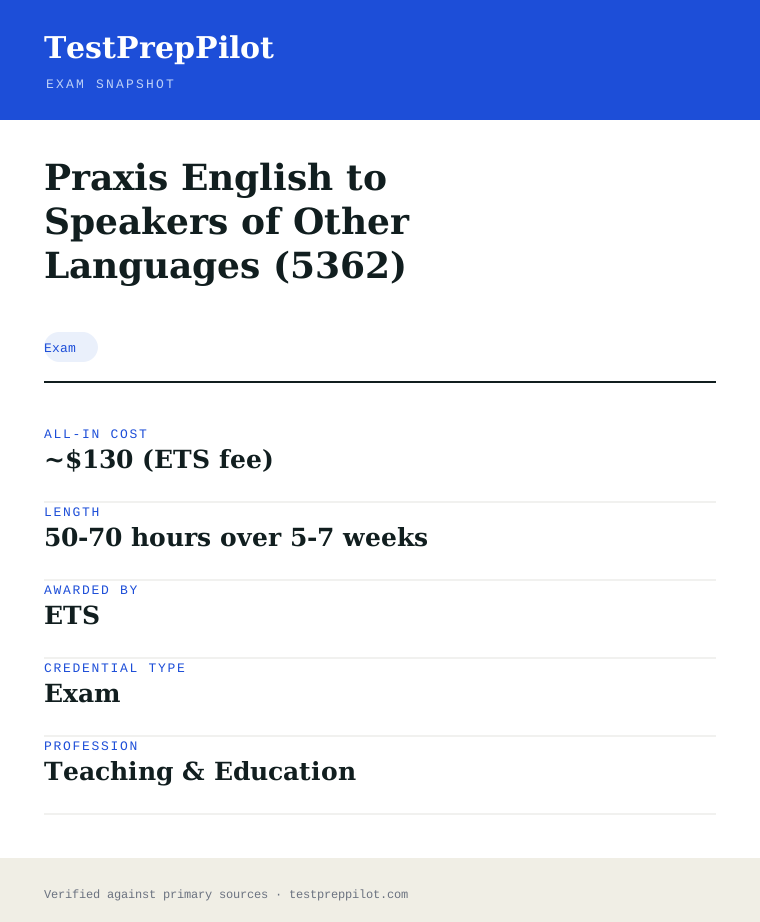
Praxis English to Speakers of Other Languages (5362) is a exam credential; awarded by ETS; the exam fee is ~$130; typical preparation is 50-70 hours over 5-7 weeks; holders typically earn $40,000-$85,000 (25-2031 median $64,580).
| Credential | Praxis English to Speakers of Other Languages (5362) |
|---|---|
| Abbreviation | Praxis ESOL |
| Type | Exam |
| Profession | Teaching & Education |
| Specialty | Praxis World Languages |
| Awarded by | ETS |
| Difficulty | Mixed |
| Typical prep time | 50-70 hours over 5-7 weeks |
| All-in cost | ~$130 (ETS fee) |
| Typical salary range | $40,000-$85,000 (25-2031 median $64,580) |
| Credential | Praxis English to Speakers of Other Languages (5362) |
| Awarding body | ETS |
| Exam format | Proctored, computer-based |
| Validity | State-set passing score; validity varies by state |
| Languages | Varies — see awarding body |
| Scope | National / Multi-state |
| Also known as | 5362, ESOL |
Real questions
Frequently asked questions about the Praxis English to Speakers of Other Languages (5362)
How do I register for the Praxis English to Speakers of Other Languages (5362) exam?
Register through ETS's official portal or an authorized test provider (e.g., Pearson VUE or Prometric where applicable). Create an account, select the exam, pay the fee, and schedule a date.
How much does the exam cost?
Fees vary by location and currency. Confirm the current fee on the official registration page before scheduling.
How long is the credential valid, and how do I renew?
Validity varies by credential (commonly 2–3 years). Renewal usually requires continuing education or a recertification exam — see ETS's policy.
What if I do not pass?
Most bodies allow retakes after a waiting period and payment of the full or partial fee. Check ETS's retake policy before rescheduling.
Is HiSET run by ETS or by PSI?
Both. ETS develops the HiSET test content and PSI delivers it operationally, following the ETS acquisition of PSI in January 2024. In practice you register and schedule through myHiSET on the PSI platform.
Do I have to live in a HiSET state to test?
Usually not. Several HiSET states, including Georgia and Oklahoma, explicitly allow non-residents to test, though you generally must pass your final subtest in the state whose credential you want.
Is HiSET easier than the GED?
They are set to comparable standards but structured differently: HiSET has five subtests with reading and writing separated, while the GED combines them into one Reasoning Through Language Arts test. HiSET is more widely available on paper, which some candidates prefer.
In short
Is the Praxis English to Speakers of Other Languages (5362) worth it?
- Praxis English to Speakers of Other Languages (5362) is awarded by ETS.
- Validates job-ready competence in Education & Teaching.
- Registration is through the awarding body or an authorized test provider.
- Renewal and retake policies vary — confirm before scheduling.
Same awarding body
What other credentials does ETS award?
Worth comparing
How does the Praxis English to Speakers of Other Languages (5362) compare with similar credentials?
Trust
Where does this information come from?
Everything above is taken from the awarding body's own published material. Fees, question counts and domain weights are revised regularly — check the official page before you pay.
- ETS Awarding body
Research confidence: medium · Last reviewed 2026-08