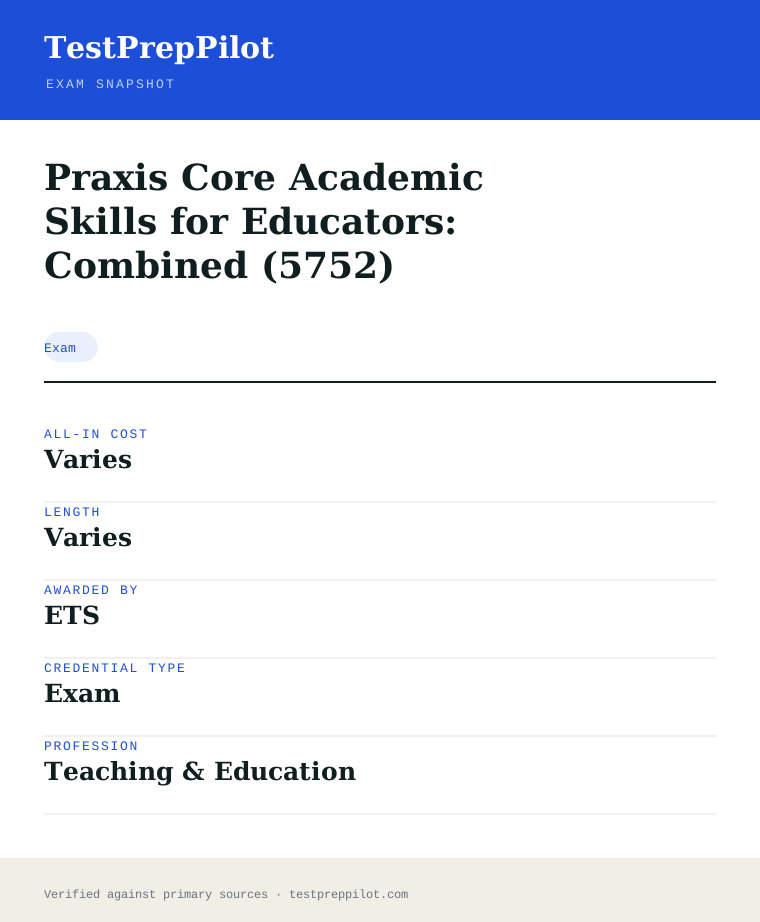
The short version
What is the Praxis Core Academic Skills for Educators: Combined (5752) and is it worth it?
Praxis Core Academic Skills for Educators: Combined (5752) is a professional credential administered by ETS. It validates job-ready knowledge and skills in the Education & Teaching field and is used for career entry, advancement, or compliance.
- Recognized credential from ETS
- Demonstrates verified competence in Education & Teaching
- Supports career advancement and may satisfy licensing or employer requirements
What is it?
What exactly is the Praxis Core Academic Skills for Educators: Combined (5752)?
Praxis Core Academic Skills for Educators: Combined (5752) — Education & Teaching credential from ETS
Single sitting combining the reading, writing and mathematics Core subtests, the usual entry requirement for teacher preparation programmes. Offered by ETS, it is designed for candidates who need to demonstrate verified competence in the Education & Teaching field. The credential is commonly used for career entry, advancement, regulatory compliance, or employer requirements. Candidates should review the official handbook for eligibility, exam format, and scoring before registering.
The path in brief
- Confirm you meet any eligibility or prerequisites
- Review the official handbook and study materials
- Register and pay through the awarding body or authorized provider
- Schedule and take the exam (test center or online proctoring)
- Receive your score and, if passed, your credential
Before you book
Who is eligible to sit the Praxis Core Academic Skills for Educators: Combined (5752)?
Eligibility varies; many credentials are open to all, while others require coursework, work experience, or sponsorship.
Who it is for: Professionals and candidates seeking to validate Education & Teaching competence.
The test itself
What is the format of the Praxis Core Academic Skills for Educators: Combined (5752)?
The Praxis Core Academic Skills for Educators: Combined (5752) is administered by ETS and runs ~4.5 hours (275 minutes) for all three subtests and contains 152 selected-response + 2 essays questions.
| Administered by | ETS |
|---|---|
| Questions | 152 selected-response + 2 essays |
| Time limit | ~4.5 hours (275 minutes) for all three subtests |
| Pass mark | Passing score set by the awarding body; see the official score report |
| Exam fee | $150 combined (or $90 per subtest taken separately) |
| Format | Proctored, computer-based (test center or online remote proctoring) |
Content outline
What topics are on the Praxis Core Academic Skills for Educators: Combined (5752)?
The Praxis Core Academic Skills for Educators: Combined (5752) covers 4 content domains.
Weightings come from the official exam outline. Study time is best allocated in roughly these proportions rather than evenly across domains.
- Subject content
Topic area tested on the exam; see the official blueprint for the detailed breakdown.
- Instruction & pedagogy
Topic area tested on the exam; see the official blueprint for the detailed breakdown.
- Assessment
Topic area tested on the exam; see the official blueprint for the detailed breakdown.
- Classroom management
Topic area tested on the exam; see the official blueprint for the detailed breakdown.
The path
How do you register for the Praxis Core Academic Skills for Educators: Combined (5752)?
- 1
Read your state requirements page20 minutes
Open hiset.org and select your state or jurisdiction. Age minimums, residency rules, whether you must enrol in an adult education programme first, and the exact fees are all set locally.
- 2
Create a myHiSET account15 minutes
Sign up through the state requirements page to generate your HiSET number, which you need for scheduling, score access and any state paperwork.
- 3
Take the official practice tests1 to 2 hours per subtest
HiSET publishes free and low-cost official practice tests for each subtest. Unlike the GED at-home route, HiSET does not require a practice-test pass before you can schedule.
- 4
Schedule subtests one at a time10 minutes each
Book any of the five subtests in any order, on paper or computer at a test centre or through HiSET@Home online proctoring where your state allows it.
- 5
Test with valid photo ID65 to 120 minutes per subtest
Bring a current government-issued photo ID showing your name, date of birth, signature and photograph. At-home testers need a private room, a webcam and a stable connection.
- 6
Check scores and claim your credential1 to 2 weeks
Multiple-choice results typically post within about five to seven days and essay results within about seven to ten days. Once all five subtests pass, your state issues the credential.
The fine print
What are the retake and renewal rules for the Praxis Core Academic Skills for Educators: Combined (5752)?
- Proctoring & delivery
- HiSET is offered in three ways: paper-based at a test centre, computer-based at a test centre and HiSET@Home under live online proctoring, with availability depending on the state. Calculators and formula sheets are supplied at test centres. The full battery in English or Spanish is permitted, and several states allow candidates to mix languages across subtests.
- Retake policy
- Retake rules are set per state, but a common pattern allows three attempts per subtest in a calendar year, sometimes extending to six. Several states use a favourable pricing structure in which the full fee is charged only on the first and fourth attempts while the second and third cost only the test centre or proctor fee.
- Score reporting
- Each of the five subtests is scored 1 to 20. To pass you must score at least 8 on every subtest, at least 2 out of 6 on the Language Arts Writing essay, and at least 45 out of 100 in total across the five. A score of 15 or higher on a subtest is treated as HiSET honours-level performance in several states.
- Recertification
- The credential a state issues on the strength of a passing HiSET battery is permanent and needs no renewal. Passing subtest scores are carried forward within a state-defined window while you complete the remaining subjects.
- Refunds & rescheduling
- Refund and reschedule windows are administered by PSI and vary by state and test centre; most centres require cancellation at least 24 hours before the appointment. Registering by phone rather than online attracts an additional fee in some states.
Context
HiSET subtests at a glance
| Subtest | Questions | Time | |
|---|---|---|---|
| Language Arts - Reading | About 40 to 50 multiple choice | 65 minutes | |
| Language Arts - Writing | About 50 multiple choice plus 1 essay | 120 minutes | |
| Mathematics | About 50 multiple choice | 90 minutes | |
| Science | About 50 multiple choice | 80 minutes | |
| Social Studies | About 50 multiple choice | 70 minutes |
What it pays
How much does this credential pay?
$62,340 median for elementary school teachers (BLS, May 2024)
The Praxis Core is not tied to a single occupation the way a nursing or engineering exam is — it is a gatekeeper that sits in front of essentially every public-school teaching career, from pre-kindergarten through high school, depending on the state. That makes any single salary figure a rough proxy rather than a precise match, and we have chosen the largest and most representative of the licensed-teaching occupations to anchor this page: elementary school teachers except special education, SOC 25-2021. That occupation had a May 2024 median annual wage of $62,340, with the lowest 10 percent earning under $46,440 and the highest 10 percent over $102,010. The spread matters because teacher pay in the United States is set overwhelmingly by district salary schedules — years of experience plus education level — rather than by market pressure, so geography dominates the numbers: a first-year teacher in a high-paying state such as New York or California can out-earn a ten-year veteran in a low-paying state. BLS counted 1,539,800 kindergarten and elementary school teachers in 2024 and projects a 2 percent decline in employment from 2024 to 2034, driven by falling elementary enrollment, yet still expects about 103,800 openings a year, essentially all of them replacement need from retirement and turnover. The honest reading for a Praxis Core candidate is that the exam does not move your salary the way a specialized certification can; it is a toll gate on a career whose pay is determined by district schedules, tenure and additional credentials. What the exam does gate is access to the profession itself, which is why treating it as a fast, well-prepared hurdle — rather than a long campaign — is the economically sensible approach.
| Measure | Figure | Source / note |
|---|---|---|
| Median annual wage, elementary school teachers (except special education) | $62,340 | BLS Occupational Outlook Handbook, May 2024 |
| Lowest 10 percent | less than $46,440 | BLS OOH Pay tab, May 2024 |
| Highest 10 percent | more than $102,010 | BLS OOH Pay tab, May 2024 |
| Employment, 2024 (kindergarten and elementary) | 1,539,800 jobs | BLS OOH Quick Facts, 2024 |
| Projected annual openings | ~103,800 per year | BLS OOH Job Outlook, 2024-34 — almost all replacement need |
Job growth.-2% projected change 2024-34 (decline driven by falling elementary enrollment), with ~103,800 replacement openings a year. Teacher pay is set by district schedules, so geography and years of service matter more than the credential itself.
Source: BLS Occupational Outlook Handbook — Kindergarten and Elementary School Teachers
Your odds
What are the pass rates?
ETS publishes no pass rate by test — the cut score is set by each state
ETS does not publish a pass-rate statistic for Praxis Core or any individual Praxis test, and it never has. What ETS publishes instead is the scaled score range — each Core subtest is reported on a 100 to 200 scale — and the fact that the passing score is determined by each state education agency, not by ETS. That is why you will see figures like 150, 156, 162 or 168 cited for the same subtest in different states: those are state-set cut scores, and the spread is wide enough that the same paper could pass in one state and fail in another. This makes "what is the pass rate" the wrong question; the right question is "what is my state’s cut score for each subtest", and the answer lives on the state’s teacher-certification page and on the ETS Praxis state requirements list. What is verifiable and consistent nationwide is the retake policy: ETS requires you to wait 21 days after score release before retaking a failed subtest, there is no limit on the number of attempts, and each attempt is paid at full price. Because the Combined (5752) is scored per subtest, a partial pass behaves sensibly — if you pass two subtests and fail one, you only re-sit the failed subtest, at the individual $90 rate, rather than the whole combined test. That single policy is the reason the combined test is not a high-risk gamble: the downside of a partial pass is one paid retake, not starting over.
Read this before quoting the number.ETS publishes no pass rate by exam. Cut scores are set independently by each state education agency on the 100-200 scaled score scale; confirm your state's requirement before registering, because the same subtest passes at different scores in different states.
Your schedule
How long should I study for it?
65-85 hours of focused study
The Combined (5752) stacks all three Core subtests into one ~4.5-hour appointment: Reading (5713) at 56 selected-response questions in 85 minutes, Writing (5723) at 40 selected-response questions plus two essays in 100 minutes, and Mathematics (5733) at 56 questions including numeric-entry items in 90 minutes. The total is about 152 selected-response questions plus two essays, and every subtest is scored independently on a 100-200 scale with a state-set cut. Because the subtests are separately scored, your study plan should be built from your weakest subtest first, not equally across all three — a candidate with a 145 in math and a 170 in reading has one problem, and it is not reading. The plan below runs eight weeks at roughly 8-10 hours a week, with the first three weeks on the weakest subtest and the final week on a full-length timed mock of all three in one sitting to rehearse stamina. Two structural facts shape the schedule. First, the Writing subtest is unique among the three: its essays are scored by trained raters using a rubric, and your score reflects the quality of the argument and language, not a right/wrong key — so essay practice needs to be written, timed and reviewed against the rubric, not just outlined. Second, the Mathematics subtest provides an on-screen calculator and permits no personal calculators, so all math practice should be done with the on-screen tool in mind rather than a handheld device, and numeric-entry questions require you to type the exact value, which punishes rounding mistakes.
- Week 18-10 hrs
Diagnostic and weakest-subtest mapping
- Take one timed subtest of each kind (Reading, Writing SR, Math) under exam conditions to get a raw picture of where you stand
- Look up your state's exact cut score for all three subtests on the ETS Praxis state requirements page and write them down
- Decide the week allocation: the two weakest subtests get roughly 60 percent of your study time
- Set up the official Study Companions for 5713, 5723 and 5733 as your content map
- Weeks 2-39-11 hrs/week
Weakest subtest — content repair
- If math: drill the three content categories — number and quantity, algebra and functions, geometry, statistics and probability — using the Study Companion objectives as a checklist
- If reading: work the three categories — key ideas and details, craft and structure, integration of knowledge — on real passages with timing
- If writing: complete the SR grammar and research-skills items AND write at least two full timed essays per week, then score them against the published rubric
- Log every miss by category, not by question number, so the repair list stays short
- Week 49-11 hrs
Second-weakest subtest
- Repeat the content-repair loop from Weeks 2-3 on the second-weakest subtest
- Keep the weakest subtest alive with 30-45 minutes of spaced drills so the repair does not fade
- For math, begin doing all timed work with the on-screen calculator only
- For reading, practise the two-essay Writing section as a single 100-minute block once
- Weeks 5-69-11 hrs/week
Integrated timed drills
- Two full-length timed subtests per week, rotated so all three stay warm
- For Writing, write both essays in the 100-minute block every week and review them against the rubric — quantity of written essays is the highest-yield activity in this entire exam
- For math, drill numeric-entry items specifically and eliminate rounding slips
- Re-test the original weakest subtest to confirm the repair took before Week 7
- Week 78-10 hrs
Full-length combined rehearsal
- One full Combined (5752) mock: all three subtests in one sitting, ~4.5 hours, with only the scheduled break
- Replicate the real conditions: no phone, on-screen calculator only, timed essays written by hand or typed exactly as your test centre allows
- Review the mock by subtest and category; the score matters less than the pattern of what you missed under fatigue
- Drill the specific categories that cost points in the mock
- Week 86-8 hrs
Taper and logistics
- Light review only: category checklists, miss lists, and the writing rubric
- Rehearse the essay structure one final time — thesis, two to three developed reasons, counterargument or synthesis, conclusion
- Confirm your state cut scores, your ID name matches your Praxis account, and your test-centre or online-proctoring slot
- One quiet day before the exam
Adjusting the pace
Strong in all three subtests.Four to five weeks at 6-8 hrs/week. Skip Weeks 2-3, run the integrated drills earlier, and invest the recovered time in the two essays — the constructed-response Writing items are where even strong candidates lose points.
Working full-time.Twelve weeks at 5-6 hrs/week. The essay workload is the scheduling problem: you need two full 100-minute Writing blocks per week for the last six weeks, which does not fit in thirty-minute pockets. Protect those two blocks explicitly.
Returning adult, out of school for years.Ten to twelve weeks at 7-9 hrs/week. Start with the math subtest regardless of your self-assessment — the numeracy and algebra categories decay fastest with disuse — and treat the essays as a skill to rebuild with weekly timed writing, not as knowledge to review.
How to study
How do I prepare most effectively?
Praxis Core rewards general academic skill rather than specialist knowledge, which means the exam is more trainable than most: the three subtests are built from the same reading, writing and quantitative skills that every college-educated adult has used, and the gap between a weak score and a passing score is usually drilling under time pressure plus learning the question style, not acquiring new knowledge. The strategies below are ordered by score impact, and the two highest-yield ones cost nothing but time.
Write the two essays every single week, timed
The Writing subtest (5723) is 40 selected-response items plus two scored essays — argumentative and informative/explanatory — each written in 30 minutes, and the essays carry a large share of the Writing score. Candidates who outline essays in their head and never write one under a clock lose points in structure, development and syntax that are entirely avoidable. Write both essays weekly, score them against the published ETS rubric (score, development, organization, language), and revise your weakest dimension each week. This is the single highest-yield activity on the entire exam.
Do all math practice with the on-screen calculator
The Mathematics subtest (5733) provides an on-screen calculator and does not permit personal devices, and it includes numeric-entry questions where you type the exact answer. If you practise with a handheld calculator or a phone, the transition costs you both speed and accuracy on the day. Force yourself through every timed block with the on-screen tool from Week 4 onward, and drill numeric-entry items specifically until you stop making rounding and transcription slips.
Map every miss to a Study Companion category
The three subtests each have published content categories — Reading has key ideas and details, craft and structure, and integration of knowledge; Math has numbers, algebra, geometry, and statistics; Writing has text types and language/research skills. When you miss an item, tag it to a category, not a question number. After two weeks the tag list shows your actual weaknesses, and you can stop guessing where to drill.
Read passages for structure, not just comprehension
Reading (5713) is entirely passage-based and asks about main idea, author purpose, text organization, and how ideas connect. Practise naming the structure of a passage — cause/effect, compare/contrast, problem/solution — in one sentence after each read. Candidates who read for content only get the literal items and miss the craft-and-structure items, which are a third of the subtest.
Know your state cut score before you start
Because passing scores are set by state and vary from roughly 150 to 168 per subtest, a candidate studying to "beat a 160" may be over- or under-preparing depending on where they will be licensed. Look up your state's requirement in Week 1 and aim for the state target plus a small safety margin, not for an abstract national number that does not exist.
Rehearse the full four-and-a-half-hour sitting once
The Combined (5752) is a long appointment and stamina is a real factor: two-thirds of candidates are fine for two subtests and visibly sloppier in the third. One full-length combined mock in Week 7, with the same break schedule as the real test, tells you exactly where fatigue will cost you and lets you plan your pacing — for example, doing the subtests in the presented order rather than reordering under fatigue.
What to buy
Which study resources are worth paying for?
The buying decision here is unusual because the highest-value resources are free: ETS publishes a Study Companion for each subtest with the content categories and sample questions, and ETS's own Interactive Practice Test is cheap and closer in style to the real items than most third-party banks. Third-party courses add structure and drilling volume, but for a skills exam the cost-effectiveness curve is steep — pay for timed practice and essay feedback, not for content lectures on material you already partly know.
| Resource | Price | Format | Best for |
|---|---|---|---|
| ETS Study Companions (5713, 5723, 5733) and the Combined 5752 page | Free | PDF content outlines with sample questions and the Writing rubric | The authoritative content map — start here and tag every miss to these categories |
| ETS Praxis Interactive Practice Test (5752) | ~$20 | Timed online practice test with immediate scoring | The closest question style to the real exam; the best single readiness check |
| Combined test registration (5752) | $150 (vs. $90 per subtest taken alone) | Prometric test centre or online proctoring | Required — the combined booking saves $120 if you need all three subtests |
| 240 Tutoring Praxis Core study guide | ~$80-100 subscription | Diagnostic plus domain-by-domain lessons and practice questions | Structured repair for a specific weak subtest, especially math |
| Khan Academy (free math) + Mometrix flashcards | Free to ~$40 | Video lessons and drill decks | Cheap, targeted math repair and vocabulary/skill recall |
| Community-college or district Praxis prep course | Often free or low-cost | In-person or live online with instructor feedback | Essay feedback on the Writing subtest — the one thing self-study cannot replace |
Prices checked 2026-08 in USD before promotions; ETS registration fees are set by ETS and state surcharges may apply. Passing scores are set by state, not included in any fee. We do not rank by commission.
Avoid these
What mistakes do candidates most often make?
Praxis Core failure is rarely a knowledge problem — it is a pacing, structure or strategy problem, and the six traps below account for most of them. The through-line is that candidates treat a skills exam like a content exam: they read broadly instead of drilling under time pressure, they outline essays instead of writing them, and they study to an imaginary national passing score instead of their own state cut.
✕Studying to the wrong pass score
✓There is no national Praxis Core cut score; each state sets its own, typically between roughly 150 and 168 per subtest on the 100-200 scale. Look up your state's exact requirement in Week 1 and aim at that target plus a safety margin. Candidates who train to "beat a 160" may be drilling far above or far below the line that actually applies to them.
✕Outlining essays instead of writing them
✓The two essays are scored by raters against a rubric, and the score reflects the finished essay — structure, development, organization, language. Candidates who outline in their heads discover on the day that producing a coherent 500-word argument in 30 minutes is a different skill. Write both essays weekly, timed, and score them against the published rubric.
✕Practising math with a handheld calculator
✓The Math subtest provides an on-screen calculator and allows no personal devices, and numeric-entry items require typing the exact value. Practising with a physical calculator trains a workflow you cannot use on the day. From Week 4, every timed math block runs on the on-screen tool only.
✕Studying the three subtests equally
✓The subtests are independently scored and independently re-takable, so a balanced plan is a wasted plan. Spend roughly 60 percent of your time on the two weakest subtests, repair them first, and confirm the repair with a re-test before the exam. A partial pass is not a disaster — you only re-sit the failed subtest — but a passing plan does not need to risk one.
✕Skipping the full-length combined rehearsal
✓The Combined (5752) is a ~4.5-hour appointment, and fatigue is a real score factor: many candidates are noticeably weaker in the third subtest. One full combined mock in Week 7, under the same break and no-phone conditions, exposes exactly where you fade and lets you pace accordingly.
✕Ignoring the 21-day retake wait
✓ETS requires a 21-day wait after score release before retaking a failed subtest, and every attempt is paid at full price. A candidate who books the retake "to be safe" and then passes the first attempt loses the fee; a candidate who fails and needs the score by a licensure deadline may miss it entirely because of the wait. Treat the first attempt as serious and schedule with the 21-day buffer in mind.
What you'll face
What question types will I see?
The Combined (5752) is about 152 selected-response questions plus two essays across three separately timed subtests, scored per subtest on a 100-200 scale with a state-set cut. Reading (5713) is 56 passage-based selected-response items in 85 minutes covering key ideas and details, craft and structure, and integration of knowledge — every item refers to a passage, and outside knowledge is not required. Writing (5723) is 40 selected-response items in 40 minutes plus two essays of 30 minutes each: one argumentative prompt and one informative/explanatory prompt, scored by trained raters against a rubric. Mathematics (5733) is 56 questions in 90 minutes covering number and quantity, algebra and functions, geometry, and statistics and probability, mixing selected-response with numeric-entry items where you type the exact value; an on-screen calculator is provided and personal calculators are not permitted. Because the subtests are independent, pacing is per subtest: roughly 90 seconds per reading item, one minute per writing SR item, and about 90 seconds per math item, with the essays consuming their own full 30-minute blocks. The two essays are the part of the paper where candidates most often misjudge the clock — a 30-minute essay that is started but not finished scores poorly, so budgeting the full block to a finished draft beats polishing an opening paragraph.
Main idea, author purpose, text organization, inference, vocabulary in context. Every item ties to a passage; no outside knowledge required.
The SR items cover grammar, usage and research skills; the essays are an argumentative prompt and an informative/explanatory prompt scored by raters on a rubric.
Number and quantity, algebra, geometry, statistics and probability. Numeric-entry items require the exact typed value; on-screen calculator provided.
Try these
Q1A writer argues that school libraries should remain open after hours during the summer. In the final paragraph, the writer introduces a counterargument and then responds to it. Which term best describes the function of that final paragraph?
Answer:B
A paragraph that states an opposing position and then answers it is performing the classic argumentative move of anticipating and rebutting an objection — it strengthens the case by showing the writer considered the other side (B). A would describe a conclusion that only repeats the thesis, which is not what a counterargument-and-response does. C misreads the paragraph as a topic shift. D misreads rebuttal as surrender; responding to an objection is not conceding the thesis.
Q2In the equation 3x - 7 = 2x + 5, what is the value of x?
Answer:C
Collect the variable terms on one side: subtract 2x from both sides to get x - 7 = 5, then add 7 to both sides to get x = 12 (C). A (2) comes from miscombining constants. B (6) comes from adding 7 and 5 but forgetting to carry the variable step correctly. D (-12) comes from reversing the sign when moving the 7. Numeric-entry versions of this item type would require typing 12 exactly rather than choosing a letter.
Q3A student writes: "The experiment was a failure, but the data revealed an unexpected pattern. The team decided to change their hypothesis." Which revision most improves the sentence-to-sentence flow?
Answer:B
The relationships are best signalled with although and so: the surprise is that despite failure (although), the data showed something, and therefore (so) the team changed the hypothesis. B makes each clause's logical role explicit. A uses a flat and that under-signals cause. C is a comma splice. D inverts the cause-and-effect order, implying the failure followed from the pattern rather than the pattern emerging from the failure.
Samples are editor-written illustrations of the published blueprint, not live exam items.
The big day
What should I expect on exam day?
The Combined (5752) is one appointment of roughly 4.5 hours at a Prometric test centre or via online proctoring, containing all three subtests in sequence: Reading (85 minutes), Writing (100 minutes, including the two essays), and Mathematics (90 minutes). You are given a scheduled break between subtests, and the clock runs independently for each section. The most common way a qualified candidate loses the seat is administrative: your government-issued photo ID must match your Praxis account name exactly, and for online proctoring you need a private room, a working camera and microphone, and a clean desk. Check your account spelling and your state cut scores the week before. At the centre you are checked in, photographed, and seated at a computer; scratch work is provided and collected. Inside each subtest you can flag items and move freely within that section, but once a section's time expires you cannot return to it — the subtests are not cross-navigable. Pace each section by its own budget: reading and math allow roughly 90 seconds per item, the writing SR items about a minute, and each essay must receive its full 30 minutes to reach a finished draft. The essays are typed into the testing interface, so practise typing your essays in the final week rather than handwriting them. When you finish, your subtest scores appear on screen, and official score reports follow in about five weeks, auto-sent to the score recipients you selected at registration.
Bring
- Government-issued photo ID with your name matching your Praxis account exactly
- Your Praxis registration confirmation or candidate ID in case check-in cannot locate the booking
- For online proctoring: a phone for check-in, a private room, and a webcam and microphone already tested on the machine you will use
- Confirmation of your state's cut scores for all three subtests, in case you want to verify reporting choices at the desk
Leave at home
- Phones, smartwatches, fitness trackers and earbuds — secured in a locker at a centre
- All notes, textbooks and printed study materials — no personal scratch paper is allowed
- Personal calculators; the Math subtest provides an on-screen calculator only
- Bags, coats, food and drink beyond what the centre permits
- Any other person in the room for online proctoring; the session is recorded
How the day runs
Rules in the room
- Scores are reported per subtest on a 100-200 scale; passing scores are set by each state and are not printed on your score report as a pass/fail for all states.
- Each subtest is separately timed and separately scored; you cannot return to a section whose time has expired, and sections are not cross-navigable.
- A scheduled break is provided between subtests; unscheduled breaks may be taken but the clock does not stop.
- The Math subtest provides an on-screen calculator; personal calculators are not permitted.
- Scratch paper is issued at a test centre and collected; online proctoring uses a digital whiteboard only.
- Retake: ETS requires a 21-day wait after score release; no limit on attempts; each attempt paid in full.
- Scores are valid for 10 years, subject to your state's acceptance window.
Afterwards.Your three subtest scores appear on screen when you finish, and official score reports are released in about five weeks to the recipients you selected at registration — typically your state education agency and your teacher-preparation program. Because the cut score is state-set, the same number may be a pass for one state and a fail for another, so read your score against your state's published requirement, not against a number printed on the report. On a full pass, the Core requirement is cleared and you move to the subject-assessment and PLT requirements of your licensure pathway; the scores remain valid for 10 years. On a partial pass, the policy is forgiving: you re-sit only the failed subtest, at the individual $90 rate, after the 21-day wait — not the whole combined test. Do not re-book immediately out of frustration; the 21-day window is long enough to repair the specific subtest with targeted drilling, so use it. The single most common weakness on a failed attempt is not knowledge but execution — an unfinished essay, a rounding slip on numeric entry, or fatigue in the final subtest — and those are all fixable within one retake cycle.
Reference
What are the key facts about the Praxis Core Academic Skills for Educators: Combined (5752)?
Praxis Core Academic Skills for Educators: Combined (5752) is a exam credential; awarded by ETS; the exam fee is $150 combined (or $90 per subtest taken separately); typical preparation is Varies.
| Credential | Praxis Core Academic Skills for Educators: Combined (5752) |
|---|---|
| Abbreviation | Praxis Core Combined |
| Type | Exam |
| Profession | Teaching & Education |
| Specialty | Praxis Core & Basic Skills |
| Awarded by | ETS |
| Difficulty | Mixed |
| Typical prep time | Varies |
| All-in cost | Varies |
| Credential | Praxis Core Academic Skills for Educators: Combined (5752) |
| Awarding body | ETS |
| Exam format | Proctored, computer-based |
| Validity | Praxis scores are valid for 10 years. |
| Languages | Varies — see awarding body |
| Scope | National / Multi-state |
| Also known as | 5752, Praxis Core |
Real questions
Frequently asked questions about the Praxis Core Academic Skills for Educators: Combined (5752)
How do I register for the Praxis Core Academic Skills for Educators: Combined (5752) exam?
Register through ETS's official portal or an authorized test provider (e.g., Pearson VUE or Prometric where applicable). Create an account, select the exam, pay the fee, and schedule a date.
How much does the exam cost?
Fees vary by location and currency. Confirm the current fee on the official registration page before scheduling.
How long is the credential valid, and how do I renew?
Praxis Core scores are valid for 10 years, subject to your state's acceptance window; because passing scores are set by each state, your state education agency is the authority on both the cut score and the validity period.
What if I do not pass?
Most bodies allow retakes after a waiting period and payment of the full or partial fee. Check ETS's retake policy before rescheduling.
Is HiSET run by ETS or by PSI?
Both. ETS develops the HiSET test content and PSI delivers it operationally, following the ETS acquisition of PSI in January 2024. In practice you register and schedule through myHiSET on the PSI platform.
Do I have to live in a HiSET state to test?
Usually not. Several HiSET states, including Georgia and Oklahoma, explicitly allow non-residents to test, though you generally must pass your final subtest in the state whose credential you want.
Is HiSET easier than the GED?
They are set to comparable standards but structured differently: HiSET has five subtests with reading and writing separated, while the GED combines them into one Reasoning Through Language Arts test. HiSET is more widely available on paper, which some candidates prefer.
In short
Is the Praxis Core Academic Skills for Educators: Combined (5752) worth it?
- Praxis Core Academic Skills for Educators: Combined (5752) is awarded by ETS.
- Validates job-ready competence in Education & Teaching.
- Registration is through the awarding body or an authorized test provider.
- Renewal and retake policies vary — confirm before scheduling.
Same awarding body
What other credentials does ETS award?
Worth comparing
How does the Praxis Core Academic Skills for Educators: Combined (5752) compare with similar credentials?
Trust
Where does this information come from?
Everything above is taken from the awarding body's own published material. Fees, question counts and domain weights are revised regularly — check the official page before you pay.
- ETS Awarding body
Research confidence: medium · Last reviewed 2026-08