Teaching & Education • Exam
Praxis General Science: Content Knowledge (5436)
Praxis General Science: Content Knowledge (5436) — Education & Teaching credential from ETS
Researched and maintained by TestPrepPilot Editorial BoardTeacher-licensure & K-12 assessments desk · Figures last verified August 2026
The short version
What is the Praxis General Science: Content Knowledge (5436) and is it worth it?
Praxis General Science: Content Knowledge (5436) is a professional credential administered by ETS. It validates job-ready knowledge and skills in the Education & Teaching field and is used for career entry, advancement, or compliance.
- Recognized credential from ETS
- Demonstrates verified competence in Education & Teaching
- Supports career advancement and may satisfy licensing or employer requirements
What is it?
What exactly is the Praxis General Science: Content Knowledge (5436)?
Praxis General Science: Content Knowledge (5436) — Education & Teaching credential from ETS
Broad science licensure test spanning physics, chemistry, biology and earth science plus scientific methodology and safety. Offered by ETS, it is designed for candidates who need to demonstrate verified competence in the Education & Teaching field. The credential is commonly used for career entry, advancement, regulatory compliance, or employer requirements. Candidates should review the official handbook for eligibility, exam format, and scoring before registering.
The path in brief
- Confirm you meet any eligibility or prerequisites
- Review the official handbook and study materials
- Register and pay through the awarding body or authorized provider
- Schedule and take the exam (test center or online proctoring)
- Receive your score and, if passed, your credential
Before you book
Who is eligible to sit the Praxis General Science: Content Knowledge (5436)?
Eligibility varies; many credentials are open to all, while others require coursework, work experience, or sponsorship.
Who it is for: Professionals and candidates seeking to validate Education & Teaching competence.
The test itself
What is the format of the Praxis General Science: Content Knowledge (5436)?
The Praxis General Science: Content Knowledge (5436) is administered by ETS and runs 2.5 hours (verify current) and contains 135 questions (verify current) questions.
| Administered by | ETS |
|---|---|
| Questions | 135 questions (verify current) |
| Time limit | 2.5 hours (verify current) |
| Pass mark | Passing score set by the awarding body; see the official score report |
| Exam fee | ~$130 |
| Format | Proctored, computer-based (test center or online remote proctoring) |
Content outline
What topics are on the Praxis General Science: Content Knowledge (5436)?
The Praxis General Science: Content Knowledge (5436) covers 4 content domains.
Weightings come from the official exam outline. Study time is best allocated in roughly these proportions rather than evenly across domains.
- Subject content
Topic area tested on the exam; see the official blueprint for the detailed breakdown.
- Instruction & pedagogy
Topic area tested on the exam; see the official blueprint for the detailed breakdown.
- Assessment
Topic area tested on the exam; see the official blueprint for the detailed breakdown.
- Classroom management
Topic area tested on the exam; see the official blueprint for the detailed breakdown.
Study materials
Which study guide should you use for the Praxis General Science: Content Knowledge (5436)?
Start with the exam sponsor's official content outline. If you also want one structured resource to work through, these are the Mometrix titles that match this exam.

This links to Mometrix's Praxis subject-test range rather than a single Praxis General Science: Content Knowledge (5436) title. Check that it lists an edition for Praxis General Science: Content Knowledge (5436) before you buy.
Affiliate links We may earn a commission if you buy through these links, at no extra cost to you. Mometrix has no say in what our exam guides cover. How we make money.
The path
How do you register for the Praxis General Science: Content Knowledge (5436)?
- 1
Read your state requirements page20 minutes
Open hiset.org and select your state or jurisdiction. Age minimums, residency rules, whether you must enrol in an adult education programme first, and the exact fees are all set locally.
- 2
Create a myHiSET account15 minutes
Sign up through the state requirements page to generate your HiSET number, which you need for scheduling, score access and any state paperwork.
- 3
Take the official practice tests1 to 2 hours per subtest
HiSET publishes free and low-cost official practice tests for each subtest. Unlike the GED at-home route, HiSET does not require a practice-test pass before you can schedule.
- 4
Schedule subtests one at a time10 minutes each
Book any of the five subtests in any order, on paper or computer at a test centre or through HiSET@Home online proctoring where your state allows it.
- 5
Test with valid photo ID65 to 120 minutes per subtest
Bring a current government-issued photo ID showing your name, date of birth, signature and photograph. At-home testers need a private room, a webcam and a stable connection.
- 6
Check scores and claim your credential1 to 2 weeks
Multiple-choice results typically post within about five to seven days and essay results within about seven to ten days. Once all five subtests pass, your state issues the credential.
The fine print
What are the retake and renewal rules for the Praxis General Science: Content Knowledge (5436)?
- Proctoring & delivery
- HiSET is offered in three ways: paper-based at a test centre, computer-based at a test centre and HiSET@Home under live online proctoring, with availability depending on the state. Calculators and formula sheets are supplied at test centres. The full battery in English or Spanish is permitted, and several states allow candidates to mix languages across subtests.
- Retake policy
- Retake rules are set per state, but a common pattern allows three attempts per subtest in a calendar year, sometimes extending to six. Several states use a favourable pricing structure in which the full fee is charged only on the first and fourth attempts while the second and third cost only the test centre or proctor fee.
- Score reporting
- Each of the five subtests is scored 1 to 20. To pass you must score at least 8 on every subtest, at least 2 out of 6 on the Language Arts Writing essay, and at least 45 out of 100 in total across the five. A score of 15 or higher on a subtest is treated as HiSET honours-level performance in several states.
- Recertification
- The credential a state issues on the strength of a passing HiSET battery is permanent and needs no renewal. Passing subtest scores are carried forward within a state-defined window while you complete the remaining subjects.
- Refunds & rescheduling
- Refund and reschedule windows are administered by PSI and vary by state and test centre; most centres require cancellation at least 24 hours before the appointment. Registering by phone rather than online attracts an additional fee in some states.
Context
HiSET subtests at a glance
| Subtest | Questions | Time | |
|---|---|---|---|
| Language Arts - Reading | About 40 to 50 multiple choice | 65 minutes | |
| Language Arts - Writing | About 50 multiple choice plus 1 essay | 120 minutes | |
| Mathematics | About 50 multiple choice | 90 minutes | |
| Science | About 50 multiple choice | 80 minutes | |
| Social Studies | About 50 multiple choice | 70 minutes |
What it pays
How much does this credential pay?
$64,580 median for high school teachers (BLS, May 2024) — SOC 25-2031
The direct answer is that the occupation this exam licenses candidates into — secondary school teachers, except special and career/technical education, SOC 25-2031, the series the BLS calls "High School Teachers" — earned a median of $64,580 per year in May 2024, the most recent BLS Occupational Employment and Wage Statistics survey, and it is the correct series to cite because passing the Praxis General Science exam is a licensure step on the way to teaching secondary science, not a credential of record on its own. That median needs a careful reading before it is used for planning. First, teacher pay is set by state and district salary schedules that vary enormously — the lowest 10 percent of high school teachers earned less than $47,330 and the highest 10 percent more than $104,670, a spread driven mostly by state budgets, district wealth, and years of service rather than by subject or credential. Second, the salary picture is one of a stable, benefits-rich public career rather than a growth occupation: BLS projects high school teacher employment to decline 2 percent from 2024 to 2034, with about 66,200 openings a year that arise almost entirely from the need to replace retiring and transferring teachers — so the market rewards those who are already in it and those entering science specifically, where districts chronically struggle to fill positions and routinely offer the strongest hiring leverage. For a candidate the practical sequence is: pass the required Praxis tests including General Science (5436), complete state licensure requirements, and then let the demand for science teachers — consistently among the hardest-to-fill subject areas — do the negotiating work. The honest framing is that the exam itself is not a wage catalyst; it is the gate into a career whose median is $64,580 and whose real compensation story is the combination of salary schedule, benefits, and the scarcity premium science teachers command in most labour markets. The education premium is also real: teacher pay rises with graduate coursework and degrees along step-and-lane schedules, which is why the BLS notes that most high school teachers hold at least a bachelor's degree and many districts reward a master's.
| Measure | Figure | Source / note |
|---|---|---|
| Median annual wage, high school teachers | $64,580 | BLS Occupational Outlook Handbook, May 2024 (SOC 25-2031) |
| Lowest 10 percent | less than $47,330 | BLS OOH Pay tab, May 2024 |
| Highest 10 percent | more than $104,670 | BLS OOH Pay tab, May 2024 |
| Employment, 2024 | 1,094,500 jobs | BLS OOH Quick Facts, 2024 |
| Projected annual openings | ~66,200 per year | BLS OOH Job Outlook, 2024-34 — all from replacement need |
Job growth.-2% projected change 2024-34 (decline), with ~66,200 replacement openings a year; science teachers remain among the hardest-to-fill subject areas, which is where the hiring leverage sits
Source: BLS Occupational Outlook Handbook — High School Teachers
Your odds
What are the pass rates?
ETS publishes no national pass rate for 5436 — the number that matters is state-set, and most states set it at a scaled score around 141
There is no national pass rate for the Praxis General Science: Content Knowledge (5436) test, because ETS does not publish an aggregate pass rate for this subject test and because the exam has no single national passing score — each state and licensing agency sets its own cut, and the score that passes in one state may not pass in another. What is published and verifiable is the test specification and the passing-score model. The test is 135 selected-response questions in 2 hours 30 minutes, computer-delivered, and it is scored on the Praxis 100-to-200 scaled scale, where your raw count of correct answers is converted to a scaled score that accounts for difficulty differences between test forms; there is no penalty for wrong answers, and some items are unscored pretest items. The state-set cut for 5436 is most commonly cited around 141 — the requirement documentation for several states lists 141 for General Science — with the state range running roughly 140 to 152 across states, so a candidate must check their own licensing state's requirement on the ETS state-requirements tool rather than assume a number. Three practical implications follow. First, because there is no national pass rate to study against, the calibration tool is a practice test scored in the same scaled metric, not a percentage heuristic. Second, the 100-200 scale with a ~141 cut means the test is designed so that a qualified teacher candidate clears the line with margin — the raw-to-scaled conversion is calibrated so the cut reflects the ability a beginning secondary science teacher needs, and candidates who score well above it on practice exams are realistically positioned. Third, because some states accept the exam for multiple endorsements, confirm both your state's cut and the list of tests it accepts for your specific licence before scheduling. The honest summary is that pass-rate anxiety is misplaced for a test whose real question is "does your state's cut clear," and the only number worth memorising is the one on your state's requirement page.
Read this before quoting the number.ETS publishes no national pass rate for 5436. Passing scores are set by each state and commonly fall in the 140-152 scaled range (many states use 141); confirm your licensing state's exact cut on the ETS state-requirements tool before registering.
Your schedule
How long should I study for it?
60-100 hours over 6-10 weeks of focused study
Plan six to ten weeks and roughly 60 to 100 hours of study, starting from the premise that the Praxis General Science (5436) is a breadth exam over a defined four-category blueprint, not a deep-dive into any one branch of science: 135 selected-response questions in 2 hours 30 minutes, with the content weighted Nature and Impact of Science and Engineering 15 percent (20 questions), Physical Science 37 percent (50 questions), Life Science 26 percent (35 questions), and Earth and Space Science 22 percent (30 questions). Physical science dominates, so the schedule should weight it accordingly, but the exam also reflects the Next Generation Science Standards framework: half or more of the questions integrate a Science and Engineering Practice, and roughly a quarter to a third apply content within a Task of Teaching of Science — an instructional scenario — which means a candidate who only reviews facts is leaving a major share of the paper under-prepared. Begin with the ETS Study Companion for 5436, which is free and defines the exact content topics and their proportions, then work the four categories in weight order: two to three weeks on physical science covering atomic and nuclear structure, matter and energy, the periodic table, chemical reactions, solutions and acids and bases, mechanics, electricity and magnetism, and waves and optics; two weeks on life science — cell structure and reproduction, biochemistry, genetics, evolution, classification, plant and animal systems, and ecology; two weeks on earth and space science — the Sun-Earth-Moon system, the solar system, tectonics, minerals and rocks, the hydrosphere and atmosphere; and one week on the nature of science and engineering practices. Across every week, practise the two cross-cutting question families: the science-and-engineering-practice items, and the tasks-of-teaching items that put content in a classroom scenario. The final two weeks are for the ETS Interactive Practice Test, scored in the same scaled metric, and for targeted review of the categories where you sit below readiness. Budget $130 for the test itself, check your state's required cut and test list first, and remember that no calculators are needed — the periodic table and a constants-and-conversions table are provided on screen.
- Weeks 1-38-10 hrs/week
Physical Science (50 questions, 37%)
- Study atomic and nuclear structure, matter and energy relationships, and the periodic table
- Cover chemical composition, bonding, reactions, solutions, solubility, and acids and bases
- Review mechanics, electricity and magnetism, and waves and optics
- Practise the calculation-lite items: the exam provides the periodic table and constants, so the skill is application, not memorised numbers
- Weeks 4-58-10 hrs/week
Life Science (35 questions, 26%)
- Study cell structure and function, cell reproduction and division, and basic biochemistry
- Cover genetics, the mechanisms of evolution, and classification
- Review plant structures and functions, and human and animal anatomy and physiology
- Learn the ecology items: ecosystems, food webs, and population dynamics
- Weeks 6-76-8 hrs/week
Earth and Space Science (30 questions, 22%)
- Study the Sun-Earth-Moon system, the solar system, and stars and the universe
- Cover tectonics and internal Earth processes, minerals and rocks, and the evidence for Earth's history
- Review the hydrosphere and the atmosphere
- Work the interdisciplinary items that connect Earth science to the science-and-engineering practices
- Week 86-8 hrs/week
Nature of Science and SEPs (20 questions, 15%)
- Study the nature of scientific knowledge, investigation design, and data collection and analysis
- Cover the interdependence of science, engineering and technology, and environmental impacts
- Drill the science-and-engineering-practice items that cross every content category
- Practise the tasks-of-teaching scenarios that put science content in an instructional setting
- Weeks 9-108-10 hrs/week
Timed practice and gap closure
- Take the ETS Interactive Practice Test for 5436, scored in the scaled metric your state uses
- Re-drill the categories where you sit below the ~141 readiness line, starting with physical science
- Take one timed 2h30m practice session to rehearse pacing — about 1.1 minutes per question
- Confirm your state's required cut, register, and rest the day before
Adjusting the pace
Teaching science already, adding or renewing licensure.Four to five weeks. Your classroom experience covers the pedagogy-adjacent items; spend the time on the content breadth — physical science depth and the Earth and space items teachers under-revise — and one timed practice session.
Science degree holder, no teaching experience.Five to eight weeks. Your degree covers the content; the gap is the two cross-cutting families — science-and-engineering-practice items and tasks-of-teaching scenarios — so weight the Study Companion's practice questions and the interactive practice test.
How to study
How do I prepare most effectively?
The strategy that reliably moves a Praxis General Science (5436) score is "weight the physical science third, rehearse the two cross-cutting question families, and calibrate against the ETS practice test in the scaled metric your state uses," because the paper is a breadth test with a defined blueprint and half or more of its questions are not pure content items. The single biggest error is studying the content categories as disconnected fact lists while ignoring the science-and-engineering-practice and tasks-of-teaching families that dominate the modern form of the test. The blueprint that should drive the plan is the one ETS publishes in the Study Companion: 135 selected-response questions in 2 hours 30 minutes, with Physical Science at 50 questions (37 percent), Life Science at 35 (26 percent), Earth and Space Science at 30 (22 percent), and Nature and Impact of Science and Engineering at 20 (15 percent) — so the schedule should weight physics and chemistry first even for a candidate whose comfort is biology. The cross-cutting families are the second pillar: half or more of the questions integrate a Science and Engineering Practice — designing investigations, analysing data, developing and using models, and engaging in argument from evidence — and roughly a quarter to a third assess content applied to a Task of Teaching of Science, such as interpreting a student misconception or choosing instruction, so a candidate who studies the four categories without rehearsing these two families is leaving a large share of the paper under-prepared. The calibration pillar is the one that protects the fee: the Praxis is scored on a 100-200 scaled scale and your state's cut is typically around 141, so the only honest readiness check is the ETS Interactive Practice Test, which reports in the same scaled metric — a percentage score on a third-party test cannot tell you where you stand against the line. The on-screen periodic table and constants table are provided, so the final habit is to learn to read them rather than memorise atomic data. A candidate who weights the blueprint, rehearses the two families, and calibrates against the scaled metric is the one for whom the ~141 state cut is a formality.
Weight the blueprint, not your comfort
Physical science is 50 of the 135 questions; life science 35; earth and space 30; and the nature of science 20. Build the schedule in that order and let the percentages drive the hours — a science graduate who spends the whole plan on biology because it is enjoyable is under-prepared for the half of the paper that is physics and chemistry.
Rehearse the science-and-engineering-practice items
Half or more of the questions integrate a Science and Engineering Practice — designing investigations, analysing data, developing and using models, and engaging in argument from evidence — across all four content categories. These items look different from classic facts: they reward knowing how science is done, not just what is known. Practise them explicitly from the Study Companion.
Practise the tasks-of-teaching scenarios
Roughly a quarter to a third of the questions place content in an instructional setting — interpreting a student's misconception, choosing an investigation for a learning goal, or evaluating a lab safety decision. These are the items that distinguish prepared teacher candidates, and they are trainable: work the Study Companion's examples until the pattern is familiar.
Calibrate with the ETS Interactive Practice Test
Passing scores are scaled (100-200) and state-set around 141, so a percentage heuristic on third-party tests is the wrong yardstick. The ETS Interactive Practice Test for 5436 reports in the same scaled metric, giving you a direct read on whether you are above the line your state needs — use it mid-plan and again in the final week.
Use the on-screen periodic table, not memory
The test provides the periodic table and a table of physical constants and conversions on the Help screen, and calculators are not needed. Learn to read the periodic table quickly — trends, groups, and the information it gives you — because the item writers assume it is available, and the candidates who try to memorise atomic data waste working memory the table already holds.
What to buy
Which study resources are worth paying for?
The buying decision for Praxis General Science (5436) is dominated by free official resources: the ETS Study Companion is the exact blueprint, the ETS Interactive Practice Test is the only practice scored in the scaled metric your state uses, and the state-requirements tool tells you the number that actually matters — your state's cut. The test fee is $130, and the sensible budget is the practice test plus, at most, one review book; anything beyond that is optional for a candidate who works the Study Companion, because the exam is drawn from a published blueprint and the official materials define it exactly. The buying order that makes sense: confirm your state's required cut and the test list on the ETS state-requirements tool first, because that single step prevents both the wrong test and the wrong target; then download the free Study Companion and work its content topics and sample questions; then buy the Interactive Practice Test and take it mid-plan and again in the final week, comparing your scaled result directly against the state line; and only then consider a review book for depth in the categories where you sit below readiness. Third-party question banks can add volume, but their percentage-based scoring does not map onto the Praxis 100-200 scale, so they are for drilling, not for readiness decisions, and their currency should be checked against the Study Companion before purchase. ETS also publishes free sample questions within the Study Companion itself, and many states and universities offer fee-assistance or test-prep programmes worth checking before paying full price for anything — the $130 test fee is the real cost of this exam, and a candidate who uses the official stack can keep the total near that number.
| Resource | Price | Format | Best for |
|---|---|---|---|
| Praxis General Science (5436) exam | $130 | Computer-delivered, 135 questions, 2h30m | The exam itself — confirm your state's required cut first |
| ETS Study Companion for 5436 | Free | Official PDF | The exact content topics, proportions, and sample questions |
| ETS Interactive Practice Test | ~$20-25 | Online, scored in the scaled metric | Readiness calibration against the ~141 state-cut range |
| ETS state-requirements tool | Free | Web tool | Your state's passing score and the test list for your licence |
| Praxis review book (e.g. Mometrix, Kaplan) | ~$30-60 | Print or digital with practice questions | Structured review for the four content categories |
| Third-party question banks | ~$20-100 | Online | Additional drilling; their percentage scoring is not the scaled yardstick |
Prices checked 2026-08 in USD and approximate; ETS pricing for the test and practice products is set on the Praxis site, and state fee-assistance and university test-prep programmes can reduce or cover costs. Confirm your state's passing score before buying anything. We do not rank by commission.
Avoid these
What mistakes do candidates most often make?
The mistakes that cost Praxis General Science (5436) candidates points are mostly strategy errors rather than knowledge gaps: studying the four categories as isolated fact lists while ignoring the science-and-engineering-practice and tasks-of-teaching families, misreading percentage scores on third-party tests as readiness on a scaled exam, and scheduling before confirming the state cut and test list. Each one is avoidable, and each one maps directly onto the exam's published design. The fact-list error is the most common because it feels like preparation: half or more of the questions integrate a Science and Engineering Practice, and a quarter to a third apply content in a teaching scenario, so a candidate who memorises the four categories without rehearsing investigation design, data analysis and misconception interpretation is under-prepared for the majority of the paper's question styles. The percentage-error is the most expensive because it produces a false readiness signal: the Praxis is scored on a 100-200 scaled scale and state cuts cluster around 141, so an 80 percent score on a third-party test tells a candidate nothing reliable about the line, while the ETS Interactive Practice Test reports in the same metric and gives a direct answer. The scheduling error is the most wasteful because it is one page of checking away from being prevented: each state sets its own passing score and accepts its own test list for each licence, so a candidate who assumes the cut or the required test and registers without checking the ETS state-requirements tool can pay for the wrong test or a retake that the correct information would have avoided. The physical-science error rounds out the list: with 50 of the 135 questions on physics and chemistry, a candidate who studies the comfortable biology category at the expense of the weighted third of the paper walks in under-prepared where the points are densest. Add the memorisation error — drilling atomic data the on-screen periodic table already provides — and the list covers the gap between prepared and unprepared candidates. Every one of these is fixed by the Study Companion, the practice test, and the state-requirements page.
✕Studying content as disconnected facts
✓Half or more of the questions integrate a Science and Engineering Practice, and a quarter to a third apply content in a teaching scenario. Study each topic twice — once for the facts, once for how it would appear in an investigation design or a classroom misconception — using the Study Companion's framing, so the cross-cutting families are trained rather than discovered on test day.
✕Ignoring the physical science weighting
✓Physical science is 50 of the 135 questions — the single largest block — while the nature of science is 20. Build the schedule in blueprint order and give physics and chemistry the hours their weight demands, even if another category is more comfortable.
✕Judging readiness with percentage scores
✓The Praxis is scored on a 100-200 scaled scale and your state's cut is typically around 141, so "80 percent on a third-party test" tells you nothing reliable. Calibrate with the ETS Interactive Practice Test, which reports in the scaled metric, and compare directly against your state's requirement.
✕Scheduling before checking the state cut and test list
✓Each state sets its own passing score (commonly 140-152 for 5436) and accepts its own set of tests for each licence. Check the ETS state-requirements tool before registering — the wrong assumption can mean paying for a retake or sitting a test your licence does not even need.
✕Memorising data the on-screen table already provides
✓The test provides the periodic table and a constants-and-conversions table on the Help screen, and calculators are not needed. Learn to read the periodic table quickly and apply the constants rather than memorising them — candidates who memorise atomic data burn working memory the test designers already made available.
What you'll face
What question types will I see?
The Praxis General Science (5436) is a computer-delivered test of 135 selected-response questions in 2 hours 30 minutes, with roughly 1.1 minutes per question available and no scheduled break; it is scored on the Praxis 100-200 scaled scale with no penalty for wrong answers, and some items are unscored pretest questions. The content follows four categories — Nature and Impact of Science and Engineering (20 questions, 15%), Physical Science (50 questions, 37%), Life Science (35 questions, 26%), and Earth and Space Science (30 questions, 22%) — but two cross-cutting designs shape how those items are written: half or more of the questions integrate a Science and Engineering Practice such as designing investigations, analysing data, or developing and using models, and approximately one-quarter to one-third assess content applied to a Task of Teaching of Science, such as interpreting a student misconception or choosing instruction. Practically, the paper breaks into three families: classic selected-response content items, where the test's "variety of selected-response questions" can include choosing one or more answers, selecting from a drop-down, or clicking parts of a graphic; the practice-based items that ask how science is done; and the teaching-scenario items that ask how content plays out in a classroom. The pacing mathematics are comfortable for a prepared candidate — 135 questions in 150 minutes — and the guidance to answer everything is reinforced by the no-penalty rule. The periodic table and a constants-and-conversions table are available as a Help screen, which the item writers assume, and the samples below are editor-written illustrations of the published styles rather than live items.
Classic single-answer questions across the four categories, plus the exam's variety of formats — selecting one or more choices, drop-downs, and graphic-based items — all at one point each.
Questions that integrate a practice such as designing investigations, analysing and interpreting data, or engaging in argument from evidence, across every content category.
Content applied to an instructional scenario — a student's misconception, an investigation choice, or a lab-safety decision — designed to measure beginning-teacher readiness.
Try these
Q1A student claims that a heavier object always falls faster than a lighter one. Which classroom activity is the most appropriate way to address the misconception?
Answer:B
The task-of-teaching item rewards instruction that confronts a misconception with evidence: a controlled investigation lets the student test the claim directly, which is how the Next Generation Science Standards approach misconception resolution. A and C rely on authority or passive exposure, and D adds information without challenging the belief — the item is designed to reward the practice-based teaching choice, which is exactly the family the test says a quarter to a third of items assess.
Q2Which of the following best describes the information provided directly by the periodic table?
Answer:B
The periodic table organises elements by symbol, atomic number, and relative atomic mass, and its arrangement reflects recurring properties — the item tests reading the provided table, which the exam gives you on the Help screen. A asks for a value the table does not give directly, C overstates what the table shows, and D confuses the table with a data sheet.
Q3In an investigation of how temperature affects the rate of a chemical reaction, which set of variables is controlled correctly?
Answer:A
A controlled investigation of temperature's effect must vary only temperature and hold the other relevant variables — concentration and surface area — constant, so any change in rate can be attributed to temperature. B confounds three variables at once, C reverses the independent and controlled variables, and D eliminates the control the design requires. The item tests the science-and-engineering-practice of designing a valid investigation.
Samples are editor-written illustrations of the published blueprint, not live exam items.
The big day
What should I expect on exam day?
The Praxis General Science (5436) is a 2-hour-30-minute, 135-question computer test taken either at a Pearson VUE test centre or at home through ETS's at-home testing, and the whole session is governed by the standard Praxis rules: government-issued photo ID matching your registration, no personal items in the testing room, and no scheduled break. At a centre, arrive 30 minutes early, check in with the ID and an admission ticket printed from your ETS account, store your phone, watch, bags and notes in the locker, and expect the check-in to include a photograph, an electronic signature, and a walk through the prohibited-items policy. For at-home testing, the week before is the critical window: confirm your device meets the requirements (a laptop or desktop with the ETS Secure Test Browser — no tablets or touchscreens), verify your camera, microphone and speakers, and prepare a clean, private room with a closed door, because the proctor will ask you to scan the room with your webcam and will monitor the session live. Once the clock starts, the 135 selected-response questions run across the four content categories in no set order, with the on-screen periodic table and constants table available as Help screens; the pacing target is roughly 1.1 minutes per question, with the answer-everything rule driven by the no-penalty-for-guessing scoring. The common failure pattern is burning time on a hard physics item early and then rushing the final thirty questions, so flag and move on, then return. Results typically arrive about five weeks after the test date, posted to your ETS account, and you designate score recipients at registration — including the state agency or educator-licensing office that needs your score, which is the step candidates most often forget. If you pass your state's cut, keep the score report for your licence file; if you fall short, the scaled score shows how far from the line you are, and the ETS requirements tool plus the interactive practice test tell you exactly what to close before the retake.
Bring
- Government-issued photo ID matching your registration exactly
- A printed admission ticket from your ETS account (required at most centres)
- For at-home testing: the system-tested laptop or desktop with the ETS Secure Test Browser, webcam, microphone, speakers, and a stable connection
- A mirror or phone for the at-home room scan, and a quiet private room
- Your state's passing score noted, so you can read your scaled result against the line that matters
Leave at home
- Phones, smartwatches, earbuds and all electronics — locker at a centre, out of the room for at-home testing
- All notes, scratch paper and reference material — the on-screen periodic table and constants are the only references provided
- Your own scratch paper; centres provide it under ETS rules, and at-home testing uses a whiteboard or approved scratch material per the ETS policy
- Bags, coats, food and drink beyond what the centre or proctor permits
- For at-home testing: any other person, a second monitor, and any prohibited notes within reach
How the day runs
Rules in the room
- 135 selected-response questions in 2 hours 30 minutes, computer-delivered, with no scheduled break.
- Scored on the Praxis 100-200 scaled scale; there is no penalty for wrong answers, so answer every question.
- Passing scores are set by each state (commonly around 141 for 5436), not by ETS — confirm your state's cut and test list before registering.
- The periodic table and a constants-and-conversions table are available as Help screens; calculators are not needed.
- Government-issued photo ID matching your registration is required; at-home testing adds the ETS Secure Test Browser and a live-proctored room scan.
- Designate score recipients — including your state licensing agency — at registration.
Afterwards.Your scaled score arrives in your ETS account about five weeks after the test, alongside the score reports sent to the recipients you designated at registration — which is why designating the state licensing agency matters, because the score report is the document your licence file needs. Read the scaled score against your state's cut, not against a percentage: a score above the line clears licensure, and the margin above it tells you how comfortably. On a pass, move the report into your licence file, complete any remaining state requirements, and pursue the science-teaching market where the credential matters most — secondary science is chronically hard to fill, and the demand leverage is real in a career with a $64,580 median (BLS, May 2024). On a fail, the scaled score and the ETS Interactive Practice Test give you a precise readiness read: re-drill the categories that pulled you under the line, using the free Study Companion, and retake with a defined target rather than on hope. Either way the exam is the gate, not the destination — the value is the licence it unlocks, and the science-classroom shortage that makes your credential a negotiating asset from the first application.
Reference
What are the key facts about the Praxis General Science: Content Knowledge (5436)?
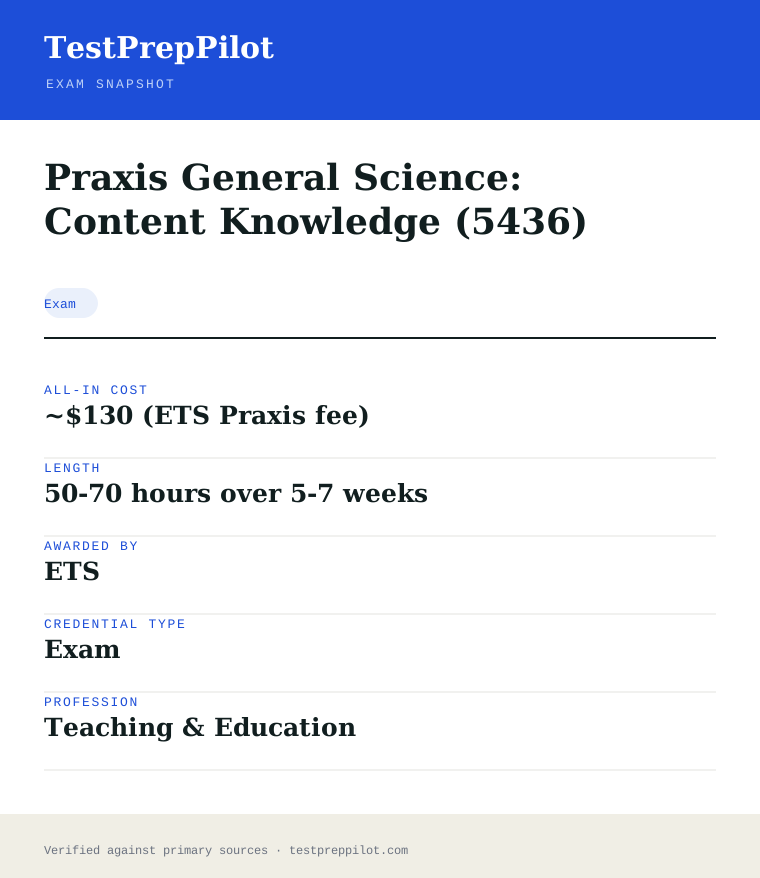
Praxis General Science: Content Knowledge (5436) is a exam credential; awarded by ETS; the exam fee is ~$130; typical preparation is 50-70 hours over 5-7 weeks; holders typically earn $40,000-$85,000 (25-2031 median $64,580).
| Credential | Praxis General Science: Content Knowledge (5436) |
|---|---|
| Type | Exam |
| Profession | Teaching & Education |
| Specialty | Praxis Mathematics & Science |
| Awarded by | ETS |
| Difficulty | Mixed |
| Typical prep time | 50-70 hours over 5-7 weeks |
| All-in cost | ~$130 (ETS Praxis fee) |
| Typical salary range | $40,000-$85,000 (25-2031 median $64,580) |
| Credential | Praxis General Science: Content Knowledge (5436) |
| Awarding body | ETS |
| Exam format | Proctored, computer-based |
| Validity | Passing score set by each state; score validity varies |
| Languages | Varies — see awarding body |
| Scope | National / Multi-state |
| Also known as | 5436 |
Real questions
Frequently asked questions about the Praxis General Science: Content Knowledge (5436)
How do I register for the Praxis General Science: Content Knowledge (5436) exam?
Register through ETS's official portal or an authorized test provider (e.g., Pearson VUE or Prometric where applicable). Create an account, select the exam, pay the fee, and schedule a date.
How much does the exam cost?
Fees vary by location and currency. Confirm the current fee on the official registration page before scheduling.
How long is the credential valid, and how do I renew?
Validity varies by credential (commonly 2–3 years). Renewal usually requires continuing education or a recertification exam — see ETS's policy.
What if I do not pass?
Most bodies allow retakes after a waiting period and payment of the full or partial fee. Check ETS's retake policy before rescheduling.
Is HiSET run by ETS or by PSI?
Both. ETS develops the HiSET test content and PSI delivers it operationally, following the ETS acquisition of PSI in January 2024. In practice you register and schedule through myHiSET on the PSI platform.
Do I have to live in a HiSET state to test?
Usually not. Several HiSET states, including Georgia and Oklahoma, explicitly allow non-residents to test, though you generally must pass your final subtest in the state whose credential you want.
Is HiSET easier than the GED?
They are set to comparable standards but structured differently: HiSET has five subtests with reading and writing separated, while the GED combines them into one Reasoning Through Language Arts test. HiSET is more widely available on paper, which some candidates prefer.
In short
Is the Praxis General Science: Content Knowledge (5436) worth it?
- Praxis General Science: Content Knowledge (5436) is awarded by ETS.
- Validates job-ready competence in Education & Teaching.
- Registration is through the awarding body or an authorized test provider.
- Renewal and retake policies vary — confirm before scheduling.
Same awarding body
What other credentials does ETS award?
Worth comparing
How does the Praxis General Science: Content Knowledge (5436) compare with similar credentials?
Trust
Where does this information come from?
Everything above is taken from the awarding body's own published material. Fees, question counts and domain weights are revised regularly — check the official page before you pay.
- ETS Awarding body
Research confidence: medium · Last reviewed 2026-08