Teaching & Education • Exam
Praxis Teaching Reading: Elementary (5205)
Praxis Teaching Reading: Elementary (5205) — Education & Teaching credential from ETS
Researched and maintained by TestPrepPilot Editorial BoardTeacher licensure & education certifications desk · Figures last verified August 2026
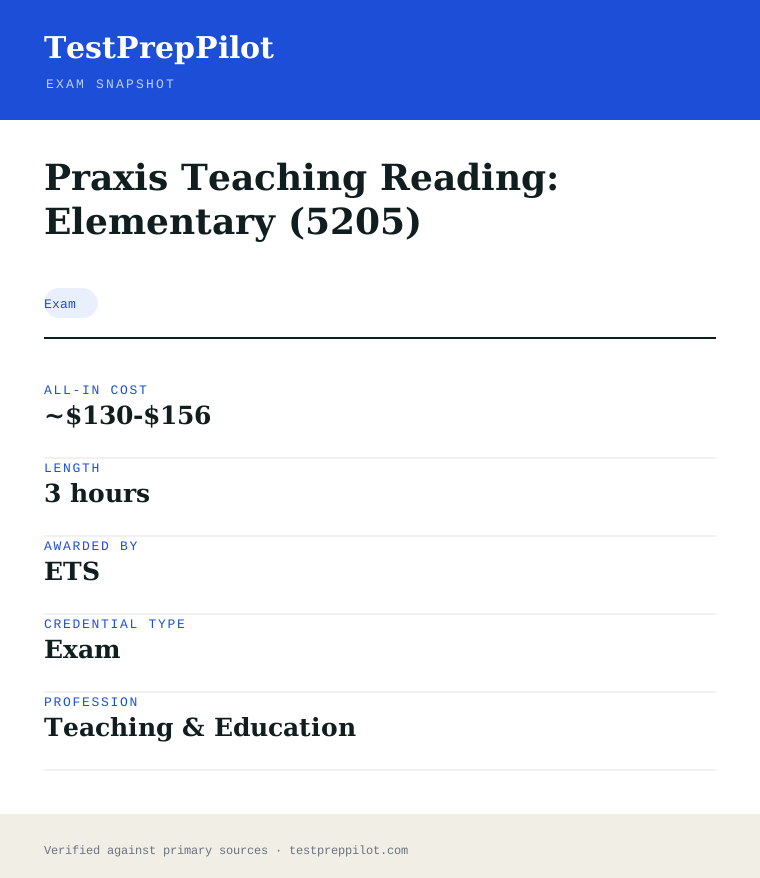
The short version
What is the Praxis Teaching Reading: Elementary (5205) and is it worth it?
Praxis Teaching Reading: Elementary (5205) is a professional credential administered by ETS. It validates job-ready knowledge and skills in the Education & Teaching field and is used for career entry, advancement, or compliance.
- Recognized credential from ETS
- Demonstrates verified competence in Education & Teaching
- Supports career advancement and may satisfy licensing or employer requirements
What is it?
What exactly is the Praxis Teaching Reading: Elementary (5205)?
Praxis Teaching Reading: Elementary (5205) — Education & Teaching credential from ETS
Standalone reading instruction test for kindergarten through grade six teachers, covering foundational skills, comprehension and assessment. Offered by ETS, it is designed for candidates who need to demonstrate verified competence in the Education & Teaching field. The credential is commonly used for career entry, advancement, regulatory compliance, or employer requirements. Candidates should review the official handbook for eligibility, exam format, and scoring before registering.
The path in brief
- Confirm you meet any eligibility or prerequisites
- Review the official handbook and study materials
- Register and pay through the awarding body or authorized provider
- Schedule and take the exam (test center or online proctoring)
- Receive your score and, if passed, your credential
Before you book
Who is eligible to sit the Praxis Teaching Reading: Elementary (5205)?
Eligibility varies; many credentials are open to all, while others require coursework, work experience, or sponsorship.
Who it is for: Professionals and candidates seeking to validate Education & Teaching competence.
The test itself
What is the format of the Praxis Teaching Reading: Elementary (5205)?
The Praxis Teaching Reading: Elementary (5205) is administered by ETS and runs 3 hours.
| Administered by | ETS |
|---|---|
| Questions | Selected-response and constructed-response items |
| Time limit | 3 hours |
| Pass mark | Passing score set by the awarding body; see the official score report |
| Exam fee | Varies by location and currency — confirm on the official registration page |
| Format | Proctored, computer-based (test center or online remote proctoring) |
Content outline
What topics are on the Praxis Teaching Reading: Elementary (5205)?
The Praxis Teaching Reading: Elementary (5205) covers 4 content domains.
Weightings come from the official exam outline. Study time is best allocated in roughly these proportions rather than evenly across domains.
- Subject content
Topic area tested on the exam; see the official blueprint for the detailed breakdown.
- Instruction & pedagogy
Topic area tested on the exam; see the official blueprint for the detailed breakdown.
- Assessment
Topic area tested on the exam; see the official blueprint for the detailed breakdown.
- Classroom management
Topic area tested on the exam; see the official blueprint for the detailed breakdown.
Study materials
Which prep course should you use for the Praxis Teaching Reading: Elementary (5205)?
Start with the exam sponsor's official content outline. If you also want one structured resource to work through, these are the Mometrix titles that match this exam.
The online course is built for Praxis Teaching Reading: Elementary (5205). The study guide and flashcards open Mometrix's wider Praxis subject-test range, so check that they list an edition for this test.
Affiliate links We may earn a commission if you buy through these links, at no extra cost to you. Mometrix has no say in what our exam guides cover. How we make money.
The path
How do you register for the Praxis Teaching Reading: Elementary (5205)?
- 1
Read your state requirements page20 minutes
Open hiset.org and select your state or jurisdiction. Age minimums, residency rules, whether you must enrol in an adult education programme first, and the exact fees are all set locally.
- 2
Create a myHiSET account15 minutes
Sign up through the state requirements page to generate your HiSET number, which you need for scheduling, score access and any state paperwork.
- 3
Take the official practice tests1 to 2 hours per subtest
HiSET publishes free and low-cost official practice tests for each subtest. Unlike the GED at-home route, HiSET does not require a practice-test pass before you can schedule.
- 4
Schedule subtests one at a time10 minutes each
Book any of the five subtests in any order, on paper or computer at a test centre or through HiSET@Home online proctoring where your state allows it.
- 5
Test with valid photo ID65 to 120 minutes per subtest
Bring a current government-issued photo ID showing your name, date of birth, signature and photograph. At-home testers need a private room, a webcam and a stable connection.
- 6
Check scores and claim your credential1 to 2 weeks
Multiple-choice results typically post within about five to seven days and essay results within about seven to ten days. Once all five subtests pass, your state issues the credential.
The fine print
What are the retake and renewal rules for the Praxis Teaching Reading: Elementary (5205)?
- Proctoring & delivery
- HiSET is offered in three ways: paper-based at a test centre, computer-based at a test centre and HiSET@Home under live online proctoring, with availability depending on the state. Calculators and formula sheets are supplied at test centres. The full battery in English or Spanish is permitted, and several states allow candidates to mix languages across subtests.
- Retake policy
- Retake rules are set per state, but a common pattern allows three attempts per subtest in a calendar year, sometimes extending to six. Several states use a favourable pricing structure in which the full fee is charged only on the first and fourth attempts while the second and third cost only the test centre or proctor fee.
- Score reporting
- Each of the five subtests is scored 1 to 20. To pass you must score at least 8 on every subtest, at least 2 out of 6 on the Language Arts Writing essay, and at least 45 out of 100 in total across the five. A score of 15 or higher on a subtest is treated as HiSET honours-level performance in several states.
- Recertification
- The credential a state issues on the strength of a passing HiSET battery is permanent and needs no renewal. Passing subtest scores are carried forward within a state-defined window while you complete the remaining subjects.
- Refunds & rescheduling
- Refund and reschedule windows are administered by PSI and vary by state and test centre; most centres require cancellation at least 24 hours before the appointment. Registering by phone rather than online attracts an additional fee in some states.
Context
HiSET subtests at a glance
| Subtest | Questions | Time | |
|---|---|---|---|
| Language Arts - Reading | About 40 to 50 multiple choice | 65 minutes | |
| Language Arts - Writing | About 50 multiple choice plus 1 essay | 120 minutes | |
| Mathematics | About 50 multiple choice | 90 minutes | |
| Science | About 50 multiple choice | 80 minutes | |
| Social Studies | About 50 multiple choice | 70 minutes |
What it pays
How much does this credential pay?
$62,340 median for kindergarten and elementary school teachers (BLS, May 2024)
The Praxis Teaching Reading: Elementary (5205) is the early-literacy pedagogy gate for elementary licensure in many states, and the wage question belongs to the occupation you enter with it: teaching. The closest official BLS occupation is Kindergarten and Elementary School Teachers, SOC 25-2021, which had a May 2024 median wage of $62,340, with the lowest 10 percent under $44,470 and the highest 10 percent above $103,540. BLS counted 1,570,100 kindergarten and elementary teacher jobs in 2024 and projects a 1 percent decline from 2024 to 2034, with about 104,600 openings a year, almost all replacement demand as veteran teachers retire. Read the median with the standard teacher-market caveats: pay is set by district salary schedules driven by years of service and education credits, varies enormously by state, and the exam itself carries no wage premium. The honest framing: the 5205 is a licensure gate, and the benchmark it unlocks is the elementary-teacher wage in your specific state and district, not a national figure that applies everywhere. The exam's practical value is that it verifies the early-literacy knowledge every elementary classroom teacher needs, which districts treat as a hiring baseline.
| Measure | Figure | Source / note |
|---|---|---|
| Median annual wage, kindergarten and elementary teachers | $62,340 | BLS OOH, SOC 25-2021, May 2024 |
| Lowest 10 percent | Under $44,470 | BLS OOH, SOC 25-2021, May 2024 |
| Highest 10 percent | Above $103,540 | BLS OOH, SOC 25-2021, May 2024 |
| Projected openings per year | ~104,600 | BLS OOH, SOC 25-2021, 2024-2034 |
Job growth.BLS projects a 1 percent decline for kindergarten and elementary teachers from 2024 to 2034, about 104,600 openings per year, mostly replacement demand.
Source: BLS Occupational Outlook Handbook - Kindergarten and Elementary School Teachers
Your odds
What are the pass rates?
ETS does not publish a single national pass rate — it publishes scaled scores, and each state sets its own passing line
ETS does not publish one national pass rate for the Praxis Teaching Reading: Elementary (5205), and any single percentage you see online is a state-specific report or a third-party estimate, so we do not present one as authoritative. What ETS does publish is the reporting model: the 5205 produces a scaled score, and the passing score is set by each state education agency — the same exam has different pass lines in different states, which is exactly why no national pass rate exists. Your target is your state's published passing score, which you should look up before you study. The exam itself is a 3-hour, computer-based test of selected-response questions and constructed-response items focused on early-literacy instruction: phonological awareness, phonics and word recognition, fluency, vocabulary and comprehension for elementary readers, plus the assessment practices that drive instruction. Because state cut scores typically sit in the mid-150s to low-160s scaled range, a candidate who covers all the content categories and writes structured constructed responses clears the line in most states — but verify your state's number, because the margin changes with it.
Read this before quoting the number.ETS reports scaled scores and each state sets its own passing score; there is no single national pass rate to quote.
Your schedule
How long should I study for it?
40-60 hours over 3-4 weeks of focused study
The Praxis Teaching Reading: Elementary (5205) is a 3-hour, computer-based exam of selected-response and constructed-response items built on the ETS content categories for early literacy: phonological awareness and the alphabetic principle, phonics and word recognition, fluency, vocabulary and comprehension, and the assessment and instruction of reading in the elementary classroom. A defensible plan runs 40 to 60 hours over three to four weeks. Week one: the foundational skills — phonological and phonemic awareness, the alphabetic principle and systematic phonics, learning the terminology and the sequence of early skill development, because the exam tests the science of reading precisely. Week two: fluency, vocabulary and comprehension — the instructional routines for elementary readers, including repeated reading, word-study and the comprehension strategies. Week three: assessment and instruction — screening, diagnostic, progress-monitoring and outcome measures, the response-to-intervention tiers and the differentiated classroom routines. Week four: practice — two timed practice exams and at least four constructed responses written against the scoring criteria. The plan is early-literacy-heavy because the 5205 rewards the evidence-backed practices of elementary reading instruction; candidates who study general teaching theory instead of the literacy science miss the exam's core.
- Week 112
Foundational skills
- Phonological and phonemic awareness
- The alphabetic principle and systematic phonics
- The sequence of early skill development
- Week 214
Fluency, vocabulary, comprehension
- Fluency routines: repeated reading and prosody
- Vocabulary and word study for elementary readers
- Comprehension strategies across texts
- Week 312
Assessment and instruction
- Screening, diagnostic and progress-monitoring tools
- RTI tiers and differentiated routines
- Intervention for struggling readers
- Week 414
Practice and essays
- Two timed practice exams
- Four constructed responses against the criteria
- Review weak categories and schedule
Adjusting the pace
Practicing elementary teacher.The classroom routines are familiar; focus study on the assessment terminology and the essay timing.
New to the science of reading.Add 1-2 weeks on phonological awareness and phonics terminology before the full plan.
How to study
How do I prepare most effectively?
The 5205 rewards the evidence-based practices of early-literacy instruction, so the dominant strategy is mastering the foundational-skill terminology and the assessment cycle precisely: phonological vs phonemic awareness, systematic phonics, the fluency indicators, and the screening-to-progress-monitoring sequence, because the exam tests these distinctions directly. Second, use the ETS content categories and the free Study Companion as the scope map, and work its sample questions to learn the item style. Third, practise the constructed-response items deliberately: the exam includes essay questions scored against criteria, and writing structured answers — naming the concept, applying it to the classroom case, and giving the instructional action — is a trainable skill. Fourth, take at least two timed practice exams; the 3-hour format with essays is a pacing test as much as a knowledge test. Finally, look up your state's passing score early and target practice scores comfortably above it, because the state cut line, not a national average, is the number that decides pass or fail.
Master the early-literacy terms
Phonological vs phonemic awareness and the phonics terms are tested precisely.
Use the Study Companion
Content categories, sample questions and constructed-response criteria.
Train the essay structure
Name the concept, apply it to the classroom case, give the instructional action.
Run two timed practice exams
3 hours with essays is a pacing test as much as a knowledge test.
Target your state's cut score
Look up your state's passing line and aim practice above it.
What to buy
Which study resources are worth paying for?
Praxis 5205 prep is inexpensive because ETS publishes the authoritative materials at low or no cost. The free Study Companion is the core resource: it lists the content categories, provides sample selected-response and constructed-response questions, and shows scored sample essays, which is the closest available window into the essay grading. ETS also sells the official study product with additional practice questions (roughly $20-$50). Third-party elementary-reading study guides ($30-$60) and question banks ($20-$80) add volume. Free resources include the Study Companion, ETS sample items and state department-of-education requirement pages. The exam fee is roughly $130-$156 (confirm at ets.org/praxis). Prices below are list prices as of mid-2026 and change frequently; we rank nothing by commission.
| Resource | Price | Format | Best for |
|---|---|---|---|
| ETS Study Companion (5205) | Free | Official PDF | The authoritative scope and essay criteria |
| ETS official study product | $20-$50 | Online practice questions | Official item-style practice |
| Elementary-reading study guides | $30-$60 | Printed or digital book | Structured content review |
| Question banks | $20-$80 | Online practice items | Selected-response volume |
| State DOE requirement pages | Free | Official state resources | Your state's passing score and rules |
List prices as of mid-2026, subject to change; the 5205 exam fee is roughly $130-$156; no commission or affiliate ranking is implied.
Avoid these
What mistakes do candidates most often make?
The most common 5205 mistake is studying general teaching theory instead of the science of early reading: candidates who prepare with generic pedagogy materials meet the phonological-awareness, phonics and fluency items unprepared, because the exam is specifically about elementary literacy instruction. The fix is literacy-science-first study. The second mistake is under-preparing the constructed-response items; candidates who only drill selected-response questions lose the essay share of the score. Third, candidates confuse the assessment terminology — screening vs diagnostic vs progress monitoring — which the exam tests precisely. Fourth, some candidates never take a timed practice exam and misjudge the 3-hour, essays-included format. Finally, candidates who do not look up their state's passing score study toward a vague target; the state cut line is the number that matters.
✕Studying generic pedagogy
✓The exam is about early-literacy instruction; study the reading science.
✕Skipping essay practice
✓The constructed responses are a real share; train the structure.
✕Confusing the assessment terms
✓Screening, diagnostic and progress monitoring are tested precisely.
✕Never timing a practice exam
✓3 hours with essays; run two timed practice exams.
✕Ignoring your state's cut score
✓Find your state's passing line and target practice above it.
What you'll face
What question types will I see?
The 5205 is a 3-hour computer-based exam with selected-response questions and constructed-response items built on the early-literacy content categories: phonological awareness, phonics and word recognition, fluency, vocabulary, comprehension, and the assessment and instruction of reading. The constructed-response items present an elementary classroom scenario and ask for the evidence-based instructional response, scored against the published criteria. Samples below are editor-written illustrations of the ETS content categories, not live exam items; they show the early-literacy style of the real items.
Early-literacy concepts, terminology and instructional practices.
Classroom scenarios with rubric-scored written answers.
Try these
Q1A kindergarten teacher claps the syllables in words such as "butterfly" during a whole-group activity. This activity primarily develops:
Answer:A
Clapping syllables exercises phonological awareness — the broader oral-language skill that includes syllables and onset-rime, of which phonemic awareness (individual phonemes) is the most advanced level. Phonics, fluency and comprehension are later skills.
Q2A first-grade teacher uses a sequence of letter-sound lessons followed by decoding practice with decodable texts. This practice aligns most closely with:
Answer:A
A planned sequence of letter-sound instruction with decodable-text practice is systematic, explicit phonics — the evidence-backed approach for early decoding. Whole-language-only, sight-word-only or deferred approaches each contradict the research the exam rewards.
Q3A teacher administers a brief word-reading measure to all students three times a year to identify those at risk. This assessment is best described as:
Answer:A
A brief measure given to all students to identify risk is universal screening — the first tier of the assessment cycle. Diagnostic assessment follows screening to pinpoint needs, and summative evaluation measures outcomes at the end.
Samples are editor-written illustrations of the ETS content categories, not live exam items.
The big day
What should I expect on exam day?
The Praxis Teaching Reading: Elementary (5205) is a 3-hour computer-based exam at a Pearson VUE centre or through online proctoring. Bring a valid government-issued photo ID matching your registration name and your appointment confirmation; personal items go in the locker. Arrive 30 minutes early; late arrivals forfeit the appointment and fee. Budget roughly two-thirds of the time for the selected-response block and the remainder for the constructed-response items, writing focused, structured answers. Your scaled score appears on screen immediately, with the official score report following. If you do not pass, the retake wait is 21 days. On a pass, the score is valid for 10 years subject to your state's acceptance window, and your state education agency applies its own passing line. The afterwards matters: forward your score to your state's licensure system through the ETS score-reporting tools, and keep the score report for your records.
Bring
- Valid government-issued photo ID matching your registration name
- Appointment confirmation
Leave at home
- Phone, smartwatch and all electronics
- Notes and study materials
- Personal bags beyond what the centre allows
How the day runs
Rules in the room
- No personal electronics in the testing room
- 3 hours for the selected-response and constructed-response items
- Retakes require a 21-day wait
Afterwards.On a pass, your score is valid 10 years subject to your state's window; report it to your state education agency. On a fail, wait 21 days and retake after additional early-literacy study.
Reference
What are the key facts about the Praxis Teaching Reading: Elementary (5205)?
Praxis Teaching Reading: Elementary (5205) is a exam credential; awarded by ETS; the exam fee is Varies by location and currency — confirm on the official registration page; typical preparation is 3 hours; holders typically earn $44,000-$104,000.
| Credential | Praxis Teaching Reading: Elementary (5205) |
|---|---|
| Type | Exam |
| Profession | Teaching & Education |
| Specialty | Praxis Elementary & Early Childhood |
| Awarded by | ETS |
| Difficulty | Mixed |
| Typical prep time | 3 hours |
| All-in cost | ~$130-$156 |
| Typical salary range | $44,000-$104,000 |
| Credential | Praxis Teaching Reading: Elementary (5205) |
| Awarding body | ETS |
| Exam format | Proctored, computer-based |
| Validity | Praxis scores are valid for 10 years. |
| Languages | Varies — see awarding body |
| Scope | National / Multi-state |
| Also known as | 5205 |
Real questions
Frequently asked questions about the Praxis Teaching Reading: Elementary (5205)
How do I register for the Praxis Teaching Reading: Elementary (5205) exam?
Register through ETS's official portal or an authorized test provider (e.g., Pearson VUE or Prometric where applicable). Create an account, select the exam, pay the fee, and schedule a date.
How much does the exam cost?
Fees vary by location and currency. Confirm the current fee on the official registration page before scheduling.
How long is the credential valid, and how do I renew?
Praxis scores are valid for 10 years, subject to your state's acceptance window; the state sets the passing score.
What if I do not pass?
Most bodies allow retakes after a waiting period and payment of the full or partial fee. Check ETS's retake policy before rescheduling.
Is HiSET run by ETS or by PSI?
Both. ETS develops the HiSET test content and PSI delivers it operationally, following the ETS acquisition of PSI in January 2024. In practice you register and schedule through myHiSET on the PSI platform.
Do I have to live in a HiSET state to test?
Usually not. Several HiSET states, including Georgia and Oklahoma, explicitly allow non-residents to test, though you generally must pass your final subtest in the state whose credential you want.
Is HiSET easier than the GED?
They are set to comparable standards but structured differently: HiSET has five subtests with reading and writing separated, while the GED combines them into one Reasoning Through Language Arts test. HiSET is more widely available on paper, which some candidates prefer.
In short
Is the Praxis Teaching Reading: Elementary (5205) worth it?
- Praxis Teaching Reading: Elementary (5205) is awarded by ETS.
- Validates job-ready competence in Education & Teaching.
- Registration is through the awarding body or an authorized test provider.
- Renewal and retake policies vary — confirm before scheduling.
Same awarding body
What other credentials does ETS award?
Worth comparing
How does the Praxis Teaching Reading: Elementary (5205) compare with similar credentials?
Trust
Where does this information come from?
Everything above is taken from the awarding body's own published material. Fees, question counts and domain weights are revised regularly — check the official page before you pay.
- ETS Awarding body
Research confidence: medium · Last reviewed 2026-08