Admissions & Academic Testing • Exam
AP Spanish Language and Culture
Show Spanish proficiency across the four skills for college language credit.
Researched and maintained by TestPrepPilot Editorial BoardAdvanced Placement & college-credit desk · Figures last verified August 2026
The short version
What is the AP Spanish Language and Culture and is it worth it?
AP Spanish Language and Culture is a fully digital exam: 55 multiple-choice questions (listening and reading) and three free-response tasks including a project presentation and argumentative essay. Scored 1-5, a 3 generally earns college Spanish credit.
- Tests all four language skills at intermediate-high level
- Accepted for language requirements and placement
- Fully digital in Bluebook from May 2027
- Themes connect language to culture and global issues
What is it?
What exactly is the AP Spanish Language and Culture?
Show Spanish proficiency across the four skills for college language credit.
AP Spanish Language and Culture assesses Spanish at the intermediate-high level across listening, reading, speaking, and writing, organized around six course themes. Under the 2026-27 revisions the exam is fully digital and includes a research project component alongside multiple-choice and free-response tasks. A 3 typically earns college Spanish credit.
The path in brief
- Join AP Spanish via My AP
- Build the four skills around the six themes
- Complete the research project prep
- Practice speaking and writing tasks
- Take the digital exam in May
Before you book
Who is eligible to sit the AP Spanish Language and Culture?
Who it is for: High-school Spanish students at intermediate-high proficiency
The test itself
What is the format of the AP Spanish Language and Culture?
The AP Spanish Language and Culture is administered by School-administered and runs About 2 hours 25 minutes, contains 55 multiple choice + 3 free response questions and requires 3 (1-5 scale) to pass.
| Administered by | School-administered |
|---|---|
| Questions | 55 multiple choice + 3 free response |
| Time limit | About 2 hours 25 minutes |
| Pass mark | 3 (1-5 scale) |
| Exam fee | $99 (US) / $129 (intl) |
| Format | Fully digital (Bluebook from May 2027) |
Content outline
What topics are on the AP Spanish Language and Culture?
The AP Spanish Language and Culture is weighted across 6 domains; the largest are Families and Communities (Theme), Personal and Public Identities (Theme), Beauty and Aesthetics (Theme).
Weightings come from the official exam outline. Study time is best allocated in roughly these proportions rather than evenly across domains.
- Families and Communities Theme
Personal and community life
- Personal and Public Identities Theme
Self, identity, beliefs
- Beauty and Aesthetics Theme
Arts and expression
- Science and Technology Theme
Innovation and society
- Contemporary Life Theme
Daily life and leisure
- Global Challenges Theme
Environment, health, society
Study materials
Which study guide should you use for the AP Spanish Language and Culture?
Start with the exam sponsor's official content outline. If you also want one structured resource to work through, these are the Mometrix titles that match this exam.

This links to Mometrix's AP range rather than a single AP Spanish Language and Culture title. Check that it lists an edition for AP Spanish Language and Culture before you buy.
Affiliate links We may earn a commission if you buy through these links, at no extra cost to you. Mometrix has no say in what our exam guides cover. How we make money.
Money & time
How much does the AP Spanish Language and Culture cost?
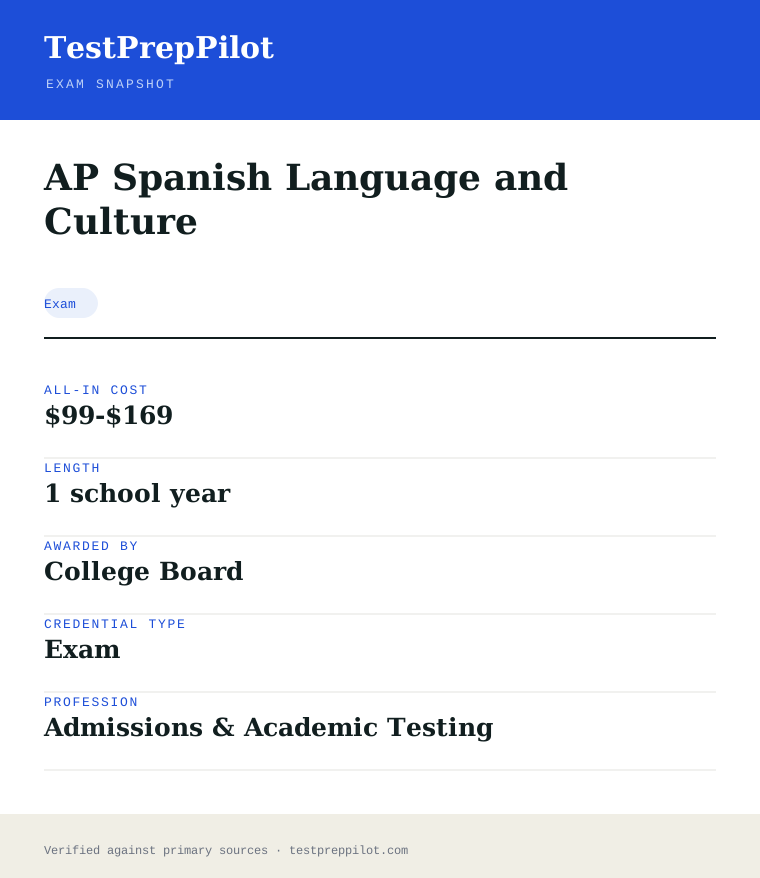
For the AP Spanish Language and Culture, the exam fee is $99 (US) / $129 (intl); the all-in cost is typically $99-$169; most candidates spend 1 school year preparing.
Cost breakdown
| AP exam fee (US, territories, Canada, DoDEA) | $99 |
|---|---|
| AP exam fee (international) | $129 |
| Late order or unused/canceled exam | $40 |
| Fee reduction for eligible students | -$37 |
| Prep materials (optional) | $0-$40 |
| Typical total | $99 US / $129 intl (eligible students pay ~$53 / ~$83); late or canceled adds $40 |
Fees are the 2025-26 AP charges. Schools may add a local administrative fee; the College Board fee reduction lowers the base by $37.
Timeline
- Enroll in the AP course Fall
- Build all four skills Aug-May
- Complete the research project Spring
- Take the digital exam May
- Receive scores Early July
Typical prep: 1 school year
The path
How do you register for the AP Spanish Language and Culture?
- 1
Create a College Board account10 minutes
Register at collegeboard.org with your legal name exactly as it appears on the photo ID you will bring on test day. One account covers the SAT, the PSAT-related assessments, AP and BigFuture.
- 2
Choose a weekend SAT date or let your school register you20 minutes
The SAT is booked directly by the student for weekend national administrations. PSAT 8/9, PSAT 10 and the PSAT/NMSQT are ordered and scheduled by the school, so for those you speak to your counselor rather than registering yourself.
- 3
Pay the fee or claim a fee waiver5 minutes
The US SAT registration fee is 68 dollars; international test takers add a regional fee of 43 dollars and, at some centres, a further test centre fee. Eligible US students get the SAT free through a counsellor-issued fee waiver, which also unlocks unlimited free score sends.
- 4
Install Bluebook and complete exam setup30 minutes
Download the free Bluebook app to your own laptop or tablet, or use a school-managed device, then run exam setup in the five days before test day to download the test and get your admission ticket.
Students who skip exam setup can be turned away or delayed at check-in.
- 5
Practise with Bluebook full-length tests and Khan Academy4 to 12 weeks
Six free adaptive full-length practice tests sit inside Bluebook, and Official Digital SAT Prep on Khan Academy is free and keyed to the same content domains.
- 6
Test, then review scores onlinetest day
Arrive with your admission ticket, acceptable photo ID and a charged device. Scores post to your College Board account, typically within about two weeks for weekend SAT dates.
The fine print
What are the retake and renewal rules for the AP Spanish Language and Culture?
- Proctoring & delivery
- All SAT Suite tests are taken in Bluebook on a laptop or tablet, in a school or an authorised weekend test centre, under a live human proctor. There is no at-home option. Bluebook locks the device, and a built-in Desmos graphing calculator and formula sheet are available throughout the Math section; you may also bring your own approved non-CAS calculator.
- Retake policy
- There is no limit on SAT attempts and no mandatory waiting period beyond the eight national dates offered each year. The PSAT-related assessments are given once per school year per grade band and are not retaken on demand. Most selective colleges superscore across SAT sittings, taking your best Reading and Writing score and your best Math score.
- Score reporting
- The SAT reports a 400 to 1600 total built from two 200 to 800 section scores. The PSAT/NMSQT and PSAT 10 report 320 to 1520 with 160 to 760 sections, and the PSAT 8/9 reports 240 to 1440 with 120 to 720 sections, so results across the suite sit on one comparable scale. PSAT/NMSQT reports also carry an NMSC Selection Index of 48 to 228.
- Recertification
- SAT Suite scores do not expire and never need renewal, but colleges commonly ask for a score from within the last five years and most students test in the spring of eleventh grade and again in the autumn of twelfth grade. Only a PSAT/NMSQT taken in eleventh grade enters the National Merit competition.
- Refunds & rescheduling
- Cancelling an SAT registration by the change deadline costs 34 dollars; cancelling after the deadline but before test day costs 44 dollars. Changing test centre costs 34 dollars, and late registration costs 38 dollars. Fee-waiver students are not charged for cancellation or late registration.
Context
The digital SAT Suite compared
| Assessment | Grades | Score scale | Length | |
|---|---|---|---|---|
| PSAT 8/9 | 8 and 9 | 240 to 1440 | 2h 14m | |
| PSAT 10 | 10 (spring) | 320 to 1520 | 2h 14m | |
| PSAT/NMSQT | 10 and 11 (autumn) | 320 to 1520 | 2h 14m | |
| SAT | 11 and 12 | 400 to 1600 | 2h 14m |
What it pays
How much does this credential pay?
AP Spanish Language and Culture has no direct salary outcome — its value is college credit and placement, and the earnings impact flows through the bachelor’s-degree premium plus the real, if indirect, market value of bilingual professional skills.
The direct salary answer for AP Spanish Language and Culture is the college-credit story shared by every AP exam: the BLS does not publish a wage for AP scores because the AP program is a college-credit and placement system rather than a job credential, so the earnings context is the education-return premium — workers with a bachelor’s degree earn substantially more over a career than high-school-only workers — plus the genuine, if hard-to-isolate, labor-market value of advanced Spanish proficiency. The exam rewards accumulated language ability rather than a fixed body of content, and a qualifying score of 3 or higher commonly earns credit toward or placement out of an intermediate college Spanish requirement, which matters for students in international business, education, health professions and government-track programs where second-language competency is a stated preference. The exam is about 3 hours: Section I is 65 multiple-choice questions in 95 minutes (30 print-text questions in 40 minutes and 35 print-and-audio questions in 55 minutes) and Section II is 4 free-response questions, two written and two spoken, scored 1-5. One honest caveat specific to this exam is cohort composition: a large share of test-takers are heritage and native speakers of Spanish, which lifts the qualifying percentages and can make a non-heritage learner’s score look worse than it is; the practical implication is to compare yourself to the score distribution rather than to classmates, and to check the target college’s credit policy, since some programs grant the credit only for a 4 or 5 and a few majors prefer that the intermediate course be taken in-house.
| Measure | Figure | Source / note |
|---|---|---|
| Score scale | 1-5 | 3+ typically qualifies for credit; 4-5 at selective schools |
| Exam length | ~3 hours | 65 MC (95 min) + 4 FRQs: 2 written, 2 spoken |
| Format | Four skills | Reading, listening, writing and speaking all scored |
| Salary impact | Indirect | College credit and placement; bilingual skill value |
Job growth.AP Spanish volume tracks AP program growth, and it remains one of the most widely taken AP language exams; the College Board reports multi-million total AP administrations per year, with Spanish Language among the largest.
Source: College Board AP Spanish Language and Culture course page
Your odds
What are the pass rates?
The College Board publishes AP Spanish Language and Culture score distributions, not pass rates; in the 2025 administration 85% of test-takers scored 3 or higher, with the top of the distribution inflated by heritage and native speakers.
The direct answer on pass rates requires precision: the College Board does not publish a "pass rate" for AP exams because scores are reported on a 1-5 scale and each college defines what score qualifies for credit, but it does publish the annual score distribution, and that is the closest published statistic. For AP Spanish Language and Culture, the 2025 distribution was 22% scoring 5, 32% scoring 4, 31% scoring 3, 12% scoring 2 and 3% scoring 1, which puts 85% of test-takers at 3 or higher — among the highest qualifying rates of any AP exam. That headline figure needs an honest caveat: the cohort is unusual because a large share of test-takers are heritage or native speakers of Spanish, so the high qualifying rates reflect both the exam and who sits for it, and a learner who acquired Spanish in the classroom should read the distribution as evidence of achievable scores rather than as a measure of how the exam feels at their proficiency level. The structure is fixed and published: about 3 hours total, with Section I carrying 50 percent of the score (30 print-text questions in 40 minutes and 35 print-and-audio questions in 55 minutes) and Section II carrying 50 percent across four free responses — an email reply, an argumentative essay built on three sources, a simulated conversation and a cultural-comparison presentation. The practical read on difficulty: every section tests the ability to understand and produce Spanish, so candidates who practise listening at native speed and rehearse the speaking tasks score higher than candidates who drill grammar in isolation, and the free-response formats are predictable enough to rehearse deliberately.
Read this before quoting the number.The College Board publishes score distributions, not pass rates; whether a 3, 4, or 5 "passes" depends on each college’s AP credit policy. The 2025 figures above (22/32/31/12/3, 85% at 3+) reflect a cohort that includes many heritage and native speakers, so read the qualifying rate accordingly.
Source: College Board AP score distribution report and AP Spanish Language and Culture exam description
Your schedule
How long should I study for it?
40-70 hours over 8-12 weeks of focused study
An efficient AP Spanish Language and Culture study plan is 40-70 hours over 8-12 weeks, because the exam is a proficiency test of all four skills — reading, listening, writing and speaking — and the fastest score gains come from rehearsing the speaking tasks and the two writing formats that carry half the score. The College Board course and exam description is the scope map: the course is organised around six themes (families and communities, personal and public identities, beauty and aesthetics, contemporary life, global challenges, and science and technology) and three modes of communication (interpretive, interpersonal and presentational), with the multiple-choice section (65 questions in 95 minutes) and the free-response section (email reply, argumentative essay, simulated conversation and cultural comparison) each worth 50 percent. The study window should split into interpretive-skill building (weeks 1-4), writing-format drilling (weeks 5-6), speaking rehearsal (weeks 7-9) and full practice exams (weeks 10-12): candidates who already hold strong receptive skills in Spanish can compress the first block, while candidates building listening comprehension from scratch need the full sequence, including daily exposure to audio at native speed. The two spoken tasks deserve their own rehearsal block because they are the part of the exam most candidates never practise at all — recording a 20-second response on a device is a different skill from holding a conversation, and the cultural-comparison presentation rewards a rehearsed two-minute structure. The final two weeks should be full practice exams at the real format, including recording the speaking tasks under the real time limits, because the pace of 65 multiple-choice questions in 95 minutes and the pressure of speaking on a timer are the two things candidates underestimate most.
- Weeks 1-46-8 hrs/week
Interpretive skills
- Build reading stamina with authentic Spanish articles, letters and charts daily
- Practise listening to interviews, podcasts and announcements at native speed
- Do timed multiple-choice sets on print and print-and-audio questions
- Weeks 5-67-9 hrs/week
Writing formats
- Drill the email reply: salutation, numbered responses and closing in 15 minutes
- Practise the argumentative essay: thesis, three sources and a counterpoint
- Write one of each format per week and self-score against the guidelines
- Weeks 7-97-9 hrs/week
Speaking rehearsal
- Record the simulated conversation: five exchanges with 20-second responses
- Rehearse the cultural comparison: a two-minute presentation with a set structure
- Listen to your own recordings and fix weak transitions and verb tenses
- Weeks 10-126-8 hrs/week
Full exams and readiness
- Take two full practice exams including the recorded speaking tasks
- Re-drill the weakest skill area and the free-response formats
- Confirm exam-day logistics, the recording device and registration
Adjusting the pace
Heritage or native speaker.Three to four weeks. Receptive skills are already strong; spend the time on the written formats, which heritage speakers often under-prepare, and on recording the speaking tasks so the device and timing are familiar.
Classroom Spanish only.Twelve to fourteen weeks. Build daily listening exposure early, because native-speed audio is the skill that transfers everywhere, and add a structured speaking rehearsal block in the final month.
Taking the course in school.Budget the lower end and weight time toward the recorded speaking tasks, which classroom work covers least.
How to study
How do I prepare most effectively?
The dominant prep strategy for AP Spanish Language and Culture is practising all four skills under exam conditions, because the exam rewards proficiency rather than memorised content and the two spoken tasks are the section candidates neglect and then fail. First, use the College Board course and exam description as the checklist: the six themes, the three modes of communication and the exam formats are published, and the past free-response questions with scoring guidelines show exactly how the email, essay and speaking tasks are graded. Second, build daily listening exposure, because the multiple-choice audio section plays native-speed material twice and candidates who only read Spanish routinely lose the audio items; podcasts, news broadcasts and interviews in Spanish for ten to fifteen minutes a day close most of that gap. Third, rehearse the two written formats to a template: the email reply has a predictable structure of greeting, numbered responses to each prompt and closing, and the argumentative essay rewards a clear thesis with explicit use of all three sources, so drilling the templates makes the timed tasks mechanical. Fourth, and most important, record the two speaking tasks repeatedly — the simulated conversation gives twenty seconds per response across five exchanges, and the cultural comparison is a two-minute presentation, and both are recorded on a device, so the muscle memory of timing and of the recording interface matters as much as the Spanish. Fifth, run full practice exams at the real timing, because completing 65 questions in 95 minutes and then writing and speaking on a clock is a stamina test. Finally, compare practice scores against the annual score distribution rather than against a classmate, since the heritage-speaker mix distorts how a raw percentage feels.
Build daily listening exposure
The audio section plays native-speed material twice, and candidates who only read Spanish lose it. Podcasts, news and interviews for 10-15 minutes a day are the highest-yield habit.
Drill the writing templates
The email reply and the argumentative essay have predictable structures. Rehearse each to a template under the real time limits until the format is mechanical.
Record the speaking tasks repeatedly
The simulated conversation and the cultural comparison are recorded on a device. Record yourself on a timer until timing and delivery are reflex; listen back and fix weak transitions.
Use past FRQs and scoring guidelines
College Board materials show exactly how the email, essay and speaking tasks are scored, and what separates a 3 from a 4 from a 5.
Run full practice exams
Sixty-five questions in 95 minutes plus four free responses is a stamina test; rehearse the full format, including the speaking section, under the real clock.
What to buy
Which study resources are worth paying for?
AP Spanish Language and Culture prep resources split into the College Board official set, review books, online courses and authentic Spanish media, and the buying logic is anchored by the official materials because the College Board publishes the course and exam description, past free-response questions, scoring guidelines and sample audio for free. The official free set — the CED, the past FRQs with scoring guidelines and the sample audio — defines the formats and the scoring standards precisely and should anchor every plan. Review books from major publishers, roughly $20-40, add structured skill coverage and practice exams, which helps both course-takers and self-studiers. Online courses and question banks, $30-100, add video instruction, interactive drilling and — most valuable for this exam — recorded speaking practice. Authentic media such as news sites, podcasts and streaming series are free or subscription-based and are genuinely the best raw material for the listening section, which review books cannot fully replicate. The footnote that anchors the comparison: prices below are list prices as of mid-2026 and change frequently, and we rank nothing by commission. The exam fee is about $99 per AP exam, with fee reductions available for eligible students. A cheap readiness check is the free sample questions, sample audio and one past FRQ set from the College Board before buying anything, because candidates who took the course often need only the review book plus full practice exams. Candidates should also verify the school’s AP registration process and deadline, since late-registration fees are a common avoidable cost.
| Resource | Price | Format | Best for |
|---|---|---|---|
| College Board official materials | Free | CED + past FRQs + scoring guides + sample audio | The authoritative formats and scoring standards |
| AP Spanish review book | $20-40 | Book with skill coverage and practice | Structured coverage for any candidate |
| Online course / speaking drill | $30-100 | Video + interactive and recorded speaking practice | Self-studiers wanting recorded speaking feedback |
| Authentic Spanish media | Free to ~$15/month | News, podcasts, streaming series | Building listening comprehension at native speed |
| AP exam registration | ~$99 | School/College Board | The real exam; fee reductions available |
List prices as of mid-2026 and change frequently; we rank nothing by commission. The AP exam fee is about $99 with reductions for eligible students.
Avoid these
What mistakes do candidates most often make?
The most common mistake on AP Spanish Language and Culture is preparing the receptive skills and never rehearsing production, because half the score is writing and speaking Spanish on a timer and the two spoken tasks in particular are the section where otherwise strong candidates lose the most points. The second is ignoring the listening section’s format: the audio is played twice, and candidates who stop concentrating after the first playthrough, or who fail to skim the printed preview and questions before the audio starts, miss items they could answer. A third recurring error is writing the email reply without addressing every numbered prompt, when the scoring rewards explicit responses to each element of the message. Candidates also routinely treat the argumentative essay as a general opinion piece, when the scoring expects a clear thesis and explicit use of the three provided sources, including the audio source. Another pattern is neglecting the recorded-speaking interface entirely, so the twenty-second timers and the recording device surprise them on test day. Finally, some candidates misjudge the difficulty distribution by comparing themselves to heritage speakers, and some never run a full practice exam at the real 3-hour format, so the stamina and the pace of 65 questions in 95 minutes surprise them. A further recurring error is speaking too slowly or reading from notes during the conversation, when short, complete, natural responses score higher than rehearsed paragraphs, and another is leaving the listening items until late in the section and rushing the final audio set when the pacing plan should reserve equal attention for all four audio selections.
✕Preparing receptive skills but not production
✓Half the score is writing and speaking Spanish on a timer; rehearse the email, essay and the two spoken tasks under the real time limits.
✕Ignoring the listening format
✓Audio is played twice and comes with printed previews; skim the questions first and stay focused through both playthroughs.
✕Missing prompts in the email reply
✓The email task is scored on explicit responses to every numbered element; check each prompt is answered before moving on.
✕Writing the essay without using the sources
✓The argumentative essay rewards a clear thesis with explicit use of all three sources, including the audio source.
✕Never recording the speaking tasks
✓The conversation and cultural comparison are recorded on a device with 20-second timers; rehearse the recording interface and timing before test day.
What you'll face
What question types will I see?
The AP Spanish Language and Culture exam is about 3 hours and tests all four skills, scored 1-5. Section I is 65 multiple-choice questions in 95 minutes, worth 50 percent: 30 print-text questions in 40 minutes (authentic written materials such as articles, letters, ads, charts and literary texts) and 35 print-and-audio questions in 55 minutes (interviews, podcasts, conversations and presentations, with the audio played twice). Section II is 4 free-response questions, worth 50 percent: an interpersonal email reply in 15 minutes, a presentational argumentative essay in about 55 minutes built on three sources, an interpersonal simulated conversation with five exchanges of about 20 seconds each, and a presentational cultural comparison that is a two-minute recorded presentation. The samples below illustrate three of the formats: an email-reply FRQ, an argumentative-essay FRQ and a simulated-conversation speaking prompt. The sample items are editor-written illustrations of the published format, not live test items. Every section requires actual Spanish production or comprehension, so the exam rewards sustained daily exposure rather than memorisation, and candidates who rehearse the free-response formats against the past-FRQ materials with scoring guidelines find the writing and speaking tasks predictable on test day. Because the multiple-choice section splits into two timed parts with their own clocks, pacing must be rehearsed part by part, and because the spoken tasks are recorded rather than live, candidates who practise with a recording device and a stopwatch remove the only truly unfamiliar element of the exam. The themes the course is organised around — families and communities, identities, beauty and aesthetics, contemporary life, global challenges, and science and technology — supply the vocabulary and context for all four sections, so breadth of exposure matters as much as grammar drills.
Authentic texts and native-speed audio played twice; tests interpretive communication in the six course themes.
Read a message and reply in 15 minutes, answering every numbered prompt in Spanish.
Write an essay in about 55 minutes using three sources — article, table or infographic, and audio — on a single topic.
A simulated conversation of five exchanges (20 seconds each) and a two-minute cultural comparison, both recorded on a device.
Try these
Q1Email-reply FRQ (illustrated): "A friend in Mexico writes to ask what you plan to do this summer and whether you would like to visit her town. Reply in Spanish, answering her questions and asking one of your own."
Answer:B
The interpersonal email task is scored on explicitly answering the message’s elements: a greeting, responses to each of her questions, an added question or comment and an appropriate closing, all in Spanish. Option B is the complete structure the scoring expects. A leaves half the message unanswered. C fails the interpersonal task by ignoring her questions. D is answered in English, which earns no credit for a Spanish-language exam.
Q2Argumentative essay FRQ (illustrated): "Write an essay in Spanish arguing whether social media has improved or damaged personal relationships. Support your position using the article, the chart and the audio source provided."
Answer:B
The presentational essay is scored on a clear, defensible thesis supported by explicit use of the provided materials — the article, the chart or infographic and the audio source — with evidence and reasoning in Spanish. Option B is the structure the scoring guidelines reward. A ignores the sources, which are the intended evidence base. C summarises but never argues, so there is no thesis to score. D lacks the focused claim the essay task requires.
Q3Simulated conversation FRQ (illustrated): "You are at a pharmacy in a Spanish-speaking country and the pharmacist greets you and asks what you need. Respond as you would in the conversation."
Answer:A
The interpersonal speaking task scores how well you maintain a natural simulated conversation, responding in complete Spanish sentences within the 20-second response window. Option A is the behaviour that earns credit. B gives too little to demonstrate the language. C breaks the conversational register the task requires. D answers in English, which earns nothing, and the task always permits a polite request to repeat, which D should have done in Spanish.
Samples are editor-written illustrations of the published blueprint, not live exam items.
The big day
What should I expect on exam day?
The AP Spanish Language and Culture exam is administered at your school on the College Board’s May AP schedule, and the direct exam-day answer is that you will sit 65 multiple-choice questions in 95 minutes (30 print-text questions and 35 print-and-audio questions), then complete the free-response section: two written tasks in 1 hour 10 minutes and two spoken tasks in about 18 minutes, recorded on a device supplied by the testing school, with scores released in July. In the current administration the multiple-choice and written free-response sections are completed on paper and the speaking tasks are recorded on a school-provided device, so arrival and check-in follow the paper-exam process: bring your school-issued AP admission ticket and a government-issued or school photo ID, plus No. 2 pencils for the multiple-choice section and black or blue pens for the written free responses. Expect a controlled testing environment with other AP candidates, and follow the proctor’s instructions exactly, because the College Board’s security rules are strict and a violation can invalidate the score. In the multiple-choice section, pace to finish with margin, and for the audio items read the printed previews before the audio plays so the two playthroughs are used well. In the free-response section, keep the email to 15 minutes with every prompt answered, give the essay the full available time, and for the spoken tasks respond in complete natural Spanish within each 20-second window rather than reading from notes. Scores are released online in July through the College Board account and can be sent to colleges; if the score falls short of the target colleges’ credit policy, the exam can be retaken the following year, since AP exams are offered once per year, and the College Board has announced a digital revision of this exam beginning with the May 2027 administration, so confirm the delivery format for the year you sit.
Bring
- School-issued AP admission ticket
- Photo ID (school or government issued)
- No. 2 pencils for the multiple-choice section
- Black or blue pens for the written free-response section
Leave at home
- Notes, electronic devices and study materials (prohibited)
- Personal stationery — the booklet and materials are provided
- Any item on the College Board prohibited list
- Scripts or notes for the speaking tasks — respond spontaneously
How the day runs
Rules in the room
- No notes, electronic devices or study materials in the testing room
- No. 2 pencils for multiple choice; black or blue pens for the written free responses
- Speaking responses are recorded on a device supplied by the testing school
- Audio items are played twice; use the printed previews before each playthrough
- Strict proctor-enforced timing on all sections
Afterwards.Receive the 1-5 score in July, send it to colleges through the College Board, and check each college’s AP credit and Spanish-placement policy. The exam can be retaken the following year if the score falls short, and a digital revision takes effect with the May 2027 administration, so confirm the format for the year you sit.
Reference
What are the key facts about the AP Spanish Language and Culture?
AP Spanish Language and Culture is a exam credential; awarded by College Board; the exam fee is $99 (US) / $129 (intl); typical preparation is 1 school year.
| Credential | AP Spanish Language and Culture |
|---|---|
| Abbreviation | AP Spanish Lang |
| Type | Exam |
| Profession | Admissions & Academic Testing |
| Specialty | Advanced Placement |
| Awarded by | College Board |
| Difficulty | Moderate |
| Typical prep time | 1 school year |
| All-in cost | $99-$169 |
| Score scale | 1 to 5 |
| Credit | 3+ typically earns language credit |
| Skills tested | Listening, reading, speaking, writing |
| Delivery | Fully digital in Bluebook from May 2027 |
| Exam timing | Early May |
| Scope | National / Multi-state |
Real questions
Frequently asked questions about the AP Spanish Language and Culture
How many credits is AP Spanish worth?
Most colleges grant three to eight language credits for a 3 or higher and may place you into intermediate or advanced coursework. Check each school's policy.
What is the exam format?
Section I is three free-response tasks worth 50 percent, including a project presentation, project Q&A, and argumentative essay. Section II is 55 multiple-choice questions in listening and reading, also 50 percent.
Is the exam hard?
It expects intermediate-high proficiency across all four skills. Consistent speaking practice is the biggest factor in success.
What score do I need for credit?
A 3 is the usual threshold; language departments may require 4 or 5 for upper-level placement.
Can I self-study?
Self-study is possible if you already speak and read Spanish well; regular conversation practice is essential, and you register through a school.
Why do all four SAT Suite tests take the same 2 hours 14 minutes?
Since the digital transition every assessment in the suite uses the same blueprint: 54 Reading and Writing questions in two 32-minute modules and 44 Math questions in two 35-minute modules. Difficulty is calibrated to the grade band rather than by adding or removing time.
Can I take an SAT Suite test at home?
No. Unlike some other admissions tests, every College Board digital assessment must be taken in a supervised school or test centre, even though it runs on your own device.
How do fee waivers work?
US students in eleventh or twelfth grade who meet income eligibility get SAT fee waivers from their school counsellor. A waiver covers the registration fee, waives cancellation and late fees, and gives unlimited free score reports to colleges.
In short
Is the AP Spanish Language and Culture worth it?
- Assesses listening, reading, speaking, and writing in Spanish
- 55 multiple-choice plus three free-response tasks
- Fully digital in Bluebook from May 2027
- Scored 1-5; a 3 generally earns language credit
Same awarding body
What other credentials does College Board award?
Trust
Where does this information come from?
Everything above is taken from the awarding body's own published material. Fees, question counts and domain weights are revised regularly — check the official page before you pay.
- College Board Awarding body
- Official AP Spanish Language and Culture exam page Exam page
Research confidence: high · Last reviewed 2026-08