Admissions & Academic Testing • Exam
CLEP History of the United States I: Early Colonization to 1877
Clear the first half of the U.S. history survey from colonization to 1877.
Researched and maintained by TestPrepPilot Editorial BoardCollege admissions & credit-by-exam desk · Figures last verified August 2026
The short version
What is the CLEP History of the United States I: Early Colonization to 1877 and is it worth it?
CLEP U.S. History I is a ~120-question, 90-minute exam covering colonization to 1877. ACE recommends a score of 50 for three semester hours at accepting schools.
- Replaces the first U.S. history survey semester for ~$97 plus a fee
- Covers political, social, economic, and cultural history
- Year-round at test centers and online with remote proctoring
- Pairs naturally with U.S. History II
What is it?
What exactly is the CLEP History of the United States I: Early Colonization to 1877?
Clear the first half of the U.S. history survey from colonization to 1877.
The CLEP History of the United States I exam covers U.S. history from early European colonization to the end of Reconstruction in 1877, equivalent to the first semester of a two-semester survey. Most questions focus on 1790–1877. It balances political, social, economic, cultural, and diplomatic developments and is a common general-education credit.
The path in brief
- Confirm your school’s history policy
- Register and pay the $97 fee
- Book a test center or remote-proctoring slot
- Focus on 1790–1877 (70% of items)
- Score 50+ for three credits
Before you book
Who is eligible to sit the CLEP History of the United States I: Early Colonization to 1877?
The test itself
What is the format of the CLEP History of the United States I: Early Colonization to 1877?
The CLEP History of the United States I: Early Colonization to 1877 is administered by CLEP test center or CLEP with Remote Proctoring and runs 90 minutes and requires 50 (ACE credit-granting score) to pass.
| Administered by | CLEP test center or CLEP with Remote Proctoring |
|---|---|
| Questions | ~120 multiple choice |
| Time limit | 90 minutes |
| Pass mark | 50 (ACE credit-granting score) |
| Exam fee | $97 (2025–26) + test-center fee |
| Format | Multiple choice |
Content outline
What topics are on the CLEP History of the United States I: Early Colonization to 1877?
The CLEP History of the United States I: Early Colonization to 1877 is weighted across 5 domains; the largest are Political Institutions and Public Policy (25%), Social Developments (25%), Cultural and Intellectual Developments (20%).
Weightings come from the official exam outline. Study time is best allocated in roughly these proportions rather than evenly across domains.
- Political Institutions and Public Policy 25%
Congress, presidency, courts
- Social Developments 25%
Class, gender, reform
- Economic Developments 15%
Growth, slavery’s economics
- Cultural and Intellectual Developments 20%
Religion, arts, ideas
- Diplomacy and Transnational Interactions 15%
Empire, war
Study materials
Which study guide should you use for the CLEP History of the United States I: Early Colonization to 1877?
Start with the exam sponsor's official content outline. If you also want one structured resource to work through, these are the Mometrix titles that match this exam.

This links to Mometrix's CLEP range rather than a single CLEP History of the United States I: Early Colonization to 1877 title. Check that it lists an edition for CLEP History of the United States I: Early Colonization to 1877 before you buy.
Affiliate links We may earn a commission if you buy through these links, at no extra cost to you. Mometrix has no say in what our exam guides cover. How we make money.
The path
How do you register for the CLEP History of the United States I: Early Colonization to 1877?
- 1
Create a College Board account10 minutes
Register at collegeboard.org with your legal name exactly as it appears on the photo ID you will bring on test day. One account covers the SAT, the PSAT-related assessments, AP and BigFuture.
- 2
Choose a weekend SAT date or let your school register you20 minutes
The SAT is booked directly by the student for weekend national administrations. PSAT 8/9, PSAT 10 and the PSAT/NMSQT are ordered and scheduled by the school, so for those you speak to your counselor rather than registering yourself.
- 3
Pay the fee or claim a fee waiver5 minutes
The US SAT registration fee is 68 dollars; international test takers add a regional fee of 43 dollars and, at some centres, a further test centre fee. Eligible US students get the SAT free through a counsellor-issued fee waiver, which also unlocks unlimited free score sends.
- 4
Install Bluebook and complete exam setup30 minutes
Download the free Bluebook app to your own laptop or tablet, or use a school-managed device, then run exam setup in the five days before test day to download the test and get your admission ticket.
Students who skip exam setup can be turned away or delayed at check-in.
- 5
Practise with Bluebook full-length tests and Khan Academy4 to 12 weeks
Six free adaptive full-length practice tests sit inside Bluebook, and Official Digital SAT Prep on Khan Academy is free and keyed to the same content domains.
- 6
Test, then review scores onlinetest day
Arrive with your admission ticket, acceptable photo ID and a charged device. Scores post to your College Board account, typically within about two weeks for weekend SAT dates.
The fine print
What are the retake and renewal rules for the CLEP History of the United States I: Early Colonization to 1877?
- Proctoring & delivery
- All SAT Suite tests are taken in Bluebook on a laptop or tablet, in a school or an authorised weekend test centre, under a live human proctor. There is no at-home option. Bluebook locks the device, and a built-in Desmos graphing calculator and formula sheet are available throughout the Math section; you may also bring your own approved non-CAS calculator.
- Retake policy
- There is no limit on SAT attempts and no mandatory waiting period beyond the eight national dates offered each year. The PSAT-related assessments are given once per school year per grade band and are not retaken on demand. Most selective colleges superscore across SAT sittings, taking your best Reading and Writing score and your best Math score.
- Score reporting
- The SAT reports a 400 to 1600 total built from two 200 to 800 section scores. The PSAT/NMSQT and PSAT 10 report 320 to 1520 with 160 to 760 sections, and the PSAT 8/9 reports 240 to 1440 with 120 to 720 sections, so results across the suite sit on one comparable scale. PSAT/NMSQT reports also carry an NMSC Selection Index of 48 to 228.
- Recertification
- SAT Suite scores do not expire and never need renewal, but colleges commonly ask for a score from within the last five years and most students test in the spring of eleventh grade and again in the autumn of twelfth grade. Only a PSAT/NMSQT taken in eleventh grade enters the National Merit competition.
- Refunds & rescheduling
- Cancelling an SAT registration by the change deadline costs 34 dollars; cancelling after the deadline but before test day costs 44 dollars. Changing test centre costs 34 dollars, and late registration costs 38 dollars. Fee-waiver students are not charged for cancellation or late registration.
Context
The digital SAT Suite compared
| Assessment | Grades | Score scale | Length | |
|---|---|---|---|---|
| PSAT 8/9 | 8 and 9 | 240 to 1440 | 2h 14m | |
| PSAT 10 | 10 (spring) | 320 to 1520 | 2h 14m | |
| PSAT/NMSQT | 10 and 11 (autumn) | 320 to 1520 | 2h 14m | |
| SAT | 11 and 12 | 400 to 1600 | 2h 14m |
What it pays
How much does this credential pay?
No direct occupation — a CLEP score of 50 earns college credit, and the payoff is the education-return premium: bachelor’s-degree holders earn $1,493/week vs $1,059 for associate and $899 for high-school-only (BLS, 2023)
The direct answer is that CLEP History of the United States I has no BLS occupation of its own — it is a credit-by-examination assessment whose payoff is the college credit it earns and the tuition and time it saves — so the salary story is the education-return premium that CLEP credit accelerates. The relevant reference points from BLS: in 2023, workers with a bachelor’s degree earned a median weekly wage of about $1,493 versus about $1,059 for associate-degree holders and about $899 for high-school-diploma-only workers, and the May 2024 median wage across all occupations was $49,500. A score of 50 or higher on the 20-to-80 CLEP scale earns the ACE-recommended credit of three semester hours for History of the United States I, and the vast majority of four-year colleges accept CLEP credit under their own policies — some require a higher score, some award the same three credits, and a few do not accept CLEP at all — so the practical financial value of the exam is the semester of survey history it can replace, which at in-state public tuition is often worth far more than the exam fee. History of the United States I is one of the most-taken CLEP exams, with roughly 120 multiple-choice questions covering early colonization through Reconstruction in 1877, and the skills it validates — source interpretation, cause-and-effect reasoning, and period analysis — transfer directly to the humanities and social-science coursework that careers in law, journalism, teaching and public service build on. The honest framing is that CLEP’s value is twofold: the credit it earns (each passing score can replace a 3-credit course) and the time-to-degree it shortens, which matters for tuition budgeting and for students on financial-aid clocks. For a student deciding whether to take it, the investment is the exam fee (about $97 plus a test-center fee) and preparation time, and the payoff is measured in credits, not in a wage line.
| Measure | Figure | Source / note |
|---|---|---|
| Reference: median wage, all occupations | $49,500 | BLS Occupational Outlook Handbook, May 2024 |
| Reference: bachelor’s degree, median weekly earnings | $1,493 | BLS Education Pays, 2023 ($77,636/yr equivalent) |
| Reference: associate degree, median weekly earnings | $1,059 | BLS Education Pays, 2023 ($55,068/yr equivalent) |
| The exam itself | No direct occupation | A credit-by-examination test; ACE recommends 3 semester hours for a score of 50+ |
| ACE credit-granting score | 50 (on a 20-80 scale) | ACE National Guide; individual colleges set their own policies |
Job growth.BLS does not project growth for a CLEP exam; the relevant projections follow the occupations the earned degree feeds into, and the value is the credit, tuition savings and time-to-degree it buys.
Source: BLS Education Pays
Your odds
What are the pass rates?
The College Board publishes no CLEP pass rate — it publishes the score scale (20-80) and the ACE recommendation (50), which most colleges use as the credit threshold
The core fact is that the College Board does not publish pass rates for CLEP exams, and no reliable national pass-rate statistic exists for History of the United States I, so any figure you see online is an estimate — but the scoring structure is fully published, and understanding it matters more than a pass rate. CLEP scores run on a scaled range of 20 to 80, and the American Council on Education recommends a credit-granting score of 50, worth three semester hours for History of the United States I; individual colleges set their own policies, with most institutions following ACE at 50, some requiring 55, and a few awarding different credit amounts. The exam is approximately 120 multiple-choice questions answered in 90 minutes, entirely computer-delivered, with no essay component for this exam — the score appears on screen the moment you submit, so you walk out knowing whether you earned credit. About 10 to 20 of the 120 questions are unscored pretest items embedded throughout the exam for future test development, and they are not labeled, so the practical rule is to treat every question as scored and answer everything, since there is no penalty for guessing. The content is weighted toward the period 1790 to 1877 (about 70 percent of questions) versus 1500 to 1789 (about 30 percent), with political institutions and social developments each about 25 percent, cultural and intellectual developments about 20 percent, and economic developments and diplomacy about 15 percent each. Because the score is scaled, it is not a simple percentage of items correct, and the practical planning rule is that a student who scores 50 or better on two or three timed practice exams using the 20-to-80 scale is in the published credit-earning range. The absence of a published pass rate is worth stating plainly: candidates should plan against the 50 target and their college’s specific policy, not against a pass-rate statistic.
Read this before quoting the number.The College Board publishes no pass-rate statistics for CLEP exams. What is published and verifiable is the 20-80 score scale, the ACE credit-granting score of 50 (3 semester hours), the 120-question / 90-minute format, and the content weightings; individual colleges set their own credit policies, and some require a score above 50.
Your schedule
How long should I study for it?
30-60 hours over 4-8 weeks (or 2-3 weeks after a recent survey course) of focused study
Plan for 4 to 8 weeks and 30 to 60 hours of study for CLEP History of the United States I if you have not recently taken a college survey course, or 2 to 3 weeks if you have, because the exam is 120 multiple-choice questions in 90 minutes testing a bounded period of U.S. history — early colonization to Reconstruction in 1877 — with about 70 percent of questions drawn from 1790 to 1877, and the content breakdown is political institutions and social developments at 25 percent each, cultural and intellectual developments at 20 percent, and economic developments and diplomacy at 15 percent each. The effective sequence is: first, take a full-length timed practice exam to baseline against the 50-on-20-to-80 scale; second, build the chronological skeleton of the exam period, because the questions reward understanding the story of the era — colonization, the Revolution, the founding, the early republic, Jacksonian democracy, sectionalism, the Civil War and Reconstruction — more than isolated date memorization; third, weight your study by the exam’s period split, spending the majority of hours on 1790 to 1877; fourth, drill the named-figure and document recognition that the exam favours — roughly a third of questions test recognition of a named figure, event, document or court case, and another third tests thematic understanding and cause-and-effect relationships; and fifth, in the final two weeks, take two more full timed practice exams and re-study the weak eras. The exam is entirely multiple choice with no essay, the score is available on screen immediately, and the practical rule is to answer every question, since there is no guessing penalty. Confirm your target college’s CLEP credit policy before you study so you know whether you need a 50 or a higher score, and note the exam fee is about $97 plus a test-center administration fee.
- Week 16-8 hrs
Baseline and the colonial era
- Take a full timed practice exam and log every miss by era
- Build the chronological skeleton: pre-1500 Americas, colonization, the British colonies
- Learn the Columbian Exchange, colonial societies and the Seven Years’ War
- Week 26-8 hrs
Revolution and founding (part of the 30%)
- The causes and consequences of the American Revolution
- The Constitution, its amendments and Supreme Court interpretation
- The development of participatory democracy and political parties
- Weeks 3-58-10 hrs/week
1790-1877 — the 70% period
- The early republic, Jeffersonian and Jacksonian democracy
- Sectionalism, slavery and resistance, reform movements
- The Civil War and Reconstruction; economic growth and expansion
- Week 66-8 hrs
Named figures, documents and themes
- Drill named-figure and document recognition by era and contribution
- Review thematic threads: women, immigration, religion, reform
- Practise cause-and-effect reasoning on the era questions
- Week 78-10 hrs
Timed full exams
- Take two full 90-minute practice exams scored on the 20-80 scale
- Re-study the weak eras your second exam exposes
- Confirm your college’s credit policy and the exact score you need
- Final days3-5 hrs
Taper
- Light review of the 1790-1877 timeline and key documents
- Confirm exam logistics and test-center fee
- Rest and sleep normally
Adjusting the pace
Recently finished a U.S. survey course.Two to three weeks. Take one diagnostic; if you are safely above 50 on the practice scale, compress to the 1790-1877 period review plus two timed full exams, because the exam weights that period at 70 percent.
Taking both History I and History II.Study the exams separately by period — History I ends at 1877, History II starts around 1865 — and consider taking them in separate sittings, since each is 3 credits and together they clear a full year of survey credit.
Strong on social history, weak on dates.The exam tests cause and effect, not just recall, so lean into the thematic and named-figure questions where you are strong, and build a compact timeline of key acts and compromises (Missouri Compromise 1820, Compromise of 1850, Kansas-Nebraska Act 1854) to anchor the dates you miss.
How to study
How do I prepare most effectively?
The strategy that reliably moves CLEP History of the United States I scores is "weight your study to 1790-1877, learn the story not just the dates, and drill named-figure recognition by era," because the exam puts about 70 percent of its questions on the period from 1790 to 1877 and tests cause-and-effect reasoning and named-figure recognition as much as recall. The highest-yield habit is building a chronological narrative of the era — colonization through the early republic through Jacksonian democracy through sectionalism, the Civil War and Reconstruction — because the questions reward understanding why events happened in sequence more than memorising isolated dates. A second proven approach is using the exam’s own weightings as your study map: political and social developments are 25 percent each, cultural and intellectual developments 20 percent, economic developments and diplomacy 15 percent each, so the high-weight topics deserve the majority of your hours. Third, drill named-figure and document recognition by era: place a figure in the correct period first, then attach the contribution, because roughly a third of the exam tests recognition of a named person, event, document or court case and era-placement alone eliminates most wrong answers. Fourth, use retrieval practice rather than rereading — read a chapter, then immediately test yourself on it, and keep testing as you move through eras, since history is a story that is easy to follow and hard to reproduce under a clock. Finally, run the 90-minute format repeatedly, answer every question (there is no guessing penalty), and confirm your target college’s credit policy early so you know whether the target is 50 or higher.
Weight study to 1790-1877
About 70 percent of the exam comes from 1790 to 1877 — the early republic, Jacksonian era, sectionalism, Civil War and Reconstruction. The colonial period gets the most airtime in popular history but only about 30 percent of the questions.
Learn the story, not just the dates
The exam tests cause and effect: why the Revolution happened, how the Constitution was interpreted, how sectionalism led to war. Build a chronological narrative and practise explaining the connections, because sequence questions punish date-only memorisation.
Use the topic weightings as your map
Political institutions and social developments are each about 25 percent; cultural and intellectual developments 20 percent; economic developments and diplomacy 15 percent each. Study the high-weight topics first and hardest.
Drill named figures by era
Roughly a third of questions test recognition of a named figure, event, document or court case. Place the name in an era first — that alone eliminates era-mismatched answers — then attach the specific contribution.
Use retrieval practice, not rereading
Read a chapter, then test yourself on it immediately and again as you move through the eras. History is easy to follow and hard to reproduce; testing forces the reproduction under pressure.
Answer every question and confirm your credit target
There is no guessing penalty and the score appears on screen immediately. Confirm your college’s policy first — most follow ACE at 50, some require 55 — so you know the exact score you need.
What to buy
Which study resources are worth paying for?
CLEP History of the United States I preparation is dominated by free official resources — the College Board CLEP page, the exam description with its exact content weightings, and official practice questions — with the exam fee of about $97 plus a test-center administration fee as the main cost. The comparison below separates official and commercial resources, with prices current to this review. The rule that works: use the free official resources and one good review book or course for the 1790-1877 weighting, take full timed practice exams scored on the 20-to-80 scale, and keep total spending well under about $150 including the exam fee, because the content is finite and the official description tells you exactly what is weighted.
| Resource | Price | Format | Best for |
|---|---|---|---|
| College Board CLEP exam page and exam description | Free | Official topic and chronological weightings | The authoritative syllabus — use it as your study map |
| The CLEP exam itself | ~$97 plus a test-center administration fee | Computer-delivered, score on screen | Required — the credit-earning event |
| CLEP review books (e.g. Princeton Review, Cracking the CLEP, REA) | ~$20-40 | Printed book + online practice | Structured review of the weighted periods |
| CLEP practice-exam banks | ~$10-40 | Online timed practice | Format calibration on the 20-80 scale |
| Free timeline and document resources | Free | Web timelines and primary-source summaries | Building the chronological skeleton and named-figure recognition |
Prices approximate and dated to this review; the exam is offered year-round by appointment at CLEP test centers and through remote proctoring, and the test-center administration fee is separate from the $97 exam fee. We do not rank by commission.
Avoid these
What mistakes do candidates most often make?
The most common mistake is studying the colonial era hardest when about 70 percent of the exam comes from 1790 to 1877. The second is memorising isolated dates instead of learning cause-and-effect narrative, which the exam tests far more heavily. A third recurring error is failing to run the 90-minute timed format, so pacing arrives as a surprise. Candidates also routinely ignore the named-figure and document recognition pattern, losing the roughly one-third of questions that test it, and many treat every question as if guessing were penalised, leaving blanks when there is no penalty at all. Finally, some students study without confirming their college’s credit policy, aiming for a 50 when their target school requires 55 or awards fewer credits.
✕Over-studying the colonial era
✓The exam weights 1790-1877 at about 70 percent and the pre-1790 period at 30 percent. Spend the majority of hours on the early republic through Reconstruction even though the colonial period dominates popular history.
✕Memorising dates without the narrative
✓The exam tests cause and effect — why events happened and how they connected. Build a chronological story of the era and practise explaining the connections; sequence and causation questions outnumber pure date recall.
✕Never running the timed format
✓120 questions in 90 minutes is a real pace. Take at least three full timed practice exams scored on the 20-to-80 scale before the real one, or pacing will be the test.
✕Ignoring named-figure recognition
✓Roughly a third of the exam tests recognition of a named figure, event, document or court case. Drill era-placement first — it eliminates era-mismatched answers — then attach the contribution.
✕Leaving questions blank
✓There is no guessing penalty on CLEP, and about 10 to 20 of the 120 questions are unscored pretest items you cannot identify. Answer everything; a blank is a guaranteed zero and a guess is worth the expected value.
✕Studying without knowing your college’s policy
✓Most colleges follow ACE at 50 for 3 credits, but some require 55 or award differently. Check your target school’s CLEP policy before you study so you are preparing for the score you actually need.
What you'll face
What question types will I see?
The CLEP History of the United States I exam is approximately 120 multiple-choice questions answered in 90 minutes, entirely computer-delivered with the score reported on a 20-to-80 scale and the ACE credit-granting score at 50. About 10 to 20 questions are unscored pretest items, and there is no essay component. The content is drawn from five topic areas — political institutions and public policy (25%), social developments (25%), cultural and intellectual developments (20%), economic developments (15%) and diplomacy and transnational interactions (15%) — across the period 1500 to 1877, with about 70 percent of questions on 1790 to 1877. The question mix is roughly a third named-figure and document recognition, a third thematic and cause-and-effect reasoning, and a third content-specific recall of dates, percentages, quotes and places. The samples below are editor-written illustrations of the published question styles, not live exam items.
Recognition of a named figure, event, document or court case and its contribution; era-placement eliminates most wrong answers.
Era characteristics, regional patterns, and why one development led to another — the exam rewards narrative understanding over recall.
Dates, percentages, quotes, named places and specific provisions — the memorisation slice of the paper.
Placing events in sequence; the slowest question type for most candidates, so flag and move on rather than freezing.
Try these
Q1Which of the following best describes John C. Calhoun’s contribution to American political history?
Answer:B
Calhoun was a South Carolina senator and vice president who became the leading theorist of states’ rights and nullification during the 1830s, defending southern interests on tariffs and slavery — exactly B. A is wrong because the Federalist Papers were written by Hamilton, Madison and Jay, and Calhoun opposed the nationalist bank position. C describes William Lloyd Garrison, not Calhoun. D is wrong because the Compromise of 1850 was shepherded by Henry Clay and then Stephen Douglas; Calhoun opposed it in his final years. The era-placement technique works here: Calhoun belongs to the 1820s-1850s southern sectionalism story, and that placement alone eliminates every answer describing a different era or movement.
Q2The Missouri Compromise of 1820 was significant primarily because it:
Answer:C
The Missouri Compromise admitted Missouri as a slave state and Maine as a free state, preserving the Senate balance, and drew a line at 36°30′ north latitude prohibiting slavery in most of the Louisiana Purchase territory above it — which C states exactly. A is wrong because the compromise allowed slavery below the line and in Missouri. B describes the broader constitutional significance that the compromise tested, but the question asks for the primary content of the compromise itself. D is wrong because the balance was a legislative arrangement, not a constitutional amendment, and it was later undone by the Kansas-Nebraska Act. This is a content-recall item where knowing the specific provisions of a named compromise is the tested fact.
Q3Which development best explains the growth of the abolitionist movement in the 1830s?
Answer:B
The 1830s abolitionist movement was defined by a decisive shift from gradual emancipation and colonization schemes to immediate emancipation preached as a moral imperative — the turn associated with William Lloyd Garrison’s The Liberator (1831) and the American Anti-Slavery Society — which B describes. A and C are wrong chronologically: the Kansas-Nebraska Act (1854) and Dred Scott (1857) galvanised northern opinion in the 1850s, a later wave. D is wrong because the Panic of 1837 did not make slavery unprofitable; cotton remained central to the southern economy. The question tests period-specific causation, and attaching the right era to the right catalyst is what separates the answers.
Samples are editor-written illustrations of the published CLEP History of the United States I question styles; they are not live exam items.
The big day
What should I expect on exam day?
The CLEP History of the United States I exam is a 90-minute, 120-question computer-delivered test taken by appointment at a CLEP test center or through remote proctoring, with the score reported immediately on a 20-to-80 scale and the ACE credit-granting score at 50 — so you walk out knowing whether you earned the three semester hours your college will review. The first thing to confirm is your test-center administration fee, because CLEP charges about $97 for the exam itself plus a separate test-center fee that varies by location, and remote proctoring has its own room and equipment requirements. Bring a valid government-issued photo ID matching your registration exactly, and confirm your CLEP account name matches the ID, because mismatches can block check-in. Leave phones, smartwatches, study materials and scratch paper at home or in a locker — the test center provides scratch paper and a basic four-function calculator is not needed for this exam, which is entirely multiple choice. Arrive at least 30 minutes early so check-in and the tutorial are complete before the 90-minute clock starts. On the exam, work steadily and flag chronological-ordering questions for later rather than freezing on them, answer every question since there is no guessing penalty, and use the fact that about 10 to 20 unscored pretest items are hidden among the scored ones to stay calm — treat every question as scored and keep moving. The score appears on screen the moment you submit, and the official score report posts to your CLEP account within a few business days, which is when you can send it to colleges. Afterward, check your target school’s CLEP credit policy against your score — most follow ACE at 50 for three credits — and order the score report to the registrar if your school requires an official copy.
Bring
- Valid government-issued photo ID matching your CLEP account name exactly
- Your CLEP registration confirmation and scheduling details
- Payment for any test-center administration fee due at the site
- For remote proctoring: a compliant room, webcam, microphone and stable connection, pre-tested
Leave at home
- Phones, smartwatches and earbuds
- All notes, study materials and scratch paper — the center provides paper
- Calculators and other devices — not needed for this all-multiple-choice exam
- Bags and coats beyond what the test center permits
How the day runs
Rules in the room
- The exam is approximately 120 multiple-choice questions in 90 minutes, computer-delivered with no essay component.
- Scoring is on a 20-80 scale; the ACE credit-granting score is 50 for 3 semester hours, and individual colleges set their own policies.
- About 10 to 20 questions are unscored pretest items embedded throughout the exam; they are not labeled.
- There is no guessing penalty — answer every question.
- The exam fee is about $97 plus a separate test-center administration fee; remote proctoring has its own requirements.
- The score appears on screen immediately; the official report posts within a few business days.
Afterwards.Your score appears on screen the moment you submit and the official report posts to your CLEP account within a few business days, and a score of 50 or higher earns the ACE-recommended three semester hours of credit — which most colleges accept under their own policies, some requiring a higher score, so the immediate next step is checking your target school’s CLEP policy and ordering the score report to the registrar if an official copy is required. The credit replaces a survey course, which shortens time-to-degree and saves tuition, and if you took the exam for a specific requirement, that requirement is now cleared subject to your school’s review. If you fell short of 50, CLEP allows retaking, but check your college’s policy and your own readiness window, since the exam is the same fee each attempt; a retake plan should target the weighted 1790-to-1877 period and the named-figure questions that dragged the score down. The natural next step for many students is CLEP History of the United States II, which starts around 1865 and together with History I clears a full year of survey credit — and both exams are worth far more in tuition saved than their fees cost.
Reference
What are the key facts about the CLEP History of the United States I: Early Colonization to 1877?
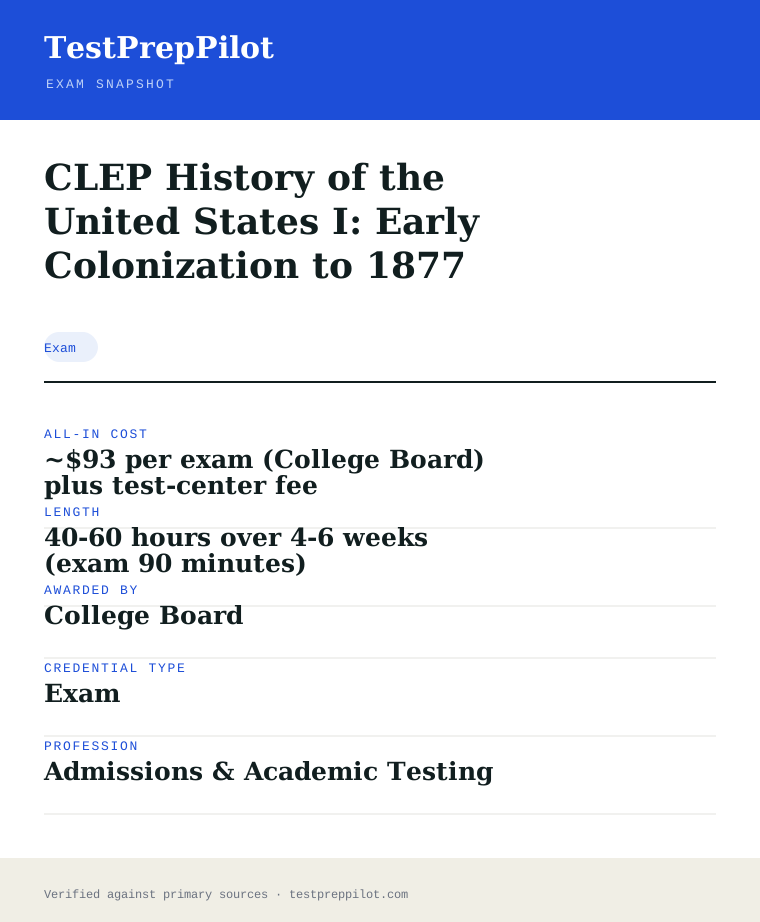
CLEP History of the United States I: Early Colonization to 1877 is a exam credential; awarded by College Board; the exam fee is $97 (2025–26) + test-center fee; typical preparation is 40-60 hours over 4-6 weeks (exam 90 minutes); holders typically earn College credit outcomes vary by school (ACE recommends 50).
| Credential | CLEP History of the United States I: Early Colonization to 1877 |
|---|---|
| Abbreviation | CLEP US History I |
| Type | Exam |
| Profession | Admissions & Academic Testing |
| Specialty | CLEP & Credit by Exam |
| Awarded by | College Board |
| Typical prep time | 40-60 hours over 4-6 weeks (exam 90 minutes) |
| All-in cost | ~$93 per exam (College Board) plus test-center fee |
| Typical salary range | College credit outcomes vary by school (ACE recommends 50) |
| Credit | ACE recommends 3 semester hours at score 50 |
| Score scale | 20–80 scaled |
| Chronology | 70% of items on 1790–1877 |
| Retake | 3-month wait; full fee each attempt |
| Scope | National / Multi-state |
Real questions
Frequently asked questions about the CLEP History of the United States I: Early Colonization to 1877
How many credits does U.S. History I grant?
ACE recommends three semester hours at a score of 50, typically satisfying the first half of a U.S. history requirement.
What time period does it cover?
From early colonization through 1877, with about 70 percent of questions on 1790–1877.
Should I take History II too?
If your school requires the full survey, yes — the two exams together cover the standard two-semester sequence.
Can I take it online?
Yes, via CLEP with Remote Proctoring or at a test center, with the same 20–80 scaled score.
Why do all four SAT Suite tests take the same 2 hours 14 minutes?
Since the digital transition every assessment in the suite uses the same blueprint: 54 Reading and Writing questions in two 32-minute modules and 44 Math questions in two 35-minute modules. Difficulty is calibrated to the grade band rather than by adding or removing time.
Can I take an SAT Suite test at home?
No. Unlike some other admissions tests, every College Board digital assessment must be taken in a supervised school or test centre, even though it runs on your own device.
How do fee waivers work?
US students in eleventh or twelfth grade who meet income eligibility get SAT fee waivers from their school counsellor. A waiver covers the registration fee, waives cancellation and late fees, and gives unlimited free score reports to colleges.
In short
Is the CLEP History of the United States I: Early Colonization to 1877 worth it?
- Equivalent to first-semester U.S. history survey
- ~120 questions in 90 minutes; score 50 for 3 credits
- 70% of items cover 1790–1877
- Pairs with U.S. History II
Same awarding body
What other credentials does College Board award?
Trust
Where does this information come from?
Everything above is taken from the awarding body's own published material. Fees, question counts and domain weights are revised regularly — check the official page before you pay.
- College Board Awarding body
- Official CLEP History of the United States I: Early Colonization to 1877 exam page Exam page
Research confidence: high · Last reviewed 2026-08