Admissions & Academic Testing • Exam
CLEP Humanities
A broad survey of literature, art, and music for three general-education credits.
Researched and maintained by TestPrepPilot Editorial BoardCollege admissions & credit-by-exam desk · Figures last verified August 2026
The short version
What is the CLEP Humanities and is it worth it?
CLEP Humanities is a ~140-question, 90-minute survey of literature and the arts. ACE recommends a score of 50 for three semester hours at accepting schools.
- Replaces a humanities distribution course for ~$97 plus a fee
- Covers literature, art, music, and performance
- Year-round at test centers and online with remote proctoring
- Rewards broad cultural knowledge over memorization
What is it?
What exactly is the CLEP Humanities?
A broad survey of literature, art, and music for three general-education credits.
The CLEP Humanities exam tests general knowledge of literature, visual art, music, and the performing arts from classical to contemporary times. It is broad rather than deep, asking you to recognize works, techniques, and periods. The exam rewards a well-rounded cultural background and is a popular way to satisfy a humanities or distribution requirement.
The path in brief
- Confirm your school’s humanities policy
- Register and pay the $97 fee
- Book a test center or remote-proctoring slot
- Review major periods and art forms
- Score 50+ for three credits
Before you book
Who is eligible to sit the CLEP Humanities?
The test itself
What is the format of the CLEP Humanities?
The CLEP Humanities is administered by CLEP test center or CLEP with Remote Proctoring and runs 90 minutes and requires 50 (ACE credit-granting score) to pass.
| Administered by | CLEP test center or CLEP with Remote Proctoring |
|---|---|
| Questions | ~140 multiple choice |
| Time limit | 90 minutes |
| Pass mark | 50 (ACE credit-granting score) |
| Exam fee | $97 (2025–26) + test-center fee |
| Format | Multiple choice |
Content outline
What topics are on the CLEP Humanities?
The CLEP Humanities is weighted across 4 domains; the largest are Literature (50%), Visual Arts (painting, sculpture) (20%), Performing Arts: Music (15%).
Weightings come from the official exam outline. Study time is best allocated in roughly these proportions rather than evenly across domains.
- Literature 50%
Fiction 15–20%, poetry 10–15%, drama 10%, nonfiction 10%
- Visual Arts (painting, sculpture) 20%
Plus architecture 5%
- Performing Arts: Music 15%
Western and global traditions
- Performing Arts: Film, Dance 10%
Plus other performance
Study materials
Which study guide should you use for the CLEP Humanities?
Start with the exam sponsor's official content outline. If you also want one structured resource to work through, these are the Mometrix titles that match this exam.

This links to Mometrix's CLEP range rather than a single CLEP Humanities title. Check that it lists an edition for CLEP Humanities before you buy.
Affiliate links We may earn a commission if you buy through these links, at no extra cost to you. Mometrix has no say in what our exam guides cover. How we make money.
The path
How do you register for the CLEP Humanities?
- 1
Create a College Board account10 minutes
Register at collegeboard.org with your legal name exactly as it appears on the photo ID you will bring on test day. One account covers the SAT, the PSAT-related assessments, AP and BigFuture.
- 2
Choose a weekend SAT date or let your school register you20 minutes
The SAT is booked directly by the student for weekend national administrations. PSAT 8/9, PSAT 10 and the PSAT/NMSQT are ordered and scheduled by the school, so for those you speak to your counselor rather than registering yourself.
- 3
Pay the fee or claim a fee waiver5 minutes
The US SAT registration fee is 68 dollars; international test takers add a regional fee of 43 dollars and, at some centres, a further test centre fee. Eligible US students get the SAT free through a counsellor-issued fee waiver, which also unlocks unlimited free score sends.
- 4
Install Bluebook and complete exam setup30 minutes
Download the free Bluebook app to your own laptop or tablet, or use a school-managed device, then run exam setup in the five days before test day to download the test and get your admission ticket.
Students who skip exam setup can be turned away or delayed at check-in.
- 5
Practise with Bluebook full-length tests and Khan Academy4 to 12 weeks
Six free adaptive full-length practice tests sit inside Bluebook, and Official Digital SAT Prep on Khan Academy is free and keyed to the same content domains.
- 6
Test, then review scores onlinetest day
Arrive with your admission ticket, acceptable photo ID and a charged device. Scores post to your College Board account, typically within about two weeks for weekend SAT dates.
The fine print
What are the retake and renewal rules for the CLEP Humanities?
- Proctoring & delivery
- All SAT Suite tests are taken in Bluebook on a laptop or tablet, in a school or an authorised weekend test centre, under a live human proctor. There is no at-home option. Bluebook locks the device, and a built-in Desmos graphing calculator and formula sheet are available throughout the Math section; you may also bring your own approved non-CAS calculator.
- Retake policy
- There is no limit on SAT attempts and no mandatory waiting period beyond the eight national dates offered each year. The PSAT-related assessments are given once per school year per grade band and are not retaken on demand. Most selective colleges superscore across SAT sittings, taking your best Reading and Writing score and your best Math score.
- Score reporting
- The SAT reports a 400 to 1600 total built from two 200 to 800 section scores. The PSAT/NMSQT and PSAT 10 report 320 to 1520 with 160 to 760 sections, and the PSAT 8/9 reports 240 to 1440 with 120 to 720 sections, so results across the suite sit on one comparable scale. PSAT/NMSQT reports also carry an NMSC Selection Index of 48 to 228.
- Recertification
- SAT Suite scores do not expire and never need renewal, but colleges commonly ask for a score from within the last five years and most students test in the spring of eleventh grade and again in the autumn of twelfth grade. Only a PSAT/NMSQT taken in eleventh grade enters the National Merit competition.
- Refunds & rescheduling
- Cancelling an SAT registration by the change deadline costs 34 dollars; cancelling after the deadline but before test day costs 44 dollars. Changing test centre costs 34 dollars, and late registration costs 38 dollars. Fee-waiver students are not charged for cancellation or late registration.
Context
The digital SAT Suite compared
| Assessment | Grades | Score scale | Length | |
|---|---|---|---|---|
| PSAT 8/9 | 8 and 9 | 240 to 1440 | 2h 14m | |
| PSAT 10 | 10 (spring) | 320 to 1520 | 2h 14m | |
| PSAT/NMSQT | 10 and 11 (autumn) | 320 to 1520 | 2h 14m | |
| SAT | 11 and 12 | 400 to 1600 | 2h 14m |
What it pays
How much does this credential pay?
No direct occupation — a CLEP Humanities score of 50 earns 3 semester hours of college credit, and the payoff is the education-return premium: bachelor’s-degree holders earned $1,493/week vs $1,059 for associate and $899 for high-school-only (BLS, 2023)
The direct answer is that CLEP Humanities has no BLS occupation of its own — it is a credit-by-examination assessment whose payoff is the college credit it earns and the tuition and time it saves — so the salary story is the education-return premium that CLEP credit accelerates for degree completion, and for students with a humanities distribution requirement the credit often clears a general-education box that would otherwise cost a semester course. The relevant reference points from BLS: in 2023, workers with a bachelor’s degree earned a median weekly wage of about $1,493 versus about $1,059 for associate-degree holders and about $899 for high-school-diploma-only workers, and the May 2024 median wage across all occupations was $49,500. A score of 50 or higher on the 20-to-80 CLEP scale earns the ACE-recommended credit of three semester hours for CLEP Humanities, which the ACE National Guide equates to a lower-division introductory humanities course covering literature, the visual arts and the performing arts, and colleges that accept CLEP credit typically grant the three hours under their own policies, with some requiring a higher score or not accepting the credit toward particular requirements. The practical financial value is concrete: a roughly $93 exam can replace a three-credit humanities course — at in-state public tuition that is often several hundred to well over a thousand dollars for three credit hours — and for students whose degree programs include a humanities or fine-arts distribution requirement, it clears that box without a semester of classes. The honest framing is that the value is measured in credits, tuition saved and time-to-degree, not in a salary line tied to the exam itself — and for a student deciding whether to sit it, the investment is the exam fee, roughly $93 plus a test-centre fee, and the preparation hours, which are real because the exam spans literature, art, architecture, music, film, dance and theatre from the classical period to the present in 140 questions and 90 minutes.
| Measure | Figure | Source / note |
|---|---|---|
| Reference: median wage, all occupations | $49,500 | BLS Occupational Outlook Handbook, May 2024 |
| Reference: bachelor’s degree, median weekly earnings | $1,493 | BLS Education Pays, 2023 ($77,636/yr equivalent) |
| Reference: associate degree, median weekly earnings | $1,059 | BLS Education Pays, 2023 ($55,068/yr equivalent) |
| The exam itself | No direct occupation | A credit-by-examination test; ACE recommends 3 semester hours for a score of 50+ |
| ACE credit-granting score | 50 (on a 20-80 scale) | ACE National Guide; individual colleges set their own policies |
Job growth.BLS does not project growth for a CLEP exam; the relevant projections follow the occupations the earned degree feeds into, and the value is the three credit hours, tuition savings and time-to-degree it buys for students with a humanities distribution requirement.
Source: BLS Education Pays
Your odds
What are the pass rates?
The College Board publishes no CLEP pass rate — it publishes only the 20-80 score scale and the ACE recommendation (50 for 3 semester hours); the civilian pass-rate figures circulating online are a stale 2017 release, not current official data
The core fact is that the College Board does not publish pass rates for CLEP Humanities or any CLEP exam, and it has not published civilian pass-rate statistics since 2017 — so the percentages you see on prep sites, including the "68 percent" Humanities figure some vendors quote, are either that stale 2017 release being passed around or a vendor’s count of its own paying customers, neither of which is an official statistic. The only genuine institutional pass-rate data that exists is published by DANTES, the Department of Defense agency, and it covers military test takers only — a funded, self-selected population that is not a national sample, so we do not present it as one. What the College Board does publish and verify is the scoring structure: CLEP scores run on a scaled range of 20 to 80, the American Council on Education recommends a credit-granting score of 50, and the ACE National Guide equates that score to three semester hours of lower-division humanities, with individual colleges setting their own credit policies. The exam itself is approximately 140 multiple-choice questions answered in 90 minutes, testing general knowledge of literature and the arts from the classical period to the present, with a published content breakdown: literature at 50 percent (drama 10 percent, poetry 10 to 15 percent, fiction 15 to 20 percent, and nonfiction including philosophy 10 percent) and the arts at 50 percent (visual arts such as painting and sculpture at 20 percent, architecture at 5 percent, music at 15 percent, and film, dance and related performing arts at 10 percent). The College Board also publishes the three skill categories: knowledge of factual information such as authors and works (50 percent), recognition of techniques such as rhyme scheme, medium and style and the ability to attribute them to writers, artists, schools or periods (30 percent), and understanding and interpretation of literary passages and art reproductions (20 percent). Because the pass line is not published, the practical planning rule is to confirm your college’s credit policy first, then prepare until you are consistently at or above the ACE-recommended 50 on full timed practice exams, because that is the only score threshold officially on the record.
Read this before quoting the number.The College Board publishes no CLEP pass rate and no current civilian score distribution; the last civilian pass-rate release was 2017 and the figures online are stale or vendor-reported. DANTES publishes military-only pass-rate data that is not a national figure. What is published and verifiable is the 20-80 score scale, the ACE credit-granting score of 50 (3 semester hours), and the approximately 140-question, 90-minute format with the published content breakdown.
Source: College Board — CLEP Humanities
Your schedule
How long should I study for it?
60-90 hours over 6-10 weeks (or a 3-5 week review with broad reading background) of focused study
Plan for 6 to 10 weeks and 60 to 90 hours of study if the humanities are unfamiliar territory, or a 3-to-5-week review if you read widely and have some art and music background, because CLEP Humanities is one of the broadest exams in the CLEP catalogue — approximately 140 questions in 90 minutes, under 39 seconds per question, spanning literature, art, architecture, music, film, dance and theatre from the classical period to the present — and the exam’s own description concedes that no one person is likely to be well informed about all the fields it covers. The published content breakdown is the planning map: literature at 50 percent (drama 10, poetry 10 to 15, fiction 15 to 20, nonfiction including philosophy 10) and the arts at 50 percent (visual arts such as painting and sculpture 20, architecture 5, music 15, film and dance 10), with questions fairly evenly divided across the classical, medieval and Renaissance, seventeenth-and-eighteenth-century, nineteenth-century, and twentieth-century periods, and at least 5 to 10 percent drawn from non-Western cultures. The most effective sequence: first, take a full timed practice exam to baseline and log every miss by category — literature versus the arts, and which period — because the exam is broad enough that the gap is usually a coverage gap; second, build the literature foundation — major authors, works and genres in fiction, poetry, drama and nonfiction, including philosophy — because literature is half the exam and the recognition items reward a studied canon; third, build the arts foundation — the major artists, composers, movements and works, with the terminology of each medium — because the arts half is where most candidates are weaker and where the biggest gains come from a systematic survey; fourth, rehearse the recognition and interpretation skills the exam explicitly weights — identifying techniques and style and attributing them to writers, artists, schools or periods (30 percent), and interpreting unfamiliar literary passages and art reproductions (20 percent) — because those combined 50 percent are the difference between knowing facts and answering the exam; and fifth, in the final two weeks, take two or three full timed exams and re-study the weakest categories. Confirm your college’s credit policy before you invest the hours, and note the exam fee is roughly $93 plus a test-centre administration fee.
- Weeks 1-210-12 hrs/week
Baseline and literature: fiction and drama
- Take a full timed practice exam and log every miss by category and period
- Survey major fiction: authors, works, movements and genres
- Survey drama from the Greeks to the modern stage — playwrights, works, and theatrical terms
- Weeks 3-410-12 hrs/week
Literature: poetry and nonfiction
- Learn poetry: major poets and works, plus the technical terms — rhyme scheme, meter, stanza, imagery
- Cover nonfiction and philosophy: essayists, philosophers and their key ideas
- Practise attributing techniques to periods and schools
- Weeks 5-610-12 hrs/week
The arts: visual arts and architecture
- Survey painting and sculpture: major artists, works, styles and movements from classical to contemporary
- Cover architecture: major monuments, styles and terminology
- Learn the vocabulary of each medium — the recognition items reward the terminology
- Weeks 7-810-12 hrs/week
The arts: music, film and dance
- Survey music: major composers, works and genres, and the terminology of form
- Cover film, dance and theatre as art forms — key works, movements and directors
- Include the non-Western content — at least 5-10% of the exam draws on other cultures
- Weeks 9-108-10 hrs/week
Full timed exams and gap closing
- Take two or three full timed practice exams under real timing
- Re-lab every miss by category and re-study the weakest — usually the arts half
- Final pass over the recognition and interpretation item styles
Adjusting the pace
Avid reader with some arts background.Three to five weeks. Your literature half is strong; spend the time on the arts survey — the terminology and major works of painting, music and architecture — then run two or three full timed exams.
Degree program with a humanities requirement.Plan the full 6-10 weeks and confirm how your college applies the credit before you invest the hours — some programs require a higher score or restrict which requirements CLEP credit can clear.
Working full-time.Stretch the plan to 10-12 weeks at 5-7 hours a week, and use flashcards for the recognition content — authors and works, artists and movements, composers and terminology — because the breadth of the canon rewards spaced repetition.
How to study
How do I prepare most effectively?
The strategy that reliably passes CLEP Humanities is "build the canon in both halves, learn the terminology, and rehearse the recognition and interpretation skills," because the exam weights factual knowledge at 50 percent, recognition of technique and style at 30 percent, and interpretation of unfamiliar passages and art reproductions at 20 percent — so a candidate who memorises names without learning to recognise styles and interpret works answers only half the paper. The single highest-yield habit is taking full timed practice exams in the real format from the start, because 140 questions in 90 minutes is under 39 seconds per question and the speed is itself a tested skill. A second proven approach is building the literature canon deliberately — the major authors, works, genres and movements in fiction, poetry, drama and nonfiction including philosophy — because literature is half the exam and the recognition items reward a studied body of knowledge, not isolated facts. Third, build the arts survey with its terminology: the major artists, composers, works and movements in painting, sculpture, architecture, music, film, dance and theatre, learning the vocabulary of each medium, because a substantial number of questions test terminology, genre and style. Fourth, practise the recognition and interpretation skills explicitly — identifying rhyme scheme, medium and matters of style, and interpreting passages and art reproductions that are likely unfamiliar — because combined they are 50 percent of the exam and they are coachable: working through attributed examples builds the ability to attribute. Fifth, cover the period spread deliberately — questions are fairly evenly divided from the classical period to the twentieth century, with at least 5 to 10 percent on non-Western cultures, so a plan that only covers one era leaves whole blocks of the paper unanswered. Finally, remember there is no guessing penalty, so answer every question, and be honest about readiness: if practice scores are not clearing 50 with margin, the exam’s breadth means the gap is usually coverage — go back to the survey rather than re-reading what you already know.
Build the canon in both halves
Literature and the arts are each 50 percent of the exam. A candidate who studies only literature leaves half the paper to the arts survey — the major artists, composers, works and movements — which is where most candidates are weakest and where the biggest score gains come from.
Learn the terminology of each medium
A substantial number of questions test terminology, genre and style — rhyme scheme and meter in poetry, medium and technique in art, form in music. The vocabulary is finite and bankable, and it is the key to the recognition items.
Practise attribution and interpretation
Recognition of technique and style is 30 percent of the exam, and interpreting unfamiliar passages and art reproductions is 20 percent. Work through attributed examples — "this passage is characteristic of which writer" — because the ability to attribute is a coachable skill, not luck.
Cover the period spread evenly
Questions are fairly evenly divided across the classical, medieval and Renaissance, seventeenth-and-eighteenth-century, nineteenth-century and twentieth-century periods, with at least 5-10% on non-Western cultures. A plan covering only one era leaves whole blocks of the paper unanswered.
Rehearse the 90-minute pace
About 140 questions in 90 minutes is under 39 seconds per question. Take full timed exams from the start and build the skip-and-return discipline — flag anything over 45 seconds and come back.
Answer every question
There is no penalty for guessing on CLEP. An educated guess costs nothing and can move a borderline scaled score across the ACE-recommended 50 line.
What to buy
Which study resources are worth paying for?
CLEP Humanities preparation is dominated by free and low-cost resources, and the buying decision is about study hours rather than product price: the College Board CLEP page defines the exact format, the content breakdown and the skill weights, the ACE National Guide confirms the three-hour credit, and the content itself — the canon of literature, art and music — is available free through libraries, museum and gallery sites, and public-domain texts. The cost structure to plan against is the exam fee — roughly $93 paid to College Board plus a separate test-centre administration fee that varies by location, commonly $15 to $40 — and because this is a breadth-based credit exam with a public blueprint, the real investment is the 60 to 90 hours of study the breadth deserves, not the price of a prep product. The Modern States free CLEP Humanities course is worth calling out because it is mapped to the syllabus and Modern States has historically offered free exam vouchers to students who complete its courses, which removes even the $93 fee for eligible candidates. The comparison below separates the official and free resources from the modest paid options, with prices current to this review. The rule that works: build the content with free resources — a good survey text from a library, museum and gallery sites for the visual arts, and public-domain texts for literature — rehearse the 90-minute, roughly 140-question timed format with practice exams until you score at or above 50 consistently, and spend money on a structured course only if self-study has already failed to reach the ACE-recommended 50 target — for a breadth-based, multiple-choice credit exam with a public blueprint, the free path is normally sufficient, and the hours matter more than the fee.
| Resource | Price | Format | Best for |
|---|---|---|---|
| College Board CLEP Humanities page and exam description | Free | Official content outline and scoring facts | The authoritative syllabus — the content breakdown and the three skill weights |
| The CLEP exam itself | ~$93 plus a test-centre administration fee | Computer-delivered at a CLEP test centre | Required — the credit-earning event |
| Library survey texts, museum sites and public-domain texts | Free | Books and web resources | Building the canon — including Modern States, which has historically offered free vouchers |
| CLEP practice-exam banks and review books | ~$10-50 | Online timed practice or printed book | Format calibration on the 90-minute timing and the recognition items |
| Structured CLEP Humanities courses | ~$50-150 | Video course with practice | Only if self-study has not reached the 50 target; the content is otherwise free |
Prices approximate and dated to this review; the exam is offered year-round by appointment, and the test-centre administration fee is separate from the ~$93 exam fee. We do not rank by commission.
Avoid these
What mistakes do candidates most often make?
The most common mistake on CLEP Humanities is studying only the half you enjoy — most candidates naturally prepare the literature block and under-prepare the arts block, when the exam is evenly split at 50 percent each and the arts survey is where the biggest score gains are available. The second is treating it as a pure recall exam when recognition of technique and style is 30 percent and interpretation of unfamiliar passages and art reproductions is 20 percent — combined, half the exam rewards the ability to attribute and interpret, not just to name — and the 90-minute, approximately 140-question pace (under 39 seconds per question) punishes anything slower than recognition. A third recurring error is ignoring the period spread: candidates study their favourite era and leave the classical-to-contemporary range half-covered, when questions are fairly evenly divided across periods and at least 5 to 10 percent draw on non-Western cultures. Candidates also routinely skip the terminology of the media, losing the substantial number of items that test rhyme scheme, genre, medium and style. Many sit the exam without confirming their college’s credit policy, discovering that a 50 earns nothing at a school that requires a higher score or does not accept the credit for their requirement. Finally, some students rely on the stale pass-rate figures online — the "68 percent" some vendors quote — as a difficulty signal; the honest target is the ACE-recommended 50 on a 20-80 scale, and the only reliable measure of readiness is a timed practice exam.
✕Studying only the half you enjoy
✓Literature and the arts are each 50 percent of the exam. Prepare both halves — most candidates over-invest in literature and under-prepare the arts survey, which is where the biggest gains are available.
✕Treating it as pure recall
✓Recognition of technique and style is 30 percent and interpretation of unfamiliar passages and art reproductions is 20 percent. Practise attribution and interpretation alongside the facts, because recall alone fails half the exam.
✕Ignoring the period spread
✓Questions are fairly evenly divided from the classical period to the present, with at least 5-10% on non-Western cultures. Cover the full range rather than your favourite era, or whole blocks of the paper go unanswered.
✕Skipping the terminology of the media
✓A substantial number of questions test terminology, genre and style — rhyme scheme, medium, matters of style. The vocabulary is finite and bankable, and it unlocks the recognition items.
✕Sitting without checking the credit policy
✓Confirm your college’s CLEP policy before investing the hours: some programs require a score above 50, and some restrict which requirements CLEP credit can clear. A 50 that earns nothing is the most expensive outcome on this list.
✕Trusting online pass-rate figures
✓No current official CLEP pass rate exists — the numbers online are a stale 2017 release or vendor self-reporting. Plan against the 50 target and your college’s policy, measured by timed practice exams, not a rumoured percentage.
What you'll face
What question types will I see?
The CLEP Humanities exam is approximately 140 multiple-choice questions answered in 90 minutes, scored on a 20-to-80 scale with the ACE credit-granting score at 50 for three semester hours, and there is no penalty for guessing. The content spans literature and the arts from the classical period to the present, with a published breakdown: literature at 50 percent — drama 10, poetry 10 to 15, fiction 15 to 20, and nonfiction including philosophy 10 — and the arts at 50 percent — visual arts such as painting and sculpture 20, architecture 5, music 15, and film, dance and related performing arts 10 — with questions fairly evenly divided across the classical, medieval and Renaissance, seventeenth-and-eighteenth-century, nineteenth-century and twentieth-century periods, and at least 5 to 10 percent drawn from non-Western cultures. The College Board publishes three skill categories: knowledge of factual information such as authors and works (50 percent), recognition of techniques such as rhyme scheme, medium and style and the ability to attribute them to writers, artists, schools or periods (30 percent), and understanding and interpretation of literary passages and art reproductions that are likely unfamiliar (20 percent). The practical pacing is under 39 seconds per question, which makes recognition speed and the skip-and-return discipline essential — flag anything that takes more than about 45 seconds and come back to it. The recognition items dominate — authors and works, artists and movements, composers and terminology — while the interpretation items present a passage or reproduction you have not seen and ask you to analyse it, which is why working through attributed examples is the highest-yield rehearsal. The samples below are editor-written illustrations of the published blueprint, not live exam items.
Authors, works, artists, composers, movements and terminology — the studied canon. Finite in scope and the most bankable cluster when the canon is covered.
Identify rhyme scheme, medium, style and genre, and attribute them to writers, artists, schools or periods. Reward working through attributed examples rather than memorising names alone.
Literary passages and art reproductions that are likely unfamiliar — analyse and interpret them. A coachable skill built by practising analysis on unseen examples.
Try these
Q1Which literary technique is most characteristic of sonnets, including those of Shakespeare and Petrarch?
Answer:B
A sonnet is a fourteen-line poem with a defined rhyme scheme — the Petrarchan (Italian) sonnet splits into an octave and a sestet, while the Shakespearean sonnet uses three quatrains and a couplet. B names the fixed structure that defines the form. A describes free verse, the opposite of the sonnet’s formal constraint. C describes blank verse — unrhymed iambic pentameter, the form of Shakespeare’s plays, not his sonnets. D describes a poetic refrain or ballad convention. This is a recognition item testing terminology and technique — the 30 percent category that rewards knowing the technical vocabulary of the forms.
Q2Which artist is most closely associated with the development of Cubism alongside Pablo Picasso?
Answer:A
Georges Braque developed Cubism together with Pablo Picasso in the years around 1907-1914, breaking objects into geometric facets and multiple viewpoints. B is wrong because Monet is the leading Impressionist, working a generation earlier on light and atmosphere. C is wrong because van Gogh is a Post-Impressionist, associated with expressive colour and brushwork rather than Cubism. D is wrong because Dalí is the leading Surrealist, known for dream imagery rather than Cubist faceting. This is a factual-knowledge item from the visual-arts survey — the 20 percent visual-arts block rewards knowing the major artists and their movements.
Q3A passage by an unknown author uses a first-person narrator who recounts childhood memories with nostalgia and includes long, flowing descriptions of nature. The style is most likely characteristic of which literary movement?
Answer:B
Nostalgia for childhood, a first-person emotional narrator and long, flowing descriptions of nature are hallmarks of Romanticism, the late-eighteenth-and-nineteenth-century movement that prized emotion, the individual and the natural world. A is wrong because Neoclassicism valued order, reason and restraint — the opposite of emotional overflow. C is wrong because Realism emphasised plain, objective depiction of everyday life. D is wrong because Modernism is characterised by fragmentation, experiment and self-consciousness rather than flowing nostalgia. This is an interpretation item — the passage is unfamiliar, and the question rewards attributing the style, exactly the 20 percent category the exam explicitly tests.
Samples are editor-written illustrations of the published blueprint, not live exam items.
The big day
What should I expect on exam day?
The CLEP Humanities exam is a 90-minute, approximately 140-question computer-delivered test taken by appointment at a CLEP test centre, with the score reported immediately on a 20-to-80 scale and the ACE credit-granting score at 50 for three semester hours. The first thing to confirm is your test-centre administration fee, because CLEP charges roughly $93 for the exam plus a separate centre fee that varies by location — commonly $15 to $40 — and the second is your college’s credit policy, so you know the score you need before you sit. Bring a valid government-issued photo ID matching your CLEP account name exactly, and leave phones, smartwatches, study materials and any personal calculators at home — no calculator is used on this exam, and the centre provides scratch paper. Arrive at least 30 minutes early so check-in and the tutorial are complete before the clock starts. When the exam begins, work at a pace of under 39 seconds per question — most recognition items take far less, so flag anything that exceeds about 45 seconds and come back to it rather than freezing, because there is no guessing penalty and every question must be answered. The interpretation items — the unfamiliar passages and art reproductions — take a little longer but reward staying with the material rather than skipping it. Budget the final minutes to revisit your flagged items and submit before the clock expires. Your score appears on screen the moment you submit, and the official report posts to your CLEP account within a few business days, after which you order the score to your registrar if your school requires an official copy — and note that a 50 earns the ACE-recommended three semester hours, so confirm exactly how your program applies the credit before you bank on it.
Bring
- Valid government-issued photo ID matching your CLEP account name exactly
- Your CLEP registration confirmation and scheduling details
- Payment for any test-centre administration fee due at the site
- A clear head — 140 questions in 90 minutes rewards recognition speed and skip-and-return discipline
Leave at home
- Phones, smartwatches and earbuds
- All notes, formula sheets and study materials — the centre provides scratch paper
- Personal calculators — none is used on this exam
- Bags and coats beyond what the test centre permits
How the day runs
Rules in the room
- The exam is approximately 140 multiple-choice questions in 90 minutes, computer-delivered at a CLEP test centre.
- Scoring is on a 20-80 scale; the ACE credit-granting score is 50 for 3 semester hours, and individual colleges set their own policies.
- There is no penalty for guessing — answer every question.
- Personal calculators are not permitted — none is used on this exam.
- The exam fee is roughly $93 plus a separate test-centre administration fee.
- The score appears on screen immediately; the official report posts within a few business days.
Afterwards.Your score appears on screen the moment you submit and the official report posts to your CLEP account within a few business days, and a score of 50 or higher earns the ACE-recommended three semester hours of lower-division humanities credit — the equivalent of a semester course covering literature and the arts — which most colleges accept under their own policies, some requiring a higher score or restricting which requirements the credit clears, so the immediate next step is checking your program’s CLEP policy and ordering the score report to the registrar if an official copy is required. For a student with a humanities or fine-arts distribution requirement, those three hours replace a semester course, which is real tuition saved and time-to-degree compressed. If you fell short of 50, re-sit only after the practice scores genuinely clear the line: the exam is so broad that the gap is almost always a coverage gap — most often in the arts half or in the periods you skipped — and the fix is completing that survey rather than repeating what you already know. The natural context is the credit-by-exam path itself: CLEP Humanities is broad but forgiving in depth — the exam’s own description concedes no one is expert in all its fields — and for a student with the requirement and the hours, it is one of the more accessible credit sources in the catalogue.
Reference
What are the key facts about the CLEP Humanities?
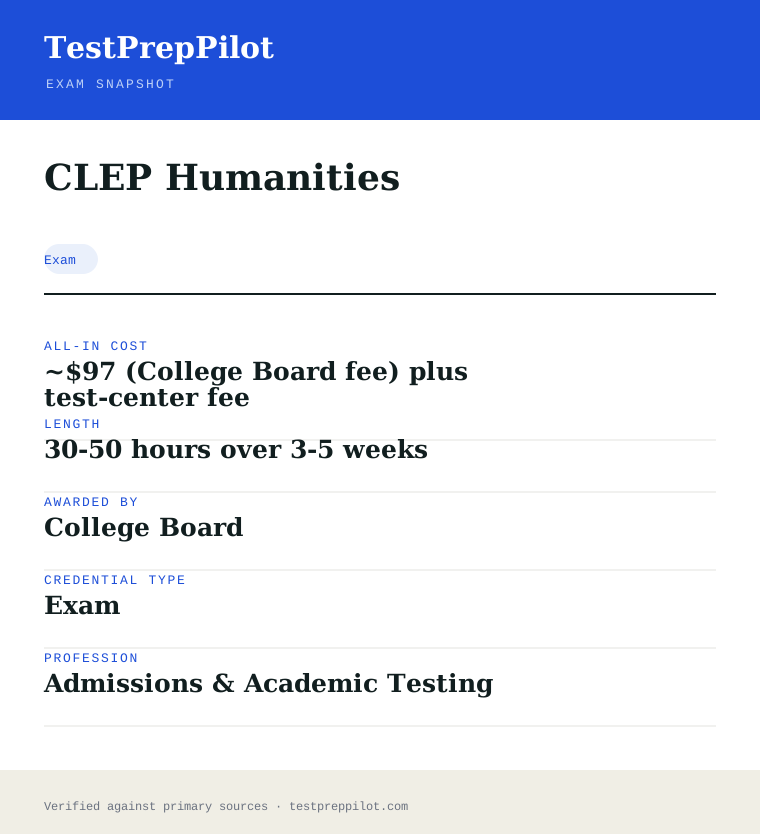
CLEP Humanities is a exam credential; awarded by College Board; the exam fee is $97 (2025–26) + test-center fee; typical preparation is 30-50 hours over 3-5 weeks; holders typically earn College credit outcomes vary by school (ACE recommends 50).
| Credential | CLEP Humanities |
|---|---|
| Type | Exam |
| Profession | Admissions & Academic Testing |
| Specialty | CLEP & Credit by Exam |
| Awarded by | College Board |
| Typical prep time | 30-50 hours over 3-5 weeks |
| All-in cost | ~$97 (College Board fee) plus test-center fee |
| Typical salary range | College credit outcomes vary by school (ACE recommends 50) |
| Credit | ACE recommends 3 semester hours at score 50 |
| Score scale | 20–80 scaled |
| Retake | 3-month wait; full fee each attempt |
| Scope | Classical to contemporary, all periods |
| Scope | National / Multi-state |
Real questions
Frequently asked questions about the CLEP Humanities
How many credits does Humanities grant?
ACE recommends three semester hours at a score of 50, often applied to a humanities or general-education distribution requirement.
Do I need deep knowledge of every art form?
No. The exam is broad; it tests recognition of major works, styles, and periods rather than expertise in any one area.
Is it hard?
Most find it moderate if they have a general arts background. The 140 questions in 90 minutes make pacing the main challenge.
Can I take it online?
Yes, via CLEP with Remote Proctoring or at a test center, with the same 20–80 scaled score.
Why do all four SAT Suite tests take the same 2 hours 14 minutes?
Since the digital transition every assessment in the suite uses the same blueprint: 54 Reading and Writing questions in two 32-minute modules and 44 Math questions in two 35-minute modules. Difficulty is calibrated to the grade band rather than by adding or removing time.
Can I take an SAT Suite test at home?
No. Unlike some other admissions tests, every College Board digital assessment must be taken in a supervised school or test centre, even though it runs on your own device.
How do fee waivers work?
US students in eleventh or twelfth grade who meet income eligibility get SAT fee waivers from their school counsellor. A waiver covers the registration fee, waives cancellation and late fees, and gives unlimited free score reports to colleges.
In short
Is the CLEP Humanities worth it?
- Equivalent to a broad humanities survey
- ~140 questions in 90 minutes; score 50 for 3 credits
- Literature and the arts each about half
- Rewards general cultural literacy
Same awarding body
What other credentials does College Board award?
Trust
Where does this information come from?
Everything above is taken from the awarding body's own published material. Fees, question counts and domain weights are revised regularly — check the official page before you pay.
- College Board Awarding body
- Official CLEP Humanities exam page Exam page
Research confidence: high · Last reviewed 2026-08