Admissions & Academic Testing • Exam
CLEP College Mathematics
A broad quantitative-literacy exam for non-math majors worth three credits.
Researched and maintained by TestPrepPilot Editorial BoardCollege admissions & credit-by-exam desk · Figures last verified August 2026
The short version
What is the CLEP College Mathematics and is it worth it?
CLEP College Mathematics is a ~60-question, 90-minute exam for non-math majors. A scaled score of 50 typically earns three semester hours at schools that accept CLEP.
- Replaces a general-education math course for ~$97 plus a fee
- Broad, practical topics: finance, stats, logic, probability
- Built-in scientific calculator
- Lighter than algebra or precalculus for many students
What is it?
What exactly is the CLEP College Mathematics?
A broad quantitative-literacy exam for non-math majors worth three credits.
The CLEP College Mathematics exam serves non-mathematics majors, covering logic, sets, numbers, algebra, functions, counting, probability, statistics, and financial mathematics. It emphasizes practical quantitative literacy over advanced computation. An online scientific calculator is available, and it is a popular general-education math credit.
The path in brief
- Confirm your school’s math policy
- Register and pay the $97 fee
- Book a test center or remote-proctoring slot
- Review finance, stats, and logic
- Score 50+ for three credits
Before you book
Who is eligible to sit the CLEP College Mathematics?
The test itself
What is the format of the CLEP College Mathematics?
The CLEP College Mathematics is administered by CLEP test center or CLEP with Remote Proctoring and runs 90 minutes and requires 50 (ACE credit-granting score) to pass.
| Administered by | CLEP test center or CLEP with Remote Proctoring |
|---|---|
| Questions | ~60 multiple choice |
| Time limit | 90 minutes |
| Pass mark | 50 (ACE credit-granting score) |
| Exam fee | $97 (2025–26) + test-center fee |
| Format | Multiple choice (calculator in software) |
Content outline
What topics are on the CLEP College Mathematics?
The CLEP College Mathematics is weighted across 7 domains; the largest are Algebra and Functions (20%), Financial Mathematics (20%), Logic and Sets (15%).
Weightings come from the official exam outline. Study time is best allocated in roughly these proportions rather than evenly across domains.
- Algebra and Functions 20%
Equations, graphs, growth
- Financial Mathematics 20%
Interest, present/future value
- Logic and Sets 15%
Statements, Venn diagrams
- Data Analysis and Statistics 15%
Graphs, mean, deviation
- Counting and Probability 10%
Combinations, events
- Geometry 10%
Triangles, circles
- Numbers 10%
Properties, number theory
Study materials
Which study guide should you use for the CLEP College Mathematics?
Start with the exam sponsor's official content outline. If you also want one structured resource to work through, these are the Mometrix titles that match this exam.

This links to Mometrix's CLEP range rather than a single CLEP College Mathematics title. Check that it lists an edition for CLEP College Mathematics before you buy.
Affiliate links We may earn a commission if you buy through these links, at no extra cost to you. Mometrix has no say in what our exam guides cover. How we make money.
The path
How do you register for the CLEP College Mathematics?
- 1
Create a College Board account10 minutes
Register at collegeboard.org with your legal name exactly as it appears on the photo ID you will bring on test day. One account covers the SAT, the PSAT-related assessments, AP and BigFuture.
- 2
Choose a weekend SAT date or let your school register you20 minutes
The SAT is booked directly by the student for weekend national administrations. PSAT 8/9, PSAT 10 and the PSAT/NMSQT are ordered and scheduled by the school, so for those you speak to your counselor rather than registering yourself.
- 3
Pay the fee or claim a fee waiver5 minutes
The US SAT registration fee is 68 dollars; international test takers add a regional fee of 43 dollars and, at some centres, a further test centre fee. Eligible US students get the SAT free through a counsellor-issued fee waiver, which also unlocks unlimited free score sends.
- 4
Install Bluebook and complete exam setup30 minutes
Download the free Bluebook app to your own laptop or tablet, or use a school-managed device, then run exam setup in the five days before test day to download the test and get your admission ticket.
Students who skip exam setup can be turned away or delayed at check-in.
- 5
Practise with Bluebook full-length tests and Khan Academy4 to 12 weeks
Six free adaptive full-length practice tests sit inside Bluebook, and Official Digital SAT Prep on Khan Academy is free and keyed to the same content domains.
- 6
Test, then review scores onlinetest day
Arrive with your admission ticket, acceptable photo ID and a charged device. Scores post to your College Board account, typically within about two weeks for weekend SAT dates.
The fine print
What are the retake and renewal rules for the CLEP College Mathematics?
- Proctoring & delivery
- All SAT Suite tests are taken in Bluebook on a laptop or tablet, in a school or an authorised weekend test centre, under a live human proctor. There is no at-home option. Bluebook locks the device, and a built-in Desmos graphing calculator and formula sheet are available throughout the Math section; you may also bring your own approved non-CAS calculator.
- Retake policy
- There is no limit on SAT attempts and no mandatory waiting period beyond the eight national dates offered each year. The PSAT-related assessments are given once per school year per grade band and are not retaken on demand. Most selective colleges superscore across SAT sittings, taking your best Reading and Writing score and your best Math score.
- Score reporting
- The SAT reports a 400 to 1600 total built from two 200 to 800 section scores. The PSAT/NMSQT and PSAT 10 report 320 to 1520 with 160 to 760 sections, and the PSAT 8/9 reports 240 to 1440 with 120 to 720 sections, so results across the suite sit on one comparable scale. PSAT/NMSQT reports also carry an NMSC Selection Index of 48 to 228.
- Recertification
- SAT Suite scores do not expire and never need renewal, but colleges commonly ask for a score from within the last five years and most students test in the spring of eleventh grade and again in the autumn of twelfth grade. Only a PSAT/NMSQT taken in eleventh grade enters the National Merit competition.
- Refunds & rescheduling
- Cancelling an SAT registration by the change deadline costs 34 dollars; cancelling after the deadline but before test day costs 44 dollars. Changing test centre costs 34 dollars, and late registration costs 38 dollars. Fee-waiver students are not charged for cancellation or late registration.
Context
The digital SAT Suite compared
| Assessment | Grades | Score scale | Length | |
|---|---|---|---|---|
| PSAT 8/9 | 8 and 9 | 240 to 1440 | 2h 14m | |
| PSAT 10 | 10 (spring) | 320 to 1520 | 2h 14m | |
| PSAT/NMSQT | 10 and 11 (autumn) | 320 to 1520 | 2h 14m | |
| SAT | 11 and 12 | 400 to 1600 | 2h 14m |
What it pays
How much does this credential pay?
No direct occupation — a CLEP College Mathematics score of 50 earns 3 semester hours of general-education math credit, and the payoff is the education-return premium: bachelor’s-degree holders earn $1,493/week vs $1,059 for associate and $899 for high-school-only (BLS, 2023)
The direct answer is that CLEP College Mathematics has no BLS occupation of its own — it is a credit-by-examination assessment whose payoff is the college credit it earns and the tuition and time it saves — so the salary story is the education-return premium that CLEP credit accelerates for degrees in business, education, nursing, the social sciences and other non-math-intensive majors. The relevant reference points from BLS: in 2023, workers with a bachelor’s degree earned a median weekly wage of about $1,493 versus about $1,059 for associate-degree holders and about $899 for high-school-diploma-only workers, and the earnings gap has persisted in every recent BLS year. A score of 50 or higher on the 20-to-80 CLEP scale earns the ACE-recommended credit of three semester hours for CLEP College Mathematics, which the ACE National Guide equates to a college course in mathematics and quantitative analysis for non-math majors, and colleges that accept CLEP credit typically grant the three hours under their own policies, with some requiring a higher score. The practical financial value is direct for students facing a general-education math requirement: three credit hours of a survey math course replaced by a $97 exam can shorten time-to-degree and save a meaningful share of tuition at in-state public rates. CLEP College Mathematics is designed for non-math majors and covers algebra and functions, financial mathematics, logic and sets, counting and probability, statistics and geometry at a broad but shallow level, with a built-in scientific calculator, and its honest value proposition is that it clears the general-education requirement for students whose degrees do not require calculus. For a student deciding whether to take it, the investment is the exam fee, about $97 plus a test-center fee, and the payoff is measured in credits, tuition saved and time-to-degree, not in a direct wage.
| Measure | Figure | Source / note |
|---|---|---|
| Reference: bachelor’s degree, median weekly earnings | $1,493 | BLS Education Pays, 2023 ($77,636/yr equivalent) |
| Reference: associate degree, median weekly earnings | $1,059 | BLS Education Pays, 2023 ($55,068/yr equivalent) |
| Reference: high-school diploma, median weekly earnings | $899 | BLS Education Pays, 2023 ($46,748/yr equivalent) |
| The exam itself | No direct occupation | A credit-by-examination test; ACE recommends 3 semester hours for a score of 50+ |
| ACE credit-granting score | 50 (on a 20-80 scale) | ACE National Guide; individual colleges set their own policies |
Job growth.BLS does not project growth for a CLEP exam; the relevant projections follow the occupations the earned degree feeds into, and the value is the three credit hours, tuition savings and time-to-degree it buys toward a general-education math requirement.
Source: BLS Education Pays
Your odds
What are the pass rates?
The College Board publishes no CLEP pass rate — it publishes the score scale (20-80) and the ACE recommendation (50 for 3 semester hours); no official pass-rate or score-distribution statistic exists for this exam
The core fact is that the College Board does not publish pass rates for CLEP exams, and it does not publish score distributions for them either, so there is no official statistic for CLEP College Mathematics — any percentage you see online is a prep-site estimate, not a College Board or ACE number, and should be read as guidance rather than as verified data. What is published and verifiable is the scoring structure: CLEP scores run on a scaled range of 20 to 80, the American Council on Education recommends a credit-granting score of 50, and the ACE National Guide equates that score to three semester hours of College Mathematics and Quantitative Analysis, with individual colleges setting their own credit policies. The exam itself is approximately 60 multiple-choice questions answered in 90 minutes, with a scientific (nongraphing) TI-30XS MultiView calculator integrated into the exam software and available throughout the test. The content is broad but shallow by design: algebra and functions (20 percent), financial mathematics (20 percent), data analysis and statistics (15 percent), logic and sets (15 percent), counting and probability, geometry and numbers (about 10 percent each), and roughly half the questions are routine problem-solving while half are non-routine conceptual problems. Because the score is scaled and no pass rate is published, the practical planning rule is to confirm your college’s credit policy first, then prepare until you are consistently above 50 on full timed practice exams, and to answer every question since there is no guessing penalty. The absence of a published pass rate should be stated plainly: candidates should plan against the 50 target, the 90-minute format and their program’s policy, not against an unverified pass-rate estimate.
Read this before quoting the number.The College Board publishes no pass-rate statistics and no score distributions for CLEP exams. What is published and verifiable is the 20-80 score scale, the ACE credit-granting score of 50 (3 semester hours), the approximately 60-question 90-minute format, and the content weightings.
Your schedule
How long should I study for it?
25-45 hours over 4-6 weeks, more if basic math is rusty of focused study
Plan for 4 to 6 weeks and 25 to 45 hours of study if your basic math is solid, or 6 to 8 weeks if you are rusty, because CLEP College Mathematics is a broad-but-shallow exam — 60 questions in 90 minutes across seven content areas, with algebra and functions and financial mathematics carrying the most weight — and the honest requirement is comfortable fluency, not mastery of any single topic. The exam splits roughly evenly between routine problem-solving and non-routine conceptual questions, and it provides a built-in TI-30XS MultiView scientific calculator throughout, so the arithmetic is handled by the calculator while your job is setting the problems up correctly. The effective sequence is: first, take a full timed practice exam to baseline, and mark every miss by content area; second, weight your time by the published percentages — algebra and functions (20 percent) and financial mathematics (20 percent) first, then data analysis and statistics (15 percent) and logic and sets (15 percent), then counting and probability, geometry and numbers at about 10 percent each; third, drill the logic-and-sets block even if it feels unfamiliar, because Venn diagrams, conditionals and set notation are content many students never saw in high school and they reward a few focused hours; fourth, rehearse the financial-mathematics formulas — simple and compound interest, present and future value — since they recur and are mechanical once memorised; and fifth, in the final two weeks, take two or three more full timed exams and re-study the areas that still drag. Confirm your college’s CLEP credit policy before you invest the hours, since some programs require a score above 50 or do not accept CLEP credit for an algebra requirement, and note the exam fee is about $97 plus a test-center fee.
- Week 16-8 hrs
Baseline and algebra and functions
- Take a full timed practice exam and log every miss by content area
- Review solving equations and inequalities, systems and function notation
- Practise reading functions from graphs, tables and verbal descriptions
- Week 26-8 hrs
Financial mathematics
- Master percent change, markups, discounts, taxes and simple interest
- Learn compound interest and the present-value and future-value formulas
- Do the calculation problems with the built-in scientific calculator
- Week 36-8 hrs
Logic, sets, counting and probability
- Study conditionals, converses and contrapositives, and set notation
- Practise Venn diagrams for two and three sets
- Cover basic counting and probability rules
- Week 46-8 hrs
Statistics, geometry and numbers
- Review mean, median, mode, range and basic data interpretation
- Cover the geometry items: lines, angles, area, perimeter and volume
- Practise the real-number-system items and their properties
- Weeks 5-66-8 hrs/week
Full timed exams and taper
- Two or three full timed practice exams under the 90-minute format
- Re-lab every miss and re-study those content areas
- Light final review and confirm exam logistics
Adjusting the pace
Just finished a college algebra course.Three weeks. Your course covers much of the algebra and function content; focus on logic and sets, financial mathematics and the non-routine conceptual questions, plus two or three full timed practice exams.
Rusty on basic math.Plan 8 weeks and 45-60 hours. Rebuild arithmetic, fractions and percent fluency first, because the exam rewards quick setup and the calculator only handles the arithmetic you set up correctly.
Needs credit for an algebra requirement.Check your program’s policy before studying: many degrees grant algebra credit only for CLEP College Algebra and treat College Mathematics as general quantitative or elective credit, so the wrong exam earns nothing toward the requirement.
How to study
How do I prepare most effectively?
The strategy that passes CLEP College Mathematics is "weight algebra and financial math, drill logic and sets, and let the built-in calculator handle the arithmetic," because the exam is a broad survey where the two largest content areas dominate, the logic-and-sets block is the least familiar material, and the on-screen TI-30XS makes computational fluency less important than setup skills. The highest-yield habit is taking full timed practice exams from the start, because the 60-question 90-minute pace at about 90 seconds per question is the real constraint, and candidates who practise the format learn to flag uncertain items and return. A second proven approach is rehearsing the financial-mathematics formulas until they are automatic, because percent change, simple and compound interest and present and future value are a mechanical block of the exam that candidates routinely leave points on. Third, do not skip logic and sets: Venn diagrams, conditionals and contrapositives are content most students never saw in high school, and a few focused hours close the gap completely because the block is finite and repeatable. Fourth, practise the non-routine half deliberately, because roughly half the questions apply concepts in unfamiliar situations and reward understanding rather than recall — working through the classic applications of each content area matters as much as drilling the routines. Fifth, build the habit of flagging and returning rather than dwelling, because the 90-second-per-question pace rewards moving on from an uncertain item and coming back, and there is no guessing penalty, so an informed guess beats leaving an item blank. Finally, since the exam is a survey, breadth of exposure across all seven areas beats depth in one: candidates who have at least attempted every content area score higher than candidates who master algebra and meet the rest cold.
Weight the two 20-percent blocks
Algebra and functions and financial mathematics together are 40 percent of the exam. Master them first and hardest, then statistics and logic and sets, then the 10-percent areas.
Drill the logic-and-sets block
Venn diagrams, conditionals, converses and contrapositives are content most students never saw in high school. It is finite and repeatable, and a few focused hours close the gap completely.
Rehearse the financial formulas
Percent change, simple and compound interest, and present and future value are a mechanical block. Memorise the formulas and practise the calculation problems with the built-in calculator.
Prepare for the non-routine half
Roughly half the questions apply concepts in unfamiliar situations. Work the classic applications of each content area, because understanding carries the conceptual half.
Answer every question
There is no guessing penalty on CLEP exams. Flag uncertain items, return to them, and never leave a question blank.
What to buy
Which study resources are worth paying for?
CLEP College Mathematics preparation is unusual in that the highest-value resources are free and the commercial options are mostly structured delivery of the same content: the College Board CLEP page defines the exact format, the ACE National Guide confirms the credit, and free resources like Khan Academy, OpenStax and the College Board’s own sample questions cover the seven content areas to a solid standard. The comparison below separates official and free resources, with prices current to this review. The rule that works: build the content with free resources, calibrate the 90-minute format with timed practice, keep total spending well under about $150 including the exam fee, and spend money only on a structured course if self-study has already failed to reach the 50 target. Because the exam is broad but shallow, the fastest path for most candidates is two to three weeks of targeted review in the weak content areas plus two or three full timed practice exams, rather than a long course. Candidates should also confirm their college’s credit policy before spending anything, since some programs treat College Mathematics as elective credit rather than as fulfilment of an algebra requirement, and should verify the current exam fee, which is about $97 plus a separate test-center administration fee. The practice banks are the component worth paying for first, because the exam’s distinctive feature is its breadth — seven content areas in 90 minutes — and only timed practice against that breadth calibrates pacing and exposes the areas a review book alone will not surface.
| Resource | Price | Format | Best for |
|---|---|---|---|
| College Board CLEP College Mathematics page | Free | Official format and content outline | The authoritative syllabus and content weightings |
| The CLEP exam itself | ~$97 plus a test-center administration fee | Computer-delivered with a built-in TI-30XS calculator | Required — the credit-earning event |
| Khan Academy math and OpenStax textbooks | Free | Video lessons and worked examples | Building content in the weak areas |
| CLEP practice-exam banks and review books | ~$10-50 | Online timed practice or printed book | Format calibration on the 90-minute timing |
| Structured CLEP College Mathematics courses | ~$50-150 | Video course with practice | Only if self-study has not reached the 50 target |
Prices approximate and dated to this review; the exam is offered year-round by appointment, and the test-center administration fee is separate from the about-$97 exam fee. We do not rank by commission.
Avoid these
What mistakes do candidates most often make?
The most common mistake on CLEP College Mathematics is mis-targeting the exam — preparing for college algebra when the degree requirement is a survey math course, or assuming this exam satisfies an algebra requirement that only CLEP College Algebra can clear. The second is neglecting the logic-and-sets block because it feels unfamiliar, when it is a finite, drillable 15 percent of the exam and a few focused hours produce outsized gains. A third recurring error is under-preparing the financial-mathematics formulas, leaving mechanical points on a block that is purely memorisation plus calculator work. Candidates also routinely treat the exam as an arithmetic test and over-practice computation, when the built-in calculator handles the arithmetic and the real skill is setting problems up correctly. Another pattern is ignoring the non-routine half, studying only routine procedures when roughly half the questions apply concepts in unfamiliar situations. Finally, some candidates never take a full timed practice exam, so the 90-second-per-question pace and the 90-minute stamina surprise them on test day, and a few sit without checking their program’s credit policy, discovering too late that a 50 earns nothing toward the specific requirement they needed to clear. A further recurring error is skipping the built-in calculator rehearsal and doing all practice arithmetic by hand, when the on-screen TI-30XS has its own interface and the exam expects you to use it, and some candidates waste time re-doing calculations on scratch paper instead of trusting the calculator for the routine arithmetic. A few also sit the exam without ever checking the target college’s required score, treating 50 as universal when the school’s policy may demand a higher score for the specific general-education requirement.
✕Mis-targeting the exam
✓Confirm the requirement first: College Mathematics clears a survey/quantitative requirement at most schools, but many programs grant algebra credit only for CLEP College Algebra, and taking the wrong exam earns nothing.
✕Neglecting logic and sets
✓It is a finite 15 percent of the exam and content most students never saw in school. Spend a few focused hours on Venn diagrams, conditionals and contrapositives; the gains are outsized.
✕Skipping the financial formulas
✓Percent change, simple and compound interest, and present and future value are mechanical points. Memorise the formulas and practise them with the built-in calculator.
✕Over-practising computation
✓The TI-30XS handles the arithmetic; the real skill is setting problems up correctly. Practise setup and reasoning rather than raw calculation.
✕Never taking a timed practice exam
✓The 90-second-per-question pace and 90-minute stamina need rehearsal. Take at least two full timed exams and re-study the areas that drag.
What you'll face
What question types will I see?
The CLEP College Mathematics exam is approximately 60 multiple-choice questions answered in 90 minutes, scored on a 20-to-80 scale with the ACE credit-granting score at 50 for three semester hours of College Mathematics and Quantitative Analysis. A scientific (nongraphing) TI-30XS MultiView calculator is integrated into the exam software and available throughout the test. The content is organised into seven areas with approximate weights: algebra and functions (20 percent), financial mathematics (20 percent), data analysis and statistics (15 percent), logic and sets (15 percent), counting and probability (10 percent), geometry (10 percent) and numbers (10 percent), and roughly half the questions are routine problem-solving while half are non-routine conceptual problems. There is no penalty for guessing, so every question should be answered. The samples below are editor-written illustrations of the published question styles, not live exam items. Because the exam is broad but shallow, candidates who practise the routine items in every content area and then work the conceptual half against a question bank find the paper predictable, and the logic-and-sets and financial-mathematics blocks reward deliberate practice more than any other content on the exam. The algebra and functions and the data-analysis items recur in the same familiar forms — solving equations and systems, interpreting graphs and tables, and computing measures of central tendency — so drilling those routines to speed leaves the working time for the non-routine conceptual questions, which are the items that separate a score around 50 from a score in the 60s. There is no penalty for guessing and no question type that rewards skipping, so every item should be attempted.
Applying standard techniques in straightforward contexts: solve the equation, compute the percent, evaluate the function. Procedure fluency under time pressure.
Applying understanding in unfamiliar or multi-step situations, including graph interpretation and application problems.
Venn diagrams, conditionals and their converses and contrapositives, and set notation — content most candidates never saw in high school.
Percent change, simple and compound interest, and present and future value, solved with the built-in scientific calculator.
Try these
Q1If $5,000 is invested at 4% annual interest compounded quarterly for 2 years, what is the value of the investment at the end of the 2 years?
Answer:B
Using the compound-interest formula A = P(1 + r/n)^(nt) with P = 5000, r = 0.04, n = 4 and t = 2 gives A = 5000(1 + 0.04/4)^(4×2) = 5000(1.01)^8 ≈ 5000 × 1.08286 ≈ $5,414, which is option B. A, about $5,400, is the result of simple interest (5000 × 0.04 × 2 added on), which ignores compounding. C comes from rounding the exponent up. D, $5,500, is the naive 10-percent-over-two-years answer that ignores both the rate and the compounding. This is the classic compound-interest item in the financial-mathematics block, and the built-in calculator handles the arithmetic once the setup is correct.
Q2Sets A = {1, 2, 3, 4} and B = {3, 4, 5, 6}. What is A ∩ B?
Answer:C
The intersection of two sets contains exactly the elements common to both, and A ∩ B = {3, 4} because 3 and 4 appear in both sets — option C. A, {1, 2, 5, 6}, lists the elements in one set but not the other, which is the symmetric difference, the most common wrong answer from candidates who confuse intersection with exclusion. B is the union, the combination of all elements from both sets. D omits 4 and includes 3, misreading one set. This item tests the set notation and Venn-diagram reasoning that makes up the logic-and-sets block.
Q3Which of the following is the negation of the statement "If it rains, the game is cancelled"?
Answer:B
The negation of a conditional "if p then q" is the conjunction "p and not q" — here, "it rains and the game is not cancelled," which is option B. A is the inverse of the original statement, which is not equivalent to its negation. C is the converse of the inverse, again a different statement. D is the conjunction of the negations, which is also not the negation of the conditional. This item is the classic logic trap of the logic-and-sets block: candidates who memorise "negate the conditional" without knowing the p-and-not-q form pick the inverse or converse instead.
Samples are editor-written illustrations of the published blueprint, not live exam items.
The big day
What should I expect on exam day?
The CLEP College Mathematics exam is a 90-minute, approximately 60-question computer-delivered test taken by appointment at a CLEP test center or through remote proctoring, with the score reported immediately on a 20-to-80 scale and the ACE credit-granting score at 50 for three semester hours of credit. The first thing to confirm is your test-center administration fee, because CLEP charges about $97 for the exam plus a separate test-center fee that varies by location, and confirm your college’s credit policy so you know the score you need before you sit. Bring a valid government-issued photo ID matching your CLEP account name exactly, and leave phones, smartwatches, study materials and personal calculators at home — the exam provides a built-in TI-30XS MultiView scientific calculator in the software, and the center provides scratch paper. Arrive at least 30 minutes early so check-in and the tutorial are complete before the clock starts, and when the exam begins, work at a pace of about 90 seconds per question, flagging uncertain items and returning rather than dwelling, since there is no guessing penalty and every question should be answered. The science of pacing is straightforward: the exam is a 60-question sprint, so move through the routine items you know quickly, mark the non-routine items, and return to them with the remaining time. Your score appears on screen the moment you submit, and the official report posts to your CLEP account within a few business days, after which you order the score to your registrar if your school requires an official copy.
Bring
- Valid government-issued photo ID matching your CLEP account name exactly
- Your CLEP registration confirmation and scheduling details
- Payment for any test-center administration fee due at the site
- For remote proctoring: a compliant room, webcam, microphone and stable connection, pre-tested
Leave at home
- Phones, smartwatches and earbuds
- All notes and study materials — the center provides scratch paper
- Personal calculators of any kind — the TI-30XS is built into the exam software
- Bags and coats beyond what the test center permits
How the day runs
Rules in the room
- The exam is approximately 60 multiple-choice questions in 90 minutes, scored on a 20-80 scale.
- The ACE credit-granting score is 50 for 3 semester hours; individual colleges set their own policies.
- A TI-30XS MultiView scientific calculator is built into the exam software; personal calculators are not permitted.
- There is no penalty for guessing — answer every question.
- The exam fee is about $97 plus a separate test-center administration fee.
- The score appears on screen immediately; the official report posts within a few business days.
Afterwards.Your score appears on screen the moment you submit and the official report posts to your CLEP account within a few business days, and a score of 50 or higher earns the ACE-recommended three semester hours of College Mathematics and Quantitative Analysis credit — which most colleges accept under their own policies, some requiring a higher score, so the immediate next step is checking your program’s CLEP policy and ordering the score report to the registrar if an official copy is required. For a student facing a general-education math requirement, those three credit hours clear a survey math course and shorten time-to-degree, and the natural follow-on is checking whether your degree also needs an algebra-level requirement that CLEP College Algebra covers. If you fell short of 50, the honest calculation is that most candidates close the gap with targeted review in the two or three content areas that dragged the score down, so re-sit only after full practice exams clear the line with margin, and note that CLEP policy allows a retake after a waiting period (currently three months — confirm at the source) at the full exam fee.
Reference
What are the key facts about the CLEP College Mathematics?
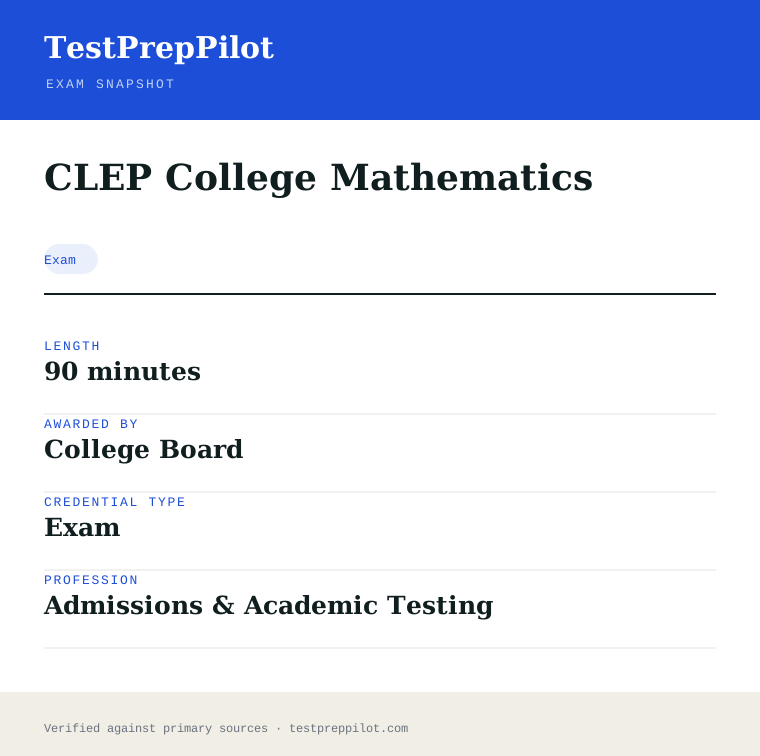
CLEP College Mathematics is a exam credential; awarded by College Board; the exam fee is $97 (2025–26) + test-center fee.
| Credential | CLEP College Mathematics |
|---|---|
| Type | Exam |
| Profession | Admissions & Academic Testing |
| Specialty | CLEP & Credit by Exam |
| Awarded by | College Board |
| Credit | ACE recommends 3 semester hours at score 50 |
| Score scale | 20–80 scaled |
| Retake | 3-month wait; full fee each attempt |
| Calculator | TI-30XS built in |
| Scope | National / Multi-state |
Real questions
Frequently asked questions about the CLEP College Mathematics
How many credits does College Mathematics grant?
ACE recommends three semester hours at a score of 50. It commonly satisfies a quantitative-reasoning general-education requirement.
Is this easier than College Algebra?
For many students yes — it spreads across finance, statistics, and logic rather than focusing on algebraic functions. Pick the one your school requires.
Do I need a calculator?
An online TI-30XS scientific calculator is built into the exam software for the whole session.
Can I take it online?
Yes, via CLEP with Remote Proctoring or at a test center, with the same 20–80 scaled score.
Why do all four SAT Suite tests take the same 2 hours 14 minutes?
Since the digital transition every assessment in the suite uses the same blueprint: 54 Reading and Writing questions in two 32-minute modules and 44 Math questions in two 35-minute modules. Difficulty is calibrated to the grade band rather than by adding or removing time.
Can I take an SAT Suite test at home?
No. Unlike some other admissions tests, every College Board digital assessment must be taken in a supervised school or test centre, even though it runs on your own device.
How do fee waivers work?
US students in eleventh or twelfth grade who meet income eligibility get SAT fee waivers from their school counsellor. A waiver covers the registration fee, waives cancellation and late fees, and gives unlimited free score reports to colleges.
In short
Is the CLEP College Mathematics worth it?
- Quantitative-literacy credit for non-math majors
- ~60 questions in 90 minutes; score 50 for 3 credits
- Financial math and algebra each 20%
- Built-in scientific calculator
Same awarding body
What other credentials does College Board award?
Worth comparing
How does the CLEP College Mathematics compare with similar credentials?
Trust
Where does this information come from?
Everything above is taken from the awarding body's own published material. Fees, question counts and domain weights are revised regularly — check the official page before you pay.
- College Board Awarding body
- Official CLEP College Mathematics exam page Exam page
Research confidence: high · Last reviewed 2026-08