IT, Cloud & Cybersecurity • Certification
Microsoft Certified: Power Platform Functional Consultant Associate
Microsoft Certified: Power Platform Functional Consultant Associate — Technology credential from Microsoft
Researched and maintained by TestPrepPilot Editorial BoardCloud, IT & cybersecurity certifications desk · Figures last verified August 2026
The short version
What is the Microsoft Certified: Power Platform Functional Consultant Associate and is it worth it?
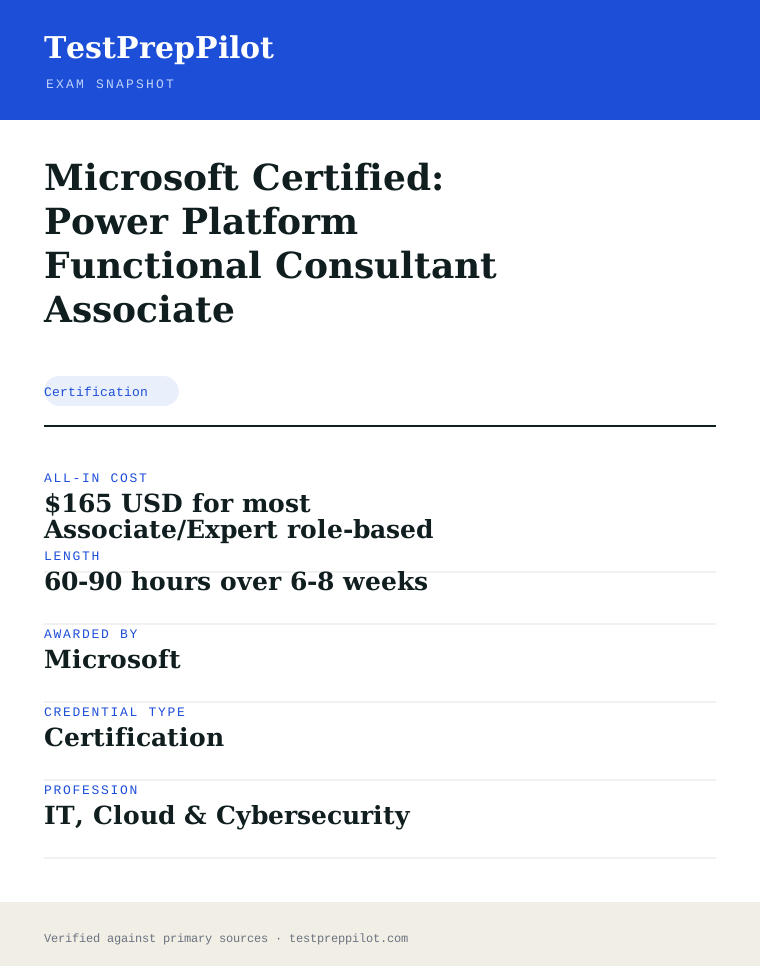
Microsoft Certified: Power Platform Functional Consultant Associate is a Microsoft credential in the Technology field. It validates job-ready competence and is used for career entry, advancement, or compliance. Exam fee: $165 USD for most Associate/Expert role-based exams; Fundamentals-tier exams (e.
- Recognized Microsoft credential
- Demonstrates verified Technology competence
- Supports career advancement and may satisfy employer or regulatory requirements
What is it?
What exactly is the Microsoft Certified: Power Platform Functional Consultant Associate?
Microsoft Certified: Power Platform Functional Consultant Associate — Technology credential from Microsoft
Associate exam on configuring Dataverse, building apps and flows, managing security roles and integrating Power Platform with business processes. Offered by Microsoft, it validates job-ready Technology competence. Exam fee: $165 USD for most Associate/Expert role-based exams; Fundamentals-tier exams (e. Review the official program page for eligibility, format, and scoring before registering.
The path in brief
- Confirm eligibility and any prerequisites
- Review the official exam guide and study materials
- Purchase and schedule the exam via Pearson VUE
- Take the exam (test center, online proctoring, or assessment)
- Receive results and your credential if passed
Before you book
Who is eligible to sit the Microsoft Certified: Power Platform Functional Consultant Associate?
Eligibility varies; many exams are open to all, while others require coursework, experience, or sponsorship.
Who it is for: Professionals and candidates seeking to validate Technology competence with a Microsoft credential.
The test itself
What is the format of the Microsoft Certified: Power Platform Functional Consultant Associate?
The Microsoft Certified: Power Platform Functional Consultant Associate is administered by Pearson VUE and runs 150 minutes and contains 40-60 questions.
| Administered by | Pearson VUE |
|---|---|
| Questions | 40-60 questions |
| Time limit | 150 minutes |
| Pass mark | Passing score set by the awarding body; see the official score report |
| Exam fee | $165 USD for most Associate/Expert role-based exams; Fundamentals-tier exams (e.g., AZ-900) are $99 USD. Priced per attempt in USD, billed in local currency; regional tax may apply. |
| Format | Proctored, computer-based — Pearson VUE test center or online remote proctoring. Price is the same either way. |
Content outline
What topics are on the Microsoft Certified: Power Platform Functional Consultant Associate?
The Microsoft Certified: Power Platform Functional Consultant Associate covers 4 content domains.
Weightings come from the official exam outline. Study time is best allocated in roughly these proportions rather than evenly across domains.
- Cloud / platform fundamentals
Topic area for this credential; see the official blueprint for the detailed breakdown.
- Configuration & implementation
Topic area for this credential; see the official blueprint for the detailed breakdown.
- Security & compliance
Topic area for this credential; see the official blueprint for the detailed breakdown.
- Operations & troubleshooting
Topic area for this credential; see the official blueprint for the detailed breakdown.
The path
How do you register for the Microsoft Certified: Power Platform Functional Consultant Associate?
- 1
Prepare with Microsoft Learn1–10 weeks depending on exam and experience
Work through the free official self-paced learning paths and, optionally, instructor-led courses for your exam. Microsoft Learn is the primary, no-cost study source and maps directly to the exam skills outline.
- 2
Schedule through Pearson VUEabout 15 minutes
Sign in with a personal Microsoft account (MSA) and schedule the exam on the Pearson VUE portal. Choose an in-person test center or online proctoring (OnVUE). Students and educators can use Certiport for Fundamentals exams.
Microsoft recommends a personal MSA account; a work or school account can lose exam records if you leave the organization.
- 3
Take the exam45–120 minutes depending on the exam
Arrive at the test center or launch the online proctoring session. Exams are computer-based and may include multiple-choice, drag-and-drop, case studies, and performance-based lab tasks in a live environment.
- 4
Receive results and badgescore at end; badge within a few days
You see a pass/fail result on screen immediately. A detailed score report is emailed within about 24 hours and posted to your Microsoft certification profile. On passing, your digital badge is issued via Credly.
- 5
Renew annuallyabout 45 minutes, once a year
Most Microsoft role-based, specialty, and fundamentals certifications expire after 12 months. Renew for free by passing a shorter online renewal assessment on Microsoft Learn before the expiry date — no need to retake the full exam.
The fine print
What are the retake and renewal rules for the Microsoft Certified: Power Platform Functional Consultant Associate?
- Proctoring & delivery
- Delivered by Pearson VUE. You can sit the exam at a Pearson VUE test center or take it online through OnVUE remote proctoring; the fee is the same for both. Online proctoring requires a quiet, private space, a working webcam, and a system check beforehand.
- Retake policy
- If you do not pass, you may retake the exam after 24 hours. A second failed attempt requires a 14-day waiting period, and any further attempts also require a 14-day wait between them, up to a maximum of five attempts in a 12-month period.
- Score reporting
- A pass/fail result is shown immediately after the exam. The official score report is emailed within about 24 hours and is also available in your Microsoft certification profile, with section-level feedback on how you performed.
- Recertification
- Microsoft role-based, specialty, and fundamentals certifications are valid for 12 months from the date earned. Renew at no cost by passing the shorter online renewal assessment on Microsoft Learn before the credential expires. Retired certifications cannot be renewed and must be re-earned through the active successor if one exists.
- Refunds & rescheduling
- Exam fees are generally non-refundable once a seat is purchased, but you can cancel or reschedule through Pearson VUE at no charge if you do so at least 24–48 hours before the appointment (exact window varies by region).
Context
Microsoft Azure / AI certifications compared
| Credential | Level | Focus | Exam fee | Validity | |
|---|---|---|---|---|---|
| AZ-900 Azure Fundamentals | Fundamentals | Cloud concepts | $99 | 1 year | |
| AI-900 Azure AI Fundamentals | Fundamentals | AI concepts | $99 | 1 year (retired Jun 30 2026) | |
| AI-901 Azure AI Fundamentals | Fundamentals | AI + Microsoft Foundry | $99 | 1 year | |
| AZ-104 Azure Administrator | Associate | Administer Azure | $165 | 1 year | |
| AZ-204 Azure Developer | Associate | Build cloud apps | $165 | 1 year (retired 2026) | |
| AZ-500 Azure Security Engineer | Associate | Security operations | $165 | 1 year (retires Aug 31 2026) | |
| AZ-700 Azure Network Engineer | Associate | Networking | $165 | 1 year | |
| AZ-140 Azure Virtual Desktop | Specialty | Virtual desktop (AVD) | $165 | 1 year | |
| AZ-305 Azure Solutions Architect | Expert | Solution design | $165 | 1 year |
What it pays
How much does this credential pay?
$132,270 median for software developers — the adjacent platform-role series (BLS, May 2024), used with an explicit caveat
There is no Bureau of Labor Statistics occupation called "Power Platform Functional Consultant", so the salary story belongs to the role the PL-200 certification serves — the consultant and business-applications professional who configures Power Platform solutions — and the closest official benchmark is Software Developers, SOC 15-1252, which had a May 2024 median of $132,270, with the lowest 10 percent under $84,060 and the highest 10 percent above $208,500. Use that figure with a deliberate caveat: PL-200 is a role-based associate certification for configuring Dataverse, Power Apps, Power Automate and Copilot Studio solutions, and the roles it feeds — Power Platform consultant, business applications consultant, functional analyst — span a wide band that runs from analyst positions below the developer median to senior consultant roles at or above it, so the median is context for the platform-role market rather than a precise wage for certificate holders. BLS counted 1,684,900 software developer jobs in 2024 and projects 17 percent growth from 2024 to 2034, with about 150,000 openings a year, and the broader business-applications demand the Power Platform serves tracks that market. There is a hard timing caveat that affects the value calculus for 2026: PL-200 is scheduled for retirement on August 31, 2026, replaced by the AB-410 Intelligent Applications Builder Associate exam, so a credential earned in mid-2026 has a short run before the market shifts to the replacement — plan the investment accordingly, and if you are reading this after that date, study AB-410 instead. Read the $132,270 figure as the upper-adjacent context for the role market, not as a PL-200-specific wage.
| Measure | Figure | Source / note |
|---|---|---|
| Median annual wage, software developers (adjacent series) | $132,270 | BLS OOH, SOC 15-1252, May 2024 |
| Lowest 10 percent | Under $84,060 | BLS OOH, SOC 15-1252, May 2024 |
| Highest 10 percent | Above $208,500 | BLS OOH, SOC 15-1252, May 2024 |
| Employment, 2024 | 1,684,900 jobs | BLS OOH Quick Facts, 2024 |
| Projected annual openings | ~150,000 per year | BLS OOH Job Outlook, 2024-34 |
Job growth.BLS projects 17 percent growth for software developers from 2024 to 2034, about 150,000 openings per year — cited as context for the business-applications role market.
Source: BLS Occupational Outlook Handbook - Software Developers
Your odds
What are the pass rates?
Microsoft publishes no pass rate — PL-200 is 40-60 questions in 120 minutes with a 700/1000 pass line, and the exam retires August 31, 2026
Microsoft does not publish pass rates for PL-200 or any of its role-based exams, and we state that plainly: no official percentage exists, and any figure you see online is a third-party estimate, so we do not present one as authoritative. What Microsoft publishes is the exam mechanics, and the two facts that should drive any candidate’s decision in 2026 are the format and the retirement date. PL-200 is 40 to 60 questions in 120 minutes, scored on a scale of 1 to 1000 with a passing line of 700, delivered through Pearson VUE at a test centre or online with proctoring. The question types are multiple choice, multiple response, drag-and-drop, build-list, matching and case studies, and the items are heavily scenario-based, testing the configuration of Power Platform business solutions rather than memorised facts. The certification is valid for one year, renewed by completing a free online renewal assessment on Microsoft Learn before the expiry date. The retirement fact is the one that changes the calculation: Microsoft announced that PL-200 retires on August 31, 2026 at 11:59 PM Central Time, with the renewal assessment retiring on the same date, and the replacement is AB-410 Intelligent Applications Builder Associate, which entered beta in April 2026 with general availability expected in mid-2026. There is no automatic migration from PL-200 to AB-410, so a candidate earning PL-200 in 2026 should either sit it early in the year for the credential’s remaining value or plan directly for AB-410. Two format details round out the picture. First, the exam includes up to 5 unscored pretest questions in the total, so the 40-60 figure mixes scored and pilot items — candidates cannot tell which are which, and the correct strategy is to answer every item as though it counts. Second, the result is reported as pass or fail with a score report by skill area, so a failed attempt is diagnostic rather than opaque: the report tells the candidate which domains dragged the score down, and the retake policy — 24 hours after the first failure, 14 days between subsequent attempts, with a limit of five attempts per twelve months — gives the failed candidate a structured path to recovery. The scenario-based design also means that preparation quality matters more than quantity: the exam rewards having configured Dataverse, apps and flows, and candidates who study only theory meet the case-study items without the practical reasoning they reward. Microsoft’s guidance of roughly six months of hands-on Power Platform experience is the honest readiness benchmark.
Read this before quoting the number.Microsoft publishes no pass rates; the published facts are the 40-60 question, 120-minute format, the 700/1000 pass line, the one-year validity, and the August 31, 2026 retirement date.
Source: Microsoft Learn - Exam PL-200 study guide and exam page
Your schedule
How long should I study for it?
60-100 hours over 6-8 weeks, gated by the August 2026 retirement date of focused study
PL-200 is 40 to 60 scenario-based questions in 120 minutes on configuring Power Platform solutions — Dataverse data modelling, model-driven and canvas apps, cloud flows, Copilot Studio, environments and ALM — so a defensible plan runs 60 to 100 hours over six to eight weeks, and the first planning step for 2026 is the retirement calendar: with PL-200 retiring August 31, 2026, a candidate should sit it early in the year to get value from the credential, or study AB-410 instead, because there is no automatic migration. Week 1 is orientation and baseline: read the current exam study guide, confirm the retirement timeline, and take a practice exam. Weeks 2-3 cover the platform foundation: Dataverse tables, columns and relationships, security roles and environment management, and the difference between the configuration surface and the code surface. Weeks 4-5 cover the applications: building model-driven apps with forms, views and business rules; canvas apps with components and variables; and cloud flows with triggers, conditions and actions — working hands-on in a Power Platform trial environment alongside the reading, because the scenario items reward having configured these tools. Weeks 6-7 cover the remaining domains: Copilot Studio basics, Power Pages for external-facing sites, solutions and ALM, and the functional-consultant workflow of discovery, requirements capture and stakeholder engagement. Weeks 7-8 are rehearsal: two full timed practice exams at the real 120-minute format, then targeted review of the weak domains. The two planning errors that cost the most are studying without a trial environment and ignoring the retirement calendar.
- Week 18
Study guide and baseline
- Read the current PL-200 study guide and confirm the retirement timeline
- Set up a Power Platform trial environment
- Take a practice exam to baseline
- Weeks 2-322
Dataverse and environments
- Tables, columns, relationships and security
- Environment management and the configuration surface
- Hands-on data modelling in the trial environment
- Weeks 4-524
Apps and automation
- Model-driven apps: forms, views and business rules
- Canvas apps and cloud flows with triggers and conditions
- Build a working solution end to end
- Weeks 6-718
Copilot, pages and ALM
- Copilot Studio basics and Power Pages
- Solutions, environments and application lifecycle
- Discovery and requirements for the consultant workflow
- Weeks 7-814
Timed rehearsal
- Two full timed exams at the real 120-minute format
- Re-lab every miss rather than re-reading it
- Review weak domains and schedule the exam
Adjusting the pace
Candidate after the August 2026 retirement.PL-200 retires August 31, 2026 and there is no migration; study AB-410 Intelligent Applications Builder Associate instead, using the same Power Platform foundation.
Working Power Platform consultant.Daily work covers most of the exam; focus on the domains outside your daily work and the scenario-question format.
New to the Power Platform.Add two weeks of platform fundamentals before the plan, or start with PL-900 (Power Platform Fundamentals) as a stepping stone.
How to study
How do I prepare most effectively?
PL-200 rewards hands-on configuration plus scenario reasoning, so the dominant strategy is building a real Power Platform trial environment and working the published skill areas with it, because the exam items are scenario-based and reward having configured the tools. First, set up a Power Platform trial environment and build a working solution — Dataverse tables, a model-driven app, a canvas app and a cloud flow — because candidates who only read about the tools meet the scenario items without the practical intuition they reward. Second, use the Microsoft Learn study guide as the scope map and complete the official learning paths for PL-200, which are free and map directly to the exam. Third, master the scenario-question style deliberately: the exam is 40 to 60 questions with case studies and drag-and-drop items, and practising with official and third-party question banks is the way to learn the reasoning pattern, since answers hinge on choosing the right tool or configuration for a described business need. Fourth, cover the Dataverse data-modelling and security content thoroughly, because it underpins apps, flows and the consultant role. Fifth, rehearse under the real 120-minute clock twice, because the pace with case studies is part of the test. Finally, for 2026 candidates, make the retirement decision explicit before spending study time: sit PL-200 early for its remaining value, or switch to AB-410, and diary the one-year renewal if you pass. A further strategy is to learn the consultant workflow as the exam frames it — discovery, requirements capture, stakeholder engagement, then configuration — because the case-study items test the whole arc, and a candidate who can reason from a described business need to the right Dataverse table, app type and flow is answering the exam’s core question. Practise the drag-and-drop, build-list and matching formats specifically, because they appear across the paper and reward knowing the sequence of configuration steps, and candidates who only drill multiple-choice meet them cold. Use the official learning paths’ hands-on labs rather than reading the modules, since the trial environment is the same tool the scenario items assume. Finally, because the exam measures the functional-consultant role, rehearse the "which tool fits this need" reasoning out loud or in notes: given a described process, is this a model-driven app, a canvas app, a flow, or Copilot Studio — the discrimination is the exam, and the practice makes it automatic.
Build a real trial-environment solution
Dataverse tables, a model-driven app, a canvas app and a cloud flow; scenario items reward having configured them.
Work the Microsoft Learn paths
The free PL-200 learning paths map directly to the exam skills.
Master the scenario-question style
Case studies and drag-and-drop items reward choosing the right tool for a described business need.
Cover data modelling and security
Dataverse underpins every other domain and the consultant role.
Rehearse under the 120-minute clock
Two full timed practice exams; the case-study pace is part of the test.
Make the retirement decision explicit
PL-200 retires August 31, 2026; sit it early or study AB-410 instead.
What to buy
Which study resources are worth paying for?
PL-200 prep is inexpensive because Microsoft publishes the authoritative materials free. The Microsoft Learn study guide, the official PL-200 learning paths and the free Power Platform trial environment cover the scope at no cost, and the exam sandbox lets candidates explore the testing environment. Microsoft Learn also offers a free practice assessment for PL-200. Third-party providers sell PL-200 courses and question banks at roughly $30-300; their value is scenario-question volume and structure rather than unique content, and a question bank is the standard paid purchase because the scenario style is best rehearsed. The exam fee is $165 in the United States (fees vary by country), with a reduced retake price in some regions and no free retake included. A realistic total budget is $200 to $500 including the exam fee and optional prep materials. There is one overriding buying caution for 2026: with PL-200 retiring on August 31, 2026, material and courses for PL-200 have a short useful life, so either purchase early or buy AB-410 preparation instead. Prices below are list prices as of mid-2026 and change frequently; we rank nothing by commission. The buying logic is dominated by the free official core: the Microsoft Learn study guide, the learning paths, the trial environment and the free practice assessment cover the scope at no cost, and a candidate who uses them with a genuine trial environment has the majority of the preparation done. The question bank is the one paid item that reliably earns its cost, because the scenario and interactive formats are best rehearsed, and its value is calibrating the "which tool fits this need" reasoning rather than adding content. A course adds structure for candidates who need external pacing or who are new to the platform, and its labs compress the ramp-up. The hard caution for 2026 is the retirement date: PL-200 material has a short useful life, so candidates should either buy early and sit before August 31, or buy AB-410 preparation instead — and any third-party PL-200 resource should state the exam version clearly, because Microsoft revised the skills measured in December 2024 and older courses may test a superseded objective set. The exam fee is $165 in the United States, with the retake priced lower in some regions, and the renewal assessment is free on Microsoft Learn — the cheapest part of the whole credential cycle, once the exam is passed.
| Resource | Price | Format | Best for |
|---|---|---|---|
| Microsoft Learn study guide and PL-200 learning paths | Free | Official online | The authoritative scope and skills |
| Power Platform trial environment | Free | Real platform sandbox | The hands-on configuration the scenario items reward |
| Microsoft Learn practice assessment | Free | Official online practice | A first calibration against the item style |
| Third-party courses and question banks | ~$30-300 | Video courses and practice items | Scenario-question volume and structure |
| PL-200 exam | $165 (US; varies by country) | Pearson VUE test centre or online | The certification itself — retires 8/31/2026 |
| AB-410 replacement exam | Pricing at Microsoft Learn | Pearson VUE delivery | Candidates preparing after the PL-200 retirement |
List prices as of mid-2026, subject to change; PL-200 retires August 31, 2026 and is replaced by AB-410. No commission-based ranking.
Avoid these
What mistakes do candidates most often make?
The most expensive PL-200 mistake in 2026 is ignoring the retirement date: PL-200 retires on August 31, 2026 with no automatic migration to the AB-410 replacement, so a candidate who starts studying mid-year or later can spend 100 hours earning a credential the market is already moving past. The fix is to make the retirement decision before studying. The second mistake is studying without configuring: candidates who read about Dataverse and Power Apps but never build in a trial environment meet the scenario items without the practical intuition they reward. Third, candidates under-prepare Dataverse data modelling and security, which underpin every other domain. Fourth, candidates never practise the scenario-question style — case studies and drag-and-drop — and misjudge the 120-minute pace with heavier item types. Fifth, candidates confuse PL-200 with other Power Platform exams (PL-100 personal apps, PL-400 developer, PL-600 architect) and study the wrong skills. Finally, candidates forget the one-year validity and let the renewal assessment lapse, or assume the renewal survives the exam’s retirement — it does not; the PL-200 renewal assessment retires on the same date as the exam. Two further mistakes are specific to the exam’s format. The first is under-rehearsing the interactive items: drag-and-drop, build-list and matching questions test the sequence of configuration steps, and candidates who drill only multiple-choice meet those formats cold and lose time learning the mechanics mid-exam. The second is studying platform features without the consultant workflow: the case-study items test discovery, requirements and stakeholder engagement as well as configuration, and a candidate who can build a table but cannot reason from a described business need to the right tool is missing the exam’s core question. Candidates also misjudge the 120-minute budget with case studies, which take longer per question than standard multiple-choice, and the fix is at least two full timed practice exams at the real format. Finally, candidates new to Power Platform attempt PL-200 without the recommended hands-on experience and meet the scenario items without the practical intuition they reward; the honest sequence is a trial-environment build-out before the exam, not after a failed attempt.
✕Ignoring the retirement date
✓PL-200 retires 8/31/2026 with no migration; sit it early or study AB-410 instead.
✕Studying without configuring
✓Build Dataverse tables, apps and flows in a trial environment.
✕Under-preparing data modelling and security
✓Dataverse underpins every other domain; cover it thoroughly.
✕Skipping the scenario-question style
✓Case studies and drag-and-drop items need rehearsal under the 120-minute clock.
✕Confusing PL-200 with sibling exams
✓PL-200 is the functional consultant; PL-100, PL-400 and PL-600 test different roles.
✕Forgetting the one-year renewal
✓The renewal assessment retires with the exam on 8/31/2026; renew early or plan the switch.
What you'll face
What question types will I see?
PL-200 is a computer-based exam of 40 to 60 questions in 120 minutes, scored on a scale of 1 to 1000 with a passing line of 700, delivered through Pearson VUE. The question types are multiple choice, multiple response (choose all that apply), drag-and-drop, build-list, matching and case studies, and the items are heavily scenario-based: they describe a business need — a data model to build, an automation to configure, a security model to apply — and ask which Power Platform tool or configuration fits. The skills measured follow the published study guide: configure Microsoft Dataverse (data modelling, security, environment management); create apps with Power Apps (model-driven and canvas); implement automation with Power Automate (cloud flows, triggers and conditions); configure Copilot Studio; and manage solutions, environments and application lifecycle. Because the scenario style dominates, candidates should practise the case-study and drag-and-drop formats under the real 120-minute clock, and because the exam retires August 31, 2026, candidates should decide whether the current PL-200 or the AB-410 replacement is the right target before investing study time. Samples below are editor-written illustrations of the published skills, not live exam items; they show the platform-configuration style of the real items. The format details shape the strategy. With 40 to 60 questions in 120 minutes, the average budget is two to three minutes per question, but the case-study and interactive items legitimately take longer, so candidates should bank the standard multiple-choice items first and reserve the clock for the heavier formats. The unscored pretest questions are indistinguishable from scored ones, so every item should be answered as though it counts. The scenario style means reading each stem for the described business need before choosing: the correct answer follows from the requirement — which table, which app type, which flow — and the distractors are typically real configurations that serve a different need. The case-study items test the consultant workflow as a whole, from discovery through configuration to validation, so they reward the ability to reason through a multi-step scenario rather than recall a single fact. Because the exam retires August 31, 2026, the format details matter most for candidates sitting before that date; after it, the AB-410 replacement builds on the same platform foundation with added Copilot and agent content.
Which Dataverse table, column, relationship or setting fits a described business need.
Cloud flow triggers, conditions and actions for described processes.
Multi-question scenarios testing the full consultant workflow.
Drag-and-drop, build-list and matching items for configuration sequences.
Try these
Q1A company must track a new "Project" entity with custom fields, relate it to accounts, and control who can see which projects. The most appropriate first configuration step is:
Answer:A
A new entity with custom fields, a relationship and access control is a custom Dataverse table with a relationship to Account and a security model. Adding fields to Account conflates the entity, a spreadsheet is not a platform data source, and a canvas app with no data source fails the requirement entirely.
Q2A team needs an automated approval when a support ticket meets specific criteria. Which tool is most appropriate?
Answer:A
Power Automate cloud flows orchestrate the automated approval workflow, triggering on the described criteria and using approval actions. Manual emails, reports and layout changes do not automate the approval.
Q3A business wants a sales pipeline dashboard that updates as the underlying data changes, visible only to the sales team. Which approach fits?
Answer:A
The platform’s reporting gives live dashboards with row and object-level security applied to the sales team. Static spreadsheets, public pages and unsecured apps fail the live-update or security requirement.
Q4A functional consultant is gathering requirements for a Power Platform solution. Which activity belongs to discovery?
Answer:A
Discovery is the requirements phase: interviews, current-state documentation and stakeholder engagement, which the consultant then turns into solution design. Coding, deployment and security configuration are later phases of the consultant workflow.
Samples are editor-written illustrations of the published skills, not live exam items.
The big day
What should I expect on exam day?
PL-200 is delivered through Pearson VUE at a test centre or online with proctoring, and the exam is 40 to 60 questions in 120 minutes with a 700/1000 pass line. At a test centre, arrive about 30 minutes early with a valid government-issued photo ID matching your registration name and your appointment confirmation; personal items go in the locker, and the exam is closed book with no personal devices. For online delivery, complete the Pearson VUE system check on the exact machine you will use, sit in a quiet private room with a clear desk and no second monitor, and follow the proctor’s room-scan rules. Pace the 120 minutes by working the standard multiple-choice items first and spending the remaining time on the heavier case-study, drag-and-drop and build-list items; flag uncertain questions and return rather than dwelling. The exam is scenario-heavy, so read each stem for the described business need before choosing. The result is reported as pass or fail on screen immediately after submission, with the score report showing your performance by skill area. On a pass, the certification is valid for one year, renewed by completing the free renewal assessment on Microsoft Learn before the expiry date — and for 2026 candidates, remember the renewal assessment retires with the exam on August 31, 2026. The practical rhythm of the day follows the format: start with the standard multiple-choice items to bank points, then spend the remaining time on the case studies and interactive formats, and flag uncertain questions rather than dwelling — the exam rewards completion across the paper, and an unfinished case study scores nothing. Read each scenario for the described business need before choosing, because the correct answer follows from the requirement and the distractors are real configurations that serve different needs. There is no scheduled break in the 120-minute session, so the pre-exam routine is minimal — settle the environment before check-in, and confirm the proctoring room meets the rules, since a failed system check or an unacceptable room can cost the session before the first question. The result appears as pass or fail on screen, with the score report by skill area following, and that report is the planning document for the renewal on a pass or for the retake on a fail — the retake is available 24 hours after the first failure, but the better play is to use the skill-area breakdown to target the weak domains first.
Bring
- Valid government-issued photo ID matching your registration name
- Appointment confirmation
- For online delivery: verified system, webcam and quiet room
- Your Microsoft Learn profile and exam registration details
Leave at home
- Phone, smartwatch and personal electronics
- Notes and open browser tabs — the exam is closed book
- Second monitors and other devices for online delivery
- Any assumption that PL-200 will outlive the August 2026 retirement
How the day runs
Rules in the room
- The exam is 40-60 questions in 120 minutes with a 700/1000 pass line.
- The session is proctored and closed book.
- No personal devices, notes or second monitors are permitted.
- The certification is valid one year, renewed by a free Microsoft Learn assessment.
- PL-200 and its renewal assessment retire August 31, 2026.
Afterwards.PL-200 reports pass or fail on screen the moment you submit, with a score report showing your performance by skill area, and the immediate follow-ups are the calendar and the renewal. On a pass, the certification is valid for one year and is renewed by completing the free renewal assessment on Microsoft Learn before the expiry date — but for 2026 candidates the harder fact is the retirement: PL-200 retires on August 31, 2026 and the renewal assessment retires the same day, so a credential earned in mid-2026 has a short runway, and the plan should be either to use the credential immediately in job applications or to make the transition to AB-410, the Intelligent Applications Builder Associate replacement, whose beta launched in April 2026 with general availability expected in mid-2026. There is no automatic migration, so treat AB-410 as a new study commitment built on the same Power Platform foundation. On a fail, the retake policy allows a re-attempt 24 hours after the first failure, with 14 days between subsequent attempts and a limit of five attempts per twelve months; the score report by skill area tells you which domains to re-work, and given the retirement date, a failed attempt in 2026 should prompt a quick decision between retaking PL-200 and pivoting to AB-410. Either way, the skills — Dataverse, Power Apps, Power Automate and Copilot Studio — transfer across both exams and across the consultant career.
Reference
What are the key facts about the Microsoft Certified: Power Platform Functional Consultant Associate?
Microsoft Certified: Power Platform Functional Consultant Associate is a certification credential; awarded by Microsoft; the exam fee is $165 USD for most Associate/Expert role-based exams; Fundamentals-tier exams (e.g., AZ-900) are $99 USD. Priced per attempt in USD, billed in local currency; regional tax may apply.; typical preparation is 60-90 hours over 6-8 weeks; holders typically earn $70,000-$130,000 (15-1252 median $132,270).
| Credential | Microsoft Certified: Power Platform Functional Consultant Associate |
|---|---|
| Abbreviation | PL-200 |
| Type | Certification |
| Profession | IT, Cloud & Cybersecurity |
| Specialty | Microsoft |
| Awarded by | Microsoft |
| Difficulty | Mixed |
| Typical prep time | 60-90 hours over 6-8 weeks |
| All-in cost | $165 USD for most Associate/Expert role-based exams; Fundamentals-tier exams (e |
| Typical salary range | $70,000-$130,000 (15-1252 median $132,270) |
| Credential | Microsoft Certified: Power Platform Functional Consultant Associate |
| Awarding body | Microsoft |
| Exam fee | $165 USD for most Associate/Expert role-based exams; Fundamentals-tier exams (e |
| Delivery | Proctored, computer-based — Pearson VUE test center or online remote proctoring. Price is the same either way. |
| Validity | Renewable annually via free online assessment |
| Scope | National / Multi-state |
| Also known as | PL-200 |
Real questions
Frequently asked questions about the Microsoft Certified: Power Platform Functional Consultant Associate
How much does the Microsoft Certified: Power Platform Functional Consultant Associate exam cost?
$165 USD for most Associate/Expert role-based exams; Fundamentals-tier exams (e.g., AZ-900) are $99 USD. Priced per attempt in USD, billed in local currency; regional tax may apply.
How do I register and schedule?
Register and schedule through Pearson VUE. Create an account, purchase the exam, and pick a date (test center, online proctoring, or assessment as applicable).
How long is the credential valid, and how do I renew?
Free online renewal assessment on Microsoft Learn (role-based and specialty certs renew this way; effectively no recurring fee).
What is the retake policy?
Full fee per attempt. First retake after 24 hours; subsequent retakes after a 14-day wait; maximum 5 attempts in 12 months.
Can I take a Microsoft exam online from home?
Yes. Exams are delivered by Pearson VUE with two options: an in-person test center or OnVUE online proctoring from a private space with a webcam. The fee is identical for both.
Do Microsoft certifications expire?
Most role-based, specialty, and fundamentals certifications are valid for 12 months. You renew for free by passing a shorter online assessment on Microsoft Learn before the expiry date.
What happens if my certification is retired?
You keep the credential until its current expiry date, but you can no longer earn or renew it. Microsoft typically points candidates to the active successor exam or certification.
In short
Is the Microsoft Certified: Power Platform Functional Consultant Associate worth it?
- Microsoft Certified: Power Platform Functional Consultant Associate is awarded by Microsoft.
- Validates Technology competence.
- Exam fee: $165 USD for most Associate/Expert role-based exams; Fundamentals-tier exams (e.
- Renewal: Free online renewal assessment on Microsoft Learn (role-based and specialty certs renew this way; effectively no recurring fee).
Same awarding body
What other credentials does Microsoft award?
Worth comparing
How does the Microsoft Certified: Power Platform Functional Consultant Associate compare with similar credentials?
Trust
Where does this information come from?
Everything above is taken from the awarding body's own published material. Fees, question counts and domain weights are revised regularly — check the official page before you pay.
- Microsoft Awarding body
- Microsoft certification programme Programme rules
Research confidence: medium · Last reviewed 2026-08