The short version
What is the Microsoft Certified: Azure Developer Associate and is it worth it?
AZ-204 was the Azure Developer Associate exam: 40–60 questions in about 120 minutes, scaled pass mark 700/1000, fee $165. Microsoft retired the certification in 2026, so it is no longer available to sit or renew; plan instead for the active AI-204 or AI-103 developer credential.
- Covered the full Azure application-development lifecycle
- Mapped directly to developer and cloud-engineer job roles
- Included hands-on, SDK-based tasks
- Skill areas carry over to the current developer exams
- Was renewable yearly for free while active
What is it?
What exactly is the Microsoft Certified: Azure Developer Associate?
The Azure developer associate exam — now retired by Microsoft, but its skills map to the current AI-204 developer paths.
Microsoft Certified: Azure Developer Associate (AZ-204) was the associate credential for developers who build end-to-end solutions on Azure — Azure Functions, web apps, storage, security, and integrations. As of 2026 Microsoft has retired this certification and its renewal assessment, so it can no longer be earned or renewed; candidates are directed to the active successor developer path. The exam historically measured developing Azure compute solutions, developing for Azure storage, implementing Azure security, monitoring and optimizing solutions, and connecting to and consuming Azure and third-party services. It assumed at least two years of programming experience and proficiency with Azure SDKs, the Azure CLI, and PowerShell. We retain this page because many job posts and study plans still reference AZ-204, and its skill areas remain directly relevant to current Azure and AI developer exams.
The path in brief
- Note AZ-204 is retired — confirm the active successor
- Review the retired skills outline for study relevance
- Target the current AI-204 / AI-103 developer path
- Schedule the active exam via Pearson VUE
- Pass and renew yearly for free
Before you book
Who is eligible to sit the Microsoft Certified: Azure Developer Associate?
While it was offered, AZ-204 was open to all. It is now retired and cannot be registered for; eligibility guidance applies to the active successor exam.
Who it is for: Azure developers and cloud engineers (historical); now a reference for the active developer path.
The test itself
What is the format of the Microsoft Certified: Azure Developer Associate?
The Microsoft Certified: Azure Developer Associate is administered by Pearson VUE (retired) and runs 120 minutes (historical), contains 40–60 (retired — no longer offered) questions and requires 700 / 1000 (scaled) to pass.
| Administered by | Pearson VUE (retired) |
|---|---|
| Questions | 40–60 (retired — no longer offered) |
| Time limit | 120 minutes (historical) |
| Pass mark | 700 / 1000 (scaled) |
| Exam fee | $165 USD (historical) |
| Format | Computer-based, multiple-choice, case studies, and labs (retired) |
Content outline
What topics are on the Microsoft Certified: Azure Developer Associate?
The Microsoft Certified: Azure Developer Associate is weighted across 5 domains; the largest are Develop Azure compute solutions (25–30%), Develop for Azure storage (15–20%), Implement Azure security (15–20%).
Weightings come from the official exam outline. Study time is best allocated in roughly these proportions rather than evenly across domains.
- Develop Azure compute solutions 25–30%
Azure Functions, App Service, container instances, and Kubernetes basics (historical outline).
- Develop for Azure storage 15–20%
Blob, queue, table, and Cosmos DB SDK access and data operations.
- Implement Azure security 15–20%
Managed identities, Key Vault, and authentication/authorization for apps.
- Monitor, troubleshoot, and optimize Azure solutions 15–20%
App Insights, logging, and performance tuning.
- Connect to and consume Azure and third-party services 15–20%
Event-driven messaging, API management, and service connectors.
The path
How do you register for the Microsoft Certified: Azure Developer Associate?
- 1
Prepare with Microsoft Learn1–10 weeks depending on exam and experience
Work through the free official self-paced learning paths and, optionally, instructor-led courses for your exam. Microsoft Learn is the primary, no-cost study source and maps directly to the exam skills outline.
- 2
Schedule through Pearson VUEabout 15 minutes
Sign in with a personal Microsoft account (MSA) and schedule the exam on the Pearson VUE portal. Choose an in-person test center or online proctoring (OnVUE). Students and educators can use Certiport for Fundamentals exams.
Microsoft recommends a personal MSA account; a work or school account can lose exam records if you leave the organization.
- 3
Take the exam45–120 minutes depending on the exam
Arrive at the test center or launch the online proctoring session. Exams are computer-based and may include multiple-choice, drag-and-drop, case studies, and performance-based lab tasks in a live environment.
- 4
Receive results and badgescore at end; badge within a few days
You see a pass/fail result on screen immediately. A detailed score report is emailed within about 24 hours and posted to your Microsoft certification profile. On passing, your digital badge is issued via Credly.
- 5
Renew annuallyabout 45 minutes, once a year
Most Microsoft role-based, specialty, and fundamentals certifications expire after 12 months. Renew for free by passing a shorter online renewal assessment on Microsoft Learn before the expiry date — no need to retake the full exam.
The fine print
What are the retake and renewal rules for the Microsoft Certified: Azure Developer Associate?
- Proctoring & delivery
- Delivered by Pearson VUE. You can sit the exam at a Pearson VUE test center or take it online through OnVUE remote proctoring; the fee is the same for both. Online proctoring requires a quiet, private space, a working webcam, and a system check beforehand.
- Retake policy
- If you do not pass, you may retake the exam after 24 hours. A second failed attempt requires a 14-day waiting period, and any further attempts also require a 14-day wait between them, up to a maximum of five attempts in a 12-month period.
- Score reporting
- A pass/fail result is shown immediately after the exam. The official score report is emailed within about 24 hours and is also available in your Microsoft certification profile, with section-level feedback on how you performed.
- Recertification
- Microsoft role-based, specialty, and fundamentals certifications are valid for 12 months from the date earned. Renew at no cost by passing the shorter online renewal assessment on Microsoft Learn before the credential expires. Retired certifications cannot be renewed and must be re-earned through the active successor if one exists.
- Refunds & rescheduling
- Exam fees are generally non-refundable once a seat is purchased, but you can cancel or reschedule through Pearson VUE at no charge if you do so at least 24–48 hours before the appointment (exact window varies by region).
Context
Microsoft Azure / AI certifications compared
| Credential | Level | Focus | Exam fee | Validity | |
|---|---|---|---|---|---|
| AZ-900 Azure Fundamentals | Fundamentals | Cloud concepts | $99 | 1 year | |
| AI-900 Azure AI Fundamentals | Fundamentals | AI concepts | $99 | 1 year (retired Jun 30 2026) | |
| AI-901 Azure AI Fundamentals | Fundamentals | AI + Microsoft Foundry | $99 | 1 year | |
| AZ-104 Azure Administrator | Associate | Administer Azure | $165 | 1 year | |
| AZ-204 Azure Developer | Associate | Build cloud apps | $165 | 1 year (retired 2026) | |
| AZ-500 Azure Security Engineer | Associate | Security operations | $165 | 1 year (retires Aug 31 2026) | |
| AZ-700 Azure Network Engineer | Associate | Networking | $165 | 1 year | |
| AZ-140 Azure Virtual Desktop | Specialty | Virtual desktop (AVD) | $165 | 1 year | |
| AZ-305 Azure Solutions Architect | Expert | Solution design | $165 | 1 year |
What it pays
How much does this credential pay?
$133,080 median for software developers (BLS, May 2024) — but AZ-204 itself is no longer obtainable
The occupation behind AZ-204 is in excellent shape even though the exam is not. The credential mapped to software developers who build on Azure — Functions, App Service, Container Apps, Cosmos DB, Key Vault, Service Bus, API Management — and the honest Bureau of Labor Statistics occupation for that work is Software Developers (SOC 15-1252), reported at a median of $133,080 in May 2024. That is the highest-paying occupation behind any exam in the Azure family covered on this site, and unlike the administrator occupations it is projected to grow strongly: 15% from 2024 to 2034, much faster than the average for all occupations, with about 129,200 openings a year across the broader developer, QA analyst and tester group. Two things follow from that, and they pull in different directions. First, if you already hold the Azure Developer Associate credential, nothing about your market has weakened. The demand for people who can build production services on Azure is the same demand it was before Microsoft reorganised its certification catalogue, and a lapsed or retired credential does not un-teach you Container Apps and managed identities. Second, be realistic about what the badge itself was worth. Developer salaries are driven overwhelmingly by demonstrated shipped work, language depth and system-design ability; the certification functioned as a filter for recruiters and a procurement requirement for Microsoft partner organisations rather than as a pay lever. That is why the Skillsoft self-reported figure below sits *below* the BLS median for the occupation — the survey population skews toward infrastructure-adjacent and consulting roles rather than product engineering. Anyone weighing what to do next should be choosing between AI-200 and simply building things, not treating the retirement as a career problem.
| Measure | Figure | Source / note |
|---|---|---|
| Median annual wage — software developers (SOC 15-1252) | $133,080 | BLS Occupational Outlook Handbook, May 2024 wage data. The occupation AZ-204 mapped to most directly. |
| Median annual wage — software developers, QA analysts and testers (combined group) | $131,450 | BLS OOH quick facts, 2024 median pay for the combined occupational group. |
| Employment, 2024 (combined group) | 1,895,500 jobs | BLS OOH, 2024 base-year employment. |
| Projected annual openings, 2024-2034 | ~129,200 per year | BLS OOH, combined developer/QA/tester group. |
| Self-reported average, Microsoft Certified: Azure Developer Associate holders | $100,998 | Skillsoft "top-paying Microsoft certifications" material drawn from its IT Skills and Salary survey (2025) — worldwide, self-reported respondent data, NOT government statistics. Note it sits well below the US BLS developer median, which is a good illustration of why a worldwide self-reported survey and a US government wage series are not comparable. |
Job growth.15% projected growth 2024-2034 for software developers, QA analysts and testers — much faster than average (BLS OOH)
Source: BLS Occupational Outlook Handbook — Software Developers, Quality Assurance Analysts, and Testers
Your odds
What are the pass rates?
No official pass rate was ever published — and now no further attempts are possible
Microsoft never published a pass rate for AZ-204, for the same reason it publishes none for any of its certification exams: it does not release attempt counts, first-time pass percentages or score distributions. AZ-204 attracted more "pass rate" speculation than most Azure exams because it had a reputation as the hardest of the associate tier — a reputation built on the fact that it assumed at least two years of programming experience, expected proficiency with the Azure SDKs, and asked candidates to read code rather than describe architecture. That reputation may well have been deserved, but it was never a measurement, and we are not going to convert forum sentiment into a table row. For the historical record, the scoring model applied exactly as it does across the programme. The pass mark was 700 on a scale of 1 to 1,000, and Microsoft states explicitly that this is a scaled score which may not equal 70% of the available points, because candidates receive question sets of differing difficulty. There was no penalty for guessing. An unidentifiable subset of items on any form was unscored pilot content. Candidates received a preliminary pass or fail on screen within minutes and a score report showing relative strength across the five skill areas as a bar chart, with Microsoft explicit that those bars could not be summed or converted into a percentage. The retake ladder was the standard one — 24 hours after a first failure, 14 days between subsequent attempts, five attempts maximum in the 12 months after the first sitting, full USD $165 fee each time. None of that is actionable now; it is here because people arriving on this page mid-preparation deserve to understand what they were preparing for, and because the identical mechanics apply to AI-200.
Read this before quoting the number.Microsoft published no pass rate for AZ-204 at any point, and the exam retired on 31 July 2026 at 11:59 PM CST, so no new data will ever exist. Any percentage you encounter for this exam is vendor marketing or a self-selecting poll. If you are researching AZ-204 because you were mid-preparation, the mechanics above carry over unchanged to Exam AI-200 (Azure AI Cloud Developer Associate), which is the successor for the developer role: 700/1,000 scaled, no guessing penalty, unscored pilot items, preliminary result on screen, and the same retake ladder at the same USD $165 fee. Verified against the Microsoft AZ-204 study guide retirement warning, the Azure Developer Associate certification page, the Azure AI Cloud Developer Associate certification page, the exam scoring page and the exam retake policy, 2026-08-04.
Source: Microsoft Learn — Study guide for Exam AZ-204 (retirement warning and skills measured)
Avoid these
What mistakes do candidates most often make?
The mistakes worth warning about here are not study errors. AZ-204 cannot be booked. These are the errors people are actually making in August 2026 as they work out what the retirement means for them.
✕Buying an AZ-204 course or practice bundle in 2026
✓Check the retirement date before you pay. Several large training platforms still list AZ-204 courses, some with countdown-timer pricing, and the search results have not caught up with a retirement that only took effect on 31 July 2026. There is no sitting to book. If a provider is still selling AZ-204 exam preparation as a route to certification, that is a reason to distrust the provider, not a sign the exam is available. If you have already paid, most platforms have a refund window — use it.
✕Assuming the certification you already hold has been revoked
✓It has not. A retired exam does not invalidate credentials already earned. Your Azure Developer Associate badge, transcript and certificate remain in your Microsoft Learn certification dashboard and remain verifiable by employers. What changes is the future: because Microsoft has retired the renewal assessment as well as the exam, the credential will run to its existing expiry date and cannot be extended. Download your certificate and transcript link now and put them somewhere you will find them in two years.
✕Waiting for the renewal assessment window to open
✓It will not open. This is the detail most people miss, because it is unusual. The Azure Developer Associate certification page warns that the certification and the renewal assessment are both retired — not just the proctored exam. Under the normal model an associate certification expires after 12 months and you renew free via an unproctored online assessment on Microsoft Learn. That path is closed here. If your expiry date is approaching and you want a current developer credential, the action is to sit AI-200, not to wait.
✕Treating AI-200 as AZ-204 with a new number
✓It is a different exam with a different centre of gravity. The Azure AI Cloud Developer Associate is assessed on developing containerized solutions on Azure, developing AI solutions using Azure data management services, connecting to and consuming Azure services, and securing, monitoring and troubleshooting Azure solutions. The overlap with AZ-204 is real — containers, messaging, storage, security, monitoring — but the AI and vector-database material is new, and Microsoft's stated prerequisites now include Python proficiency and familiarity with vector databases. If your AZ-204 work was all C# and App Service, budget for the gap rather than assuming a fortnight of revision.
✕Expecting AI-200 to have the same support ecosystem AZ-204 had
✓It does not yet. As of August 2026 the exam is offered in English only, and Microsoft's own certification page states that the practice assessment is not currently available and that practice assessments generally appear within eight weeks of an exam leaving beta. That means no free official question bank, and any third-party AI-200 practice test on sale right now was written against a study guide rather than against experience of the live exam. Weight the official study guide and hands-on work far more heavily than you would have for a mature exam.
✕Missing that this is a catalogue-wide reorganisation, not a one-off
✓AZ-204 did not retire in isolation. The Azure AI Engineer Associate credential behind AI-102 carries the same certification-and-renewal retirement warning, and Microsoft has introduced a new AI-centred family for these roles — Azure AI Cloud Developer Associate (AI-200), Azure AI Apps and Agents Developer Associate, AI Agent Builder Associate, and a Multi-Agent AI Solutions Expert (Exam AI-500) at advanced level. Before you plan a certification path around any Azure developer credential, open the current browse page and confirm it is still live. The catalogue moved a long way in 2026.
✕Assuming 700 out of 1,000 meant 70% — and carrying that assumption into AI-200
✓It never did, and it still does not. Microsoft states that the score is scaled and may not equal 70% of the points available, because different candidates see question sets of different difficulty. This tripped up AZ-204 candidates in particular, because a code-heavy exam invites you to count the questions you are confident about. Doing arithmetic mid-exam produces panic and costs time. The same scoring model applies to AI-200.
✕Discarding the AZ-204 material you already studied
✓Most of it is still directly employable and much of it is still examinable under a different code. Container Registry, Container Instances, Container Apps, managed identities, Key Vault, App Configuration, Event Grid, Event Hubs, Service Bus, Queue Storage, API Management policies, Cosmos DB consistency levels and change feed, blob lifecycle management, and Application Insights instrumentation all appear in one form or another in the successor blueprint or in the day job. Keep your notes and your lab repos. What genuinely goes stale is the exam-specific drilling, not the platform knowledge.
What you'll face
What question types will I see?
This section is a historical record of how AZ-204 was constructed, kept for two reasons: people arriving here mid-preparation deserve to know what they were working toward, and the item formats carry over essentially unchanged to Exam AI-200, which is the successor for the developer role. AZ-204 was an associate role-based exam, so it drew on Microsoft's full item library rather than the reduced fundamentals set: standard multiple choice and multiple response, plus drag-and-drop and build-list, hot area, active screen, repeated-scenario yes/no sets, and on some forms a case study block or a live lab in a real Azure environment. Duration was 100 minutes without a lab and 120 with one, and Microsoft did not publish which forms contained labs because labs are pulled at short notice during outages. Because it was associate role-based, AZ-204 also carried the in-exam Microsoft Learn panel — the full learn.microsoft.com domain minus Q&A, practice assessments and your signed-in profile, in a resizable split screen, with the clock running and no extra time granted. What made AZ-204 feel different from its sibling exams was not the format list but the content inside the formats. This was the only Azure associate exam that routinely put code on the screen and asked you to reason about it: a C# or Python snippet using an Azure SDK client with one argument wrong, a `host.json` or binding configuration with a missing property, an API Management policy XML fragment to complete from a drop-down. Candidates who came from AZ-104 and expected portal screenshots found something closer to a code review. Microsoft's public exam sandbox at aka.ms/examdemo still demonstrates every one of these formats and remains the right place to rehearse the interface before AI-200.
Usually a short development scenario with a deciding constraint — cost, latency, throughput, "without storing credentials in code" — where more than one option was technically workable.
Select all that apply. Frequently used for SDK capabilities, binding types and the set of steps required to configure a service.
A code block — commonly C#, sometimes Python — with two or three drop-downs embedded in it. You selected the correct class, method, parameter or enum value in each. This is why AZ-204 was hard to pass on video study alone: it required having actually written against the SDKs.
Order the deployment steps, match triggers to bindings, or assemble a sequence of CLI commands. Distractor items were routinely included, so the list you were given was longer than the answer.
A rendered configuration screen, portal blade or configuration file with selectable regions or drop-downs — deployment slot settings, Function App configuration, API Management policy scopes.
The same scenario restated three times with a different proposed solution each time, judged independently. All three could be correct or all three wrong. Once you moved past one you could not return to it.
A multi-tab scenario — existing environment, requirements, technical constraints — followed by several linked questions. On AZ-204 these typically described an application architecture and asked you to choose services and configurations that satisfied stated non-functional requirements. You could not return to a case study after moving past it.
A real Azure environment with tasks to complete. Grading looked at end state rather than method. A form with a lab carried 120 minutes of exam time and 140 minutes of seat time instead of 100 and 120.
Try these
Q1You are building an Azure Function that must read a connection secret at runtime from Azure Key Vault. The function runs on a Premium plan. Security policy states that no credential, certificate or secret may be stored in application settings, in source control, or in the deployment pipeline. Which approach should you use?
Answer:B
A system-assigned managed identity is created and rotated by the platform, is never visible to you as a value, and therefore cannot be stored anywhere — which is exactly what the policy demands. Grant the identity get/list on secrets and the runtime resolves the reference for you. A and C both fail the stated constraint outright: they simply move a secret into a different place where it is still a secret you hold. C additionally puts it in a file that commonly ends up committed. D is not a real mechanism — shared access signatures belong to Storage, not to Key Vault, and this kind of plausible-sounding cross-service distractor was a recurring AZ-204 device. The phrase "no credential may be stored" was the tell: it almost always pointed to managed identity.
Q2An Azure Cosmos DB for NoSQL container backs a multi-region shopping-cart service. The team requires that a user always reads their own most recent write, including immediately after switching between regions, while keeping write latency and cost as low as the requirement allows. Which consistency level should you configure?
Answer:C
Session consistency guarantees read-your-own-writes within a session, which is precisely the stated requirement, and it is markedly cheaper in request units and lower in write latency than the stronger levels. It is also the Cosmos DB default. A satisfies the requirement but over-delivers: Strong consistency in a multi-region account forces synchronous replication, raising write latency and RU cost, which the question explicitly asked you to minimise. B provides a bounded lag guarantee that is stronger than needed and still costlier than Session. D provides no read-your-own-writes guarantee at all and would let a user add an item and not see it. The pattern to notice: consistency-level questions almost always give you a correctness requirement plus a cost or latency constraint, and the answer is the weakest level that still satisfies the correctness requirement.
Samples are written by our editors to illustrate the final published AZ-204 skills outline (skills measured as of 14 January 2026). They are not real exam items, are not drawn from any question bank, and no live Microsoft exam content is reproduced anywhere on this page. AZ-204 retired on 31 July 2026; these are retained as an illustration of the item styles, which carry over to Exam AI-200.
Reference
What are the key facts about the Microsoft Certified: Azure Developer Associate?
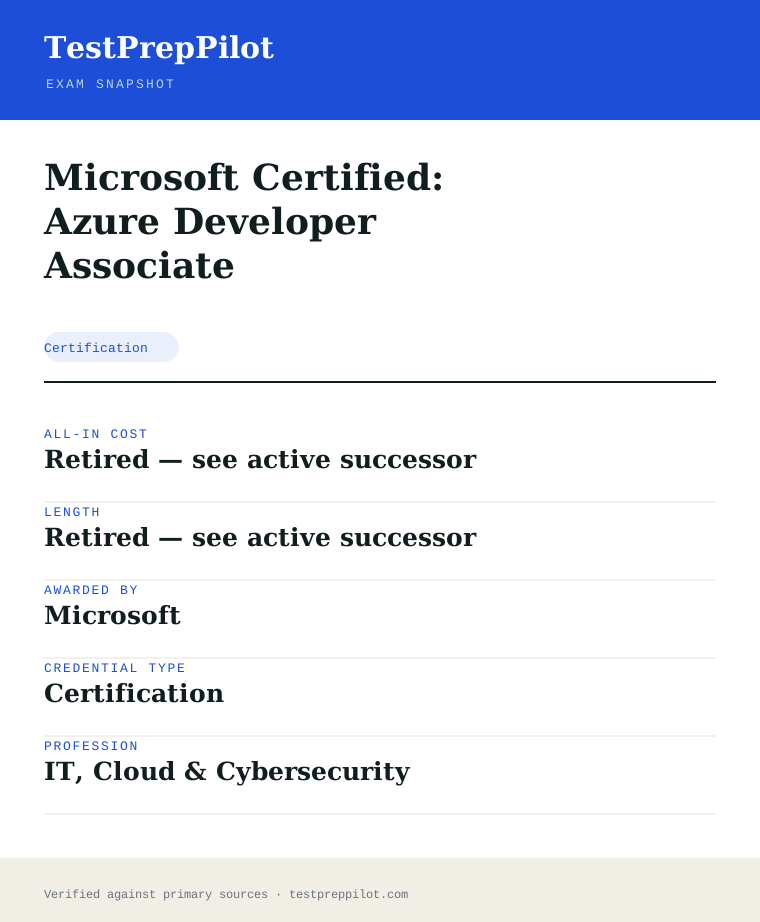
Microsoft Certified: Azure Developer Associate is a certification credential; awarded by Microsoft; the exam fee is $165 USD (historical); typical preparation is Retired — see active successor; holders typically earn $95,000 – $140,000.
| Credential | Microsoft Certified: Azure Developer Associate |
|---|---|
| Abbreviation | AZ-204 |
| Type | Certification |
| Profession | IT, Cloud & Cybersecurity |
| Specialty | Microsoft |
| Awarded by | Microsoft |
| Difficulty | Moderate |
| Typical prep time | Retired — see active successor |
| All-in cost | Retired — see active successor |
| Typical salary range | $95,000 – $140,000 |
| Credential | Microsoft Certified: Azure Developer Associate (RETIRED) |
| Exam code | AZ-204 |
| Status | Retired by Microsoft in 2026 |
| Historical exam length | 40–60 questions · 120 minutes |
| Historical passing score | 700 / 1000 |
| Historical fee | $165 USD |
| Successor | Active AI-204 / AI-103 developer path |
| Renewal | No longer available |
| Scope | National / Multi-state |
| Also known as | AZ-204 |
Real questions
Frequently asked questions about the Microsoft Certified: Azure Developer Associate
Is AZ-204 still available?
No. Microsoft has retired the Azure Developer Associate certification and its renewal assessment in 2026. You can no longer register for or renew AZ-204; plan for the active developer successor instead.
What replaces AZ-204?
Microsoft points candidates to the current AI-focused developer path (for example AI-204 / AI-103). Check the official Microsoft credentials catalog for the exam that matches your role, since the successor lineup was updated in 2026.
Do my AZ-204 skills still matter?
Yes. The core skills — compute, storage, security, monitoring, and service integration on Azure — remain directly relevant to the active developer exams, so prior study is not wasted.
If I already held AZ-204, is it still valid?
Certifications earned before retirement remain valid until their existing 12-month expiry; they simply cannot be renewed, and you would move to the successor to stay current.
How were the AZ-204 exam and fee structured?
Historically it was 40–60 questions in about 120 minutes, scaled pass mark 700/1000, with a $165 fee delivered by Pearson VUE — the same associate-tier shape as AZ-104.
Can I take a Microsoft exam online from home?
Yes. Exams are delivered by Pearson VUE with two options: an in-person test center or OnVUE online proctoring from a private space with a webcam. The fee is identical for both.
Do Microsoft certifications expire?
Most role-based, specialty, and fundamentals certifications are valid for 12 months. You renew for free by passing a shorter online assessment on Microsoft Learn before the expiry date.
What happens if my certification is retired?
You keep the credential until its current expiry date, but you can no longer earn or renew it. Microsoft typically points candidates to the active successor exam or certification.
In short
Is the Microsoft Certified: Azure Developer Associate worth it?
- AZ-204 (Azure Developer Associate) is retired by Microsoft as of 2026 and can no longer be earned or renewed.
- Its historical shape was 40–60 questions in ~120 minutes, pass mark 700/1000, fee $165.
- Skill areas — compute, storage, security, monitoring, and integrations — carry directly into the active developer successor exams.
- Treat this page as a reference and target the current AI-204 / AI-103 developer credential for a live certification.
Same awarding body
What other credentials does Microsoft award?
Worth comparing
How does the Microsoft Certified: Azure Developer Associate compare with similar credentials?
Trust
Where does this information come from?
Everything above is taken from the awarding body's own published material. Fees, question counts and domain weights are revised regularly — check the official page before you pay.
- Microsoft Awarding body
- Official Microsoft Certified: Azure Developer Associate exam page Exam page
- Microsoft certification programme Programme rules
Research confidence: medium · Last reviewed 2026-08