The short version
What is the Microsoft Certified: Azure AI Fundamentals (AI-900) and is it worth it?
AI-900 was the Azure AI Fundamentals exam: 40–60 questions in about 45 minutes, scaled pass mark 700/1000, fee $99. Microsoft retired it on June 30, 2026 and replaced it with AI-901, so it is no longer available to sit or renew.
- Was a gentle, no-code entry to AI/ML concepts
- Covered ML, vision, NLP, and generative AI
- Low cost ($99) and short format
- Prepared candidates for role-based AI certs
- Was renewable yearly for free while active
What is it?
What exactly is the Microsoft Certified: Azure AI Fundamentals (AI-900)?
The original Azure AI Fundamentals exam — retired June 30, 2026, and replaced by AI-901.
Microsoft Certified: Azure AI Fundamentals (AI-900) was the beginner credential for artificial intelligence and machine learning concepts on Azure. It validated conceptual knowledge of AI workloads, the fundamentals of machine learning, computer vision, natural language processing, and generative AI, without requiring coding or data-science experience. As of June 30, 2026, Microsoft has retired AI-900 and replaced it with AI-901, the updated Azure AI Fundamentals exam; AI-900 can no longer be earned or renewed. The skills it measured — describing AI workloads and considerations, ML principles, computer vision, NLP, and generative AI — remain the conceptual foundation for the new exam and for role-based AI credentials. We keep this page because many study plans and job posts still reference AI-900.
The path in brief
- Note AI-900 is retired — register for AI-901 instead
- Study the AI-901 Microsoft Learn path
- Take the official practice assessment
- Schedule the $99 AI-901 exam via Pearson VUE
- Pass and renew yearly for free
Before you book
Who is eligible to sit the Microsoft Certified: Azure AI Fundamentals (AI-900)?
While offered, AI-900 was open to all, including non-technical candidates. It is now retired and cannot be registered for; eligibility guidance applies to AI-901.
Who it is for: Students, non-technical learners, and AI beginners (historical); now a reference for AI-901.
The test itself
What is the format of the Microsoft Certified: Azure AI Fundamentals (AI-900)?
The Microsoft Certified: Azure AI Fundamentals (AI-900) is administered by Pearson VUE / Certiport (retired) and runs 45 minutes (historical), contains 40–60 (retired — no longer offered) questions and requires 700 / 1000 (scaled) to pass.
| Administered by | Pearson VUE / Certiport (retired) |
|---|---|
| Questions | 40–60 (retired — no longer offered) |
| Time limit | 45 minutes (historical) |
| Pass mark | 700 / 1000 (scaled) |
| Exam fee | $99 USD (historical) |
| Format | Computer-based, multiple-choice (retired) |
Content outline
What topics are on the Microsoft Certified: Azure AI Fundamentals (AI-900)?
The Microsoft Certified: Azure AI Fundamentals (AI-900) is weighted across 5 domains; the largest are Describe Artificial Intelligence workloads and considerations (15–20%), Describe fundamental principles of machine learning on Azure (15–20%), Describe features of computer vision workloads on Azure (15–20%).
Weightings come from the official exam outline. Study time is best allocated in roughly these proportions rather than evenly across domains.
- Describe Artificial Intelligence workloads and considerations 15–20%
AI workloads, responsible AI, and when to use AI. (Historical outline.)
- Describe fundamental principles of machine learning on Azure 15–20%
ML types, regression, classification, clustering, and Azure ML basics.
- Describe features of computer vision workloads on Azure 15–20%
Image classification, object detection, OCR, and face analysis.
- Describe features of Natural Language Processing (NLP) workloads on Azure 15–20%
Text analysis, speech, translation, and language understanding.
- Describe features of generative AI workloads on Azure 20–25%
Generative AI capabilities, copilots, and responsible use.
The path
How do you register for the Microsoft Certified: Azure AI Fundamentals (AI-900)?
- 1
Prepare with Microsoft Learn1–10 weeks depending on exam and experience
Work through the free official self-paced learning paths and, optionally, instructor-led courses for your exam. Microsoft Learn is the primary, no-cost study source and maps directly to the exam skills outline.
- 2
Schedule through Pearson VUEabout 15 minutes
Sign in with a personal Microsoft account (MSA) and schedule the exam on the Pearson VUE portal. Choose an in-person test center or online proctoring (OnVUE). Students and educators can use Certiport for Fundamentals exams.
Microsoft recommends a personal MSA account; a work or school account can lose exam records if you leave the organization.
- 3
Take the exam45–120 minutes depending on the exam
Arrive at the test center or launch the online proctoring session. Exams are computer-based and may include multiple-choice, drag-and-drop, case studies, and performance-based lab tasks in a live environment.
- 4
Receive results and badgescore at end; badge within a few days
You see a pass/fail result on screen immediately. A detailed score report is emailed within about 24 hours and posted to your Microsoft certification profile. On passing, your digital badge is issued via Credly.
- 5
Renew annuallyabout 45 minutes, once a year
Most Microsoft role-based, specialty, and fundamentals certifications expire after 12 months. Renew for free by passing a shorter online renewal assessment on Microsoft Learn before the expiry date — no need to retake the full exam.
The fine print
What are the retake and renewal rules for the Microsoft Certified: Azure AI Fundamentals (AI-900)?
- Proctoring & delivery
- Delivered by Pearson VUE. You can sit the exam at a Pearson VUE test center or take it online through OnVUE remote proctoring; the fee is the same for both. Online proctoring requires a quiet, private space, a working webcam, and a system check beforehand.
- Retake policy
- If you do not pass, you may retake the exam after 24 hours. A second failed attempt requires a 14-day waiting period, and any further attempts also require a 14-day wait between them, up to a maximum of five attempts in a 12-month period.
- Score reporting
- A pass/fail result is shown immediately after the exam. The official score report is emailed within about 24 hours and is also available in your Microsoft certification profile, with section-level feedback on how you performed.
- Recertification
- Microsoft role-based, specialty, and fundamentals certifications are valid for 12 months from the date earned. Renew at no cost by passing the shorter online renewal assessment on Microsoft Learn before the credential expires. Retired certifications cannot be renewed and must be re-earned through the active successor if one exists.
- Refunds & rescheduling
- Exam fees are generally non-refundable once a seat is purchased, but you can cancel or reschedule through Pearson VUE at no charge if you do so at least 24–48 hours before the appointment (exact window varies by region).
Context
Microsoft Azure / AI certifications compared
| Credential | Level | Focus | Exam fee | Validity | |
|---|---|---|---|---|---|
| AZ-900 Azure Fundamentals | Fundamentals | Cloud concepts | $99 | 1 year | |
| AI-900 Azure AI Fundamentals | Fundamentals | AI concepts | $99 | 1 year (retired Jun 30 2026) | |
| AI-901 Azure AI Fundamentals | Fundamentals | AI + Microsoft Foundry | $99 | 1 year | |
| AZ-104 Azure Administrator | Associate | Administer Azure | $165 | 1 year | |
| AZ-204 Azure Developer | Associate | Build cloud apps | $165 | 1 year (retired 2026) | |
| AZ-500 Azure Security Engineer | Associate | Security operations | $165 | 1 year (retires Aug 31 2026) | |
| AZ-700 Azure Network Engineer | Associate | Networking | $165 | 1 year | |
| AZ-140 Azure Virtual Desktop | Specialty | Virtual desktop (AVD) | $165 | 1 year | |
| AZ-305 Azure Solutions Architect | Expert | Solution design | $165 | 1 year |
What it pays
How much does this credential pay?
Retired exam, but the credential still counts — no salary premium on its own
AI-900 retired on 30 June 2026, so nobody is earning this one any more. That does not make the credential worthless: Microsoft states plainly that retiring an exam does not revoke or invalidate certifications already earned, and Fundamentals certifications do not expire, so if you passed AI-900 at any point between 2021 and June 2026 you hold Microsoft Certified: Azure AI Fundamentals permanently. What is changing is what that badge signals to a reader in late 2026 and beyond. AI-900 was, by Microsoft's own audience profile, open to technical and non-technical candidates alike, required no data-science or software-engineering experience, and contained no code whatsoever. It certified AI literacy — the ability to describe machine-learning concepts, computer-vision and NLP workloads, and generative-AI capabilities, plus the responsible-AI principles. It was genuinely valuable for the population it targeted: analysts, project managers, presales staff and marketers who needed to talk credibly about AI without building it. Its replacement is a different proposition, and hiring managers who follow the certification programme will increasingly read AI-901 as the technical credential and AI-900 as the literacy one. If you hold AI-900 and your work is now hands-on, that distinction may eventually be worth the $99 to close. If your role is non-technical, it is not — you already hold the credential that was designed for you, and AI-901 with its Python requirement is not aimed at your job. On pay: there is no BLS occupation for AI literacy, and no fundamentals certificate on its own moves a salary. The figures below describe the occupations AI-900 holders sit in, not what the certificate pays.
| Measure | Figure | Source / note |
|---|---|---|
| Median wage — computer and information technology occupations (group) | $105,990 | BLS Occupational Outlook Handbook, May 2024 wage data; group page last modified 28 August 2025. Used because no BLS occupation corresponds to "AI fundamentals". |
| Median wage — computer user support specialists (SOC 15-1232) | $60,340 | BLS OOH, May 2024. The realistic baseline for the non-technical population AI-900 was designed for. |
| Median wage — computer network support specialists (SOC 15-1231) | $73,340 | BLS OOH, May 2024. |
| Projected annual openings, all IT occupations, 2024-2034 | ~317,700 | BLS OOH, computer and information technology occupations group. |
| Self-reported average, Microsoft Certified: Azure AI Fundamentals holders | $90,484 | Skillsoft "30+ Top-Paying Microsoft Certifications" (2025), from its IT Skills and Salary survey — worldwide, self-reported respondent data, NOT government statistics. Respondents held multiple certifications and substantial experience, so this reflects the person rather than the badge. |
Job growth.Overall IT occupations projected to grow much faster than average, 2024-2034 (BLS OOH)
Source: BLS Occupational Outlook Handbook — Computer and Information Technology Occupations
Your odds
What are the pass rates?
Microsoft never published a pass rate for AI-900, and now never will
Across five years of delivery Microsoft published no pass rate for AI-900 — no first-time percentage, no attempt counts, no score distribution — and with the exam retired on 30 June 2026 no such figure will ever be released. This matters because AI-900 accumulated more circulating "pass rate" folklore than almost any other Microsoft exam, on the strength of being cheap, short and widely taken. Numbers in the eighties and nineties were quoted constantly. Every one of them originated with a training provider, a bootcamp, or a self-selecting poll of people who had already decided to post about their result online. None was ever validated by Microsoft, and a self-selected sample of forum users systematically over-represents people who passed. We are not reproducing any of them here. What Microsoft did publish, and what still applies to the successor exam, is the scoring mechanism. Results were reported on a 1-1,000 scale with 700 required to pass, and Microsoft states in its scoring documentation that this is a scaled score which "may not equal 70% of the points", because candidates see question sets of differing difficulty and the raw points needed move accordingly. There was no penalty for guessing, and an undisclosed subset of items on any form was unscored pilot content. The score report gave one overall number plus a bar chart of relative strength across the five skill areas — and Microsoft warns explicitly that those bars cannot be summed or read as percentages, which is why candidates regularly reported bars apparently above 70% alongside a fail.
Read this before quoting the number.No official AI-900 pass rate ever existed, and the exam is now retired so none will appear. Any percentage still circulating online is vendor marketing or forum self-selection. If you are researching this because you are choosing between exams, note that the same is true of AI-901 and more so — it has only been generally available since June 2026, so no credible sample can exist for it either. The published facts that actually help you plan are unchanged: 700/1000 scaled rather than 70% correct, a score report showing relative strength by skill area rather than a mark scheme, a $99 fee payable again on every attempt, and a retake policy of 24 hours before the second attempt, 14 days between all subsequent attempts, and five attempts maximum per 12 months from the first sitting. Verified against Microsoft's exam scoring and retake policy pages, 2026-08-04.
Avoid these
What mistakes do candidates most often make?
The mistakes that matter for AI-900 in late 2026 are no longer study mistakes — the exam cannot be sat. They are transition mistakes: people booking an exam that no longer exists, buying courses for it, or panicking about a certification that is in fact perfectly safe.
✕Trying to book or study for AI-900
✓You cannot. Microsoft retired the exam on 30 June 2026 and Pearson VUE no longer schedules it. If you want Microsoft Certified: Azure AI Fundamentals, the only route is Exam AI-901. Redirect your preparation there and be aware it is a substantially different exam — two skill areas instead of five, built around Microsoft Foundry, and requiring Python literacy that AI-900 never asked for.
✕Believing your existing AI-900 certification has been revoked or expired
✓It has not. Microsoft states that retirement of an exam does not revoke or invalidate certifications already earned, and separately that Fundamentals certifications do not expire. Your Azure AI Fundamentals credential remains valid indefinitely and continues to appear on your transcript and Credly badge. There is no renewal assessment to take and no deadline to miss.
✕Paying $99 to re-earn a credential you already hold
✓Microsoft's guidance is explicit that existing holders need take no action. Sitting AI-901 gives you the same certification name you already have. The only reason to do it is if you specifically want the Foundry, agent and Python-adjacent skills reflected in your recent exam history — a defensible choice for a developer, a waste of money for a project manager.
✕Buying an "AI-900" course in 2026
✓Check the exam code and the publication date before you pay. A large volume of AI-900 material remains indexed and on sale, and some of it has been relabelled for AI-901 without being rewritten. The tell is Microsoft Foundry: if a course marketed for the current Azure AI Fundamentals exam never mentions Foundry, or promises that no coding is required, it is AI-900 content in a new wrapper.
✕Assuming AI-901 is the same exam with a new number
✓It is not. AI-900 had five roughly equal conceptual domains and Microsoft's audience profile said data-science and software-engineering experience were not required. AI-901's audience profile requires knowledge of Python coding syntax and programming techniques plus familiarity with provisioning Azure resources, and 55-60% of it is implementing solutions in Microsoft Foundry. The certification name is identical; the exam is not.
✕Believing 700/1000 meant 70% correct
✓It never did, on this exam or any other in the programme. Microsoft states that the score is scaled and may not equal 70% of the points available. This misconception outlived the exam itself and is worth unlearning before you sit AI-901, where it applies identically.
✕Treating AI-900 as a prerequisite you now need to replace
✓AI-900 was never a prerequisite for anything. Microsoft's own exam page said you could use Azure AI Fundamentals to prepare for role-based certifications such as Azure Data Scientist Associate or Azure AI Engineer Associate, "but it's not a prerequisite for any of them". The same remains true of AI-901. If your goal is a role-based AI certification, you may go straight there.
What you'll face
What question types will I see?
This section is kept as a historical record and as a comparison point for anyone deciding whether their AI-900 preparation transfers to AI-901. It largely does not. AI-900 was, by design, one of the most approachable exams Microsoft ever published: 45 minutes of exam time inside a 65-minute seat, $99, a 700/1000 scaled pass mark, and — crucially — not a single line of code anywhere on the paper. Microsoft's audience profile stated that data-science and software-engineering experience were not required, and the item formats reflected that. You saw multiple choice, multiple response, drag-and-drop matching, hot-area selections and the recurring three-statement true/false block, all applied to conceptual material. There were no case studies and no interactive labs; both belong to associate and expert role-based exams. There was also no in-exam Microsoft Learn panel, since Microsoft has never offered that resource on Fundamentals exams. The blueprint, last revised on 2 May 2025, split the paper into five near-equal parts: AI workloads and considerations (15-20%), fundamental principles of machine learning on Azure (15-20%), computer vision workloads (15-20%), natural language processing workloads (15-20%), and generative-AI workloads (20-25%). That symmetric five-domain structure is the fastest way to identify outdated study material: AI-901 has two domains, weighted 40-45% and 55-60%. The single biggest format change in the successor exam is the appearance of Python code-comprehension items, which AI-900 contained none of. If your preparation consisted of learning which Azure AI service does what, roughly the first domain of AI-901 will feel familiar and the larger Foundry implementation domain will not.
A one- or two-sentence scenario and four options, typically asking which Azure AI service or which ML concept fits. Distractors were adjacent services rather than nonsense.
Count stated in the stem and enforced. Used heavily for responsible-AI principles and for listing capabilities of a given workload type.
Match workload descriptions to AI types, or services to capabilities. Scored per correct placement, so partial credit was available.
Statements with embedded dropdowns, or a diagram region to select.
Three independent statements about one scenario, judged separately. A dependable partial-credit format.
This is the defining difference from AI-901, whose audience profile requires Python syntax knowledge and which presents snippets calling AI models and services. AI-900 asked nothing of the kind.
Both are features of associate and expert role-based exams. No Fundamentals exam has used them.
Try these
Q1A retailer wants to automatically read the text printed on product packaging from photographs taken in its warehouses. Which type of AI workload does this requirement describe?
Answer:B
Extracting printed text from an image is optical character recognition, which sits within computer vision — the workload category concerned with deriving meaning from images and video. Natural language processing (A) is the distractor most candidates picked, because the task involves text and the word "read" suggests language; but NLP operates on text that is already in machine-readable form, analysing sentiment, entities, translation or intent. The step of getting characters out of a photograph is vision. Anomaly detection (C) identifies unusual data points in a series and is unrelated. Conversational AI (D) covers bots and assistants. This workload-classification question shape was the backbone of AI-900's first domain (15-20%) and remains relevant to AI-901's conceptual domain, which is why we have kept it here.
Q2A hospital deploys a model that recommends treatment priorities. Clinicians report they cannot determine why any given recommendation was made and are unwilling to act on the output. Which responsible-AI principle does this failure most directly implicate?
Answer:A
Transparency concerns whether the behaviour of an AI system can be understood and explained to the people affected by it and the people relying on it. Clinicians unable to determine why a recommendation was produced is precisely a transparency failure. Accountability (D) is the closest distractor and the one that catches most candidates: it is about the humans and organisations remaining answerable for how the system operates and is governed, which is a related but distinct idea — you can have clear accountability for an opaque system. Fairness (B) would apply if recommendations differed systematically across patient groups; nothing in the stem says so. Inclusiveness (C) concerns AI serving people of all abilities and backgrounds. Responsible AI was examined by scenario rather than definition on AI-900 and continues to be on AI-901, so this reasoning pattern does transfer.
Samples are editor-written illustrations of the published blueprint, not live exam items. AI-900 is retired; these are retained to illustrate how its conceptual question style differed from AI-901.
Reference
What are the key facts about the Microsoft Certified: Azure AI Fundamentals (AI-900)?
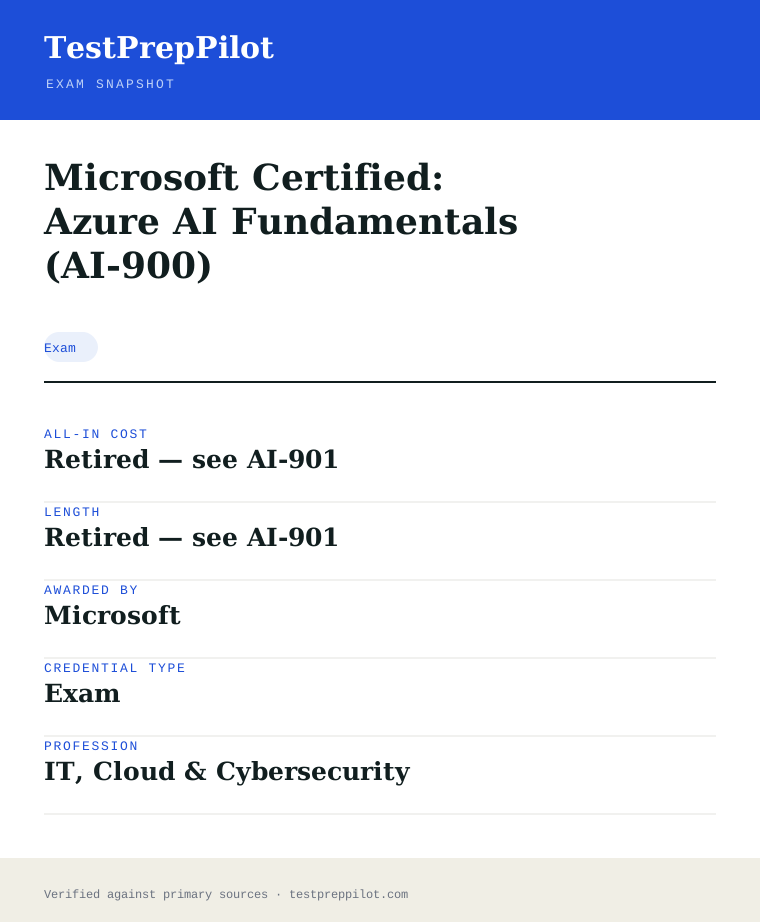
Microsoft Certified: Azure AI Fundamentals (AI-900) is a exam credential; awarded by Microsoft; the exam fee is $99 USD (historical); typical preparation is Retired — see AI-901; holders typically earn $70,000 – $110,000.
| Credential | Microsoft Certified: Azure AI Fundamentals (AI-900) |
|---|---|
| Abbreviation | AI-900 |
| Type | Exam |
| Profession | IT, Cloud & Cybersecurity |
| Specialty | Microsoft |
| Awarded by | Microsoft |
| Difficulty | Easy |
| Typical prep time | Retired — see AI-901 |
| All-in cost | Retired — see AI-901 |
| Typical salary range | $70,000 – $110,000 |
| Credential | Microsoft Certified: Azure AI Fundamentals (RETIRED) |
| Exam code | AI-900 |
| Status | Retired June 30, 2026 |
| Replacement | AI-901 (Azure AI Fundamentals) |
| Historical exam length | 40–60 questions · 45 minutes |
| Historical passing score | 700 / 1000 |
| Historical fee | $99 USD |
| Renewal | No longer available |
| Scope | National / Multi-state |
| Also known as | AI-900 |
Real questions
Frequently asked questions about the Microsoft Certified: Azure AI Fundamentals (AI-900)
Is AI-900 still available?
No. Microsoft retired AI-900 on June 30, 2026 and replaced it with AI-901. You can no longer register for or renew AI-900; take AI-901 for the current Azure AI Fundamentals credential.
What replaced AI-900?
AI-901, the updated Azure AI Fundamentals exam. It keeps the beginner, no-code focus and adds Microsoft Foundry and agentic AI topics while retiring the older ML/vision/NLP breakdown.
Do my AI-900 skills still matter?
Yes. The conceptual AI, ML, vision, NLP, and generative-AI knowledge remains the foundation for AI-901 and the role-based AI certs.
If I already held AI-900, is it still valid?
Certifications earned before retirement stay valid until their existing 12-month expiry; they simply cannot be renewed, and AI-901 becomes the path to stay current.
How were the AI-900 exam and fee structured?
Historically it was 40–60 questions in about 45 minutes, scaled pass mark 700/1000, with a $99 fee delivered by Pearson VUE or Certiport.
Can I take a Microsoft exam online from home?
Yes. Exams are delivered by Pearson VUE with two options: an in-person test center or OnVUE online proctoring from a private space with a webcam. The fee is identical for both.
Do Microsoft certifications expire?
Most role-based, specialty, and fundamentals certifications are valid for 12 months. You renew for free by passing a shorter online assessment on Microsoft Learn before the expiry date.
What happens if my certification is retired?
You keep the credential until its current expiry date, but you can no longer earn or renew it. Microsoft typically points candidates to the active successor exam or certification.
In short
Is the Microsoft Certified: Azure AI Fundamentals (AI-900) worth it?
- AI-900 (Azure AI Fundamentals) was retired by Microsoft on June 30, 2026 and replaced by AI-901.
- Its historical shape was 40–60 questions in ~45 minutes, pass mark 700/1000, fee $99.
- It covered AI workloads, ML principles, computer vision, NLP, and generative AI.
- For a live Fundamentals credential, register for AI-901 instead.
Same awarding body
What other credentials does Microsoft award?
Trust
Where does this information come from?
Everything above is taken from the awarding body's own published material. Fees, question counts and domain weights are revised regularly — check the official page before you pay.
- Microsoft Awarding body
- Official Microsoft Certified: Azure AI Fundamentals (AI-900) exam page Exam page
- Microsoft certification programme Programme rules
Research confidence: high · Last reviewed 2026-08