IT, Cloud & Cybersecurity • Certification
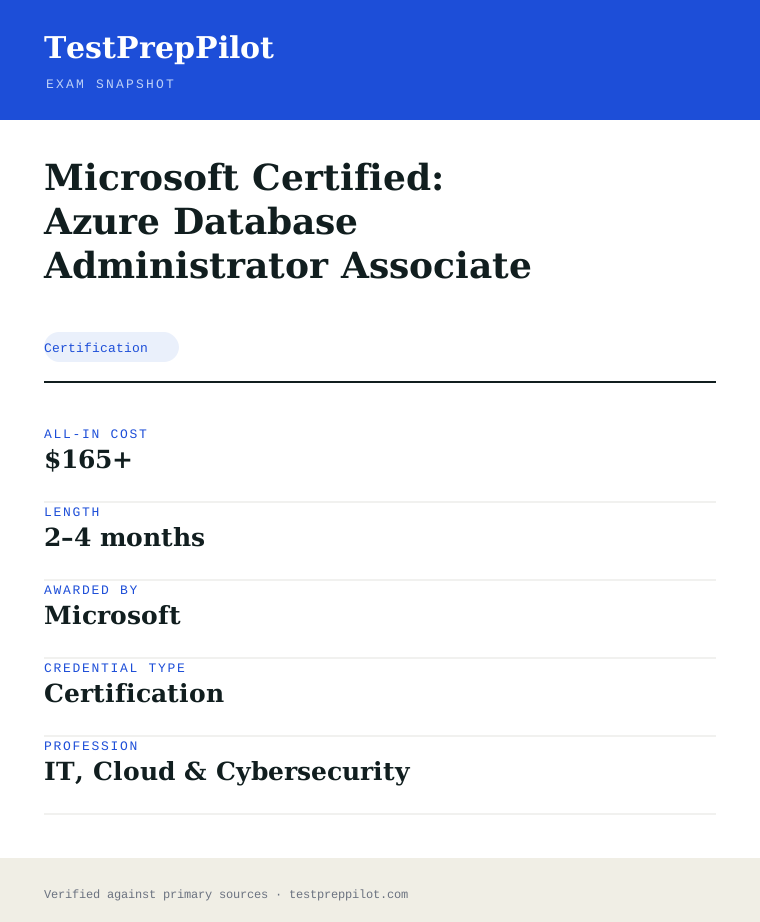
Microsoft Certified: Azure Database Administrator Associate
Azure database administrator associate
Researched and maintained by TestPrepPilot Editorial BoardCloud & database certifications desk · Figures last verified August 2026
The short version
What is the Microsoft Certified: Azure Database Administrator Associate and is it worth it?
DP-300 is the database administrator associate exam covering SQL deployment, performance, security and high availability.
- DBA focus
- Hands-on
- Renews yearly
What is it?
What exactly is the Microsoft Certified: Azure Database Administrator Associate?
Azure database administrator associate
Microsoft Certified: Azure Database Administrator Associate (DP-300) validates skills to administer relational databases on Azure SQL.
Before you book
Who is eligible to sit the Microsoft Certified: Azure Database Administrator Associate?
Who it is for: Database administrators
The test itself
What is the format of the Microsoft Certified: Azure Database Administrator Associate?
The Microsoft Certified: Azure Database Administrator Associate is administered by Pearson VUE and runs 120 minutes, contains 40–60 questions and requires 700 of 1000 to pass.
| Administered by | Pearson VUE |
|---|---|
| Questions | 40–60 |
| Time limit | 120 minutes |
| Pass mark | 700 of 1000 |
| Exam fee | $165 |
| Format | Multiple-choice + labs |
Content outline
What topics are on the Microsoft Certified: Azure Database Administrator Associate?
The Microsoft Certified: Azure Database Administrator Associate is weighted across 5 domains; the largest are Monitor and optimize (25%), Plan and deploy (20%), Secure (20%).
Weightings come from the official exam outline. Study time is best allocated in roughly these proportions rather than evenly across domains.
- Plan and deploy 20%
- Secure 20%
- Monitor and optimize 25%
- High availability 20%
- Automation 15%
Money & time
How much does the Microsoft Certified: Azure Database Administrator Associate cost?
For the Microsoft Certified: Azure Database Administrator Associate, the exam fee is $165; the all-in cost is typically $165+; most candidates spend 2–4 months preparing.
Cost breakdown
| Exam fee | $165 |
|---|---|
| Typical total | $165+ |
Academic pricing lower.
Timeline
- Study + labs 6–10 weeks
- Sit DP-300 test day
Typical prep: 2–4 months
The path
How do you register for the Microsoft Certified: Azure Database Administrator Associate?
- 1
Prepare with Microsoft Learn1–10 weeks depending on exam and experience
Work through the free official self-paced learning paths and, optionally, instructor-led courses for your exam. Microsoft Learn is the primary, no-cost study source and maps directly to the exam skills outline.
- 2
Schedule through Pearson VUEabout 15 minutes
Sign in with a personal Microsoft account (MSA) and schedule the exam on the Pearson VUE portal. Choose an in-person test center or online proctoring (OnVUE). Students and educators can use Certiport for Fundamentals exams.
Microsoft recommends a personal MSA account; a work or school account can lose exam records if you leave the organization.
- 3
Take the exam45–120 minutes depending on the exam
Arrive at the test center or launch the online proctoring session. Exams are computer-based and may include multiple-choice, drag-and-drop, case studies, and performance-based lab tasks in a live environment.
- 4
Receive results and badgescore at end; badge within a few days
You see a pass/fail result on screen immediately. A detailed score report is emailed within about 24 hours and posted to your Microsoft certification profile. On passing, your digital badge is issued via Credly.
- 5
Renew annuallyabout 45 minutes, once a year
Most Microsoft role-based, specialty, and fundamentals certifications expire after 12 months. Renew for free by passing a shorter online renewal assessment on Microsoft Learn before the expiry date — no need to retake the full exam.
The fine print
What are the retake and renewal rules for the Microsoft Certified: Azure Database Administrator Associate?
- Proctoring & delivery
- Delivered by Pearson VUE. You can sit the exam at a Pearson VUE test center or take it online through OnVUE remote proctoring; the fee is the same for both. Online proctoring requires a quiet, private space, a working webcam, and a system check beforehand.
- Retake policy
- If you do not pass, you may retake the exam after 24 hours. A second failed attempt requires a 14-day waiting period, and any further attempts also require a 14-day wait between them, up to a maximum of five attempts in a 12-month period.
- Score reporting
- A pass/fail result is shown immediately after the exam. The official score report is emailed within about 24 hours and is also available in your Microsoft certification profile, with section-level feedback on how you performed.
- Recertification
- Microsoft role-based, specialty, and fundamentals certifications are valid for 12 months from the date earned. Renew at no cost by passing the shorter online renewal assessment on Microsoft Learn before the credential expires. Retired certifications cannot be renewed and must be re-earned through the active successor if one exists.
- Refunds & rescheduling
- Exam fees are generally non-refundable once a seat is purchased, but you can cancel or reschedule through Pearson VUE at no charge if you do so at least 24–48 hours before the appointment (exact window varies by region).
Context
Microsoft Azure / AI certifications compared
| Credential | Level | Focus | Exam fee | Validity | |
|---|---|---|---|---|---|
| AZ-900 Azure Fundamentals | Fundamentals | Cloud concepts | $99 | 1 year | |
| AI-900 Azure AI Fundamentals | Fundamentals | AI concepts | $99 | 1 year (retired Jun 30 2026) | |
| AI-901 Azure AI Fundamentals | Fundamentals | AI + Microsoft Foundry | $99 | 1 year | |
| AZ-104 Azure Administrator | Associate | Administer Azure | $165 | 1 year | |
| AZ-204 Azure Developer | Associate | Build cloud apps | $165 | 1 year (retired 2026) | |
| AZ-500 Azure Security Engineer | Associate | Security operations | $165 | 1 year (retires Aug 31 2026) | |
| AZ-700 Azure Network Engineer | Associate | Networking | $165 | 1 year | |
| AZ-140 Azure Virtual Desktop | Specialty | Virtual desktop (AVD) | $165 | 1 year | |
| AZ-305 Azure Solutions Architect | Expert | Solution design | $165 | 1 year |
What it pays
How much does this credential pay?
$133,080 median for software developers (BLS, May 2024) — the closest published reference for Azure database administration roles, which occupy the developer-adjacent data tier of the technology labour market
There is no Bureau of Labor Statistics occupation called "Azure database administrator", so the salary story is indirect and should be stated honestly. The closest official reference is Software Developers (SOC 15-1252), the broad occupational series that Azure database administrator and data-platform roles most commonly sit within, which had a May 2024 median of $133,080, with the lowest 10 percent earning less than $79,850 and the highest 10 percent more than $211,450. The database administrators and architects series (SOC 15-1244) is the closer functional match — BLS reports a $123,100 median for that group — but it is a smaller occupation, and Microsoft’s own role guidance places DP-300 holders alongside developers and data engineers rather than inside a single BLS code. DP-300 is an associate-level credential that certifies the operational side of the data platform: planning and implementing resources, securing environments, monitoring and optimising, automating tasks, and planning high availability and disaster recovery — the skills of a database administrator working across Azure SQL and SQL Server. The honest framing is that the certification is a hireability signal and a salary-supporting credential, not a pay ladder by itself: employers use it to shortlist candidates for database administrator and data-platform roles, and BLS projects 15 percent growth for software developers from 2024 to 2034 with roughly 129,200 openings a year, while the database administrators and architects occupation projects 4 percent growth. The exam costs $165, requires roughly 40-80 hours of study plus hands-on Azure time, and the credential must be renewed every 12 months through Microsoft’s free online renewal assessment — a cheap, fast credential to maintain once earned.
| Measure | Figure | Source / note |
|---|---|---|
| Reference: median wage, software developers | $133,080 | BLS Occupational Outlook Handbook, May 2024 |
| Reference: database administrators and architects | $123,100 | BLS OOH Pay tab, May 2024 — the closer functional fit |
| Reference: software developers, lowest 10 percent | less than $79,850 | BLS OOH Pay tab, May 2024 |
| Reference: software developers, highest 10 percent | more than $211,450 | BLS OOH Pay tab, May 2024 |
| The certification itself | No direct occupation | A hireability and salary-supporting credential, not a pay ladder |
Job growth.BLS projects 15% growth for software developers 2024-34 and 4% for database administrators and architects; the credential feeds into the data tier of both.
Source: BLS Occupational Outlook Handbook — Software Developers
Your odds
What are the pass rates?
Microsoft publishes no pass rate — but it publishes the bar: 700 out of 1,000 on a 40-60 question, 150-minute exam, with renewal required every 12 months via a free online assessment
Microsoft does not publish pass-rate statistics for DP-300 or any of its role-based exams, so any percentage you see online is unverifiable. What is published and more useful is the scoring structure: DP-300 is scored on a 1,000-point scale with a passing score of 700, the exam contains roughly 40-60 questions (a mix of multiple-choice, case-study, and best-answer items, with the count varying by form), and the allotted time is 150 minutes. Because scoring is scaled and the question count varies, 700 is not a fixed percentage of items correct — the practical target is to be comfortably above 700 on official-style practice material rather than to compute a percentage. The exam fee is $165 in the US, with pricing varying by region. The other published fact that shapes planning is the renewal model: DP-300 contributes to the Microsoft Certified: Azure Database Administrator Associate certification, which is valid for 12 months and renewed at no cost by passing Microsoft’s online renewal assessment on Microsoft Learn before the expiry date. That means the credential is not a one-and-done investment — it carries an annual renewal obligation, and candidates who are not prepared to renew every year should factor that into the decision. Microsoft also publishes the skills-measured study guide, which defines the exam content at a level of detail no third-party source matches, and a free practice assessment, which is the honest readiness signal available at zero cost before you spend on anything else.
Read this before quoting the number.Microsoft publishes no pass rates. Published and verifiable are the 700/1,000 passing score, the 40-60 question / 150-minute format, the $165 fee, and the 12-month renewal via free online assessment. We have deliberately left no pass-rate percentage in this table.
Your schedule
How long should I study for it?
50-80 hours over 6-10 weeks, plus hands-on Azure time of focused study
Plan for six to ten weeks and 50 to 80 hours of study for DP-300, plus real hands-on time in Azure — this exam rewards operational fluency, and candidates who only study theory consistently underperform on the scenario and case-study items. The exam is roughly 40-60 questions in 150 minutes, scored 700/1,000, priced $165, and the published skills areas are Plan and Implement Data Platform Resources, Implement a Secure Environment, Monitor and Optimize Data Resources, Configure and Manage Automation of Tasks, and Plan and Configure a High Availability and Disaster Recovery Environment. Microsoft recommends about two years of database administration experience and at least a year of hands-on Azure before sitting. Weeks one through three should build the platform foundation: Azure SQL Database, SQL Managed Instance, and SQL Server on Azure VMs, plus IAM, networking, and the shared-responsibility model, because security and resource planning underpin a huge share of the paper. Weeks four and five should cover monitoring and optimisation — performance metrics, index and statistics maintenance, query tuning concepts, and the tooling — and automation with Azure Automation and other tooling. Week six should be high availability and disaster recovery: failover groups, geo-replication, backups and restores, and recovery time objectives. Weeks seven through nine should be practice-heavy, using Microsoft’s free practice assessment and full-length timed exams, with re-study of any skill area scoring below 80 percent. Week ten is review and logistics, including confirming the current exam version and scheduling through Pearson VUE.
- Weeks 1-318-24 hrs
Platform foundation and security
- Provision Azure SQL Database, SQL Managed Instance, and a SQL Server VM so the deployment models are real to you
- Learn IAM, network security (NSGs, private endpoints), and the shared-responsibility model
- Study the Plan and Implement Data Platform Resources skills area in the official study guide
- Work the Implement a Secure Environment objectives: encryption, authentication, and access control
- Weeks 4-514-18 hrs
Monitoring, optimisation, and automation
- Learn performance monitoring: metrics, dynamic management views, and performance baselines
- Study index and statistics maintenance, auto-tuning, and resource governor concepts
- Practise interpreting performance data to identify blocking, fragmentation, and query issues
- Cover automation: Azure Automation, jobs, and scheduling operational tasks
- Week 68-10 hrs
High availability and disaster recovery
- Learn failover groups, geo-replication, and availability for Azure SQL and SQL Managed Instance
- Study backup and restore, long-term retention, and recovery objectives
- Practise HADR scenario reasoning: which configuration for which availability requirement
- Work the Plan and Configure HADR objectives end to end
- Weeks 7-912-18 hrs
Practice and gap closing
- Take Microsoft’s free practice assessment and score it honestly
- Run full-length timed practice exams under the 150-minute clock
- Re-study every skill area scoring below 80%
- Drill the case-study and scenario item styles — read the full scenario before answering
- Week 106-8 hrs
Review and logistics
- Final pass over the highest-weight skills and your miss log
- Confirm the current DP-300 version and any recent study-guide updates
- Schedule the exam through Pearson VUE and confirm delivery method
- Rest before the exam
Adjusting the pace
Practising SQL Server DBA migrating to Azure.Compress to 5-6 weeks. Your SQL Server knowledge transfers; the gap is Azure-specific — platform services, IAM, private endpoints, and the HADR tooling. Spend the recovered time hands-on in Azure.
Data engineer or developer broadening into operations.Plan 10-12 weeks. You know the data platform from the build side; the gap is operational — monitoring, automation, backups, and HADR. Budget extra time on those skills areas.
Entry-level candidate with limited DB experience.Start with DP-900 (Azure Data Fundamentals) or equivalent study first, then plan 12-14 weeks for DP-300 with heavy hands-on time. Microsoft recommends about two years of DB experience, and the exam will expose any gap.
How to study
How do I prepare most effectively?
The single highest-yield strategy for DP-300 is to combine the official study guide with real hands-on Azure time, because the exam’s scenario and case-study items test operational decisions, not theory recall — a candidate who has provisioned and broken an Azure SQL database answers those items from experience. Second, read the current skills-measured document on Microsoft Learn and study by weight, because Microsoft updates the exam and candidates who study an older blueprint waste time on retired content. Third, use Microsoft’s free practice assessment before spending on anything else — it is the official readiness signal and tells you which skill areas to target. Fourth, drill the case-study format specifically: several linked questions can hang off one scenario, the sections cannot always be revisited after submission, and reading the full scenario before answering is the difference between a pass and a fail for many candidates. Fifth, master the security and HADR domains, which carry heavy weight and are the areas where candidates with on-premises-only backgrounds are weakest. Finally, plan for the 12-month renewal from day one: the credential expires unless renewed via Microsoft’s free online assessment, so a credential plan without a renewal habit is a credential plan that lapses.
Study hands-on in Azure, not just from books
The scenario and case-study items reward operational fluency. Provision Azure SQL, set up private endpoints, break a failover group, restore a backup — the hands-on hours are where the exam items become answerable.
Anchor to the current skills-measured document
Microsoft updates DP-300 and publishes every change in the study guide. Check the current version and its update history before buying material, and treat the official document as the only authoritative syllabus.
Take the free practice assessment first
Microsoft’s official practice assessment is free and mirrors the real exam. Take it before spending on courses or tests, use it to map weak skill areas, and re-take it after study to confirm readiness.
Drill the case-study format
Case studies hang several linked questions off one scenario, and navigation may be restricted. Read the full scenario before answering, and rehearse this format specifically — it is where unprepared candidates run out of time and context.
Weight security and HADR
Implementing a secure environment and planning high availability and disaster recovery carry substantial weight and are the areas where on-premises-only DBAs are weakest. Give them dedicated study, not leftover time.
Plan the 12-month renewal now
The Azure Database Administrator Associate certification expires after 12 months unless renewed via Microsoft’s free online assessment. Note the expiry at certification time so renewal is a light refresh, not a lapse and a full re-exam.
What to buy
Which study resources are worth paying for?
DP-300 preparation can be done almost entirely with official and low-cost resources, and the total spend is modest relative to the exam’s career value. Microsoft Learn provides the skills-measured study guide and a free practice assessment — both official, both free, and both the correct first resources. The mandatory spend is the $165 exam voucher. Hands-on Azure time is not optional for this exam, but it can be nearly free: a new Azure account includes free credit, and the free tier covers Azure SQL configurations for learning; budget $0-30 for incidental resource costs. Third-party resources are plentiful — video courses at $15-30 during sales, practice-test subscriptions at $20-40, and printed study guides at $30-50 — and they are useful accelerators, but they are supplements to the official material and the hands-on work, not substitutes. The buying rule is: official study guide and practice assessment first, hands-on Azure second, one timed practice-test product third for pacing calibration, and video courses only if you want structured pacing. The one caution is version freshness: Microsoft updates DP-300 periodically, so verify that any third-party material covers the current version before buying, and prefer sources that state their update date.
| Resource | Price | Format | Best for |
|---|---|---|---|
| DP-300 exam voucher | $165 (varies by region) | Pearson VUE, test centre or online | The required step |
| Official DP-300 study guide (Microsoft Learn) | Free | Web document | The authoritative syllabus — read it first and by weight |
| Official free practice assessment | Free | Online practice questions | The honest readiness signal before you spend on anything else |
| Hands-on Azure subscription | ~$0-30 with free credits | Cloud console | The operational fluency the exam rewards — non-negotiable |
| Third-party video courses | ~$15-30 during sales | Online video | Structured pacing — verify they cover the current version |
| Third-party practice tests and study guides | ~$20-50 | Online or print | Extra timed reps and pacing calibration |
Prices checked 2026-08 in USD and approximate. Microsoft updates DP-300 periodically; confirm any third-party material covers the current version. We do not rank by commission.
Avoid these
What mistakes do candidates most often make?
The most common DP-300 mistakes are about preparation method and exam strategy. The biggest is studying theory without hands-on Azure time — the scenario and case-study items test operational decisions, and candidates who have never provisioned or broken an Azure SQL environment answer those from guesswork. The second is studying an outdated blueprint: Microsoft updates DP-300 and its skills-measured document, and candidates who study an older version waste hours on retired content and miss the current weighting. Third, candidates mismanage the case-study format — they skim the scenario, answer linked questions out of context, and run out of time because they did not rehearse it. Fourth, many candidates under-weight the security and HADR domains, the areas where on-premises-only DBAs are weakest and where the exam concentrates points. Fifth, candidates rely on question banks and treat practice-question scores as readiness when the honest signal is the official free practice assessment and full-length timed exams. Finally, many candidates earn the credential and then let the 12-month renewal lapse, turning a $165 investment into a re-exam because they did not build the renewal habit.
✕Studying theory without hands-on Azure
✓The exam rewards operational fluency. Provision Azure SQL, configure private endpoints, fail over a group, restore a backup — the hands-on hours are where the scenario items become answerable, and no book substitutes for them.
✕Using an outdated blueprint
✓Microsoft updates DP-300 and publishes every change in the skills-measured study guide. Check the current version and its update history, and anchor all study to the current document rather than older material.
✕Mismanaging the case-study format
✓Case studies carry several linked questions and may restrict navigation. Read the full scenario before answering, rehearse the format in practice, and never answer a linked item without its context.
✕Under-weighting security and HADR
✓Implementing a secure environment and planning high availability and disaster recovery carry substantial weight and are the classic weak spots for on-premises-only DBAs. Give them dedicated study time.
✕Treating question banks as readiness
✓Question-bank scores are not readiness. Use Microsoft’s free official practice assessment and full-length timed exams, scored honestly by skill area, and re-study everything below 80%.
✕Letting the 12-month renewal lapse
✓The credential expires unless renewed via Microsoft’s free online assessment. Note the expiry date at certification time and build the annual renewal into your calendar — a lapsed credential is a $165 re-exam plus re-study.
What you'll face
What question types will I see?
DP-300 is a computer-based exam of roughly 40-60 questions in 150 minutes, scored on a 1,000-point scale with a passing score of 700, delivered through Pearson VUE at a test centre or online. The question mix spans multiple-choice, best-answer, and case-study items, and the count varies by form, which is why the score is scaled rather than a percentage. The published skills areas are Plan and Implement Data Platform Resources, Implement a Secure Environment, Monitor and Optimize Data Resources, Configure and Manage Automation of Tasks, and Plan and Configure a High Availability and Disaster Recovery Environment. The case-study items are the distinctive feature: a scenario with several linked questions, sometimes delivered in sections that cannot be revisited after submission, which makes reading the full scenario before answering the single most important tactical habit. The samples below are editor-written illustrations of the published skills areas, not live exam items.
Single-choice items across platform resources, security, monitoring, and HADR — many phrased as operational decisions.
A scenario with several linked questions; sections may not be revisitable. Read the full scenario before answering any linked item.
Interpreting metrics, identifying blocking or fragmentation, and selecting the right optimisation — tested as operational decisions.
Choosing the right availability or recovery configuration for a stated requirement — failover groups, geo-replication, backups, recovery objectives.
Try these
Q1A company needs database workloads with automated patching, high availability, and the lowest possible administrative overhead, without managing the underlying infrastructure. Which Azure service best fits?
Answer:B
Azure SQL Database is a fully managed platform service: patching, backups, and high availability are handled by the platform, which is exactly the "lowest administrative overhead" requirement. SQL Server on an Azure VM (A) still requires the customer to manage patching and availability; C is not an Azure service at all; and D (Azure SQL Database Edge) is a small-footprint engine for edge workloads, not a general database platform choice. The item tests the deployment-model decision that anchors the Plan and Implement Data Platform Resources domain.
Q2A database administrator observes that an index maintenance job is causing blocking during business hours and that query performance degrades as a result. Which approach best addresses the problem?
Answer:B
Index maintenance belongs in a maintenance window outside business hours, and a well-run operation rebuilds or reorganises indexes based on measured fragmentation rather than on a fixed schedule. A increases the interference during peak hours, C is destructive and performance-hostile, and D only refreshes statistics, leaving fragmentation unaddressed. The item tests the monitoring and optimisation decision-making — knowing when and how to maintain indexes — that characterises the Monitor and Optimize domain.
Q3A global application needs a database that can survive the failure of an entire Azure region with automatic failover and minimal data loss. Which configuration best meets this requirement?
Answer:A
Active geo-replication to a secondary region with automatic failover is the configuration designed to survive a full regional outage while minimising data loss. Local backup and restore (B) cannot survive a regional failure because the backups are regional; C provides no redundancy; and D, read replicas in the same region, does not survive a region-level failure and does not provide automatic failover. The item tests the HADR decision logic — matching the configuration to the availability and data-loss requirement — central to the Plan and Configure HADR domain.
Samples are editor-written illustrations of the published skills areas, not live exam items.
The big day
What should I expect on exam day?
DP-300 is a computer-based exam of roughly 40-60 questions in 150 minutes, scored 700/1,000, priced $165, and delivered through Pearson VUE at a test centre or online via OnVUE proctoring. For test-centre delivery, bring two forms of identification — one government-issued photo ID — with names matching your Pearson VUE registration exactly, and arrive early enough to complete check-in; personal items go in a locker. For online delivery, run the OnVUE system test on the same machine and network you will use, set up in a private room with a closed door, and clear the desk — the proctor scans the room before the exam begins. On the clock, the 150 minutes works out to roughly two to three minutes per question including case studies, so the pacing strategy is: move quickly through the straightforward multiple-choice items, and spend the case-study sections deliberately, reading the full scenario before answering any linked question and noting that some sections cannot be revisited after submission. Flag uncertain items and return to them where navigation allows. There are no scheduled breaks in the exam, and the clock does not stop if you leave. Your result appears on completion, and a pass at 700 or above contributes to the Microsoft Certified: Azure Database Administrator Associate credential, which is valid for 12 months and renewed through Microsoft’s free online assessment before expiry.
Bring
- Two forms of identification, one a government-issued photo ID, names matching your registration
- For OnVUE: a private room, webcam, microphone, and a connection already system-tested
- Your Pearson VUE sign-in and exam confirmation details
- A clear picture of the delivery method, start time, and any check-in requirements
Leave at home
- Phones, smartwatches, fitness trackers, and earbuds — locker at a centre, out of reach for OnVUE
- All notes and study material — closed-book exam
- A second monitor and any other person in the room for OnVUE
- The assumption that ID name mismatches can be fixed at the desk — correct them before test day
How the day runs
Rules in the room
- Roughly 40-60 questions in 150 minutes; passing score 700 on a 1,000-point scale.
- Question types include multiple-choice, best-answer, and case-study items; case-study sections may not be revisitable.
- Closed-book and proctored at a test centre or online via OnVUE.
- No scheduled breaks; the clock does not stop if you leave.
- The credential is valid 12 months and renewed via Microsoft’s free online assessment.
Afterwards.Your DP-300 result appears on completion, and a pass at 700 or above contributes to the Microsoft Certified: Azure Database Administrator Associate credential, which is valid for 12 months and renewed at no cost through Microsoft’s online renewal assessment on Microsoft Learn — set the reminder the week you pass, because the renewal habit is what keeps the credential alive. Update your resume and LinkedIn with the credential and its certification ID, and treat it as one rung of a deliberate ladder: the natural next steps are the DP-203 Azure Data Engineer or AZ-305 Azure Solutions Architect exams, or the SQL Server-focused specialisations, depending on whether your path runs toward data engineering or solution architecture. On a fail, the honest recovery is targeted: review the skill areas on your score report, re-do the hands-on labs in the weak domains (security and HADR are the usual suspects), re-take the free official practice assessment, and retake within a few weeks rather than cold. Because the credential requires annual renewal, also make peace with the fact that this certification is a maintenance commitment, not a one-time line on a resume — the yearly assessment is short and free, but it is not optional, and a lapsed credential forces a full $165 re-exam plus re-study.
Reference
What are the key facts about the Microsoft Certified: Azure Database Administrator Associate?
Microsoft Certified: Azure Database Administrator Associate is a certification credential; awarded by Microsoft; the exam fee is $165; typical preparation is 2–4 months; holders typically earn $100,000 – $140,000.
| Credential | Microsoft Certified: Azure Database Administrator Associate |
|---|---|
| Abbreviation | DP-300 |
| Type | Certification |
| Profession | IT, Cloud & Cybersecurity |
| Specialty | Microsoft |
| Awarded by | Microsoft |
| Difficulty | Hard |
| Typical prep time | 2–4 months |
| All-in cost | $165+ |
| Typical salary range | $100,000 – $140,000 |
| Exam code | DP-300 |
| Renewal | Annual (free assessment) |
| Scope | National / Multi-state |
| Also known as | DP-300 |
Real questions
Frequently asked questions about the Microsoft Certified: Azure Database Administrator Associate
Does it expire?
Yes, after 12 months; renew with a free online assessment.
How do I register for microsoft-dp-300?
You register and schedule microsoft-dp-300 through Pearson VUE. Pick a test-centre appointment or online proctoring, then sit the exam on your booked date.
What is the microsoft-dp-300 exam format?
The exam is delivered as Multiple-choice + labs, with about 40–60 items, in 120 minutes. The published pass mark is 700 of 1000.
How long is the microsoft-dp-300 certification valid?
Most Microsoft role-based certifications expire after 12 months but are renewed with a free online assessment; retired certs must be re-earned.
How much does microsoft-dp-300 cost?
The exam fee is $165. Optional study materials and retakes are priced separately.
Who should take microsoft-dp-300?
Database administrators
Can I take a Microsoft exam online from home?
Yes. Exams are delivered by Pearson VUE with two options: an in-person test center or OnVUE online proctoring from a private space with a webcam. The fee is identical for both.
Do Microsoft certifications expire?
Most role-based, specialty, and fundamentals certifications are valid for 12 months. You renew for free by passing a shorter online assessment on Microsoft Learn before the expiry date.
What happens if my certification is retired?
You keep the credential until its current expiry date, but you can no longer earn or renew it. Microsoft typically points candidates to the active successor exam or certification.
In short
Is the Microsoft Certified: Azure Database Administrator Associate worth it?
- DP-300 is the Azure DBA associate cert.
- It covers Azure SQL administration.
- It renews yearly.
Same awarding body
What other credentials does Microsoft award?
Worth comparing
How does the Microsoft Certified: Azure Database Administrator Associate compare with similar credentials?
Trust
Where does this information come from?
Everything above is taken from the awarding body's own published material. Fees, question counts and domain weights are revised regularly — check the official page before you pay.
- Microsoft Awarding body
- Official Microsoft Certified: Azure Database Administrator Associate exam page Exam page
- Microsoft certification programme Programme rules
Research confidence: high · Last reviewed 2026-08