IT, Cloud & Cybersecurity • Certification
Certified Ethical Hacker
The world’s best-known ethical hacking knowledge exam.
Researched and maintained by TestPrepPilot Editorial BoardCloud, IT & cybersecurity certifications desk · Figures last verified August 2026
The short version
What is the Certified Ethical Hacker and is it worth it?
CEH v13 (exam 312-50) is a 125-question, 4-hour multiple-choice exam with a form-based cut score of 60%–85%, costing about $950 via ECC Exam Center or $1,199 via Pearson VUE (plus a $100 self-study eligibility fee). Training or two years of experience is required. It is valid three years.
- Globally recognised, DoD-approved baseline
- Broad coverage of hacking methodology and tools
- ANSI/ISO 17024 accredited
- Stepping stone to CEH Practical and CEH Master
What is it?
What exactly is the Certified Ethical Hacker?
The world’s best-known ethical hacking knowledge exam.
The EC-Council Certified Ethical Hacker (CEH) v13 is a knowledge-based exam covering reconnaissance, scanning, exploitation, malware, web attacks and cloud hacking. It validates that a candidate understands attacker methodology and countermeasures. CEH is an ANSI/ISO 17024 accredited, DoD 8570/8140 approved baseline and a common first step before hands-on certs such as CPENT or OSCP.
The path in brief
- Complete training or prove 2yr experience
- Pay fee + $100 eligibility
- Book exam
- Pass the 125-question test
- Maintain via ECE (120 credits/3yr)
Before you book
Who is eligible to sit the Certified Ethical Hacker?
Who it is for: Aspiring penetration testers and security analysts.
The test itself
What is the format of the Certified Ethical Hacker?
The Certified Ethical Hacker is administered by ECC Exam Center (remote) or Pearson VUE and runs 4 hours, contains 125 multiple choice questions and requires Form-based cut score 60%-85% to pass.
| Administered by | ECC Exam Center (remote) or Pearson VUE |
|---|---|
| Questions | 125 multiple choice |
| Time limit | 4 hours |
| Pass mark | Form-based cut score 60%-85% |
| Exam fee | ~$950 (ECC) / $1,199 (Pearson VUE) |
| Format | Multiple choice |
Content outline
What topics are on the Certified Ethical Hacker?
The Certified Ethical Hacker covers 6 content domains.
Weightings come from the official exam outline. Study time is best allocated in roughly these proportions rather than evenly across domains.
- Reconnaissance and Footprinting
OSINT and enumeration
- Scanning and Enumeration
Network and vulnerability discovery
- System and Application Hacking
Exploitation methodology
- Malware and Wireless
Threats and attacks
- Web and Cloud Attacks
OWASP, multi-cloud
- Social Engineering and IoT
Human and emerging vectors
Money & time
How much does the Certified Ethical Hacker cost?
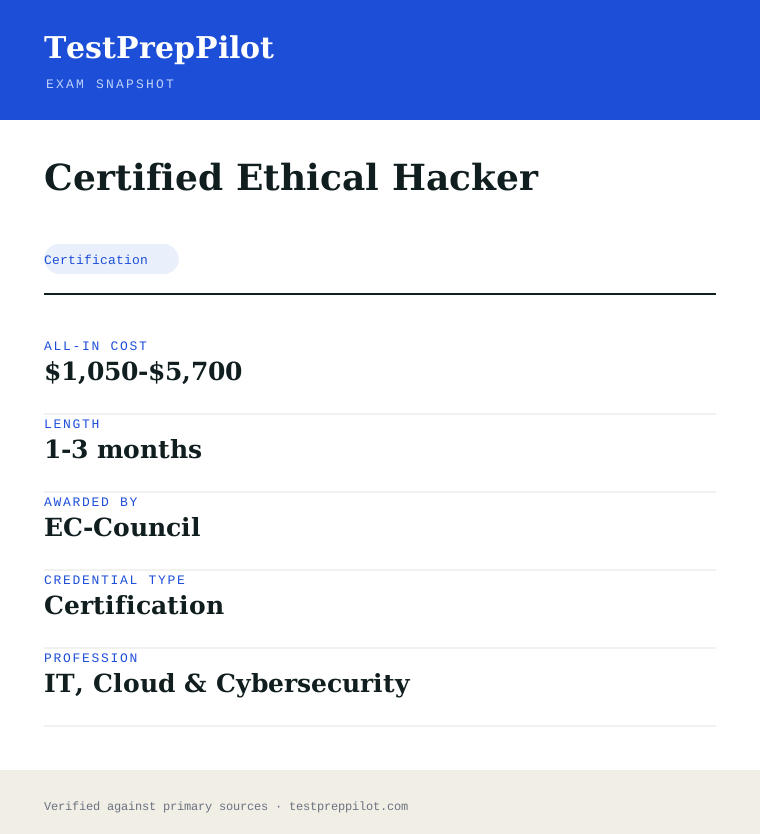
For the Certified Ethical Hacker, the exam fee is ~$950 (ECC) / $1,199 (Pearson VUE); the all-in cost is typically $1,050-$5,700; most candidates spend 1-3 months preparing.
Cost breakdown
| Exam voucher | $950-$1,199 |
|---|---|
| Self-study eligibility | $100 |
| Training (optional) | $2,000-$4,500 |
| Typical total | $1,050-$5,700 |
Note: since April 2026 CEH no longer grants the CISSP one-year experience waiver.
Timeline
- Study 5 days bootcamp to 3 months
Typical prep: 1-3 months
The path
How do you register for the Certified Ethical Hacker?
- 1
Choose a path
Either complete official EC-Council training or apply for self-study eligibility (with a non-refundable fee).
- Training route waives eligibility fee
- Self-study requires experience + $100 fee
- 2
Obtain a voucher
Purchase an exam voucher valid for one year from issuance.
- 3
Schedule the exam
Book through the ECC Exam Center (remote proctored) or a Pearson VUE test centre.
- 4
Take the exam
Complete the proctored knowledge or practical exam and view the result transcript.
The fine print
What are the retake and renewal rules for the Certified Ethical Hacker?
- Proctoring & delivery
- Knowledge exams are delivered via the ECC Exam Center (remote proctored) or Pearson VUE test centres. Practical exams run in the Aspen iLabs cyber range and are proctored by EC-Council.
- Retake policy
- EC-Council applies a form-based cut score of 60%–85%. Retake rules vary by exam; some allow up to five attempts per year, while practical exams require repurchase after included attempts. CEH free retakes apply only with Exam Insurance.
- Score reporting
- Exams use multiple forms, each with its own statistically set cut score between 60% and 85%. The candidate transcript shows the achieved score and cut score.
- Recertification
- Most EC-Council certifications are valid for three years and maintained through the EC-Council Continuing Education (ECE) program: 120 ECE credits plus an $80 annual membership fee.
What it pays
How much does this credential pay?
$124,910 median for information security analysts (BLS, May 2024)
There is no Bureau of Labor Statistics occupation called "CEH" — the Certified Ethical Hacker credential validates offensive-security knowledge, and the wage question belongs to the role you perform with it. The closest official BLS occupation is Information Security Analysts, SOC 15-1212, which had a May 2024 median wage of $124,910, with the lowest 10 percent under $71,280 and the highest 10 percent above $173,780. The fit is deliberate: CEH holders work as penetration testers, security analysts and red-team members, all inside or directly adjacent to the information-security occupation, and BLS counted 182,300 information security analyst jobs in 2024, projecting a striking 30 percent growth from 2024 to 2034 with about 17,500 openings a year. The limitation to state plainly: the BLS median covers the whole occupation at all levels, credentialed or not, and the CEH's value is as a recognised offensive-security signal that many employers — especially government contractors and MSSPs — require or prefer for penetration-testing roles. Read the number as the market for the occupation, with the CEH concentrated in the security-testing segment of it.
| Measure | Figure | Source / note |
|---|---|---|
| Median annual wage, information security analysts | $124,910 | BLS OOH, SOC 15-1212, May 2024 |
| Lowest 10 percent | Under $71,280 | BLS OOH, SOC 15-1212, May 2024 |
| Highest 10 percent | Above $173,780 | BLS OOH, SOC 15-1212, May 2024 |
| Projected openings per year | ~17,500 | BLS OOH, SOC 15-1212, 2024-2034 |
Job growth.BLS projects 30 percent growth for information security analysts from 2024 to 2034, about 17,500 openings per year.
Source: BLS Occupational Outlook Handbook - Information Security Analysts
Your odds
What are the pass rates?
EC-Council publishes no official pass rate — the CEH exam format is 125 questions in 4 hours, with the score reported against EC-Council's passing standard
EC-Council does not publish cohort pass rates for the CEH exam, and third-party estimates are not official data, so we do not treat them as authoritative. What EC-Council does publish is the format: the CEH (312-50) exam has 125 multiple-choice questions with a 4-hour time limit, delivered by computer through Pearson VUE or ECC exam centres, and the result is reported against EC-Council's passing standard (the scaled passing score is not published as a simple percentage). The exam content follows the published blueprint: the 20 CEH modules covering information security threats and attack vectors, reconnaissance, scanning, enumeration, vulnerability analysis, system hacking, malware threats, sniffing, social engineering, denial of service, session hijacking, web application attacks, wireless attacks, cryptography, and the CEH practical toolkit. The absence of a published pass rate is not an absence of standards: the CEH is a breadth exam, and the 125-question format rewards systematic coverage of the full blueprint rather than deep skill in one area. The practical reading: prepare with the blueprint as the scope map, drill the tool-and-technique items, and budget for the retake possibility, because candidates who study only their favourite topics fail the breadth items.
Read this before quoting the number.EC-Council publishes the format but no official pass rate; the passing standard is reported as a scaled score rather than a published percentage.
Your schedule
How long should I study for it?
120-200 hours over 8-12 weeks of focused study
The CEH exam is a 125-question, 4-hour exam built on the 20-module blueprint, and it is a breadth exam: the modules span reconnaissance through system hacking, web attacks, wireless, cryptography and the CEH toolkit. A defensible plan runs 120 to 200 hours over 8 to 12 weeks, typically built around an EC-Council training course or a structured alternative. Weeks 1-2: the foundations — networking and security fundamentals, the threat-and-attack-vector model, and the recon, scanning and enumeration modules. Weeks 3-4: the attack modules — system hacking, malware threats, sniffing, social engineering and denial of service. Weeks 5-6: the application and infrastructure modules — session hijacking, web application attacks, SQL injection, wireless attacks and IoT. Weeks 7-8: the crypto and tooling modules — cryptography, cloud security, and the CEH toolkit of tools and their uses. Weeks 9-12: question-bank drilling in volume and full timed practice exams at the real 125-question, 4-hour format. The plan is breadth-driven because the exam rewards coverage; candidates who front-load the modules they enjoy and skip the rest fail the breadth items.
- Weeks 1-230
Foundations and recon
- Network and security fundamentals
- Reconnaissance, scanning and enumeration
- Vulnerability analysis
- Weeks 3-435
Attack modules
- System hacking and privilege escalation
- Malware threats and sniffing
- Social engineering and denial of service
- Weeks 5-635
Applications and infrastructure
- Session hijacking and web attacks
- SQL injection and XSS
- Wireless attacks and IoT
- Weeks 7-830
Crypto and tools
- Cryptography and PKI
- Cloud and mobile security
- The CEH toolkit and tools
- Weeks 9-1250
Drill and mocks
- Question-bank drilling in volume
- Two full timed practice exams
- Review weak modules and schedule
Adjusting the pace
Working security professional.The recon and system-hacking modules accelerate; spend extra time on web attacks, wireless and crypto.
IT professional entering security.Add 2-3 weeks of networking and security fundamentals before the blueprint work.
How to study
How do I prepare most effectively?
The CEH rewards breadth across the 20-module blueprint, so the dominant strategy is systematic coverage with tool-and-technique drilling: the exam asks what a tool does, which technique fits an attack phase, and which countermeasure applies — so practise the tool names, their purposes and the attack-phase mapping. Second, use the official blueprint as the scope map and audit every study resource against it, because the exam is built from the blueprint and third-party courses drift. Third, drill the attack chains deliberately: the exam rewards knowing the sequence of an attack — recon, scanning, enumeration, exploitation, post-exploitation — and which tool belongs at each step. Fourth, take at least two full timed practice exams at the real 125-question, 4-hour format; the length and the breadth reward stamina and coverage. Finally, plan the practical exam: the CEH has a separate practical (hands-on) component in the current program, so understand both parts of the certification path before you start.
Drill tools and techniques
Which tool fits which attack phase is the exam's core pattern.
Audit against the blueprint
The 20-module blueprint is the authoritative scope.
Learn the attack chains
Recon to exploitation sequences and their tools are tested directly.
Run two full timed mocks
125 questions in 4 hours; stamina and coverage are part of the test.
Plan the practical component
The CEH path includes a hands-on practical exam.
What to buy
Which study resources are worth paying for?
CEH prep spans official EC-Council training and third-party resources. EC-Council's official training courses run roughly $850 to $2,500 depending on format (self-paced, instructor-led or the bundle with the exam voucher); the official courseware is the source the exam is built from. Third-party alternatives — books ($40-$100), video courses ($50-$300) and question banks ($50-$200) — are popular because the official training is expensive; many candidates use a book-plus-question-bank stack. The exam fee is about $100-$150 if you have a voucher from training, or $550-$1,199 without, depending on the purchase path. A realistic total budget is $200 to $2,800 depending on whether you take official training. Prices below are list prices as of mid-2026 and change frequently; we rank nothing by commission.
| Resource | Price | Format | Best for |
|---|---|---|---|
| EC-Council official training | $850-$2,500 | Self-paced or instructor-led + voucher | The source the exam is built from |
| CEH books | $40-$100 | Printed or digital book | Structured blueprint coverage |
| Third-party video courses | $50-$300 | Video courses and quizzes | Lower-cost structured alternatives |
| Question banks | $50-$200 | Online practice items | Tool-and-technique drilling |
| CEH exam | ~$550-$1,199 (or ~$100 with training voucher) | Computer-based exam | The certification itself |
List prices as of mid-2026, subject to change; EC-Council pricing varies by path; no commission or affiliate ranking is implied.
Avoid these
What mistakes do candidates most often make?
The most common CEH mistake is studying favourite topics and skipping the breadth: candidates who drill hacking techniques but ignore cryptography or IoT meet the breadth items unprepared, because the 125-question format draws from all 20 modules. The fix is systematic blueprint coverage. The second mistake is memorising tools without learning what they do and when to use them — the exam rewards the tool-to-phase mapping, not the names. Third, candidates study from a single course that drifts from the blueprint; audit every resource against the official blueprint. Fourth, many candidates never run a full timed practice exam and underestimate the 4-hour stamina. Finally, some candidates overlook the practical component of the current CEH path and plan only for the multiple-choice exam; understand both parts before starting.
✕Studying favourite topics only
✓The 125-question format draws from all 20 modules; cover the blueprint.
✕Memorising tool names
✓Learn what each tool does and which attack phase it fits.
✕Relying on drifting courses
✓Audit every resource against the official blueprint.
✕Skipping timed mocks
✓125 questions in 4 hours; run two full timed practice exams.
✕Ignoring the practical exam
✓The CEH path includes a hands-on component; plan for both.
What you'll face
What question types will I see?
The CEH exam is a 125-question multiple-choice exam in 4 hours. The items span the 20-module blueprint with a heavy concentration on tools and techniques: which tool performs a described action, which technique fits an attack phase, and which countermeasure or detection applies. Scenario items describe an attack in progress and ask for the correct identification, tool or response. Samples below are editor-written illustrations of the published blueprint, not live exam items; they show the tool-and-technique style of the real items.
Which tool or technique fits a described attack phase.
Attack situations with the correct identification or response.
Defences, detection and cryptographic concepts.
Try these
Q1An attacker wants to discover live hosts and open ports on a target network before exploitation. The most appropriate phase and tool pairing is:
Answer:A
Host and port discovery is the scanning phase, and Nmap is the standard tool for it. Hashing, rootkits and phishing belong to different phases and purposes.
Q2Which attack technique tricks a user into revealing credentials by impersonating a trusted entity?
Answer:A
Phishing impersonates a trusted entity to trick users into revealing credentials or other sensitive information. SQL injection attacks databases, buffer overflows exploit memory, and session replay reuses captured sessions.
Q3To protect data at rest on a stolen laptop, the most appropriate control is:
Answer:A
Full-disk encryption protects data at rest — without the key, the data is unreadable even if the device is stolen. A password alone is bypassable, and firewalls and antivirus protect the device while running, not the data at rest.
Samples are editor-written illustrations of the published blueprint, not live exam items.
The big day
What should I expect on exam day?
The CEH exam is a 125-question, 4-hour computer-based exam at a Pearson VUE centre or through an ECC exam centre. Bring the required identification matching your registration and your exam confirmation; personal items go in the locker. Arrive early — late arrivals may forfeit the appointment and fee. Pace at about 1.9 minutes per item, flag uncertain items for review, and budget time for the reading-heavy scenario items. Your result is reported after the exam, with the official score report following. If you do not pass, the retake policy and fee apply. On a pass, the CEH is valid for three years and is renewed by earning 120 continuing education credits (ECEs) or retaking. The afterwards matters: log your ECEs as you earn them, because EC-Council audits renewals, and plan the practical component of the certification path if you have not completed it.
Bring
- Required identification matching your registration
- Exam confirmation
Leave at home
- Phone, smartwatch and all electronics
- Notes and study materials
- Personal bags beyond what the centre allows
How the day runs
Rules in the room
- The exam is computer-based and timed
- 4 hours for 125 questions; the clock does not pause
- The certification renews every 3 years with 120 ECEs (or a retake)
Afterwards.On a pass, your CEH is valid for three years; earn 120 ECEs (or retake) to renew. On a fail, retake per the EC-Council policy after additional blueprint study.
Reference
What are the key facts about the Certified Ethical Hacker?
Certified Ethical Hacker is a certification credential; awarded by EC-Council; the exam fee is ~$950 (ECC) / $1,199 (Pearson VUE); typical preparation is 1-3 months; holders typically earn $90,000-$130,000.
| Credential | Certified Ethical Hacker |
|---|---|
| Abbreviation | CEH |
| Type | Certification |
| Profession | IT, Cloud & Cybersecurity |
| Specialty | Cybersecurity (Vendor-Neutral) |
| Awarded by | EC-Council |
| Difficulty | Moderate |
| Typical prep time | 1-3 months |
| All-in cost | $1,050-$5,700 |
| Typical salary range | $90,000-$130,000 |
| Delivery | ECC Exam Center or Pearson VUE |
| Retake | Free retake only with Exam Insurance add-on |
| Validity | 3 years; 120 ECE credits + $80/yr |
| Scope | National / Multi-state |
| Also known as | CEH, 312-50 |
Real questions
Frequently asked questions about the Certified Ethical Hacker
Is CEH multiple choice or hands-on?
The standard CEH (312-50) is a 125-question multiple-choice knowledge exam. The separate CEH Practical is the hands-on component.
What is the pass mark?
EC-Council sets a per-form cut score between 60% and 85%; there is no single fixed percentage. Target a consistent 80%+ in practice.
What are the eligibility routes?
Complete official training (waives experience) or apply via the self-study route with two years of security experience and a $100 fee.
How do I renew CEH?
Earn 120 ECE credits over three years and pay the $80 annual EC-Council membership fee.
What is the CEH pass mark?
There is no fixed percentage. EC-Council sets a per-form cut score that ranges from 60% to 85% depending on difficulty.
How do I maintain an EC-Council certification?
Earn 120 ECE credits over three years and pay the $80 annual membership fee before the credential lapses.
In short
Is the Certified Ethical Hacker worth it?
- CEH v13 is EC-Council’s ethical hacking knowledge exam
- 125 questions, 4 hours, cut score 60-85%, ~$950-$1,199
- Requires training or 2yr experience + $100 fee
- 3-year ECE renewal
Trust
Where does this information come from?
Everything above is taken from the awarding body's own published material. Fees, question counts and domain weights are revised regularly — check the official page before you pay.
- EC-Council Awarding body
- Official Certified Ethical Hacker exam page Exam page
- EC-Council certification programme Programme rules
Research confidence: high · Last reviewed 2026-08