IT, Cloud & Cybersecurity • Certification
Certificate of Cloud Security Knowledge
The foundational, vendor-neutral cloud security certificate.
Researched and maintained by TestPrepPilot Editorial BoardCloud & cybersecurity certifications desk · Figures last verified August 2026
The short version
What is the Certificate of Cloud Security Knowledge and is it worth it?
CCSK is a 60-question, 120-minute open-book online exam with an 80% pass mark, costing $445 and including two attempts over two years. It has no experience prerequisite and does not expire. Study the CSA Security Guidance v5 and Cloud Controls Matrix.
- Vendor-neutral foundation for any cloud role
- Open-book and self-paced; two attempts included
- Strong stepping stone to the advanced CCSP
- Considered a lifetime certificate (no renewal)
What is it?
What exactly is the Certificate of Cloud Security Knowledge?
The foundational, vendor-neutral cloud security certificate.
The Certificate of Cloud Security Knowledge (CCSK) is CSA’s entry-level cloud security credential and is often called the "mother of cloud certifications." It validates a broad understanding of cloud security across governance, architecture, data, application and incident response, based on the CSA Security Guidance and Cloud Controls Matrix. There are no prerequisites and the exam is open-book.
The path in brief
- Download the free Prep Kit
- Study Security Guidance v5 + CCM
- Buy the exam
- Pass at 80%
- Pursue CCSP for advanced validation
Before you book
Who is eligible to sit the Certificate of Cloud Security Knowledge?
None
Who it is for: IT and security staff working with or moving into cloud.
The test itself
What is the format of the Certificate of Cloud Security Knowledge?
The Certificate of Cloud Security Knowledge is administered by Online, unproctored open-book and runs 90 min, contains 60 (80% passing, 48/60) questions and requires 80% (48/60) to pass.
| Administered by | Online, unproctored open-book |
|---|---|
| Questions | 60 (80% passing, 48/60) |
| Time limit | 90 min |
| Pass mark | 80% (48/60) |
| Exam fee | ~$395 |
| Format | Open-book online |
Content outline
What topics are on the Certificate of Cloud Security Knowledge?
The Certificate of Cloud Security Knowledge covers 11 content domains.
Weightings come from the official exam outline. Study time is best allocated in roughly these proportions rather than evenly across domains.
- Cloud Concepts & Architectures
Service/deployment models, shared responsibility
- Cloud Governance
Policies, standards, frameworks
- Risk, Audit & Compliance
Risk management and auditing
- IAM
Identity and access management
- Security Monitoring
Logging and detection
- Infrastructure & Networking
Network and virtualization security
- Cloud Workload Security
Containers, serverless, VMs
- Data Security
Encryption and data lifecycle
- Application Security
DevSecOps and secure development
- Incident Response & Resilience
IR planning and BCP
- Related Technologies
AI/GenAI and emerging tech
Money & time
How much does the Certificate of Cloud Security Knowledge cost?
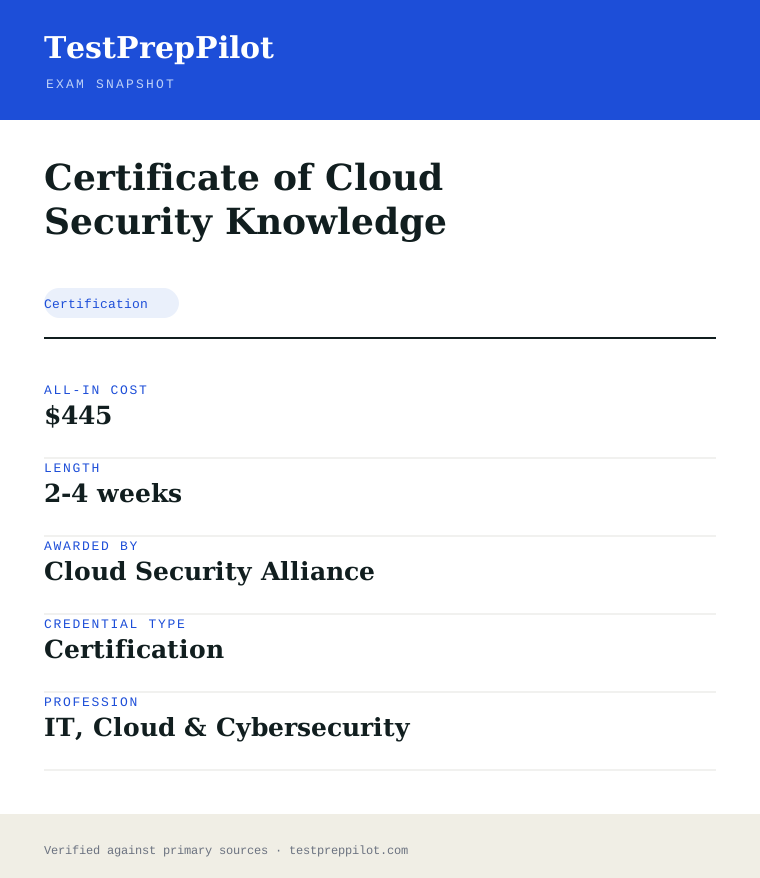
For the Certificate of Cloud Security Knowledge, the exam fee is ~$395; the all-in cost is typically $445; most candidates spend 2-4 weeks preparing.
Cost breakdown
| Exam (2 attempts) | $445 |
|---|---|
| Training | $0 (free Prep Kit) |
| Typical total | $445 |
The free Prep Kit covers the material; paid training is optional.
Timeline
- Study 2-4 weeks
Typical prep: 2-4 weeks
The path
How do you register for the Certificate of Cloud Security Knowledge?
- 1
Download the free Prep Kit (CCSK)
CCSK provides a free study kit based on the CSA Security Guidance and Cloud Controls Matrix.
- 2
Purchase the exam
Buy the exam voucher; CCSK includes two attempts within two years, CCAK one attempt within one year.
- 3
Schedule the online proctored exam
CCSK is an open-book online exam; CCAK is an online proctored exam.
- 4
Complete the assessment
CCSK is open-book multiple choice; CCAK is proctored multiple choice.
The fine print
What are the retake and renewal rules for the Certificate of Cloud Security Knowledge?
- Proctoring & delivery
- CCSK is an online, open-book exam taken from your own computer. CCAK is an online proctored multiple-choice exam.
- Retake policy
- CCSK includes two attempts within a two-year window. CCAK provides a single attempt within one year of purchase.
- Score reporting
- CCSK requires an 80% minimum score. CCAK requires a 70% minimum. Results are provided on completion.
- Recertification
- CSA states the CCSK does not expire. The CCAK has no formal continuing-education requirement, though staying current with CSA guidance is recommended.
What it pays
How much does this credential pay?
CCSK certifies cloud-security fundamentals: information security analysts earned a $124,910 median in May 2024 (BLS)
The Certificate of Cloud Security Knowledge (CCSK) is the Cloud Security Alliance’s foundational cloud-security certification, covering the CSA Guidance for Critical Areas of Focus in Cloud Computing - cloud architecture, governance, data security, identity, and the shared-responsibility model. It is a vendor-neutral certification rather than a job license, so no single BLS SOC code attaches to it; the salary story belongs to the security occupations it serves. BLS reported that information security analysts (SOC 15-1212) earned a median of $124,910 in May 2024, projected to grow 30 percent from 2024 to 2034 - one of the fastest-growing occupations BLS tracks; cloud-security roles (cloud security analyst, cloud security engineer, security architect) sit within and above this range, and the shared-responsibility and cloud-architecture knowledge the CCSK certifies is the vocabulary of those roles. The structural point is that the CCSK is the most widely recognized vendor-neutral cloud-security credential - it is commonly paired with vendor cloud certifications (AWS, Azure, GCP security) and is a common requirement or preference in cloud-security job postings; it is also the natural precursor to the CCSP (Certified Cloud Security Professional) for the advanced credential. BLS classifies workers by occupation, not certifications, so no certificate maps to a specific wage; the value is the domain signal in a market where cloud security expertise is in high demand. The CCSK exam is 60 questions in 90 minutes (verify the current format), passes at 80 percent, and costs about $395, with the voucher including the exam and the training materials access.
| Measure | Figure | Source / note |
|---|---|---|
| Information security analysts median, May 2024 | $124,910 | BLS OEWS, SOC 15-1212 |
| Computer and mathematical occupations median, May 2024 | $105,850 | BLS OEWS occupational group |
| All-occupation median, May 2024 | $49,500 | BLS OEWS |
| CCSK exam | 60 questions / 90 min (verify) | CSA, 80% passing |
Job growth.Information-security-analyst employment is projected to grow 30 percent from 2024 to 2034; cloud security is a leading demand area.
Source: BLS Occupational Outlook Handbook - Information Security Analysts
Your odds
What are the pass rates?
CCSK requires 80 percent (48 of 60) on the exam; the CSA publishes no pass rates
The Cloud Security Alliance does not publish pass-rate statistics for the CCSK, but the assessment mechanics are public. The CCSK exam is a computer-based test of 60 multiple-choice questions with a time allowance of 90 minutes, and the passing score is 80 percent, meaning at least 48 of 60 correct (verify the current question count and format on the CSA site, as the exam has been updated over the years, including versions covering the CSA Guidance v4 and v5). The exam is delivered through the CSA’s online proctored format, and the voucher price of about $395 includes the exam plus access to the official training materials (the CSA Security Guidance and the training modules); candidates who do not pass may purchase a retake voucher. The exam covers the domains of the CSA Guidance: cloud computing concepts and architecture, governance and enterprise risk management, legal and compliance, data security, information governance, management plane and business continuity, infrastructure security, virtualization and containers, incident response, application security, data and encryption, identity and access management, security as a service, and the related cloud technology areas. The certification is valid for two years, and renewal requires re-certification (CSA moved CCSK to a two-year validity with recertification; verify the current policy). The honest summary is that the passing bar is 48 of 60, the voucher includes the official training access, and the published CSA Guidance is the authoritative study source.
Read this before quoting the number.The CSA publishes no pass rates; CCSK requires 80% (48/60) with a 2-year validity (verify current format and policy).
Source: Cloud Security Alliance - CCSK
Your schedule
How long should I study for it?
40-80 hours over 3-6 weeks of focused study
A realistic CCSK plan runs 40-80 hours over 3-6 weeks for a security professional with some cloud exposure, and more for newcomers. The exam is based on the CSA Security Guidance (the free PDF is the official body of knowledge) and the CSA Cloud Controls Matrix, covering: cloud architecture and the shared-responsibility model, governance and risk management, legal and compliance, data security and encryption, identity and access management, infrastructure and network security, virtualization and containers, incident response, application security, and the management plane. Week 1: read the CSA Security Guidance v4/v5 summary and the Cloud Controls Matrix overview, and take a baseline assessment; candidates with AWS/Azure/GCP experience start with the architecture domain largely covered. Weeks 2-4: work through the guidance domains with the official training modules (included with the voucher) - the key concepts are the shared-responsibility model (what the provider secures vs what the customer secures), the cloud deployment and service models, data protection and encryption strategies, IAM, and the governance and compliance domains. Week 5: review the Cloud Controls Matrix and practice with the official practice questions and third-party question banks. Week 6: take the exam. The dominant resources are the free CSA Security Guidance PDF, the training modules included with the voucher, and a practice-question bank; candidates who combine the guidance reading with the training modules and hands-on cloud experience are the realistic pass profile.
- Week 18
Guidance and baseline
- Read the CSA Security Guidance summary
- Cloud Controls Matrix overview
- Weeks 2-440
Domain coverage
- Training modules per domain
- Shared responsibility, data security, IAM emphasis
- Week 515
Review and practice
- Cloud Controls Matrix review
- Official and third-party practice questions
- Week 63
Exam
- Take the proctored exam (80%)
Adjusting the pace
Experience track.Security professionals with cloud exposure can compress to 3-4 weeks with the guidance and practice questions.
Path to CCSP.CCSK is the natural precursor to the CCSP; many candidates take CCSK first and CCSP after.
How to study
How do I prepare most effectively?
The most effective CCSK strategies center on the shared-responsibility model and the guidance’s domain structure. Strategy one: master the shared-responsibility model cold - what the cloud provider secures (physical infrastructure, the hypervisor, the management plane) versus what the customer secures (data, configurations, IAM, application security) - because it is the conceptual spine of the exam and the framing for many scenario items. Strategy two: read the CSA Security Guidance as the primary source, because the exam is written against it and the Cloud Controls Matrix is the control-by-control companion; the guidance PDF is free and is the official body of knowledge. Strategy three: learn the cloud models precisely - the deployment models (public, private, hybrid, community), the service models (IaaS, PaaS, SaaS) and their security implications, and the management plane concept - because these recur across the exam. Strategy four: master the data-security and IAM domains, which carry heavy weight: encryption strategies (encrypting data at rest, in transit, in use), key management, and identity federation and access control. Strategy five: use the training modules included with the voucher and a practice-question bank, because the question style is distinctive and exam-condition repetition is the final checkpoint. Strategy six: plan the two-year renewal and the CCSP path, because the certification’s career value compounds with the advanced credential.
Master shared responsibility
The conceptual spine of the exam and many scenario items.
Read the CSA Guidance
The free official body of knowledge.
Learn the cloud models precisely
Deployment and service models and their security implications.
Weight data security and IAM
Encryption, key management and identity are heavily tested.
Use the included training
The voucher includes the official training modules.
What to buy
Which study resources are worth paying for?
The CCSK resource market is anchored by the Cloud Security Alliance’s official materials. The CSA Security Guidance (free PDF) and the Cloud Controls Matrix (free) are the official body of knowledge and the authoritative study sources. The exam voucher (about $395) includes the exam plus access to the official training modules, which makes the voucher the core purchase; retake vouchers are separate. Official practice questions and the training modules are included with the voucher or available through CSA channels. Third-party courses and question banks ($100-$500) add structure and practice volume, and the honest caveat is that only the CSA materials match the exam’s domain scope precisely. The certification is valid two years, and renewal requires re-certification (verify the current policy). The honest ranking: the free CSA Guidance and CCM, the exam voucher with the included training (the required purchase), a practice-question bank for volume, and a course only for structured learners. Prices here are current as of 2025-26 and change annually.
| Resource | Price | Format | Best for |
|---|---|---|---|
| CSA Security Guidance | Free PDF | Downloadable | The official body of knowledge |
| Cloud Controls Matrix | Free | Online | Control-by-control reference |
| CCSK exam voucher (incl. training) | ~$395 | Online proctored | The exam plus the official training modules |
| Third-party course / question bank | $100-$500 | Online | Structure and practice volume |
Prices dated 2025-26; the CCSK voucher is ~$395 and includes the training access. No commission-based ranking.
Avoid these
What mistakes do candidates most often make?
The most common CCSK mistakes come from misreading the shared-responsibility model and skipping the guidance. Mistake one: blurring the shared-responsibility boundaries; the exam’s most-tested concept is what the provider secures versus what the customer secures, and candidates who answer from a generic "cloud is secure" mindset miss the scenario items. Mistake two: studying vendor materials only; the CCSK is vendor-neutral and based on the CSA Guidance, and candidates who study AWS or Azure security content without the guidance miss the framework items. Mistake three: skipping the governance and compliance domains as "boring"; legal, compliance and risk domains carry real weight and are commonly skipped by technical candidates. Mistake four: under-preparing data security and IAM; encryption strategies and identity are heavily tested, and candidates who skim them lose the largest clusters. Mistake five: using outdated guidance; the exam tracks the current CSA Guidance version (v4/v5), and older materials train the wrong scope. Mistake six: ignoring the two-year renewal; the certification expires and requires re-certification, so the validity window should be planned from the start.
✕Blurring shared responsibility
✓Master what the provider secures vs the customer.
✕Vendor-only study
✓The exam is based on the CSA Guidance, vendor-neutral.
✕Skipping governance and compliance
✓Legal and risk domains carry real weight.
✕Skimming data security and IAM
✓Encryption and identity are the heaviest clusters.
✕Using outdated guidance
✓Match the current CSA Guidance version.
What you'll face
What question types will I see?
The CCSK exam is 60 multiple-choice questions in 90 minutes (verify the current format), passing at 80 percent (48 of 60), delivered online with proctoring. The content follows the CSA Security Guidance domains: cloud architecture and shared responsibility, governance and risk, legal and compliance, data security and encryption, information governance, infrastructure and network security, virtualization and containers, incident response, application security, identity and access management, and the Cloud Controls Matrix. Samples below are editor-written illustrations of the published exam domains, not live exam items.
Models, management plane, who secures what.
At rest, in transit, in use; key management.
Identity, federation, risk and compliance.
Network, containers, app security, IR.
Try these
Q1In an IaaS deployment, which responsibility typically remains with the cloud customer?
Answer:B
Under shared responsibility in IaaS, the customer secures the guest OS, applications and data configurations; the provider secures the physical infrastructure, hypervisor and network fabric.
Q2Which approach best protects data at rest in a cloud object store?
Answer:A
Server-side encryption with customer-managed keys protects data at rest while giving the customer control over the keys; the other options do not protect the data.
Q3An organization wants to centralize access control across cloud services using existing corporate identities. Which approach is most appropriate?
Answer:A
Identity federation with SSO links corporate identity to cloud services with centralized access control; the other options fragment or weaken access management.
Samples are editor-written illustrations of the published exam domains, not live exam items.
The big day
What should I expect on exam day?
The CCSK exam is delivered online with proctoring through the CSA’s exam platform (and at some events with in-person delivery; verify the current options). Candidates register on the CSA site, pay the voucher fee (about $395), complete the official training access, and schedule the proctored exam window. On the day, complete the proctor system check ahead of time, use a quiet private room with a stable connection, and follow the proctor’s rules (no notes, no second screens, no assistance); the exam runs 60 questions in 90 minutes with an 80 percent passing line. Results are typically available shortly after. The certification is valid two years, and renewal requires re-certification (verify the current policy). Afterwards, add the badge to LinkedIn and your resume, note the expiry for renewal planning, and consider the CCSP as the advanced next step, because the CCSK-to-CCSP path is the standard progression for cloud-security careers.
Bring
- CSA account sign-in
- Verified system and quiet room for proctoring
- Appointment confirmation
- Stable internet connection
Leave at home
- Notes or study materials (prohibited)
- Second monitors or devices
- Distractions - the exam is proctored
How the day runs
Rules in the room
- The exam is online and proctored.
- The passing score is 80% on 60 questions.
- No notes, second monitors, or assistance are permitted.
- The certification is valid 2 years with re-certification.
Afterwards.Add the badge to LinkedIn and your resume, note the expiry for renewal planning, and plan the CCSP as the advanced cloud-security step.
Reference
What are the key facts about the Certificate of Cloud Security Knowledge?
Certificate of Cloud Security Knowledge is a certification credential; awarded by Cloud Security Alliance; the exam fee is ~$395; typical preparation is 2-4 weeks; holders typically earn $90,000-$140,000.
| Credential | Certificate of Cloud Security Knowledge |
|---|---|
| Abbreviation | CCSK |
| Type | Certification |
| Profession | IT, Cloud & Cybersecurity |
| Specialty | Cybersecurity (Vendor-Neutral) |
| Awarded by | Cloud Security Alliance |
| Difficulty | Easy |
| Typical prep time | 2-4 weeks |
| All-in cost | $445 |
| Typical salary range | $90,000-$140,000 |
| Delivery | Online open-book exam |
| Attempts | Two attempts within a two-year window |
| Validity | Lifetime; no renewal required |
| Scope | National / Multi-state |
| Also known as | CCSK |
Real questions
Frequently asked questions about the Certificate of Cloud Security Knowledge
Is the CCSK open book?
Yes. You may reference study materials during the exam. However, questions require critical thinking about the Security Guidance, not simple lookups.
How many attempts do I get?
The $445 purchase includes two exam attempts valid for two years.
Does CCSK expire?
CCSK requires 80% (48 of 60) and is based on the CSA Security Guidance and Cloud Controls Matrix; the voucher includes the official training.
Should I take CCSK before CCSP?
It is a common and recommended path. CCSK builds the foundation; CCSP is the advanced, experience-backed credential that builds on it.
Does the CCSK expire?
No. The CCSK is considered a lifetime foundational certificate and does not require renewal.
Is the CCSK open book?
Yes. You may reference study materials during the exam, but questions require critical thinking rather than lookup.
In short
Is the Certificate of Cloud Security Knowledge worth it?
- CCSK is CSA’s foundational, vendor-neutral cloud security cert
- 60 questions, 120 minutes, 80% to pass, $445 (2 attempts)
- Open-book, based on Security Guidance v5 and CCM
- Lifetime validity; no renewal
Worth comparing
How does the Certificate of Cloud Security Knowledge compare with similar credentials?
Trust
Where does this information come from?
Everything above is taken from the awarding body's own published material. Fees, question counts and domain weights are revised regularly — check the official page before you pay.
- Cloud Security Alliance Awarding body
- Official Certificate of Cloud Security Knowledge exam page Exam page
Research confidence: high · Last reviewed 2026-08