IT, Cloud & Cybersecurity • Certification
Systems Security Certified Practitioner
The hands-on practitioner credential beneath CISSP.
Researched and maintained by TestPrepPilot Editorial BoardCybersecurity certifications desk · Figures last verified August 2026
The short version
What is the Systems Security Certified Practitioner and is it worth it?
SSCP is a 2-hour, 100–125-question CAT exam scored 700/1000, costing $249. It requires one year of paid experience in a domain (or Associate status). It is valid three years with CPE credits and the $135 Annual Maintenance Fee.
- Practitioner-level, hands-on counterpart to CISSP
- Lower cost and experience bar than CISSP
- DoD 8140 IAT Level II recognised
- Associate pathway if short on experience
What is it?
What exactly is the Systems Security Certified Practitioner?
The hands-on practitioner credential beneath CISSP.
The Systems Security Certified Practitioner (SSCP) is ISC2’s certification for hands-on security practitioners — administrators, analysts and engineers who implement and monitor controls. As of October 2025 it is delivered as a CAT exam. It requires one year of experience (or the Associate pathway) and sits one rung below CISSP.
The path in brief
- Confirm 1yr experience (or Associate)
- Study the 7 domains
- Book CAT exam
- Pass at 700/1000
- Maintain with CPE + AMF
Before you book
Who is eligible to sit the Systems Security Certified Practitioner?
Who it is for: Security administrators, analysts and engineers.
The test itself
What is the format of the Systems Security Certified Practitioner?
The Systems Security Certified Practitioner is administered by Pearson VUE test centre or online proctoring and runs 3 hours, contains 125 questions and requires 700 / 1000 scaled to pass.
| Administered by | Pearson VUE test centre or online proctoring |
|---|---|
| Questions | 125 questions |
| Time limit | 3 hours |
| Pass mark | 700 / 1000 scaled |
| Exam fee | ~$250-275 |
| Format | Multiple choice + advanced items (CAT) |
Content outline
What topics are on the Systems Security Certified Practitioner?
The Systems Security Certified Practitioner is weighted across 7 domains; the largest are Security Concepts and Practices (16%), Network and Communications Security (16%), Access Controls (15%).
Weightings come from the official exam outline. Study time is best allocated in roughly these proportions rather than evenly across domains.
- Security Concepts and Practices 16%
Frameworks and ethics
- Access Controls 15%
DAC, MAC, RBAC
- Risk Identification, Monitoring and Analysis 15%
Risk quantification
- Incident Response and Recovery 14%
IR and BCP
- Network and Communications Security 16%
Perimeter and VPN
- Systems and Application Security 15%
Hardening
- Cryptography 9%
Algorithms and PKI
Money & time
How much does the Systems Security Certified Practitioner cost?
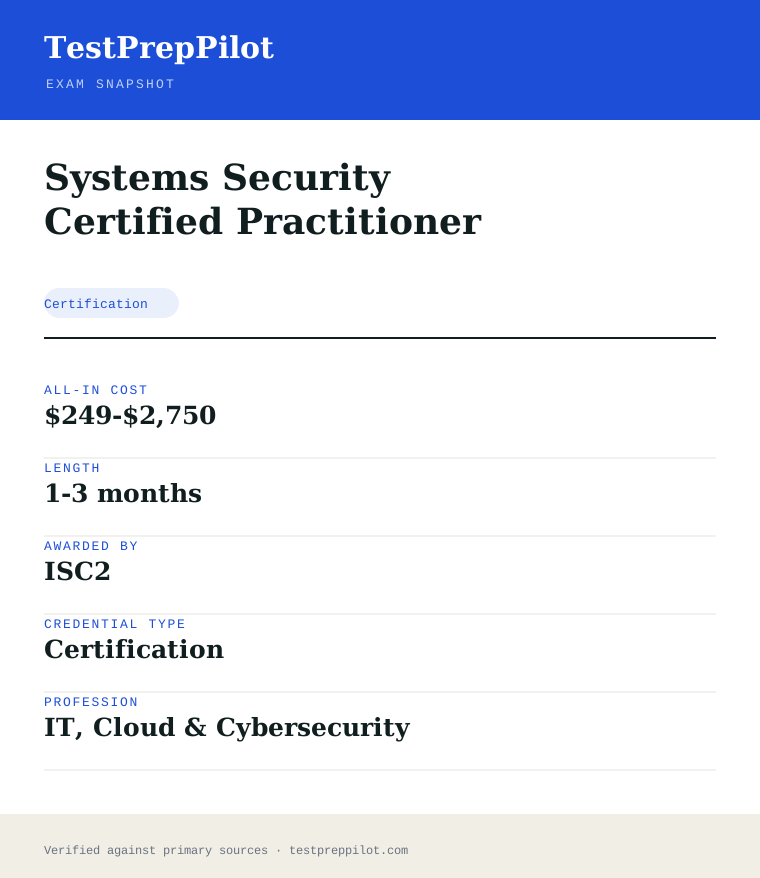
For the Systems Security Certified Practitioner, the exam fee is ~$250-275; the all-in cost is typically $249-$2,750; most candidates spend 1-3 months preparing.
Cost breakdown
| Exam fee | $249 |
|---|---|
| Training (optional) | $499-$2,500 |
| Typical total | $249-$2,750 |
AMF of $135/year applies after certification.
Timeline
- Study 1-3 months
Typical prep: 1-3 months
The path
How do you register for the Systems Security Certified Practitioner?
- 1
Confirm eligibility
Most ISC2 credentials require paid work experience; you may sit the exam first and earn the Associate of ISC2 title if short on experience.
- 2
Register and pay
Pay the exam fee and schedule through Pearson VUE.
- 3
Pass the CAT exam
Complete the adaptive exam at a Pearson VUE centre or via online remote proctoring.
- 4
Submit endorsement
Have your experience endorsed by an ISC2 member within nine months of passing.
The fine print
What are the retake and renewal rules for the Systems Security Certified Practitioner?
- Proctoring & delivery
- Delivered by Pearson VUE at test centres or via online proctoring. CC, CISSP, CCSP and SSCP use Computerized Adaptive Testing (CAT); CGRC, CSSLP and the CISSP concentrations use linear fixed forms.
- Retake policy
- If you fail, you wait 30 days for the second attempt, 60 days for the third, and 90 days for subsequent attempts within a one-year eligibility window.
- Score reporting
- All ISC2 exams are scored on a 700/1000 scale. CAT exams end when statistical confidence is reached; linear exams use the full item count.
- Recertification
- Certifications are valid for three years. Holders must earn Continuing Professional Education (CPE) credits and pay the Annual Maintenance Fee ($135) to keep the credential active.
What it pays
How much does this credential pay?
Expect information-security-analyst pay at a May 2024 median of $124,910 (BLS) — the SSCP is the practitioner-level ISC2 credential, and the security-operations roles it serves sit in the fastest-growing segment of IT
The direct answer is that the SSCP (Systems Security Certified Practitioner) is the practitioner-level credential from ISC2, and the occupation it serves, information security analysts (SOC 15-1212), earned a May 2024 median annual wage of $124,910, with the lowest 10 percent under about $73,000 and the highest 10 percent above about $170,000. The honest framing is that the certification does not set pay — security-analyst salaries are set by market, employer, and experience — but the credential signals hands-on security-operations competence (access controls, security operations, risk identification, and network security) that employers list for security-admin and analyst roles, and it sits in the fastest-growing segment of IT: BLS projects about 30 percent employment growth for information security analysts from 2024 to 2034, much faster than average, with roughly 18,000 annual openings. The exam itself is 125 questions with 3 hours, scored pass/fail on a scale with a passing standard set by ISC2, and candidates must meet the experience requirement (typically one year of relevant experience, or a degree waiver). The practical read: the SSCP is the step between entry-level security certifications and the CISSP — it targets security practitioners with hands-on roles rather than managers — and its value is the ISC2 security-operations signal in a high-demand field. For candidates deciding whether to pursue it, the exam rewards applied security knowledge across the seven domains, and the strongest preparation combines the ISC2 official study materials with practice-exam calibration.
| Measure | Figure | Source / note |
|---|---|---|
| Median annual wage, information security analysts | $124,910 | BLS Occupational Outlook Handbook, May 2024 (SOC 15-1212) |
| Lowest 10 percent | less than $73,000 | BLS OOH, May 2024 |
| Highest 10 percent | more than $170,000 | BLS OOH, May 2024 |
| Projected growth, 2024-34 | +30% | BLS Employment Projections |
| The certification itself | Practitioner credential | 125 questions, 3 hours; 1-year experience requirement |
Job growth.BLS projects about 30% growth for information security analysts from 2024 to 2034, much faster than average.
Your odds
What are the pass rates?
ISC2 publishes no pass rates — the SSCP is 125 questions in 3 hours with a pass standard set by ISC2, and ISC2 reports pass/fail rather than cohort data
The core fact is that ISC2 does not publish pass rates for the SSCP exam, and none is available from an independent source, because ISC2 reports candidate pass/fail rather than cohort pass percentages. What is published is the exam structure: the SSCP is a computer-based test of 125 multiple-choice questions with 3 hours allowed, delivered at Pearson VUE testing centers, with a passing standard set by ISC2 through standard-setting; the exam covers seven domains — security operations and administration, access controls, risk identification, monitoring and analysis, cryptography and the PKI, network and communications security, and systems and application security — weighted across the paper. Candidates must meet the experience requirement: typically one year of cumulative relevant work experience in one or more domains, or a relevant degree that waives a portion. Because ISC2 publishes the exam outline and official study materials, the preparation is studying the outline and calibrating with practice exams; the classic failure mode is under-practising the applied scenario items, which reward hands-on security knowledge rather than memorised theory. The certification is valid for three years and renews with continuing professional education (CPE) credits. The honest advice is to treat the exam outline as the syllabus, complete the ISC2 official study materials or an approved course, and take practice exams before booking.
Read this before quoting the number.ISC2 publishes no pass rates; a pass standard is set by ISC2 and certification renews every 3 years with CPEs.
Source: ISC2 — SSCP certification
Your schedule
How long should I study for it?
100-150 study hours over 8-12 weeks of focused study
Plan for roughly 8 to 12 weeks and 100 to 150 hours of study for the SSCP, structured around the seven domains — security operations, access controls, and risk identification carry the largest shares — with practice-exam calibration. The most effective sequence is: first, confirm the experience requirement and obtain the exam outline; second, study the security-operations and access-controls content, the core domains; third, work the risk, monitoring, and cryptography content; fourth, study the network and systems security domains; and fifth, take full-length practice exams under real timing in the final month. The highest-yield habits are the practice exams (the 125-question, 3-hour format is a stamina test) and drilling the applied scenario items, which dominate the paper. Budget the security-operations domain the most time, since it carries the largest question share. After passing, note the three-year CPE renewal and plan the CISSP step, since the SSCP is the practitioner-level credential that leads toward the manager-level CISSP.
- Weeks 1-340
Baseline + operations
- Confirm eligibility and get the outline
- Study security operations and administration
- Take a baseline practice exam
- Weeks 4-750
Access + risk + crypto
- Study access controls and risk identification
- Work monitoring and cryptography content
- Take a second practice exam
- Weeks 8-1040
Network + systems
- Study network and systems security
- Drill applied scenario items
- Take full-length practice exams
- Final weeks15
Exam readiness
- Light outline review
- Confirm exam logistics
- Book the exam
Adjusting the pace
CISSP.The manager-level ISC2 credential; the SSCP is the practitioner step before it.
Experience requirement.Typically 1 year of relevant experience, or a degree waiver.
How to study
How do I prepare most effectively?
The strategy that reliably passes the SSCP is "anchor on the exam outline, weight security operations and access controls, and run full-length practice exams," and the single biggest error is studying theory without the applied scenario practice the exam rewards. A second proven approach is mastering the security-operations domain, the largest question share, with the scenario format. Third, drill the access-controls content, which is both weighted and scenario-heavy. Fourth, use the full-length practice exams as the calibration tool — the 125-question, 3-hour format is a stamina test, and practice scores are the honest readiness signal. Fifth, confirm the experience requirement early, since eligibility is part of the certification gate. Finally, plan the three-year CPE renewal and the CISSP step, since the practitioner-to-manager path is the credential’s career logic.
Anchor on the exam outline
The exam is built from the seven-domain outline.
Weight security operations
The largest domain share; drill the scenario format.
Master access controls
Weighted and scenario-heavy content.
Run full-length practice exams
The 125-question format is a stamina test.
Confirm eligibility and plan CPEs
The experience gate and 3-year renewal are part of the credential.
What to buy
Which study resources are worth paying for?
SSCP preparation runs $300 to $800 depending on the package, with the ISC2 official study materials and practice exams as the core investment. The comparison below separates the exam fee, official resources, and the major prep options, with prices current to this review. The buying rule is to budget for the official study materials and a practice-exam package, since the exam format rewards the calibrated approach.
| Resource | Price | Format | Best for |
|---|---|---|---|
| SSCP exam registration | ~$250-275 | Computer-based at Pearson VUE | The exam itself |
| ISC2 SSCP exam outline | Free | Official PDF | The authoritative syllabus |
| ISC2 official study guide | ~$50-100 | Book or digital | The core content |
| Prep courses and practice exams | ~$200-600 | Online courses + question banks | Structured review and calibration |
| CPE renewal cycle | Included | Continuing professional education | The 3-year renewal |
Prices approximate and dated to this review; the experience requirement applies and CPEs maintain the certification.
Avoid these
What mistakes do candidates most often make?
The most common mistake is studying theory without the applied scenario practice the exam rewards; the second is under-weighting the security-operations domain, the largest share. A third recurring error is being weak on the access-controls items, which are both weighted and scenario-heavy. Candidates also routinely skip full-length practice exams and fail on stamina, and many ignore the experience requirement until after the exam. Finally, some candidates treat the SSCP as the endpoint, missing the CISSP step the practitioner credential is designed to precede.
✕Theory-only study
✓Drill the applied scenario format with practice exams.
✕Under-weighting security operations
✓The largest domain share; master it first.
✕Weak on access controls
✓Access-control items are weighted and scenario-heavy.
✕Skipping full-length mocks
✓The 125-question format is a stamina test.
✕Missing the CISSP step
✓Plan the manager-level credential as the career path.
What you'll face
What question types will I see?
The SSCP contains 125 multiple-choice questions in 3 hours, covering seven domains — security operations and administration, access controls, risk identification, monitoring and analysis, cryptography, network and communications security, and systems and application security — with a large share of applied scenario items. The samples below are editor-written illustrations of the published exam outline, not live exam items.
Operations, administration, and compliance.
Identification, authentication, and authorisation.
Risk analysis, monitoring, and analysis.
Cryptographic concepts and the PKI.
The technical security domains.
Try these
Q1Which control provides the strongest defence against unauthorised access to a system?
Answer:A
Multifactor authentication combines multiple factors to strengthen access control.
Q2Which cryptographic concept ensures that data has not been altered in transit?
Answer:B
Integrity ensures data has not been modified; hashing provides integrity verification.
Q3Which action is most appropriate when an anomaly is detected in security monitoring?
Answer:A
Anomalies are investigated and escalated through the incident-response process.
Samples are editor-written illustrations of the published exam outline, not live exam items.
The big day
What should I expect on exam day?
The SSCP is taken on computer at a Pearson VUE testing center: 125 multiple-choice questions with 3 hours, pass/fail via ISC2’s pass standard, with results typically available within a few days. The core rules: bring valid photo ID, arrive early, and follow testing-center rules. After passing, complete the experience verification and plan the three-year CPE renewal. The most useful exam-day habits: pace at about 1.4 minutes per question, flag and return to the scenario items, and answer every question (no penalty for guessing). If you do not pass, ISC2 allows retakes after a waiting period. After the certification, plan the CPE cycle and the CISSP step, since the practitioner credential leads toward the manager-level credential.
Bring
- Valid photo ID
- Arrival 30 minutes early
- A 3-hour sitting mindset
Leave at home
- Phone, smartwatch, and study materials (testing-center rules)
- Personal notes in the testing room
How the day runs
Rules in the room
- 125 questions, 3 hours
- Computer-based at Pearson VUE
- Pass standard set by ISC2
- 3-year CPE renewal
Afterwards.Passing the SSCP plus the experience verification earns the Systems Security Certified Practitioner credential, ISC2’s practitioner-level certification, renewable every 3 years with CPEs.
Reference
What are the key facts about the Systems Security Certified Practitioner?
Systems Security Certified Practitioner is a certification credential; awarded by ISC2; the exam fee is ~$250-275; typical preparation is 1-3 months; holders typically earn $68,000-$120,000.
| Credential | Systems Security Certified Practitioner |
|---|---|
| Abbreviation | SSCP |
| Type | Certification |
| Profession | IT, Cloud & Cybersecurity |
| Specialty | Cybersecurity (Vendor-Neutral) |
| Awarded by | ISC2 |
| Difficulty | Moderate |
| Typical prep time | 1-3 months |
| All-in cost | $249-$2,750 |
| Typical salary range | $68,000-$120,000 |
| Delivery | Pearson VUE CAT exam |
| Retake | 30/60/90-day waiting periods |
| Validity | 3 years; CPE + $135 AMF |
| Scope | National / Multi-state |
| Also known as | SSCP |
Real questions
Frequently asked questions about the Systems Security Certified Practitioner
What changed with SSCP in 2026?
From October 2025 SSCP moved to Computerized Adaptive Testing: 100–125 questions over two hours, replacing the old fixed 125-question linear exam.
What experience do I need?
One year of paid experience in a domain. If you lack it, you can pass and hold Associate of ISC2 status, then submit experience within two years.
How is it scored?
On the ISC2 700/1000 scale. Because it is adaptive, you cannot go back and change answers.
How does SSCP relate to CISSP?
SSCP is the practitioner-level credential for hands-on roles; CISSP is the broader management/technical credential requiring five years of experience.
What score do I need to pass an ISC2 exam?
A scaled score of 700 out of 1000 on every ISC2 certification exam.
Can I take the exam before I have the required experience?
Yes. You receive the Associate of ISC2 title and have a set period (commonly two years) to submit verified experience.
In short
Is the Systems Security Certified Practitioner worth it?
- SSCP is ISC2’s hands-on practitioner certification
- 100-125 CAT questions, 2 hours, 700/1000, $249
- Seven domains; 1yr experience or Associate path
- 3-year validity; CPE + $135 AMF
Same awarding body
What other credentials does ISC2 award?
Worth comparing
How does the Systems Security Certified Practitioner compare with similar credentials?
Trust
Where does this information come from?
Everything above is taken from the awarding body's own published material. Fees, question counts and domain weights are revised regularly — check the official page before you pay.
- ISC2 Awarding body
- Official Systems Security Certified Practitioner exam page Exam page
- ISC2 certification programme Programme rules
Research confidence: high · Last reviewed 2026-08