IT, Cloud & Cybersecurity • Training
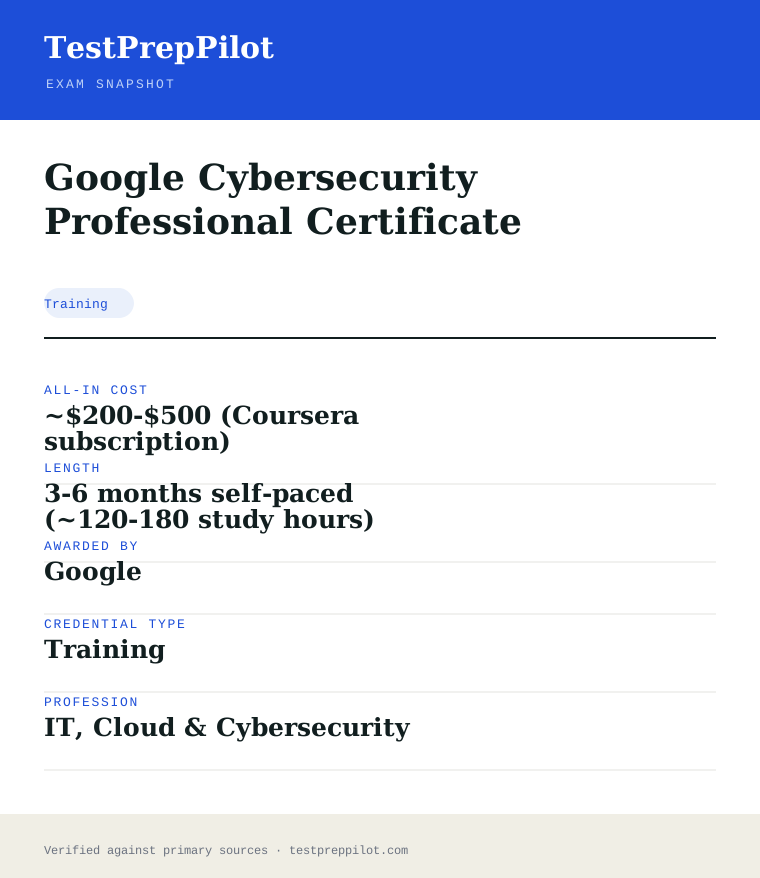
Google Cybersecurity Professional Certificate
Google Cybersecurity Professional Certificate — Technology credential from Google
Researched and maintained by TestPrepPilot Editorial BoardCloud, IT & cybersecurity certifications desk · Figures last verified August 2026
The short version
What is the Google Cybersecurity Professional Certificate and is it worth it?
Google Cybersecurity Professional Certificate is a professional credential administered by Google. It validates job-ready knowledge and skills in the Technology field and is used for career entry, advancement, or compliance.
- Recognized credential from Google
- Demonstrates verified competence in Technology
- Supports career advancement and may satisfy licensing or employer requirements
What is it?
What exactly is the Google Cybersecurity Professional Certificate?
Google Cybersecurity Professional Certificate — Technology credential from Google
Entry-level online programme covering security frameworks, network security, Linux, SQL, Python and incident detection for aspiring SOC analysts. Offered by Google, it is designed for candidates who need to demonstrate verified competence in the Technology field. The credential is commonly used for career entry, advancement, regulatory compliance, or employer requirements. Candidates should review the official handbook for eligibility, exam format, and scoring before registering.
The path in brief
- Confirm you meet any eligibility or prerequisites
- Review the official handbook and study materials
- Register and pay through the awarding body or authorized provider
- Schedule and take the exam (test center or online proctoring)
- Receive your score and, if passed, your credential
Before you book
Who is eligible to sit the Google Cybersecurity Professional Certificate?
Eligibility varies; many credentials are open to all, while others require coursework, work experience, or sponsorship.
Who it is for: Professionals and candidates seeking to validate Technology competence.
The test itself
What is the format of the Google Cybersecurity Professional Certificate?
The Google Cybersecurity Professional Certificate is administered by Google and runs 3-6 months self-paced.
| Administered by | |
|---|---|
| Questions | No single exam — graded courses and a capstone |
| Time limit | 3-6 months self-paced |
| Pass mark | Passing score set by the awarding body; see the official score report |
| Exam fee | Varies by location and currency — confirm on the official registration page |
| Format | Proctored, computer-based (test center or online remote proctoring) |
Content outline
What topics are on the Google Cybersecurity Professional Certificate?
The Google Cybersecurity Professional Certificate covers 4 content domains.
Weightings come from the official exam outline. Study time is best allocated in roughly these proportions rather than evenly across domains.
- Foundational concepts
Topic area tested on the exam; see the official blueprint for the detailed breakdown.
- Configuration & deployment
Topic area tested on the exam; see the official blueprint for the detailed breakdown.
- Security & compliance
Topic area tested on the exam; see the official blueprint for the detailed breakdown.
- Operations & troubleshooting
Topic area tested on the exam; see the official blueprint for the detailed breakdown.
The path
How do you register for the Google Cybersecurity Professional Certificate?
- 1
Enroll on Coursera5 minutes
Sign up for the Google Career Certificate on Coursera and start the self-paced modules.
- 2
Complete the courseworkstudy phase
Work through video lessons, graded quizzes and hands-on labs at your own pace.
- 3
Build the portfoliocapstone
Complete the capstone case study (Data Analytics) or the regression/ML projects (Advanced).
- 4
Earn the certificatecompletion
Finish all modules to receive the shareable Google Career Certificate.
The fine print
What are the retake and renewal rules for the Google Cybersecurity Professional Certificate?
- Proctoring & delivery
- There is no centralized proctored exam. Courses are graded through Coursera quizzes, peer-reviewed assignments and portfolio projects completed in your own environment.
- Retake policy
- Coursera lets you re-attempt graded items and revisit modules at no extra cost beyond the subscription while enrolled.
- Score reporting
- Progress is tracked through Coursera’s course-completion model rather than a single numeric exam score; a certificate is awarded on finishing all required modules.
- Recertification
- Google Career Certificates do not expire and do not require recertification; learners simply keep access to the credential on their profile.
- Refunds & rescheduling
- Coursera offers a 7-day free trial; after that you pay a monthly subscription (around $39–49 USD) until you finish. Financial aid is available for eligible learners.
Context
Google data-analytics certificates (2026)
| Certificate | Focus | Delivery | |
|---|---|---|---|
| Data Analytics | Sheets, SQL, R, Tableau | Coursera subscription | |
| Advanced Data Analytics | Python, stats, ML | Coursera subscription |
What it pays
How much does this credential pay?
$124,910 median for information security analysts (BLS, May 2024)
There is no Bureau of Labor Statistics occupation called "Google Cybersecurity Certificate" — the program is a career certificate that prepares learners for entry-level cybersecurity roles, and the wage question belongs to the occupation you enter with it. The closest official BLS occupation is Information Security Analysts, SOC 15-1212, which had a May 2024 median wage of $124,910, with the lowest 10 percent under $71,280 and the highest 10 percent above $173,780. The fit must be read with an honest caveat: the BLS median describes experienced information-security analysts, and a career-certificate holder is entering the bottom of that market — security support, SOC and junior analyst roles that pay well below the median until experience accumulates. BLS counted 182,300 information security analyst jobs in 2024 and projects a striking 30 percent growth from 2024 to 2034, with about 17,500 openings a year, and that growth is precisely the demand the career certificate targets. The limitation to state plainly: the certificate carries no wage premium in government data, and employers hire on the combination of the credential, hands-on skills and demonstrated projects; read the BLS figure as the destination market, not the entry wage.
| Measure | Figure | Source / note |
|---|---|---|
| Median annual wage, information security analysts (destination market) | $124,910 | BLS OOH, SOC 15-1212, May 2024 |
| Lowest 10 percent | Under $71,280 | BLS OOH, SOC 15-1212, May 2024 |
| Highest 10 percent | Above $173,780 | BLS OOH, SOC 15-1212, May 2024 |
| Projected openings per year | ~17,500 | BLS OOH, SOC 15-1212, 2024-2034 |
Job growth.BLS projects 30 percent growth for information security analysts from 2024 to 2034, about 17,500 openings per year.
Source: BLS Occupational Outlook Handbook - Information Security Analysts
Your odds
What are the pass rates?
Google publishes no pass rate — each course ends with a graded assessment, and the certificate requires completing all courses
Google does not publish cohort pass rates for the Cybersecurity Professional Certificate, and third-party estimates are not official data, so we do not treat them as authoritative. What Google does publish is the structure: the certificate is a sequence of courses — typically eight, covering security foundations, network security, the Linux operating system and SQL, assets-threats-and-vulnerabilities, detection and response, and automation with Python — each ending with a graded assessment, and the certificate is awarded when all courses are completed. The assessments are project-based and hands-on: learners complete labs and practical tasks (such as using a SIEM, analysing logs and scripting responses) rather than a single proctored exam, and the final course includes a capstone portfolio project. The absence of a published pass rate is not an absence of standards: the graded assessments require genuine skill demonstration, and the certificate is only as credible as the work behind it. The practical reading: because the path is course-based, preparation is about consistent progress and hands-on practice rather than a single test, and the real filter is your ability to demonstrate the skills in interviews after you finish.
Read this before quoting the number.Google publishes the course structure but no pass rate; the certificate requires completing all graded courses and the capstone.
Your schedule
How long should I study for it?
120-180 hours over 3-6 months (self-paced) of focused study
The Google Cybersecurity Professional Certificate is a sequence of roughly eight courses on Coursera, each ending in graded assessments, with no single proctored exam — so the plan is a schedule, not a cram plan. A defensible plan runs 120 to 180 hours over 3 to 6 months of part-time study (the program is self-paced; Google suggests about 6 months at under 10 hours a week). Months one to two: the foundations — the cybersecurity fundamentals course, then network security (TCP/IP, network attacks and defences) and the Linux and SQL course, which build the technical base. Months two to three: the core analyst skills — assets, threats and vulnerabilities, and the detection-and-response courses, which include the SIEM labs that define the SOC analyst job. Months three to four: the automation-with-Python course and the capstone, which tie the skills together in a portfolio project. The plan is hands-on because the graded assessments reward doing the labs and projects, and the portfolio is what you show employers; treat every lab as a portfolio artifact, not a checkbox.
- Months 1-260
Foundations and technical base
- Cybersecurity fundamentals course
- Network security: TCP/IP, attacks and defences
- Linux and SQL for analysts
- Months 2-355
Core analyst skills
- Assets, threats and vulnerabilities
- Detection and response with SIEM labs
- Incident-handling practice
- Months 3-445
Automation and capstone
- Python for security automation
- The capstone portfolio project
- Resume and interview preparation
Adjusting the pace
IT professional cross-training.The Linux and networking courses accelerate; spend the extra time on the SIEM and Python content.
Complete beginner.Stretch to 6 months; the fundamentals course matters most before the technical courses.
How to study
How do I prepare most effectively?
The Google Cybersecurity Certificate rewards hands-on skill demonstration, so the dominant strategy is doing every lab and project fully and treating them as portfolio artifacts: the graded assessments test real tasks — SIEM analysis, log review, Linux commands, Python scripting — and the work you produce is what you will show employers. Second, keep the schedule steady: the program is self-paced and course-based, and the most common failure mode is stalling between courses, so set a weekly hour target and protect it. Third, build the portfolio deliberately: the capstone and the best lab projects should be collected into a documented portfolio with write-ups, because entry-level cybersecurity hiring weighs demonstrable skills heavily. Fourth, pair the certificate with the recognised entry certifications (such as the CompTIA Security+ or the ISC2 CC) if your target employers require them, because the certificate and the certifications reinforce each other. Finally, use the career resources Google provides — the interview prep and the employer network — because the certificate's value is realised in the job search, not at completion.
Treat labs as portfolio artifacts
The graded work is what you show employers; do it fully and document it.
Protect the weekly schedule
Self-paced programs fail by stalling; set a weekly hour target.
Build a documented portfolio
The capstone and best labs need write-ups for the job search.
Stack recognised certifications
Pair the certificate with Security+ or ISC2 CC for employer requirements.
Use the career resources
Interview prep and the employer network realise the certificate's value.
What to buy
Which study resources are worth paying for?
The Google Cybersecurity Certificate costs are subscription-based: it is delivered on Coursera, and learners pay roughly $49-$99 per month until completion, with the total typically $200-$500 over three to six months; financial aid is available through Coursera for eligible learners. The program includes all its labs and projects, so there are no separate study-material costs. Optional additions are the recognised entry certifications (Security+ at about $392, ISC2 CC at about $199) and their prep materials ($50-$200), which many candidates add for employer requirements. A realistic total budget is $200 to $800 including the certificate subscription and an optional certification. Prices below are list prices as of mid-2026 and change frequently; we rank nothing by commission.
| Resource | Price | Format | Best for |
|---|---|---|---|
| Google Cybersecurity Certificate | ~$49-$99/month (typically $200-$500 total) | Coursera courses + labs + capstone | The program itself |
| Coursera financial aid | Free application | Sponsored access | Eligible learners who need it |
| CompTIA Security+ (optional stack) | ~$392 exam + $50-$200 prep | Exam + prep materials | Employers that require a recognised cert |
| ISC2 CC (optional stack) | ~$199 exam | Exam + free training | A low-cost recognised entry cert |
List prices as of mid-2026, subject to change; Coursera pricing varies by plan; no commission or affiliate ranking is implied.
Avoid these
What mistakes do candidates most often make?
The most common mistake with the Google Cybersecurity Certificate is treating it as a passive video course: learners who watch the lessons without doing the labs and projects finish with a certificate but no demonstrable skill, and the job search exposes the gap. The fix is hands-on work in every course. The second mistake is stalling mid-program — the self-paced structure has no external deadline, and the most common failure is simply stopping; protect the weekly schedule. Third, some learners assume the certificate alone qualifies them for analyst roles; pairing it with a recognised certification and a documented portfolio is what clears employer filters. Fourth, candidates neglect the career resources — the interview prep and employer network — which are part of the program's value. Finally, treating completion as the finish line instead of the start of the job search misses the point; the certificate is a market-access credential, and the search is where it pays off.
✕Watching without doing
✓Complete every lab and project; the skills are the credential.
✕Stalling mid-program
✓Self-paced means self-managed; protect the weekly schedule.
✕Assuming the certificate alone suffices
✓Pair it with a recognised cert and a documented portfolio.
✕Ignoring the career resources
✓Interview prep and the employer network are part of the program.
✕Stopping at completion
✓The job search is where the certificate pays off.
What you'll face
What question types will I see?
The Google Cybersecurity Certificate has no single proctored exam; each course ends with graded assessments that are largely hands-on and project-based — completing tasks such as analysing SIEM alerts, reviewing logs, applying Linux commands and writing Python scripts — plus quizzes and peer-reviewed projects, with a capstone portfolio in the final course. Samples below are editor-written illustrations of the kind of assessment tasks the courses use, not live test items; they show the practical, task-based style of the program.
SIEM analysis, log review, Linux and Python tasks.
Security concepts, network and vulnerability material.
The portfolio project tying the skills together.
Try these
Q1A security analyst reviews a SIEM alert showing repeated failed logins to a workstation from a foreign IP. The most appropriate first step is to:
Answer:A
Alert triage starts with assessing whether the alert is a true positive, then investigating the source and following the incident-response process. Ignoring it, overreacting by disconnecting the network or deleting logs each fail the analyst's core duty.
Q2Which Linux command displays the contents of a file?
Answer:A
cat displays file contents. cd changes directories, pwd prints the working directory and mkdir creates directories — the exam-style Linux tasks test these command distinctions.
Q3A vulnerability scanner reports an open port on a server that should be closed. The most appropriate next step is to:
Answer:A
Vulnerability findings should be verified, risk-assessed and remediated or documented — the standard handling process. Acting without verification, ignoring the report or restarting the server each skip the structured response.
Samples are editor-written illustrations of the program's assessment style, not live test items — the certificate has no single proctored exam.
The big day
What should I expect on exam day?
There is no single "exam day" for the Google Cybersecurity Certificate — the credential is earned by completing the course sequence and its graded assessments on Coursera. The practical checklist is a completion plan: keep the subscription active until you finish, complete every graded assessment and lab, and finish the capstone. The afterwards is where the program pays off: build the portfolio with your best labs and the capstone, update your resume and LinkedIn with the credential, use Google's career resources (interview prep and the employer network), and pair the certificate with a recognised certification if your target roles require one. Treat the certificate as market access, and put the demonstrated skills at the centre of your job search.
Bring
- A consistent study schedule and a working computer
- A Coursera account with an active subscription
- A portfolio folder for your labs and capstone
Leave at home
- The assumption that the certificate alone lands the job — the skills and search matter
How the day runs
Rules in the room
- The certificate requires completing all courses and the capstone
- The program is self-paced; keep the subscription until completion
- The value is realised in the job search, not at completion
Afterwards.On completion, build the portfolio, update your profiles and use the career resources. Pair the certificate with recognised entry certifications if your target employers require them.
Reference
What are the key facts about the Google Cybersecurity Professional Certificate?
Google Cybersecurity Professional Certificate is a training credential; awarded by Google; the exam fee is Varies by location and currency — confirm on the official registration page; typical preparation is 3-6 months self-paced (~120-180 study hours); holders typically earn $71,000-$174,000 (destination market).
| Credential | Google Cybersecurity Professional Certificate |
|---|---|
| Abbreviation | Google Cybersecurity |
| Type | Training |
| Profession | IT, Cloud & Cybersecurity |
| Specialty | Google Cloud & Google |
| Awarded by | |
| Difficulty | Intermediate |
| Typical prep time | 3-6 months self-paced (~120-180 study hours) |
| All-in cost | ~$200-$500 (Coursera subscription) |
| Typical salary range | $71,000-$174,000 (destination market) |
| Credential | Google Cybersecurity Professional Certificate |
| Awarding body | |
| Exam format | Proctored, computer-based |
| Validity | The certificate does not expire. |
| Languages | Varies — see awarding body |
| Scope | National / Multi-state |
| Also known as | Google Cybersecurity Certificate |
Real questions
Frequently asked questions about the Google Cybersecurity Professional Certificate
How do I register for the Google Cybersecurity Professional Certificate exam?
Register through Google's official portal or an authorized test provider (e.g., Pearson VUE or Prometric where applicable). Create an account, select the exam, pay the fee, and schedule a date.
How much does the exam cost?
Fees vary by location and currency. Confirm the current fee on the official registration page before scheduling.
How long is the credential valid, and how do I renew?
The Google Cybersecurity Certificate does not expire; its value is the demonstrated skills and portfolio you present to employers.
What if I do not pass?
Most bodies allow retakes after a waiting period and payment of the full or partial fee. Check Google's retake policy before rescheduling.
Do Google Career Certificates require a proctored exam?
No. They are completed on Coursera through graded quizzes, labs and a portfolio case study rather than a single proctored test. You pay a monthly subscription until you finish.
How long do they take?
Google estimates about six months of part-time study (~10 hours/week) for the Data Analytics certificate; the Advanced certificate builds on it.
Do they expire?
Google Career Certificates do not expire and require no recertification.
In short
Is the Google Cybersecurity Professional Certificate worth it?
- Google Cybersecurity Professional Certificate is awarded by Google.
- Validates job-ready competence in Technology.
- Registration is through the awarding body or an authorized test provider.
- Renewal and retake policies vary — confirm before scheduling.
Same awarding body
What other credentials does Google award?
Worth comparing
How does the Google Cybersecurity Professional Certificate compare with similar credentials?
Trust
Where does this information come from?
Everything above is taken from the awarding body's own published material. Fees, question counts and domain weights are revised regularly — check the official page before you pay.
- Google Awarding body
Research confidence: low · Last reviewed 2026-08