IT, Cloud & Cybersecurity • Certification
Salesforce Certified Business Analyst
Salesforce Certified Business Analyst — Technology credential from Salesforce
Researched and maintained by TestPrepPilot Editorial BoardCloud, IT & cybersecurity certifications desk · Figures last verified August 2026
The short version
What is the Salesforce Certified Business Analyst and is it worth it?
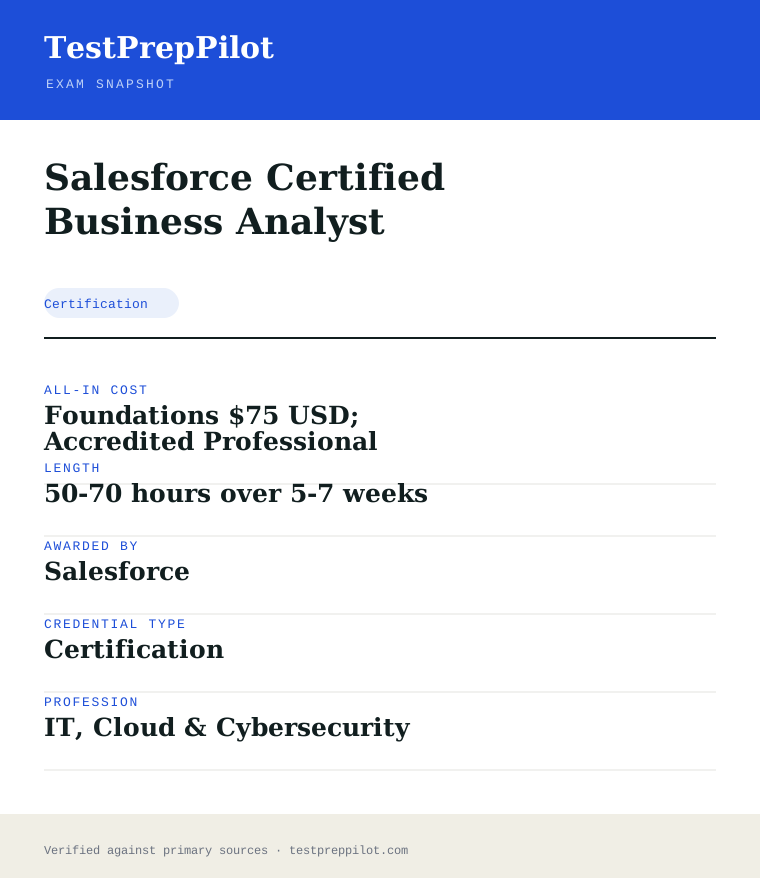
Salesforce Certified Business Analyst is a Salesforce credential in the Technology field. It validates job-ready competence and is used for career entry, advancement, or compliance. Exam fee: Foundations $75 USD; Accredited Professional $100–150; Core (Administrator/Developer/Consultant) $200; Tableau $250; Architect $400; Certified Technical Architect (CTA) $6,000.
- Recognized Salesforce credential
- Demonstrates verified Technology competence
- Supports career advancement and may satisfy employer or regulatory requirements
What is it?
What exactly is the Salesforce Certified Business Analyst?
Salesforce Certified Business Analyst — Technology credential from Salesforce
Validates discovery, requirement elicitation and solution design skills for Salesforce implementations working with business stakeholders. Offered by Salesforce, it validates job-ready Technology competence. Exam fee: Foundations $75 USD; Accredited Professional $100–150; Core (Administrator/Developer/Consultant) $200; Tableau $250; Architect $400; Certified Technical Architect (CTA) $6,000. Review the official program page for eligibility, format, and scoring before registering.
The path in brief
- Confirm eligibility and any prerequisites
- Review the official exam guide and study materials
- Purchase and schedule the exam via Webassessor (Pearson VUE)
- Take the exam (test center, online proctoring, or assessment)
- Receive results and your credential if passed
Before you book
Who is eligible to sit the Salesforce Certified Business Analyst?
Eligibility varies; many exams are open to all, while others require coursework, experience, or sponsorship.
Who it is for: Professionals and candidates seeking to validate Technology competence with a Salesforce credential.
The test itself
What is the format of the Salesforce Certified Business Analyst?
The Salesforce Certified Business Analyst is administered by Webassessor (Pearson VUE) and runs 110 minutes and contains 60 questions.
| Administered by | Webassessor (Pearson VUE) |
|---|---|
| Questions | 60 questions |
| Time limit | 110 minutes |
| Pass mark | Passing score set by the awarding body; see the official score report |
| Exam fee | Foundations $75 USD; Accredited Professional $100–150; Core (Administrator/Developer/Consultant) $200; Tableau $250; Architect $400; Certified Technical Architect (CTA) $6,000. Retake ~50% of exam fee. Plus local tax. |
| Format | Proctored, computer-based — online or at a test center via Webassessor. |
Content outline
What topics are on the Salesforce Certified Business Analyst?
The Salesforce Certified Business Analyst covers 4 content domains.
Weightings come from the official exam outline. Study time is best allocated in roughly these proportions rather than evenly across domains.
- Platform administration
Topic area for this credential; see the official blueprint for the detailed breakdown.
- Configuration & automation
Topic area for this credential; see the official blueprint for the detailed breakdown.
- Data & security model
Topic area for this credential; see the official blueprint for the detailed breakdown.
- Implementation best practices
Topic area for this credential; see the official blueprint for the detailed breakdown.
The path
How do you register for the Salesforce Certified Business Analyst?
- 1
Create an account on the awarding body’s certification portal
- 2
Select the exam/credential and review its requirements
- 3
Purchase the exam (voucher or password) and pay the fee
- 4
Schedule the exam (test center, online proctoring, or assessment)
- 5
Complete the exam within the allotted time
- 6
Receive your results and, if passed, your digital credential
The fine print
What are the retake and renewal rules for the Salesforce Certified Business Analyst?
- Proctoring & delivery
- Proctored, computer-based — online or at a test center via Webassessor.
- Retake policy
- Retake fee is roughly 50% of the exam fee (e.g., $100 for a $200 exam). First retake after 1 day; later retakes 14-day wait; max 6 attempts/year.
- Score reporting
- Scores / results are released per the body’s process (usually electronically after the exam).
- Recertification
- Annual maintenance via assigned Trailhead modules (free but mandatory); expired credentials require a full retake.
What it pays
How much does this credential pay?
$132,270 median for software developers — the adjacent platform-role series (BLS, May 2024), used with an explicit caveat
There is no Bureau of Labor Statistics occupation called "Salesforce Business Analyst" — the credential validates business-analysis skill applied to the Salesforce platform, and the wage question belongs to the role you perform with it. Salesforce business analysts translate business needs into platform requirements, gather and document requirements, and collaborate with stakeholders, and no single BLS occupation fits them perfectly; we use Software Developers, SOC 15-1252, as the adjacent platform-series benchmark, with a May 2024 median of $132,270, and Computer Systems Analysts (SOC 15-1211) as the business-systems alternative with a median of $112,290. The honest caveat: business-analyst roles span a wide band — from analyst positions below the developer median to senior consulting roles at or above it — and the credential’s value is as a hiring signal in the Salesforce ecosystem, where employers specifically seek certified analysts for implementation projects. BLS counted 1,684,900 software developer jobs in 2024 and projects 17 percent growth from 2024 to 2034, with about 150,000 openings a year, and the platform-ecosystem demand the Salesforce certification serves tracks that broader software market. There is no formal prerequisite for the exam, though Salesforce recommends hands-on business-analysis and platform experience, and the credential is valid for one year, maintained by completing the annual maintenance badge on Trailhead. Read the cited figure as context for the platform-role market, not as a precise business-analyst wage. Two further points sharpen the story for a Business Analyst candidate. First, the credential has no formal prerequisite, so its position in the career path is more flexible than the advanced administrator’s — Salesforce recommends hands-on business-analysis and platform experience, but candidates can sit it without a prior Salesforce certification, which makes it an accessible entry point for experienced analysts moving into the ecosystem. Second, the exam is weighted toward the analysis craft rather than the platform mechanics: the largest domains are Collaboration with Stakeholders, Requirements and User Stories, so the credential signals the analyst’s core skills — elicitation, documentation, consensus-building — with Salesforce capability knowledge as the supporting layer, and that mix is what employers in implementation projects recognise. The credential is valid for one year, maintained by the annual Trailhead maintenance badge, so its value depends on keeping the maintenance current. BLS does not classify workers by certification, so the wage figures above are occupational context rather than a certificate-specific number, and the practical value of the exam is the verifiable signal of analysis skill inside the Salesforce ecosystem.
| Measure | Figure | Source / note |
|---|---|---|
| Median annual wage, software developers (adjacent platform series) | $132,270 | BLS OOH, SOC 15-1252, May 2024 |
| Lowest 10 percent | Under $84,060 | BLS OOH, SOC 15-1252, May 2024 |
| Highest 10 percent | Above $208,500 | BLS OOH, SOC 15-1252, May 2024 |
| Median, computer systems analysts (business-systems alternative) | $112,290 | BLS OOH, SOC 15-1211, May 2024 |
Job growth.BLS projects 17 percent growth for software developers from 2024 to 2034, about 150,000 openings per year — cited as context for the platform-role market.
Source: BLS Occupational Outlook Handbook - Software Developers
Your odds
What are the pass rates?
Salesforce publishes no pass rate — the Business Analyst exam is 60 questions in 105 minutes, reported as pass/fail with prep providers estimating a 65-72% threshold
Salesforce does not publish cohort pass rates for its certification exams, and we state that plainly: no official percentage exists for the Business Analyst exam, and any figure you see online is a prep-vendor estimate or a community survey, so we do not treat it as authoritative. What Salesforce does publish is the format and the reporting model. The Business Analyst exam has 60 scored multiple-choice questions, plus up to 5 unscored pretest items, with a 105-minute time limit; the result is reported as pass/fail with a section breakdown. The passing threshold is not officially published by Salesforce, and prep providers differ on the estimate — some report roughly 65 percent while recent vendor guides report a higher threshold around 72 percent — so the honest reading is that the exact cut is not public and practice should target well above any estimate. There is no formal prerequisite, though Salesforce recommends hands-on business-analysis experience, and the content follows the official exam guide: Collaboration with Stakeholders, Customer Discovery, Business Analysis Planning, Needs Assessment, Business Process Mapping, Requirements, User Stories, and Development Support and User Acceptance, with the exam weighted toward stakeholder collaboration, requirements and user stories. The certification is valid for one year, maintained by completing the annual maintenance badge on Trailhead before the due date. The practical reading: the absence of a published pass rate is not an absence of standards, the scenario-based format rewards the analyst’s actual reasoning, and the section breakdown tells candidates exactly where they fell short.
Read this before quoting the number.Salesforce publishes the format, the 105-minute limit and pass/fail reporting with a section breakdown, but no cohort pass rate and no official passing percentage; prep providers estimate the threshold at roughly 65-72%.
Source: Salesforce - Business Analyst certification page and exam guide
Your schedule
How long should I study for it?
60-100 hours over 6-8 weeks of focused study
The Business Analyst exam is 60 scenario-based questions in 105 minutes, built on the official exam guide — with the largest weight on Collaboration with Stakeholders, Requirements and User Stories, and meaningful blocks on Customer Discovery, Business Analysis Planning, Business Process Mapping, and Development Support and User Acceptance — so a defensible plan runs 60 to 100 hours over six to eight weeks, using Trailhead plus the official exam guide as the scope map. Weeks 1-2 cover the analysis core: Customer Discovery and Needs Assessment — uncovering stakeholder needs, discovery sessions, as-is versus to-be state, root-cause analysis and business case fundamentals. Weeks 3-4 cover Collaboration with Stakeholders and Business Analysis Planning: facilitation techniques, elicitation methods such as interviews, workshops, surveys and observation, conflict resolution, and the planning of the analysis approach. Weeks 5-6 cover Requirements and User Stories — the largest combined weight — including the user-story format, acceptance criteria, prioritisation techniques such as MoSCoW, and process mapping, plus Development Support and User Acceptance. Weeks 6-7 add the Salesforce-specific layer: how the platform’s data model, automation, security and reporting map to the analysis and solution-evaluation sections, because the exam expects the analyst to know what Salesforce can do. Weeks 7-8 are rehearsal: work through scenario-based practice questions — the exam is scenario-heavy, so identifying the right technique for each situation is the core skill — then run two full timed practice exams at the real format. The most common planning error is studying platform features while neglecting the analysis techniques, or vice versa; the exam tests both.
- Weeks 1-224
Discovery and needs assessment
- Customer Discovery: empathy mapping and discovery sessions
- As-is vs to-be analysis and root cause
- Business case fundamentals
- Weeks 3-422
Collaboration and planning
- Facilitation and elicitation techniques
- Managing competing priorities and consensus
- Defining the analysis approach and success metrics
- Weeks 5-626
Requirements, user stories and process mapping
- Scope, requirements and user stories
- Acceptance criteria and MoSCoW prioritisation
- Business process mapping and UAT support
- Weeks 6-716
Salesforce platform layer
- Data model, automation and security mapped to analysis
- Reporting and solution evaluation in a Salesforce context
- Capability-to-requirement matching
- Weeks 7-820
Scenario rehearsal
- 50-60 scenario questions across all sections
- Two full timed practice exams at 105 minutes
- Review weak sections from the breakdown
Adjusting the pace
Working business analyst.Daily analysis work covers the technique content; focus on the Salesforce platform layer and the exam format.
Salesforce administrator adding analysis skills.The platform layer is familiar; focus on the analysis techniques — elicitation, process mapping and user stories.
Career switcher into the Salesforce ecosystem.Take the recommended two years of business-analysis experience seriously before the exam; the scenario items assume practised judgement.
How to study
How do I prepare most effectively?
The Business Analyst exam is scenario-heavy, so the dominant strategy is practising the analyst’s reasoning: given a described situation, which technique, document or sequence fits. First, use the official exam guide as the scope map and complete the Salesforce certification prep trail on Trailhead, which is free and maps to the exam. Second, master the technique-selection style, because the exam rewards choosing the right elicitation technique (interviews for deep-dive insights, workshops for consensus, surveys for large audiences, observation for current workflows), the right sequence (as-is before to-be), and the right user-story components — "As a [role], I want [feature] so that [benefit]" with measurable acceptance criteria. Third, cover all eight domains rather than the largest three: Collaboration with Stakeholders, Requirements and User Stories carry the biggest weight, but Business Process Mapping, Customer Discovery, Needs Assessment, Business Analysis Planning and Development Support and User Acceptance each contribute, and candidates who skip a domain lose a real block. Fourth, learn the Salesforce capability layer: the exam expects the analyst to know what the platform’s data model, automation, security and reporting can do so requirements can be matched to capabilities. Fifth, run two full timed practice exams at the real 60-question, 105-minute format, aiming for consistent 75 percent or better on practice sets, since the passing threshold is not officially published and estimates range from 65 to 72 percent. Finally, rehearse the scenario style with a question bank, because identifying the right BA action in each situation is the core skill the exam measures.
Use the official exam guide and Trailhead
The free certification prep trail and exam guide are the authoritative scope.
Master the technique-selection style
Which elicitation technique, sequence or document fits each described situation.
Cover all eight domains
The three largest carry the most weight, but every domain contributes.
Learn the Salesforce capability layer
The exam expects matching requirements to what the platform can do.
Run two timed practice exams
105 minutes at the real format; target 75%+ on practice sets.
Rehearse scenario reasoning
A question bank builds the identify-the-right-action skill the exam measures.
What to buy
Which study resources are worth paying for?
Salesforce Business Analyst prep is inexpensive because Trailhead provides the core resources free. The Trailhead business analyst learning path and certification prep trail, the official exam guide, the free practice org and the practice exam cover the scope at no cost. Third-party providers sell business analyst courses and scenario-question banks at roughly $30-300; the question bank is the standard paid purchase because the scenario-heavy style is best rehearsed, and candidates should look for banks that emphasise technique selection rather than pure platform trivia. The exam fee is $200 per attempt, with a reduced $100 retake within the eligibility window. A realistic total budget is $250 to $600 including the exam fee and optional prep materials. Prices below are list prices as of mid-2026 and change frequently; we rank nothing by commission. The buying logic is dominated by the free official core: the Trailhead business analyst learning path, the certification prep trail, the official exam guide and the free practice org cover the scope at no cost, and the practice exam Salesforce offers is the closest thing to the real item style. The scenario-question bank is the one paid item that reliably earns its cost, because the exam’s core skill is technique selection — which elicitation method, which document, which sequence fits a described situation — and that reasoning is best rehearsed against a large question set. A course adds structure for candidates who need external pacing or who are new to business analysis. The unavoidable cost is the exam fee of $200 per attempt, with a reduced $100 retake within the eligibility window, and because there is no prerequisite, a candidate can budget just the one exam plus optional materials — roughly $250 to $600 all in. Candidates who already hold the Administrator or another Salesforce credential will find the platform layer familiar and can weight their spending toward the analysis-side practice material. The maintenance badge is free but has a due date, and the budget should account for the time it requires, because missing it expires a credential that cost real money to earn.
| Resource | Price | Format | Best for |
|---|---|---|---|
| Trailhead business analyst path and official exam guide | Free | Official online modules | The authoritative scope; the primary resource |
| Salesforce practice exam | Free or included | Official online practice | The closest official item style |
| Free practice org (Developer Edition) | $0 | Real platform environment | Seeing what the platform can do for requirement matching |
| Third-party courses and scenario banks | $30-300 | Video courses and practice items | Technique-selection rehearsal at volume |
| Business Analyst exam | $200 (retake $100) | Proctored online or test centre | The certification itself |
List prices as of mid-2026, subject to change; the exam fee is $200 with a reduced retake. No commission-based ranking.
Avoid these
What mistakes do candidates most often make?
The most common Business Analyst exam mistakes come from studying the wrong half of the syllabus. The first is studying platform features while neglecting the analysis techniques: the exam is weighted toward stakeholder collaboration, requirements and user stories, and candidates who drill Salesforce trivia but cannot pick the right elicitation technique for a described situation lose the biggest block of items. The fix is balanced coverage of both halves. The second mistake is skipping the smaller domains — Business Process Mapping, Customer Discovery, Needs Assessment, Business Analysis Planning and Development Support and User Acceptance — on the assumption that only the largest three matter; every domain contributes, and skipping one loses a real block. Third, candidates treat the user-story content casually and fail the components: user stories must carry the "so that" benefit, and acceptance criteria must be measurable — the exam tests these precisely. Fourth, candidates propose solutions before understanding the root problem, which the scenario items punish; the correct sequence is as-is before to-be. Fifth, candidates never take a timed practice run and misjudge the 105-minute pace with heavier scenario items. Finally, candidates ignore the annual maintenance requirement and let the one-year certification expire; the Trailhead maintenance badge must be completed by the due date. Two further mistakes are specific to the exam’s design. The first is studying platform trivia instead of the analysis reasoning: the exam is weighted toward stakeholder collaboration, requirements and user stories, so a candidate who drills Salesforce feature names but cannot choose the right elicitation technique for a described situation fails the item type the exam is built around — the fix is scenario-bank rehearsal of the technique-selection pattern, not more feature memorisation. The second is treating the user-story and acceptance-criteria content as obvious: the exam tests the components precisely — the "so that" benefit, measurable acceptance criteria — and candidates who write vague stories in practice repeat the vagueness under exam pressure. Candidates also propose solutions before documenting the problem, which the scenario items punish; the correct sequence is as-is before to-be, and rehearsing that discipline is part of the preparation. Finally, candidates who never take a timed practice run misjudge the 105-minute pace with heavier scenario items, and the full timed exam is the only calibration that reveals the real speed of the analyst’s reasoning under the clock.
✕Studying only platform features
✓The exam is weighted to analysis techniques; balance both halves of the syllabus.
✕Skipping the smaller domains
✓Business Process Mapping, Discovery and UAT each contribute; cover all eight.
✕Treating user stories casually
✓"As a [role] I want [feature] so that [benefit]" with measurable acceptance criteria.
✕Proposing solutions before the problem
✓Document as-is before to-be; the scenarios punish premature solutions.
✕Never timing a practice run
✓60 questions in 105 minutes at the real format; run it twice.
✕Ignoring the annual maintenance
✓The credential expires if the Trailhead maintenance badge is missed.
What you'll face
What question types will I see?
The Business Analyst exam is 60 scored multiple-choice questions, plus up to 5 unscored pretest items, in 105 minutes, delivered proctored online or at a test centre, with the result reported as pass/fail and a section breakdown. The items are scenario-based: they describe a project situation — a stakeholder conflict, a vague requirement, a process to map, a discovery to run — and ask which technique, document, sequence or user story best fits. The content follows the official exam guide: Collaboration with Stakeholders, Customer Discovery, Business Analysis Planning, Needs Assessment, Business Process Mapping (12 percent), Requirements (18 percent), User Stories (18 percent) and Development Support and User Acceptance (12 percent). Because the passing threshold is not officially published and prep-provider estimates range from about 65 to 72 percent, practice targets should sit well above any estimate. The dominant item style rewards choosing the right BA action: interviews versus workshops versus surveys, as-is before to-be, complete user-story components, measurable acceptance criteria, and the correct treatment of requirements and UAT. Samples below are editor-written illustrations of the published exam guide, not live exam items; they show the scenario style of the real items. The format details shape the strategy. With 60 scored questions plus up to 5 unscored in 105 minutes, the average budget is about 1.75 minutes per scored item, but the scenario items take longer to read than a straight fact question, so candidates should sweep the items they know quickly and reserve the clock for the described-situation items. The unscored pretest items are indistinguishable from scored ones, so every item should be answered as though it counts. The dominant item style rewards choosing the right BA action: given a project situation — a stakeholder conflict, a vague requirement, a process to map — which technique, document, sequence or user story best fits, and the distractors are plausible analysis actions that serve a different purpose. Because the passing threshold is not officially published and prep-provider estimates range from about 65 to 72 percent, practice targets should sit well above any estimate, and consistent 75 percent or better on practice sets is the sensible scheduling bar. The weighting toward Collaboration with Stakeholders, Requirements and User Stories means candidates should expect a disproportionate share of the paper’s scenario items in those three domains, and the preparation should weight accordingly.
Which technique — interviews, workshops, surveys, observation — fits a described situation.
Scope versus requirements, user-story components, acceptance criteria and prioritisation.
Documenting processes, managing scope, and supporting user acceptance testing.
Facilitation, managing competing priorities and stakeholder consensus.
Try these
Q1A project team needs to capture the detailed pain points of a small number of key stakeholders in an ambiguous new initiative. Which elicitation technique is most appropriate first?
Answer:A
In-depth interviews are the right first technique for deep-dive insights from a small number of key stakeholders in an ambiguous initiative. Surveys suit large audiences, memos are one-way, and observation alone does not capture stated pain points.
Q2Which user story is complete and correct?
Answer:A
A complete user story follows "As a [role], I want [feature], so that [benefit]." Only option A carries all three components; the others drop the role, the benefit or both.
Q3Stakeholders disagree about whether a new process should replace an existing manual workflow. Before proposing a solution, the analyst should:
Answer:A
The correct sequence in needs assessment is documenting the current state before designing the future state, then building consensus. Choosing immediately, skipping documentation or consulting one stakeholder bypasses the analysis the scenario demands.
Q4A requirement must be traceable through delivery. What does the analyst document to maintain that traceability?
Answer:A
Traceability is bidirectional: requirements link forward to test cases and backward to business goals, which is exactly what a requirements traceability matrix captures. Emails, budgets and agendas do not provide that linkage.
Samples are editor-written illustrations of the published exam guide, not live exam items.
The big day
What should I expect on exam day?
The Business Analyst exam is a 60-scored-question, 105-minute proctored exam delivered online or at a test centre, with up to 5 additional unscored pretest questions. Bring the required identification matching your registration and your exam confirmation; personal items go in the locker. For online delivery, complete the proctoring system check on the exact machine you will use, sit in a quiet private room with a clear desk and no second monitor, and follow the proctor’s room-scan rules. Pace at about 1.75 minutes per scored item: the exam is scenario-heavy, so read each stem for the described situation before choosing, sweep the items you know, flag the uncertain ones and return to them. The result is reported as pass/fail after the exam, with a section breakdown showing performance by domain. The certification is valid for one year, and the maintenance requirement matters: complete the annual Trailhead maintenance badge by the due date or the credential expires. On a pass, record the renewal date immediately and consider the next credential — the Administrator certification pairs naturally with the Business Analyst credential for consultants. On a fail, use the section breakdown to target the retake, which is available at the reduced fee within the eligibility window. The practical rhythm of the day follows the format: read each scenario for the described situation before choosing, sweep the items you know, flag the uncertain ones, and return to them, reserving extra time for the scenario items that reward careful reading. The exam is closed book with no browser access, so every decision comes from the reasoning practised beforehand — a candidate who has rehearsed technique selection against a question bank answers faster and more accurately than one who studied only theory. There is no scheduled break in the 105-minute session, so the pre-exam routine is minimal and the online-delivery environment must pass the proctor’s room scan before the first question. The result appears as pass or fail with a section breakdown, and that breakdown is the planning document for either path: on a pass, it confirms the strong domains and informs the maintenance and next-credential planning; on a fail, it names the domains that dragged the result — most commonly the technique-selection items or user-story components — and two or three weeks of scenario practice in those areas is what turns the reduced-fee retake into a different outcome.
Bring
- Required identification matching your registration
- Exam confirmation
- For online delivery: a working webcam, verified system and quiet space
- Your Trailhead and certification profile details
Leave at home
- Phone and other devices within the proctor’s view
- Notes and open browser tabs — the exam is closed book
- Second monitors for online delivery
- Any assumption that the maintenance badge can wait until after the year
How the day runs
Rules in the room
- The exam is 60 scored questions plus up to 5 unscored in 105 minutes.
- The session is proctored and closed book.
- The items are scenario-based; read the described situation before choosing.
- The certification is valid 1 year, maintained by the annual Trailhead badge.
- The result is pass/fail with a section breakdown; retakes use the reduced fee within the window.
Afterwards.The Business Analyst exam reports pass or fail with a section breakdown, and the follow-ups are the maintenance calendar and the career plan. On a pass, the certification is valid for one year and expires if you do not complete the annual maintenance badge on Trailhead by the due date — so diary the maintenance requirement the week you pass, because Salesforce is strict about expiry. The credential signals analysis skill in the Salesforce ecosystem and pairs naturally with the Administrator certification for consultants and implementation teams; many certified business analysts build toward a consultant credential or the Administrator credential to round out the platform knowledge, and the combination is what employers in the ecosystem typically seek. On a fail, the section breakdown is the diagnostic: identify the one or two domains that dragged the result — most commonly the technique-selection items or user-story components — and spend two to three weeks on scenario practice in those areas before the reduced-fee retake within the eligibility window; re-sitting on the same reasoning gaps is how a $200 exam becomes a $300 one. Keep the practice-org habit alive either way, because the maintenance badge and the next certification will keep asking for platform knowledge, and the analysis skills the exam measures are the ones the role uses daily.
Reference
What are the key facts about the Salesforce Certified Business Analyst?
Salesforce Certified Business Analyst is a certification credential; awarded by Salesforce; the exam fee is Foundations $75 USD; Accredited Professional $100–150; Core (Administrator/Developer/Consultant) $200; Tableau $250; Architect $400; Certified Technical Architect (CTA) $6,000. Retake ~50% of exam fee. Plus local tax.; typical preparation is 50-70 hours over 5-7 weeks; holders typically earn $70,000-$130,000 (15-1252 median $132,270).
| Credential | Salesforce Certified Business Analyst |
|---|---|
| Type | Certification |
| Profession | IT, Cloud & Cybersecurity |
| Specialty | Enterprise Platforms |
| Awarded by | Salesforce |
| Difficulty | Mixed |
| Typical prep time | 50-70 hours over 5-7 weeks |
| All-in cost | Foundations $75 USD; Accredited Professional $100–150; Core (Administrator/Developer/Consultant) $200; Tableau $250; Architect $400; Certified Technical Architect (CTA) $6,000 |
| Typical salary range | $70,000-$130,000 (15-1252 median $132,270) |
| Credential | Salesforce Certified Business Analyst |
| Awarding body | Salesforce |
| Exam fee | Foundations $75 USD; Accredited Professional $100–150; Core (Administrator/Developer/Consultant) $200; Tableau $250; Architect $400; Certified Technical Architect (CTA) $6,000 |
| Delivery | Proctored, computer-based — online or at a test center via Webassessor. |
| Validity | Annual maintenance required (Trailhead) |
| Scope | National / Multi-state |
| Also known as | Business Analyst |
Real questions
Frequently asked questions about the Salesforce Certified Business Analyst
How much does the Salesforce Certified Business Analyst exam cost?
Foundations $75 USD; Accredited Professional $100–150; Core (Administrator/Developer/Consultant) $200; Tableau $250; Architect $400; Certified Technical Architect (CTA) $6,000. Retake ~50% of exam fee. Plus local tax.
How do I register and schedule?
Register and schedule through Webassessor (Pearson VUE). Create an account, purchase the exam, and pick a date (test center, online proctoring, or assessment as applicable).
How long is the credential valid, and how do I renew?
Annual maintenance via assigned Trailhead modules (free but mandatory); expired credentials require a full retake.
What is the retake policy?
Retake fee is roughly 50% of the exam fee (e.g., $100 for a $200 exam). First retake after 1 day; later retakes 14-day wait; max 6 attempts/year.
How much does a Salesforce exam cost?
Foundations $75 USD; Accredited Professional $100–150; Core (Administrator/Developer/Consultant) $200; Tableau $250; Architect $400; Certified Technical Architect (CTA) $6,000. Retake ~50% of exam fee. Plus local tax.
How do I renew the credential?
Annual maintenance via assigned Trailhead modules (free but mandatory); expired credentials require a full retake.
In short
Is the Salesforce Certified Business Analyst worth it?
- Salesforce Certified Business Analyst is awarded by Salesforce.
- Validates Technology competence.
- Exam fee: Foundations $75 USD; Accredited Professional $100–150; Core (Administrator/Developer/Consultant) $200; Tableau $250; Architect $400; Certified Technical Architect (CTA) $6,000.
- Renewal: Annual maintenance via assigned Trailhead modules (free but mandatory); expired credentials require a full retake.
Same awarding body
What other credentials does Salesforce award?
Worth comparing
How does the Salesforce Certified Business Analyst compare with similar credentials?
Trust
Where does this information come from?
Everything above is taken from the awarding body's own published material. Fees, question counts and domain weights are revised regularly — check the official page before you pay.
Research confidence: medium · Last reviewed 2026-08