IT, Cloud & Cybersecurity • Certification
HubSpot Inbound Certification
HubSpot Inbound Certification — Technology credential from HubSpot
Researched and maintained by TestPrepPilot Editorial BoardMarketing, growth & business certifications desk · Figures last verified August 2026
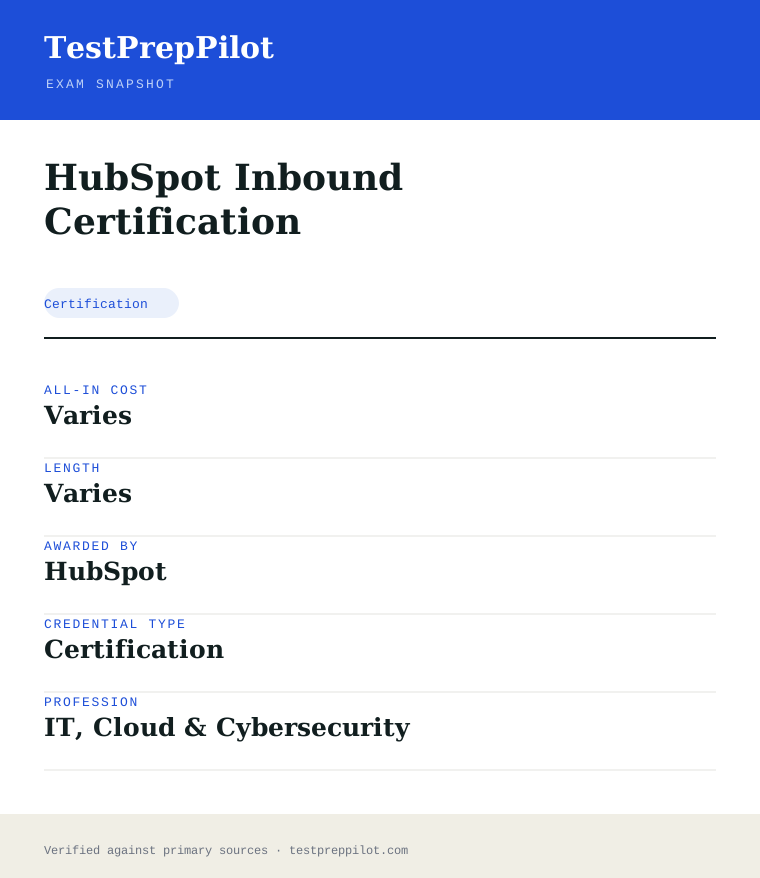
The short version
What is the HubSpot Inbound Certification and is it worth it?
HubSpot Inbound Certification is a professional credential administered by HubSpot. It validates job-ready knowledge and skills in the Technology field and is used for career entry, advancement, or compliance.
- Recognized credential from HubSpot
- Demonstrates verified competence in Technology
- Supports career advancement and may satisfy licensing or employer requirements
What is it?
What exactly is the HubSpot Inbound Certification?
HubSpot Inbound Certification — Technology credential from HubSpot
Free foundational credential covering inbound methodology, content, social, SEO and nurturing for marketing and sales professionals. Offered by HubSpot, it is designed for candidates who need to demonstrate verified competence in the Technology field. The credential is commonly used for career entry, advancement, regulatory compliance, or employer requirements. Candidates should review the official handbook for eligibility, exam format, and scoring before registering.
The path in brief
- Confirm you meet any eligibility or prerequisites
- Review the official handbook and study materials
- Register and pay through the awarding body or authorized provider
- Schedule and take the exam (test center or online proctoring)
- Receive your score and, if passed, your credential
Before you book
Who is eligible to sit the HubSpot Inbound Certification?
Eligibility varies; many credentials are open to all, while others require coursework, work experience, or sponsorship.
Who it is for: Professionals and candidates seeking to validate Technology competence.
The test itself
What is the format of the HubSpot Inbound Certification?
The HubSpot Inbound Certification is administered by HubSpot and runs Up to 3 hours and requires ~45/60 (~75%) — HubSpot publishes no pass rates to pass.
| Administered by | HubSpot |
|---|---|
| Questions | ~60 multiple-choice questions |
| Time limit | Up to 3 hours |
| Pass mark | ~45/60 (~75%) — HubSpot publishes no pass rates |
| Exam fee | Free |
| Format | Online exam through your HubSpot Academy account (no test center, no proctoring) |
Content outline
What topics are on the HubSpot Inbound Certification?
The HubSpot Inbound Certification covers 4 content domains.
Weightings come from the official exam outline. Study time is best allocated in roughly these proportions rather than evenly across domains.
- Foundational concepts
Topic area tested on the exam; see the official blueprint for the detailed breakdown.
- Configuration & deployment
Topic area tested on the exam; see the official blueprint for the detailed breakdown.
- Security & compliance
Topic area tested on the exam; see the official blueprint for the detailed breakdown.
- Operations & troubleshooting
Topic area tested on the exam; see the official blueprint for the detailed breakdown.
The path
How do you register for the HubSpot Inbound Certification?
- 1
Visit the awarding body’s official website and create an account
- 2
Select the credential and review its specific requirements
- 3
Complete any required eligibility (education, experience, or training)
- 4
Pay the registration fee
- 5
Schedule the exam at a test center or online
- 6
Take the exam and receive your results
The fine print
What are the retake and renewal rules for the HubSpot Inbound Certification?
- Proctoring & delivery
- Proctored, computer-based delivery (test center or remote online proctoring), varying by exam.
- Retake policy
- Varies by credential — most bodies permit retakes after a waiting period and full or partial fee.
- Score reporting
- Scores are reported per the body’s timeline, typically electronically after the exam.
- Recertification
- Varies; many credentials require renewal every 2–3 years via continuing education or a recertification exam.
What it pays
How much does this credential pay?
$161,030 median for marketing managers (BLS, May 2024)
The HubSpot Inbound Certification is not a license and it does not gate any single occupation, so the wage answer is the role you perform with it, and the closest official BLS fit is Marketing Managers, SOC 11-2021, which had a May 2024 median annual wage of $161,030, with the lowest 10 percent earning less than $81,900 and the highest 10 percent more than $239,200, and the credential itself does not appear in wage data because BLS classifies by job duty rather than by certificate. The fit needs an honest caveat: this certification is broader than a marketing credential — its seven lessons cover the inbound methodology, the flywheel, company purpose, business goals, buyer personas and the buyer’s journey as they apply across marketing, sales and service teams — so the relevant BLS occupations include not only marketing managers but also sales managers (SOC 11-2022, May 2024 median of $138,060) and the coordinator and specialist roles below both manager tiers, which are not broken out separately in the OOH; read the $161,030 figure as the destination the credential helps you climb toward rather than a starting salary. BLS counted 407,000 marketing manager jobs in 2024, within a combined advertising, promotions and marketing managers group of 434,000, and projects 7 percent growth for marketing managers from 2024 to 2034, faster than the average for all occupations, with the combined group producing about 36,400 openings a year. The practical reading for a candidate is that a free HubSpot inbound certification is a low-cost signal on a customer-facing career ladder: it demonstrates command of the attract-engage-delight methodology and the flywheel model that employers name in inbound, growth and demand-generation roles across marketing and sales, and it is most useful early in that career, when the credential and a portfolio together move candidates toward coordinator and specialist roles and, over years of results, toward the manager tier where the BLS median lives.
| Measure | Figure | Source / note |
|---|---|---|
| Median annual wage, marketing managers | $161,030 | BLS OOH, SOC 11-2021, May 2024 |
| Lowest 10 percent | Less than $81,900 | BLS OOH, SOC 11-2021, May 2024 |
| Highest 10 percent | More than $239,200 | BLS OOH, SOC 11-2021, May 2024 |
| Employment, marketing managers, 2024 | 407,000 jobs | BLS OOH Quick Facts, 2024 (SOC 11-2021) |
| Projected annual openings (combined group) | ~36,400 per year | BLS OOH Job Outlook, 2024-34 — 7% growth for marketing managers |
Job growth.BLS projects 7 percent growth for marketing managers from 2024 to 2034, faster than the average for all occupations.
Source: BLS Occupational Outlook Handbook - Advertising, Promotions, and Marketing Managers
Your odds
What are the pass rates?
HubSpot publishes no pass rate — the Inbound Certification exam is 60 questions with a ~75% pass mark and a 3-hour time limit, valid about two years
HubSpot Academy does not publish pass-rate statistics for the Inbound Certification or for any of its certifications, so any pass percentage you see quoted in blogs or forums is a private estimate rather than an official figure, and we do not restate one as fact. What HubSpot does publish, through its own certification-support pages and community guidance, is the exam structure: the Inbound Certification exam is roughly 60 multiple-choice questions with a pass mark around 75 percent — about 45 of 60 correct — and a time limit of up to 3 hours, delivered online through your free HubSpot Academy account, with the timer starting as soon as you open the first page of questions. The course behind the exam is free and self-paced: seven lessons totaling roughly 2 hours 45 minutes of video, covering the fundamentals of inbound, the flywheel model, company purpose, setting business goals, creating buyer personas and developing the buyer’s journey, and HubSpot markets the credential as the cross-functional version of its inbound family — the broader companion to the Inbound Marketing Certification, which focuses on marketing alone. The certification is valid for approximately two years, after which you retake the exam to renew, and HubSpot emails you before expiry; the Academy FAQ confirms you can retake the exam as many times as you wish, once it unlocks again about 12 hours after a failed attempt, and that HubSpot sends a breakdown of which questions you got correct and incorrect after the exam. Two exam mechanics matter: you cannot revisit a question once you have answered it, so each answer is final as you move through, and a failed attempt costs time, not money, because the certification is free. One naming caveat is worth stating plainly: HubSpot has renamed and reorganized its inbound certifications over the years — the original Inbound Certification became the Inbound Marketing Certification, and a distinct broader Inbound Certification remains in the current catalog — so confirm the exact course page and current exam details before starting. The practical reading: because the threshold is a fixed 75 percent and the content is free, your preparation competes with the syllabus, not a cohort.
Read this before quoting the number.HubSpot publishes no pass rate for the Inbound Certification. The published format is about 60 questions with a ~75% (about 45/60) passing threshold, a 3-hour time limit, a ~12-hour retake lockout, and about two years of validity. HubSpot has renamed its inbound certifications over time, so confirm the current course page.
Your schedule
How long should I study for it?
8-15 hours (course + exam), typically over one to two weeks of focused study
The HubSpot Inbound Certification is a free, self-paced credential, and the study plan is simple because there is no test centre and no fee to protect: watch the seven course lessons (roughly 2 hours 45 minutes of video), take notes on the inbound vocabulary and frameworks, rehearse with practice questions, and sit the 60-question exam when you can score above the 75 percent bar consistently. A realistic plan runs about one to two weeks at 4-6 hours per week for a candidate who watches everything at a normal pace, or a single focused weekend for a candidate with marketing or sales experience; most candidates complete the course and exam in a handful of sittings rather than a structured campaign. The plan below assumes you are working through the lessons in order: the early lessons establish the fundamentals of inbound and the flywheel — attract, engage, delight and how the flywheel replaces the traditional funnel across marketing, sales and service — the middle lessons cover creating a company purpose and setting business goals, and the later lessons cover building buyer personas and developing the buyer’s journey, which the exam treats as cross-functional tools rather than marketing-only concepts. Because the exam cannot be revisited question by question, the pacing skill is answering deliberately the first time, and because the threshold is a fixed 75 percent, the risk is not difficulty but terminology drift: candidates who watch without notes forget the specific HubSpot vocabulary — attract-engage-delight, flywheel, buyer persona, buyer’s journey stages, company purpose, shared goals — that the scenario items expect. The single most important scheduling fact is that the certification is free and expires in about two years, so there is no cost pressure to rush: the mistake is the opposite, treating it as trivial and sitting cold, which produces a fail and a 12-hour lockout before you can retake. Candidates with marketing or sales experience can compress the plan to a single focused weekend; candidates new to the methodology should spread the lessons across two weeks so the framework and vocabulary sink in before the exam.
- Step 1 — Course lessons3-5 hrs
Watch the seven lessons
- Early lessons: fundamentals of inbound, attract-engage-delight, the flywheel
- Middle lessons: creating a company purpose, setting business goals
- Later lessons: building buyer personas, developing the buyer’s journey, next steps
- Take notes on the specific HubSpot vocabulary as you watch
- Step 2 — Practice and recall3-5 hrs
Drill the vocabulary and scenarios
- Build a one-page glossary: flywheel, attract-engage-delight, buyer persona, buyer’s journey, company purpose, shared goals
- Rehearse free-recall: cover a definition and name the term, and vice versa
- Take a practice test of 60 questions if available and log every miss
- Re-watch the lessons tied to your misses
- Step 3 — Exam day1-3 hrs
Sit the 60-question exam
- Choose a quiet block with no interruptions; the exam allows up to 3 hours
- Work the 60 questions deliberately — you cannot revisit an answered question
- Target 45+ correct answers (75%)
- If you fail, review the misses and retake after the ~12-hour lockout
Adjusting the pace
Experienced marketer or sales professional.Compress the plan to one focused weekend: skim the familiar lessons, spend the time on terminology recall and a practice test, then sit the exam while the frameworks are fresh.
New to inbound methodology.Spread the lessons across two weeks at 4-6 hours per week so the framework and vocabulary sink in before the exam; the fixed 75% bar punishes rushing.
Renewing a lapsed certification.The credential is valid about two years; on renewal, re-watch the updated lessons — HubSpot updates courses regularly — and re-sit rather than assuming the old material still matches the exam.
How to study
How do I prepare most effectively?
Because the Inbound Certification exam tests the course content specifically and the certification is free, the preparation levers are watching the lessons with notes, memorising the inbound vocabulary, and rehearsing with practice questions — not paying for courses or cramming from third-party dumps, which are both unnecessary for a free, self-paced credential. The strategies below are ordered by what actually moves the result. First, watch the official lessons end to end and take notes: the exam is written against the course, so the seven video lessons are the authoritative syllabus, and candidates who skip them and study third-party summaries miss the specific frameworks and terminology HubSpot expects. Second, build a vocabulary glossary: the scenario items use inbound-specific terms — flywheel, attract-engage-delight, buyer persona, buyer’s journey stages, company purpose, shared goals — and candidates who understand the gist but cannot name the term under a clock hesitate and lose the 75 percent bar. Third, rehearse with practice questions and log every miss: the exam is 60 questions in up to 3 hours, and free-recall drilling converts the lesson reading into the recognition the scenario items demand; a practice test that scores below 45 correct means re-watching the weak lessons. Fourth, understand the exam mechanics before sitting: you cannot revisit an answered question, so answer deliberately the first time, and if you fail you must wait out the roughly 12-hour lockout before retaking, so a clean first attempt is also the fast one. Fifth, do not over-prepare: the certification is free and entry-level, so the marginal hour is better spent on a practice test than on a paid course; the risk is complacency, not difficulty. Finally, confirm the current course and exam details on the Academy page before starting, because HubSpot has renamed and reorganized its inbound certifications over the years — the original Inbound Certification became the Inbound Marketing Certification, and the current catalog also lists a broader Inbound Certification — so studying the wrong version wastes the effort.
Watch the official lessons with notes
The exam is written against the course, so the seven lessons are the authoritative syllabus; take notes on the frameworks and vocabulary as you watch.
Build a vocabulary glossary
The scenario items use inbound-specific terms — flywheel, attract-engage-delight, buyer persona, buyer’s journey, company purpose. Free-recall both directions daily; most wrong answers are a neighbouring term.
Rehearse with practice questions
A practice test of 60 questions shows whether you can hit 45 correct; log every miss and re-watch the associated lessons.
Know the exam mechanics
You cannot revisit an answered question, and a fail locks you out for about 12 hours; answer deliberately the first time.
Do not over-prepare
The certification is free and entry-level; the marginal hour is better spent on a practice test than a paid course, and the risk is complacency, not difficulty.
Confirm the current course and exam
HubSpot has renamed and reorganized its inbound certifications over time; check the Academy page before starting so you study the current version.
What to buy
Which study resources are worth paying for?
The decisive fact about resources for the HubSpot Inbound Certification is that the official course and exam are free, so the buying logic is almost entirely about supplements and the main advice is to start with the free official material before paying for anything. The official HubSpot Academy course — seven video lessons covering the fundamentals of inbound, the flywheel, company purpose, business goals, buyer personas and the buyer’s journey — is the authoritative syllabus and costs nothing beyond a free HubSpot Academy account, and the exam itself is free, online and self-paced, with a roughly 12-hour retake lockout after a fail. Practice question banks for the HubSpot Inbound exam, roughly $10-40 on third-party platforms, add exam-style drilling and are the most useful paid supplement for candidates who want reps beyond the course; free flashcard sets and glossaries of HubSpot inbound vocabulary, available on quiz platforms, cover the terminology recall the exam rewards and cost nothing. HubSpot also offers related free certifications — Inbound Marketing, Content Marketing, Sales Enablement, Inbound Sales — which overlap in content and are worth noting because a candidate building a customer-facing credential stack can take them in sequence at no cost. Paid courses and third-party training companies offer inbound methodology training from roughly $20 to $200, but for this specific certification the free official course is complete, and paid courses mostly add structure rather than content the exam requires. The footnote that anchors the comparison: prices below are list prices as of mid-2026 and change frequently, and we rank nothing by commission. Candidates should confirm the current exam details — question count, time limit, passing threshold, validity and the exact course name — on the HubSpot Academy page before starting, because HubSpot has renamed and reorganized its inbound certifications over the years and the details can shift.
| Resource | Price | Format | Best for |
|---|---|---|---|
| HubSpot Academy Inbound course + exam | Free | Online, self-paced video lessons + online exam | The authoritative syllabus; required |
| HubSpot inbound vocabulary flashcards | Free | Web / app / quiz platforms | Vocabulary recall — the highest-yield free resource |
| HubSpot inbound practice question banks | $10-40 | Online practice items | Drilling the 60-question format and pacing |
| Related HubSpot free certifications | Free | Online courses + exams | Inbound Marketing, Content Marketing, Sales Enablement — a free credential stack |
| Third-party inbound training courses | $20-200 | Video courses / bootcamps | Structured learners; optional, since the official course is complete |
Prices checked 2026-08 in USD; the official HubSpot course and exam are free, and third-party prices vary with promotions. We do not rank by commission.
Avoid these
What mistakes do candidates most often make?
The most common mistakes on the HubSpot Inbound Certification are studying the wrong version, sitting cold on vocabulary, and misreading the exam mechanics — and all are avoidable because the certification is free and self-paced. First, candidates study the wrong certification: HubSpot has renamed and reorganized its inbound family over the years — the original Inbound Certification became the Inbound Marketing Certification, and the current catalog also lists a broader Inbound Certification and an Inbound Marketing Optimization Certification — so third-party summaries and old course notes drift from the exam on the page you are actually studying; the fix is to start from the official Academy course page and confirm the current lesson list and exam details before studying anything else. Second, candidates watch the lessons without taking notes and then fail on vocabulary: the scenario items use specific inbound terminology — flywheel, attract-engage-delight, buyer persona, buyer’s journey stages, company purpose, shared goals — and understanding the gist is not the same as naming the term under a clock; the fix is to build a glossary and free-recall it both directions. Third, candidates underestimate the exam mechanics: you cannot revisit an answered question, so working in presented order without a strategy wastes points, and a fail triggers a roughly 12-hour lockout before you can retake; the fix is to answer deliberately the first time and to treat a practice test as the readiness check. Fourth, candidates over-prepare and over-spend: the certification is free and entry-level, and paying for a bootcamp or dumps to pass a free exam is wasted money; the fix is to use the free course, a free glossary and at most a low-cost practice bank. Finally, candidates treat the credential as a permanent certification: it is valid for about two years, so a certificate earned years ago signals nothing until renewed; the fix is to diary the expiry and re-watch the updated course and re-sit before it lapses, because employers verify the badge and its current status.
✕Studying the wrong version
✓HubSpot has renamed and reorganized its inbound certifications; start from the official Academy course page for the exact certification you want and confirm the current lesson list and exam details before studying anything else.
✕Failing on vocabulary recall
✓The scenario items use specific inbound terminology — flywheel, attract-engage-delight, buyer persona, buyer’s journey. Build a glossary and free-recall it both directions; understanding the gist is not naming the term under a clock.
✕Misreading the exam mechanics
✓You cannot revisit an answered question, and a fail locks you out for about 12 hours. Answer deliberately the first time and use a practice test as the readiness check.
✕Over-preparing and over-spending
✓The certification is free and entry-level; paying for a bootcamp or dumps to pass a free exam is wasted money. Use the free course, a free glossary and at most a low-cost practice bank.
✕Treating the credential as permanent
✓The certification is valid for about two years. Diary the expiry and re-watch the updated course and re-sit before it lapses; employers verify the badge and its current status.
What you'll face
What question types will I see?
The HubSpot Inbound Certification exam is a single online exam of roughly 60 multiple-choice questions, with a pass mark around 75 percent (about 45 of 60) and a time limit of up to 3 hours, delivered through HubSpot Academy and free of charge; the exam cannot be revisited question by question, so each answer is final as you move through, and the timer starts as soon as you open the first page of questions. The content follows the course lessons and tests both recall and application across the three inbound functions: definition and terminology items (what is a flywheel, what are the attract-engage-delight stages), methodology items (how the flywheel replaces the funnel, how sales and service hand off within the flywheel), best-practice items (how to write a company purpose, how to set goals that align teams), scenario items (a company situation with the best next step, a persona mismatch with the right response) and analysis items (what information belongs in a persona, how many customers to interview to define the job a product does). The style is single-best-answer multiple choice with select-all-that-apply items mixed in, and the distractors are typically plausible but not-quite-right practices drawn from the course — a wrong answer that a working professional might defend, which is exactly what separates a candidate who studied the HubSpot framework from one who relies on general experience. Because the exam is written against the course, the practical pacing implication is simple: candidates who watched the lessons and drilled the vocabulary finish comfortably within the time limit, while candidates who sit cold on scenario items spend the clock hesitating between plausible options. The select-all-that-apply items are the most-tested trick: the course teaches nuanced positions about the inbound methodology and the flywheel, and the exam rewards the exact framing the lessons present rather than the common-sense answer. The samples below are editor-written illustrations of the course content and the style of the real items, not live exam questions; confirm the current exam details on the HubSpot Academy page before sitting.
Flywheel, attract-engage-delight, buyer persona, buyer’s journey stages, company purpose.
Flywheel versus funnel, shared goals, persona information, journey mapping — the exact framing the lessons teach.
A company situation with the best next step or the right cross-team handoff.
Reward the exact course framing, not the common-sense answer.
Try these
Q1How can thinking of a business as a flywheel improve the handoff between sales and services?
Answer:A
The course teaches that the flywheel reveals how delight feeds back into attract and engage, so the sales-to-services handoff matters: more visibility into the steps makes the transition smooth and keeps momentum, whereas merging teams, shifting post-sale work, or removing the journey each work against the model. This reflects the flywheel and handoff scenario items in the course.
Q2What kinds of information does a marketing team most likely need included in a buyer persona?
Answer:A
The course teaches that personas are research-based profiles of ideal customers, built to inform strategy — so how they research problems and how they prefer to communicate are core persona inputs. Personal email addresses, monthly site-visit quotas and competitor purchase lists are not what the framework puts in a persona. This reflects the persona-building items in the course.
Q3A sales rep is speaking with a person who does not exactly match their assigned persona. What should the rep do?
Answer:A
The course teaches that personas guide strategy but do not replace the individual conversation: a rep serves the person in front of them, and if the same discrepancy comes up repeatedly, the persona may need to be updated. Ignoring the person, routing them back, or inventing a new persona per prospect each misuses the tool. This reflects the persona-in-practice scenario items in the course.
Samples are editor-written illustrations of the published blueprint, not live exam items.
The big day
What should I expect on exam day?
The HubSpot Inbound Certification exam day is low-stakes and entirely online: you log into your HubSpot Academy account, open the exam, and work through roughly 60 multiple-choice questions with up to 3 hours on the clock, needing about 45 correct answers (75 percent) to pass, and the entire process is free. There is no test centre and no fee to lose — the practical exam-day preparation is choosing a quiet block with a stable connection, clearing distractions, and confirming your HubSpot Academy account is ready, because the exam is delivered through that account and the timer starts the moment you open the first page of questions. The exam mechanics are the real exam-day risk: you cannot revisit a question once you have answered it, so the pacing strategy is to answer each item deliberately the first time rather than skipping and returning, and to use the generous time limit to read scenario items carefully rather than rushing; you can navigate away from the exam, but if you do not return and finish within three hours you fail and the exam locks for about 12 hours. If you pass, the certificate and badge appear in your HubSpot Academy account immediately, and you can share the badge and verification link on LinkedIn and your resume; the certification is valid for approximately two years, and HubSpot emails you before expiry so you can re-certify. If you fail, you can retake the exam after a lockout period of roughly 12 hours, and HubSpot sends an email breakdown of which questions you got correct and which incorrect — a failed attempt costs time, not money, and the fastest path is to review the missed topics in the course and re-sit. Because the pass mark is a fixed 75 percent and the exam is free, the pressure on the day is performance against the syllabus, not cost; candidates who watched the lessons and rehearsed the vocabulary pass comfortably, while candidates who sit cold on the select-all-that-apply and scenario items miss the bar and wait out the retake window. Confirm the current exam details — question count, time limit, pass mark, retake policy and the exact course name — on the HubSpot Academy page before sitting, because HubSpot has renamed and reorganized its inbound certifications over the years.
Bring
- Your HubSpot Academy account login and a stable internet connection
- A quiet, distraction-free space for up to 3 hours
- Your notes and glossary for a last review before starting the exam
Leave at home
- The assumption that you can revisit an answered question — each answer is final as you move through
- Browser tabs, group chats and notifications that could interrupt the exam
- Third-party answer sheets — the exam is free, and relying on dumps teaches the wrong content
How the day runs
Rules in the room
- The exam is about 60 multiple-choice questions with a ~75% (about 45/60) passing threshold and up to 3 hours to complete.
- The exam is online through your HubSpot Academy account; there is no test centre and no fee.
- The timer starts as soon as you open the first page of questions; navigating away does not stop the clock.
- You cannot revisit a question once you have answered it; answer deliberately the first time.
- If you fail, you can retake after a lockout period of roughly 12 hours.
- The certification is valid for approximately two years and is renewed by re-taking the exam.
Afterwards.On a pass, your certificate and digital badge appear in your HubSpot Academy account immediately, and you can share the badge and its verification link on LinkedIn, your resume and your email signature — employers verify the credential in one click, which is the practical value of the certificate. The certification is valid for approximately two years, and HubSpot emails you before expiry, so diary the date and re-watch the updated course and re-sit before it lapses rather than discovering a lapsed badge at interview time. Because the credential is free and entry-level, its real value is as one line in a growing stack: pair it with HubSpot’s other free certifications — Inbound Marketing, Content Marketing, Sales Enablement — and, more importantly, with a portfolio of campaigns and customer interactions you planned, ran and measured, because employers hire results, and the badge proves you learned the methodology. On a fail, the retake is a free and normal part of the process: review the email breakdown HubSpot sends showing which questions you missed, review those topics in the course, wait out the roughly 12-hour lockout, and re-sit.
Reference
What are the key facts about the HubSpot Inbound Certification?
HubSpot Inbound Certification is a certification credential; awarded by HubSpot; the exam fee is Free; typical preparation is Varies.
| Credential | HubSpot Inbound Certification |
|---|---|
| Type | Certification |
| Profession | IT, Cloud & Cybersecurity |
| Specialty | Enterprise Platforms |
| Awarded by | HubSpot |
| Difficulty | Intermediate |
| Typical prep time | Varies |
| All-in cost | Varies |
| Credential | HubSpot Inbound Certification |
| Awarding body | HubSpot |
| Exam format | Proctored, computer-based |
| Validity | Varies by credential (commonly 2–3 years) |
| Languages | Varies — see awarding body |
| Scope | National / Multi-state |
| Also known as | Inbound |
Real questions
Frequently asked questions about the HubSpot Inbound Certification
How do I register for the HubSpot Inbound Certification exam?
Register through HubSpot's official portal or an authorized test provider (e.g., Pearson VUE or Prometric where applicable). Create an account, select the exam, pay the fee, and schedule a date.
How much does the exam cost?
Fees vary by location and currency. Confirm the current fee on the official registration page before scheduling.
How long is the credential valid, and how do I renew?
Validity varies by credential (commonly 2–3 years). Renewal usually requires continuing education or a recertification exam — see HubSpot's policy.
What if I do not pass?
Most bodies allow retakes after a waiting period and payment of the full or partial fee. Check HubSpot's retake policy before rescheduling.
How do I register for a HubSpot credential?
Register through the official website, select your exam, pay the fee, and schedule a date.
How do I renew a credential?
Renewal policies vary by credential; check the specific program page for requirements and cycles.
In short
Is the HubSpot Inbound Certification worth it?
- HubSpot Inbound Certification is awarded by HubSpot.
- Validates job-ready competence in Technology.
- Registration is through the awarding body or an authorized test provider.
- Renewal and retake policies vary — confirm before scheduling.
Trust
Where does this information come from?
Everything above is taken from the awarding body's own published material. Fees, question counts and domain weights are revised regularly — check the official page before you pay.
Research confidence: low · Last reviewed 2026-08