IT, Cloud & Cybersecurity • Certification
Salesforce Certified Advanced Administrator
Salesforce Certified Advanced Administrator — Technology credential from Salesforce
Researched and maintained by TestPrepPilot Editorial BoardCloud, IT & cybersecurity certifications desk · Figures last verified August 2026
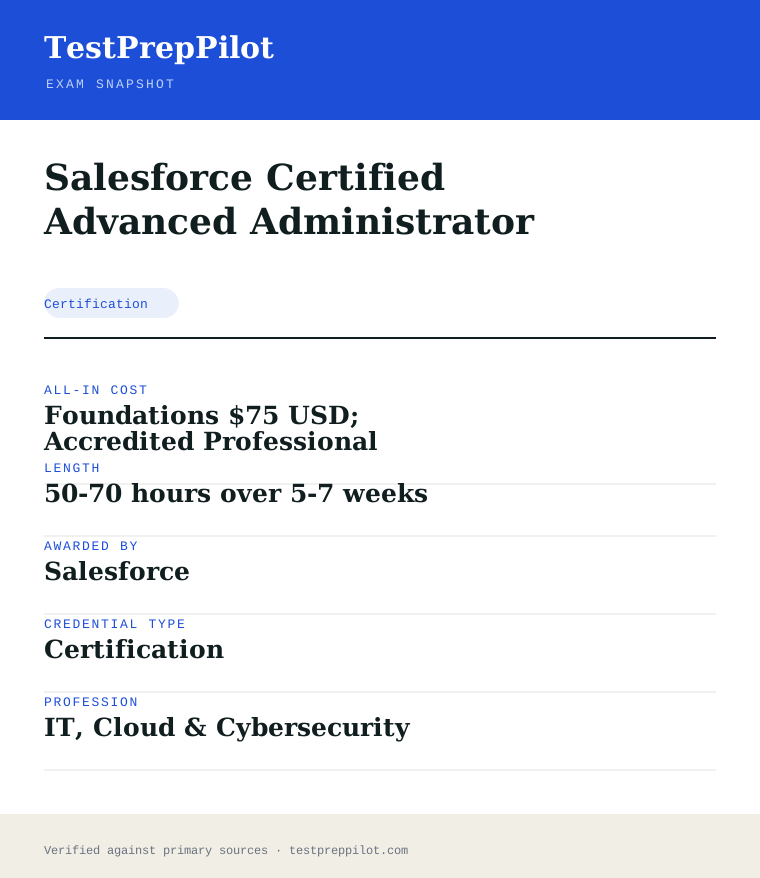
The short version
What is the Salesforce Certified Advanced Administrator and is it worth it?
Salesforce Certified Advanced Administrator is a Salesforce credential in the Technology field. It validates job-ready competence and is used for career entry, advancement, or compliance. Exam fee: Foundations $75 USD; Accredited Professional $100–150; Core (Administrator/Developer/Consultant) $200; Tableau $250; Architect $400; Certified Technical Architect (CTA) $6,000.
- Recognized Salesforce credential
- Demonstrates verified Technology competence
- Supports career advancement and may satisfy employer or regulatory requirements
What is it?
What exactly is the Salesforce Certified Advanced Administrator?
Salesforce Certified Advanced Administrator — Technology credential from Salesforce
Advanced credential covering complex automation, complex security models, auditing and extending Salesforce for experienced administrators. Offered by Salesforce, it validates job-ready Technology competence. Exam fee: Foundations $75 USD; Accredited Professional $100–150; Core (Administrator/Developer/Consultant) $200; Tableau $250; Architect $400; Certified Technical Architect (CTA) $6,000. Review the official program page for eligibility, format, and scoring before registering.
The path in brief
- Confirm eligibility and any prerequisites
- Review the official exam guide and study materials
- Purchase and schedule the exam via Webassessor (Pearson VUE)
- Take the exam (test center, online proctoring, or assessment)
- Receive results and your credential if passed
Before you book
Who is eligible to sit the Salesforce Certified Advanced Administrator?
Eligibility varies; many exams are open to all, while others require coursework, experience, or sponsorship.
Who it is for: Professionals and candidates seeking to validate Technology competence with a Salesforce credential.
The test itself
What is the format of the Salesforce Certified Advanced Administrator?
The Salesforce Certified Advanced Administrator is administered by Webassessor (Pearson VUE) and runs 105 minutes and contains 60 questions.
| Administered by | Webassessor (Pearson VUE) |
|---|---|
| Questions | 60 questions |
| Time limit | 105 minutes |
| Pass mark | Passing score set by the awarding body; see the official score report |
| Exam fee | Foundations $75 USD; Accredited Professional $100–150; Core (Administrator/Developer/Consultant) $200; Tableau $250; Architect $400; Certified Technical Architect (CTA) $6,000. Retake ~50% of exam fee. Plus local tax. |
| Format | Proctored, computer-based — online or at a test center via Webassessor. |
Content outline
What topics are on the Salesforce Certified Advanced Administrator?
The Salesforce Certified Advanced Administrator covers 4 content domains.
Weightings come from the official exam outline. Study time is best allocated in roughly these proportions rather than evenly across domains.
- Platform administration
Topic area for this credential; see the official blueprint for the detailed breakdown.
- Configuration & automation
Topic area for this credential; see the official blueprint for the detailed breakdown.
- Data & security model
Topic area for this credential; see the official blueprint for the detailed breakdown.
- Implementation best practices
Topic area for this credential; see the official blueprint for the detailed breakdown.
The path
How do you register for the Salesforce Certified Advanced Administrator?
- 1
Create an account on the awarding body’s certification portal
- 2
Select the exam/credential and review its requirements
- 3
Purchase the exam (voucher or password) and pay the fee
- 4
Schedule the exam (test center, online proctoring, or assessment)
- 5
Complete the exam within the allotted time
- 6
Receive your results and, if passed, your digital credential
The fine print
What are the retake and renewal rules for the Salesforce Certified Advanced Administrator?
- Proctoring & delivery
- Proctored, computer-based — online or at a test center via Webassessor.
- Retake policy
- Retake fee is roughly 50% of the exam fee (e.g., $100 for a $200 exam). First retake after 1 day; later retakes 14-day wait; max 6 attempts/year.
- Score reporting
- Scores / results are released per the body’s process (usually electronically after the exam).
- Recertification
- Annual maintenance via assigned Trailhead modules (free but mandatory); expired credentials require a full retake.
What it pays
How much does this credential pay?
$132,270 median for software developers — the adjacent platform-role series (BLS, May 2024), used with an explicit caveat
There is no Bureau of Labor Statistics occupation called "Salesforce Advanced Administrator" — the credential validates advanced platform-administration skill, and the wage question belongs to the role you perform with it. Salesforce administrators are business-systems professionals who configure and maintain the CRM platform, and no single BLS occupation fits them perfectly; we use Software Developers, SOC 15-1252, as the adjacent platform-series benchmark, with a May 2024 median of $132,270, and Computer Systems Analysts (SOC 15-1211) as the business-systems alternative with a median of $112,290. The honest caveat: advanced administrator roles sit above entry-level CRM administration and are held by seasoned professionals, but the role band still spans a wide range — from senior administrator positions below the developer median to consultant and platform-lead roles at or above it — and the credential’s value is as a hiring signal in the Salesforce ecosystem, where employers specifically require or prefer the administrator and advanced administrator certifications. BLS counted 1,684,900 software developer jobs in 2024 and projects 17 percent growth from 2024 to 2034, with about 150,000 openings a year, and the platform-ecosystem demand the Salesforce certification serves tracks that broader software market. The certification requires the base Administrator credential as a prerequisite, so the career path is deliberate: the advanced credential is the second step for a working administrator, and its wage effect is indirect — it signals seniority and depth in a role that is already held. Read the cited figure as context for the platform-role market, not as a precise administrator wage.
| Measure | Figure | Source / note |
|---|---|---|
| Median annual wage, software developers (adjacent platform series) | $132,270 | BLS OOH, SOC 15-1252, May 2024 |
| Lowest 10 percent | Under $84,060 | BLS OOH, SOC 15-1252, May 2024 |
| Highest 10 percent | Above $208,500 | BLS OOH, SOC 15-1252, May 2024 |
| Median, computer systems analysts (business-systems alternative) | $112,290 | BLS OOH, SOC 15-1211, May 2024 |
Job growth.BLS projects 17 percent growth for software developers from 2024 to 2034, about 150,000 openings per year — cited as context for the platform-role market.
Source: BLS Occupational Outlook Handbook - Software Developers
Your odds
What are the pass rates?
Salesforce publishes no pass rate — the Advanced Administrator exam is 60 scored questions in 105 minutes, reported as pass/fail with a section breakdown
Salesforce does not publish cohort pass rates for its certification exams, and we state that plainly: no official percentage exists for the Advanced Administrator exam, and any figure you see online is a community estimate or a prep-vendor survey, so we do not treat it as authoritative. What Salesforce does publish is the format and the reporting model. The Advanced Administrator exam has 60 scored multiple-choice and multiple-select questions, plus up to 5 unscored pretest items, with a 105-minute time limit; the result is reported as pass/fail with a section breakdown, and the passing threshold is commonly reported by prep providers at roughly 65 percent — about 39 correct of 60 — though Salesforce does not publish that percentage officially, so treat it as a benchmark rather than a guarantee. The exam requires the Salesforce Certified Administrator credential as a prerequisite, and its content follows the official exam guide, with Security and Access as the largest domain at about 20 percent, followed by Process Automation at about 13 percent, and the rest spanning data modelling and management, business logic, user interface, reporting and analytics. The certification is valid for one year, maintained by completing the annual maintenance badge on Trailhead before the due date — if the maintenance requirement is not met, the certification expires. The practical reading: the absence of a published pass rate is not an absence of standards, the 60-question format rewards applied platform knowledge, and the section breakdown tells candidates exactly where they fell short. Three further facts keep the pass-rate question in perspective. First, the community-reported first-attempt pass rates for Salesforce platform exams sit roughly in the 60 to 70 percent range, but those are survey estimates rather than official statistics, and they vary with the cohort — so treat any specific percentage as context, not as a prediction about your own attempt. Second, because the exam requires the Administrator credential as a prerequisite and assumes working-administrator depth, the effective difficulty is concentrated in the advanced domains — security edge cases and complex automation — and candidates who prepared only at the base level face a different exam than the format suggests. Third, the result is pass/fail with no numeric score published, so the only official signal on a failed attempt is the section breakdown, which is precisely the diagnostic a retake should be planned around. The exam’s value as a signal is why the pass-rate absence matters less than the preparation: employers in the Salesforce ecosystem recognise the credential by name, and the advanced version signals seniority that the base Administrator does not.
Read this before quoting the number.Salesforce publishes the format, the 105-minute limit and the pass/fail reporting with a section breakdown, but no cohort pass rate and no official passing percentage; prep providers report a ~65% threshold.
Source: Salesforce - Advanced Administrator certification page and exam guide
Your schedule
How long should I study for it?
80-120 hours over 6-8 weeks, after holding the Administrator credential of focused study
The Advanced Administrator exam is 60 scored questions in 105 minutes, built on the official exam guide — with Security and Access the largest domain at about 20 percent, Process Automation at about 13 percent, and data modelling, business logic, user interface, reporting and analytics making up the rest — so a defensible plan runs 80 to 120 hours over six to eight weeks, using Trailhead plus a real practice org. Weeks 1-2 establish the platform foundation from an advanced angle: the security model in depth — profiles, permission sets, org-wide defaults, sharing rules and when each applies — because Security and Access is the heaviest domain and the source of the most commonly missed items. Weeks 3-4 cover data modelling and management: custom objects and relationships, field types and formulas, data quality and validation, and data-management tools. Weeks 5-6 cover process automation — Flow and the automation toolset, which are the heart of the advanced exam — plus business logic, user interface and reporting. Weeks 7-8 are rehearsal: practice exams in volume, then two full timed runs at the real 60-question, 105-minute format. The plan is hands-on-heavy because the exam rewards real platform experience; the prerequisite Administrator credential means most candidates come in with platform knowledge, so the plan should push into the advanced configuration scenarios — security edge cases, complex Flows and reporting — rather than re-learning the basics. Candidates who do not yet hold the Administrator credential should earn it before starting this plan, since it is a hard prerequisite.
- Weeks 1-232
Security and access (the largest domain)
- Profiles, permission sets and field-level security
- Org-wide defaults, sharing rules and the role hierarchy
- Security edge-case scenarios in a practice org
- Weeks 3-428
Data modelling and management
- Custom objects, relationships and field types
- Validation rules, formulas and data quality
- Data management tools and mass operations
- Weeks 5-632
Process automation and business logic
- Flow: screen, record-triggered and scheduled
- Automation scenarios end to end
- User interface and reporting for the exam sections
- Weeks 7-824
Drill and mocks
- Practice exams in volume
- Two full timed runs at the real format
- Review weak sections from the breakdown
Adjusting the pace
Working advanced administrator.Daily work covers much of the exam; focus on the domains outside your daily work and on the scenario-question format.
Administrator credential in hand, newer to advanced work.Follow the full plan; the security and automation domains are where the advanced exam most differs from the base.
No Administrator credential yet.Earn the base Administrator certification first; it is a hard prerequisite and the foundational knowledge is assumed.
How to study
How do I prepare most effectively?
The Advanced Administrator exam rewards deep applied platform knowledge, so the dominant strategy is hands-on practice in a real Salesforce org on the advanced configuration scenarios the exam tests. First, master the security model in depth — profiles, permission sets, field-level security, org-wide defaults, sharing rules and the role hierarchy, and the edge cases where they interact — because Security and Access is the largest domain at about 20 percent and the source of the most commonly missed items. Second, use Trailhead as the primary learning resource: the free platform includes the advanced administrator learning path, and the official exam guide is the scope map; complete the certification prep trail before scheduling. Third, master Flow and the automation material deliberately, because process automation is the second-heaviest domain and the advanced exam tests more complex automation scenarios than the base Administrator exam. Fourth, practise the scenario-question style with question banks, because the exam presents described business needs and asks which configuration fits — rehearsal on that reasoning pattern is the closest thing to the real item style. Fifth, use the free practice org to rebuild each scenario you study, since the exam rewards having configured the platform. Finally, run two full timed practice exams at the real 60-question, 105-minute format, and use the section breakdown on the real exam to target any re-study on a retake. A further strategy is to practise the security and automation edge cases as scenarios rather than as facts: the exam presents a described org situation — a sharing model to design, a permission conflict to resolve, a flow to build — and asks which configuration fits, so rehearsing the reasoning pattern with question banks is the closest thing to the real item style, and the candidates who pass are the ones who can apply the security model, not merely recite it. Use the free Developer Edition org to rebuild each studied scenario, because the exam rewards having configured the platform, and the act of rebuilding the sharing rule or the flow fixes the knowledge in a way that reading does not. On the automation domain, work through complete flows — screen, record-triggered and scheduled — end to end, because the advanced exam tests automation complexity that the base Administrator exam does not. Finally, schedule the exam when the practice scores clear the reported threshold with margin, and use the official exam guide as the final checklist rather than a read-once document.
Master the security model in depth
Security and Access is ~20% of the exam; profiles, sharing rules and their edge cases are the most missed items.
Use Trailhead and the official exam guide
The free advanced administrator path and exam guide are the authoritative scope.
Master Flow and automation
Process automation is the second-heaviest domain; the advanced exam tests complex automation.
Practise the scenario-question style
Question banks rehearse choosing the right configuration for a described business need.
Rebuild scenarios in a practice org
The exam rewards having configured the platform, not just having read about it.
Run two timed full exams
60 questions in 105 minutes; the pace is part of the test.
What to buy
Which study resources are worth paying for?
Salesforce Advanced Administrator prep is inexpensive because Trailhead provides the core resources free. The Trailhead advanced administrator learning path, the official exam guide, the free practice org and the certification prep trail cover the scope at no cost, and the practice exam Salesforce offers is the closest thing to the real item style. Third-party providers sell advanced administrator courses and question banks at roughly $30-300; many candidates use Trailhead plus a question bank, and the question bank is the standard paid purchase because the scenario style is best rehearsed. The exam fee is $200 per attempt, with a reduced $100 retake within the eligibility window. Because the Advanced Administrator credential requires the base Administrator certification as a prerequisite, the realistic total budget should include that first certification ($200) if you do not already hold it, plus the advanced exam and optional prep materials — roughly $450 to $700 all in. Prices below are list prices as of mid-2026 and change frequently; we rank nothing by commission. The buying logic is dominated by the free official core: the Trailhead advanced administrator path, the official exam guide and the free practice org cover the scope at no cost, and the practice exam Salesforce offers is the closest thing to the real item style. The question bank is the one paid item that reliably earns its cost, because the scenario-based reasoning the exam measures is best rehearsed, and its value is practising the "which configuration fits" pattern rather than adding content. A course adds structure for candidates who need external pacing or who are newer to advanced administration. The unavoidable cost is the exam fee itself — $200 per attempt with a reduced $100 retake within the eligibility window — plus the $200 for the prerequisite Administrator exam if you do not already hold it, which makes the realistic total budget $450 to $700 all in for a candidate starting from the base. Because the credential requires annual maintenance, the budget should also include the time for the Trailhead maintenance badge, which is free but has a due date; missing it expires a credential that cost real money to earn.
| Resource | Price | Format | Best for |
|---|---|---|---|
| Trailhead advanced administrator path and official exam guide | Free | Official online modules | The authoritative scope; the primary resource |
| Salesforce practice exam | Free or included | Official online practice | The closest official item style |
| Free practice org (Developer Edition) | $0 | Real platform environment | The hands-on scenarios the exam rewards |
| Third-party courses and question banks | $30-300 | Video courses and practice items | Scenario-question volume and structure |
| Advanced Administrator exam | $200 (retake $100) | Proctored online or test centre | The certification itself |
| Administrator prerequisite exam | $200 | Proctored online or test centre | Required before the advanced exam |
List prices as of mid-2026, subject to change; the exam fee is $200 with a reduced retake, and the Administrator credential is a prerequisite. No commission-based ranking.
Avoid these
What mistakes do candidates most often make?
The most common Advanced Administrator mistakes come from treating it like the base Administrator exam. The first is under-preparing the security domain: Security and Access is the largest domain at about 20 percent, and candidates who skim the edge cases — sharing rules interacting with the role hierarchy, field-level security versus layout visibility, grant access using hierarchies — lose the biggest block of items. The fix is deep security practice. The second mistake is underestimating process automation: the advanced exam tests complex Flow scenarios beyond the base exam, and candidates who only review basic automation meet them cold. Third, candidates study without a practice org and never build the advanced configurations, meeting the scenario items without the practical intuition they reward. Fourth, candidates skip the scenario-question rehearsal and misjudge the 105-minute pace. Fifth, candidates assume the annual maintenance is optional and let the certification expire — the credential is valid one year and expires if the Trailhead maintenance badge is not completed by the due date. Finally, candidates sit the exam without the Administrator prerequisite or without enough experience, and the advanced exam assumes a working administrator’s depth; the section breakdown on a failed attempt tells them exactly which domains to re-work. Two further mistakes are specific to the exam’s design. The first is studying the platform’s feature list rather than the scenario reasoning: the exam presents described org situations and asks which configuration fits, so a candidate who can recite what a sharing rule does but cannot decide when to use one fails the item type the exam is built around — the fix is question-bank rehearsal of the decision pattern, not more feature memorisation. The second is neglecting the maintenance requirement until it is too late: the credential is valid one year, expires if the annual Trailhead maintenance badge is missed, and a lapsed credential costs the full retake path to restore, so the renewal date should be diaried the week of the pass. Candidates also underestimate the automation depth the advanced exam expects, having cleared the base exam on simpler automation; the advanced paper tests complex Flow scenarios, and practising those end to end in a practice org is the only preparation that reliably transfers. Finally, candidates who skip the practice org entirely meet the scenario items without the practical intuition they reward, which is the difference between a prepared attempt and an expensive diagnostic.
✕Under-preparing the security domain
✓Security and Access is ~20%; drill the sharing-rule and permission edge cases.
✕Underestimating process automation
✓The advanced exam tests complex Flow scenarios; practise them end to end.
✕Studying without a practice org
✓Build the advanced configurations in a free org; the exam rewards experience.
✕Skipping scenario-question rehearsal
✓Practise the described-need style under the 105-minute clock.
✕Ignoring the annual maintenance
✓The credential expires if the Trailhead maintenance badge is not completed by the due date.
✕Sitting it without the prerequisite
✓The Administrator credential is required; treat it as the foundation.
What you'll face
What question types will I see?
The Advanced Administrator exam is 60 scored multiple-choice and multiple-select questions, plus up to 5 unscored pretest items, in 105 minutes, delivered proctored online or at a test centre, with the result reported as pass/fail and a section breakdown. The items are scenario-based: they describe a business need — a sharing model to design, an automation to configure, a data-quality problem to solve — and ask which configuration, tool or setting fits. The content follows the official exam guide: Security and Access (about 20 percent, the largest domain), Process Automation (about 13 percent), and the remaining share across Data Modelling and Management, Business Logic and Process Automation, User Interface, Reporting and Analytics, and the other sections. Prep providers commonly report a passing threshold around 65 percent — roughly 39 of 60 scored questions — though Salesforce does not publish that figure officially, so treat it as a benchmark. Because the exam rewards applied platform knowledge, candidates should rehearse the scenario style with question banks and full timed runs. Samples below are editor-written illustrations of the published exam guide, not live exam items; they show the platform-configuration style of the real items. The format details shape the strategy. With 60 scored questions plus up to 5 unscored in 105 minutes, the average budget is about 1.75 minutes per scored item, but the scenario items take longer to read than a straight fact question, so candidates should sweep the items they know quickly and reserve the clock for the described-need items. The unscored pretest items are indistinguishable from scored ones, so every item should be answered as though it counts. The scenario style means reading each stem for the business need before choosing: the correct answer follows from the requirement — which sharing rule, which permission set, which flow — and the distractors are real configurations that serve a different need. Because Security and Access is the largest domain at about 20 percent and Process Automation follows at about 13 percent, candidates should expect a disproportionate share of the paper’s scenario items in those two areas, and the preparation should weight accordingly. The reported passing threshold of roughly 65 percent — about 39 of 60 scored — is a prep-vendor estimate rather than an official figure, so practice targets should clear it with margin.
Sharing rules, profiles, permission sets and the role hierarchy in described business needs.
Flow and the automation toolset for described processes.
Objects, relationships, validation and data quality in context.
Reports, dashboards and user interface configuration for described needs.
Try these
Q1An org has private org-wide defaults on the Account object. The strategy team needs read access only to accounts where a "Strategic" checkbox is true. What should the administrator configure?
Answer:A
Criteria-based sharing rules grant access based on field values, which is exactly the described need — read access to accounts where Strategic is checked. Owner-based rules grant by ownership, manual sharing is unscalable, and View All grants far more access than the requirement.
Q2A regional lead must create users, reset passwords and assign only a small set of profiles for users in specified subordinate roles, without full user-management rights. What should the administrator configure?
Answer:A
Delegated administration lets selected users perform limited user-management tasks — user creation, password resets and a restricted profile set — for defined roles, without broad org-wide powers. Full Manage Users grants too much, and sharing rules and login flows do not delegate user administration.
Q3A custom object has private org-wide defaults, and executives should not automatically see records owned by users below them in the hierarchy. What should the administrator do?
Answer:A
For custom objects, administrators can disable Grant Access Using Hierarchies so visibility does not roll upward through the role hierarchy, preserving a private model. Public Read Only opens everything, removing roles breaks the hierarchy broadly, and converting the object changes its data model.
Q4A subset of users across many profiles needs temporary Edit access to Campaigns. What is the most maintainable solution?
Answer:A
Permission sets extend object and field access for specific users without profile sprawl, which is the maintainable choice for a targeted temporary need. Cloning profiles multiplies maintenance, sharing rules address record access rather than object permissions, and moving users into roles changes the hierarchy.
Samples are editor-written illustrations of the published exam guide, not live exam items.
The big day
What should I expect on exam day?
The Advanced Administrator exam is a 60-scored-question, 105-minute proctored exam delivered online or at a test centre, with up to 5 additional unscored pretest questions. Bring the required identification matching your registration and your exam confirmation; personal items go in the locker. For online delivery, complete the proctoring system check on the exact machine you will use, sit in a quiet private room with a clear desk and no second monitor, and follow the proctor’s room-scan rules. Pace at about 1.75 minutes per scored item: sweep the items you know, flag the uncertain ones, and return to them, budgeting extra time for the scenario items that require reading a described business need carefully. The result is reported as pass/fail after the exam, with a section breakdown showing performance by domain. The certification is valid for one year, and the maintenance requirement matters: complete the annual Trailhead maintenance badge by the due date or the credential expires. On a pass, record the renewal date immediately and plan the maintenance cadence, and consider the next credential — often a consultant certification — while the platform knowledge is fresh. On a fail, use the section breakdown to target the retake, which is available at the reduced fee within the eligibility window. The practical rhythm of the day follows the format: sweep the items you know, flag the uncertain ones, and return to them, reserving extra time for the scenario items that require reading a described business need carefully. The exam is closed book with no browser access, so every decision comes from the knowledge and practice built beforehand — a candidate who has rebuilt the security and automation scenarios in a practice org answers faster and more accurately than one who studied only theory. There is no scheduled break in the 105-minute session, so the pre-exam routine is minimal and the online-delivery environment must pass the proctor’s room scan before the first question. The result appears as pass or fail with a section breakdown, and that breakdown is the planning document for either path: on a pass, it confirms the strong domains and informs the maintenance and next-credential planning; on a fail, it names the domains that dragged the result, and the two or three weeks of targeted scenario rebuild in those areas — usually Security and Access or Process Automation — is what turns the reduced-fee retake into a different outcome.
Bring
- Required identification matching your registration
- Exam confirmation
- For online delivery: a working webcam, verified system and quiet space
- Your Trailhead and certification profile details
Leave at home
- Phone and other devices within the proctor’s view
- Notes and open browser tabs — the exam is closed book
- Second monitors for online delivery
- Any assumption that the maintenance badge can wait until after the year
How the day runs
Rules in the room
- The exam is 60 scored questions plus up to 5 unscored in 105 minutes.
- The session is proctored and closed book.
- The Administrator credential is a prerequisite.
- The certification is valid 1 year, maintained by the annual Trailhead badge.
- The result is pass/fail with a section breakdown; retakes use the reduced fee within the window.
Afterwards.The Advanced Administrator exam reports pass or fail with a section breakdown, and the follow-ups are the maintenance calendar and the career plan. On a pass, the certification is valid for one year and expires if you do not complete the annual maintenance badge on Trailhead by the due date — so diary the maintenance requirement the week you pass, and check the maintenance badge page for the due date, because Salesforce is strict about expiry. The credential confirms you as a seasoned administrator and is typically the platform for the next step: the consultant certifications (Sales Cloud, Service Cloud) build on the same platform depth and are the usual next credential for advanced administrators moving toward consulting. On a fail, the section breakdown is the diagnostic: identify the one or two domains that dragged the result — most commonly Security and Access or Process Automation — and spend two to three weeks rebuilding those scenarios in a practice org before the reduced-fee retake within the eligibility window; re-sitting on the same knowledge is how a $200 exam becomes a $300 one. Keep the practice-org habit alive either way, because the advanced exam rewards platform experience and the maintenance badge and future certifications will keep asking for it.
Reference
What are the key facts about the Salesforce Certified Advanced Administrator?
Salesforce Certified Advanced Administrator is a certification credential; awarded by Salesforce; the exam fee is Foundations $75 USD; Accredited Professional $100–150; Core (Administrator/Developer/Consultant) $200; Tableau $250; Architect $400; Certified Technical Architect (CTA) $6,000. Retake ~50% of exam fee. Plus local tax.; typical preparation is 50-70 hours over 5-7 weeks; holders typically earn $70,000-$130,000 (15-1252 median $132,270).
| Credential | Salesforce Certified Advanced Administrator |
|---|---|
| Abbreviation | ADM-211 |
| Type | Certification |
| Profession | IT, Cloud & Cybersecurity |
| Specialty | Enterprise Platforms |
| Awarded by | Salesforce |
| Difficulty | Mixed |
| Typical prep time | 50-70 hours over 5-7 weeks |
| All-in cost | Foundations $75 USD; Accredited Professional $100–150; Core (Administrator/Developer/Consultant) $200; Tableau $250; Architect $400; Certified Technical Architect (CTA) $6,000 |
| Typical salary range | $70,000-$130,000 (15-1252 median $132,270) |
| Credential | Salesforce Certified Advanced Administrator |
| Awarding body | Salesforce |
| Exam fee | Foundations $75 USD; Accredited Professional $100–150; Core (Administrator/Developer/Consultant) $200; Tableau $250; Architect $400; Certified Technical Architect (CTA) $6,000 |
| Delivery | Proctored, computer-based — online or at a test center via Webassessor. |
| Validity | Annual maintenance required (Trailhead) |
| Scope | National / Multi-state |
| Also known as | ADM-211 |
Real questions
Frequently asked questions about the Salesforce Certified Advanced Administrator
How much does the Salesforce Certified Advanced Administrator exam cost?
Foundations $75 USD; Accredited Professional $100–150; Core (Administrator/Developer/Consultant) $200; Tableau $250; Architect $400; Certified Technical Architect (CTA) $6,000. Retake ~50% of exam fee. Plus local tax.
How do I register and schedule?
Register and schedule through Webassessor (Pearson VUE). Create an account, purchase the exam, and pick a date (test center, online proctoring, or assessment as applicable).
How long is the credential valid, and how do I renew?
Annual maintenance via assigned Trailhead modules (free but mandatory); expired credentials require a full retake.
What is the retake policy?
Retake fee is roughly 50% of the exam fee (e.g., $100 for a $200 exam). First retake after 1 day; later retakes 14-day wait; max 6 attempts/year.
How much does a Salesforce exam cost?
Foundations $75 USD; Accredited Professional $100–150; Core (Administrator/Developer/Consultant) $200; Tableau $250; Architect $400; Certified Technical Architect (CTA) $6,000. Retake ~50% of exam fee. Plus local tax.
How do I renew the credential?
Annual maintenance via assigned Trailhead modules (free but mandatory); expired credentials require a full retake.
In short
Is the Salesforce Certified Advanced Administrator worth it?
- Salesforce Certified Advanced Administrator is awarded by Salesforce.
- Validates Technology competence.
- Exam fee: Foundations $75 USD; Accredited Professional $100–150; Core (Administrator/Developer/Consultant) $200; Tableau $250; Architect $400; Certified Technical Architect (CTA) $6,000.
- Renewal: Annual maintenance via assigned Trailhead modules (free but mandatory); expired credentials require a full retake.
Same awarding body
What other credentials does Salesforce award?
Worth comparing
How does the Salesforce Certified Advanced Administrator compare with similar credentials?
Trust
Where does this information come from?
Everything above is taken from the awarding body's own published material. Fees, question counts and domain weights are revised regularly — check the official page before you pay.
Research confidence: medium · Last reviewed 2026-08